Canadian Home Rotors Baby Belle Safari    

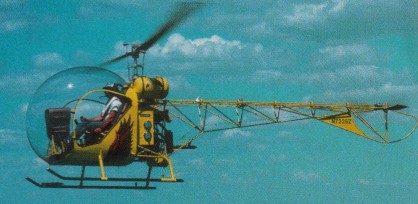
Canadian Home Rotors Inc. (CHR) are the manufacturers of the Safari helicopter. A scaled Bell 47G look alike, that has consist¬ently placed at the top of the custom built helicopter pile. Originally called the Baby Belle, but after objection from Bell Helicopters the name was changed to Safari.
A two seat side by side enclosed helicopter, the 4130 steel tube frame cabin monocoque and boom can be made up in the home workshop while awaiting delivery of the factory built main rotor and tail rotor gearboxes along with the main rotor head and blades. Main rotor is gear driven, tail rotor is shaft driven. Tail boom is steel tube. The main rotor blades are skinned all-aluminium with extruded aluminium leading and trailing edges. Blades are shaped by one solid rib each 6 inches from the root to three feet outboard, then one rib per 12 inches to the tip. Each blade contains 16 ribs. The main rotor flies at 500 rpm, and tail-rotor at a 5.4:1 rpm ratio.
The four foot diameter, 4 inch chord tail rotor blades are stainless steel, with a solid steed spar running out 6 inches from each blade root and wrapped with stainless sheeting to form the airfoil.
The main rotor gearbox includes clutches and engine fan. The cabin bubble is sourced from Nordam Plastics, manufacturers of the original Bell 47 item. The bubble is an actual Bell 47 series enclosure.
A Delta teetering system provides the control. Aluminium castings are used in the swashplate-controlled main rotor system.
The instrument panel carries operational instruments and a main transmission temp indicator and chip detectors for the main and tail rotor gearboxes. Engine, seats and cockpit fittings were generally the items sourced from written off Robinson R22.
Fuel capacity of 28 US gallons is carried in two 14 USG aluminium tanks aft of the cabin.
Skid landing gear is built with 2 inch diameter tubing, the bottom horizontals black anodised.
In 1996 the kit price was US$38,000.

CHR are constantly improving the Safari with experience, including increased service intervals on the main rotor gearbox. Build weight is always slightly different between machines but generally just under 1,000 lbs., which allows a useful load of better than 500 lb. The 12 foot span blades feature an eight inch chord and weigh 40 lb. each.
The Safari is powered by a Lycoming 160 hp aircraft engine, maintaining the highly trustworthy flying abilities of this classic design. Cruising speed is 80 mph with climb rate of 1,000 fpm & an operating ceiling of 10,000ft. Max. speed is 100mph.
A US corporation, CHR International Inc acquired Safari Helicopter. The owners of CHR International Inc., Bobby and Delane Baker, have been involved with Safari for several years. Murray Sweet, one of the original developers of the Safari, was to remain involved with the new company as a technical consultant, as will other long time members of the Safari team.
Much of the production was to remain in Canada, with assembly and flight training continuing in Marianna, Florida. They reduced the dealership requirements in most parts of the world, with positive results.
Gallery

Engine: Lycoming O-320, 150 hp.
HP range: 150-180.
Disk span: 25 ft 11 in
Rotor Blades chord: 8 in
Disk area: 490.6 sq.ft.
Width 6 ft
Height 8 ft
Length 29 ft 8 in
Weight empty: 920-945 lbs.
Gross: 1450 lbs.
Speed max: 100 mph.
Cruise: 80 mph.
Range: 200 sm.
ROC: 1000 fpm at 45 mph.
Service ceiling: 10,000 ft.
HIGE: 7000 ft
HOGE: 2000 ft
Fuel cap: 28 USG.
Seats: 2.
Landing gear: skids.

Engine: Lycoming O-320, 150 hp
Rotor span: 7.30 m
MAUW: 750 kg
Empty weight: 372 kg
Fuel capacity: 108 lt
Max speed: 160 kph
Cruise speed: 145 kph
Minimum speed: 0 kph
Climb rate: 5 m/s
Seats: 2
Price (1998): $88,500
Plan price (1998): $150
Kit price (1998): $38,430
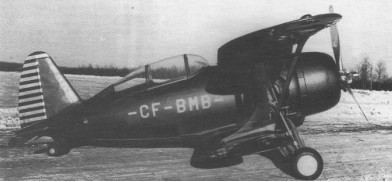
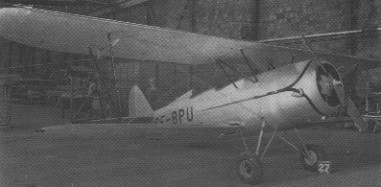
Canadian Car & Foundry FDB-1 Gregor Fighter        

Can Car’s final attempt to produce its own design was the FDB 1, the so called ‘Gregor Fighter’, named after Michael Gregor, the chief aeronautical engineer who preceded Miss MacGill. The FDB 1 was designed as a highly manoeuvrable, biplane fighter/dive bomber with retractable undercarriage and powered by a Pratt & Whitney R 1535 SI34 G Twin Wasp Junior. The fuselage was of stressed skin construction while the wings were fabric covered metal structures with trailing edge flaps on upper and lower planes and automatic leading edge slots on the former. Port and starboard sections of the upper wing were separate, joining the fuselage in a modified gull wing form, which helped to improve forward visibility.
Despite the excellent manoeuvrability of the prototype, which first flew on 17 December 1938 at Fort William, Ontario, its speed was considerably less than had been predicted and there were problems with controls and flaps. Aircraft of this type were rapidly becoming outdated and, since by this time CCF had become involved in what was to be its most successful contract, the Gregor Fighter was placed in storage at Cartierville, Quebec, where it was burned in 1945.

Canadian Car & Foundry Maple Leaf II

The Maple Leaf I was followed by the Maple Leaf II, which, despite the name, had little more than the empennage in common with its predecessor. The design and engineering team, led by Miss E G MacGill, at that time the only female chief aeronautical engineer in Canada, had the prototype ready for its first flight in the fall of 1939. Although it gave creditable performances in tests by the Department of Transport and the RCAF, the Maple Leaf II never reached the production line, mainly because at that time the company had already committed its Fort William plant to the production of the much needed Hurricane. The prototype, along with various components and parts of at least two partly finished aircraft, was eventually exported to Mexico.

Canadian Aerodrome Company Hubbard Monoplane “Mike” 

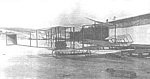
The Canadian Aerodrome Company Hubbard Monoplane “Mike” (Hubbard II) designed and built in Canada in 1910.

J. A. D. McCurdy set up the Canadian Aerodrome Company after the AEA was dissolved. Gardiner Hubbard was a cousin of Bell’s wife, Mabel Gardiner Hubbard.

The Hubbard Monoplane, also nicknamed “Mike”, was designed by John McCurdy and built by the Canadian Aerodrome Company. It was commissioned by Gardiner Greene Hubbard II of Boston. The monoplane was constructed at the Beinn Bhreagh estate of Alexander Graham Bell in Baddeck, Nova Scotia, by John McCurdy and F. W. “Casey” Baldwin. The aircraft was the third to be built by the Canadian Aerodrome Company, and the first to represent an indigenous design, although loosely based on the Blériot XI. The aircraft made two brief flights on 3 March 1910, flown by McCurdy.

After it was shipped to Montreal for the 1910 Montreal Air Meet, Hubbard was unsuccessful in flying the aircraft, it possibly being too low-powered to do more than taxiing. Shortly after, Hubbard had the aircraft dismantled and shipped to Boston, making it the first Canadian aircraft sold and built for export. The intent was to enter the aircraft at the Harvard-Boston Aero Meet in Boston. The aircraft was displayed at the aero meet, and was included in the photographs of the flight line, but it did not leave the ground.

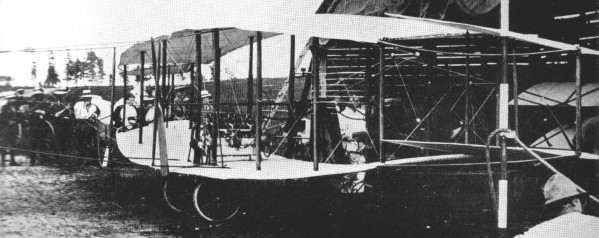
Baddeck No. 2
Engine: 1 × Kirkham air-cooled piston engine, 40 hp (30 kW)

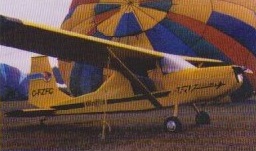
Canada Air RV ARV Griffin          

Engine mounts were available for Subaru, Continental, and CAM-100.

By 1998 twenty kits had been delivered.

Engine: Divers
Wing span: 10.8 m
Wing area: 10.7 sq.m
MAUW: 681 kg
Empty weight: 340 kg
Fuel capacity: 140 lt
Max speed: 238 kph
Cruise speed: 215 kph
Minimum speed: 73 kph
Climb rate: 8.5 m/s
Seats: 2
Fuel consumption: 25 lt/hr
Kit price (1998): $21,450

Engine: Continental O-200, 100 hp.
HP range: 65-100.
Speed max: 135 mph.
Cruise: 121 mph.
Stall: 45 mph.
Range: 828sm.
ROC: 850 fpm.
Take-off dist: 250 ft.
Landing dist: 450 ft.
Service ceiling: 18,000 ft.
Fuel cap: 37 USG.
Weight empty: 640 lbs.
Gross: 1500 lbs.
Height: 8 ft.
Length: 21 ft.
Wing span: 35.5 ft.
Wing area: 115 sq.ft.
Seats: 2.
Landing gear: nose or tail wheel.

Canadair CL-44 / CC-106 Yukon

CL-44

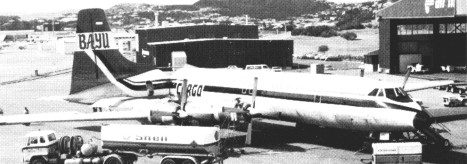
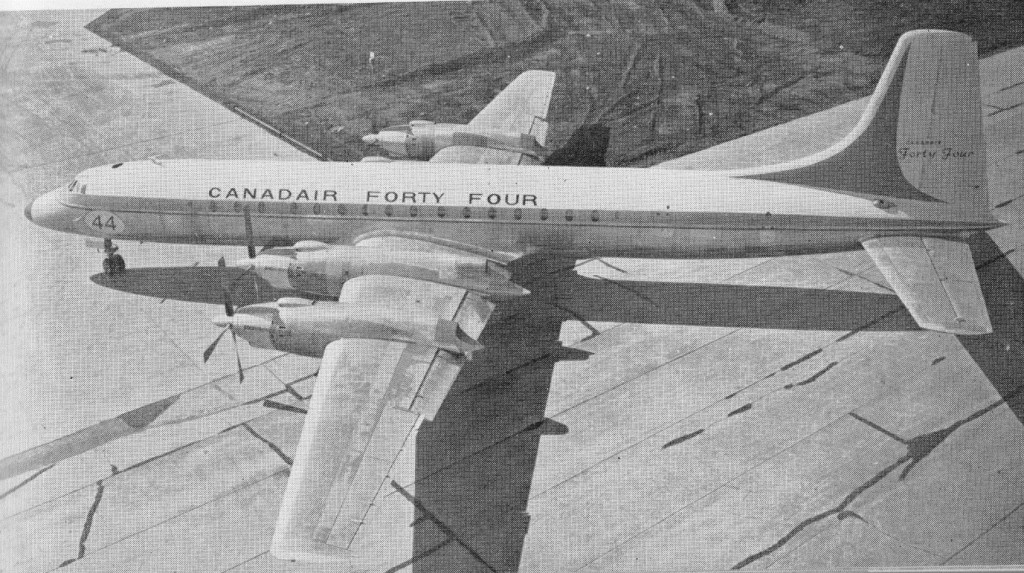
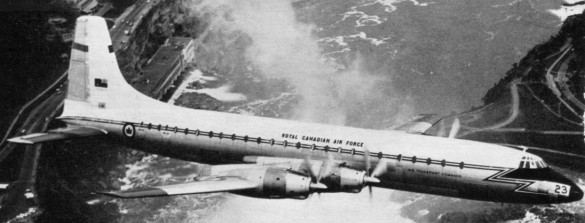
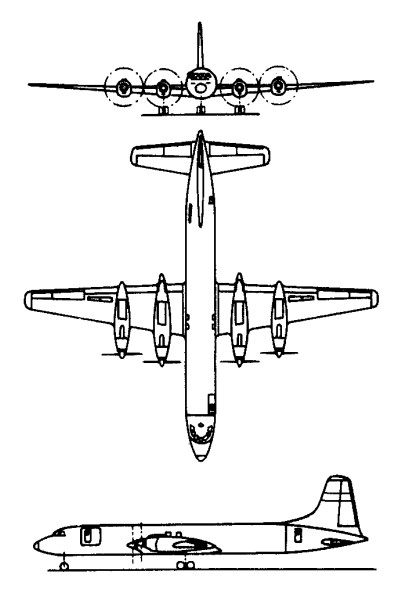
The RCAF was looking for replacements for it’s C-54GM North Star to provide personnel and logistics support for Canadian Forces in Europe. Canadair had already acquired a licence for the Bristol Britannia and announced in January 1957 plans for a fleet of long range transports based on the Britannia. Canadair received a contract for 8 aircraft, later increased to 12, designated CL-44-6 and CC-106 by the RCAF. The design used the modified Argus wings and controls. The fuselage was almost identical to the Britannia 300 with two cargo doors on the left-hand side. The cabin was pressurised to maintain a cabin altitude of 2.400m at 9.000m (30,000 ft). The Yukon could accommodate 134 passengers and a crew of nine and in the casualty evacuation role it could take 80 patients and a crew of 11. The RCAF had specified the CL-44 to be equipped with Bristol Orion engines but when the British Ministry of Supply dropped the Bristol Orion, the RCAF decided to use the Rolls Royce Tyne 11.

Canadair CL-44 Article

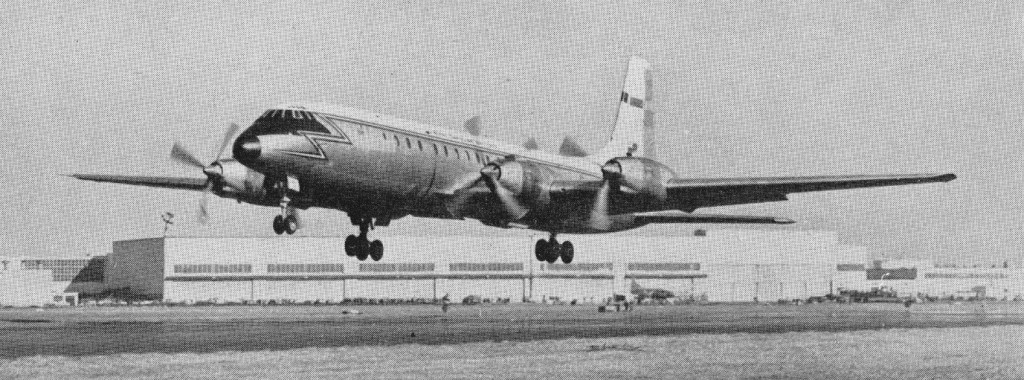
The roll out of the Yukon was a disaster all over. When the prototype was supposed to be pushed out of the hangar the tail was too high. The first plane took off 15 November 1959.

CL-44 No.1

During test flights all kind of problems where encountered from complete electrical failure to engines shaking loose and almost falling off. Rolls Royce had problems delivering engines resulting in “Yukon gliders” being parked outside Canadair as late as 1961.

Once in Service the Yukon proved very well and on December 1961 a Yukon set a world record for its class when it flew 10.860 Km (6.750mi) from Tokyo to Trenton, Ontario, in 17 hours three minutes at an average speed of 640 Km/h (400 mph). Later a Yukon even set a new record staying airborne for 23 hours and 51 minutes. These records stayed untouched until broken by the new 747SP in 1975. Eleven Yukons flew for 437 Transport Squadron. Two flew as VIP transports for 412 Squadron.

The RCAF needed an aircraft, which could operate as an in-flight refuelling tanker, and there was a chronic shortage of spares as the CL-44 had never gone into large-scale production. Consequently spare parts tended to be in short supply and relatively expensive. All Yukons were sold to South American and African operators since it could not be registered in Northern America or Europe since the Britannia windshields did not meet new security standards. The Yukons retired in March 1971 and were replaced by Boeing 707.

CC-106 Yukon

At a similar time as the Yukon contract came in Canadair announced its intentions to re-enter the civilian market with a slightly modified Yukon. The plane generated little interest with the passenger airlines, but cargo airlines found the cost projections made by Canadair compared with the high operating cost of Super constellations and DC-6B interesting.
The Flying Tiger Line and Seaboard World Airlines pushed Canadair to develop a system to load and unload the 29.5 tons of cargo in 45 minutes enabling turn-around in less then 60 minutes. This became the “Swingtail”. After the initial eight Yukons, Canadair built the first civilian CL-44 with a swingtail, designated CL-44D4. The APU that the Yukon carried in the nose was removed to increase payload and Canadair built the plane without a launch customer. This Aircraft, serial #9, used as a demonstrator for many years, was built in 1960 but not sold to Loftleidir until 1965.
While the prototype was being built a problem arose as the FAA refused to certify the Britannia type windshields for its vision standards. The Convair CV880/990 windshields were compatible enough to be adopted into the flight deck structure. A requirement was set for structural fatigue testing. The CL-44 had to simulate 80,000 flight hours in a watertank to be certified for 40,000 hours.
The Flying Tiger Line ordered 12 aircraft and Seaboard World Airlines ordered 7 aircraft. Pakistan ordered five aircraft, but the Canadian government refused to issue an export permit for Pakistan for fear of offending India. Saudi Arabia withdrew their two aircraft after the Pakistan cancallation. Japan Cargo Airlines ordered three Aircraft but cancelled after Japan airlines opposed the purchase. BOAC appeared to be a certain client until their management changed and stopped the discussion. (BOAC Cargo later leased a D4 from Seaboard while waiting for their new Boeing 707).

First flight of CL-44D, November 1959

In 1960 the USAF Military Air Transport Service (MATS) was thinking of buying up to 232 D4’s. The United States wanted Canada to bolster its northern fighter defences and proposed a deal whereby the Canadian would buy 100 F-101 Voodoo fighters plus a possible participation in the maintenance of the Pinetree early warning radar line. The quantity of D4’s had dwindled to 37 when Ontario conservatives objected on the grounds that it would be politically unacceptable to award a major aircraft contract to Quebec after having cancelled the Ontario-built Avro Arrow. MATS quickly changed their minds and bought Boeing C-135.Canadair built a Total of 39 CL-44 aircraft. 12 CC-106 Yukon and 27 CL-44D4. Seaboard World Airlines bought seven aircraft and The Flying Tiger Line bought twelve. Later Slick Airways ordered four more. This left Canadair with the unsold prototype and three CL-44D4s already finished but not sold. Canadair knew that the Icelandic low fare carrier Loftleidir was searching for alternatives to replace their ageing fleet of DC6B. Loftleidir bought those with the condition that they would all be stretched to accommodate more passengers. An engineering office in the United States on behalf of Loftleidir carried out a study to stretch the CL-44. Canadair carried out the work and the first stretched D4 flew on November 8, 1965. Loftleidir had already taken the other three D4s into service but returned them one after another in order to be converted.

CL-44D4-2 EL-AMC

Another D4 was converted by Jack Conroy Aviation of California into a CL-44-0 “Guppy”. This aircraft had its upper fuselage removed and replaced by an enlarged section, which raised the cabin height by 1.5m.The forty-four proved to be a nightmare for mechanics. But it was an extremely profitable aircraft to run. At the time the fuel burn of a CL-44 was half compared to a Boeing 707.
After 40 years, out of the 39 built, 17 either crashed or were destroyed in operation. 19 aircraft have been cut up.
No CL-44 has been preserved.

Gallery

Canadair CL-41 Tutor / CT-114

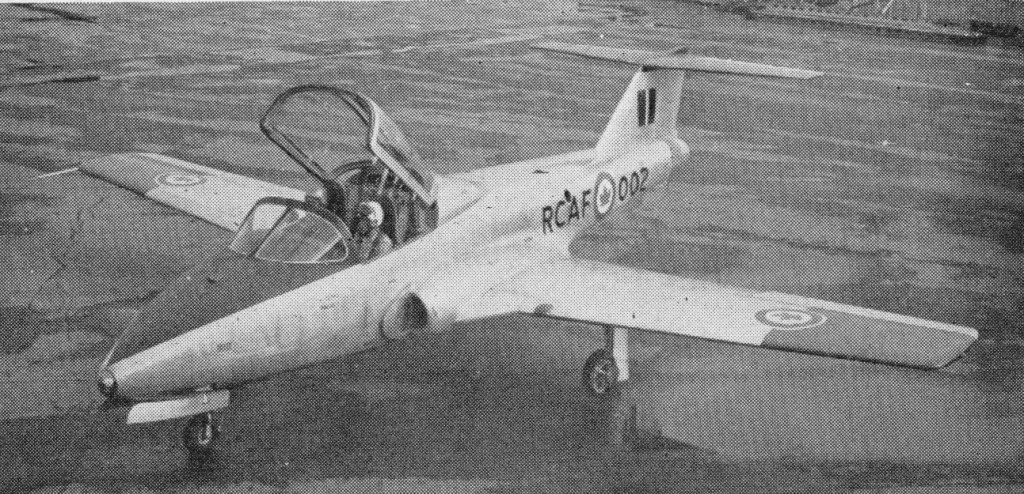
CL-41A

Canadair started design of a jet trainer in 1958 as a private venture. Controls and systems of the Tutor are relatively simple with hydraulic power to the landing gear, flaps and nosewheel steering, and manual flying controls. The cabin is pressurized and zero-level ejection seats are fitted. It is fully equipped for navigation, instrument and night flying training. The Tutor has side-by-side seating and a single turbojet engine built by Orenda Engines in Canada.

Canadair CL-41 Tutor Article

First flown on January 13, 1960, the 190 CL 41A aircraft were built for the Canadian air force as the CT 114 Tutor, ordered into production in 1961. It was used from 1963 until 2000 when it was replaced with the CT-156 Harvard II and the CT-155 Hawk as primary jet trainers.

The Tutor is best known in North America for the formation aerobatics of the Snowbird team who have performed from the Northwest Territories to Mexico. Officially known as 431 Air Demonstration Squadron, the team had fifteen Tutors, eleven of which travel with the team during the airshow season.

In 1965 Canadair was testing a prototype of a counter-insurgency version of the CL-41. The CL-41G was being tested by the USAF Air Commando Wing at Elgin AFB, Florida. Powered by a single Canadian built General Electric Orenda J85 turbojet rated at 3000 lb thrust, the -41G test version featured two 500 lb and two 250 lb bombs under wings, with pair of GE minigun pods under the fuselage.

Following the Canadian aircraft were 20 CL 41G Tebuan light attack derivative for Malaysia, production ending in 1967.
The CL-41R features an extended, pointed nose, as an NASARR (North American Search and Range Radar) electronics training version.

Gallery

CL-41
Engine: Pratt & Whitney JT-12

CL-41A / CT-114 Tutor
Engine: 2,650 lbs.t. (1202 kgp) Orenda built J85 Can 40 turbojet.
Max speed, 486 mph (782 kph) at 27,500ft (8382m)
Cruise, 356 mph (560 kph)
Initial climb, 4,420 fpm (22.45 m/sec)
Service ceiling, 44,500ft (13564 m)
Range, 944 mls (1519 km)
Empty weight, 4,840 lb (2195 kg)
Loaded weight, 7348 lb (3333 kg)
Max TO weight: 11,288 lb (5131 kg)
Span, 36 ft 4in. (11 m)
Length, 32 ft (9.75 m)
Wing area, 220 sq.ft (20.44 sq.m)
Height: 9 ft 3.75 in (2.84 m).

CL-41G Tebuan
Engine: 1 x General Electric J85-J4 turbojet, 13.1kN
Max Take-off weight: 5120 kg / 11288 lb
Empty weight: 2402 kg / 5296 lb
Wingspan: 11.13 m / 37 ft 6 in
Length: 9.75 m / 32 ft 0 in
Height: 2.76 m / 9 ft 1 in
Wing area: 20.44 sq.m / 220.01 sq ft
Max. speed: 772 km/h / 480 mph
Ceiling: 12860 m / 42200 ft
Range: 2157 km / 1340 miles
Crew: 2
Hardpoints: 6
Armament: 1814kg load

CL-41R

CL-41R

CAMS 37

(CAMS 37A model)

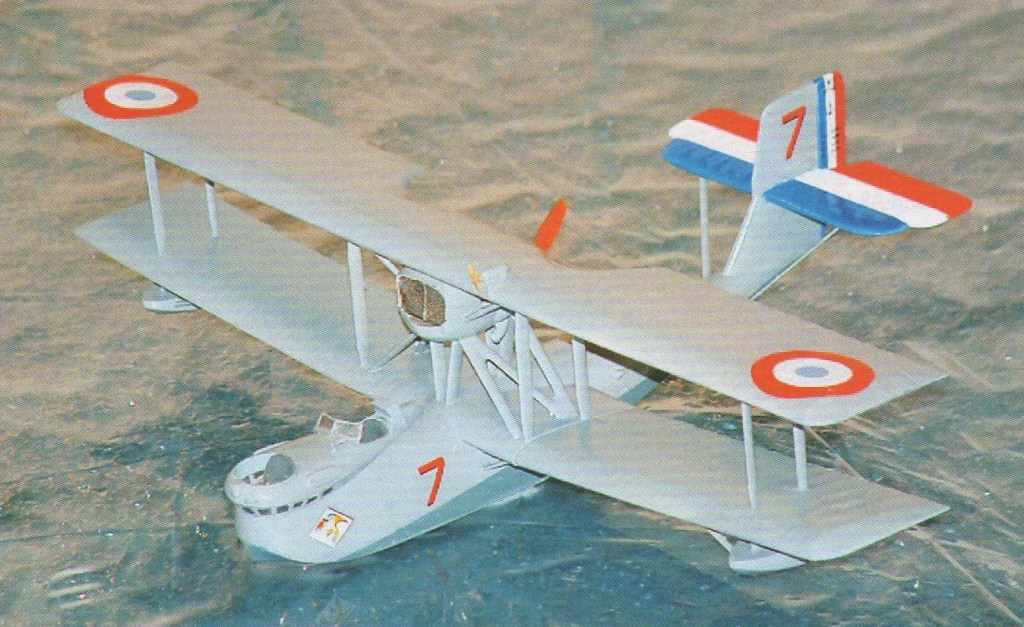
For shipborne observation/patrol, CAMS’ bay-windowed 37A first flew in 1926. About 150 were produced in the inter-war years. With its Lorraine 450hp broad arrow V12 and coarse pitch and small diameter pusher propeller it lasted longer than most with one example being operated by the Free-French from Tahiti. It could be operated from land strips when a wheeled main gear was attached, but was not capable of amphibious use since it could neither take off nor land on water in this configuration.