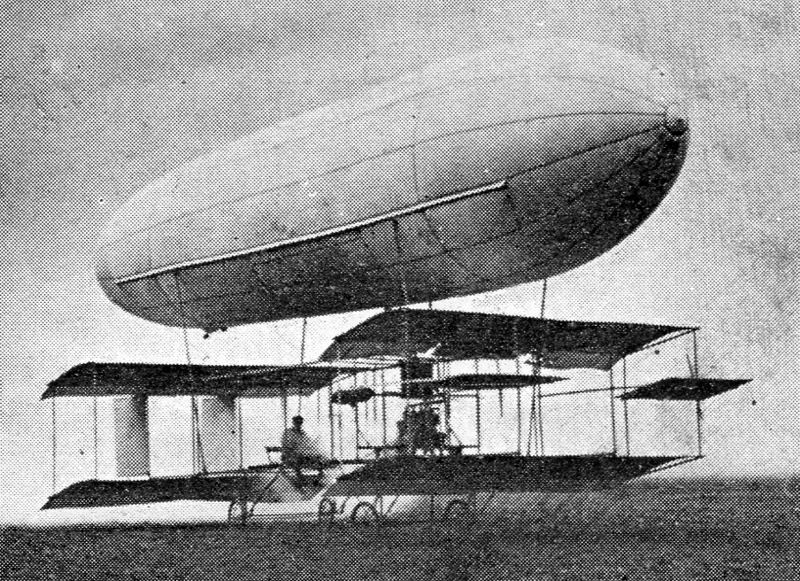
This tandem biplane design of central pusher configuration is attributed to Léopold César, but was a modification of a 1909 design of Eugène Boutaric. The Boutaric design had the same construction, but used a 25 hp Anzani which drove two propellers via chains. The propellers were placed just behind the front biplane wing in tractor configuration. There are no reports that the César tandem-wing machine left the ground, not even when fitted with a balloon on struts above it. Wing span was only six metres. It had a 50 hp Prini-Berthaud engine, mounted quite some way behind the front biplane wings on the connecting structure between the wing cells.
First flown in 1971, the CERVA CE-43 Guepard (Cheetah) was an all metal derivative of the Wassmer WA-40 Srs. A six-seat Tiara engine version was flown in 1974.
Engine: Lycoming IO-540-C4B5, 250 hp Wingspan: 32 ft 9.5 in / 10.00 m Length: 27 ft 6.5 in / 8.40 m Cabin max width: 3 ft 7 in / 1.09 m Empty weight: 1863 lb / 845 kg MTOW utility: 3220 lb / 1460 kg MTOW normal: 3527 lb / 1600 kg Max cruise: 167 kt / 192 mph / 310 kph Max ROC SL: 1080 fpm / 330 m/min Service ceiling: 17,400 ft / 5300 m Range max fuel: 1565 nm / 1800 mi / 2900 km Seats: 4
Centra Volo a Vela also produced prototypes of the P.110 three/four-seat cabin monoplane and P.M. 280 Tartuca single-seat low-wing monoplane.
Designed by Ing. Ermenegildo Preti, the P.110 was of all wood construction and the enclosed cabin seats four in two pairs.
The sole prototype was built by the Centro Volo a Vela (Gliding Centre) of the Milan Polytechnic School, originally designated C.V.V. P.110 or, alternatively, Preti CP.110.
The manufacturing rights were acquired by Construzioni Aeronautiche Giovanni Agusta, and the type was evaluated by the Italian Air Force, but no production orders materialised.
Engine: Alfa 110ter, 145 hp Wingspan: 34 ft 9 in Length: 23 ft 11 in Empty weight: 1500 ft Loaded weight: 2425 lb Max speed: 170 mph Cruise: 149 mph Range 620 mi
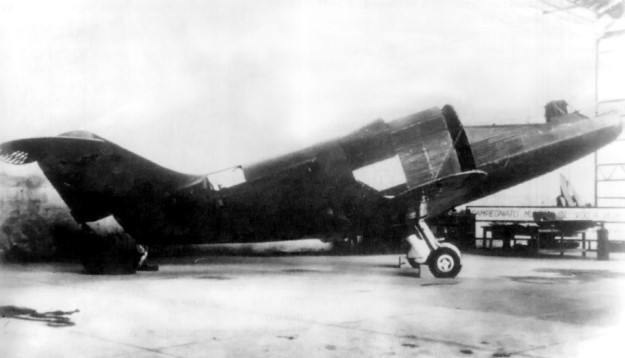
The Heliconair HC-Ib Convertiplano sits nearly finished in a hangar. The slit behind the cockpit was the intake for air used to cool the fuselage-mounted R-3350 engine. The scoop on the upper fuselage brought air to the engine’s carburetor. Note the Spitfire wings and main gear.
Immediately following World War II, Germany was prohibited from designing and manufacturing aircraft. Post war, Henrich Focke assisted with helicopter development in France and worked for a car company in Germany. He also spent some time in the Netherlands, where he began to design a VTOL aircraft that was capable of relatively high speeds. In 1952, Focke was recruited by the CTA (Centro Técnico de Aeronáutica or Technical Center of Aeronautics) to work in the recently established ITA (Instituto Técnico de Aeronáutica or Technical Institute of Aeronautics). The ITA was the first of four institutes formed by the CTA, all of which were located in São José dos Campos, Brazil. Brazil was working on building an aeronautics and aerospace industry and was actively recruiting German engineers. In addition to Focke, many of his associates and former co-workers were also recruited.
The CTA was impressed with Focke’s VTOL aircraft design and approved its construction. The CTA believed that the aircraft’s capabilities would allow it to reach remote parts of Brazil. Focke set to work on the aircraft—a tiltrotor convertiplane design that was partially inspired by the Fa 269. The aircraft was known as the Heliconair HC-I Convertiplano. Its fuselage and wings were fairly conventional for an aircraft, but it had of two sets of rotors. One pair of rotors was placed near the nose of the aircraft, and the other pair was placed between the wings and tail. All of the rotors were of a tractor configuration and rotated up for vertical flight. The HC-I accommodated two pilots in the cockpit and four passengers in the fuselage. The aircraft’s estimated performance included a top speed of 311 mph (500 km/h) and a range of 943 miles (1,517 km).
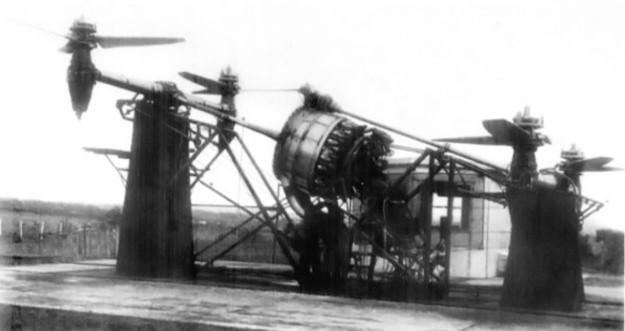
The test rig for the engine, transmission, gearboxes, shafts, right-angle drives, and rotors illustrates the complexity of the HC-Ib’s power system. The R-3350 engine did not have any Power Recovery Turbines, which means it was not a Turbo Compound engine.
To save time and money, the decision was made to build the HC-I using the wings and the horizontal stabilizer from a Supermarine Spitfire. A Spitfire XIVe (RM874) was purchased without its Rolls-Royce Griffon 65 engine from Britain by the Brazilian Air Attaché on 19 December 1952. A new fuselage was built to house a 3,000 hp (2,237 kW) Armstrong Siddeley Double Mamba turboprop engine behind the passenger compartment. However, Armstrong Siddeley and the British did not want one of their new, advanced engines being used in such a radical project and declined selling a Double Mamba engine to Brazil.
Focke and the Convertiplano team changed the HC-I’s design to accommodate a 2,200 hp (1,641 kW) Wright R-3350 radial engine and redesignated the aircraft HC-Ib. The R-3350 was larger and heavier than the Double Mamba, and it produced less power. Some sources state a Turbo Compound R-3350-DA3 (3,250 hp / 2,424 kW) was used, but images show that there are no Power Recovery Turbines on the engine installed in a test rig. Extensive modifications to the aircraft’s fuselage were required to accommodate the air-cooled engine. The passenger compartment was omitted, and the R-3350 was installed in the middle of the fuselage. An annular slit behind the cockpit was added to bring in cooling air for the engine. After passing through the engine’s cylinders, the air exited via a jet-like duct at the rear of the aircraft. The Spitfire’s landing gear was strengthened to compensate for the R-3350’s weight.
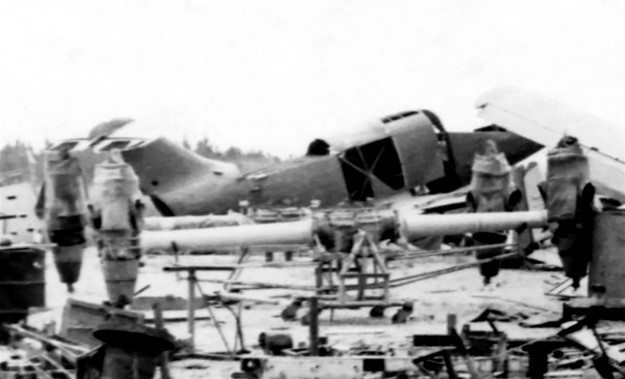
The HC-Ib sits in the background with the front and rear gearboxes and rotor drives in the foreground. The rotor blades, the only surviving component of the Convertiplano project, are not seen in the image. Note the opening at the rear of the fuselage, which was the exit for engine cooling air.
A gearbox transmission mounted to the front of the R-3350 split the engine’s power to two shafts. The front shaft extended from the engine to the front gearbox. The front gearbox had shafts that extended to the left and right. These shafts led to right-angle gearboxes that powered the front rotors. Power delivery for the rear rotors was more complex. A shaft extended vertically from the transmission on the front of the engine and met a right-angle gearbox positioned directly above the engine. From the right-angle gearbox, a shaft extended back to the rear gearbox. The rear gearbox had the same shafts and right-angle drives for the rear rotors as the front gearbox. The transmission and gearboxes were designed by Willi Bussmann and built by BMW in Germany. Bussmann was a former BMW employee and had worked with Focke on several Focke-Achgelis projects.
Each rotor consisted of three blades. The blades were built in Sweden and made of a steel frame that was covered with wood. The blades’ pitch automatically adjusted and had collective and cyclic control. The rotors were counter-rotating, with the right rotors turning counterclockwise and the left rotors turning clockwise. The HC-Ib had a 37 ft 6 in (11.42 m) wingspan and was 35 ft 3 in (10.74 m) long.
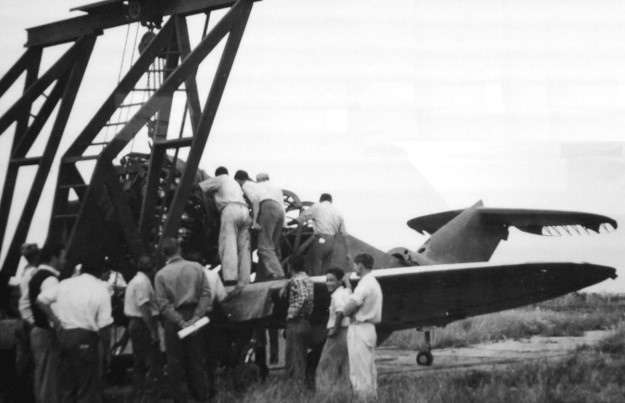
Given the state of the aircraft and the surrounding unchecked growth of vegetation, it can be assumed this image is of the R-3350 engine being removed sometime after the HC-Ib project was cancelled. The image does give proof that the engine was installed in the airframe at one point.
A rig was built, and tests of the engine, gearboxes, shafts, right-angle drives, and rotors began in late 1953. However, vibrations from the radial engine caused some issues that took time to resolve. The HC-Ib airframe was almost completely constructed and had its engine installed when the project was cancelled in 1955. The aircraft was more expensive than anticipated, and interest in the HC-1b had steadily declined after the switch to the R-3350 engine. To make matters worse, many of the Germans returned to Europe or went to the United States as their contracts with the CTA expired. Some Germans did stay and ultimately became part of Embraer. After the project was cancelled, the HC-Ib Convertiplano was left to rot in outside storage for some time and was eventually scrapped in the 1970s. There are some reports that the rotor blades are the only part of the aircraft that survived.