Cessna CE-210 Centurion

CE-210

Cessna engineers fitted a retractable undercarriage to a model 182B resulting in the 210. The first 210s were flown in January 1957, and the airplane has always been a 160 knot cruiser that can go 175 knots. When its hydraulically activated landing gear is retracted, the gear doors seal it completely within the fuselage. (The 1979 model no longer has the all covering doors; the main gear nestles up into open wheel wells. As a result, the gear extension speeds have been raised 25 knots, and a more simple design has been obtained without any loss in performance.) The first in the Cessna range to introduce the swept vertical tail surfaces and a fully-retractable undercarriage.

The first production aircraft flew in December 1959 powered by a 194kW Continental IO-470-E engine. The initial 210s carried four people; then in 1964, two seats were added. The four seat 210s were made from 1960 to 1963, with wing struts, two windows per side and no rear window. The early models are powered by the 260 horsepower, fuel-injected Continental with a 1,200 hour TBO. Those 210s carried 65 USG of fuel, but in 1962, when the option was first offered, most buyers chose the 84 gallon long range tanks. The early 210s gross at 2,900 pounds, with a standard useful load of about 1,165 pounds.

Cessna CE-210 Centurion Article

An example of the Model 210 was first demonstrated in Britain early in 1960.

The 1961 210A model introduced two more cabin windows, additional headroom and an improved heating and ventilating system, and by 1963 an autopilot was offered as an option. The 1962 210B introduced a re-designed fuselage with all-round cabin vision and a simplified hydraulic system. The 1963 210C differed only in its restyled cabin, but the 1964 210D Centurion has a 285 hp engine in place of the 260 hp Continental IO-470-S. In January 1965 the Model 210E Centurion had supplanted earlier versions and was powered by a 213kW Continental IO-520-A. The Model 210F followed in 1966.

The Centurion, a heavier, bigger, more powerful 210, was introduced in 1964. The first Centurion had a 285 hp Continental, still fuel injected, still with a 1,200 hour TBO. The gross weight was increased to 3,100 pounds, which raised the useful load by 105 pounds. The cabin was expanded to seat six with the addition of two tiny rear seats that can be folded flush with the baggage compartment floor.

In 1966 the first turbocharged model became available in the form of the T210F Turbo-System Centurion with a 213kW Continental TSIO-520C; the extra power conferred a useful increase in performance, particularly in altitude. A new wing, first flown on a T210 in June 1965, was later introduced on production aircraft, and eliminated the need for external bracing struts. The turbocharged version eventually outsold the basic model two to one.
In 1967, the Centurion lost its wing struts, took on two standard 45 gallon fuel tanks and gained 100 pounds, for a gross of 3,400. With a 1,960 pound empty weight, the full fuel payload went to about 905 pounds.
In 1969, the TBO on the engine went up to 1,500 hours. The following year, the cabin was enlarged and the rear seats expanded to make the airplane an honest six seater. The gross weight went up again, this time to 3,800 pounds, and the useful load rose to 1,720, for a full fuel payload of about 1,186 pounds. At the same time, the old, square passenger windows were replaced by a three foot long window on each side, aft of the doors. The engine, still rated at 285 hp, was allowed to develop 300 hp for takeoff and five minutes of climb out.
By 1970 Cessna had dropped its suffix letter system from model numbers and in that year introduced two new versions, the Centurion II and Turbo Centurion II which incorporated a factory-installed package of avionics and equipment as standard, these being produced alongside the Centurion and Turbo Centurion. By then the Centurions were of six-seat capacity and offered powerplant options of a 224kW Continental IO-520-L for the Centurion and a 213kW TSIO-520H for the Turbo Centurion.
In 1975, the three blade prop became standard.
The 210L models featured larger picture windows which greatly im¬proved the visibility for the rear seat passengers.
The Turbo Centurion was first built with strutted wings. That was remedied in 1967 with a center section to make the Turbo Centurion’s wing full cantilever, eliminating the struts. A new airfoil was incorporated at the same time. Gone was the classic Cessna wing, swapped for a new laminar flow section. The strutless wing arrangement added 95 pounds to the empty weight, increased the stalling speed six knots, resulted in a 154 fpm decrease in rate of climb (largely from a 100 pound gross weight increase to preserve useful load) and improved the cruising speed but two knots. The first strutless Turbo Centurion almost had too much dihedral in the wings but that was quickly remedied.
The Centurion’s performance has been greatly improved, too, through a series of small but important aerodynamic refinements. The 1975 Centurion is basically the same airframe as that used since 1970, when six full size seats were first offered. It uses the same engine, also, but incorporates such features as a retractable cabin step which gives it 10 knots additional cruise at maximum power settings.
In November 1977 a new pressurised version of the Model 210, the Pressurized Centurion, was announced. Generally similar to the standard Centurion, it differed by having a pressure cabin and a 231kW Continental TSIO-520-P which incorporated a high-capacity turbocharger to support the pressurisation system, and like the earlier models was available in standard and Pressurized Centurion II versions.

Cessna P210N Pressurized Centurion II

The 210R model, with a longer span stabiliser and cambered wingtips, was produced for the 1986 sales year and only 112 were produced in the final year of production.
All six versions remained available until 1986 when sales slowed down and at the end of 1987 when production ceased, a total of 8,453 Model 210s and Centurions had rolled off the line together with 851 Pressurized Centurions.
Turbocharged Centurions established several world records in their class: including time-to-height records, a round the world speed record of 204km/h, and an altitude record of 12905m established on 13 May 1967.

Gallery

210
1960 – strut braced wing
Engine: Continental IO-470-D, 260 ho
Seats: 4

210A
1960 – larger cabin windows plus two extra

210B
1962 – cut down at rear fuselage

210C
1953 – improved cabin appointments

210D
1964
Engine: Continental IO-520-A, 285 hp
Wingspan: 36 ft 7 in
Length: 27 ft 9 in
Height: 9 ft 9 in
Wing area: 173.5 sq.ft
Empty weight: 1830 lb
Loaded weight: 3100 lb
Max speed: 199 mph
Cruise 75%: 191 mph at 6500 ft
ROC: 1210 fpm
Max range: 1305 mph

210E
1965 – modified engine cowling

210F
1966

210G
1967 – fully-cantilevered wing

210H
1968 – improved instrumentation

210
1969 – longer, restyled nose cowling, larger dorsal fin, reduced engine dihedral

210
1970
Seats: 6

1973 Cessna Centurion T210L
Base price: US$544,295
Engine: Continental TSIO-520H, 285 hp to 17,000 ft
TBO (hrs.): 1400
Fuel type: 100/100LL
Propeller type: McCauley CS/3-blade
Landing gear type: Tri./Retr.
Max ramp weight (lbs): 3800
Gross weight (lbs.): 3800
Landing weight (lbs.) 3800
Empty weight, std. (lbs.): 2195
Useful load, std. (lbs.): 1605
Useful fuel, std (gals.): 89
Payload, full std. fuel (lbs.): 1071
Wingspan: 36 ft. 9 in.
Overall length: 28 ft. 3 in.
Height: 9 ft. 7 in.
Wing area (sq. ft.): 175.1
Wing loading (lbs./sq.ft.): 21.7
Wheel size (in.): 6.00 x 6
Power loading (lbs./hp):12.3
Seating capacity: 6
Cabin doors: 2
Cabin width (in.): 45.5
Cabin height (in.): 48
Cruise speed (kts.) 80% power: 198@20,000 ft.
Cruise speed (kts.) 70% power: 190@20,000 ft.
Fuel consumption (USgph.) 80% power: 17.2
Fuel consumption (USgph.) 70% power: 15.5
Range (plus reserve, nm) 80% power: 830
Range (plus reserve, nm) 70% power: 880
Vso (kts.): 57
Best rate of climb, SL (fpm): 1115
Service ceiling (ft.): 28,500
Takeoff distance (ft.): 1170
Takeoff over 50 ft. obstacle (ft.): 2030
Landing distance (ft.): 765
Landing over 50 ft. obstacle (ft.): 1500

1977 Cessna T210M
Engine: Continental TSIO-520H, 310 hp
TBO hr: 1400
Propeller type: Const. spd.
Landing gear type: Tri/Retr.
Gross weight (lbs.): 3800
Empty weight, std. (lbs.): 2324
Useful load, std. (lbs.): 1476
Fuel (USgals.): 89
Wingspan: 36 ft. 9 in.
Overall length: 28 ft. 2 in.
Height: 9 ft. 5 in.
Wing area (sq. ft.):175
Seating capacity: 6
Cabin width (in.): 42.5
Cabin height (in.): 48
Baggage capacity (lbs.): 240
Cruise speed (kt) 75% power @ 24,000 ft: 198
Cruise speed (kt) 65% power @ 6,500 ft.: 168
Max range (w/ reserve) (nm) 75% power: 870
Max range (w/ reserve) (nm) 65% power: 880
Fuel consumption (USgph) 70% power: 17.8
Fuel consumption (USgph) 65% power: 14.0
Estimated endurance (65% power with 1-hr. reserve): 5 hrs. 30 mins.
Stall speed (gear, flaps down) (knots): 56
Best rate of climb (fpm): 1030
Service ceiling (ft.): 28,500
Takeoff ground roll (ft.): 1150
Landing ground roll (ft.): 765

CE-210N
Engine: 1 x Continental IO-520-L, 300 hp.
TBO: 1700 hrs.
Prop: McCauley 3 blade, constant speed 80 in.
Seats: 6.
Length: 28.2 ft.
Height: 9.7 ft.
Wingspan: 36.8 ft.
Wing area: 175 sq.ft.
Wing aspect ratio: 7.7.
Max ramp wt: 3812 lbs.
Max take off wt: 3800 lbs.
Standard empty wt: 2153 lbs.
Max useful load: 1659 lbs.
Max landing wt: 3800 lbs.
Wing loading: 21.7 lbs/sq.ft.
Power loading: 12.7 lbs/hp.
Max useable fuel: 522 lbs.
Climb rate: 950 fpm @ 96 kts.
Climb gradient: 597 ft/nm.
Rate of climb @ 8000 ft: 560 fpm.
Service ceiling: 17,300 ft.
Max speed: 175 kts.
Cruise @ 65% power @ 8,000ft: 160 kts.
Fuel flow @ 65% power @ 8,000ft: 82 pph.
Endurance @ 65% power @ 8,000ft: 6.2 hr.
Stalling speed clean: 65 kts.
Stall speed gear/flaps down: 56 kts.
Turbulent air penetration speed: 125 kts.
Retractable nose wheel undercarriage.

1983 Cessna Turbo 210N Centurion II
Engine: Continental TSIO-520-R
Takeoff power: 310 hp @2700 rpm / 36.5-in manifold pressure
Max continuous power: 285 hp @2600 rpm / 35-in. manifold pressure
TBO hrs.: 1600
Fuel Type:100/100LL
Propeller type/diameter: McCauley CS/80 in
Landing Gear type: Tri./Retr.
Max ramp weight (lbs.): 4016
Gross weight (lbs.): 4000
Landing weight (lbs.): 3800
Empty weight, std. (lbs.): 2303
Useful load, std. (lbs.): 1697
Payload (lbs.): 896 with 120-USgallon auxillary tanks
Usable fuel, std. (USgals.): 90
Oil capacity (qts.): 11
Wingspan: 39 ft. 9 in With Flint Tip Tanks
Overall length: 28 ft. 2 in.
Height: 9 ft. 8 in.
Wing area (sq. ft.):181
Wing loading (lbs./sq. ft.): 22.9
Power loading (lbs./hp.): 12.9
Wheel base (in.): 72
Seating capacity: 6
Cabin doors: 2
Cabin width (in.): 41.8
Cabin height (in.): 48
Baggage capacity (lbs.): 370
Cruise speed (kt) 75% power @ 2000/24,000 ft.: 157/192
Cruise speed (kt) 65% power @ 2000/24,000 ft.: 150/175
Cruise speed (kt) 45% power @ 2000/24,000 ft.: 135/154
Range (w/45-min. reserve) (nm) 75% power @ 2000/24,000 ft.: 1000/1075
Range (w/45-min. reserve) (nm) 65% power @ 2000/24,000 ft.: 1200/1125
Range (w/45-min. reserve) (nm) 45% power @ 2000/24,000 ft.: 1350/1200
Fuel consumption (est. @ .44 lbs./hp/hr. sfc gph) 75% power: 17
Fuel consumption (est. @ .44 lbs./hp/hr. sfc gph) 65% power: 15
Fuel consumption (est. @ .44 lbs./hp/hr. sfc gph) 45% power: 12
Estimated endurance (65%) (hrs): 8.0
Vso (kts.): 58
Best rate of climb (fpm): 930
Best rate of climb, 8,000 ft. (fpm): 850
Service ceiling (ft.): 27,000
Takeoff ground roll (ft.): 1300
Takeoff over 50-ft. obstacle (ft.): 2160
Landing ground roll (ft.): 765
Landing over 50-ft. obstacle (ft.): 1500

CE-P210N
Engine: 1 x Continental TSIO-520-AF, 310 hp.
TBO: 1600 hrs.
Prop: McCauley 3 blade, constant speed 80 in.
Seats: 6.
Length: 28.2 ft.
Height: 9.6 ft.
Wingspan: 36.8 ft.
Wing area: 175 sq.ft.
Wing aspect ratio: 7.7.
Max ramp wt: 4016 lbs.
Max take off wt: 4000 lbs.
Standard empty wt: 2426lbs.
Max useful load: 1590 lbs.
Max landing wt: 3800 lbs.
Wing loading: 22.9 lbs/sq.ft.
Power loading: 12.9 lbs/hp.
Max useable fuel: 522 lbs.
Climb rate: 945 fpm @ 100 kts.
Climb gradient: 567 ft/nm.
Rate of climb @ 8000 ft: 860 fpm.
Certificated ceiling: 23,000 ft.
8000ft cabin altitude at 17,350 ft.
Max speed: 201 kts.
Cruise @ 65% power @ 8,000ft: 154 kts.
Cruise @ 65% pwr @ 18,000 ft: 166 kts.
Fuel flow @ 65% power @ 18,000ft: 88 pph.
Endurance @ 65% power @ 18,000ft: 5.7 hr.
Stalling speed clean: 67 kts.
Stall speed gear/flaps down: 58 kts.
Turbulent air penetration speed: 130 kts.
Retractable nose wheel undercarriage and pressurised.

1985 Cessna P210R
Engine: Continental TSIO-520CF, 325
TBO hr: 1600
Propeller type: CS
Landing Gear type: Tri./Retr.
Gross weight (lbs.): 4100
Empty weight, std. (lbs.): 2471
Useful load, std. (lbs.): 1629
Fuel (lbs.): 115
Wingspan: 33 ft. 5 in.
Overall length: 28 ft. 4 in.
Height: 9 ft. 8 in.
Seating capacity: 6
Cabin width (in.): 42
Cabin height (in.): 48
Baggage capacity (lbs.):200
Cruise speed (kt) 75% power: 210
Cruise speed (kt) 65% power: 196
Max range (w/ reserve) (nm) 75% power: 1045
Max range (w/ reserve) (nm) 65% power: 1137
Fuel consumption (USgph) 75% power: 18.2
Fuel consumption (USgph) 65% power: 15.8
Estimated endurance (65% power with 1-hr. reserve) (hrs): 6 hrs.
Stall speed (gear, flaps down) (knots): 55
Best rate of climb (fpm): 1150
Service ceiling (ft.): 23,000
Takeoff ground roll (ft.): 1325
Landing ground roll (ft.): 840

CE-T210N
Engine: 1 x Continental TSIO-520-R, 310 hp. turbo charged
TBO: 1400-1500 hrs.
Fuel Type:100LL
Prop: McCauley 3 blade Q-Tip , constant speed 80 in.
Seats: 6.
Length: 28.2 ft.
Height: 9.8 ft.
Wingspan: 36.8 ft.
Wing area: 175 sq.ft.
Wingspan (ft.): 39.7, Flint wingtip tanks
Wing aspect ratio: 7.7.
Max ramp wt: 4016 lbs.
Max take off wt: 4000 lbs.
Standard empty wt: 2237 lbs.
Max useful load: 1779 lbs.
Payload, full std. fuel: 718lb
Max landing wt: 3800 lbs.
Wing loading: 22.9 lbs/sq.ft.
Power loading: 12.9 lbs/hp.
Usable fuel, std. (gals.): 88 main, 123 w/aux. tanks
Max useable fuel: 522 lbs.
Best rate of climb (SL fpm): 1035
Best rate of climb, 8,000 ft. (fpm): 840
Best climb speed: 100 kt
Climb gradient: 558 ft/nm.
Rate of climb @ 8000 ft: 845 fpm.
Service ceiling: 27,000 ft.
Max speed: 204 kts.
Cruise @ 65% power @ 8,000ft: 156 kts.
Cruise @ 65% pwr @ 18,000 ft: 167 kts.
Cruise speed (kts.) @ 10,000 ft 75% power: 174
Cruise speed (kts.) @ 10,000 ft 65% power: 164
Cruise speed (kts.) @ 10,000 ft 55% power: 157
Fuel consumption (lb) 75% power: 94 pph
Fuel flow @ 65% power @ 18,000ft: 86 pph.
Fuel consumption (lb) 55% power: 73 pph
Endurance @ 65% power @ 18,000ft: 5.9 hr.
Max range (w/reserve, 75% power) (nm): 1235
Stalling speed clean: 67 kts.
Stall speed gear/flaps down: 58 kts.
Turbulent air penetration speed: 130 kts.
Undercarriage: Retractable / nose wheel
Wheel track (ft.): 8.8
Cabin width (in.): 43
Cabin height (in.): 48
Baggage capacity (lbs.): 200
Takeoff ground roll (ft.): 1300
Takeoff over 50-ft. obstacle (ft.): 2160
Landing ground roll (ft.): 765
Landing over 50-ft. obstacle (ft.): 1500

1978 Pressurized Centurion
Engine: Continental TSIO 520 P, 310hp for takeoff, 285 maximum continuous.
TBO: 1,500 hrs.
Prop: three blade, constant speed, 80 in. diameter.
Length: 28 ft. 2 in.
Height: 9 ft. 5 in.
Wingspan: 36 ft. 9 in.
Wing area: 174.6 sq.ft.
Wing loading: 22.9 lb/sq.ft.
Power loading: 12.9 lb/hp.
Seats: 6.
Empty weight: 2588 lb.
Useful load: 1412 lb.
Payload with full fuel: 878 lb.
Gross wt: 4000 lb.
Useable fuel: 89 USG/534 lb.
Maximum landing weight 3,800 lbs.
Max ramp wt: 4,016 lbs.
Maximum rate of climb 930 fpm.
Certificated ceiling 23,000 ft.
Maximum speed 206 kts.
Max cruise, 79% power at 20,000 ft: 195kts.
Econ cruise, 55% power at 20,000 ft: 158 kts.
Duration at max cruise 4.7 hrs.
Duration at econ cruise (leaned to peak EGT) 7.3 hrs.
Stalling speed, clean, forward CG 73 kts.
Stalling speed, full flaps, forward CG 58 kts.
Pressurization differential 3.35 psi.
10,000 ft. cabin at 20,000 ft.
Max range: 926 nm.
ROC: 930 fpm.
Takeoff dist 50 ft obstacle: 2,160 ft.
Landing dist 50 ft obstacle: 1,500 ft.

O&N Aircraft Modifications Cessna 210 Silver Eagle
Engine: Allison 250-B17F/2, 450 shp
TBO hrs.: 3500
Fuel Type: Jet A, Jet A1, JP 8, limited avgas
Propeller make/type: 90-inch CS three-blade full-feather reversing
Landing Gear type: Tri./Retr.
Max ramp weight (lbs.): 4016
Gross weight (lbs.): 4000
Max landing weight (lbs.): 3800
Empty weight (lbs.): 2470
Useful load (lbs.): 1530
Payload, full fuel (lbs.): 1545
Usable fuel (USgals.): 114
Oil capacity (qts.): 12
Wingspan: 36 ft. 11 in.
Overall length: 29 ft. 6 in.
Height: 9 ft. 6 in.
Wing area (sq. ft.): 175
Wing loading (lbs./sq. ft.): 22.9
Power loading (lbs./hp.): 8.89
Wheel track (in.): 8 ft. 7 in.
Wheel size (in.): 6.00 x 6 main; 5.00 x 5 nose
Seating capacity: 6
Cabin doors: 1
Cabin width (in.): 41.75
Cabin height (in.): 57
Baggage capacity (lbs.): 181.5
Cruise speed (kts.): 215
Cruise speed (kt) @ 12,000 ft.: 200
Cruise speed (kt) @ 17,500 ft.: 215
Cruise speed (kt) @ 23,000 ft.: 208
Max range (w/ reserve) @ 12,000 ft: 570 nm
Max range (w/ reserve) @ 17,500 ft.: 860 nm
Max range (w/ reserve) @ 23,000 ft.: 910 nm
Fuel consumption (USgph): @ 12,000 ft.: 24.0
Fuel consumption (USgph): @ 17,500 ft.: 22.7
Fuel consumption (USgph): @ 23,000 ft.: 19.5
Estimated endurance (standard fuel)(hrs): 5.0
Stall speed (flaps up) (knots): 76
Stall speed (flaps down) (knots): 61
Best rate of climb (SL fpm): 2200
Service ceiling (ft.): 23,000
Takeoff ground roll (ft.): 600
Takeoff over 50 ft. obstacle (ft.): 900
Landing ground roll (ft.): 500
Landing over 50 ft obstacle (ft.): 1000

CE-210D Centurion
T210 Turbo Centurion II

Cessna CE-208 Caravan / C-98

CE-208B Grand Caravan

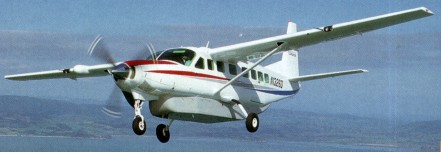
First flown on 9 December 1982, the Caravan I was Cessna’s first wholly new design for some years. The type was planned as the Model 208 to succeed the company’s earlier Models 180, 185, and 206 while also assuming the utility mantle of de Havilland Canada types such as the Beaver and Otter. The Caravan I is a thoroughly utilitarian design with a strut-braced wing in the high-set postion, a capacious fuselage accessed by large doors, and fixed tricycle landing gear with tall legs so that a ventral freight container can be fitted when required. The spring steel main undercarriage legs were designed to tear away without damaging the fuselage structure in an accident. The nosewheel fore-and-aft location is taken not on the airframe but by means of a drag link spring, attached near the fork to reduce bending loads in the strut. Steering to 15 degs either way is by linkage to the rudder pedals, and the wheel is free to castor to 56 degs either side. All fuel is carried inside the wings between the two spars for safety, and the tips and leading and trailing edges are made from lighter-gauge metal than the rest of the wing structure, which should thus remain intact in the event of minor damage. The wings are an aerofoil section the same as the Citation’s, and the flaps take up so much of the span that lateral control is helped by spoilers on the top surface acting in conjunction with the ailerons.

Cessna CE-208 Caravan Article

The first production aircraft rolled out in August 1984.
The 208 received FAA certification in October 1984 and the first deliveries in February 1985. Because of FAR Part 23 restrictions, American registered Caravans have no more than 10 seats in their 17 foot cabins. An increase in MAUW to 8000 lbs (from 7300) allows them to carry more than their basic empty weight of 3800 lbs and promising much useful load-carrying.
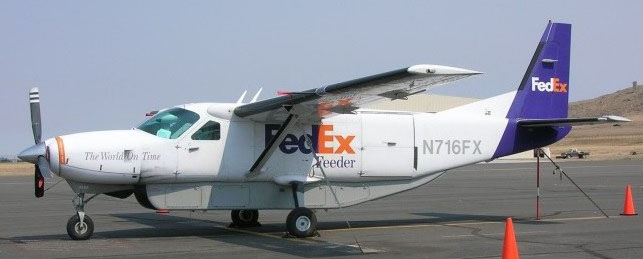
The higher gross weight Model 208A, ordered in December 1983 by the US small parcel airline Federal Express and called Cargomaster by them, is fitted with more comprehensive all-weather avionics and an underfuselage pannier, but has the fuselage windows deleted. Flight testing began on 3 March 1986, followed by certification and first delivery to Federal Express, who have ordered 210, in October the same year. By the end of 1989 more than 370 variants of the Model 208 had been delivered.
In 1984 the company launched development of a purely military model as the U-27A. This is externally identical with the Model 208A but is stressed for higher maximum take-off and landing weights in its role as a utility transport for troops and freight. The type can also be configured for the casualty evacuation and forward air control roles, while the 100-cu ft (2.83 cu.m) freight container can be replaced by a reconnaissance pod with optical and infra-red sensors as well as a data-link.
In 1985 Cessna released details of a quasi-military/special mission version of the Caravan I designated U-27A by the US Department of Defense and marketed as the Low Intensity Conflict Aircraft (LICA). Equipped with six hardpoints under the wing plus another on the fuselage centreline able to carry either a General Dynamics F-16 reconnaissance pod, or a cargo pannier, the LICA also has a electrically operated ‘roll up’ cargo door with slipstream deflector, openable in flight, and bubble windows for downward surveillance and observation. Cessna are also offering a similarly equipped version of the stretched Model 208B for special mission.
Following experience with the 208A, Federal Express ordered the Model 208B Super Cargomaster with the fuselage stretched by four feet / 1.22m, also built without windows and equipped with a pannier. The first Caravan Super Cargomaster flew on 3 March 1986.

Cessna 208B Super Cargomaster

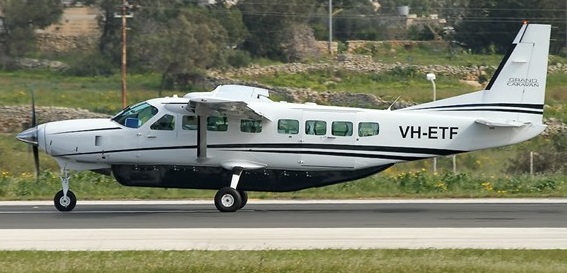
The Caravan family of aircraft consists of four distinct aircraft: the original Cessna Caravan, the Grand Caravan, the Super Cargomaster and the Caravan Amphibian. The original Caravan had its origins dating back to the early 80s and the Grand Caravan, like the Super Cargomaster, is essentially a stretched version of the original Cessna Caravan but powered by the A variant of the reliable Pratt and Whitney Canada PT6A-114 turboprop, which produces 675 shp (75 shp more than the standard version).

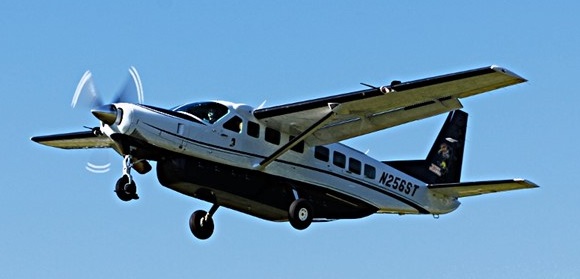
The Grand Caravan 208B first flew in 1990, some eight years after the Caravan I, and retains all of the conventional design aspects of the original: single-engine, high wing, unpressurised, with a fixed tricycle undercarriage. The PT6A-114A drives a three-blade McCauley propeller, which is governed to a constant speed of 1900 rpm and can be both feathered and reversed. While 1.2 m longer at 12.7 m, the Grand Caravan has room for up to fourteen (a pilot and thirteen passengers), the same as the Caravan I, and the fuselage itself is made up of a sheet metal bulkhead and a stringer and skin design. Although it narrows slightly towards the tail, the 5.1 m cabin is spacious and offers 9.6 cu.m of volume. This, combined with the more powerful turboprop, means that the Grand Caravan does have a higher useful load than the original. The wings on the Grand Caravan (which span 15.9 m) are conventional aerofoils, and both contain an integral fuel bay with a capacity totalling 1270 litres which feeds into a fuel reservoir before continuing to the turbine. The tail stands 4.5 m high and the control surfaces are again conventional: horn-balanced elevators and rudder. The flight control system is cables, bell cranks and push-pull rods, providing positive control and simple maintenance. The aircraft is steered by the nose wheel and the shock absorption for the main landing gear is provided by the tubular spring steel struts with an “intertube” connecting the two. Once at 10,000 ft, the Grand Caravan will cruise at 184 kts and, with a payload of just under 2,000 lbs and a reserve of 45 minutes, has a range of about 900 nm. Block time for such a flight would be around five hours. With 3,500 lbs on board, range drops to about 100 nm. It is these tasks where the Grand Caravan comes into its own; flying large loads to or from rough and short surfaces. At gross weight, landing requires just 745 ft, 1655 ft to clear a 50-ft obstacle, while a zero-wind take-off requires 1205 ft (2,210 ft to clear a 50 ft obstacle).
In 1997 the Caravan 675, which used the same engine as the Grand Caravan, was announced and deliveries started in May 1998.
The type was in service with military air arms in Brazil, Liberia, Thailand and with the Royal Canadian Mounted Police as amphibians.

Variations:
Soloy Corp Pathfinder

Gallery

CE-208
Engine: Pratt & Whitney PT6A-114, 600 shp.
Prop: Hartzell 3 blade 100-inch dia.
Wing span: 51ft 8in.
Length: 37ft 7in.
Height: 14ft 2in.
Cruise: 186 kt (214 mph).
MTOW: 6,700 lbs.
Seats: 14 pax.
Cabin width: 5ft 2in.
Cabin height: 4ft 3in.
Cabin vol: 337 cu. ft.
Payload: 3000 lbs.
Fuel cap: 330USG.

Cessna 208 Caravan I
Engine: 1 x Pratt & Whitney Canada PT6A-114 turboprop, 477kW
Take-off weight: 3629 kg / 8001 lb
Empty weight: 1752 kg / 3863 lb
Wingspan: 15.88 m / 52 ft 1 in
Length: 11.46 m / 37 ft 7 in
Height: 4.32 m / 14 ft 2 in
Wing area: 25.96 sq.m / 279.43 sq ft
Cruise speed: 341 km/h / 212 mph
Ceiling: 8410 m / 27600 ft
Range: 1797 km / 1117 miles

Cessna 208 B Caravan I
Engine: Pratt & Whitney Canada PT 6 A 114, 441 shp
Length: 37.73 ft / 11.5 m
Height: 14.108 ft / 4.0 m
Wingspan: 52.165 ft / 15.9 m
Wing area: 279.864 sq.ft / 26.0 sq.m
Max take off weight: 7336.0 lb / 3327.0 kg
Weight empty: 3801.4 lb / 1724.0 kg
Payload: 3534.6 lb / 1603.0 kg
Max. speed: 184 kts / 341 km/h
Landing speed: 60 kts / 111 km/h
Cruising speed: 175 kts / 325 km/h
Initial climb rate: 1200.79 ft/min / 6.10 m/s
Service ceiling: 26608 ft / 8110 m
Wing load: 26.24 lbs/sq.ft / 128.00 kg/sq.m
Range: 972 nm / 1800 km
Crew: 1
Payload: 9-14pax

2008 Cessna 208B Grand Caravan
Standard Price: US$1,990,000
Engine: Pratt & Whitney PT6A-114A, 675 shp
Prop: 2.7m
Length: 12.7m.
Wing span: 15.9m.
Height: 4.5m
Max ramp wt: 8785 lbs.
Gross Weight (lbs.): 8750
Empty Weight (lbs.): 5013
Useful Load (lbs.): 3772
Max ldg wt: 8500 lb
Fuel Capacity (gals./lbs.): 335/2245, 1270 lt
Payload, Full Standard Fuel (lbs.): 1548
Rate Of Climb, SL (fpm): 975
Max Operating Altitude (ft.): 23,700
Max Cruise Speed, 10,000 Ft. (kts.): 184
Max Range, 10,000 Ft. (nm): 917
Ldg roll: 745 ft
T/O run: 1205 ft
Ldg dist from 50 ft: 1655 ft
T/O dist to 50 ft: 2210 ft
Capacity: 450 cu.ft

U-27A Caravan I
Engine: one 600-shp (447-kW) Pratt & Whitney Canada PT6A-114 turboprop.
Maximum speed 203 mph (326 km/h) at optimum altitude
Initial climb rate 1050 ft (320 m) per minute
Service ceiling 30,000 ft (9,145 m)
Range 1,105 miles (1,778 km)
Empty wt: 3,850 lb (1,746 kg)
Maximum take-off 8,000 lb (3,629 kg)
Wing span 52 ft 1 in (15.88 m)
Length 37 ft 7 in (11.46 m)
Height 14 ft 2 in (4.32 m)
Wing area 279.4 sq ft (25.96 sq.m).
Payload: 14 passengers or 4,185 lb (1,898 kg) of freight.

Caravan 675
Engine: Pratt & Whitney PT6A-114A turboprop, 675 shp.

Cessna CE-207

CE-207A Stationair 8

On 3 January 1969 Cessna flew the first production example of the lengthened seven-seat Model 207, which reverted to the name Skywagon. This introduced a second access door on the starboard side; a 54kg capacity baggage compartment, forward of the cabin; and the more powerful IO-520-J engine. The 206 and 207 use the same airframe, except that the 207 Skywagon is 3 feet 6.75 inches longer. This extra length is inserted just ahead of the double cargo doors, which adds cubic feet to the cabin, and an extra window on each side, making this a seven-place airplane.

Later the type became known as the Stationair 7 and then the Stationair 8.

CE-207

Both the Models 206 and 207 can be flown with cargo doors removed for the air-dropping of supplies, parachuting and photography. Both can carry a 136kg glassfibre cargo pack beneath the fuselage, and ambulance kits comprising a stretcher, oxygen supply, and attendant seat are available. The Model 207 also serves with several armed services.

Replaced by the Model 208 Caravan, volume production of the 206 and 207 ended in 1985, although around 100 more airframes were produced and sold. By 31 December 1987, no less than 7,652 Model 206 Skywagon and Stationairs had been delivered, including 643 Super Skylane luxury versions.

Gallery

CE-207A Stationair 8
Engine: 1 x Continental IO-520-F, 300 hp.
TBO: 1700 hrs.
Prop: McCauley 3 blade, constant speed, 80 in.
Seats: 8.
Length: 32.2 ft.
Height: 9.6 ft.
Wingspan: 35.8 ft.
Wing area: 174 sq.ft.
Wing aspect ratio: 7.4.
Max ramp wt: 3812 lbs.
Max take off wt: 3800 lbs.
Standard empty wt: 2123 lbs.
Max useful load: 1689 lbs.
Max landing wt: 3800 lbs.
Wing loading: 21.8 lbs/sq.ft.
Power loading: 12.7 lbs/hp.
Max useable fuel: 438 lbs.
Climb rate: 810 fpm @ 87 kts.
Climb gradient: 555 ft/nm.
Rate of climb @ 8000 ft: 385 fpm.
Service ceiling; 13,300 ft.
Max speed: 150 kts.
Cruise @ 65% power @ 8,000ft: 136 kts.
Fuel flow @ 65% power @ 8,000ft: 82 pph.
Endurance @ 65% power @ 8,000ft: 5.1 hr.
Stalling speed clean: 65 kts.
Stall speed flaps down: 58 kts.
Turbulent air penetration speed: 129 kts.
Fixed undercarriage.

1981 Cessna Caravan 207
Price: $132,000
Engine: Continental IO-520F, 300 hp
TBO hr: 1700
Fuel Type: 100/100LL
Propeller type: McCauley/CS
Landing Gear: Tri/Fixed
Max ramp weight (lbs.): 3812
Gross weight (lbs.): 3800
Landing weight (lbs.): 3800
Empty weight, std. (lbs.): 2172
Useful load, std. (lbs.): 1628
Payload, full fuel (lbs.): 1190
Usable fuel (gals.): 73
Oil capacity (qts.): 12
Wingspan: 35 ft. 10 in.
Overall length: 32 ft. 2 in.
Height: 9 ft. 7 in.
Wing area (sq. ft.):174
Wing loading (lbs./sq. ft.): 21.8
Power loading (lbs./hp.): 12.7
Wheel track (in.): 10 ft. 2 in.
Wheel size (in.): 8.00 x 6
Seating capacity: 4
Cabin doors: 4
Cabin width (in.): 44.5
Cabin height (in.): 49
Baggage capacity (lbs.): 300
Cruise speed (kt) 75% power: 143
Cruise speed (kt) 65% power: 138
Cruise speed (kt) 45% power: 129
Max range (w/ reserve) (nm) 75% power: 529
Max range (w/ reserve) (nm) 65% power: 560
Max range (w/ reserve) (nm) 45% power: 640
Fuel consumption (USgph) 75% power: 15.8
Fuel consumption (USgph) 65% power:13.7
Fuel consumption (USgph) 45% power: 11.7
Estimated endurance (65% power w/1 hr reserve) (hrs): 4.5
Stall speed (gear, flaps up) (knots): 65
Stall speed (gear, flaps down) (knots): 58
Best rate of climb (SL fpm): 810
Service ceiling (ft.): 13,300
Takeoff ground roll (ft.): 1100
Landing ground roll (ft.): 765

Cessna 1981 207 Stationair
Engine: Continental TSIO-520H, 300 hp
TBO hr: 1700
Propeller type: Const. spd.
Landing gear type: Tri/Fixed
Gross weight (lbs.): 3800
Empty weight, std. (lbs.): 2172
Useful load, std. (lbs.): 1628
Fuel (gals.): 73
Wingspan: 35 ft. 10 in.
Overall length: 32 ft. 2 in.
Height: 9 ft. 7 in.
Wing area (sq. ft.):174
Seating capacity: 8
Cabin width (in.): 44.5
Cabin height (in.): 49
Baggage capacity (lbs.): 300
Cruise speed (kts) 75% power: 143
Cruise speed (kts) 65% power: 138
Max range (w/ reserve) (nm) 75% power: 525
Max range (w/ reserve) (nm) 65% power: 560
Fuel consumption (USgph) 75% power: 15.8
Fuel consumption (USgph) 65% power: 13.7
Estimated endurance (65% power with 1-hr. reserve) (hrs): 4.5
Stall speed (gear, flaps down) (knots): 58
Best rate of climb (fpm): 810
Service ceiling (ft.): 13,300
Takeoff ground roll (ft.): 1100
Landing ground roll (ft.): 765

CE-T207 Turbo Stationair 8
Engine: 1 x Continental TSIO-520-M, 310 hp, 231kW.
TBO: 1400 hrs.
Prop: McCauley 3 blade, constant speed 80 in.
Seats: 8.
Length: 9.8 m / 32 ft 2 in
Height: 2.92 m / 9 ft 7 in
Wingspan: 10.92 m / 35 ft 10 in
Wing area: 16.16 sq.m / 174 sq.ft.
Wing aspect ratio: 7.4.
Max ramp wt: 3816 lbs.
Max take off wt: 1724 kg / 3800 lbs.
Standard empty wt: 990 kg / 2199 lbs.
Max useful load: 1617 lbs.
Max landing wt: 3800 lbs.
Wing loading: 21.8 lbs/sq.ft.
Power loading: 12.3 lbs/hp.
Max useable fuel: 438 lbs.
Climb rate: 885 fpm @ 87 kts.
Climb gradient: 602 ft/nm.
Rate of climb @ 8000 ft: 790 fpm.
Service ceiling; 7925 m / 26,000 ft.
Max speed: 170 kts. / 315 km/h / 196 mph
Cruise @ 65% power @ 8,000ft: 132 kts.
Cruise @ 65% pwr @ 18,000 ft: 143 kts.
Fuel flow @ 65% power @ 8,000ft: 86 pph.
Endurance @ 65% power @ 18,000ft: 4.9 hr.
Stalling speed clean: 65 kts.
Stall speed flaps down: 58 kts.
Turbulent air penetration speed: 129 kts.
Fixed undercarriage.

Cessna CE-206

CE-206H Stationair

The Model 206 Super Skylane was, in effect, a fixed-gear version of the 210D Centurion, and this craft was built through 1971. The original six-seat Cessna Model 206, introduced in 1964, was designated the Super Skywagon as it was an improved version of the Cessna 185.
The Stationair replaced the U206 Skywagon in 1971 (as Cessna considered the 206 a utility aircraft, the prefix U was added), combining the U206 airframe with a 300-hp Continental I0-520-F engine.
The U206 had a double door on the right side of the fuselage and a single on the left by the pilots seat. It also had a Continental IO-520 of 285 hp and a redesigned wing with wide span flaps and wide chord ailerons.
The 205A was also built in 1964 but changed to a P206 in 1965, also getting the 520 engine at that time. The U206 accounted for 90% of sale.
The P206 was called a Super Skylane and the U206 a Super Skywagon. The Super Skywagon changed to Stationair when, after 1970, only the U206 version was built.
Cessna released a number of models of the 206, which differed only slightly and included the Turbo Stationairs.
Both U206 and P206 became available with turbochargers in 1966, the U206 becoming the TU206, and in that year the U206 MTOW increased to 3600 lb and the horsepower to 300 for take-off. Optional fuel was 80 USG. In 1968 came an enlarged horizontal tail and cantilever wing. The U206 got a camber lift wing (drooped leading edge) in 1973.
The TU206 remained 285 hp until 1977, with a new IO-520 rated at 310 hp for take-off and 285 continuous, and a wet wing replaced the bladder fuel system in 1979.
The replacement of the 260 hp Continental by a 285 hp engine resulted in the model 205 changing to the model 206. Sales remained steady so that 1700 had been built by 1971. Cessna offered operators the choice of the tricycle undercarriage Super Skywagon with omnivision or the taildragger model 185 Skywagon. These early model 206s can be identified by the third door on one side for the rear seat passengers.
A new name was allocated to the Stationair from 1978, the Stationair 6.
Cessna’s Model 185 had the civil name Skywagon and when an improved version was evolved this was designated Cessna Model 206 Super Skywagon. Changes included replacement of the tailwheel landing gear with one of tricycle type; introduction of conical-camber wingtips to reduce induced drag; enlargement of the tailplane and flaps; addition of double cargo doors measuring 1.22 by 0.91m; and a more powerful 213kW Continental IO-520-A flat-six engine.

Cessna U206 F

The Super Skylane series is the P-206 Model, because the U-206 Model, produced 1964-1971 inclusive, is called the Skywagon 206. In fact, it was called the Super Skywagon until 1969, but the Model 207 Skywagon was introduced that year, and Cessna dropped the “Super.” Cessna eventually simplified this by dropping the Super Skylanes and 206 Skywagons (plural because both were offered with turbocharging) in 1972, replacing them with the Stationair, which continued in production, along with the 207 Skywagon. The 206 and 207 use the same airframe, except that the 207 Skywagon is 3 feet 6¾ inches longer.

A redesign in 1972 gave the U206, now marketed as the Stationair, double loading doors to enable bulky items to be loaded with ease. Between 1972 and 1976 1820 “206F” models were built. Factory prices for 1976 Stationairs begin at $41,850, and range up to $58,200 for the Turbo Stationair II with complete avionics.

Production figures climbed dramatically so that more than 5000 had been built by 1984. The 1981 TU206 sold for US$78,400 standard.
Replaced by the Model 208 Caravan, volume production of the 206 and 207 ended in 1985, although around 100 more airframes were produced and sold. By 31 December 1987, no less than 7,652 Model 206 Skywagon and Stationairs had been delivered, including 643 Super Skylane luxury versions.

August 1996 marked the first flight of new Turbo 206 Stationair prototype. The Stationair Model U206H is offered in two versions: the normal aspirated 206H and a turbo T206H. The turbo 206 actually flew before the standard model on 6 August 1996, while the 206H flew on 6 November 1996 with the Lycoming 580 engine fitted. Cessna switched to the 540 because of reliability concerns and production was pushed back by about 10 months, but the 206H was certified two years later on 9 September 1998 and the T206H followed on 1 October 1998. The all-metal Stationair 206H is equipped with a tricycle landing gear and the main undercarriage is the proven leaf spring system and the 206H has options for large tires and spats and there is a floatplane option. The NZ 1999 fly-away price of the IFR equipped 206H is NZ$625,000.

Gallery

CE-206 Super Skywagon
Engine: 260 hp Continental IO-470-S
Wingspan: 36 ft 7 in
Length: 27 ft 4 in
Height: 9 ft 9 in
Wing area: 175.5 sq.ft
Empty weight: 1730 lb
Loaded weight: 3300 lb
Max speed: 173 mph at SL
Cruise 75%: 162 mph at 6500 ft
ROC: 965 fpm
Service ceiling: 16,100 ft
Max range: 1275 mi

CE-206 Super Skywagon
Engine: 260 hp Continental IO-520-A
Wingspan: 36 ft 7 in
Length: 27 ft 9 in
Height: 9 ft 9 in
Wing area: 175.5 sq.ft
Empty weight: 1780 lb
Loaded weight: 3300 lb
Max speed: 177 mph at SL
Cruise 75%: 166 mph at 6000 ft
ROC: 1075 fpm
Service ceiling: 16, 700 ft
Max range: 1075 mi

CE-P206 Skylane
Engine: 300 hp.
Wing span: 35 ft 10 in.
Length: 28 ft 3 in.
Height: 9 ft 7.5 in.
Empty wt: 1835 lbs.
Gross wt: 3600 lbs.
Useful load: 1765 lbs.
Wing loading: 20.7 lbs/sq.ft.
Pwr loading: 12 lb/hp.
Max speed: 152 kts / 174 mph.
Cruise speed: 142 kts / 163 mph.
Stall speed: 53 kts / 61 mph.
Initial ROC: 920 fpm.
Service ceiling: 14,800 ft.
Range (63 USG): 650 sm.

CE-U206G Stationair 6
Engine: 1 x Lycoming IO-520-F, 300 hp.
TBO: 1700 hrs.
Prop: McCauley 3 blade, constant speed 80 in.
Seats: 6.
Length: 28 ft.
Height: 9.6 ft.
Wingspan: 35.8 ft.
Wing area: 174 sq.ft.
Wing aspect ratio: 7.4.
Max ramp wt: 3612 lbs.
Max take off wt: 3600 lbs.
Standard empty wt: 1942 lbs.
Max useful load: 1670 lbs.
Max landing wt: 3600 lbs.
Wing loading: 20.7 lbs/sq.ft.
Power loading: 12 lbs/hp.
Max useable fuel: 528 lbs.
Climb rate: 920 fpm @ 84 kts.
Climb gradient: 644 ft/nm.
Rate of climb @ 8000 ft: 470 fpm.
Service ceiling; 14,800 ft.
Max speed: 156 kts.
Cruise @ 65% power @ 8,000ft: 140 kts.
Fuel flow @ 65% power @ 8,000ft: 82 pph.
Endurance @ 65% power @ 8,000ft: 6.2 hr.
Stalling speed clean: 62 kts.
Stall speed flaps down: 54 kts.
Turbulent air penetration speed: 120 kts.
Fixed undercarriage.
First built in 1963

CE-206H Stationair
Engine: Textron Lycoming I0-540-ACIA5, 300-bhp (at 2,700 rpm).
Prop: 3-blade, cs, 2.01-m dia McCauley.
Fuel cap: 348 litres (333 litres usable).
Useful load: 1,404 lbs.
MAUW: 1,633 kgs (3,600lbs).
TO Dist: 910 ft (1,395 ft to 50-ft).
ROC: 900 fpm.
Cruise 6,200 ft: 142 kts (75 % pwr).
Range std res: 605 nm.
Stall: 62-54 kts.

CE-TU206G Turbo Stationair 6
Engine: 1 x Continental TSIO-520-M, 310 hp 285 hp continuous.
TBO: 1400-1700 hrs.
Prop: McCauley 3 blade, constant speed 80 in.
Seats: 6.
Length: 28.25 ft.
Height: 9.33 ft.
Wingspan: 35.8 ft.
Wing area: 174 sq.ft.
Wing aspect ratio: 7.4.
Max ramp wt: 3616 lbs.
Max take off wt: 3600 lbs.
Standard empty wt: 2021 lbs.
Max useful load: 1595 lbs.
Max landing wt: 3600 lbs.
Wing loading: 20.7 lbs/sq.ft.
Power loading: 11.6 lbs/hp.
Max useable fuel: 528 lbs / 88 USG.
Climb rate SL: 1010 fpm @ 88 kts.
Climb gradient: 687 ft/nm.
Rate of climb @ 8000 ft: 910 fpm.
Service ceiling; 27,000 ft.
Max speed: 174 kts at 17,000 ft.
Cruise @ 65% power @ 8,000ft: 1136 kts.
Cruise @ 65% pwr @ 18,000 ft: 148 kts.
Fuel flow @ 65% power @ 18,000ft: 86 pph.
Endurance @ 65% power @ 18,000ft: 5.66 hr.
Stalling speed clean: 62 kts.
Stall speed flaps down: 54 kts.
Turbulent air penetration speed: 120 kts.
Fixed undercarriage.
First built in 1966.

1996 Cessna 206 Stationair
Engine: Textron Lycoming IO 540, 296 hp
Length: 28.248 ft / 8.61 m
Height: 9.285 ft / 2.83 m
Wingspan: 35.991 ft / 10.97 m
Wing area: 173.839 sq.ft / 16.15 sq.m
Max take off weight: 3618.4 lb / 1641.0 kg
Weight empty: 2273.4 lb / 1031.0 kg
Max. speed: 178 kt / 330 km/h
Cruising speed: 164 kt / 304 km/h
Initial climb rate: 1049.21 ft/min / 5.33 m/s
Service ceiling: 27001 ft / 8230 m
Cruising altitude: 20013 ft / 6100 m
Wing load: 20.91 lb/sq.ft / 102.0 kg/sq.m
Range: 813 nm / 1506 km
Endurance: 6 h
Crew: 1
Payload: 5 pax (max. 609kg)

1999 Cessna 206 Stationair
Engine: Lycoming IO-540-AC1A, 300 hp
TBO hrs.: 2000
Propeller: Const. spd.
Landing gear type: Tri/Fixed
Gross weight (lbs.): 3600
Empty weight, std. (lbs.): 2146
Useful load, std. (lbs.): 1404
Fuel (USgals.): 88
Wingspan: 35 ft.
Overall length: 28 ft. 3 in.
Height: 9 ft. 4 in.
Wing area (sq. ft.):174
Seating capacity: 6
Cabin width (in.): 44
Cabin height (in.): 49
Baggage capacity (lbs.): 180
Cruise speed (kts.) 75% power: 142
Cruise speed (kts.) 65% power: 134
Max range (w/ reserve) (nm) 75% power: 600
Max range (w/ reserve) (nm) 65% power: 660
Fuel consumption (USgph) 75% power: 16.5
Fuel consumption (USgph) 65% power: 14.3
Estimated endurance (65% power with 1-hr. reserve): 5 hrs.
Stall speed (gear, flaps down) (knots):54
Best rate of climb (fpm): 988
Service ceiling (ft.): 15,700
Takeoff ground roll (ft.): 910
Landing ground roll (ft.): 735

2001 Cessna Turbo Stationair
Base price: US$364,900
Engine: Lycoming TIO-540-AJ1A, 310 hp@2700@SL
TBO hrs.: 2000
Fuel Type:100/100LL
Propeller type: McCauley CS
Landing Gear type: Tri/Fixed
Max ramp weight (lbs.): 3616
Gross weight (lbs.): 3600
Empty weight, std. (lbs.): 2279
Useful load, std. (lbs.): 1324
Oil capacity (qts.): 11
Wingspan: 35 ft.
Overall length: 28 ft. 3 in.
Height: 9 ft. 4 in.
Wing area (sq. ft.):174
Wing loading (lbs./sq. ft.): 20.7
Power loading (lbs./hp.): 11.6
Wheel track (in.): 8 ft. 1 in.
Wheel size (in.): 8.00 x 6
Seating capacity: 6
Cabin doors: 2-3
Cabin width (in.): 44
Cabin height (in.): 49
Cabin length (in.): 144
Baggage capacity (lbs.):180
Cruise speed (kt) 75% power @ 20,000 ft.: 164
Cruise speed (kt) 75% power @ 10,000 ft.: 150
Cruise speed (kt) 65% power @ 20,000 ft.: 152
Cruise speed (kt) 65% power @ 10,000 ft.: 141
Max range (w/ reserve) (nm) 75% power @ 20,000 ft.: 568
Max range (w/ reserve) (nm) 75% power @ 10,000 ft.: 541
Fuel consumption (USgph) 75% power: 19.1
Fuel consumption (USgph) 65% power: 16.7
Fuel consumption (USgph) 55% power: 14.0
Estimated endurance (65%) (hrs): 4.0
Stall speed (flaps up) (knots): 62
Stall speed (flaps down) (knots): 54
Best rate of climb (fpm): 1050
Service ceiling (ft.): 27,000
Takeoff ground roll (ft.): 910
Takeoff over 50 ft. obstacle (ft.):1740
Landing ground roll (ft.): 735
Landing over 50 ft. obstacle (ft.): 1395

2003 Cessna Turbo Stationair
Engine: Lycoming TIO-540-AJ1A, 310 hp@2500@SL
TBO hrs.: 2000
Propeller type/diameter: McCauley CS/79 in
Landing gear type: Tri./Fixed
Max ramp weight (lbs.): 3617
Gross weight (lbs.): 3600
Empty weight, std. (lbs.): 2933
Useful load, std. (lbs.): 1324
Payload, full std. fuel (lbs.): 802
Usable fuel (USgals.): 87
Oil capacity (qts.): 11
Wingspan: 36 ft.
Overall length: 28 ft. 3 in.
Height: 9 ft. 4 in.
Wing area (sq. ft.): 174
Wing loading (lbs./sq. ft.): 20.7
Power loading (lbs./hp): 11.6
Wheel track: 8 ft. 1 in.
Wheel size (in.): 8.00 x 6
Seating capacity: 6
Cabin doors: 2-3
Cabin width (in.): 44
Cabin height (in.): 49
Cabin length (in.): 144
Baggage capacity (lbs./cu. ft.): 180
Cruise speed (kt) 75% power @ 10,000/20,000 ft.: 150/163
Cruise speed (kt) 65% power @ 10,000/20,000 ft.: 141/152
Max range (w/ reserve) (nm) 75% power @ 10,000/20,000 ft.: 541/568
Max range (w/ reserve) (nm) 55% power @ 10,000/20,000 ft.: 692/713
Fuel consumption (USgph) 75% power:19.1
Fuel consumption (USgph) 65% power: 16.7
Fuel consumption (USgph) 45% power: 14
Estimated endurance (65%) (hrs): 4.2*
Vs (kts.): 62
Single-engine rate of climb (fpm): 54
Best rate of climb (SL fpm): 1050
Service ceiling (ft.): 27,000
Takeoff ground roll (ft.): 910
Takeoff over 50-ft. obstacle (ft.): 1740
Landing ground roll (ft.): 735
Landing over 50-ft. obstacle (ft.): 1395

2005 Cessna Turbo Stationair
Engine: Lycoming TIO-540-AJ1A, 310 hp@2500@SL
TBO hrs.: 2000
Fuel type:100/100LL
Propeller type/diameter: McCauley CS/79
Landing gear type: Tri./Fixed
Max ramp weight (lbs.):3617
Gross weight (lbs.): 3600
Empty weight, std. (lbs.): 2279
Useful load, std. (lbs.): 1321
Payload, full std. fuel (lbs.): 793
Usable fuel, std. (gals.): 88
Oil capacity (qts.):11
Wingspan: 36 ft.
Overall length: 24 ft. 3 in.
Height: 9 ft. 4 in.
Wing area (sq. ft.):174
Wing loading (lbs./sq. ft.): 20.7
Power loading (lbs./hp.): 11.6
Wheel track: 8 ft. 1 in.
Wheel size (in.): 6.00 x 6
Seating capacity: 6
Cabin doors: 2-3
Cabin width (in.): 44
Cabin height (in.): 50
Baggage capacity (lbs.):180
Cruise speed (kt) 75% power @ 10,000/20,000 ft.: 150/164
Cruise speed (kt) 65% power @ 10,000/20,000 ft.: 141/152
Max range (w/ reserve) (nm) 75% power @ 10,000/20,000 ft.: 541/568
Fuel consumption (USgph) 75% power:19.1
Fuel consumption (USgph) 65% power: 16.7
Fuel consumption (USgph) 55% power: 14.0
Estimated endurance (65%) (hrs): 4.0
Vs (kts.): 62
Vso (kts):54
Best rate of climb (fpm): 1050
Service ceiling (ft.): 27,000
Takeoff ground roll (ft.): 910
Takeoff over 50-ft. obstacle (ft.): 1740
Landing ground roll (ft.): 735
Landing over 50-ft. obstacle (ft.): 1395

2007 Cessna T206H Stationair
Engine:Lycoming TIO-540-AJ1A, 310 hp@SL
TBO hrs.: 2000
Fuel Type:100/100LL
Propeller type: CS/3-blade McCauley
Landing Gear type: Tri./Fixed
Max ramp weight (lbs.):3617
Gross weight (lbs.): 3600
Landing weight (lbs.): 3600
Empty weight, std. (lbs.): 2362
Useful load, std. (lbs.): 1255
Useful fuel, std. (USgals.): 87
Payload, full std. fuel (lbs.): 733
Wingspan: 36 ft.
Overall length: 28 ft. 3 in.
Height: 9 ft. 4 in.
Wing area (sq. ft.):174
Wing loading (lbs./sq. ft.): 25.5
Power loading (lbs./hp.): 12
Seating capacity: 6
Cabin doors: 2/3
Cabin width (in.): 44
Cabin height (in.): 49
Cruise speed @ 10,000 ft.(kt) 75% power: 150
Cruise speed @ 10,000 ft.(kt) 65% power: 141
Cruise speed @ 10,000 ft.(kt) 55% power: 129
Cruise speed @ 20,000 ft.(kt) 75% power: 164
Cruise speed @ 20,000 ft.(kt) 65% power:152
Cruise speed @ 20,000 ft.(kt) 5% power:136
Max range (nm) 75% power: 570
Max range (nm) 65% power: 620
Max range (nm) 55% power: 670
Fuel consumption (USgph) 75% power: 19.1
Fuel consumption (USgph) 65% power: 16.7
Fuel consumption (USgph) 55% power: 14.4
Vso (kts.): 54
Best rate of climb (SL fpm): 1050
Service ceiling (ft.): 27,000
Takeoff ground roll (ft.): 910
Takeoff over 50-ft. obstacle (ft.): 1740
Landing ground roll (ft.): 735
Landing over 50-ft. obstacle (ft.): 1385

2009 CESSNA TURBO STATIONAIR T206
Engine: Lycoming TIO-540-AJ1A, 310 hp@SL to 20,000 feet
TBO (hrs.): 2000
Fuel type: 100LL
Propeller type: CS/3-blade
Landing gear type: Tri./Fixed
Gross weight (lbs.): 3600
Empty weight, std. (lbs.): 2349
Useful load, std. (lbs.): 1268
Usable fuel, std. (gals./lbs.): 87/522
Payload, full std. fuel (lbs.): 746
Wingspan (ft.): 36
Overall length: 28 ft. 3 in.
Overall height: 9 ft. 3 in.
Wing area (sq. ft.): 175.6
Wing loading (lbs./sq. ft.): 20.5
Power loading (lbs./hp): 11.6
Seating capacity: 6
Cabin doors: 3
Cabin width (in.): 42.5
Cabin height (in.): 49.5
Cruise speed, 75% power (kts.): 164@20,000 feet
Range, 75% power (nm): 630
Best rate of climb, SL (fpm): 1051
Service ceiling (ft.): 27,000
Vso (kts.): 54
Takeoff ground roll (ft.): 910
Takeoff over 50 ft. obstacle (ft.): 1740
Landing ground roll (ft.): 735
Landing over 50 ft. obstacle (ft.): 1395

Cessna CE-205

The Cessna Model 205, introduced in 1962 and dubbed a 1963 model, was developed from the Model 182, although in appearance it was a fixed landing gear version of the Cessna 210 with omnivision windows. Without retracting undercarriage taking up cabin space the 205 was a full 6 seater. The cabin had doors on each side of the fuselage and a smaller door for access to the rear row of seats.
FAA certification on 14 June 1962 was under the designation Model 210-5. Powered by a 194kW Continental engine, the Model 205 was complementary to the tailwheel Model 185 Skywagon, having similar performance at slightly greater weight.

Deliveries began in August 1962, and in December 1963 Cessna introduced the Model 205A with detail improvements. Cessna 205A (officially listed as a 210 5A) of 1964 vintage were the last of 577 Cessna 205s built.
The Model 205/205A series could be flown with floats, skis or various sizes of wheels.

Model 205A
Engine: 1 x Continental IO-470-S, 260 hp / 194kW
Take-off weight: 1497 kg / 3300 lb
Empty weight: 794 kg / 1750 lb
Wingspan: 11.15 m / 36 ft 7 in
Length: 8.46 m / 27 ft 9 in
Height: 2.97 m / 9 ft 9 in
Wing area: 16.3 sq.m / 175.45 sq ft
Max. speed: 278 km/h / 173 mph
Cruise speed: 261 km/h / 162 mph
Ceiling: 4905 m / 16100 ft
Range: 1633 km / 1015 miles

CE-205A Super Skywagon

Cessna CE-190 / U-20 / LC-126 / CE-195

CE-190

The T 50 lived on long past its time in the form of Cessna’s very first postwar project, the Model 190.
The prototype 190 was essentially a pre-war Cessna Airmaster airframe with metal wings and tail and leftover T 50 engine, prop and cowling. After a brief pause to rush out the two seat 120/140, Cessna returned to the 190 project. They decided to go all metal on the fuselage as well as the wings and tail, re-placed the T 50 engine with a 300 hp Jacobs under a distinctive tight fitting, dimpled cowl and produced the last of the classics the Cessna 190, their very first all metal airplane. Unique amongst postwar Cessna single-engined light-planes in being powered by radial engines.

CE-195

Sharing the same airframe as the CE-190, the 195 offered a choice of three Jacob radial engines, including the 179kW Continental R-670-23.
The two types were produced in parallel between 1947 and 1954.
The 190 series came from the factory with 4 different engines:
the Jacobs R 755-A2 at 300 hp (223.71 KW)
the Jacobs R755-B2 at 275 hp
the Jacobs R755-9 at 245 hp
the 240 hp Continental W670-23.

Model 195 prototype

If it was factory fitted with a Jacobs the data plate said it was a 195 (with appropriate dash number) and if it started life with a Continental it was called a 190. The Continental was really the old 220 hp (164.05 kw) rated 240 hp for 2 minutes for takeoff. The TC data sheets in effect say that all SN airframes are elegible for all these engines. There have been modifications, some STC’s and some “one time STC’s” and possibly 337’s to put the Continental IO 470 flat 6 cylinder in the airframe as well as the L6 Jacobs rated at 330 hp. Also some have been fitted with the R985 P&W at 450 hp.
Built 1947 to 1954, a total of 204 model 190 were built.
Production Models of the 195 built in 1953 and 1954 195A were identifiable by their close-cowled engines, a small propeller spinner, and an increase of 50% in the area of the flaps let into the undersurfaces of the high-set unbraced wings. The series is also notable for the fact that it introduced Cessna’s now-celebrated spring-steel main landing gear legs.
There were 6 versions of the 195:
195 (300hp Jacobs R755-A2 engine)
195A (240hp R755-L4)
195B (275hp R755-B2)
LC-126A (US Air Force version – 15 built)
LC-126B (US Army National Guard – 5 built)
LC-126C (US Army – 63 built).

All 83 LCs were equipped with the 300hp Jacobs R755-A2 engines. The differences between the three LC variants were mostly minor: i.e. different radios & instruments. However, the LC-126C version included a double-width baggage door for use in loading/unloading stretcher (litter) patients when used in an airborne ambulance role. The U.S.A.F. has acquired a number of these aircraft for Arctic rescue duties, with interchangeable wheel, float and ski undercarriage.

890 CE-195s were produced 1947-1957, plus 83 delivered to the military as U-20, LC-126, LC-126B and LC-126Cs.

LC-126A

The 195 has an important AD Note calling for rebuild of the center spar.

Cessna 195

Gallery

190
Engine: Jacobs R 755-A2, 300 hp (223.71 KW)

190
Engine: Jacobs R755-B2, 275 hp

190
Engine: Jacobs R755-9, 245 hp

190
Engine: Continental W670-23, 240 hp.

195
Engine: Jacobs R755-A2, 300hp / 183kW
TBO (hrs.): 1200
Fuel type: 80 octane (minimum)
Propeller type: Ham Std. CS/2-blade
Wing span: 36 ft 2 in. / 11.02 m
Length: 27 ft 4 in. / 8.33 m
Height: 7 ft 2 in. / 2.18 m
Wing area: 20.26 sq.m / 218.08 sq ft
Wing loading: 15.36 lbs/sq.ft.
Empty weight, std. (lbs.): 2030
Useful load, std. (lbs.): 1320
Gross wt: 3350 lbs. / 1520 kg
Landing weight (lbs.): 3350
Max ramp weight (lbs.): 3350
Useful load: 1250 lbs.
Usable fuel (USgals.): 82
Payload, full std. fuel (lbs.): 828
Pwr loading: 11.16 lbs/hp.
Baggage cap: 220 lbs.
Max speed: 161 kts / 185 mph.
Cruise speed 75% power: 143 kt
Fuel consumption 75% power: 14.3 USgph
Stall: 54 kts / 62 mph.
Best rate of climb (SL fpm): 1210
Service ceiling: 18,300 ft.
Range (75 USG): 800 sm.
Takeoff over 50 ft. obstacle (ft.):1500
Landing over 50 ft. obstacle (ft.): 1495
Wheel size (in.): 6.5 x 10
Seating capacity: 5
Cabin doors: 1
Cabin width (in.): 46
Cabin height (in.): 48
Landing gear type: Conv./Fixed

195A
Engine: 240hp R755-L4

195A
Engine: 245hp Jacobs R-744-A2
Wingspan: 36 ft 2 in
Wing area: 218.125 sq.ft
Length: 27 ft 4 in
Height: 7 ft 2 in
Empty weight: 2030 lb
Loaded weight: 3350 lb
Max speed: 173 mph
Cruise: 155 mph
ROC: 1050 fpm
Service ceiling: 16,000 ft
Range: 750 mi

1952 CE-195B Businessliner
Engine: Jacobs R-755-B2, 275 hp.
TBO hr: 1200
Fuel type: 100LL
Propeller type: Ham Std 2B20
Landing gear type: Fixed/Conv.
Max ramp weight (lbs.): 3350
Gross weight (lbs.): 3350
Landing weight (lbs.): 3350
Empty weight, std. (lbs.): 2050
Useful load (lbs.): 1300
Payload, full std. fuel (lbs.): 845
Usable fuel, std. (USgals.): 80
Wingspan: 36 ft. 2 in.
Overall length: 27 ft. 3 in.
Height: 7 ft. 2 in.
Wing area (sq. ft.): 218
Wing loading (lbs./sq. ft.): 15.4
Power loading (lbs./hp.): 11.1
Seating capacity: 5
Cabin doors: 2
Baggage capacity (lbs.): 220
Cruise speed 75% power, 7,000 ft: 143 kts
Max Range (w/reserve): 583 nm
Fuel consumption: 13 to 15 USgph
Estimated endurance, 65%: 6 hrs
Vso: 54 kts
Best rate of climb: 1135 fpm
Best rate of climb, 8,000 ft: 550 fpm
Service ceiling: 16,250 ft
Takeoff over 50-ft. obstacle: 1605 ft
Landing over 50-ft. obstacle: 1495 ft

LC-126A
Engine: Jacobs R-755-A2, 300 hp.
Span: 36 ft. 2 in
Weight: 3,350 lb
Max. Speed: 180 m.p.h.
Seats: 4-5
Range: over 750 miles at 165 m.p.h.
15 built

LC-126B
Engine: Jacobs R-755-A2, 300 hp
Span: 36 ft. 2 in.
Length: 27 ft. 4 in.
Height: 8 ft. 4 in.
Weight: 3,350 lbs. loaded
Armament: None
Crew: One
Passengers: Four
5 built

LC-126C
Engine: Jacobs R-755-A2, 300 hp.
63 built

Cessna CE-188 Agwagon / Aviones de Colombia Sa AgTrainer

CE-A188 AgTruck

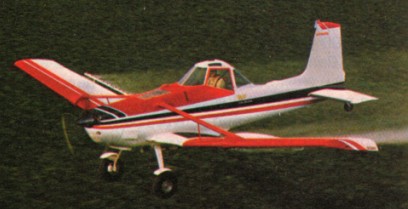
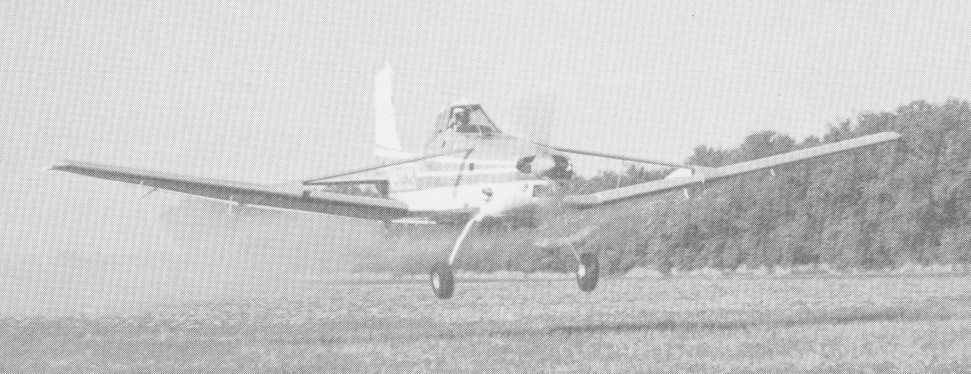
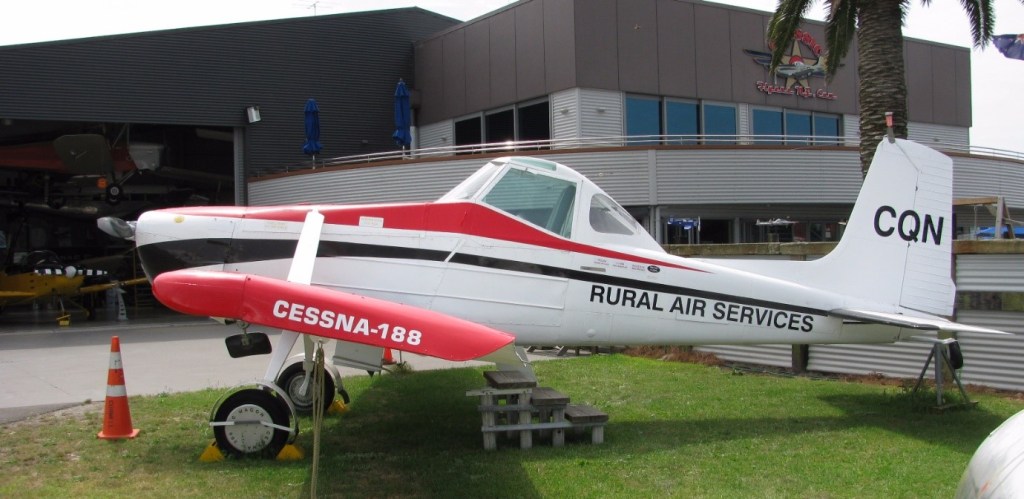
First flown on 19 February 1965, the Agwagon was Cessna’s first production low-wing single. Utilising as many model 180 parts as possible, the Agwagon was sensibly priced and proved a good seller.
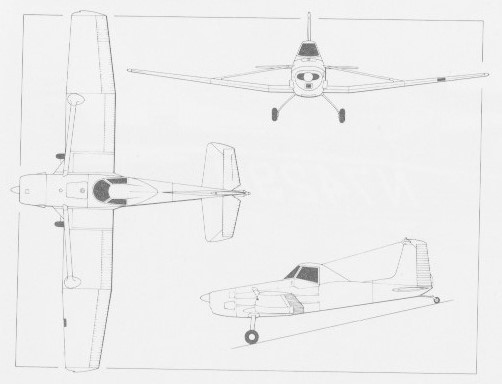
The Cessna Model 188 AGwagon (later renamed AG Wagon) is a braced low-wing monoplane of all-metal construction, with non-retractable tailwheel landing gear, and accommodation for the pilot in an enclosed cabin protected by a steel overturn structure.

AGwagon

Power was provided by either a 172kW Continental IO-470-R or a 224kW Continental IO-520-D engine for the AGwagon 230 or AGwagon 300 respectively. Standard agricultural equipment included a 757-litre or 816kg capacity glassfibre hopper between the engine firewall and the cabin, and optional dusting or spraying equipment was available.

An increasing market for the AGwagon resulted in the introduction of a new model of this aircraft in late 1971; plus two additional versions designated as the AGpickup and AGtruck. The AGpickup was the basic model, a new name applied to the Continental O-470-R version of the original AGwagon; the Continental IO-520-D AGwagon was renamed AGwagon C and introduced a number of detail refinements; and the AGtruck was generally similar to the AGwagon C, except for the provision of a 1060-litre hopper plus a complete spray system and a wide range of equipment as standard. Of these three types the AGpickup was discontinued in 1976, and production of the AGwagon ended during 1981, after 1,589 had been built.

The final production version, introduced in 1979, was the T188C AG-HUSKY was powered by a turbocharged 310 hp / 231kW TSIO-520-T engine. US conversions to 400 hp are known of. Three hundred and eighty-five Cessna T188C AgHuskys, variants of the popular Cessna Agwagon and AgTruck agricultural aircraft, were built until late in 1985 when production ended.
In total, 3976 CE-188 were built

A two seat conversion was performed on three Cessna Al88 Agwagons for Hazelton Air Services of Cudal, NSW. Aerosmith converted VH DOD (s/n AI 88 0125) at Sydney in 1967. Major work included widening the rear fuselage and installing a raised turtledeck. The cockpit sides are near vertical and a much larger windscreen fitted. The flying controls were shifted to the port side, but dual controls were not fitted. When a second aircraft was required, Aerosmith converted and certified another aircraft on 18 January 1971. The aircraft, VH KVA (s/n A188 0169), was registered as a Cessna A.188A/2 on 07 May 1971. A third aircraft (s/n A188 0066) was also converted and registered in February 1972. This aircraft was damaged beyond repair in January 1984 and first conversion, VH-DOD, was written off in 1986.

Aviones de Colombia Sa, originally a Cessna dealership (1961), then also assembled selected Cessna aircraft, produced a two-seat training derivative of the Cessna AgTruck, known as AgTrainer.

Gallery

CE-A188 AgPickup
Engine: Continental O-470-R, 230 hp
Length: 26 ft (8 m)
Wingspan: 41 ft 8 in (12.7 m)
Maximum speed: 121 mph (195 kph)
Range: 370 miles (595 km)
Service Ceiling: 11,000 ft (3,383 m)

CE-A188A Agtruck

AGwagon
Engines: Continental IO-520-D, 300 hp.
Seats: 1.
Wing loading: 16.3 lb/sq.ft.
Pwr loading: 13.3 lb/hp.
Max TO wt: 4000 lb.
Empty wt: 2189 lb.
Equipped useful load: 1759 lb.
Payload max fuel: 1447 lb.
Range max fuel 75% pwr: 253 nm / 2.6 hr.
Service ceiling: 11,100 ft.
Hopper cap: 200 USG.
75% cruise: 99 kt.
Working speed: 105 kt.
Working endurance: 3.1 hr.
Stall: 50-53 kt.
ROC: 690 fpm.
Min field length: 1265 ft.
Fuel cap: 312 lb.

CE-A188A Agwagon B

CE-A188B Agwagon C
Engine: Continental IO 520 D, 300 hp.
Cruise speed: 113 mph.
Std empty wt: 2,164 lbs.
Max wt Restricted Category: 4,000 lb.
Hopper cap: 200 USG.
Range 75% pwr: 295 sm.
Takeoff dist 50 ft obstacle: 1,090 ft.
Landing dist 50 ft obstacle: 1,265 ft.

CE-A188B AGtruck
First built: 1972.
Engine: 1 x Continental IO-520-D, 300 hp, 224kW.
TBO: 1200 hrs.
Prop: McCauley 2 blade, constant speed 86 in.
Seats: 1.
Length: 7.9 m / 25 ft 11 in
Height: 2.49 m / 8 ft 2 in
Wingspan: 12.7 m / 41 ft 8 in.
Wing area: 19.05 sq.m / 205.05 sq ft
Wing aspect ratio: 8.47.
Max ramp wt: 4200 lbs.
Max take off wt: 4200 lbs.
Standard empty wt: 1012 kg / 2231 lb
Max useful load: 1901 lbs.
Max landing wt: 3300 lbs.
Wing loading: 20.5 lbs/sq.ft.
Power loading: 14 lbs/hp.
Max useable fuel: 324 lbs.
Hopper capacity: 280 USG.
Climb rate: 465 fpm.
Service ceiling; 7,800 ft.
Max speed: 122 kts.
Working speed: 100 kts.
Cruise speed: 187 km/h / 116 mph
Fuel flow @ working speed: 82 pph.
Endurance @ working speed: 3.7 hr.
Stalling speed clean: 66 kts.
Stall speed flaps down: 56 kts.
Ceiling: 2375 m / 7800 ft
Range: 466 km / 290 miles
Turbulent air penetration speed: 98 kts.
Fixed tail-wheel undercarriage.

CE-T188C AGhusky
First built: 1978.
Engine: 1 x Continental TSIO-520-T, 310 hp.
Prop: McCauley 3 blade, constant speed 80 in.
Seats: 1.
Length: 26.69 ft.
Height: 8.2 ft.
Wingspan: 41.7 ft.
Wing area: 205 sq.ft.
Wing aspect ratio: 8.2.
Max ramp wt: 4400 lbs.
Max take off wt: 4400 lbs.
Standard empty wt: 2322 lbs.
Max useful load: 2078 lbs.
Max landing wt: 3300 lbs.
Wing loading: 21.5 lbs/sq.ft.
Power loading: 14.2 lbs/hp.
Max useable fuel: 324 lbs.
Hopper capacity: 280 USG.
Climb rate: 510 fpm.
Rate of climb @ 8000 ft: 255 fpm.
Certificated ceiling: 14,000 ft.
Max speed: 113 kts.
Working speed: 100 kts.
Fuel flow @ working speed: 93 pph.
Endurance @ working speed: 3.2 hr.
Stalling speed clean: 62 kts.
Stall speed flaps down: 58 kts.
Turbulent air penetration speed: 98 kts.
Fixed tail-wheel undercarriage.

AGwagon

Cessna CE-185 Skywagon / U-17  

CE-185

In July 1960 Cessna flew the prototype of the Model 185 Skywagon. This was in most respects similar to the Model 180 apart from the provision of extra power in the form of a 224kW / 260 hp injected version of the Continental IO-520 engine.

Cessna CE-185 Skywagon / U-17 Article

Normal gross weight for the 185 is 3,000 to 3,300 pounds, depending on the model.
The rear wall of the passenger cabin was placed further back and this change to the centre of gravity made the model 185 quite different to fly when compared to the 180, particularly for those used for topdressing. Exterior dimensions are the same as the 180, but internally the 185 has additional bracing, a stronger wing, and a dorsal fin. The two Model 185 versions were to carry under the fuselage a detachable glassfibre Cargo-Pack, capable of carrying some 136kg.
The 185 joined the Cessna utility fleet in 1961, and it was powered with the IO-470-F Continental of 260-hp through the 185E Model of 1966. But the 1966 185E also was offered with the Continental IO-520-D of 300-hp, and in 1967 dropped the 260-hp 185 altogether. A lot of detail changes/improvements have been made since – like raising the flap extension speed from 111 to 138 mph, bigger windows, and better cabin heating – but the 1976 185 is basically the same machine as the 1966 model. The advertised 300 hp is “take-off horsepower” the maximum continuous rating of this engine is 285 hp.
The 185 factory list in 1976 was US$35,5503.

During 1962 the USAF sought a suitable light utility aircraft for supply to countries eligible for MAP aid. Cessna’s Model 185 was selected and ordered under the designation U-17, more than 450 being supplied. These comprised the U-17A with a 194kW Continental IO-470-F flat-six engine, followed by the U-17B with a 224kW Continental IO-520-D. The final U-17C production version had a Continental O-470-L engine which had a carburettor instead of fuel injection.
In 1966 the Al85E was introduced featuring an optional 300 hp IO-520 Continental, and in 1967 the 260 hp option was dropped.

Cessna A185F Skywagon

In 1971 Cessna introduced the Model 185 AGcarryall. This was designed principally for an agricultural role, for spraying procedures, ferry people and equipment. It failed to attract sufficient sales and production ended in 1979 after 108 had been built.
By February 1980, 4,000 Model 185 variants had been delivered and when production ceased, in mid-1985 4,356 Skywagons had been built, including 497 U-17A/B/C military versions.

Twenty-five Skywagons were delivered to the South African Air Force.

Gallery

CE-185
Engine: Continental IO-470-F, 260 hp.

CE-185A
Engine: Continental IO-470-F, 260 hp.

CE-185B
Engine: Continental IO-470-F, 260 hp.

CE-185C
Engine: Continental IO-470-F, 260 hp
Max speed: 176 mph at SL
Cruise 75%: 168 mph at 6000 ft
ROC: 1000 fpm
Range: 700 mi
Max range: 1235 mi
Service ceiling: 17,300 ft
Empty weight: 1560 lb
Loaded weight: 3200 lb
Wingspan: 36 ft 0 in
Length: 26 ft 2 in
Height: 7 ft 9 in
Wing area: 174 sq.ft

CE-185D
Engine: Continental IO-470-F, 260 hp.

CE-185E
Engine: Continental IO-470-F, 260 hp. or Continental IO-520-D, 300 hp.

CE-A185F Skywagon
Engine: Continental IO-520-D, 300 hp.
TBO: 1700 hrs.
Prop: McCauley 3-blade, 80-in.
Seats: 6. Length: 25.6 ft.
Height: 7.8 ft.
Wingspan: 35.8 ft.
Wing area: 174 sq.ft.
Wing aspect ratio: 7.4.
Maximum ramp weight: 3362 lbs.
Maximum takeoff weight: 3350 lbs.
Standard empty weight: 1700 lbs.
Maximum useful load: 1662 lbs.
Maximum landing weight: 3350 lbs.
Wing loading: 19.3 lbs/sq.ft.
Power loading: 11.2 lbs/hp.
Maximum usable fuel: 504 lbs.
Best rate of climb: 1075 @ 90 kts.
Climb gradient: 738 ft/nm.
ROC @ 8000 ft: 640 fpm.
Service ceiling: 17,900 ft.
Maximum speed: 154 kts.
Normal cruise @ 65% pwr @ 8000 ft: 138 kts.
Fuel flow @ normal cruise: 82 pph.
Endurance at normal cruise: 5.9 hrs:
Stalling speed clean: 56 kts.
Stalling speed flaps down: 49 kts.
Turbulent-air penetration speed: 115 kts.
Fixed tail wheel under carriage.

Engine: Continental IO 520 D, 285 hp max continuous power.
TBO: 1,500 hrs.
Prop: three blade, constant speed.
Length: 25 ft. 7 in.
Height: 7 ft. 9 in.
Wingspan: 36 ft.
Wing area: 173.5 sq.ft.
Wing loading: 19.3 lb/sq.ft.
Power loading: 11.2 lb/hp.
Seats: 6.
Empty weight: 1,854 lbs.
Useful load: 1,496 lbs.
Payload with full fuel: 1,052 lbs.
Gross weight: 3,350 lbs.
Usable fuel capacity: 74 USG/444 lbs.
Maximum landing weight: 3,350 lbs.
Maximum rate of climb: 1,010 fpm.
Service ceiling: 17,150 ft.
Maximum speed: 155 kts.
Max cruise, 75% power (2,550 rpm) at 7,500 ft: 145 kts.
Econ cruise, 55 % power at 10.000 ft: 129 kts.
Duration at max cruise: 4.6 hrs.
Duration at econ cruise: 6.3 hrs.
Stalling speed, clean: 55 kts.
Stalling speed, full flaps: 48 kts.

1970
Engine: Continental IO-520-D, 300 hp.
Wing span: 35 ft 10 in. Length: 25 ft 9 in.
Height: 7 ft 9 in.
Empty wt: 1575 lbs.
Gross wt: 3350 lbs.
Useful load: 1776 lbs.
Wing loading: 19.3 lbs/sq.ft.
Pwr loading: 11.2 lbs/hp.
Baggage cap: 400 lbs.
Max speed: 155 kts / 178 mph.
Cruise: 147 kts / 169 mph.
Stall: 52 kts / 59 mph.
Initial ROC: 1010 fpm.
Service ceiling: 17,150 ft.
Range (65 USG): 660 sm.

1978 Cessna 185 Skywagon
Engine:Continental IO-520-D, 300 hp
TBO hrs.: 1700
Landing gear type:
Conv./FixedMax ramp weight (lbs.): 3350
Gross weight (lbs.): 3350
Max Landing weight (lbs.): 3350
Empty weight, std. (lbs.): 1750
Useful load, std. (lbs.): 1600
Usable fuel (USgals.): 88
Payload – full std. fuel(lbs.): 959
Wingspan: 35 ft. 10 in.
Overall length: 25 ft. 8 in.
Height: 7 ft. 9 in.
Seating capacity: 6
Max Speed (kts): 155
Cruise speed (kts): 145
Range (nm): 645
Vs (kts.): 49
Best rate of climb (fpm): 1075
Service ceiling (ft.): 17,900
Takeoff ground roll (ft.): 825
Takeoff over 50-ft. obstacle (ft.): 1430
Landing ground roll (ft.): 610
Landing over 50-ft. obstacle (ft.): 1400

1979 Cessna Skywagon 185
Engine: Continental IO 520 D, 300 hp.
Max speed: 155 kt.
Max cruise speed: 145 kt.
Max range: 836 nm.
Max unable fuel: 84 USG.
ROC: 1,010 fpm.
Service ceiling: 17,150 ft.
Takeoff dist 50 ft obstacle: 1,365 ft.
Landing dist 50 ft obstacle: 1400ft.
Max ramp wt: 3,362 lbs.
Max useful load: 1,681 lbs.
Seats: 6.

AGcarryall
Engine: Continental IO-520-D, 300 hp.
Seats: 2/6.
Wing loading: 19.3 lb/sq.ft.
Pwr loading: 11.2 lb/hp.
Max TO wt: 3350 lb.
Empty wt: 1905 lb.
Equipped useful load: 1393 lb.
Payload max fuel: 949 lb.
Range max fuel/ 75% pwr: 481 nm/ 4 hr.
Service ceiling: 13,400 ft.
Hopper cap: 151 USG.
75% cruise: 122 kt.
Stall: 49-57 kt.
ROC: 845 fpm.
Min field length: 1450 ft.
Fuel cap: 330/444 lb.

1967 Cessna 185 (Robinson STOL vortex generators)
Engine:Continental IO-520-D, 300 hp
Max continuous hp: 285
TBO hrs.: 1700
Fuel Type: 100/100LL
Propeller type: McCauley/CS
Landing Gear type: Tailwheel
Max ramp weight (lbs.): 3350
Gross weight (lbs.): 3350
Landing weight (lbs.): 3350
Usable fuel (USgals.): 76
Oil capacity (qts.): 12
Wingspan: 36 ft. 2 in.
Overall length: 25 ft. 9 in.
Height: 7 ft. 9 in.
Wing area (sq. ft.): 174
Wing loading (lbs./sq. ft.): 18.9
Power loading (lbs./hp.): 11
Wheel track: 7 ft. 8 in.
Wheel size (in.): 8.5 x 6
Seating capacity: 4
Cabin doors: 2
Cabin width (in.): 40.25
Cabin height (in.): 42.75
Baggage capacity (lbs.): 350
Cruise speed 75% power: 140kt
Cruise speed 65% power: 128 kt
Cruise speed 55% power: 122 kt
Max range (w/ reserve) 75% power: 600 nm
Max range (w/ reserve) 65% power: 640 nm
Max range (w/ reserve) 55% power: 710 nm
Fuel consumption (USgph) 75% power: 15.5
Fuel consumption (USgph) 65% power: 13.5
Fuel consumption (USgph) 55% power: 11.7
Estimated endurance (65% power with 1-hr. reserve) (hrs): 4.5
Stall speed (gear, flaps up) (knots): 44
Stall speed (gear, flaps down) (knots): 39
Best rate of climb (SL fpm): 1040
Service ceiling (ft.): 25,000
Takeoff ground roll (ft.): 487
Landing ground roll (ft.): 328

CE-185C

Cessna CE-182 Skylane

CE-182S

The evolution of the Skylane actually began at the 1949 Model 170A, an all-metal, 145 hp, four seat taildragger. Bigger flaps arrived in 1952 with the 170B, and one year later came that design’s first off-spring, the 180, with 225 hp. Tricycle gear was added in 1956; it was now called the 182. Introduced at the same time as the model 172, the more powerful and luxurious 182 was in the 1956 Cessna line-up. Essentially the 182, 182A and 182B produced between 1956 and 1959 was a tricycle-undercarriage version of the 180. As expected, sales of the 180 dropped off as those of the 182 picked up. An addition to the standard fixed-gear family, it was powered by a 172kW Continental O-470-S and available in Standard, Skylane and Skylane II versions.
The earliest models had straight tails and no rear windows. That first Skylane retained the basic hull of the 170 and the 172. They had relatively narrow fuselages and a gross weight of 2,650 pounds. The airplane was lowered when the landing gear was widened in 1957 and again in 1962. In 1958, the Skylane version was introduced a deluxe 182 with added soundproofing and extra standard equipment. The first airplanes held only 60 USG of fuel. But the capacity was increased to 65 USG in 1958, and in 1962, the optional 84 USG (79 usable) long range tanks were first offered. In that year, the airplane was given a new four inch wider fuselage, a rear window, electric flaps and a low, flat cockpit floor. Consequently, the gross weight was raised 150 pounds.
The 1960 and 1961 model 182C and 182D introduced the swept tail (1960) and third cabin window. The 1962 model 182 introduced the omnivision window arrange¬ment and elctric flaps. Apart from changes to the rear window shape, cowling, spinner, and spats, there have been few changes apart from cosmetic ones. Early 180s were equipped with a Conti¬nental O 470 A engine rated at 225 hp. There were a lot of maintenance problems, notably cracked cylinders. The engines were prone to overheating, as were the Goodyear brakes. After 1957, the engine was the 230¬hp K version, and after 1961, the R; both gave excellent service, until a Continental service bulletin called for tapping the valve guides to improve valve stem lubrication. This modification proved disastrous; guides wore out rapidly, valves bounced around, and several small bush operations went bankrupt trying to keep up with the top overhauls. Me-chanics started reverting to the original guides, and eventually, Continental decided to do so as well.

The 1962 m182E featured some fuselage re-design with 360 degree cabin visibility. The 182F and 182G were externally similar.

In 1964 the MTOW increased to 2800 lbs, and in 1970, to 2950 lbs.
On the other hand, Cessna has cleaned up the fuselage to the point that cruise airspeeds on the more modern 182s are slightly better than those of their lightweight predecessors. In 1967, the size of the long range tanks was reduced to 80 USG.
Tending to be a low maintenance machine, the 182 has been the target of only a few expensive airworthiness directives, one of which mandated the replacement of many nose gear forks in 1971.
For ’72 the Skylane gets a radiused leading edge of the type popularized by the Robertson STOL conversions a more rounded contour with a slightly convex lower lip, and a pronounced twist tailored along the span to provide a controlled stall progression and keep the outboard section at a lower angle of attack. Originally a Robertson rework that included drooping ailerons and a stall fence, it was later offered by other modifiers without the extra cost and complexity of the aileron/flap interconnection. The drooped, large radius leading edge does a lot for the 180 and 185’s slow flying characteristics, preserving aileron effectiveness right into the stall and possibly shaving a bit off the stalling speed though apparent stall speed reductions of 10 or 20 miles an hour are the result of errors in the airspeed indicating system. The all important decrease in runway requirements results from the greater precision with which minimum speed approaches can be flown.
Earlier Skylanes with the long popular spring steel slab gear legs had a maximum landing weight 150 pounds lower than allowable takeoff gross, but this year the ‘Lane gets a tapered tubular steel gear similar to that on the rest of the fixed-gear line (except the 180 and 185). This new gear has three important advantages – it is attached further back on the fuselage, and so widens the center of gravity envelope by 7½ %, it puts the main wheels nearly a foot further apart than they were on the old gear for an even more solid ground stance, and it permits landings at 2,950 lb.
In 1977, a new, higher compression version of the same engine was installed. It develops the 230 horse-power at 2,400 rpm, 200 rpm less than the earlier engines, and it is rated for 100LL fuel. It has a 1,500 hour TBO.
Introduced in 1978 the Skylane RG replaced the 177RG Cardinal RG in the model lineup. It was simply a model 182Q fitted with the same type of retractable gears as fitted to the R172 and 210 Centurion, and a 28v electric system. Nearly 2000 were produced. The 182 had a total production run of over 10,000 to 1993.
The only addition to the Cessna single engined line of general aviation aircraft for 1981 was the Turbo Skylane, a turbo supercharged version of the basic Model 182 Skylane. The 235 hp Lycoming engine already used to power the retractable undercarriage Turbo Skylane RG was offered in the standard fixed gear Skylane to boost the performance and payload. At the same time, Cessna has announced a 150 lb (68¬ kg) increase in the gross weight of the basic Skylane model, to match the weight of the Turbo Skylane version. A number of small improvements were also adopted as standard for both models, and a three bladed propeller is an optional alternative for the two blader on the Turbo Skylane. The CE182T involves a cleaned up airframe, give a four knot cruise over the 182S model, plus the Lycoming TIO-540-AK1A turboed engine of 235 hp at 2400 rpm as an option. A small number of the turbocharged 182s were built in 1981 and 1982. Versions available in 1982 included the Model 182 Skylane/Skylane II which was available also in Turbo Skylane and Turbo Skylane II with a 175kW Avco Lycoming O-540-L3C5D turbo-charged engine, and in Skylane RG and Skylane RG II and Turbo Skylane RG and Turbo Skylane RG II retractable landing gear equivalents.

Cessna TR182 Turbo Skylane RG II

All three of the 1979 Skylanes share usable fuel ca¬pacity up to 88 USG (from a previ¬ous 75). The new tanks are formed by sealing off part of the wing. There’s a forward facing fuel vent for each tank, located behind the wing strut in what should be an ice free area. The caps are also vented.
The conversion to tail wheel (CE-182TW) essentially makes the 182 into a 180.

In July 1996 Cessna flew the first Model 182 Skylane produced in more than 10 years.

Cessna’s diesel 182 JT-A, still in its certification process, was forced to make an emergency landing in a field due to an engine failure late August 2013. The pilot flying at the time reported that the “engine blew” necessitating an emergency landing in a field near the intersection of two roads outside Pretty Prairie, KS. The pilot was uninjured.

The 182 JT-A first flew in May 2013 and had flown over 200 hours during its certification process.

The CE-182 were also assembled by Reims Aviation in France.

Four CE-182 were delivered to the Royal Canadian Army, designated L-19L.

Gallery

1956 Cessna 182
Engine: Continental O-470L, 179 hp @5000ft
TBO: 1500 hr
Fuel Type: 100LL
Propeller type: CS
Landing Gear: Tri./Fixed
Max ramp weight: 2800 lb
Gross weight: 2800 lb
Empty weight, std: 1560 lb
Useful load, std: 1005 lb
Payload, full std. fuel: 645 lb
Fuel capactiy, std: 55 USgal
Wingspan: 36 ft. 2 in.
Overall length: 27 ft. 10 in.
Height: 9 ft.
Wing area:174 sq. ft
Seating capacity: 4
Cabin doors: 2
Cabin width: 45 in
Cabin height: 46 in
Baggage capacity: 120 lb
Cruise speed @ 5,000 ft 75% power: 160 mph
Cruise speed @ 5,000 ft 65% power: 151 mph
Cruise speed @ 5,000 ft 55% power: 141 mph
Max range (w/ reserve) @ 5,000 ft 75% power: 680 nm
Max range (w/ reserve) @ 5,000 ft 65% power: 750 nm
Max range (w/ reserve) @ 5,000 ft 55% power: 790 nm
Fuel consumption 75% power: 13.0 USgph
Fuel consumption 65% power:11.1 USgph
Fuel consumption 55% power: 10.0 USgph
Estimated endurance (65%) (hrs): 4.9
Vs: 62 mph
Vso: 59 mph
Best rate of climb: 1200 fpm
Service ceiling: 20,100 ft
Takeoff ground roll: 620 ft
Takeoff over 50-ft. obstacle:1020 ft
Landing ground roll: 610 ft
Landing over 50-ft. obstacle: 1290 ft

CE-182D
Engine: Continental, 230 hp.
Wing span: 35 ft 10 in.
Length: 28 ft 2 in.
Height: 9 ft 1.5 in.
Empty wt: 1645 lbs.
Gross wt: 2950 lbs.
Useful load: 1305 lbs.
Wing loading: 16.9 lbs/sq.ft.
Pwr loading: 12.8 lbs/hp.
Baggage cap: 200 lbs.
Max speed: 146 kts / 168 mph.
Cruise: 139 kts / 160 mph.
Stall: 50 kts / 57 mph.
Initial ROC: 890 fpm.
Service ceiling: 17,700 ft.
Range (49 USG): 690 sm.

Engine: Continental 0-470-R, 230 hp.
Wing Span: 35 ft 10 in / 10.92 m
Length: 28 ft 2in / 8.59 m
Height: 9 ft 1.5 in.
Gross weight: 2950 lb / 1338 kg
Empty weight: 1595 lb / 723 kg
Wing Load: 16.9 lbs/sq. ft.
Power Load: 12.8 lbs/hp.
Top Speed: 168 mph.
Cruise Speed, 75%: 157 mph / 136 kt / 253 kph at 6500 ft / 1980 m
Range, max, (aux fuel): 1,160 st. miles / 1007 nm / 1864 km at 97 kt / 112 mph / 180 kph
Rate of Climb: 890 fpm / 271 m/min
Service Ceiling: 17,700 ft / 5395 m
Takeoff roll: 705 ft.
Takeoff Over 50 ft: 1,350 ft.
Landing Roll: 590 ft.
Landing Over 50 ft: 1,350 ft.
Stall Speed: 57 mph
Seats: 4

1979 Skylane
Engine: Continental O 470 U, 230 hp.
TBO: 1,500 hrs.
Prop: two blade, constant speed.
Length: 28 ft.
Height: 9 ft. 3 in.
Wingspan: 36 ft.
Wing area: 174 sq.ft.
Max ramp weight: 2,960 lbs.
Max takeoff weight: 2,950 lbs.
Standard empty weight: 1,700 lbs.
Max useful load: 1,260 lbs.
Empty weight: 1,838 lbs.
Useful load: 1,122 lbs.
Max landing weight: 2,950 lbs.
Wing loading: 16.9 lb/sq.ft.
Power loading: 12.8 lb/hp.
Max usable fuel: 88 USG/528 lbs.
Max rate of climb, sea level: 1,010 fpm.
Max rate of climb, 8,000 ft: 565 fpm.
Service ceiling: 16,500 ft.
Max speed: 148 kts.
Max cruise speed: 144 kt.
Max range: 1,095 nm.
Cruise, 65 % power at 8,000 ft: 135 kts.
Fuel flow at 65% power: 11.1 USG/hr.
Endurance at 65% pwr, 45 min. res: 7.8 hrs.
Stalling speed, clean: 56 kts.
Stalling speed, flaps down: 50 kts.
Turbulent air penetration speed: 111 kts.
Takeoff dist 50 ft obstacle: 1350 ft.
Landing Dist 50 ft obstacle: 1,350 ft.
Seats: 4.

Skylane II
Engine: Continental O 470 U, 230 hp.
TBO: 1,500 hrs.
Prop: Constant speed, two blade, 82 in. dia.
Length: 28 ft. 1.5 in.
Height: 9 ft. 1.75 in.
Wingspan: 36 ft.
Wing area: 174.55 sq. ft.
Wing loading: 16.9 lbs./sq. ft.
Seats: 4.
Empty wt: 1,837 lbs.
Useful load: 1,113 lbs.
Gross weight: 2,950 lbs.
Power loading: 12.8 lb/hp.
Fuel cap: 75 USG/450 hp.
Minimum runway requirement: 1,350 ft.
Rate of climb: 1,010 fpm.
Service ceiling: 16,500 ft.
Maximum speed: 148 knots.
Maximum cruise, 75% power at 8,000 ft: 144 knots.
Economy cruise, 59% power at 8,000 ft: 129 knots.
Range at max cruise (45 min res): 735 nm.
Range at economy cruise (45 min res): 830 nm.
Duration at max cruise (45 min res): 5.22 hrs.
Stalling speed, full flaps: 52 knots.

CE-182G
Engine: 230 hp Continental O-307-R
Wingspan: 36 ft 2 in
Length: 27 ft 4 in
Height: 9 ft 0 in
Wing area: 174 sq.ft
Empty weight: 1545 lb
Loaded weight: 2800 lb
Max speed: 167 mph
Cruise 75%: 159 mph
ROC: 980 fpm
Max range: 1190 mi

1965 Cessna 182H Skylane
Engine: Continental O-470R, 230 hp
TBO: 1500 hr
Propeller: Const. spd.
Landing gear: Tri/Fixed
Gross weight: 2800 lb
Empty weight, std: 1560 lb
Useful load, std: 1240lb
Fuel: 79 USgal
Wingspan: 36 ft. 2 in.
Overall length: 27 ft. 10 in.
Height: 9 ft.
Wing area: 174 sq. ft
Seating capacity: 4
Cabin width: 45 in
Cabin height: 46 in
Baggage capacity:120 lb
Cruise speed 75% power: 140 kt
Cruise speed 65% power: 133 kt
Max range (w/ reserve) 75% power: 655 nm
Max range (w/ reserve) 65% power: 735 nm
Fuel consumption 75% power: 13.9 USgph
Fuel consumption 65% power: 12.1 USgph
Estimated endurance (65% power with 1-hr. reserve): 5 hr 12 min
Stall speed (gear, flaps down): 48 knot
Best rate of climb: 980 fpm
Service ceiling: 18,900 ft
Takeoff ground roll: 625 ft
Landing ground roll: 590 ft
No built: 840.

1997 Cessna 182 Skylane
Engine: Lycoming IO-540-AB1A5, 230 hp
TBO: 2000 hr
Propeller: Const. spd.
Landing gear: Tri/Fixed
Gross weight: 3100 lb
Empty weight, std: 1881 lb
Useful load, std: 1219 lb
Fuel: 88 USgals
Wingspan: 36 ft.
Overall length: 28 ft.
Height: 9 ft. 3 in.
Wing area:175.5 sq. ft
Seating capacity: 4
Cabin width: 42 in
Cabin height: 48 in
Baggage capacity:200 lb
Cruise speed 75% power: 140 kt
Cruise speed 65% power: 135 kt
Max range (w/ reserve) 75% power: 813 nm
Max range (w/ reserve) 65% power: 870 nm
Fuel consumption 75% power: 13.5 USgph
Fuel consumption 65% power:12.2 USgph
Estimated endurance (65% power with 1-hr. reserve): 6 hrs. 12 mins.
Stall speed (gear, flaps down): 46 knot
Best rate of climb: 924 fpm
Service ceiling: 18,100 ft
Takeoff ground roll: 795 ft
Landing ground roll: 540 ft

CE-182P

CE-182Q
Engine: 1 x Continental O-470-U, 230 hp.
TBO: 1500 hrs.
Prop: McCauley 2 blade, constant speed, 82 in.
Seats: 4.
Length: 28 ft.
Height: 9.3 ft.
Wingspan: 35.8 ft.
Wing area: 174 sq.ft.
Wing aspect ratio: 7.4.
Max ramp wt: 3110 lbs.
Max take off wt: 3100 lbs.
Standard empty wt: 1730 lbs.
Max useful load: 1380 lbs.
Max landing wt: 2950 lbs.
Wing loading: 17.8 lbs/sq.ft.
Power loading: 13.5 lbs/hp.
Max useable fuel: 528 lbs.
Climb rate: 865 fpm @ 81 kts.
Climb gradient: 640 ft/nm.
Rate of climb @ 8000 ft: 455 fpm.
Service ceiling; 14,900 ft.
Max speed: 146 kts.
Cruise @ 65% power @ 8,000ft: 133 kts.
Fuel flow @ 65% power @ 8,000ft: 67 pph.
Endurance @ 65% power @ 8,000ft: 7.6 hr.
Stalling speed clean: 54 kts.
Stall speed flaps down: 49 kts.
Turbulent air penetration speed: 109 kts.
Fixed undercarriage.

CE-182RG
Engine: Lycoming O 540 J3C5D, 235 hp.
TBO: 2,000 hrs.
Prop: two blade, constant speed.
Length: 28 ft. 8 in.
Height: 8 ft. 11 in.
Wingspan: 36 ft.
Wing area: 174 sq.ft.
Max ramp weight: 3,112 lbs.
Max takeoff weight: 3,100 lbs.
Standard empty weight: 1,732 lbs.
Max useful load: 1,380 lbs.
Empty weight: 1,876 lbs.
Useful load: 1,236 lbs.
Max landing weight: 3,100 lbs.
Wing loading: 17.8 lb/sq.ft.
Power loading: 13.2 lb/hp.
Max usable fuel: 88 USG/528 lbs.
Max rate of climb, sea level: 1,140 fpm.
Max rate of climb, 8,000 ft: 555 fpm.
Service ceiling: 14,300 ft.
Max speed: 160 kts.
Max cruise speed: 156 kt.
Cruise, 65 % power at 8,000 ft: 148 kts.
Fuel flow at 65% power: 11.8 USG/hr.
Endurance at 65% pwr, 45 min. res: 6.6 hrs.
Stalling speed, clean: 54 kts.
Stalling speed, flaps down: 50 kts.
Turbulent air penetration speed: 111 kts.
Max X-wind: 18 kts.
Takeoff dist 50 ft obstacle: 1,570 ft.
Landing dist 50 ft obstacle: 1,320 ft.
Seats: 4.

CE-182S
Engine: Lycoming IO-540-AB1A5, 230 hp.
Prop: McCauley 2 blade CS.
Empty wt: 1910 lbs.
Range: 825 nm.
Cruise 75% 8000 ft: 140 kt.
Cruise SL: 146 kt.
Service ceiling: 14,900 ft.
ROC: 865 ft.
TO dist: 805 ft.
Max ramp wt: 3110 lb.
Usable fuel: 88 USG.
Useful load: 1360 lb.

2000 Cessna 182S
Engine: Lycoming IO-540-AB1A5, 230 hp @SL
TBO: 2000 hr
Fuel Type: 100/100LL
Propeller type: McCauley CS three-blade/79 in.
Landing Gear: Tri./Fixed
Max ramp weight:3110 lb
Gross weight: 3100 lb
Landing weight: 2950lb
Empty weight, std: 1928 lb
Useful load, std: 1182 lb
Payload, full std. fuel: 654lb
Usable fuel: 88 USgal
Wingspan: 36 ft.
Overall length: 29 ft
Height: 9 ft. 4 in.
Wing area:174 sq. ft
Wing loading: 17.8 lbs./sq. ft
Power loading: 13.5 lbs./hp
Wheel track: 9 ft.
Wheel size: 6.00 x 6 in
Seating capacity: 4
Cabin doors: 2
Cabin width: 42 in
Cabin height: 48.5 in
Baggage capacity: 200 lb
Cruise speed 75% power @ 6,000 ft: 140 kt
Cruise speed 65% power @ 8,000 ft: 130 kt
Cruise speed 45% power @ 10,000 ft: 121 kt
Max range (w/ reserve) 75% power @ 6,000 ft: 820 nm
Max range (w/ reserve) 65% power @ 8,000 ft: 910 nm
Max range (w/ reserve) 45% power @ 10,000 ft: 968 nm
Fuel consumption 75% power @ 6,000 ft: 12.5 USgph
Fuel consumption 65% power @ 8,000 ft: 11.1 USgph
Fuel consumption 45% power @ 10,000 ft: 9.5 USgph
Estimated endurance (65%): 7.0 hr
Stall speed (gear, flaps up): 56 knot
Stall speed (gear, flaps down): 50 knot
Best rate of climb: 924 fpm
Best rate of climb (@8,000 ft): 565 fpm (est.)
Service ceiling: 18,100 ft
Takeoff ground roll: 795 ft
Takeoff over 50 ft. obstacle: 1514 ft
Landing ground roll: 590 ft
Landing over 50 ft. obstacle: 1350 ft

2004 Cessna 182T Skylane
Engine: Lycoming IO-540-AB145, 230 hp
Propeller: 3-blade CS/79 in
Landing gear type: Tri/Fixed
Max ramp weight: 3110 lb
Gross weight: 3110 lb
Max landing weight: 2950 lb
Empty weight, std: 1897 lb
Max useful load, std: 1213 lb
Payload, full std. fuel: 728 lb
Usable fuel, std: 88 USgal
Wingspan: 36 ft.
Overall length: 29 ft.
Height: 9 ft. 4 in.
Wing area (sq. ft.):174Wing loading (lbs./sq. ft.): 17.8
Power loading (lbs./hp.): 13.5
Wheel size, nose (in.):5.00 x 5
Wheel size, main (in.): 6.00 x 6
Seating capacity: 4
Cabin width (in.): 42 Cabin height (in.): 48.5
Baggage capacity (lbs.):200
Max speed, SL (kts.): 149
80% power @ 6,000 ft. (kts.): 145
Cruise: 80% @ 12,500 ft: 158 kts.
Max range (nm): 75% power @ 6,000 ft.: 968
55% power @ 10,000 ft.: 845
Vs (kts.): 54Vso (kts.): 49
Rate of climb (SL fpm): 924
Service ceiling (ft.): 18,100
Takeoff ground roll (ft.): 795
Takeoff over 50-ft. obstacle (ft.):1514
Landing ground roll (ft.): 590
Landing over 50-ft. obstacle (ft.): 1350
Source: Cessna Aircraft Corporation

CE-R182
First built in 1977.
Engine: 1 x Lycoming O-540-J3C5D, 235 hp.
TBO: 2000 hrs.
Prop: McCauley 2 blade, constant speed 82 in.
Seats: 4.
Length: 28.6 ft.
Height: 8.9 ft.
Wingspan: 35.8 ft.
Wing area: 174 sq.ft.
Wing aspect ratio: 7.4.
Max ramp wt: 3112 lbs.
Max take off wt: 3100 lbs.
Standard empty wt: 1757 lbs.
Max useful load: 1355 lbs.
Max landing wt: 3100 lbs.
Wing loading: 17.8 lbs/sq.ft.
Power loading: 13.2 lbs/hp.
Max useable fuel: 528 lbs.
Climb rate: 1140 fpm @ 88 kts.
Climb gradient: 784 ft/nm.
Rate of climb @ 8000 ft: 560 fpm.
Service ceiling: 18,000ft.
Max speed: 160 kts.
Cruise @ 65% power @ 8,000ft: 148 kts.
Fuel flow @ 65% power @ 8,000ft: 71 pph.
Endurance @ 65% power @ 8,000ft: 7.3 hr.
Stalling speed clean: 54 kts.
Stall speed gear/flaps down: 50 kts.
Turbulent air penetration speed: 112 kts.
Retractable nose wheel undercarriage.

Cessna T182T Skylane
Engine: Lycoming IO-540-AK1A, 235 hp @SL to 20,000 ft
TBO: 2000 hr
Fuel Type: 100/100LL
Propeller type: McCauley 3-blade CS
Landing Gear: Tri/Fixed
Max ramp weight: 3112 lb
Gross weight: 3100 lb
Landing weight: 2950 lb
Empty weight, std: 2048 lb
Useful load, std: 1052 lb
Payload, full std. fuel: 524 lb
Usable fuel, std: 88 USgal
Wingspan: 36 ft.
Overall length: 29 ft.
Height: 9 ft. 4 in.
Wing area: 174 sq. ft
Wing loading: 17.8 lbs./sq. ft
Power loading: 13.2 lbs./hp
Wheel base: 5 ft. 6 in.
Wheel track: 9 ft.
Wheel size: 6.00 x 6 in
Seating capacity: 4
Cabin doors: 2
Cabin width: 44 in
Cabin height: 48.5
Baggage capacity: 200 lb
Cruise speed 88% power @ 12,000 ft.: 160 kt
Max range (w/ reserve) 75% power @ 10,000 ft.: 700 nm
Estimated endurance (65%): 5.5 hr
Stall speed (gear, flaps up): 54 knot
Stall speed (gear, flaps down): 49 knot
Best rate of climb (SL): 1060 fpm
Best rate of climb, 10,000 ft: 1000 fpm
Service ceiling: 20,000 ft
Takeoff ground roll: 790 ft
Takeoff over 50 ft. obstacle: 1475 ft
Landing ground roll: 590 ft
Landing over 50 ft. obstacle: 1350 ft

CE-TR182
First built in 1978.
Engine: 1 x Lycoming O-540-L3C5D, 235 hp.
TBO: 2000 hrs.
Prop: McCauley 2 blade, constant speed 82 in.
Seats: 4.
Length: 28.6 ft.
Height: 8.9 ft.
Wingspan: 35.8 ft.
Wing area: 174 sq.ft.
Wing aspect ratio: 7.4.
Max ramp wt: 3112 lbs.
Max take off wt: 3100 lbs.
Standard empty wt: 1794 lbs.
Max useful load: 1318 lbs.
Max landing wt: 3100 lbs.
Wing loading: 17.8 lbs/sq.ft.
Power loading: 13.2 lbs/hp.
Max useable fuel: 528 lbs.
Climb rate SL: 1040 fpm @ 90 kts.
Climb gradient: 711 ft/nm.
Rate of climb @ 8000 ft: 930 fpm.
Certificated ceiling: 20,000 ft.
Max speed (20,000ft): 187 kts.
Cruise @ 65% power @ 8,000ft: 146 kts
Cruise @ 65% pwr @ 18,000 ft: 159 kts.
Fuel flow @ 65% power @ 18,000ft: 74 pph.
Endurance @ 65% power @ 18,000ft: 7 hr
Stalling speed clean: 54 kts.
Stall speed gear/flaps down: 50 kts.
Turbulent air penetration speed: 112 kts.
Undercarriage: Retractable nose wheel.
Max Range: 1030 nm
Take-off 50ft: 1570 ft
Landing 50 ft: 1320 ft

CE-TR182T
Engine: 1 x Lycoming O-540-L3C5D, 235 hp.
TBO: 2000 hrs.
Prop: McCauley 2 blade, constant apeed 82 in.
Seats: 4.
Length: 28.4 ft.
Height: 9.2 ft.
Wingspan: 35.8 ft.
Wing area: 174 sq.ft.
Wing aspect ratio: 7.4.
Undercarriage track, 9 ft 0 in (2,74 m)
Wing dihedral, 1 deg 44 sec constant
Max ramp wt: 3112 lbs.
Max take off wt: 3100 lb
Standard empty wt: 1740 lb
Max useful load: 1372 lbs.
Max landing wt: 2950 lbs.
Wing loading: 17.8 lbs/sq.ft.
Power loading: 13.2 lbs/hp.
Max useable fuel: 528 lbs.
Climb rate: 965 fpm @ 87 kts.
Climb gradient: 670 ft/nm.
Rate of climb @ 8000 ft: 850 fpm.
Certificated ceiling; 20,000 ft
Max speed: 168 kts at 20,000 ft (6 100 m)
Cruising speed at 20,000 ft (6 100 m) 75 per cent power: 158 kts (293 km/h)
Cruising speed at 10,000 ft (3050 m) 75 per cent power: 145 kts (269 km/h)
Cruise @ 65% power @ 8,000ft: 133 kts
Cruise @ 65% pwr @ 18,000ft: 145 kts
Fuel flow @ 65% power @ 18,000ft: 75 pph
Endurance @ 65% power @ 18,000ft: 6.8 hr
Range at 20,000 ft (6 100 m) at 75 per cent power: 745 nm (1380 km)
Max range at 10,000 ft (3 050 m): 920 nm (1704 km).
Stalling speed clean: 54 kts.
Stall speed flaps down: 49 kts.
Turbulent air penetration speed: 111 kts.
Take off distance to 50 ft (15,2 m): 1,475 ft (450 m)
Landing distance from 50 ft (15,2m): 1,350 ft (411 m).
Undercarriage: Fixed.
First built:1981.

2005 Cessna Turbo Skylane 182
Engine: Textron Lycoming TIO-540 AK1A, 235 hp @20,000 ft
TBO: 2000 hr
Fuel Type: 100/100LL
Propeller type: McCauley CS
Landing Gear type: Tri./Fixed
Max ramp weight: 3112 lb
Max landing weight: 2950 lb
Empty weight, std: 2017 lb
Max useful load: 1089 lb
Payload, full std. fuel: 567lb
Useful fuel, std: 87 USgals
Wingspan: 36 ft
Overall length: 29 ft
Height: 9 ft. 4 in.
Wing area: 174 sq. ft
Wing loading: 17.8 lbs./sq. ft
Power loading: 13.2 lbs./hp
Wheel size: 6.00 x 6 in
Seating capacity: 4
Cabin doors: 2
Cabin width: 42 to 44 in
Cabin height: 48.5 in
Cruise speed 88% power @ 12,500 ft: 158kt
Fuel consumption 88% power: 14.0 USgph
Vso: 49 kt
Best rate of climb (SL): 1040 fpm
Max operating altitude: 20,000 ft
Takeoff ground roll: 775 ft
Takeoff over 50-ft. obstacle: 1385 ft
Landing ground roll: 590 ft
Landing over 50-ft. obstacle: 1350 ft

2008 Cessna Turbo Skylane
Engine: Lycoming TIO-540-AK1A, 250 hp
TBO: 1700 hr
Fuel type: 100/100LL
Propeller: CS McCauley
Undercarriage; Fixed/Retractable
Max ramp weight (lbs.): 3112
Gross weight (lbs.): 3100
Landing weight (lbs.): 2950
Empty weight, std. (lbs.): 2082
Useful load, std. (lbs.): 1030
Payload, full std. fuel (lbs.): 508
Usable fuel, std. (gals.): 87
Wingspan (ft.): 36
Overall length (ft.): 29
Height: 9 ft. 4 in.
Wing area (sq. ft.): 174
Wing loading (lbs./sq. ft.): 17.8
Power loading (lbs./hp.): 13.2
Wheel size (in.): 6.00 x 6
Seating capacity: 4
Cabin doors: 2
Cabin width (in.): 42
Cabin height (in.): 48.5
Cruise speed, 88%, FL200: 176 kt
Cruise speed, 88%, 12,500 ft: 159 kt
Range@FL200 88% power: 763 nm
Range@FL200 45% power: 915 nm
Vso (kts.): 49
Best rate of climb, SL (fpm): 1040
Service ceiling (ft.): 20,000
Takeoff distance (ft.): 775
Takoff over 50 ft. obstacle (ft): 1385
Landing distance (ft.): 590
Landing over 50 ft. obstacle (ft): 1350

Cessna Turbo Skylane RG II
Engine: Lycoming 0-540L3C5D, 235 hp
TBO hrs: 2000
Fuel type: 100LL
Propeller: Constant speed / 82 in
Landing gear type: Tri./Retr.
Max ramp weight (lbs.): 3112
Gross weight (lbs.): 3100
Landing weight (lbs.): 3100
Empty weight, std. (lbs.): 1815
Useful load, std. (lbs.): 1297
Usable fuel, std. (USgals.): 88
Wingspan: 36 ft.
Overall length: 28 ft. 7.5 in.
Height: 8 ft. 11 in.
Wing area (sq. ft.): 174
Wing loading (lbs./sq. ft.): 17.8
Power loading (lbs./hp.): 13.2
Wheel base: 5 ft. 4 in.
Wheel track (ft.): 9
Wheel size, nose (in.): 5
Wheel size, mains (in.): 6
Seating capacity: 4
Cabin doors: 2
Cabin width (in.): 42
Cabin height (in.): 48.5
Baggage capacity, two areas (lbs.): 120/80
Cruise speed 75% power: 128 kt
Max range (w/ reserve) 75% power: 444 nm
Max range (w/ reserve) 65% power: 487 nm
Max range (w/ reserve) 55% power: 522 nm
Vs (kts.): 45
Best rate of climb, SL (fpm): 667
Service ceiling (ft.): 15,100
Takeoff distance (ft.): 1135
Takeoff over 50-ft. obstacle (ft.): 1608
Landing distance (ft.): 920
Landing over 50-ft. obstacle (ft.): 1400

Cessna 1979 182 Turbo Skylane RG
Engine: Lyc. O-540-L3C5D, 235 hp
TBO hr: 2000
Propeller: Const. spd.
Landing gear type: Tri/Retr.
Gross weight (lbs.): 3100
Empty weight, std. (lbs.): 1844
Useful load, std. (lbs.): 1256
Fuel (USgals.): 88
Wingspan: 35 ft. 10 in.
Overall length: 28 ft. 7.5 in.
Height: 8 ft. 11 in.
Wing area (sq. ft.): 174
Seating capacity: 4
Cabin width (in.): 42
Cabin height (in.): 48.5
Baggage capacity (lbs.): 200
Cruise speed 75% power: 173kt
Cruise speed 65% power: 162 kt
Max range (w/ reserve) 75% power: 825 nm
Max range (w/ reserve) 65% power: 905 nm
Fuel consumption 75% power: 14.2 USgph
Fuel consumption 65% power: 12.4 USgph
Estimated endurance (65% power with 1-hr. reserve): 6 hrs.
Stall speed (gear, flaps down) (knots): 50
Best rate of climb (fpm): 1040
Service ceiling (ft.): 20,000
Takeoff ground roll (ft.): 820
Landing ground roll (ft.): 600

Cessna 182 Texas Skyways O-550 Conversion
Engine: Continental O-550-F/TS, 285 hp
TBO hr: 2500
Fuel Type: 100LL
Propeller type: Hartzell/McCauley two- or three-blade
Landing Gear type: Tri/Fixed
Max ramp weight (lbs.): 2950/3100
Gross weight (lbs.): 2950/3100
Max landing weight (lbs.): 2950/3100
Empty weight, std. (lbs.): 1600
Usable fuel (USgals.): 74
Wingspan: 36 ft.
Overall length: 28 ft. 1.5 in.
Height: 9 ft. 2 in.
Wing area (sq. ft.): 174
Wing loading (lbs./sq. ft.): 16.9
Power loading (lbs./hp.): 10.6
Wheel track: 9 ft. 1 in.
Wheel size (in.): 6
Seating capacity: 4
Cabin doors: 2
Cabin width (in.): 42
Cabin height (in.): 48.5
Baggage capacity (lbs.): 120
Cruise speed @ 6,500 ft 75% power: 162 kts
Cruise speed @ 6,500 ft 65% power: 159 kts
Cruise speed @ 6,500 ft 55% power: 148 kts
Max range (w/ reserve)(88 USgal) 75% power: 850 nm
Max range (w/ reserve)(88 USgal) 65% power: 976 nm
Max range (w/ reserve)(88 USgal) 55% power: 1084 nm
Fuel consumption 75% power: 15 USgph
Fuel consumption 65% power: 13 USgph
Fuel consumption 55% power: 11 USgph
Estimated endurance (65%) (1-hr. reserve) (hrs): 5.7
Vs (kts.): 50
Vso (kts.): 45
Best rate of climb (fpm): 1600
Takeoff ground roll (ft.): 400
Landing ground roll (ft.): 600
Max level speed (knots): 170

2004 Cessna Skylane 182T
230 hp @SL
Gross weight (lbs.): 3110
Wing loading (lbs./sq. ft.): 17.8
Power loading (lbs./hp.): 13.5
Cruise speed, 80% power @ 6000 ft. (kts.): 145
Range, 75% power @ 6000 ft. (nm): 968
Fuel Capacity (USgals.) 88
Best rate of climb, SL (fpm): 924
Takeoff distance (ft.): 795
Landing distance (ft.): 590

Cessna 182 SMA Diesel Skylane
Engine: SMA SR305-230, 230 hp
TBO hrs: 2000
Fuel type: Jet A
Propeller: MT/CS
Landing gear type: Tri./Fixed
Gross weight (lbs.): 2950
Landing weight (lbs.): 2950
Empty weight, std. (lbs.): 1843
Useful load, std. (lbs.): 1007
Payload, full std. fuel (lbs.): 479
Useful fuel, std. (USgals.): 88
Wingspan: 35 ft. 10 in.
Overall length: 28 ft.
Height: 79 ft. 3 in.
Wing area (sq. ft.): 183.4
Wing loading (lbs./sq. ft.): 16.1
Power loading (lbs./hp.): 12.8
Wheel size (in.): 6.00 x 6
Seating capacity: 4
Cabin doors: 2
Cabin width (in.): 43
Cabin height (in.): 47
Max cruise speed SL: 129 kt
Max cruise speed @ 10,000 ft.: 138 kt
Max cruise speed @ 12,500 ft.: 140 kt
Fuel consumption 100%: 12.4 USgph
Fuel consumption 85% power: 8.9 USgph
Fuel consumption 65% power: 6.6 USgph
Vso (kts.): 45
Best rate of climb (SL fpm): 1000
Maximum operating altitude (ft.): 12,500
Takeoff ground roll (ft.): 780
Takeoff over 50-ft. obstacle (ft.): 1440
Landing ground roll (ft.): 590
Landing over 50-ft. obstacle (ft.): 1350

182 JT-A
Fuel: Diesel

CE-182
CE-182G

Cessna CE-180

CE-180H Skywagon

To counter competition from Beech’s Bonanza and North American’s Navion, work began, under the direction of project engineer Web Moore, on a higher performance aircraft based on the Cessna 170B.

Cessna took a Cessna 170 fuselage and installed a Conti¬nental six-cylinder engine 0-470, together with a Hartzell constant speed aluminium alloy propeller. In its original form, the 0-470-A, the engine developed 225 horsepower/168kW, and to compen¬sate for the extra torque on take-off the characteristic rounded tailfin (which had featured on all Cessnas since 1927) was replaced by a big bold square tail and larger and more powerful elevators were required. But by the time the prototype Cessna 180 (NX41697, c/n 604) had reached flying stage on 26 May 1952 (Piloted by Cessna’s chief pilot, Hank Waring), the type had gained a completely new fuselage.

The all metal wing section was of the classic ‘NACA 2412’ series the same wing and flap system as the Model 170B, and included slotted Fowler flaps and the chrome vanadium spring steel undercarriage legs also found in the Cessna 170 and Cessna 305 (Bird Dog). The tail wheel features a tubular steel spring with a steerable and full swiveling pneumatic tire and wheel. In those days the Fowler flaps were dubbed “Para Lift” flaps, by Cessna and were operated by a single lever (known as the Johnson bar). The flap lowering speed was initially 100 mph (87 knots), until 1964 when it was increased to 110 mph (95 knots). With the airspeed indicator now in knots, from 1976 onwards 10 degrees could be lowered at speeds up to 120 knots, with VFE for the 20- to 40-degree settings being 90 knots. The additional power available for the Model 180 permitted an increase in maximum take-off weight from 998 to 1157kg with the same wing area of 16.16sq.m.

Fuel was in gravity feed from wing tanks originally “cells” but “wet wings” eventually became the norm. The early models held 60 gallons, but between 1957 and 1964 the Cessna 180s were fitted with 65-gallon tanks and the 84-gallon tanks were a later option.

Certification of the type (#5A6) was achieved on 23 December 1952 and the first production machines rolled out in October 1952, customer deliveries began in February of 1953. Floats and skis were approved from the early days. All models of the Cessna 180 are approved for operation on floats. In 1955 the Edo Corporation introduced an amphibious model which could be installed on any 180. The Cessna 180 was the first aircraft of a four place type ever to be approved for use with retractable gear amphibious floats. In addition, a very wide variety of ski installations are also approved, including wheel replacement, wheel penetration and hydraulic retractable wheel skis. The “prototype” aircraft was scrapped in May 1954.

Cessna 180 ZK-WGT Serial No 30012         Courtesy G W Thompson

Production of the Cessna model 180 began in 1953 with the production prototype, N2800A. This model had no external baggage door and was powered by the Continental 0-470-A engine, which gave 225 hp at 2,600 rpm. In 1954 the outside baggage door was introduced and the powerplant was changed to the 0-470-J near the end of the production year, giving the same power output at 50 less rpm.
In 1955 the spring steel undercarriage was raked forward three inches to improve ground handling. A heavier windshield was fitted, as well as other sound proofing in the cabin. The fresh air inlets near the wing roots were moved further out along the wing leading edge-beyond the propeller slipstream in an effort to further reduce the interior noise levels.
In 1956 the Continental 0-470-K of 230 hp at 2,600 rpm came on stream with larger steel cast cylinder heads with thinner, and therefore more, cooling fins. Dynamic dampeners were fitted and revised engine mounts made for a smoother engine. A large single stainless steel muffler and exhaust pipe replaced the previous dual muffler system and accordingly the engine cowling was redesigned with the carburettor air scoop now at the bottom. The fuel vent to the main tanks was moved from above the left wing root to behind the left wing strut. This year also saw Cessna add a nosewheel to the 180 to create the model 182.
The Cessna 180A was released in 1957, which had an increase in its maximum take-off weight of 100 lbs and stronger undercarriage legs. Electric fuel gauges also appeared, replacing the manual variety, and the fuel capacity was upped to 65 gallons. In 1958 the exhaust was moved to the right-hand side to direct the outflow beneath the fuselage, instead of the previous tendency to stain along the left-hand side due to slipstream effects. A new ratchet mechanism was also added to prevent the trim wheel from creeping.
In 1959 the Model 180B was released. Changes included heavier door hinges and another revised instrument panel.

  1. Model 180C released. Mark ruled with Continental 0-470-L and incorporated a new cowl and nose cap. The wing fuel filler caps were made flush, and a redesigned bulkhead and fuselage top skin gave increased headroom in rear seat area.
Cessna 180C ZK-BXV

In 1961 the Model 180D was released. Bendix “shower of sparks” magnetos were fitted. New lever type of cowl flap control introduced. A “heavy-duty” version of the Cessna 180 with more power and a greater useful load was introduced as the Cessna 185.
In 1962 the Model 180E was released, fitted with a Continental 0-470-R engine and new wingtips. New fuel tank outlets were also added (to give two per tank) to improve fuel flow.
Released in 1963 the Model 180F had magnetos changed to the impulse model, new magnesium cast rudder pedals fitted and lighting controls for the instruments were introduced into an overhead panel. A 10-degree flap position was also introduced.
The 1964 Model 180G featured a third window added to the fuselage side, with scaling for six an option. Cessna 185 landing gear with a strengthened axle fitted. VNE was increased to 192 mph (from 184), and flap extension speed increased to 110 mph. MAUW increased by 150 lbs. Generator replaced with a 52-amp alternator.
The Model 180H was released in1965 featuring the Cessna 182 firewall, making the 180 and the 185 basic airframe identical. The panel was redesign with a central radio stack. In 1967 a more pointed propeller spinner was introduced and the rear baggage area extended. A 60-amp alternater fitted, and Cleveland brakes became standard, and in 1969, the Skywagon name used for the first time. 1970 introduced the conical camber wingtip, which reduced the wingspan by four inches.
In 1973 the Model 180J was released and the “Camber Lift’ wing appeared with its bonded loading edge (the same modified 2412 airfoil, further modified). The instrument panel was again revised and now incorporated rocker switches, and the two landing lights moved from the wings to the engine cowling. In 1974 a redesigned vertical fin attachment was fitted.
In 1975 the powerplant changed to the Continental O-470-S and a float plane kit included the Cessna vertical fin/fillet.
In 1976 the airspeed indicator was changed to knots, the flap extension speed was increased to 120 knots and McCauley main wheels and brakes were introduced.
In 1977 Model 180K was released. The high compression Continental 0-470-U was fitted, which gave 230 hp at 200 rpm less to satisfy the noise certification requirements. This engine was actually the IO-470-U with the fuel injection removed and run at only 2400 revolutions; run at 2,600 rpm the engine produces 250 hp. A vernier mixture control became standard, and stronger McCauley tailwheel on strengthened spring tube was also fitted. The fuel bladder tanks were replaced by “wet wing” tankage of 88 gallons in 1979.

CE-180K Skywagn II

In the late 1970s the Model 180 was available in two forms: the basic Model 180 Skywagon, and the improved Model 180 Skywagon II with a factory-installed avionics package.
In 1981, thirty-five aircraft were built in this, the 180’s final production year. By 10 September 1981, when the last Cessna 180 rolled off the production line, 7203 had been built. This last aircraft (53203) became VH-MQQ on 10 October 1981.
The empty weights have changed from 1953, 1480 lbs; 1555 lbs, 1957, and 1525 lbs in 1964. The gross weights from 1953: 2550 lbs, 1957: 2650 lbs and 1964: 2800 lbs. Service ceiling of 19,000 ft.

The first 180s, 1953 through 1956, had a factory list price of $12,950. This was up to $30,150 for the 1976 model.

Gallery

Production:

1953 180
Engine: Continental O-470-A, 225 hp at 2600rpm
Wingspan: 36 ft
Length: 26 ft 2 in
Height: 7 ft 6.6 in
Wing area: 175 sq.ft
Empty weight: 1460 lb
Loaded weight: 2550 lb
Max speed: 165 mph
Cruise: 150 mph
ROC: 1150 fpm
Service ceiling: 19,800 ft
Endurance: 4.5 hr
Fuel: 80/87
Compression: 7-1
No made: 639
SN 30,000 through 30,639

1954 180
Engine: Continental O-470-J, 225 hp at 2550rpm
Fuel: 80/87
Compression: 7-1
No made: 619
SN 30,640 through 31,259

1955 180
The engine was changed to O-470-J near the end of 1954 production run.
No made: 890
SN 31,260 through 32,150

1956 180
Engine: Continental O-470-K, 230hp @ 2600rpm
Fuel: 80/87
Compression: 7-1
No made: 519
SN 32,151 through 32,661

1957 180
Engine: Continental O-470-K, 230hp @ 2600rpm
Fuel: 80/87
Compression: 7-1
No made: 442
SN 32,662 through 32,999 and 50,000 through 50,105

1958 180A
Engine: Continental O-470-K, 230hp @ 2600rpm
Fuel: 80/87
Compression: 7-1
No made: 249
SN 50,106 through 50,355

1959 180B
Engine: Continental O-470-K, 230hp @ 2600rpm
Fuel: 80/87
Compression: 7-1
No made: 305
SN 50,356 through 50,661

1960 180C
Engine: Continental O-470-L, 230hp @ 2600rpm
Fuel: 80/87
Compression: 7-1
No made: 249
SN 50,662 through 50,911

1961 180D
Engine: Continental O-470-L, 230hp @ 2600rpm
Fuel: 80/87
Compression: 7-1
No made: 151
SN 50,912 through 51,063

1962 180E
Engine: Continental O-470-R, 230hp @ 2600rpm
Fuel: 80/87
Compression: 7-1
No made: 119
SN 51,064 through 51,183

1963 180F
Engine: Continental O-470-R, 230hp @ 2600rpm
Fuel: 80/87
Compression: 7-1
No made: 128
SN 51,184 through 51,312

1964 180G
Engine: Continental O-470-R, 230hp @ 2600rpm
Fuel: 80/87
Compression: 7-1
Wingspan: 36 ft 2 in
Length: 25 ft 6 in
Height: 7 ft 6.5 in
Wing area: 174 sq.ft
Empty weight: 1525 lb
Loaded weight: 2800 lb
Max speed: 170 mph at SL
Cruise 75%: 164 mph
ROC: 1090 fpm
Service ceiling: 19,600 ft
Max range: 1215 mi
No made: 132
SN 51,313 through 51,445

1965 180H
Engine: Continental O-470-R, 230hp @ 2600rpm
Fuel: 80/87
Compression: 7-1
No made: 161
SN 51,446 through 51,607

1966 180H
Engine: Continental O-470-R, 230hp @ 2600rpm
Fuel: 80/87
Compression: 7-1
No made: 166
SN 51,608 through 51,774

1967 180H
Engine: Continental O-470-R, 230hp @ 2600rpm
Fuel: 80/87
Compression: 7-1
No made: 100
SN 51,775 through 51,875

1968 180H
Engine: Continental O-470-R, 230hp @ 2600rpm
Fuel: 80/87
Compression: 7-1
No made: 117
SN 51,876 through 51,993

1969 180H
Engine: Continental O-470-R, 230hp @ 2600rpm
Fuel: 80/87
Compression: 7-1
No made: 109
SN 51,994 through 52,103

1970 180H
Engine: Continental O-470-R, 230hp @ 2600rpm
Fuel: 80/87
Compression: 7-1
No made: 71
SN 52,104 through 52,175

1971 180H
Engine: Continental O-470-R, 230hp @ 2600rpm
Fuel: 80/87
Compression: 7-1
No made: 45
SN 52,176 through 52,221

1972 180H
Engine: Continental O-470-R, 230hp @ 2600rpm
Fuel: 80/87
Compression: 7-1
No made: 62
SN 52,222 through 52,284

1973 180J
Engine: Continental O-470-S, 230hp @ 2600rpm
Fuel: 80/87
Compression: 7-1
No made: 99
SN 52,285 through 52,384

1974 180J
Engine: Continental O-470-S, 230hp @ 2600rpm
Fuel: 80/87
Compression: 7-1
No made: 115
SN 52,385 through 52,500

1975 180J
Engine: Continental O-470-S, 230hp @ 2600rpm
Fuel: 80/87
Compression: 7-1
No made: 119
SN 52,501 through 52,620

1976 180J
Engine: Continental O-470-S, 230hp @ 2600rpm
Fuel: 80/87
Compression: 7-1
No made: 149
SN 52,621 through 52,770

1977 180K
Engine: Continental O-470-U, 230hp @ 2400rpm
Fuel: 100 LL
Compression: 8.6-1
No made: 134
SN 52,771 through 52,905

1978 180K
Engine: Continental O-470-U, 230hp @ 2400rpm
Fuel: 100 LL
Compression: 8.6-1
No made: 94
SN 52,906 through 53,000

1979 180K
Engine: Continental O-470-U, 230hp @ 2400rpm
Fuel: 100 LL
Compression: 8.6-1
No made: 114
SN 53,001 through 53,115

1980 180K
Engine: Continental O-470-U, 230hp @ 2400rpm
Fuel: 100 LL
Compression: 8.6-1
No made: 51
SN 53,116 through 53,167

1981 180K
Engine: Continental O-470-U, 230hp @ 2400rpm
Fuel: 100 LL
Compression: 8.6-1
No made: 35
SN 53,168 through 53,203

Specifications:

CE-180
Engine: Continental O-470A, 225 hp.
MTOW: 2550 lb.

CE-180A
Engine: Continental O-470K, J or R, 225 hp.
Prop: Hartzell.
Wheel track: 7 ft 8 in.

CE-180A (1970)
Engine: 230 hp.
Wing span: 35 ft 10 in.
Length: 25 ft 9 in.
Height: 7 ft 9 in.
Empty wt: 1560 lbs.
Gross wt: 2800 lbs.
Useful load: 1240 lbs.
Wing loading: 16.1 lbs/sq.ft.
Pwr loading: 12.2 lbs/hp.
Baggage cap: 400 lbs.
Max speed: 149 kts / 170 mph.
Cruise: 141 kts / 162 mph.
Stall: 48 kts / 55 mph.
Initial ROC: 1090 fpm.
Service ceiling: 19,600 ft.
Range (65 USG): 695 sm.

CE-180H
Engine: Continental O-470R.

1977 CE-180 Skywagon
Engine: 1 x Continental O-470-U, 230 hp.
Seats: 4/6.
Wing loading: 16.1 lb/sq.ft.
Pwr loading: 12.2 lb/hp.
Gross wt: 2800 lb.
Empty wt: 1617 lb.
Equipped useful load: 1097 lb.
Payload max fuel: 647 lb.
Range max fuel/75% pwr: 724nm/5.1hr.
Range max fuel / 55% pwr: 893 nm/ 7.2 hr.
Service ceiling: 17,700 ft.
75% cruise: 141 kt.
55% cruise: 125 kt.
Stall: 44-50 kt.
1.3 Vso: 57 kt.
ROC: 1100 fpm.
Min field length: 1365 ft.
Fuel cap: 336/450 lb.

1979 Cessna Skywagon 180
Engine: Continental 0 470 U, 230 hp.
Max speed: 148 kt.
Max cruise speed: 142 kt.
Max range: 1,010 nm.
Max usable fuel: 84 USG.
ROC: 1,100 fpm.
Service ceiling: 17,700 ft.
Takeoff dist 50 ft obstacle: 1,205 ft.
Landing dist 50 ft obstacle: 1,365 ft.
Max ramp wt: 2,810 lbs.
Max useful load: 1,167 lbs.
Seats: 6.

Cessna 1976 180J Skywagon
Engine: Continental O-470S, 230 hp
TBO: 1500 hr
Propeller: Const. spd.
Landing gear type: Fixed/Conv.
Gross weight: 2800 lb
Empty weight, std: 1617 lb
Useful load, std: 1183 lb
Fuel: 75 USgal
Wingspan: 36 ft.
Overall length: 25 ft. 9 in.
Height: 7 ft. 9 in.
Wing area: 174 sq. ft
Seating capacity: 4-6
Cabin width: 41 in
Cabin height: 47 in
Baggage capacity: 350lb
Cruise speed 75% power: 141kt
Cruise speed 65% power: 138 kt
Max range (w/ reserve) 75% power: 670 nm
Max range (w/ reserve) 65% power: 730 nm
Fuel consumption 75% power: 13.9 USgph
Fuel consumption 65% power: 12.2 USgph
Estimated endurance (65% power with 1-hr. reserve): 4 hrs.
Stall speed (gear, flaps down): 48 knots
Best rate of climb: 1090 fpm
Service ceiling: 19,600 ft
Takeoff ground roll: 625 ft
Landing ground roll: 480 ft