Condor Aircraft Condor

Condor II

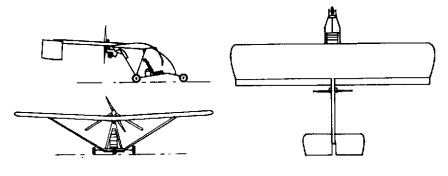
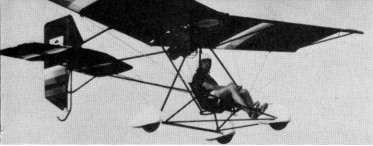
The Condor II is a single seat single engined high wing mono¬plane with conventional three axis control. Wing has unswept leading and trailing edges, and constant chord; cruciform tall. Pitch control by elevator on tail; yaw control by fully flying rudder; roll control by one third span spoilerons; control inputs through stick for pitch/roll and pedals for yaw. Wing braced from above by kingpost and cables, from below by cables; wing profile; single¬ surface. Undercarriage has three wheels in tricycle formation; torsion bar suspension on nosewheel. No ground steering. No brakes. Aluminium¬ tube framework, with optional pod. Engine mounted below wing driving pusher propeller.
All rigging wires are stainless steel with a vinyl coating and double swaging, and the aluminium tubing is ano¬dized clear and ‘covered with stabilised Dacron’.
Lift off and landing speeds are quoted as 20 24 mph (32 39 kph) and 20 25 mph (32¬40kph) respectively.
Options include floats, ballistically de¬ployed parachute, strobe, pod and electric start; normally, starting is by recoil, with an in flight restart facility. Price in 1982 of $5245.
Condor Aircraft describe the Condor III as a beefed up version of the Condor II, designed for heavier payloads, and accordingly the company quotes a much higher maximum take off weight for this side by side two seater with single centre stick.
The Condor III+2 is a two-seat version. Dual stick and rudder three-axis controls, dual throttle.

Condor II
Engine: Kawasaki TA440, 40 hp at 6000 rpm.
Prop¬eller diameter and pitch 56×36 inch, 1.42×0.91m.
Toothed belt reduction, ratio 2.0/1.
Max static thrust 238 lb, 108 kg.
Power per unit area 0.24hp/sq.ft, 2.6 hp/sq.m .
Fuel capacity 5.0 US gal, 4.2 Imp gal, 18.9 litre.
Length overall 10.0 ft, 3.05 m.
Height overall 9.7ft, 2.96m.
Wing span 32.0ft, 9.75m.
Constant chord 5.3 ft, 1.60 m.
Sweepback 0 deg.
Total wing area 168 sq.ft, 15.6sq.m.
Wing aspect ratio 6.3/1.
Empty weight 240 lb, 109kg.
Max take off weight 545 lb, 247kg.
Payload 305 lb, 138kg.
Max wing loading 3.24 lb/sq.ft, 15.7 kg/sq.m.
Max power loading 13.6 lb/hp, 6.2 kg/hp.
Load factors +5.0, 3.0 design.
Max level speed 55 mph, 88 kph.
Never exceed speed 60 mph, 97kph.
Max cruising speed 55mph, 88kph.
Economic cruising speed 42mph, 68kph.
Stalling speed 19 mph, 31 kph.
Max climb rate at sea level 775 ft/min, 3.9 m/s.
Best glide ratio with power off 7/1.
Take off distance 40 ft, 12 m. Landing distance 75 ft, 23 m.

Condor III
Engine: Kawasaki 440 A or B, 40 or 50 hp.
2:1 reduction drive to 56×36 prop.
Wing span 33.0ft, 10.06m.
Constant chord 5.1 ft, 1.55 m.
Total wing area 168 sq.ft, 15.6sq.m.
Wing aspect ratio 6.5/1.
Empty weight 252 lb, 114kg.
Max take off weight 657 lb, 298kg.
Payload 405 lb, 184kg.
Max wing loading 3.91 lb/sq.ft, 19.1kg/sq.m.
Max power loading 16.4 lb/hp, 7.5kg/hp.
Never exceed speed 65 mph, 105 kph.
Max cruising speed 51 mph, 82 kph.
Economic cruising speed 38 mph, 61 kph.
Stalling speed 24 mph, 39 kph.
Max climb rate at sea level 600ft/min, 3.0m/s.
Take off distance 60ft, 18m.
Landing dis¬tance 90 ft, 27 m.

Condor III+2
Wingspan 32’.
Wing area 168 sq.ft.
Length 10’.
Empty weight 286 lbs.
Gross weight 684 lbs.
Cruise speed 45 mph.
Stall speed 25 mph.
Vmax 55 mph.
Vne 75 mph.
Takeoff roll 90’.
Landing roll 90-120’.
Fuel capacity 5 USG.
Engine: Kawasaki 440
2:1 reduction drive to 56×36 wood prop.
50- or 75-hp version was available.

Condor Shoestring K-10

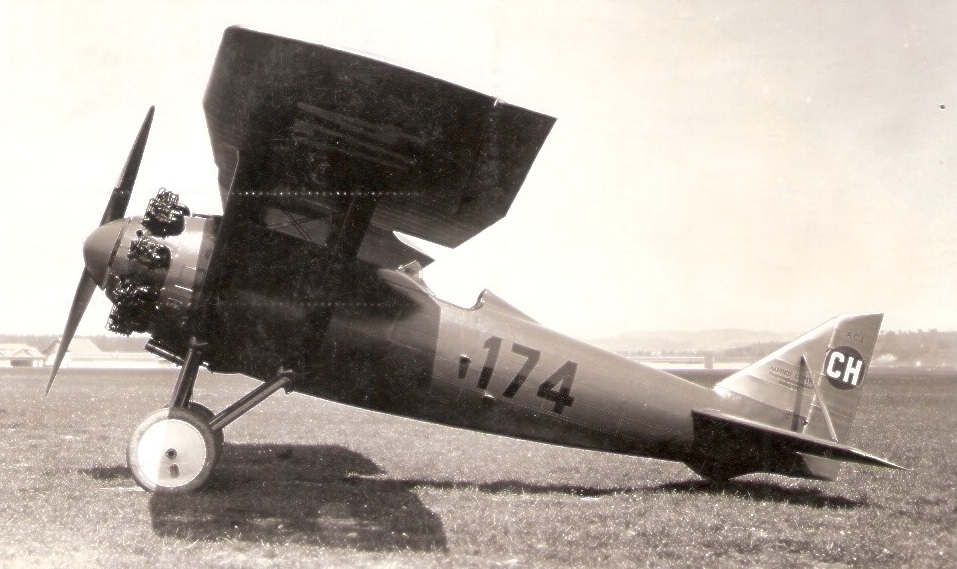
The original Shoestring was designed by Rod Kriemendahl and was built in Van Nuys, California, by Carl and Vince Ast, with help. Shoestring is a Formula One airplane. Its 19-foot wing has an aspect ratio of over five. All Formula One racers are required to have a minimum of 66 square feet of wing area, but Rivets and Shoestring stand alone with their tapered, longish wings. Apparently, the better overall efficiency of the higher aspect ratio wings is well worth the slight increase in drag because these two airplanes consistently bring home all the trophies.

The original drawings and engineering studies done by Kriemendahl in 1949 were lost or destroyed, a fact that worried John Anderson, one of the several past owners of the original Shoestring. Before Anderson sold the airplane to Ray Cote, he commissioned Ketner, a Piper engineering draftsman at Vero Beach, to go through the airplane with a tape measure and dividers and come up with a set of drawings he could use for repair work in case he ever dinged it. Ketner measured until he had enough dimensions to make up a complete set of working drawings. He had an engineering study run on the main spar and it was increased in thickness to bring it up to a 10-G strength. He has proof loaded the fuselage structure to 9 Gs with no deformation.

Constructed from the conventional combination of steel tubing, wood, and fabric, the racer is powered by a 100-hp O-200 Continental engine. By 1974, the Shoestring racer had accumulated 14 first places in major air race competitions. Other recommended engines are the Continental 85-and 90-hp versions.

The aircraft first flew in 1949 and entered its first competition race in 1950.

Yellow Jacket, the first reproduction of Shoestring, was built by Jim Strode of Melbourne, Florida. The plans for the airplane are produced by Landis Ketner and Jim was building parts as fast as Landis could make the drawings. Building Shoestring Yellow Jacket took just over a year.

Strode made four different cowlings before he got the shape and weight he wanted. This one weighs only 11 pounds. The cowling, wing fairings, landing gear fairings, and the canopy fit into their own little recesses, making everything flush. The wing is completely wooden construction, with plywood skins.

Gallery

Engine: 85-100 hp.
Span: 19’.
Wing area: 66 sq.ft.
Length: 17’8”.
Max wt: 800 lbs.
Empty wt: 565 lbs.
ROC: 3000 fpm.
Max speed: 225 mph.
Stall: 65 mph.
Cruise: 173 kts.
Fuel cap: 10 USG.
Takeoff run 500 ft.
Range 360 miles.
Seats: 1.

Comte A.C.12 Moskito

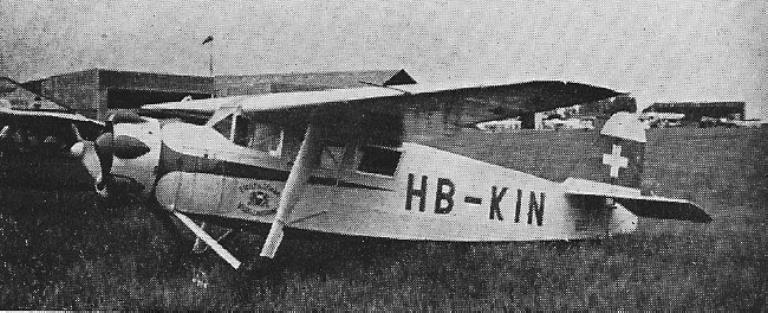
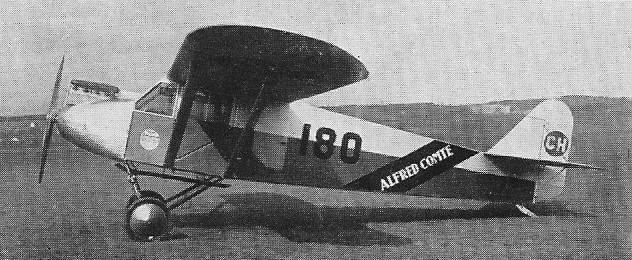
The A.C.12 Moskito cabin monoplane was first produced by Alfred Comte in 1931, and ten were built with the 95 hp Argus As 8, 120 hp de Havilland Gipsy III, or 100 hp Armstrong Siddeley Genet Major.

The Moskito provides accommodation for three. The wings are wooden, fuselage welded steel-tube, and tail assembly with plywood and fabric covering.

Engine: 95 hp Argus As 8
Wing span: 38 ft 2 in
Wing area: 171 sq.ft
Length: 24 ft 7 in
Height: 7 ft 5 in
Empty weight: 1100 lb
Loaded weight: 1980 lb
Max speed: 112 mph
Cruise: 96 mph
Time to 3280 ft: 6 min
Ceiling: 16,400 ft

Comte A.C.8

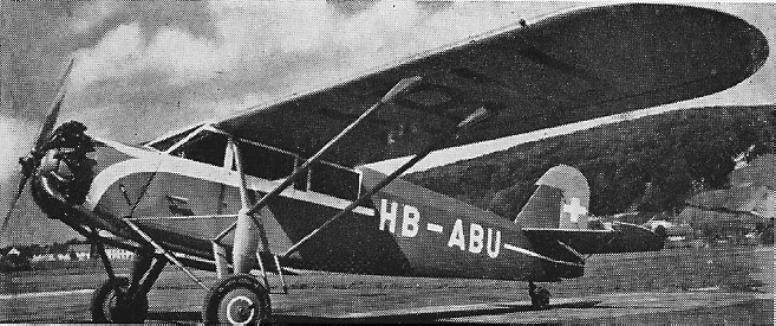
Produced in 1930 by Alfred Comte (Schweizerisch Flugzeugfabrik) of Zurich, the A.C.8 six-seat cabin monoplane is powered by a 300 hp Wright J-6 radial. Only three examples of the A.C.8 were built, of mixed construction, the wing being spruce and plywood and the fuselage a welded steel-tube structure. Dual controls were fitted and the cabin seats the pilot and five passengers.

Engine: 300 hp Wright J-6
Wing span: 47 ft 6 in
Wing area: 301.3 sq.ft
Length: 30 ft 2 in
Height: 9 ft 6 in
Empty weight: 3453 lb
Loaded weight: 3850 lb
Max speed: 133 mph
Cruise: 109 mph
Time to 3280ft: 4.8 min
Service ceiling: 16,400 ft
Range: 560 mi

Comte AC-4 Gentleman

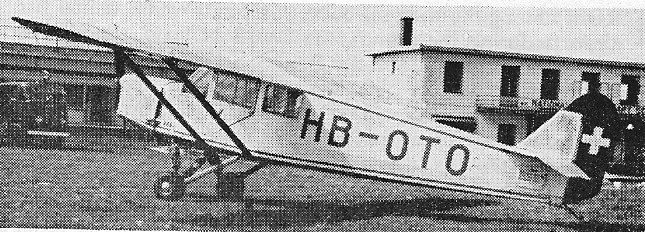
The three-seat AC4 Gentleman, designed by Alfred Comte, was the first aircraft that has been build commercially in Switzerland. The A.C.4 Gentleman is a two-seat cabin monoplane of mixed construction.

The prototype was being flown in 1928, and the AC-4 was in production 1928-1930.

Six of the first version, powered by 90 hp Cirus III engines were produced from 1928.

A second series was produced in 1930 powered by 110 hp Cirrus Hermes or 140 hp Genet Major engines.

One machine, owned by Swissair, was re-engined with an Armstrong-Siddeley Genet Major radial.

Engine: Cirrus Hermes III A.D.C., 138 hp
Wingspan: 40.354 ft / 12.3 m
Wing area: 215.28 sq.ft / 20.0 sq.m
Length: 26.575 ft / 8.1 m
Height: 9.186 ft / 2.8 m
Max take off weight: 1764.0 lb / 800.0 kg
Weight empty: 1102.5 lb / 500.0 kg
Max. weight carried: 661.5 lb / 300.0 kg
Max. speed: 92 kts / 170 km/h
Initial climb rate: 590.55 ft/min / 3.0 m/s
Service ceiling: 13123 ft / 4000 m
Wing load: 8.20 lb/sq.ft / 40.0 kg/sq.m
Range: 378 nm / 700 km
Endurance: 6 h
Crew: 2+1

Competition Aircraft Firebird Flyer

Single seat single engined high wing monoplane with hybrid control. Wing has unswept leading and trailing edges, and constant chord; inverted V tail. Pitch/yaw control by elevon; roll control by full span ailerons; control inputs through stick for pitch/yaw/ roll. Wing braced from below by struts; wing profile; double surface. Undercarriage has three wheels in tricycle formation; suspension on all wheels. Nosewheel steering independent from yaw control. No brakes. Aluminium tube framework, without pod. Engine mounted below wing driving pusher propeller.
In 1983 this machine was still in its prototype stage and therefore its characteristics and performances are not fully known. However, R J Davies has two original ideas in this new design. Firstly, the full span ailerons can be operated together to serve as flaps. Secondly, the motor on the Firebird Flyer (a Spitfire 250FA of 28hp or possibly later a water-cooled 220LC of 35 hp) drives a two bladed pusher propeller, which rotates about the axis of the tubular metal boom which carries the tail.