Curtiss 56 Thrush

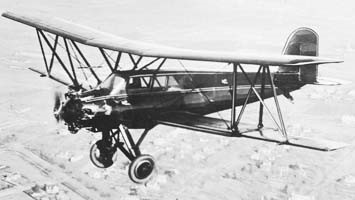
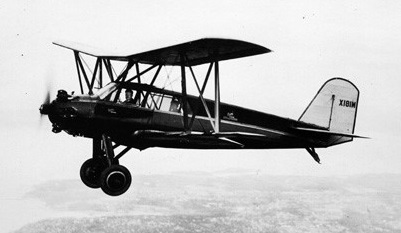
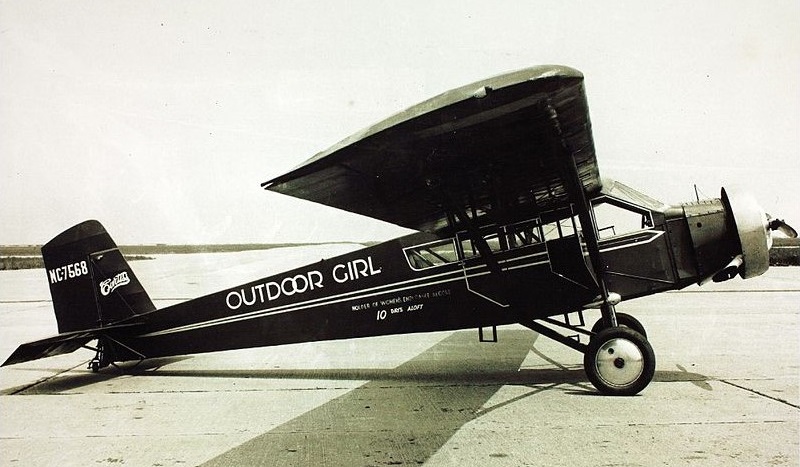
Curtiss Thrush J “Outdoor Girl”.

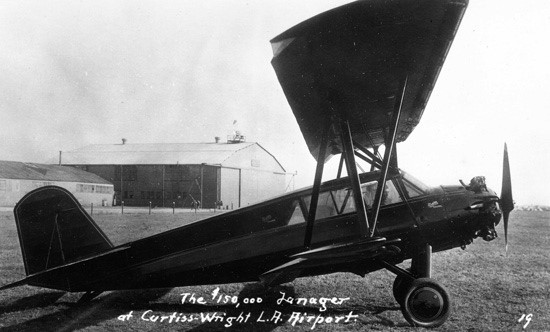
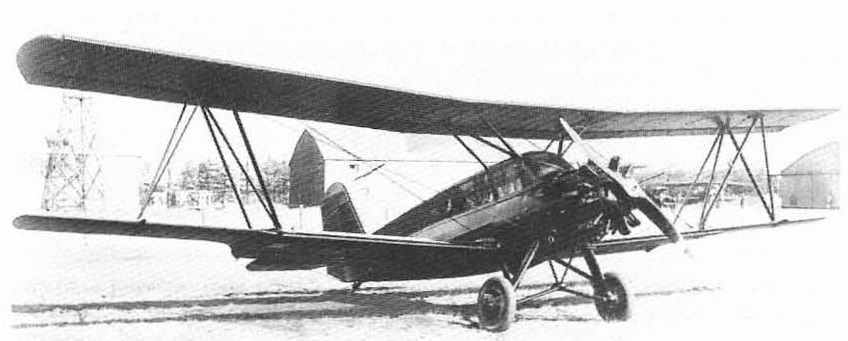
Designed by T.P. Wright, the Curtiss/Curtiss-Robertson Model 56 Thrush was a 1929 six passenger high-wing fixed undercarriage single-engine cabin monoplane airliner and utility transport powered by either a Curtiss Challenger or a Wright Whirlwind radial engine and built as an enlargement of the earlier Curtiss Robin.

The fuselage was built up as a Pratt truss frame formed mainly from Duraluminum tubing and fittings with welded Chrome-moly tubing reinforcing highly stressed areas and covered in fabric. The wing was a fabric covered semi-cantilever braced with steel tube struts, and had solid spruce spars and stamped Alclad ribs with Alclad sheet wrapped over leading edge. A fuel tank is mounted within each wing near the root. Rudder and elevators were welded chrome-moly steel tubing. 116″ track undercarriage is fitted with oleo-pneumatic shock absorbers and Bendix brakes, and is braced to the front struts and lower longerons.
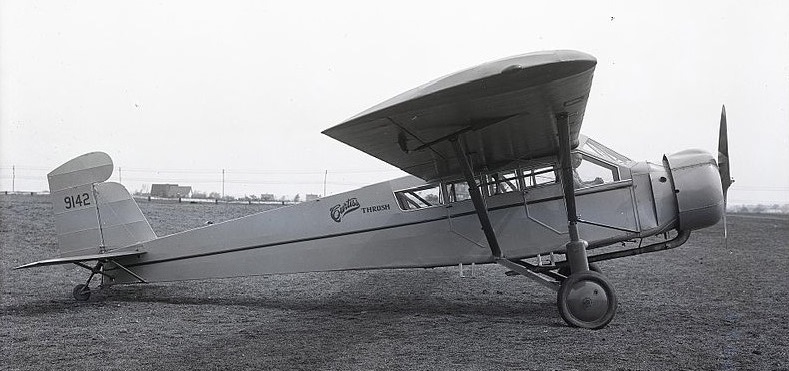
Prototype Thrush with Challenger engine in experimental cowling and prototype rudder shape

Three 170 hp (130 kW) Curtiss Challenger-engined Curtiss Thrush prototypes (serialled G-1 to G-3 ATC 159 & 160) were built at Curtiss’ Garden City factory, but these were underpowered and production examples, re-designated Thrush J (serialled 1001 to 1010) with 225 hp (168 kW) Wright Whirlwind engines, were built at the Curtiss-Robertson St Louis factory. All three prototypes were later re-engined with Whirlwinds to make them Thrush Js (ATC 236). The fuselage of the Thrush formed the basis for the twin-engine Curtiss Kingbird which was developed roughly in parallel.

Ten of the Thrush J (ATC 261) main production variant with 225 hp Wright J-6-7 Whirlwind were built.

12 examples were ordered by China National Aviation Corporation (CNAC) for $12,000 but only ten production examples were built. All but one was then registered in the US, as many aircraft exported to the CNAC were, however only one example made it to China, which it did in 1930, and it may not have entered CNAC service. One of the ten was lost on its first flight (serial 1006) and its registration was transferred to the next aircraft built. One of the prototypes went to Venezuela to a private individual, and a production example went to Cuba where it was the first aircraft operated by the Compañía Nacional Cubana de Aviación Curtiss (CNCAC), forerunner of Cubana de Aviación, Cuba’s national airline- one example registered NM-3..

From the 14th to the 22nd of August 1932, Louise Thaden & Frances Marsalis flew prototype Thrush J NC9142 “I.J. Fox” (named for their sponsor, a fur coat company and nicknamed the “Flying Boudoir” by the press) for 196 hours 5 minutes, refuelling in flight from a Curtiss Robin to set an endurance record near Valley Stream, New York. For this and other record-breaking flights, Thaden received the Harmon Trophy in 1936.
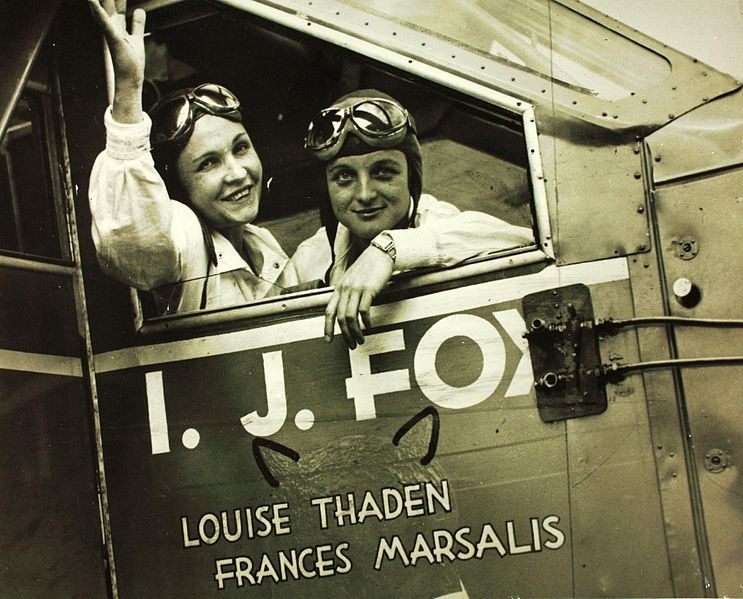
Louise Thaden and Frances Marsalis in the cockpit of Thrush, “I.J. Fox”, in which they broke the women’s endurance record for a flight of 196 hours 5 minutes in 1932.

Helen Richey and Frances Marsalis flew production Thrush J NC7568 “Outdoor Girl” (named for a brand of women’s cosmetics, a new sponsor) for 237 hours, 42 minutes (nearly ten days) from the 20th to the 30th of December 1933 over Miami, Florida. Like the first flight, it too was refuelled from the air from a Curtiss Robin.
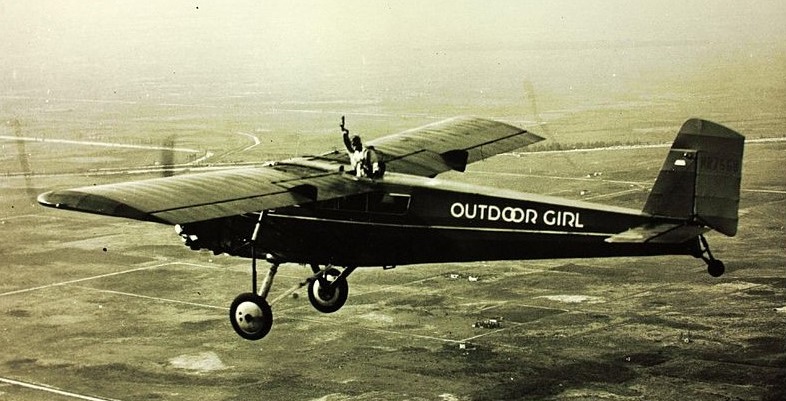
Thrush J “Outdoor Girl” setting a record of 237 hours 42 minutes aloft (nearly 10 days) in 1933

Jean LaRene and Mary Elizabeth Owens made five attempts at the world’s endurance record at the Curtiss-Reynolds Airport in August during the 1934 Chicago World’s Fair in Curtiss Thrush J NR581N “Lone Star” Jean LaRene made another attempt in NR581N on the record with Henrietta Sumner from 30 November 1934 over Oklahoma City but experienced engine problems and was forced down after 198 hours and 13 minutes aloft.

Two examples found their way to Alaska where they were used as bush planes, one by Ralph Savory before he joined Star Air Service, and a second was flown in Alaska by Gordon MacKenzie. The remainder were used in the United States by various operators as air taxis and feeder airliners.

The Thrush Special were one converted from a Thrush J with 240 hp Wright J-6-7 Whirlwind and a second converted with Wright J-5.

Thrush J – ATC 261
Engine: 1 × Wright J-6-7 (R-760), 225 hp (168 kW)
Propeller: 2-bladed Curtiss-Reed metal fixed pitch propeller
Length: 32 ft 7 in (9.93 m)
Wingspan: 48 ft 0 in (14.63 m)
Wing area: 305 sq ft (28.3 m2)
Airfoil: Curtiss C-72 Chord: 7 ft 0 in (2.13 m)
Height: 9 ft 3 in (2.82 m)
Empty weight: 2,260 lb (1,025 kg)
Gross weight: 3,800 lb (1,724 kg)
Fuel capacity: 110 gallons
Oil capacity: 9 gallons
Maximum speed: 122 mph (196 km/h; 106 kn)
Cruise speed: 104 mph (167 km/h; 90 kn)
Minimum control speed: 52 mph (84 km/h; 45 kn)
Range: 900 mi (782 nmi; 1,448 km)
Service ceiling: 13,200 ft (4,000 m)
Rate of climb: 650 ft/min (3.3 m/s) from sea level
Time to altitude: 10 minutes to 5300 feet
Wing loading: 12.46 lb/sq ft (60.8 kg/m2)
Fuel consumption: .76 lb/mi (0.21 kg/km)
Crew: one-two (dual controls)
Capacity: six passengers
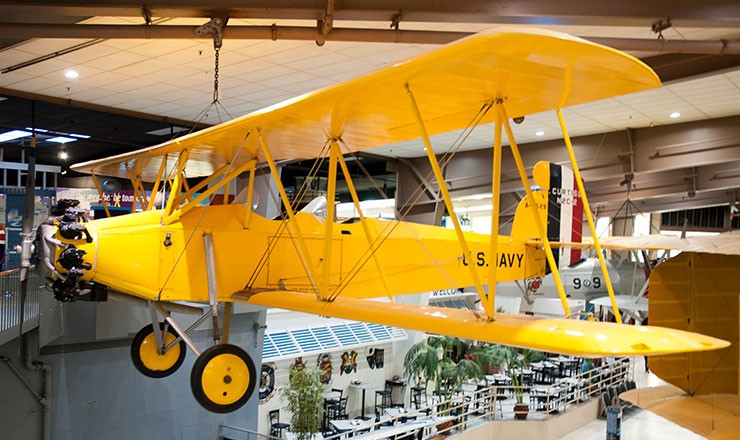
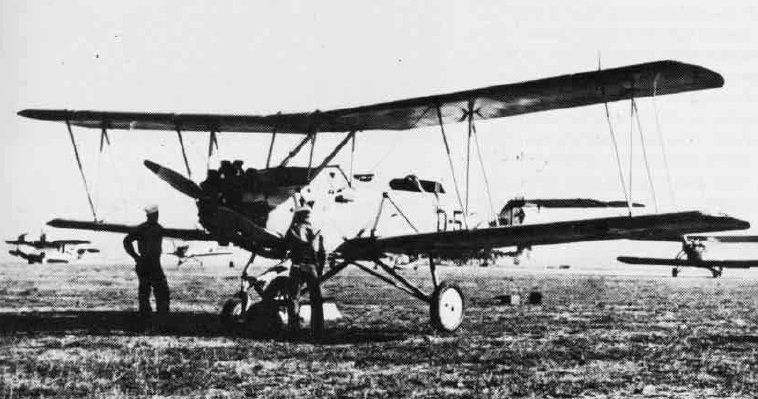
Curtiss Fledgling / Model 48 / Model 51 / N2C

A Curtiss N2C-2 at the National Museum of Naval Aviation

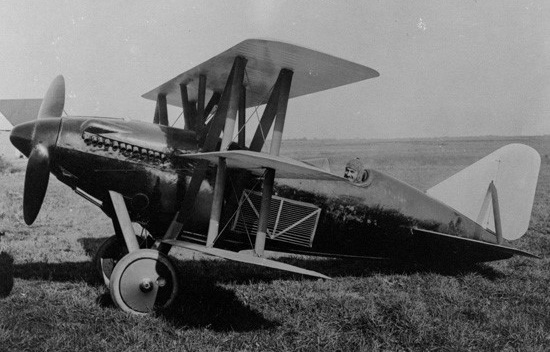
The Fledgling was designed by Theodore Paul Wright in response to a 1927 Navy requirement for a new primary trainer, and was selected after evaluation in competition with fourteen other submissions. The Fledgling was a conventional biplane design with two-bay, staggered wings of equal span braced with N-struts. The pilot and instructor sat in tandem, open cockpits, and the fixed tailskid undercarriage could be easily swapped for a large central pontoon and outrigger floats under the wings for seaplane training. The Navy ordered two batches of the Fledgling, each powered by different versions of the Wright Whirlwind engine, both of which were built under the Curtiss designation Model 48.

In 1928 Curtiss’ XN2C-1 Fledgling trainer was evaluated by the Navy and won the competition for a new primary trainer beating out 14 other competing designs. The original design was powered by the 165 horsepower Curtiss Challenger engine, but in ordering 31 of the aircraft, the Navy specified the 220 horsepower Wright Whirlwind engine in 30 of the aircraft, leaving one aircraft, the only one in naval service, to be powered by the unique Challenger engine that featured twin rows of six cylinders each.

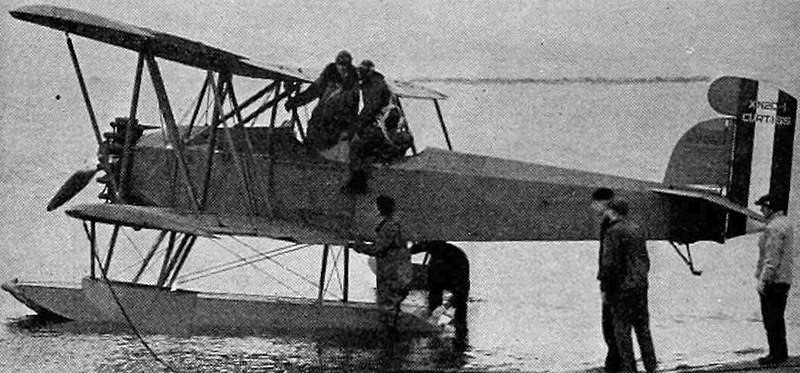
Curtiss XN2C-1 floatplane

In the United States Navy service they were known as the N2C. The Navy ordered 31 N2C-1s and 20 N2C-2 versions of the airplane. Though trainers, they were not assigned to Naval Air Station (NAS) Pensacola, but instead were operated by Naval Reserve units around the country. By the late 1930s, surviving N2Cs were modified with tricycle landing gear and turned into radio-controlled drones used as targets for anti-aircraft gunners. One drone was used to execute an attack on a target ship, a precursor of today’s anti-ship missiles.

Curtiss N2C-2 NAF drone 1938-39

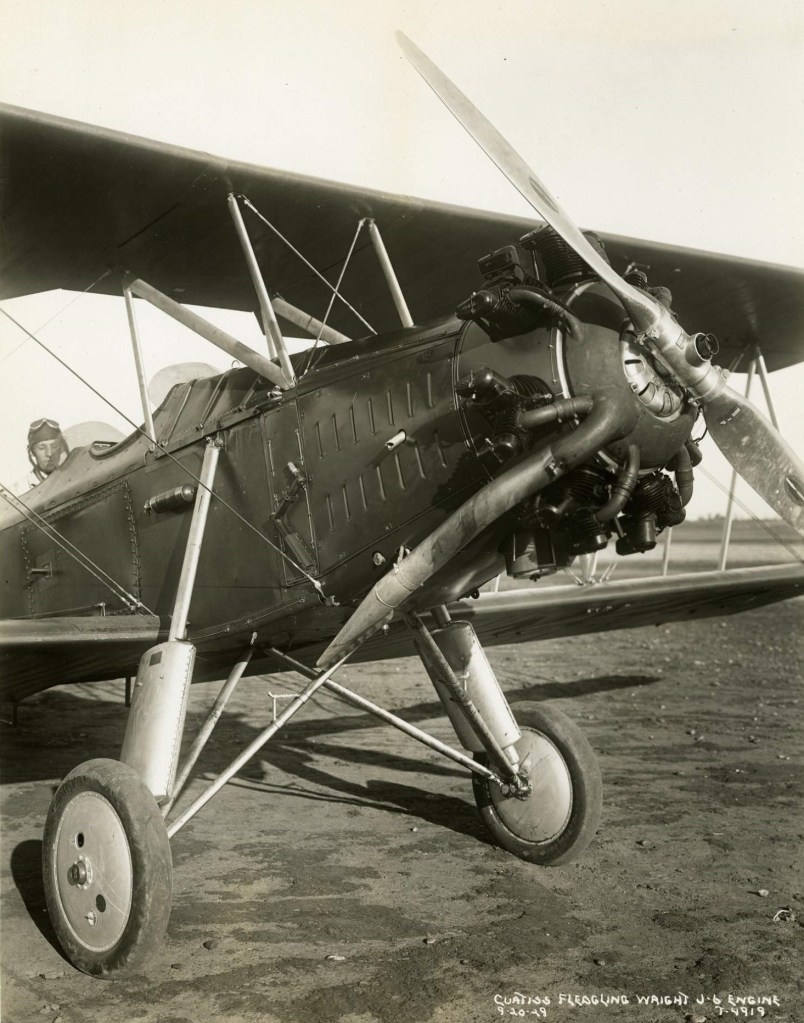
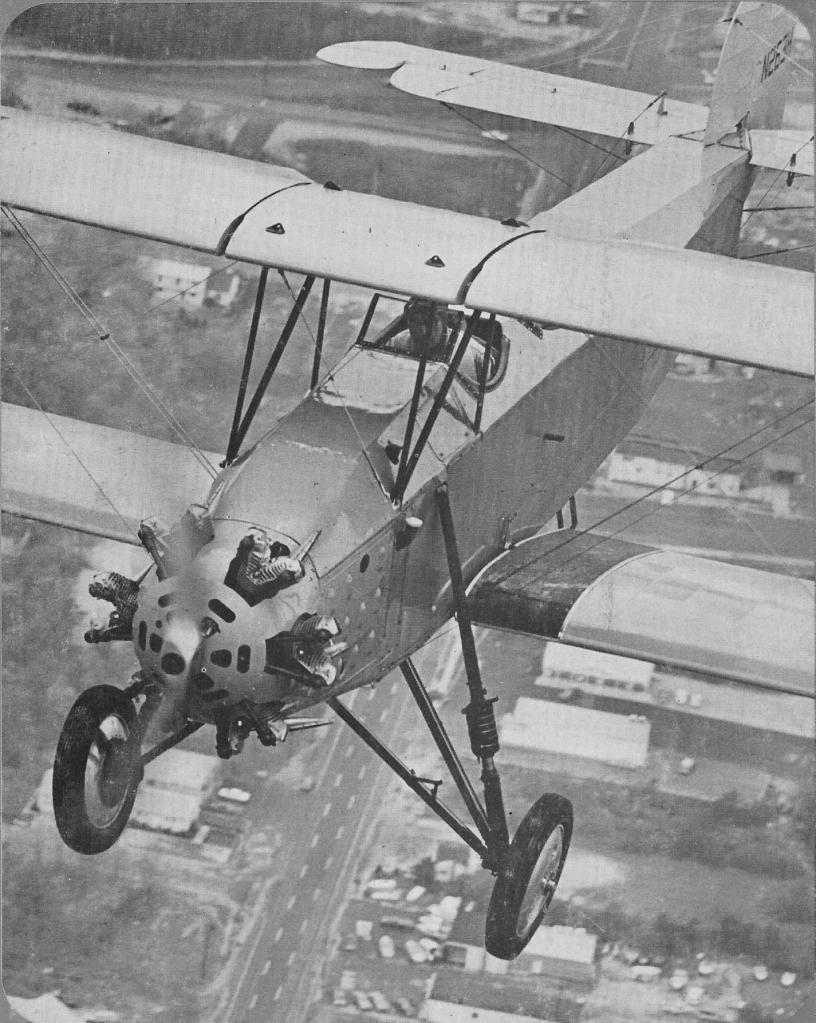
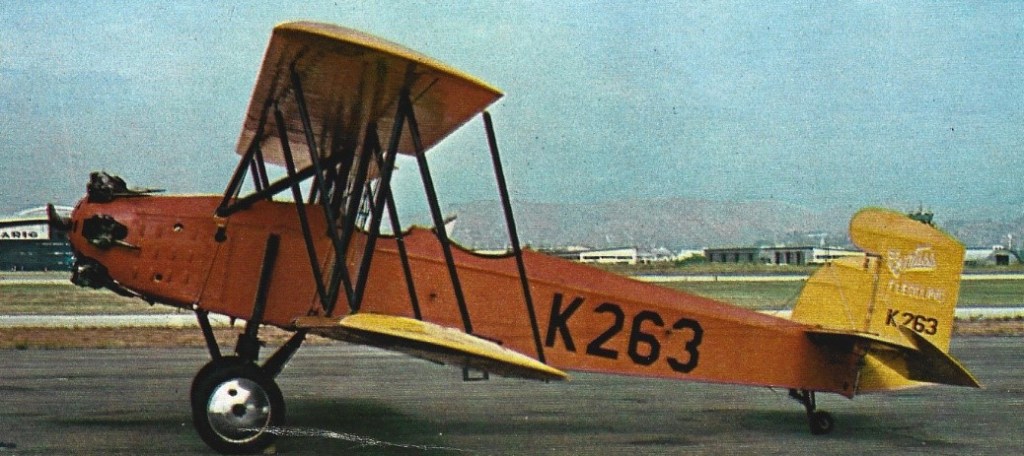
Believing the design to have commercial potential, Curtiss developed the Model 51 as a civil equivalent powered by the less powerful Curtiss Challenger engine. The company operated 109 of these aircraft in its own air taxi service, the Curtiss Flying Service during the 1930s. A number of these aircraft were experimentally fitted with the same Wright engines used in their military counterparts as the J-1 and J-2, but these were not produced in quantity.

Curtiss Fledgling J-2 (Model 51) Wright Whirlwind J-6 Series

Another experimental variant, the reduced-wingspan Fledgling Junior was produced to the extent of a single prototype only.

First flying in 1927, about 160 of all models were built.

A number of Model 51s were exported to foreign military services for evaluation: four to Canada and one to Czechoslovakia, but these did not lead to any purchases. Curtiss also delivered at least seven N2C-1 kits to Turkey in 1933, as part of an agreement to produce the Curtiss Hawk Model 35 under licence in Turkey. These N2C-1s were used as trainers and liaison aircraft by the Turkish Air Force until 1945. At least one N2C-1 is thought to have been given to Iran as a gift from the Turkish Air Force.

Brasil

Variants:

Model 48
XN2C-1
Navy prototypes (3 built)
N2C-1
Navy version powered by Wright J-5 Whirlwind (31 built)
N2C-2
Navy version powered by Wright J-6-7 Whirlwind (20 built)

Model 51
Fledgling
commercial version with Curtiss Challenger engine (109 built)
J-1
commercial version with Wright J-6-5 Whirlwind engine (four converted)
J-2
commercial version with Wright J-6-7 Whirlwind engine built to N2C-2 standard (two converted)

Fledgling Junior
reduced wingspan version (one built)

Fledgling Guardsman
convertible civil-military challenger powered versions.

A-3
designation assigned by the United States Army Air Corp USAAC for use of the Fledgling as a radio-controlled target aircraft

Gallery

N2C-1
Engine: 1 × Wright J-5, 220 hp (160 kW)
Propeller: 2-bladed fixed pitch propeller
Wingspan: 39 ft 2 in (11.93 m)
Wing area: 365 sq ft (33.9 sq.m)
Length: 27 ft 4 in (8.33 m)
Height: 10 ft 4 in (3.14 m)
Empty weight: 2,135 lb (968 kg)
Gross weight: 2,832 lb (1,285 kg)
Maximum speed: 108.7 mph (175 km/h; 94 kn)
Cruise speed: 87 mph (140 km/h; 76 kn)
Range: 366 mi (318 nmi; 589 km)
Service ceiling: 15,100 ft (4,600 m)
Rate of climb: 695 ft/min (3.53 m/s)
Crew: 2

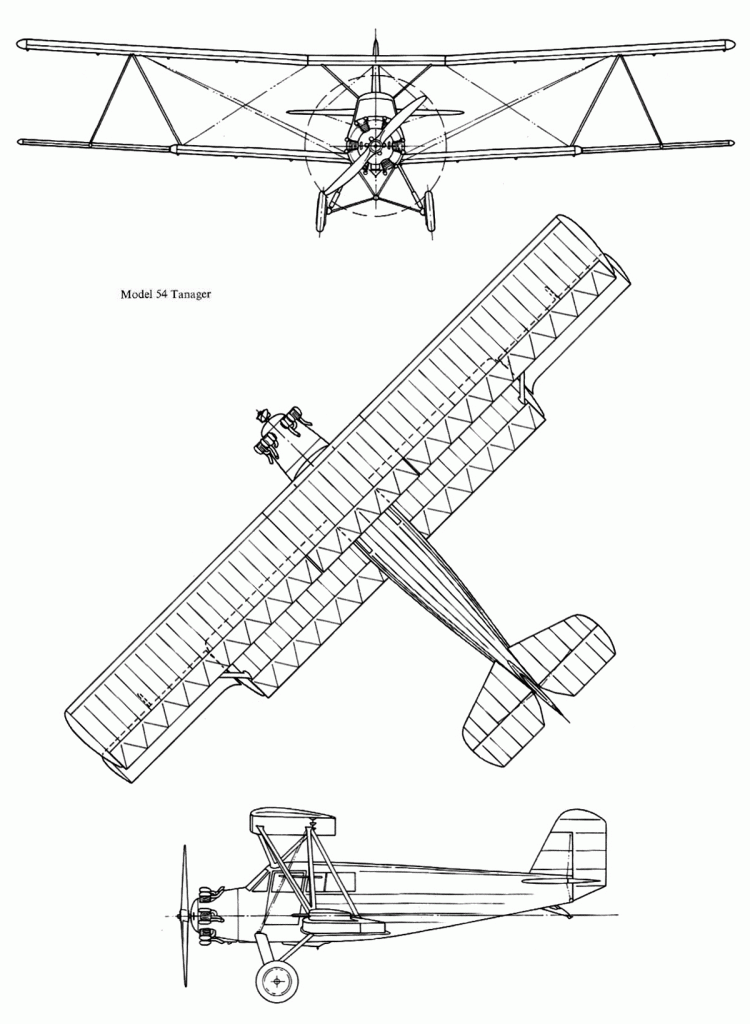
Curtiss 54 Tanager

Designed by Robert R. Osborn and Theodore Paul Wright, the Curtiss Model 54 Tanager was an aircraft constructed in 1929 as Curtiss’ entry in the Guggenheim Safe Aircraft Competition organized by Daniel Guggenheim. The purpose of this competition was to create a civilian aircraft with a specific speed range, which allowed at low speeds to avoid accidents with a stall into a tailspin.

In accordance with the requirements of the competition, the minimum safe speed was to be 35 mph (56 km / h) but the requirements also indicated a maximum speed of at least 110 mph (177 km / h). Other specifications included a take-off distance from the starting point to a height of 35 feet (10 meters), not exceeding 500 feet (152 meters), the ability to carry two people for three hours and a payload of at least 5 pounds per horsepower (2, 26 kg / hp).

First flying on 12 October 1929, the Model 54 was a conventional biplane design with a highly streamlined fuselage with a closed cockpit that contained a pilot and two passengers. The wings were fitted with a variety of high-lift devices, including automatic leading edge slots on the upper wing, flaps that extended along the entire span of the upper wing, and “floating” ailerons on the lower wing that, in the absence of pilot input, automatically adjusted themselves parallel to the airflow over the wing. To ensure the possibility of flying at minimum speed, the rear edges of both wings were fully occupied by flaps, and the front edges were fully occupied by Handley Page automatic slats. These devices added 33% and 50% to the total lift coefficient, respectively. The combination of these devices gave the Tanager a stall speed of just 31 mph (50 km/h) and allowed it to land in only 90 ft (27 m). The main landing gear had a large shock absorber designed to absorb loads during rough landings and a reinforced fuselage frame in the cabin.

Only the Tanager and the Handley Page Gugnunc passed the qualifying round of the competition, and ultimately, the Tanager was to beat its rival by only one point to claim the $100,000 (£20,000) prize, the Gugnunc failing to achieve a minimum speed below 38 mph. Even before the competition was decided, however, Handley Page was suing Curtiss for the unlicensed use of the leading-edge slot. Curtiss claimed they were using the slots experimentally and would apply for a license for any commercial use. Curtiss counter-sued Handley Page for infringements of six of their patents in the Handley Page machine. They also cited a ruling that the British machine was not permitted to be imported into the US.

Following the competition, the only Tanager built was destroyed in a fire when sparks from its engine set the grass alight.

Gallery

Engine: 1 × Curtiss Challenger, 185 hp (138 kW)
Wingspan: 43 ft 10 in (13.35 m)
Wing area: 333 sq.ft (30.93 sq.m)
Length: 26 ft 8 in (8.12 m)
Height: 11 ft 4 in (3.45 m)
Empty weight: 1,958 lb (888 kg)
Gross weight: 2,841 lb (1,289 kg)
Maximum speed: 112 mph (180 km/h)
Cruise speed: 95 mph (153 km/h)
Service ceiling: 12,500 ft (8,810 m)
Rate of climb: 700 ft/min (3.6 m/s)
Range: 535 miles (861 km)
Crew: one pilot
Capacity: two passengers

Curtiss R-7

The Curtiss R-7 of 1916 was a long-wing version of the R-6 specially built for the New York Times. The long range landplane was built for an attempted to fly non-stop from Chicago to New York in 1916. It failed to complete the flight but still set an American distance record of 452 miles (727 km).

Fitted with long-span wings, it was similar to the R-3 and R-6, and powered by Curtiss V-2-3 engine. Only one was built.

Curtiss 18 / MF / Seagull / MF-2

USCG Curtiss MF

The 1916 Model 18 MF (Acronym was for “Modernized F”) was first powered by the 100hp Curtiss OXX-3. Later motors included 150hp K-6 and 400hp K-12.

Twenty-two were built; A2345-2350, A4403-4418, of which many were modified after WW1 by Cox-Klemin Co for civil use. Post-war production version became the Seagull.

No.124 had a Packard A for tests as MF-2.

Engine: 100hp Curtiss OXX-3
Wingspan: 49’9″
Length: 28’10”
Useful load: 638 lb
Speed: 72 mph
Range: 345 mi
Seats: 2

Curtiss 41 Lark

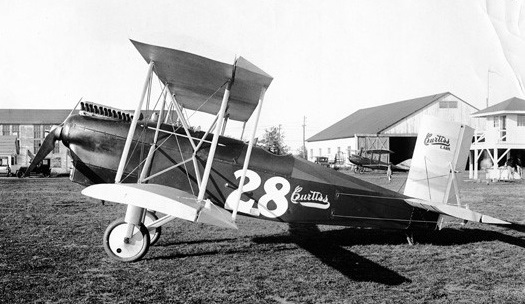
Curtiss Lark at the 1925 National Air Races

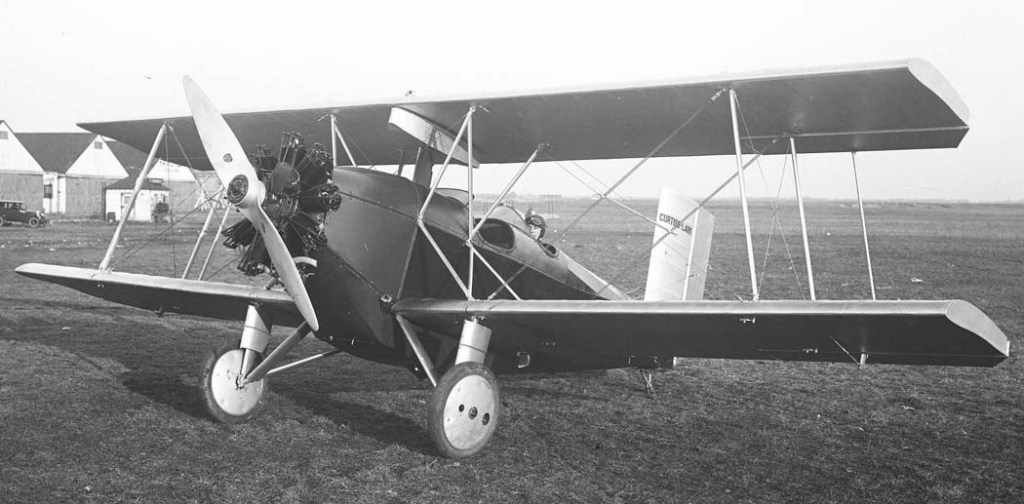
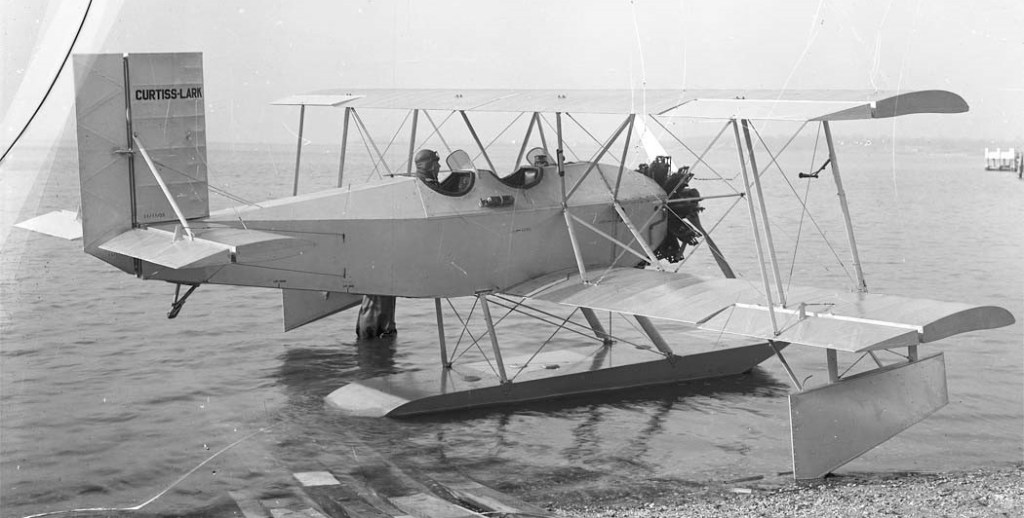
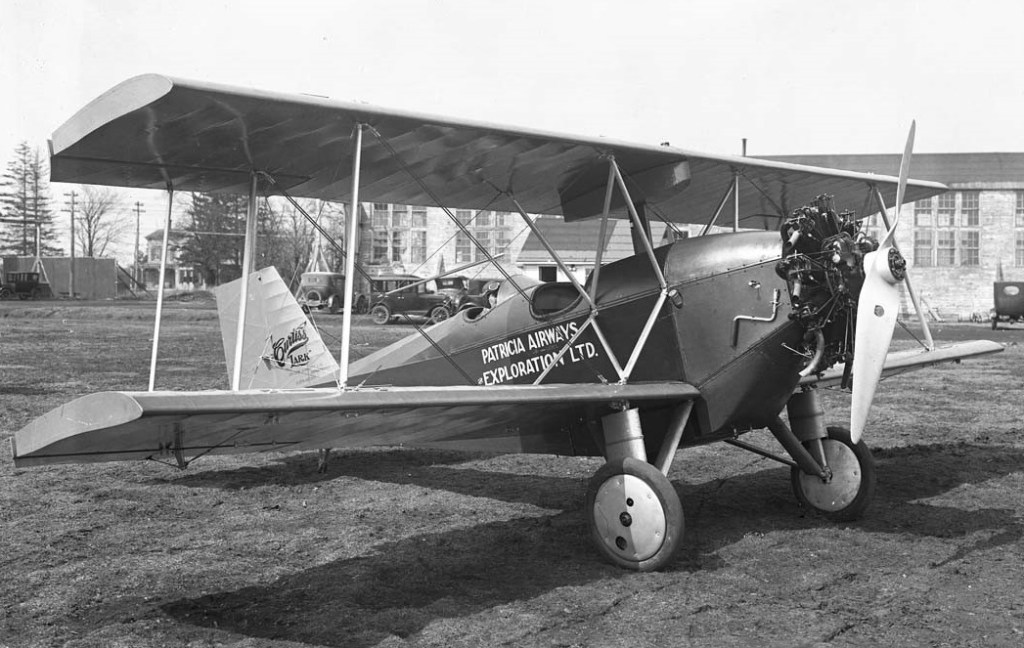
Developed in 1925, the Curtiss Model 41 Lark biplane was based on the Curtiss Carrier Pigeon, a purpose-built aircraft for airmail operations. The Lark also had a longer-span lower wing, similar to the Carrier Pigeon. Some models were converted to floatplane configuration with a central mounted pontoon and wing-mounted floats.

It was a four-seater biplane of a mixed design, equipped with a Curtiss C-6 engine with a power of 160 hp. The biplane was made of welded tube with fabric covering. It was available with three engine choices, the Curtiss C-6, the Wright J-4 Whirlwind, and the Wright-Hisso E. All four wing panels were interchangeable, giving the aircraft its unusual longer lower wings.

Lark with J-4 motor Whirlwind

A 200 hp Wright J-4 variant was tested for the United States Navy with two floats. This installation proved superior in performance to the Curtiss engined model. This version eventually became the basis for the Curtiss Fledgling series of aircraft.

Patrica Airways operated a Lark for early bushplane operations. The aircraft flew with floats in warm weather, and skis in the winter. The aircraft was pressed into service as an early hearse once, with the cargo needing to be seated upside down in the open seat and secured with haywire.

Florida Airways operated a Curtiss Lark Miss Tallahassee on its CAM-10 U.S. airmail route between Miami and Atlanta. The aircraft was bought to take the place of two lost Stout 2-AT Pullman aircraft that could not operate out of the poorly prepared airstrips.

Colonial Air Transport owned the first Curtiss Lark C1052 which was one of the first aircraft to be registered using the new Underwriters Laboratories all-letter system (1921 to 1923). This Lark, a single place special mailplane, registered as N-AABC, was used on the CAM-1 U.S. airmail route.

Lark with Curtiss C-6 engine

One other was C1063.

Gallery

Engine: 1 × Curtiss C-6, 160 hp (120 kW)
Wingspan: 30 ft 7.5 in (9.335 m)
Wing area: 264.3 sq ft (24.55 sq.m)
Length: 22 ft 2.5 in (6.769 m)
Height: 8 ft 11 in (2.72 m)
Empty weight: 1,579 lb (716 kg)
Gross weight: 2,708 lb (1,228 kg)
Maximum speed: 99 kn; 183 km/h (114 mph)
Cruise speed: 84 kn; 156 km/h (97 mph)
Stall: 48 mph
Range: 382 nmi; 708 km (440 mi)
Ferry range: 330 nmi; 612 km (380 mi)
Absolute ceiling: 13,100 ft
Service ceiling: 12,500 ft (3,800 m)
Rate of climb: 860 ft/min (4.4 m/s)
Crew: one

Engine: Wright J-4 Whirlwind, 160 hp
Wing span: 9.34 m
Length: 6.77 m
Height: 2.72 m
Wing area: 24.55 sq.m
Empty weight: 692 kg
MTOW: 1228 kg
Maximum speed: 188 km / h
Cruising speed: 163 km / h
Range: 611 km
Rate of climb: 244 m / min
Ceiling: 3993 m
Crew: 1
Passengers: 3

Curtiss 22 Cox Racer / Cactus Kitten / Texas Wildcat

Texas Wildcat

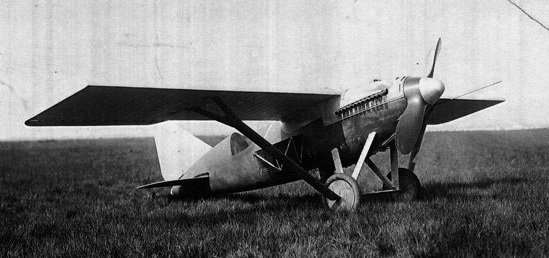
In 1920 the American oil millionaire S.Cox had two specialised racing monoplanes built for him by the Curtiss Aeroplane and Motor Company to take part in the Gordon Bennett Trophy race to be held in France in September 1920. The two aircraft, named Texas Wildcat and Cactus Kitten, were single-engined, braced, high-wing monoplanes powered by a 427 hp (318 kW) Curtiss C-12 inline piston engine. They had streamlined wooden fuselages with the pilot sitting in an enclosed cockpit towards the rear of the fuselage, under a forward sliding canopy. The wing, which had a special double camber airfoil section, was high-mounted, and was braced by struts to the mainwheels of the fixed conventional landing gear. The V-12 engine drove a two-bladed tractor propeller, and was cooled by radiators mounted on the side of the fuselage between the cockpit and the wings.

The Texas Wildcat was briefly tested in the United States before shipment, being fitted with a different wing with a more conventional airfoil for operation out of the confined Curtiss Field. First flying on July 25, it demonstrated a speed of 183 mph (295 km/h), with a speed of 215 mph (346 km/h) expected when fitted with the high speed racing wing. Both aircraft were then sent by ship to France, with no testing carried out on the high speed wing and Cactus Kitten unflown before sailing. Texas Wildcat was reassembled at the Morane-Saulnier factory with the high speed wing, but was found to be unstable at high speeds when flown by test pilot Roland Rohlfs. A set of biplane wings were therefore quickly designed and fitted to Texas Wildcat. Texas Wildcat was wrecked in a landing accident when being flown to Étampes prior to the race.

Although the Cactus Kitten was taken to France it remained unflown and was returned to the United States. It was then rebuilt with a set of short-span triplane wings modified from those of a Curtiss 18T, with the enclosed cockpit replaced by a more conventional open cockpit.

Cactus Kitten

Thus modified, it was entered into the 1921 Pulitzer Trophy Race, where, flown by Clarence Coombs at an average speed of 170.3 mph (274.1 km/h), it gained second place behind a Curtiss CR piloted by Bert Acosta. It was later sold to the United States Navy as a trainer for high-speed racing aircraft.

Engine: 1 × Curtiss C-12, 435 hp (324 kW)
Wingspan: 20 ft (6.1 m)
Wing area: 175 sq ft (16.3 m2)
Length: 19 ft 3 in (5.87 m)
Gross weight: 2,406 lb (1,091 kg)
Maximum speed: 196 mph (315 km/h; 170 kn)
Crew: one

Curtiss M

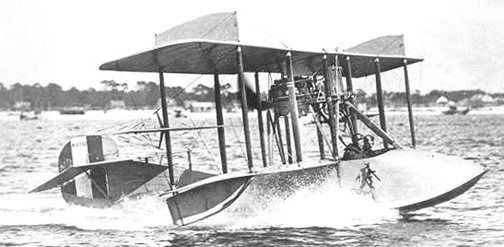
The Curtiss M flying boat was built to order for Raymond V. Morris, a Curtiss employee.

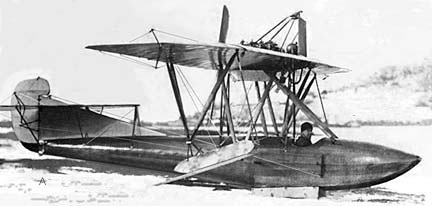
It featured swept-back, birdlike parasol wing and full-length, V-bottom wooden hull.

A single seater first flying in January 1914, it was the world’s first monoplane flying boat.

After unsatisfactory tests were performance was marginal, it was converted to a biplane layout at San Diego.

Engine: Curtiss O, 90hp
Wingspan: 34’0″
Length: 25’0″
Seats: 1