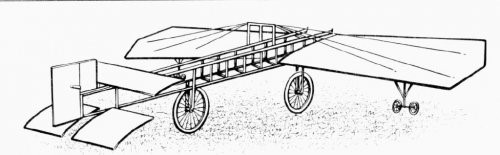
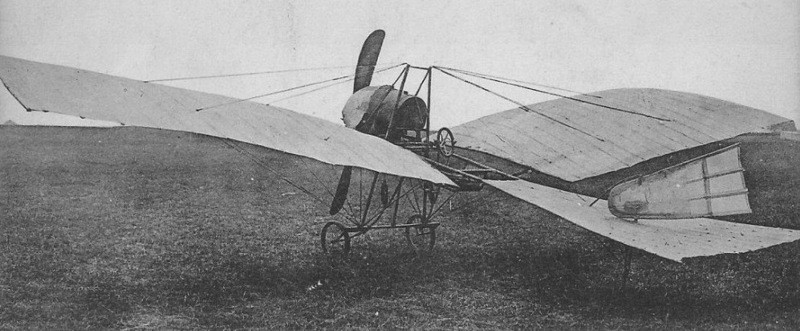
The Demkin Monoplane was the first Russian aircraft with bicycle landing gear. This was supplemented by twin outrigger wheels beneath the wing. Monoplane with uncovered fuselage. Rudder had aerodynamically compensation.
Aircraft was tested in 1910 at St.Petersburg by Georgy Konstantinovich Demkin himself (who was a law student). The aircraft only achieved short hop flights.
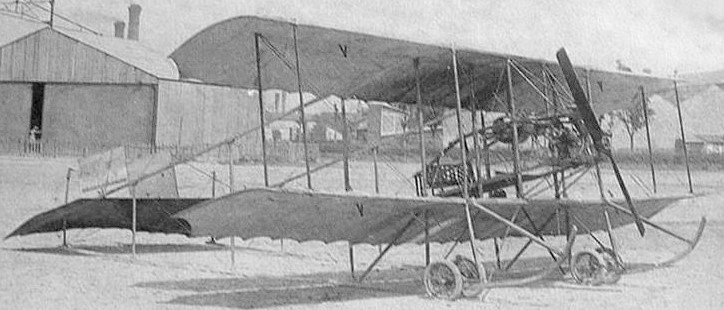
Lucien and Paul Demazel (son and father) ran a flying school at Issy-les-Moulineaux, in Paris, France, and built at least two different types of flying machines two Caudron copies built in 1912.
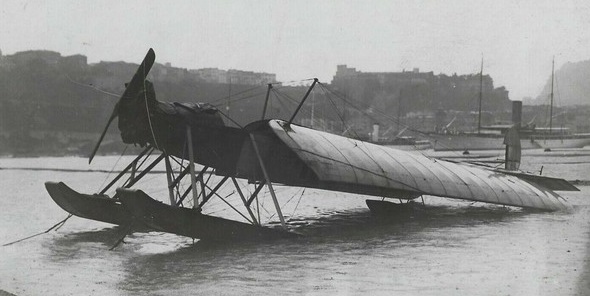
The 1920 de Marcay Sport-Farman was a two-seater biplane with a span of 23 ft and weighing 450 lb. The landing speed was 16 mph and top speed 87 mph. It could take-off in 30 yds with two POB, and 10 yds with one.
The De Marcey ‘Sport Biplane’ was powered with a 60 hp Le Rhone and wingspan of 18 ft. The motor was neatly cowled and the propeller was fitted with a large spinner and a streamlined monocoque fuselage, Top speed was 118 mph with a landing speed of 28 mph.
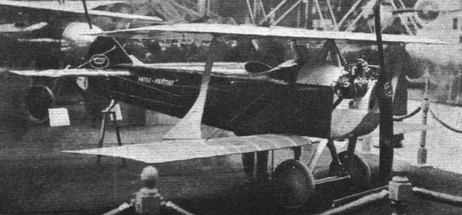
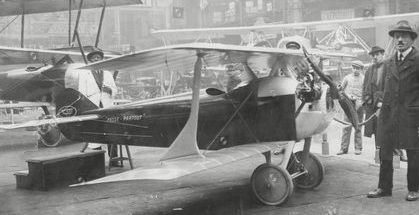
The de Marçay Passe-Partout (lit. '”de Marçay Master-Key”‘) was a small, low-powered single-seat sport and touring aircraft built by SAECA Edmond de Marçay (Société Anonyme d’Etudes et de Construction Aéronautique Edmond de Marçay) in France just after World War I.
The Passe-Partout was the smallest and lightest de Marçay aircraft of the three on display at the Paris Aero Salon of 1919. It had a very low power engine, the same 10 hp (7.5 kW) ABC 8 hp adapted flat-twin motorcycle engine that powered the English Electric Wren. Flight magazine doubted its practicality with this engine.
It was a single bay biplane with a single interplane strut on each side defining a bay braced with a single flying wire and a single landing wire. Both wings were two spar structures; there was marked forward stagger but no dihedral The interplane struts were slender at the top but smoothly widened towards their feet, linking the upper rear spar to both lower wing spars. The narrow upper joint provided a fixed point about which control wires could warp the trailing edge. Short cabane struts from the fuselage supported the centre of the upper wing.
The Passe-Partout had a monocoque fuselage of rounded rectangular cross-section. Its engine was mounted, with cylinders exposed, in the upper nose. The pilot’s open cockpit placed him just aft of the upper trailing edge but over the lower wing because of the stagger. At the rear a plywood covered tailplane was mounted high on the fuselage and fitted with fabric covered elevators. Both the fin and rounded rudder were also ply covered. Its fixed landing gear was of the conventional tailskid type with mainwheels on a single axle rubber rubber sprung from a frame consisting of two V-form struts from the lower fuselage with a single cross-member.
The Passe-Partout hadn’t yet flown when it appeared at the Paris Salon in December 1919 but it had flown by the following May. Marçay continued to advertise it until at least October 1920 but Flight’s doubts about its practicality seem to have been justified for in May 1928, when the de Marçay company ceased to exist, Les Ailes noted that the Passe-Partout had undertaken only a few, inconclusive trials and further, that de Marçay himself saw it more of a curiosity than a practical aircraft.
Powerplant: 1 × ABC 8 hp, 7.5 kW (10 hp) Propeller: 2-blade Wingspan: 4.04 m (13 ft 3 in) Wing area: 8.50 m2 (91.5 sq ft) Length: 3.797 m (12 ft 5.5 in) Height: 1.37 m (4 ft 6 in) Empty weight: 104 kg (230 lb) Gross weight: 189 kg (417 lb) Endurance: 2 hr Maximum speed: 109 km/h (68 mph, 59 kn) Service ceiling: 1,000 m (3,300 ft) Crew: one
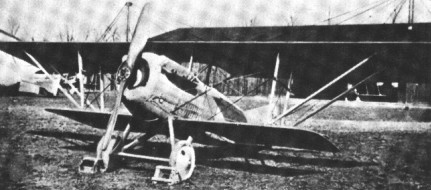
An experimental single-seat scout, the de Marcay Type C utilised a SPAD 13 fuselage, built in 1919.
The initial design was based on the use of an eight-cylinder Liberty engine, but the difficulties experienced with this engine led to revision of the design to take a 300 hp Hispano-Suiza 8Fb eight-cylinder water-cooled engine as the de Marcay 2 Cl. An unequal-span staggered single-seat biplane with horn-balanced ailerons on the upper wing only and an armament of two synchronised 7,7-mm Vickers machine guns.
The Type C achieved 157 mph at Villacoublay flown by Lt. Lebeau. Although the fastest fighter participating in the 1919 Service Aéronautique contest held at Villacoublay, no production order was placed for the de Marcay 2 Cl and only one prototype was completed.
Engine: 300 hp Hispano-Suiza 8Fb eight-cylinder Max speed, 156 mph (252 km/h) at sea level, 144 mph (232 km/h) at 9,840 ft (3000 m). Time to 16,405 ft (5000 m), 16.27 min. Span, 30 ft 4 1/8 in (9,25 m). Length 21 ft 8.6 in (6,62 m). Wing area, 269.1 sq ft (25,00 sq.m).
At the Concours de Sécurité of 1914, a Gnôme-powered monoplane designed by Balassian de Mana was a project to improve stability, especially in the case of engine failure, with the wings attached to the fuselage with springs so as to vary the position of the centre of lift: the wings could move fore and aft automatically or under pilot control.
The fuselage consisted only of two spars with a fabric seat slung between them. A large fuel tank mounted on the same spars provided minimal wind protection but completely blocked forward vision. The spring undercarriage was unique. Each wheel was set into a horizontal frame pivoting on the steel tube axle, the wheels forward and below the axle, with a long horn extending backwards from each frame, the end hung from two heavy shock cords attached to the underside of the fuselage.
Damaged during the qualification tests, the machine did not participate in the contest.
A high-wing monoplane with conventional tail surfaces. The ailerons and elevators are operated by a control stick, while the rudder is operated by pedals. Aluminum tubing is used throughout. The wings are built from premolded leading edge forms and preformed sheet metal structural parts. Wing and tail covering is 1.8-ounce Dacron. Complete kits require final assembly. POWERPLANT: Unitrek 140-10 mounted in pusher position aft and below the main wing. A 1:1.98 reduction unit turns a two-blade wooden Ritz propeller. Fuel is carried in a high density polyethylene tank directly behind the pilot seat on GG. LANDING GEAR: Monowheel main gear with tail skid wheel. The main wheel measures 10 inches, and the rudder-connected tail wheel is 4 inches in diameter. The DS-26 allowed 28-50 hp Rotax engines. Doped double surface wing-covering, conventional three axis airplane controls, full 3600 roll cage, all metal aircraft type structure, 20 minute set-up. Units delivered to June 1981: 189. Price 1982: $3,860.
In 1984 Delta Technology had completed all design modifications on all three of the company’s Nomad and Honcho ultralights.
”The Nomad 11, Honcho 11 and Super Honcho are now ready to go, and with the completion of our new production facility, we are prepared to deliver in two to four weeks,” a company spokesman said. ”Our intent is to offer a special introduction price on.a limited number of aircraft in order to stimulate interest and awareness in the newly completed models,” he added.
Delta also reduced the price on all three models by $1,000. The Honcho 11 was $3,980, the Nomad 11 $4,380 and the Super Honcho $4,980.
The Honcho 11 features all-metal construction, traditional, strutted wing design, energy-absorbing 360 degree roll-cage fuselage, conventional three-axis controls, strong wing structure with differential ailerons, hydraulically dampened independent suspension and a 10-year lifespan on double-surface wing coverings.
This offer was good until July 31, 1984; however, a limited quantity of aircraft were available. A production number and delivery date was to be issued upon receipt of payment in full or a 50 percent deposit.
DS-26A Wingspan, 36 ft. 1 in. Wing area, 147.34 sq.ft. Aspect ratio, 8.84:1. Overall length, 22 ft. Empty weight, 152 lbs. Usable payload (include fuel), 210 lbs. Wing loading, 2.46 lbs/sq.ft. L/D power-off glide ratio, 14.5:1. Cruise speed (85% power), 35 mph Stall speed, 24 mph. Approach speed, 31 mph. Flair speed, 24 mph. Liftoff speed, 30 mph. Takeoff roll distance, 225 ft. Rate of climb, 185 fpm. Fuel capacity, 2.5 USG. Range at cruise, 106 sm. Engine displace¬ment, 8.2 cu.in. Rated HP, 10 hp. S tatic thrust, 85 lbs.
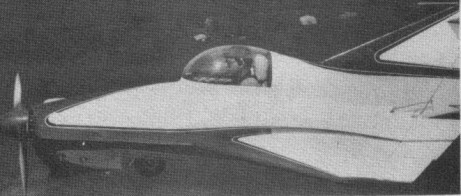
Lowell Borchers won a special Designer’s Trophy at the 1980 EAA Oshkosh Fly-In for his Delta Stingray after 6000 hours of work. The Stingray is about 70 percent plywood, 20 percent Douglas fir and 10 percent steel and fiberglass. It has a hand-carved 60/64 wooden pro¬peller and retractable landing gear. The Stingray is a take-off of John Dyke’s four-place Dyke Delta.
Gross Wt. 1075 lb. Empty Wt. 740 lb. Wingspan 15 ft Length 14 ft l0 in Engine 100-hp Continental 0-200. Top 204 mph. Cruise 180 mph. Climb rate 1400 fpm.