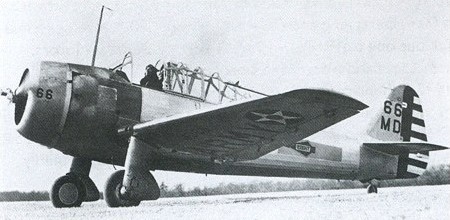
Designed as a Basic Trainer for the Army Air Force, the model 23 was fabricated out of stainless steel rather than aluminum or wood. Only 24 were built.
Designed as a Basic Trainer for the Army Air Force, the model 23 was fabricated out of stainless steel rather than aluminum or wood. Only 24 were built.
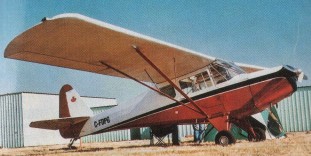
Circa 1946
Leaven Brothers of Canada produced a limited re-production of 1945 Fleet Model 80 Canuck, 1965-1966.
The Fort was the first all-metal monoplane built by Fleet Aircraft of Canada (Fort Erie); and it was intended as a cheaper version of the Harvard, also an intermediate trainer.
The Fleet Fort Model 60K was designed and built by Canadians in World War II. The Fort’s maiden flight occurred in 1940.
Initially, the RCAF did not want to order the Model 60K, and their doubts proved valid. The Fort was relatively easy for pilot trainees to master, thereby making it unsuitable for transition to combat aircraft. The RCAF took 100 on strength in 1941. Also, the RCAF decided that pilots who had soloed in Finches and Tiger Moths could proceed to Harvards without training on Forts. The Forts were then used to train wireless operators until the last Model 60K was retired in 1946.
Fleet 60K Fort I
Engine : Jacobs R-915-7, 330 hp
Wing Span : 36ft (11m)
Length : 26ft 10in (8.18m)
Height : 8ft 3in (2.5m)
Speed : 162 Mph (260km/h)
Seats: 2
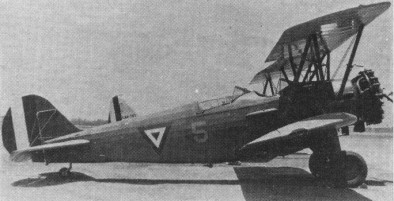
Fleet Aircraft Company built eleven Consolidated Model 21 aeroplanes for its parent company, Consolidated, in 1936 and 1937. Ten of these were exported to Mexico as basic trainers for the Mexican Air Force. The eleventh was produced in 1937 as a demonstrator for Fleet, which tried to interest the RCAF in this large biplane. Unfortunately, the days of the biplane were already numbered, and monoplanes were emerging from the world’s aircraft factories in greater quantities.
Originally built as the Model 21M with a Pratt & Whitney R-985 Wasp Jr. engine, some were converted to a Model K with the Jacobs L-6MB engine.
21M
Engine: Pratt & Whitney R-985 Wasp Jr
21K
Engine: Jacob L-6-MB, 330 hp
Wing Span: 31ft 6in (9.6m)
Length: 27ft (8.23m)
Height: 9ft 5in (2.88m)
Speed: 139 mph (224km/h)
Seats: 2
The Fleet Model 14 was a Model 2 modified for participation in Guggenheim Safe Aircraft Competition but disqualified. Around 300 were licence-built in Romania by IAR.
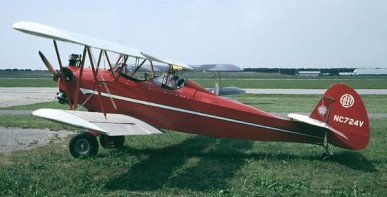
The Fleet 7 flew first in 1930, a total of 374 were built, including the Fleet 10 designed for the European market.
Forty-eight of the Fleet Model 7 version with Kinner B-5 engine were built, plus several converted from Model 2 by Fleet in Canada.
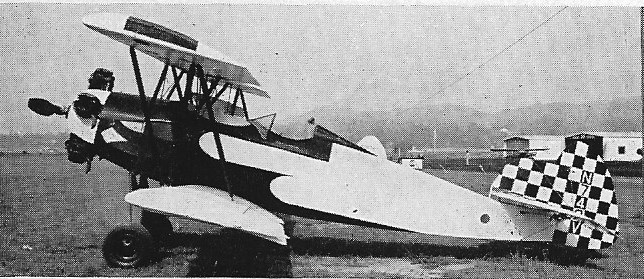
The Fleet Model 7B was a Canadian production version, as were the Fleet Model 7C with Armstrong Siddeley Civet engine and Fleet Model 7G with de Havilland Gipsy III engine.
One Model 7 with 100-hp Kinner R-370-1 (Kinner K5) engine was acquired by the US Army Air Corps for service tests as XPT-6. Ten YPT-6 followed, similar to the XPT-6, used by the US Army Air Corps for service tests and evaluation. The YPT-6A was a modified version of the Model 7 fitted with an enlarged cockpit. Used by the US Army Air Corps for service tests and evaluation.

The Fleet F.7C Trainer was built in 1937.
The Fleet Model 8 was a three-seat version similar to Model 7 (seven built), and Fleet Model 9 was a refined version of the Model 8 (12 built).
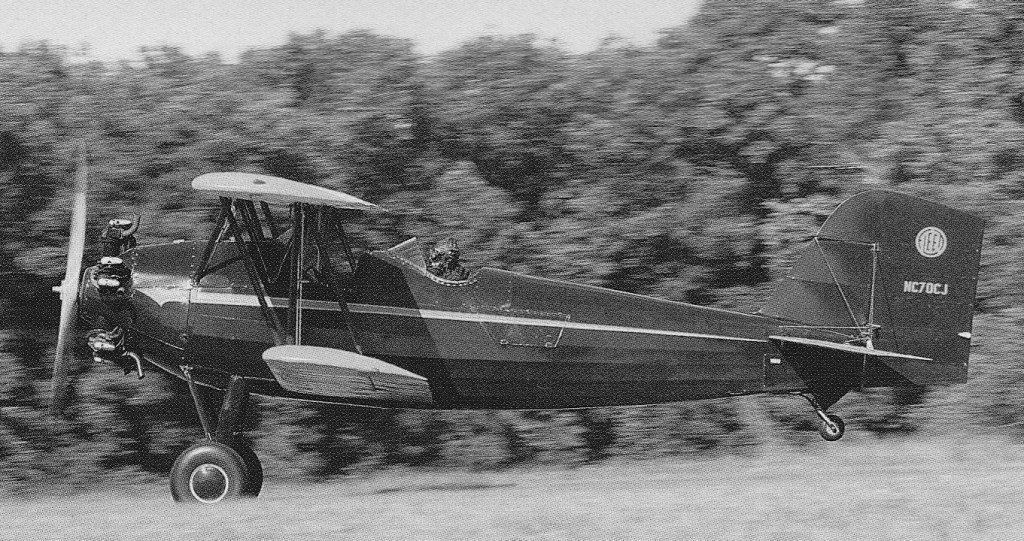
The Fleet Model 10 was a refined version of the Model 7 for export to Europe, replaced the 1928-origin “looped” landing gear radius rod of the Models 2 & 7 for their left mainwheel with a center-hinged design for both mainwheels, using a V-form transverse cabane strut to provide the hinge-point.
The Model 10A version had a 100 hp Kinner engine, Model 10B with 125 hp Kinner engine, and Model 10D a 160 hp Kinner engine. The Model 10-32D was generally similar to the Model 10D, but with an increased 4-ft 0-in (1.22-m) wingspan.
The Fleet Model 10E version was powered with a 125 hp Warner engine and Model 10F with a 145 hp Warner engine.
The Fleet Model 10G was built for the governments of Portugal and Romania, with about 70 built in Romania by ICAR as Fleet-IAR 10, sometimes listed simply as IAR-10, all powered with a de Havilland Gypsy Major engine.
The Fleet Model 10H was powered with a Menasco C-4S engine, and Fleet Model 11 with a Kinner R-5 engine. Some Model 11 were exported to Argentina, China and Mexico.
The Fleet Model 16, or Fleet Finch, was a strengthened Canadian production version with sliding canopy, powered by a 130 hp de Havilland Gipsy Major engine, about 600 were built. The Fleet Model 16B, or Fleet Finch Mk II, was a strengthened Canadian production version, powered by a Kinner B5 engine. The Model 16D was similar to the Model 16B, but fitted with a Kinner B5 engine.
The Fleet Model 16R, or Fleet Finch Mk I, was the designation of the Fleet 16D built in Canada for the RCAF.
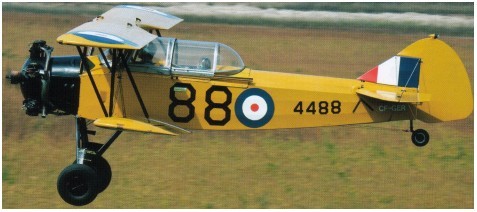
The Fleet 16B Finch II is a progressive development of the original Consolidated Fleet primary trainer, manufacture of which was commenced in Canada by Fleet Aircraft in 1930. The Fleet Finch Model 16 was developed specifically for the RCAF. In 1938 Fleet Aricraft was exporting Model 10s, when the RCAF examined a 10D for possible use as a primary trainer. The Air Force needed an aeroplane that could perform aerobatics with full military equipment; therefore, numerous modifications were made, and the aircraft built for the RCAF were designated Model 16s. The first Finch 16B for the RCAF flew in March 1940.
The Fleet 16 first entered RCAF service with tandem open cockpits, but the severity of the Canadian winter necessitated the introduction of a sliding canopy at an early stage in the trainer’s service career.
The Fleet Model 16, or Fleet Finch, was a strengthened Canadian production version with sliding canopy, powered by a 130 hp de Havilland Gipsy Major engine, about 600 were built. The Fleet Model 16B, or Fleet Finch Mk II, was a strengthened Canadian production version, powered by a Kinner B5 engine. The Model 16D was similar to the Model 16B, but fitted with a Kinner B5 engine.
The Fleet Model 16R, or Fleet Finch Mk I, was the designation of the Fleet 16D built in Canada for the RCAF.
A total of 437 Fleet Finches were produced as Model 16s, the majority (430) for the RCAF. They were used as initial trainers in the BCATP at twelve EFTS’s across Canada in parallel with the Tiger Moth. They were replaced eventually by Fairchld PT-26 Cornells, and the last of the Model 16s stayed on RCAF inventory until 1947.
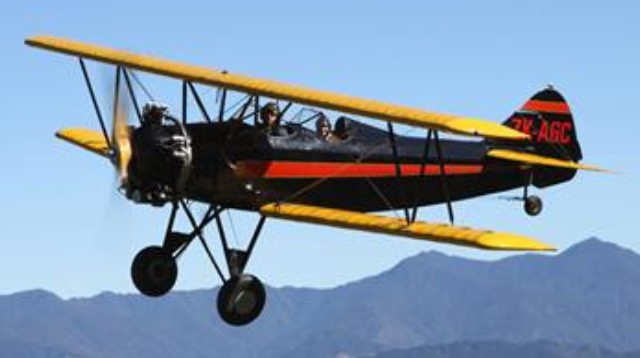
The Canadian manufacturing was a great success, with some 600 examples built for the Royal Canadian Air Force as the Fleet Fawn (Model 7) and Fleet Finch (Model 16).
United States manufacturing rights were eventually sold to Brewster Aeronautical Corporation, which intended to produce the Brewster B-1 based on the Canadian Model 16F prototype, built for Brewster.
Fleet Model 7
Engine: Kinner B-5
48 built, plus several converted from Model 2 by Fleet in Canada
Fleet Model 7A
Engine: 125 hp Kinner B-5 or 100 hp Kinner K-5
Wingspan: 28 ft
Wing area: 194 sq.ft
Length: 21 ft 6 in
Height: 7 ft 11.5 in
Max speed: 115 mph
Cruise: 90 mph
ROC: 730 fpm
Ceiling: 16,000 ft
Fleet Model 7B
Fleet F.7C
Engine: Armstrong Siddeley Genet Major, 135 hp
Fleet Model 7G
Engine: de Havilland Gipsy III
XPT-6
One Model 7 for US Army Air Corps for service tests.
Engine: 100-hp Kinner R-370-1 (Kinner K5)
YPT-6
ten built
YPT-6A
Model 7 fitted with enlarged cockpit.
Fleet Model 8
seven built
Seats: 3
Fleet Model 9
12 built
Fleet Model 10
Fleet Model 10A
Engine: 100 hp Kinner
Fleet Model 10B
Engine: 125 hp Kinner
Fleet F 10 D
Engine: Kinner K 5 radial, 160 hp
Fleet Model 10-32D
increased 4-ft 0-in (1.22-m) wingspan
Fleet Model 10E
Engine: 125 hp Warner
Fleet Model 10F
Engine: 145 hp Warner
Fleet Model 10G
Engine: de Havilland Gypsy Major
Fleet Model 10H
Engine: Menasco C-4S
Fleet Model 11
Engine: Kinner R-5
Fleet Model 16 / Fleet Finch
Engine: 130 hp de Havilland Gipsy Major
Fleet 16B Finch Mk II
Engine: Kinner B-5 five cylinder radial, 125 hp
Maximum speed: 113 mph
Empty weight: 1,102 lb (500 kg)
Loaded weight: 1,860 lb (844 kg)
Span: 28 ft (8.5 m)
Length: 21 ft 8 in (6.6 m)
Height: 7 ft 9 in (2.4 m)
Wing area: 194 sq ft (18 sq m)
Seats: 2
Fleet Model 16D
Engine: Kinner B5
Fleet Model 16F
prototype for Brewster B-1
Fleet Model 16R / Fleet Finch Mk I
Fleet 16D built in Canada for the RCAF
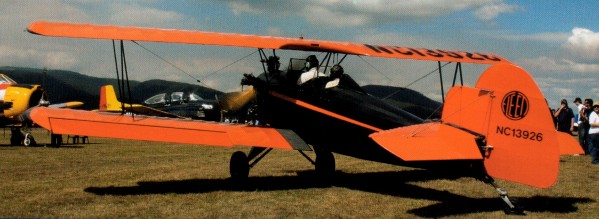
The Fleet Model 1 (originally the Consolidated 14 Husky Junior) and its derivatives were all orthodox two-seat trainer and sports biplanes with staggered, single-bay wings of equal span and fixed tailskid undercarriage. Accommodation was provided for two in tandem, originally sharing a single open cockpit, but in most examples in separate open cockpits. The fuselage was made of welded steel tube with triangular-layout Warren truss construction pattern side structures typical of the time, and the wings had a wooden spar with duralumin ribs, the entire aircraft being fabric-covered. They all shared the same basic design and varied mainly in their powerplants. Despite a superficial resemblance to Consolidated’s highly successful Trusty and Husky designs (hence the “Husky Junior” nickname), the Model 14 was an all-new design.
Originally designed by Reuben Fleet and created as a means for Consolidated to enter the civil market, the company abandoned this ambition shortly before the completion of the first prototype. The manufacturing rights were purchased by the designer and Consolidated company president Reuben Fleet to put into production under his new enterprise, Fleet Aircraft. Around five of the Consolidated Model 14 Husky Junior prototypes were built.
First flown on 9 November 1928, it was an immediate success, and in the first year of production alone, over 300 machines were sold. About 90 of the Fleet Model 1 initial production version with Warner Scarab engine were built.
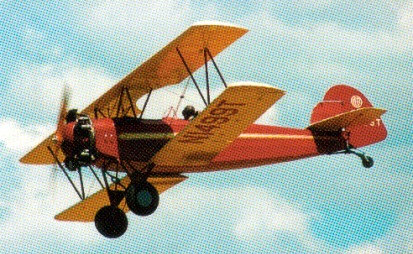
Consolidated responded by buying Fleet Aircraft and retaining it as a subsidiary while opening a second production line at Fort Erie, Ontario, Canada.
Two hundred and three of the Fleet Model 2 initial production version with Kinner K-5 engine were built. The USAAC purchased 16 Model 2 as the PT-16 for evaluation.
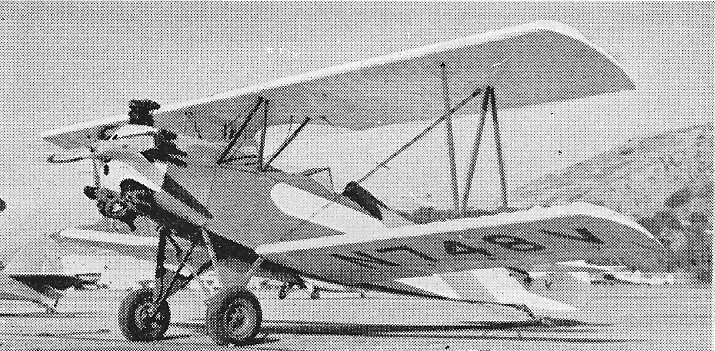
One initial prototype aircraft and six subsequent specialised production N2Y trainers were purchased by the United States Navy. These N2Y-1 aircraft were equipped with hooks to catch the trapeze on two U.S. Navy airships, the USS Akron and the USS Macon. The N2Y-1 parasite aircraft were used to train pilots that would subsequently fly the longer distance single-seat F9C Sparrowhawks reconnaissance aircraft. The two-seater N2Y-1 also acted as service aircraft, flying passengers to the inroute airships.
On July 6, 1930, future air racer and movie stunt pilot Paul Mantz flew a Fleet Model 2 biplane through 46 consecutive outside loops, an international record which stood for almost 50 years.
One Model 2 was converted to the Fleet Model 3 with a Wright J-6 engine. One Fleet Model 4 was built with a Curtiss Challenger engine, and one Fleet Model 5 version with a Brownback C-400 engine was built.
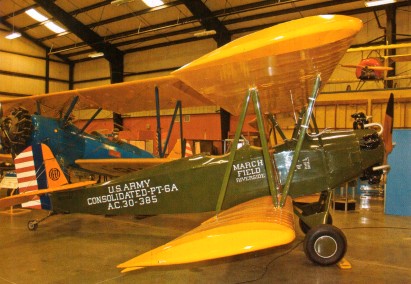
United States manufacturing rights were eventually sold to Brewster Aeronautical Corporation, which intended to produce the Brewster B-1 based on the Canadian Model 16F.
Fleet Model 1
Engine: Warner Scarab
No built: ca. 90
Fleet Model 2 / PT-6
Engine: Kinner K-5, 110 hp (82 kW)
Wingspan: 28 ft 0 in (8.53 m)
Wing area: 195 sq ft (18.1 sq.m)
Length: 20 ft 9 in (6.32 m)
Height: 7 ft 10 in (2.39 m)
Empty weight: 1,063 lb (482 kg)
Gross weight: 1,820 lb (826 kg)
Fuel capacity: 55 US gal (46 imp gal; 210 L)
Maximum speed: 113.5 mph (183 km/h; 99 kn)
Cruise speed: 88 mph (142 km/h; 76 kn)
Service ceiling: 12,200 ft (3,700 m)
Rate of climb: 730 ft/min (3.7 m/s)
Crew: 2
No built: 203 (16 as PT-6, 6 as N2Y-1)
Fleet Model 3
Engine: Wright J-6
one converted from Model 2
Fleet Model 4
Engine: Curtiss Challenger
one built
Fleet Model 5
Engine: Brownback C-400
one built
Fleet Model 6 / XN2Y-2
one built
The two-seat B.2 biplane, powered by 70 hp Gnome Rhone rotary engine, first flown 1912 and acquired by Admiralty 1914.
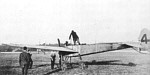
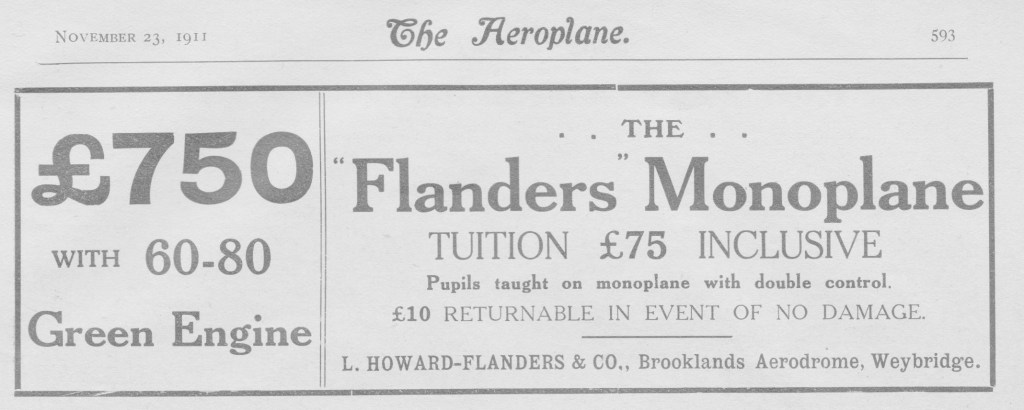
The F.2 was a single-seat monoplane, flown August 1911 then altered to two-seater as F.3. As the two-seater F.3, Fisher and a passenger lost his life on 15 May 1912.
Span: 41′
Length: 31’9″
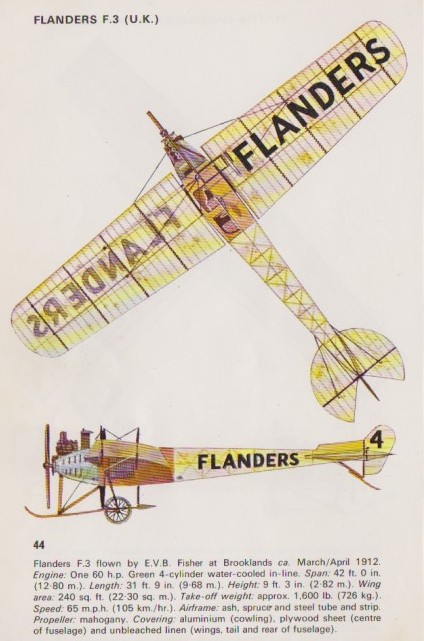
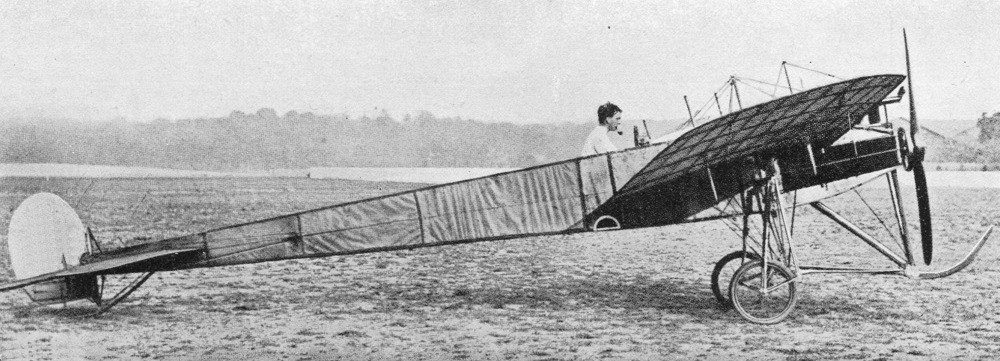
A conventional monoplane, built by L. Howard Flanders Ltd, Richmond, Surrey. It was equipped with a 60 hp Green engine and flew for the first time by E.V.B. Fisher on 31 July 1911.
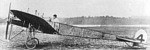
A single-seat monoplane, flown August 1911 then altered to two-seater as F.3.
Span: 34’6″
Length: 29’6″
Dihedral 4 degree

