A light aircraft built in 1910.
Engine: Humber, 40 hp
Wingspan: 10.06 m
Length: 7.01 m
Wing area: 41.81 m2
Maximum takeoff weight: 363 kg
Crew: 1
A light aircraft built in 1910.
Engine: Humber, 40 hp
Wingspan: 10.06 m
Length: 7.01 m
Wing area: 41.81 m2
Maximum takeoff weight: 363 kg
Crew: 1
The Grahame-White G.W.E.6 Bantam was a single-seat sporting biplane, designed by M Boudot the Bantam was a conventional biplane powered by a nose-mounted 80hp (60kW) Le Rhône rotary engine with a single open cockpit.
Two examples were built of this small single-seat sporting biplane, and registered K.150 (G.W.E.6) and K.153 (G.W.E.6A), and a third example was flown in South Africa in the 1920s.
Two aircraft took part in the 1919 Aerial Derby at Hendon Aerodrome, but neither finished the race.
The E.6 was developed into the Express Air Mail aircraft.
Engine: 1 × Le Rhône 9C, 80 hp (60 kW)
Wingspan: 20 ft 0 in (6.1 m)
Length: 16 ft 6 in (5.03 m)
Empty weight: 640 lb (290 kg)
Gross weight: 995 lb (451 kg)
Maximum speed: 100 mph (160 km/h)
Crew: 1
The 1919 Grahame-White “Instructional” was an obscure twin-cockpit biplane trainer with dual controls and a Le Rhone engine. It was reportedly completed but there is no indication that it was flown
The 1917 Grahame-White Experimental was an experimental two-seat biplane roughly based on the Airco (de Havilland) DH-6.
One of the most obscure Grahame-White types, it featured a disproportionately large gap and square-tipped prop fit, and a 75 hp RR Hawk engine.
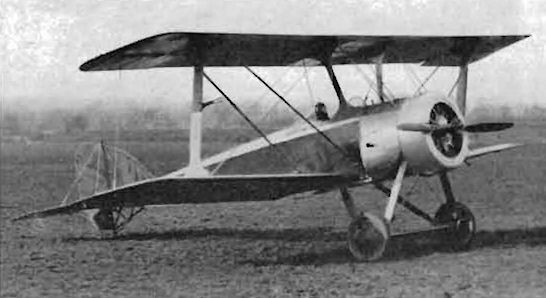
The 1917 Grahame-White Type 21 (G.W.21) was sometimes mistaken for the Type 20, despite considerable differences, this single-seat scout biplane was quite an improvement on the concept, with its unbalanced rudder, slab-sided fuselage, closer wings and the I-shaped interplane struts. It was powered by a rotary Le Rhone engine and tested with both two- and four-bladed propellers.
The Type 21 has been seen with the 80-h.p. Le Rhone driving a four-blade propeller.
Other similar aircraft by larger manufacturers were already in production and the G.W.21 remained a prototype.
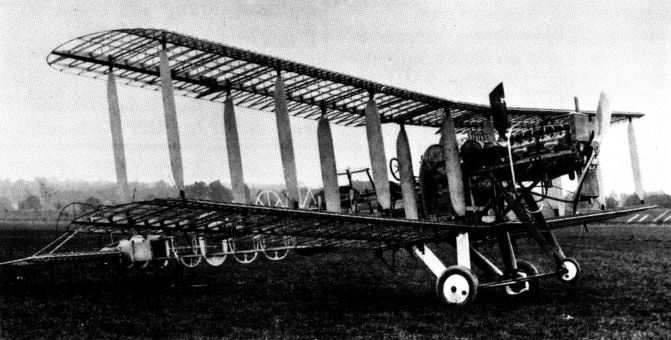
Notwithstanding the work already in progress on the big Handley Page O/100 heavy bomber, the Admiralty issued a requirement in mid-1915 for a smaller, single-engine, land-based bomber, possessing a range of about 700 miles, capable of lifting 800 lb of bombs with a crew of two and a speed of 80 mph. Shorts had been quickest to produce a contender to this requirement, and accordingly received production orders. However, both Grahame-White and J Samuel White also produced prototypes, although none of the three aircraft tendered fully satisfied the performance demands.
Design of the big Grahame-White Type 18 (G.W.18) occupied much of the summer and autumn of 1915 and centred on the choice of a single 285hp Sunbeam Maori 12-cylinder water-cooled engine, the bearers being extensions of the upper fuselage longerons. The wooden box girder, which constituted the fuselage primary structure, carried formers to fair the fuselage to oval section. The three-bay wings were built up on twin spruce spars with closely-spaced ribs and four pairs of interplane struts, the inboard pairs (which replaced conventional centre section struts) providing the rigidity required for the wing-folding attachments.
The wings, of parallel chord and equal span, featured ailerons on upper and lower surfaces, and the twin mainwheel undercarriage with V-struts and spreader bar was augmented by a small balancing nosewheel. Bomb racks, capable of supporting two 230 lb or four 112 lb bombs were attached under the lower wings immediately outboard of the fold axis. A large fuel tank was located forward of the pilot’s cockpit, and the gunner/observer was evidently provided with a Lewis gun on what appears to be a ring mounting.
The Type 18 was probably completed in the spring or summer of 1916, by which time the Handley Page O/100 was confounding its critics by demonstrating the practicality of large bombing aeroplanes and, of the three bomber designs tendered, only the Short Bomber entered production, while the Wight Bomber was developed further by conversion into a floatplane, for which production orders were placed. By contrast, work was evidently halted on the Grahame-White Type 18 soon after completion, and no record of flight performance has been traced.
Little information has survived about this single-engined 1916 machine with a counter rotating construction of two four-bladed propellers. One was ordered as A8964 but later cancelled.
It could be that the designation Grahame-White M.1 originates from the contract (card) which may be held in the UK archives.
Pictured fully built, it was destined never to fly.
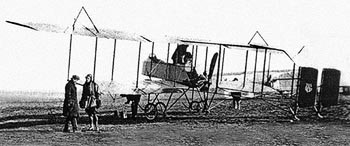
The Grahame-White Type XV (sometimes called “Bi-Rudder ‘Bus” or “Box-Kite” of 1915 was directly derived from the Type XII.
The aircraft itself was a pod-and-boom configuration biplane with three-bay un-staggered wings. In early models, two seats were fitted on the leading edge of the lower wing for the instructor and the trainee pilot; in later models, space was provided for them in tandem in an open-topped nacelle, with the engine mounted pusher-fashion behind them. The empennage was carried on four parallel beams extending two each from the top and bottom wings, and consisted of twin rudders and a horizontal stabiliser and elevator that were carried on the top two beams. Early production aircraft had wings of equal span, but later examples had long extensions fitted to increase the span of the upper wing. The landing gear comprised two separate, wing-mounted, ‘two-wheel plus skid’ assemblies and a tail-skid.
This military trainer biplane was built in quantity for the RNAS (as the Admiralty “Type 1600”) and later the RFC, for a total of 135 aircraft. It was known as the Admiralty Type 1600, since the first aircraft of the type purchased for the Royal Naval Air Service was given that serial number, and contemporary practice was to assign type numbers based on the serial number of the first example in service.
First flying in 1913, there were notable differences between the early and late examples produced, but they retained the same designation. They were made in a variety of forms from 1912 – 17, undergoing a gradual evolution, losing the front elevator and having a cockpit nacelle, aileron balance cables, top wing extensions and dual controls fitted. The Type XV can also be found as the “G.W.15” in some sources.
60hp Le Rhone, 70 & 80hp Gnome and 60hp Green engines were among those used to power the huge variation of types built under the general umbrella name of GW XV.
The Type XV was extensively used as a trainer by both the RNAS and RFC, with 135 machines being purchased for this purpose. In November 1913, one RFC Type XV was employed in the first British trials of firing a machine gun (a Lewis gun) from an aircraft at targets on the ground. Despite the number of aircraft produced, little documentation on the type has survived.
The XV trainers were the type used by No. 65 Squadron RFC, and 48 Reserve Sqn at Waddington from November 1916 to June 1917, as they were established for 18 machines, and A1700 was definitely on their charge. Along with Farman Shorthorns they were the first aircraft based here.
The Type XV was also operated by the Australian Flying Corps at Central Flying School, Point Cook, Victoria, Australia.
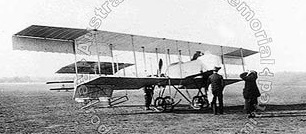
Three Type XVs survived the First World War to become civil aircraft, being some of the first aircraft to bear British aircraft registrations once civil flying was permitted in 1919.
Designed by J. D. North, the Type XIII Circuit Seaplane, originally known as the Circuit Seaplane, of 1914 was a twin-float two-seater tractor seaplane initially built to be flown by Claude Grahame-White in the Daily Mail’s 1914 “Circuit of Britain” air race that was cancelled due to the outbreak of World War I.
It was a conventional single-bay biplane with staggered wings of equal span braced by N-struts. The forward fuselage featured a highly streamlined aluminium engine cowling, with the rest of the construction being wood and fabric. The landing gear consisted of twin pontoons, with a small third pontoon carried beneath the tail.
First flown in 1914, the Type XIII was later converted into a landplane and marketed as the “Type 13 Scout” but no orders materialized.
Engine: 1 × Gnome Monosoupape, 100 hp (75 kW)
Wingspan: 27 ft 10 in (8.48 m)
Wing area: 290 ft2 (26.9 m2)
Length: 27 ft 3 in (8.31 m)
Empty weight: 1,040 lb (470 kg)
Gross weight: 1,800 lb (820 kg)
Maximum speed: 85 mph (136 km/h)
Endurance: 5 hr 30 min
Crew: One pilot
Capacity: 1 passenger
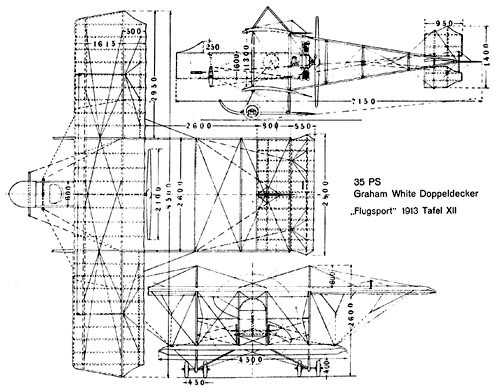
The Grahame-White Type XII “Bi-Rudder ‘Bus” of 1913 was sometimes dubbed the “School ‘Bus”.
This boxkite-type aircraft participated in numerous races before the war and led to the military Type XV. The designation “Type XII” is assumed to be right for this aircraft because the Type XV has been described as “derived from the Type XII”.

