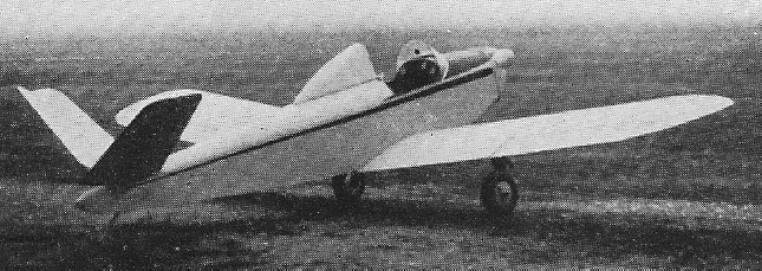
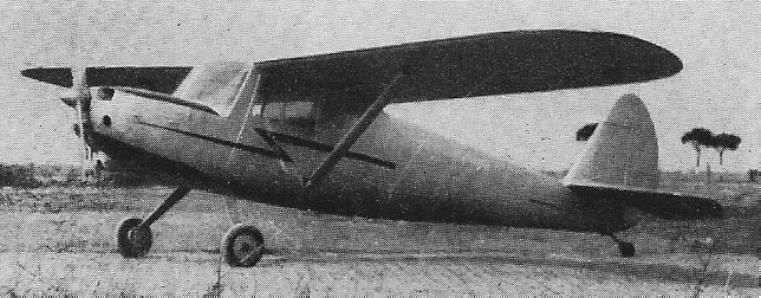
The second machine from Gruppo Costruzioni Aeronautiche of Milan, the GCA.2 Dumbo was designed by Emilio Bianchi and Giovanni.
First flown in 1951, only one prototype was built.
The Dumbo is a single-seat light monoplane with a butterfly tail assembly. All-wood construction with plywood and fabric covering. The power is a 23 hp Ambrosini P.25.
Engine: 23 hp Ambrosini P.25 Wingspan: 24 ft 3 in Wing area: 85.249 sq.ft Length: 16 ft 5 in Height: 5 ft 7 in Empty weight: 264 lb Loaded weight: 484 lb Max speed: 93 mph Cruise: 75.5 mph Time to 3280 ft: 6 min 30 sec Ceiling: 12,120 ft Range: 300 mi
Designed by Emilio Bianchi and built in 1953 by the Gruppo Costruzioni Aeronautiche, the GCA.1 Pedro is a side-ny-side two-seat cabin monoplane powered by a 60 hp C.N.A. D4 air-cooled engine.
The Pedro is of all-wood construction with plywood covering. Dual controls are fitted.
Engine: 60 hp C.N.A. D4 Wing span: 32 ft 1.5 in Wing area: 140 sq.ft Height: 6 ft 2.5 in Empty weight: 748 lb Loaded weight: 1276 lb Max speed: 106 mph Cruise: 93 mph Time to 3280 ft: 6 min 30 sec Service ceiling: 14,100 ft Absolute ceiling: 17,550 ft Cruise range: 342 mi
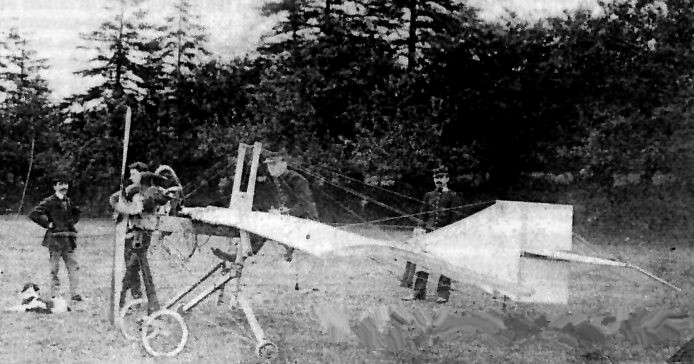
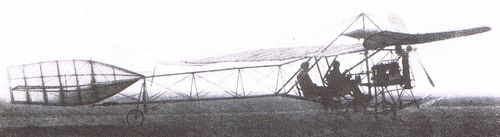
The second design of French military officer Alfred Groos. Produced in 1909, a small monoplane which was named “Quand même” [“Nevertheless”].
It was tested on 30 July 1909 as it flew about 100 meter with a speed of 55 km/hr at a height of ca. 2 meter. When it came down one part of the wing was damaged and the propeller broken. The monoplane had a four-wheel undercarriage (2 bigger in front and 2 small ones behind) and a very simple “fuselage” – about one piece of wood – and was powered by a 25 hp Anzani.
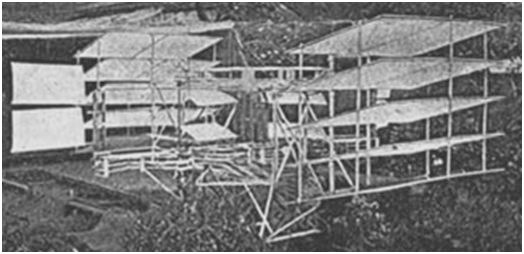
Built in the UK, this 1903 machine, which was about 80 feet in length and 60 feet in width, was to be supported on superposed planes attached to the framework both at the front and rear of the machine. It had three propellers on each side of the framework, and an extra one surmounting the whole structure. The propellers were carried on arms extending from the central driving shaft which form an axis within a rectangle, the two vertical sides of which form axes carrying the vanes of the propellers. During the driving stroke the vanes extended outside beyond the rectangle, while they returned edgewise, in a feathering position, inside it.
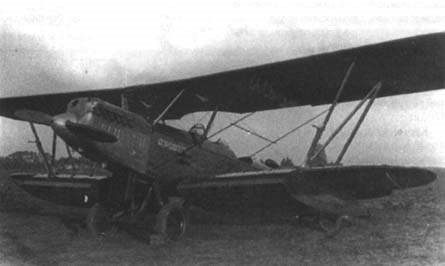
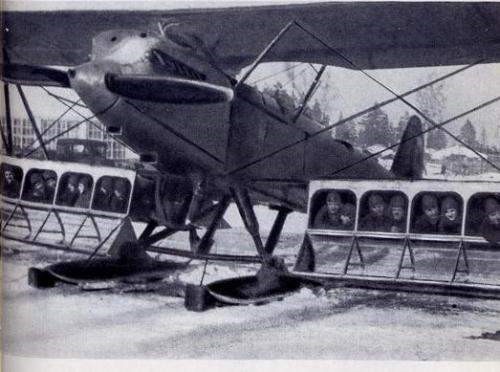
Starting in 1931, Grokhovsky worked on systems for air landing. One of the systems, the Grokhovsky G-61 (Russian: Гроховский Г-61), was to take advantage of all the payload capacity of the aircraft models without affecting their structure. It allowed a stock Polikarpov R-5 reconnaissance biplane to lift 16 people.
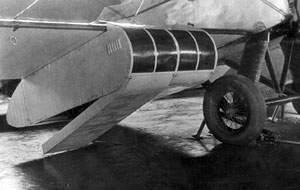
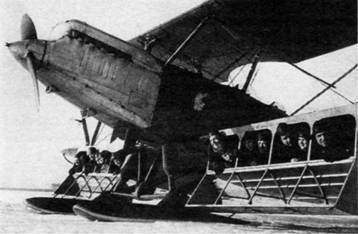
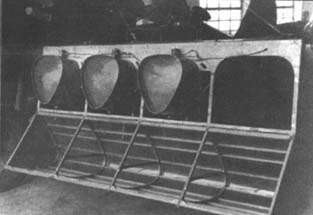
Grokhovsky decided to save resources in construction of specialized aircraft by installing two specially designed cassettes under the underwing of a stock R-5. Each had several compartments designed to carry one soldier.
The first model of the G-61 container had capacity for two paratroopers and could be opened downwards to allow jumping.
To reduce aerodynamic resistance, the cassettes were designed as a thick wing profile and by protruding from the wing plane in the front and rear area, they increased the wing area by about 7 sq.m. According to the opinion of the institute’s specialists, this should constitute an increase in the lift force and therefore increase the payload capacity of the model. The new leading edge was formed by transparent curved surfaces of Plexiglas, covering the entire width of the cassette and reinforced with a plywood structure.
In addition to transporting soldiers, these cassettes could be used to evacuate the wounded, transport supplies and cargo. Outside the military sphere, the cassettes were used to transport expeditions to remote places, carry out rescue missions, among others.
Cassettes with different capacities were designed, depending on the mission. One of the first versions of the G-61 had only 4 compartments, each calculated to transport a person weighing about 80 kg. The bottom of the compartments could be opened in flight. In this way the pilot could release loads with a parachute or launch the paratroopers into the air.
By 1935 this G-61 system passed factory tests and was delivered to state tests, but Grokhovsky kept working on higher capacity versions.
In 1936 a new version was designed. Each cassette held 7 soldiers, bringing the R-5 ‘s capacity to 15 soldiers (including one in the aircraft’s second seat). The construction turned out to be quite light, only about 200 kg. The entire structure of the R-5 was reinforced.
Yakov Alksnis and NN Polikarpov openly expressed their skepticism about the success of the new version. However, by that time Grojovski had a well-earned reputation, so he was given permission to fly his creation. The most difficult thing was finding a test pilot who wanted to test it. Three would refuse, so Grojovski finally decided to take the risk.
On December 8, 1936 at the NKTP Central Airfield in Podlipki an R-5 plane took off with the two new cassettes. The flight had been planned with sandbags until the expected takeoff weight was achieved. These sacks were jokingly known as “Iván Peskov” because this surname means “Son of the Sand”. When Alksnis and Polikarpov arrived to supervise the flight, the plane had already been loaded and the cassettes closed.
The plane with its ski undercarriage traveled around the runway for about 350 meters and took off. At the controls was Pavel Grojovski. The plane made a low-altitude circle flight and took to the runway. The surprise was tremendous when the cassettes were opened and it was found that instead of bags there were 14 Grojovski collaborators. The “official” explanation was that the Iván Peshkov sacks had not arrived on time for the tests and the collaborators had volunteered to take on the weight. In reality, this fact constitutes a sign of the confidence that the workers of the institute had in their boss.
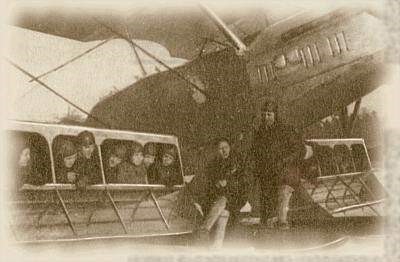
Grokhovsky poses with his teammates after the successful test.
The take-off weight on this flight, including the pilot, a passenger and an auxiliary 250-liter fuel tank, reached 1,650 kg (tests were carried out with weights up to 2,000 kg). Top speed was set at 180 km/h and cruising at about 160 km/h.
The R-5 plane with the G-61 containers under the wings after Grokhovsky ‘s flight with 14 of his companions.
Despite Grokhovsky ‘s successes at that time, he began to move away from issues related to the landing to concentrate on aeronautical production. In 1937 the institute would be reorganized and all these works abandoned.
The Polikarpov R-5 with the 14 paratroopers under the wings during tests in December 1936.
On 12 August 1937, during an attempted flight to the United States via the North Pole, the crew of the Bolkhovitinov DB-A (“Н-209”) would go missing with the crew led by polar pilot SA Levanevski.
On August 25, 1937 Grokhovsky wrote a letter to Stalin in which he reaffirmed that the capacity of the R-5 with the G-61 could be raised from 1,650 to 2000 kg. This would make it possible to locate auxiliary fuel tanks with a pump transfer system to the main tanks and increase the range of the P-5 (civilian version of the R-5) to 3,000 km. In 7 – 10 days Grokhovsky promised to have the cassettes ready. In addition to fuel, these capacities could take food for several months, a tent, an inflatable boat, and all the necessary instruments for a prolonged search.
Grokhovsky further enunciated the advantages of the R-5 for the task due to its ability to land and take off on relatively short runways, the presence of dual flight control, and the possibility of transporting the entire return crew in a single aircraft. The letter ended with a request to allow to equip a P-5 with cassettes and allow it to participate in the search for the crew of “Н-209”.
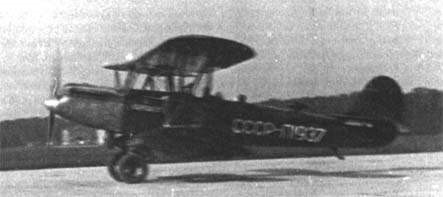
Grojovski ‘s request was approved. Two P-5 airliners were loaned from the GVF’s northern direction. The first, with factory number 8458, had been delivered in 1934, receiving registration СССР-Л1565 in August. The second example, with factory number 9627, would enter service in June 1935 with registration СССР-Л1937. Both examples received the designation PG-61.
The cassettes were installed in Factories No.89 and 241. The engineers Gubanov (Factory No.241), Mladkovski (GVF Main Directorate), Vorozhtsov (NII GVF) and instrumentalist Lomtiev played a vital role in the modifications.
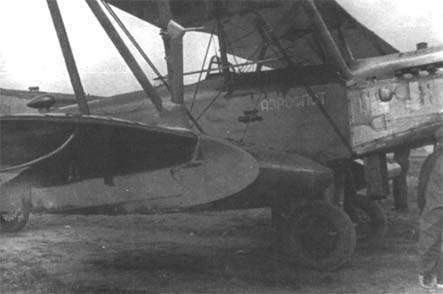
PG-61 with wing cassettes. The radio station antenna is clearly visible on the rear fuselage.
The modifications made made it possible to increase the takeoff weight of the P-5 to 4050 kg. The cassettes were designed in such a way that all the weight was concentrated near the center of gravity of the model.
On September 12, 1937, the aircraft, registered СССР-Л1565, took off from Moscow to Arkhangelsk with the pilot of the experimental institute Boris Bitski. In two days it reached its destination, where the plane was disassembled for transport aboard the steamer “Roshal”, which was traveling to Rudolf Island in the Franz Josef Land archipelago .
PG-61 СССР-Л1937 takes off towards Arkhangelsk.
The second example СССР-Л1937 was kept in Moscow for a set of tests. Auxiliary fuel tanks with a total capacity of 840 liters were installed in six of the 8 cassette compartments. The takeoff weight with fuel rose to 3350 kg. In the rest of the compartments there was a reserve radio station, food for two months, weapons, sleeping bags, and additional parts for minor repairs to the plane. The takeoff weight grew to 3780 kg. Instruments for blind flights, a radio-compass and powerful radio equipment were installed in the piloting cabins.
Fuel tanks located on the G-61 cassettes.
On September 16, 1937, pilot IS Kotov and the radio operator Degtiev began the tests of the aircraft at the Bykovsky airfield. Only four flights were carried out in which it was possible to determine that the aircraft behaved quite well in flight and could be controlled without difficulty, despite its great weight. Takeoffs and landings and horizontal flight of maximum and minimum speeds were tested. The plane behaved well and not unlike the normal P-5.
During the takeoff run, no tendency to deviate to one side was recorded. Takeoff occurred at a speed of 90-95 km/h and the run lasted about 18 seconds.
Horizontal flight was tested at speeds between 135 and 185 km/h. Gliding was tested at speeds of 135 – 140 km/h, demonstrating good stability.
The landing was not unlike normal P-5 aircraft. The auxiliary tank system also passed the tests.
After the culmination of the tests, the СССР-Л1937 plane flew to Moscow, from where it departed for Arkhangelsk, taking on board the same crew that participated in the tests. In Arkhangelsk the plane was disarmed and its crew joined that of the other plane, which had not yet boarded.
The Roshal steamer arrived in Arkhangelsk on October 1. The loading of the ship took 5 days. At the end of October, it would arrive at the island of Rudolf, where a group of Tupolev G-2 planes (civilian transport version of the Tupolev TB-3 bomber) were already present. Despite the number of aircraft and crews, constant weather problems did not allow the pilots of these aircraft to conduct an active search for Levanevski’s aircraft.
Unlike these large aircraft, which arrived flying under their own power, the P-5s, after unloading, had to be fuelled and transferred to the improvised runway. During final preparation on December 2, the ice under Bitski’s aircraft gave way and the СССР-Л1565 aircraft plunged about a meter, damaging its propeller. Next to the plane, Chuxnovski, who was helping in the preparation, fell into the water.
On December 8 both planes were prepared for flights. Both pilots calculated that the weather would improve and in about four days they could take off. In one of the planes the navigator LM Rubinshtein would travel. Inclement weather thwarted this plan.
The weather situation improved only on the 20th and the P-5s, together with Chuxnovski’s G-2, were ready. Bitski and Kotov tried twice to take off, but a broken tail skid prevented them from taking off. It is unknown if the PG-61 took part in the rescue flights or not.
It is known that СССР-Л1937 survived this adventure and was still flying at the beginning of 1941. The fate of the P-5 СССР-1565 is unknown.
Grokhovsky G-61 Powerplant: One M-17B, 680 hp takeoff / 500 hp rated power Wingspan:15.5/12.6 m Wing area: 50.2 m² Length:10.56m Loaded weight: 3800kg Wing loading: :75.7 kg/sq.m Power load: 7.6 kg/hp Payload capacity: 15 soldiers Cargo volume :4.3 cu.m Top speed: 201km/h Cruising speed: 130 km/h Take-off run max load: 400 m (30 sec) Ceiling: 2800m Accommodation: 1-2
Practical work on the development of a “tailless” aircraft began at the Oskonbyuró (Bureau for Special Constructions of the VVS RKKA) in Moscow at the beginning of 1933. The group led by Grojovski had previously tried to venture into this type of apparatus, but the large number of “gaps” did not allow it to seriously engage in the development of such a complex task. In particular, the issues related to the achievement of the necessary stability in flight became more complex.
Grojovski also clearly understood the need to start with experimental models. Only phased development would allow the necessary experience to be obtained, but this principle was foreign to the bureau’s way of working. Since its creation, all the works conceived by the group under the direction of Grojovski had a practical nature, designed so that once the tests were completed, they could go directly into service.
In those years attention began to be paid to a new type of aerial combat: the demolition of the enemy plane by ramming. In Russia this method was popularized by the pilot Nesterov and received the name “Taran”. Generally the “Tarán” was carried out placing the own plane at 6 o’clock from the enemy and cutting its tail planes or wing tips with the propeller. In the best of cases, the attacking aircraft landed with a damaged propeller, in many others it ended up destroyed along with its opponent. The “Taran” method was promoted during the first stage of the Great Patriotic War, when German aviation had air superiority. Many Soviet pilots rammed their planes into the enemy in those unequal combats.
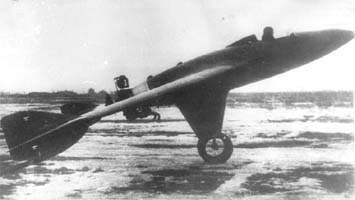
Grojovski decided to study the possibility of building a plane specialized in ramming. It was a matter of designing a model capable of inflicting great damage on the enemy plane without great damage to its own. The result of this work was an aircraft without analogues for the time that received the name G-39 from the institute and the nickname “Cockroach” (Russian: Гроховский Г-39 “Кукарача”).
As a basis for Grojovski ‘s thought, an example without tail planes was designed. Along the entire leading edge of the wing, a “knife” was installed, a thin, sharp sheet of high-strength steel. In the bow, the installation of a long bar with sharp edges was foreseen, which was to protect a pneumatic cannon. Between this bar and the wing consoles a fine steel cable was installed. It was thought that at the moment of impact, either with the cable or with the edge of the leading edge, the enemy’s tail would be destroyed.
In general, the G-39 repeated Cheranovski ‘s flying wing schemes. The short, cigar-shaped fuselage featured an enclosed bubble-like cockpit forward. In front of the windshield was an armored plate.
The wing had a 38º leading edge camber and ended in vertical surfaces inserted into the trailing edge. The tips of the wings inclined downwards.
At the rear of the fuselage, within a semicircular indentation in the wing, the propeller was located in a drive configuration. The engine was installed at the rear of the fuselage using a special system that allowed it to rotate the engine from its horizontal to vertical position. In this way, the variable pitch propeller was converted from a driver to a tractor and generated the necessary lift to allow vertical takeoff.
The landing gear of the G-39 featured four wheels. The main units featured long landing gear covered by a thin fairing and attached to the wing root, at the point of junction with the fuselage. The other two wheels were located in the lower part of the wingtip vertical surfaces.
From the drawing stage of the new model and by virtue of its appearance, the designers named it “Cockroach”.
Among the novelties incorporated in the development of the model was the introduction of vertical takeoff capability. The idea of such a possibility had been presented by Grojovski in his work “Installation of a power unit in the middle zone of the fuselage”. With this decision the technical task was to develop a tailless ramming aircraft capable of vertical takeoff and landing. The general conception of the new plane was patented by Grojovski on February 25, 1935.
Despite its technological novelty, the new model was based on a body of documented discoveries, calculations, patents, and innovations. On the other hand, there was the trust of the group in the intuition of their boss. Even without the necessary technical preparation and unable to explain how and why, Grojovski always ended up being right, even in those cases in which “science” suggested that his ideas were theoretically incorrect. For this reason, the new task did not raise doubts as to its success, neither in the bureau workers, nor in the invited specialists, and soon the new G-39 model began to take shape on the drawing sheets.
The task was presented with its specifications, but the bureau group lacked knowledge and experience for its development. A group of specialists, VF Bolkhovitinov, SG Kozlov and A. Ye Kaminov were contracted for the conception of the project.
The development and construction of the “Cockroach” was carried out in difficult conditions. The invited specialists could dedicate only their free time to the design, mainly at night. The model was not registered in any development plan, so it had no allocation of material resources.
The construction was carried out in the workshops of the TsAGI. Getting a new engine was impossible, so they had to be content with the underpowered 100-hp M-11, removed from another aircraft. To build the fuselage they had to use leftover materials from other productions. The shortage of qualified personnel was constantly felt. The lack of specialized equipment in the TsAGI workshops made it necessary to simplify the project.
The closed cockpit was replaced by an open one with a windshield. The semicircular slit in the wing, in the position of the propeller, was replaced by a rectangular one. As a result of this modification, the triangular wing ended up becoming a swept wing and its trailing edge a large horizontal stabilizer with a large area and span.
The prototype lacked the ramming equipment, neither the wing knives, nor the installation of the nose system with pneumatic cannon could be installed in the conditions of the workshop.
Another feature that seems to disappear in this prototype was the possibility of vertical takeoff. At least no evidence is collected to show that it was ever tried by the participants in the tests.
The TsAGI workshops were commonly visited by Valeri Pavlovich Chkalov. He had been entrusted with the task of testing the plane and for this reason he considered it mandatory to know the apparatus at the assembly stage. Under his advice, the cabin was set up and the equipment and instruments were placed in the correct position.
At the end of the spring of 1935 the “Cockroach” left the workshops for the development of the tests. Seeing him on the track, Chkalov commented:
“Oh! It actually looks like a cockroach. I’ll try it.”
However, flying the “Cockroach” proved impossible. The G-39 ran down the runway increasing its speed but in no case did it get up on the runway. Chkalov, not giving up, raced the plane up and down the runway failing to get it airborne until the fuel ran out.
Irritated and addressing the plane’s designers, he blurted out:
“A real Cockroach and Cockroaches don’t fly! Somewhere you miscalculated or overthought, distinguished!”
The failure of the G-39 can be explained by a series of causes: The low motor power; The position of the propeller in relation to the fuselage, the wing and the fairings of the main landers contributed to diminish the effect of the propeller; The low quality of the construction of the plane;
With all these problems against, the “Cockroach” was unable to take flight.
But Grojovski did not give up his efforts and, not without the help of some important people in the VVS, managed to have the “Cockroach” project included in the official plan of the NKTP Experimental Institute. For this he had to abandon the idea of the vertical takeoff. Work on such a “progressive” model would not have received support.
The contract with the invited specialists was not renewed. Grojovski put his replacement VD Urlapov in charge of development, taking into account that the project already existed and the experience had been accumulated to take on the job. Three months later in the Soviet press would appear: “The experimental institute of the Narkomtyazhprom in Leningrad begins the development of a model of a flying wing with a 100-hp engine. This plane can carry four passengers and fly at a speed of 220 km/h. In a period of two and a half months the plane should be ready to participate in the all-Soviet race organized by the newspaper “Pravda”, the Central Committee of the Komsomol and the Council of OSOVIAJIM . “
From this moment the development of the G-39 disappeared without a trace. All information about its development has disappeared. Neither was it clear about his fate in contacts with the institute’s workers during that time. Possibly all this is linked to the process that followed the dissolution of the institute and the repression linked to the arrest of MN Tukhachevaski.
G-39 Powerplant: 1 × 100 hp M-11 Wingspan: 6.80 m Wing area: 14.20 m² Length: 8.84m Height: 3.16m Empty weight: 520 kg Maximum takeoff weight: 698 kg Accommodation: 1
1910/11 two-seater monoplane of Dipl.-Ing. Karl Grohmann, with a high-positioned “Zanonia” wing and a fully open fuselage. It was powered by a 50 hp Argus engine, which drove the tractor screw via a chain. Immediately on its first flight the machine flew 300 meters. Later Grohmann built a single seat development of the 1911 machine. Sometimes the two-seater is identified as the Grohmann I and the single-seater as the Grohmann II, but this is probably a spurious coding introduced years after the event.
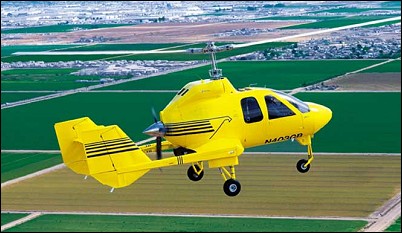
The Hawk 5 (five place) Gyroplane brings to aviation a unique aircraft with many utilitarian qualities. The Hawk’s performance and exceptional versatility also offer a safe and affordable alternative to helicopters and airplanes in many applications. The aircraft’s simple, robust, design translates into lower operating costs than any comparable turbine powered helicopter. The wide operating speed range, from 46 – 162 mph, of this highly maneuverable gyroplane also ensures the Hawk 5 a new niche in the aviation marketplace. The Hawk 5 design, intended for series production following certification, incorporates modifications gained from GBA’s experience with its Hawk 4 (four place) prototype. These include a weight reduction program and an extended cabin that will permit an additional passenger. Most notably are: higher capacity; vertical take-off and landing; a marked increase in useful load, range and endurance; and higher maximum and cruise speeds. Easy to fly and always in autorotation, the Hawk 5 offers uncompromising safety in the realm of flight.
Engine Rolls-Royce 250 C20S (420shp) gas turbine Rotor Blade 42 ft. – 2 blade system Fuselage Length 24 ft. Height 13.5 ft. Fuel Capacity 100 gal. Max. Gross Weight 3,500 lbs. Useful Load 1,525 lbs. Rate of Climb (ft./min.) 1,500 Max. Speed (VNE) 162 mph (140 kts) Cruise Speed 140 mph (122 kts) Service Ceiling 16,000 ft. Range at Cruise 508 miles (no reserve) Endurance 5 hours (no reserve) Seats 5
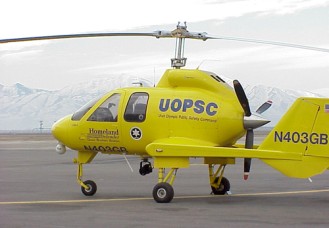
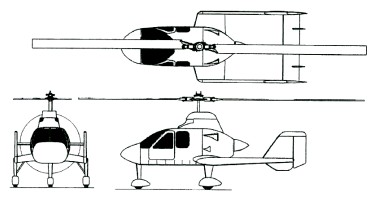
Design changes to H2X and later Hawk III in October 1998 resulted in Hawk 4. Initial aircraft (N402GB) first flew 29 September 1999, powered by a Continental piston engine, and made first vertical take-off on 9 December 1999; had flown 120 hours in 200 sorties by early April 2000. In September 2000 company switched certification effort to turbine-powered Hawk 4T (N403GB), which was renamed Hawk 4 at this time following abandonment of piston-engined version; the following October Groen changed its focus to seek government contracts for Hawk 4, slowing certification process for both piston- and turbine-powered versions until it sees market upturn. GBA analysises and optimises gyroplane rotor blade airfoil performance resulting in a family of natural laminar-flow airfoils for the rotor blades of the Hawk 4 and successor gyroplanes. The airfoil design optimizes the lift/drag relationship for the Hawk rotor system. Initial Hawk models will use aluminum rotor blades with GBA’s proprietary airfoil design, and subsequent models are anticipated to use composite blades with an enhanced GBA proprietary airfoil design that will permit increased operating speeds. The aircraft features twin tailbooms supported by stub-wings which also house main landing gear, and twin stabilisers and rudders with fixed horizontal tail surface mounted between the vertical tails. A two-blade, semi-rigid aluminium teetering rotor with swashplate has a rotor speed of 270rpm. The collective pitch-controlled rotor head allows vertical take-off (zero ground roll) and enhanced flight performance. Rotor brake is standard. Actuation by pushrods. Patented dual-control stack cyclic flight controls. The structure had a steel mast and engine mounts; stressed skin aluminium semi-monocoque fuselage, tail unit, hub structure and propeller; composites nose, engine cowling and wingtips; acrylic windscreen and doors; glass fibre nosecone and engine cowling. The undercarriage is fixed tricycle type with mainwheel tyres 6.00×6; nosewheel 5.00×5, Cleveland hydraulic brakes, and twin safety wheels at rear of tailbooms. Hawk 4 piston-powered version has air-cooled, six-cylinder Teledyne Continental TSIO-550 rated at 261kW at 2.700rpm; prototype had four-blade MTV propeller but production models will have Hartzell three-blade constant-speed propeller. Engine provides power to rotor for prerotation to provide for short and vertical take-off capability; power to rotor system never engaged during flight. Fuel capacity is 284 litres in a single tank at the rear of the fuselage and a refuelling point at the top of the fuselage. Oil capacity 11.4 litres. The pilot and up to three passengers are in an enclosed cabin in two pairs of seats. The rear seats folding to provide baggage space. The electrical system is 28V DC.
The production prototype for Hawk series was powered by a 134kW Textron Lycoming O-360-A4M flat-four. The company has a flight test facility at Buckeye, Arizona, where, on 12 July 2000, the prototype Jet Hawk 4T / Hawk 4 made its initial flight. This turbine-engine version is powered by a Rolls-Royce Model 250 420shp turboprop engine driving a three-blade constant-speed propeller, first flown (N403GB) on 12 July 2000. Other changes include addition of underfins and taller landing gear. Two further prototypes under construction. The Hawk 4T is sold fully assembled with a Rolls-Royce Model 250 B17C gas turbine for $749,000 in 2001. By May 2003, deposits on 148 aircraft had been taken, via 12 dealerships at around US$749.000 (2003). Fractional ownership programme announced July 2001 but later dropped. The Hawk 4 was an integral part of security during the 2002 Winter Olympic and Paralympic Games. On 28 December 2001, Groen announced contract with Utah Olympic Public Safety Command for lease of Hawk 4, beginning 20 January 2002, for security patrols at Salt Lake International Airport, equipped with video downlink system, Spectrolab SX-5 searchlight and additional radios. The Hawk 4, during its operational period for the Utah Olympic Public Safety Command (UOPSC), was available 24-7, completed 67 missions and accumulated 75 hours of maintenance free flight time.
Hawk H4 Engine: Rolls-Royce 250, 420shp Rotor diameter: 12.80m Fuselage length: 7.31m Overall height: 4.11m Empty weight: 835kg Max. take-off weight: 1587kg Useful load: 960 lb Fuel capacity: 75 USgal Max. speed: 238km/h Cruising speed at 75% power: 212km/h Max. rate of climb at sea level: 457m/min Service seiling: 4875m Take-off run: 8m Range with max fuel at 75% power: 584km