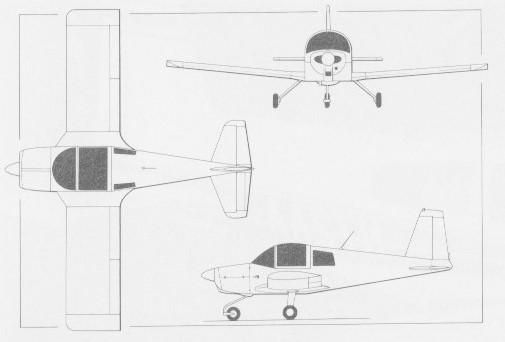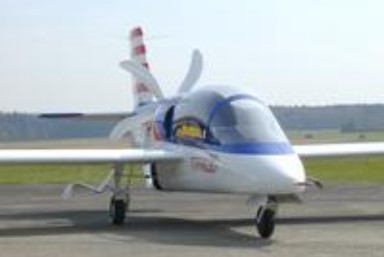
Austrian Ultralight Project looking for a producer.
Cruise: 189 kt / 217 mph / 350 kmh
Empty Weight: 520 kg / 1146 lbs
MTOW Weight: 750 kg / 1653 lbs
Climb Ratio: 1600 ft/min / 8,50 m/s
Take-off distance (50ft obstacle): 770 ft / 235 m
Austrian Ultralight Project looking for a producer.
Cruise: 189 kt / 217 mph / 350 kmh
Empty Weight: 520 kg / 1146 lbs
MTOW Weight: 750 kg / 1653 lbs
Climb Ratio: 1600 ft/min / 8,50 m/s
Take-off distance (50ft obstacle): 770 ft / 235 m
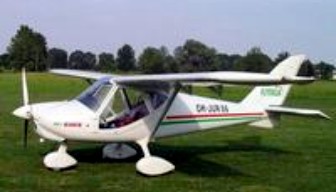
Classical all-metal high-wing with side-by-side seats designed to be ideal for training, cross-country flying and flying for fun.
Stall: 34 kt / 39 mph / 63 kmh
Cruise: 119 kt / 137 mph / 220 kmh
VNE: 148 kt / 171 mph / 275 kmh
Empty Weight: 275 kg / 606 lbs
MTOW Weight: 480 kg / 1058 lbs
Climb Ratio: 1000 ft/min / 5 m/s
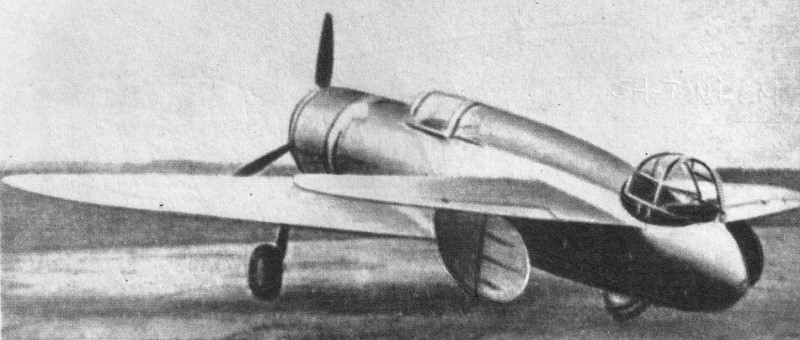
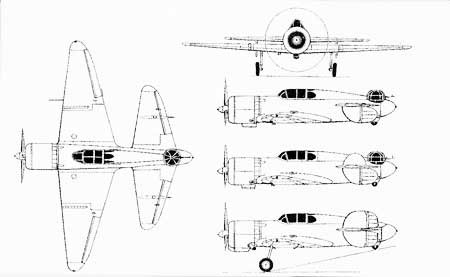
A development of the KB MAI under the direction of PD Grushin, known as Sh-MAI, MAI-3, Sh-Tandem or Tandem-MAI (Russian МАИ/Грушин Ш-Тандем), designed as a two-seater with an unconventional structure of tandem wings. This configuration was selected taking into account that the distribution of mass along the entire length of the cantral axis of the aircraft would allow excellent longitudinal stability. Another success of this configuration was the possibility of locating the gunner’s turret directly in the tail section, which together with the use of a double empennage structure, allowed excellent defensive coverage. The tandem scheme also facilitated armor plating and the location of the weapons bay.
Originally the Sh-Tandem was designed to use an M-88 air-cooled radial engine, but when it was not available an M-87 and later an M-87A were used.
The main wing was set low and housed the main landing gear lugs. The tail wheel was not retracted in flight.
The rear wing was located high on the fuselage and its area represented 45% of the main one, also working as a tailplane. Ailerons were arranged on both wings, behaving at the rear also as elevators.
The vertical empennages were located on the rear wing, roughly in the center of the console’s wingspan.Five different configurations of these vertical fins were tested, ending up with large area washer-like structures, located above and below the wing. Each fin was integrated into the wing structure and contained the rudders. This configuration affected the gunner’s firing coverage area, which led to the need to move him towards the wing.
The Sh-Tandem was built entirely in wood, mainly bakelite plywood. The wing featured a double spar with crafted covering panels.
The Sh-Tandem’s armament was standard for a light attack aircraft and consisted of 4 x 7.62mm ShKAS machine guns in the wings with 2,400 rounds total, one ShKAS machine gun in the turret with 700 rounds and capacity for 200kg bombs externally.
The Sh-Tandem prototype was built in the MAI workshops and the fuselage, the centerplane and the main consoles were built by a group of 18 workers from the institute’s workshops in just 45 days.
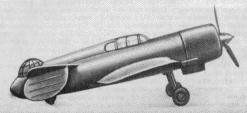
On January 8, 1939, the plane in a single-seat configuration and without weapons carried out the first flight tests with the M-87 engine. In these flights, a high speed was achieved, the performance corresponding to the calculated data. The speed at sea level reached 406 km/h and at an altitude of 4,250 meters it was 488 km/h.
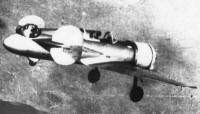
Based on the results obtained in the tests, Grushin was recommended to move the gunner’s cabin a little more to the stern and equip it with an MV-5 turret.
Between September and October 1939, the two-seater version of the Sh-Tandem with a new M-87A power plant with a nominal power of 950 hp and a BISh-3 variable pitch propeller carried out joint factory and state tests. This example featured a rearward gunner’s cabin and MV-3 turret. During the tests, 51 flights were carried out with a total time of 18 hours and 38 minutes. With a flying weight of 2,800 kg, the speed at sea level reached 361 km/h and at 5,600 meters it was 444 km/h. Landing speed without air brakes was 140 – 145 km/h. The takeoff run was 400 meters and the landing run was 480 meters.
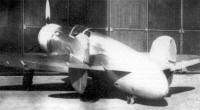
The test report was signed on October 10, reflecting the aircraft’s ease of handling, but in general it was considered that the Sh-Tandem failed the tests because it failed to achieve the results requested by the military, in addition of presenting a tendency to destabilize with increasing speed and other problems such as discomfort in the gunner’s cabin, ineffective design of the landing gear and lack of rigidity in the front wing.
The takeoff was rated as difficult and the upper position of the rear wing was considered not the most appropriate. The armament was also not considered finished. The MV-3 turret “swallowed” 34 km/h speed, so it was decided to redesign the gunner’s position to a version similar to the one used by the Fokker G.1. However, it was considered that the Sh-Tandem scheme represented military interest, so it was recommended to deliver the prototype to the TsAGI, make the improvements and present it again for testing.
The construction of a second prototype characterized by the negative dihedral in the rear wing began. This example included a retractable tricycle landing gear and an M-63 engine capable of developing 800 hp at 4,500 meters. The little formality of the design and the low power of the weapon conditioned the decision of the NKAP to abandon development in May 1939. The second prototype was 70% complete when work was definitively suspended.
The results obtained during the tests were used in the projection of the next model of the KB MAI, a light bomber that was called BB-MAI.
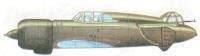
Sh-Tandem
Engine: 1 x 930 hp М-87
Wingspan: 11.00 m
Length: 8.50m
Wing area: 30.40 m²
Normal takeoff weight: 2560 kg
Wing loading: 84kg/m²
Power load: 3.3kg/hp
Maximum speed at sea level: 406 km/h
Maximum speed at altitude: 488 km/h
Landing speed: 145 km/h
Accommodation: 2
Armament: Five 7.62mm ShKAS machine guns
Bombload: 200kg
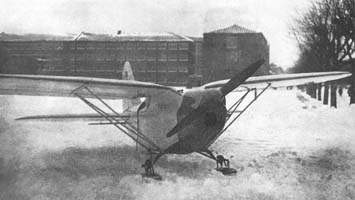
In the mid-30s at the OKB-1 of the Moscow Aviation Institute (MAI), led by PD Grushin, developed a small light aircraft with a monoplane tandem wing named Ortyabrionok (Russian: МАИ/Грушин Октябренок). This project was developed in 1935 to participate in the contest for light aircraft with low engine power, called by the management of Osoaviajim and Aviavnito. The main requirements of this contest were: totally safe flight, wide tolerance in piloting, ability to be used for the preparation of novice pilots and, above all, low manufacturing and operating cost.
The work on the Oktyabrionok included the development of a scale model for wind tunnel tests, and the development of various configurations. As a result, an airplane with tandem monoplane wings was designed.
On the Oktyabrionok the front and rear wings were fixed. Elevons were located on the forward wing along the entire wingspan of the trailing edge. These elevons that performed functions of elevators, flaps for takeoff and landing operations, and ailerons for turns. The rear wing was embedded in the airframe and lacked control surfaces. The presence of the elevators in the forward wing allowed to obtain a great efficiency in the takeoff and landing operations.
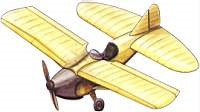
Unlike the French ” Pou du Ciel “, in the Oktyabrionok the front wing was fixed to the fuselage by means of horizontal joints linked to the control stick, which allowed a variation of the incidence of the wing in relation to the longitudinal axis. With this modification, the elevators managed to maintain their effectiveness in all flight regimes, including diving, which managed to solve one of the main deficiencies of the French model, which also caused a few accidents. This configuration was the result of wind tunnel tests and was later confirmed during flight tests. It was flown by pilots with very little experience.
The control of the flight in the basic piloting configuration was executed only by means of the flight stick. In this case the pedals only served to direct the tail wheel on the ground. Modifying the center of gravity of the airplane towards 50 – 60% of the longitudinal axis, it was possible to reduce the stability of the airplane in flight to an acceptable level for pilots with medium qualifications. In this case the pedals were connected to the rudder.
Originally in order folding wings were designed. The front ones were collected upwards and the rear ones back to the sides of the fuselage. In the model development process this option was eliminated.
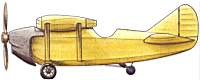
In the initial conception, a power plant that was developed as a project by the OKB-2 of MAI. This model was not yet ready at the time of the competition, so the initial power plant was a 27 hp Obré-Dunné, which was later changed to a 30 hp Bristol Cherub. The plane turned out to be somewhat heavier than the calculations, instead of 230 kg its weight was close to 400 kg. For this reason, after several modifications, a more powerful 45 hp Salmsom engine was installed.
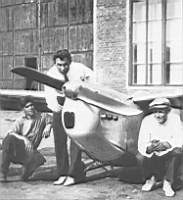
AI Grinchik, PI Blandov, PV Semionov and AA Lebiedinski took a very active part in the construction of the Oktyabrionok. In the process of developing the model, the wing spars were reinforced, shock absorbers were added to the wheels, and the rudder area was increased.
The first flight of the Oktyabrionok took place on October 23, 1936. Test pilot AI Zhukov, chief pilot of the Aviajim Factory, reached 1000 meters. After several turns over the airfield, Zhukov executed an eight, demonstrating the excellent stability of the plane. For takeoff only 50 – 60 meters were enough. For the landing only 15 meters.
On October 30, taking off from the airfield of the MAI aeroclub in Khimki, AI Zhukov flew over the institute and made several figures over the Tushino airfield.
The instructors of the MAI Flying Club, AA Lebiedinski and S. Jolobtsov, flew at Oktyabrionok and PD Grushin himself received his training as a pilot on this plane.
The Oktyabrionok flew well, but the tandem wing configuration did not allow for great aerodynamic advantages relative to the conventional monoplane layout.
After tests at the NII VVS, developed by PM Stefanovski , the Oktyabrionok was delivered to the VVS , being registered as a staff liaison aircraft. It flew successfully for a few years.
In 1938 the Oktyabrionok participated in the air show held in Tushino.
Engine: 1 x 45 hp Salmson
Forward wing span: 6.00 m
Rear wing span: 4.4 m
Total wing area: 12.80 m²
Front wing area: 7 m²
Length: 4.12 m
Empty weight: 295 kg
Maximum takeoff weight: 400 kg
Fuel capacity: 25 kg
Payload capacity: 105 kg
Wing loading: 23 kg/m²
Power load: 8.9 kg/hp
Maximum speed: 115 km/h
Cruising speed: 95 km/h
Landing speed: 55 km/h
Accommodation: 1
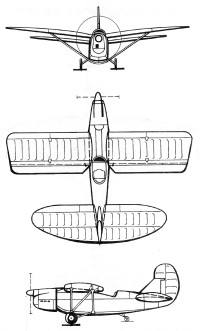
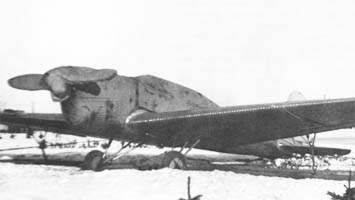
The idea for the creation of the MAI/Grushin Stal-MAI (Russian МАИ/Грушин Сталь-МАИ) arose in 1931, when the TsAGI decided to develop record-setting aircraft to achieve long-range flights. In August 1931, the Military Revolutionary Committee (Revboyensoviet) organized a commission for the development of a long-range aircraft and in December 1931 the decision was made to finance the development of the RD (ANT-25) designed by Sukhoi in the OKB of AN Tupolev and designed to reach 13,000 km. In parallel, it was requested to create an aircraft with a range of about 5000 km.
At the end of 1931, the head of the chair of construction and aeronautical projection of the MAI, DP Grigorovich organized a group of students for the design of the airplane. Such students as P. Grushin, M. Pasinnin, L. Kurbala, V. Fiedulov and A. Shelkin were included in this group.
The strength calculation was developed by VP Yarovitski and the construction was directed by the deputy director of UPM SM Belyaikin. The head of the production workshop was AS Orlov, the engineer-technologist for welding processes L. Pasiechnik. The new aircraft, named Stal-MAI (Steel-MAI) was built by A. Bajariev, V. Novikov, A. Ivanov and others in the MAI.
During the course of the construction process, the technical direction passed to PD Grushin, who in 1933 went on to lead the recently created OKB-1, built on the basis of the KB of the aeronautical construction faculty of the MAI.
The Stal-MAI was a low-wing monoplane with a straight trapezoidal wing. The relatively short fuselage with monoplane tail of conventional type. The engine was a water-cooled M-34R with 830 horsepower. The engine used in the Stal-MAI was the one used in exhibitions and for this reason it was characterized by a special finish, reflected in the polishing of the outer surface, the chrome finish of the nuts and piston heads, and the painting of the block. The M-34R used a gearbox to drive a variable-pitch metal propeller.
The Stal-MAI was one of the first aircraft in the world made entirely of steel (hence its name). The construction was entirely in Enerzh-6 stainless steel, with fabric covering on the control surfaces. The fuselage was a welded semi-monocoque structure covered with light plates.
The wing featured a double spar. The front spar was located at the thickest point of the profile (28% of the chord) and was built on the basis of shaped strips. The rear spar was made of chrome molybdenum steel tubes. The wings had a wingspan of 18 meters and an area of 40 m², allowing a calculated speed of 320 km/h, with a landing speed close to 100 km/h.
Virtually all construction of the fuselage, wing and tail was made using electric spot welding. The wing and fuselage skin was made with thin 0.3 – 0.5 mm steel sheets. At some key points the shell was reinforced with internally welded corrugated steel. All the ribbing was also made with shaped steel parts.
The landing gear was of the conventional type with retractable main landing gear with air shocks and a tailwheel. The main units retracted into the wing with the help of a hand crank mechanism.
The cabin was two-seater, closed by a single cover.
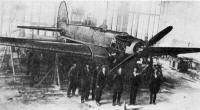
The Stal-MAI was built at the UPM MAI and was delivered for testing in the summer of 1934. The tests took place at the Jodinka airfield and the test pilots were IF Kozlov and Yu. I. Pyontkovsky.
On September 19, 1934, Yu . I. Piontkovski made the first flight of the model. During the fifth flight an accident occurred due to an overheating of the engine. Yu. I. Piontkovski and PD Grushin were able to land successfully, but during touchdown the power bank and the wing fixing base deformed. The repair process was extremely long, extending practically throughout 1935, without actually finishing it, so the plane never took flight again.
Powerplant: 1 x 830 hp M-34R
Wingspan: 18.00 m
Wing area: 40.00 m²
Length: 11.30m
(Calculated)
Maximum speed: 320 km/h
Cruise speed: 280 km/h
Landing speed: 100 km/h
Range: 5000km
Accommodation: 2
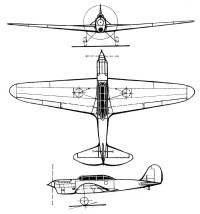
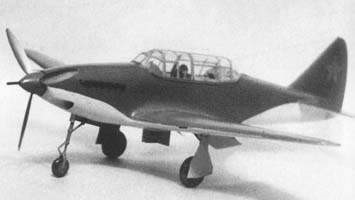
Developed in the late 1930s by the Moscow Aviation Institute in the OKB-1 led by PD Grushin, was a ground attack aircraft and light bomber that received the designation MAI/Grushin BB-MAI (Russian: МАИ/Грушин ББ-МАИ).
The BB-MAI was designed as a classic monoplane layout airplane with a 1050 hp M-105 powerplant and was designed during 1938 and 1939.
The BB-MAI introduced the use of bakelite plywood construction, introduced with the help of a group of specialists from VIAM, the engine used a compressor that worked with exhaust gases, developed by TsIAM, for the first time in the USSR, a nose Wheel undercarriage, and a movable turret.
The double-spar wing was made up of three C-sections made of Bakelite plywood. When these sections were joined together, the “back” formed the spar wall and its base became the wing covering. The sections were glued with VIAM B-3 glue during assembly, producing a structure of considerable rigidity. The wing area was small at 15.2 m², therefore, with a takeoff weight close to 3,500 kg, the wing loading reached 210 kg/m². The wing also had automatic slats.
The coating on the base of the wing reached 5 mm and on the tail section 3 mm. The walls of the stringers were 25 mm. The fuselage was of the monocoque type made of bakelite plywood glued with the same glue. This construction achieved such strength that the internal structure could be lightened. As in the case of the Grushin Sh-Tandem, the surface was highly polished.
The main wheels were retracted towards the wing, to the sides of the fuselage, with a 90º turn of the wheels. Behind the front wheel was the radiator.
Construction of the prototype began in 1939 and it was completed in 1940 at KBMAI. The main builder of the prototype was AA Lebiedinski and AA Manucharov was appointed as the main test engineer. The BB-MAI was tested by MAI graduate AN Grinchik, a Soviet test pilot who would die in a crash in the USSR’s first turbojet aircraft.
Construction delays led to the first flight taking place in December 1941. By that time the interest of the VVS for an aircraft with these characteristics had already disappeared. Grushin himself had been appointed KB ‘s main builder at Kharkiv Aviation Factory (JAZ) No.135 and KB MAI was soon shut down for a few years.
Only one prototype was built and flown in the December 1941. The proximity of the war led to the end of the project. The BB-MAI was never armed.
Powerplant: 1 x 1050 hp М-105
Wing span: 10.00 m
Wing area: 16.80 m²
Length: 9.60m
Empty weight: 2965 kg
Normal takeoff weight: 3490 kg
Wing loading: 208 kg/m²
Power load: 3.3 kg/hp
Maximum speed at sea level: 508 km/h
Maximum speed at altitude: 550 km/h
Ascent time to 5000 m: 9.2 min.
Practical range: 500 km
Practical ceiling: 9000 m
Accommodation: 2
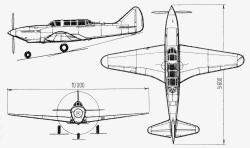
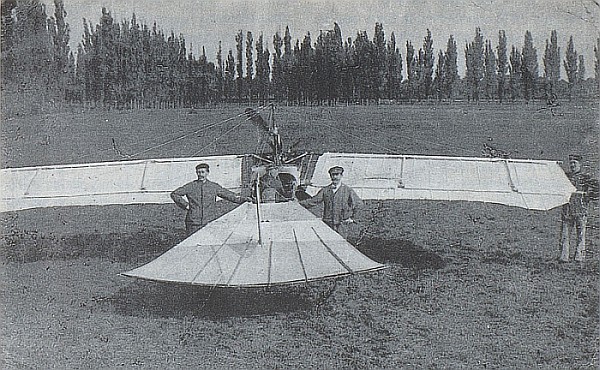
The first aeroplane built in Speyer (Pfalz), by a Leutnant Grundner with assistance of the officers of the Kgl. II Bayerische II. Pionierbataillon, which was stationed at Speyer. Details of its flying capabilities (if there were any) and other facts are missing. Flat wings without airfoil and exposed structure on the upper wing surface were for 1912 unusual features and not helpful to get the monoplane in the air.
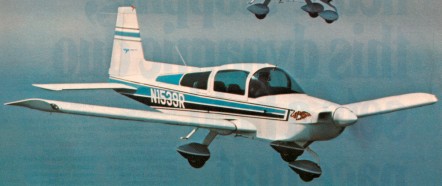
The production 4-seaters were the AA-5 Traveller introduced in 1971, the AA-5A Cheetah and AA-5B Tiger.
First introduced in 1972 as the AA-5 Traveler, with 150 horsepower, this four-seater resembled an enlarged AA-1 and also utilised the bonded metal and tubular spar construction of the AA-1. In 1975 Grumman American introduced a major airframe clean up and the more powerful 180 hp AA-5B Tiger. The Tiger features an enlarged and redesigned tailplane (from the AA-5), fixed pitch prop and undercarriage. The modified airframe was reunited with 150 hp in 1976, and the new AA-5A Cheetah replaced the Traveler.
All these airplanes share key features. Entrance is through a sliding canopy, which can be left open during flight. Rear seat backs are removable, and the rest of the rear seat folds flat to form a cavernous cargo area, station wagon style. All three airplanes have fixed gear and fixed pitch propellers. And the airframes of the little airplanes are made partially of an aluminum honeycomb material; most of the skins are bonded rather than riveted together.
This skin bonding process has had its troubled moments. Problems occurred when Grumman American moved its light¬plane manufacturing from the Cleveland, Ohio area to Savannah, Georgia. The new plant’s bonding process went through a shakedown period during which, occasionally, an airplane control surface would delaminate. But this never happened suddenly, so there was no safety problem, and the factory made good the airplanes that were affected.
Fuel is drawn from one wing or the other, and a pointer, activated by the selector, indicates which fuel gauge to read.
Taxiing is with the full-swiveling nose wheel dictating that you guide with the toe-brakes.
In addition to their basic clean up modifications, the Tiger and Cheetah also have horizontal and vertical stabilizers that differ from those on the Traveler. The changes offer more balance and more responsive control and eliminate the need for the Traveler’s dorsal fin.
The Grummans share a free castoring nosewheel. Trying to keep the airplane simple, the makers of the Grumman American lightplanes decided to have no steering on the front wheel. Diffeeential braking on the mains swings the nose in the desired direction, and the free turning nosegear follows.
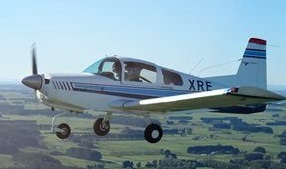
For the 1977 model cabin noise is way down from the 1976 model, thanks to a windshield that’s twice as thick and the firewall’s being raised and extended to meet the top of the cowl deck; formerly, there had been a crescent shaped opening that allowed engine noise to pass. The aft skirt of the canopy has a new, redesigned seal, and the forward edge now has two bladder like seals that meet an opposing rubber strip instead of the bare metal of the windshield bow.
Because people had complained about the airplane’s tendency to pitch like a rocking horse on rough surfaces, sometimes leading to prop clings, there’s a new shock absorber for the nosewheel made up of a pair of oleos at the top of the strut, to absorb fore and aft jolts.

The rubber seal that covers the attach ¬point gap at the wing roots has been widened. The propeller spinner bulkhead has been beefed up in response to frequent replacements necessitated by cracking. Fuel tank sealing has been im¬proved, as has access to the tanks. Primary airspeed indication is in knots.
The GA Tiger, announced late in 1974, has the same airframe as the Cheetah nee Traveler, but is powered with the Lycoming O-360-A4K of 180-hp, and sold, new, for $5,000 more than the Cheetah. The Tiger has excellent performance, but we’ll deal lightly with it here, because it will be rare in the used market for a while, and priced close to the new ones. The 1976 Tiger’s basic price wasUS$24,170, which may easily go above $30,000 fully equipped.
By 1975, GA was building 200 Travelers per year, along with an equal number of Grumman American Tigers (the 180-hp model) and, following a move from Cleveland to Savannah, programmed for 500 of their four-placers in 1976.
Late in 1975, GA gave the Traveler more stabilizer and flap and rechristened it the “Cheetah”.
The 1976 Cheetah’s basic price is $19,094.
AA-5 Traveller
Engine: Lycoming O-320-E2G, 150 hp
Wingspan: 31 ft 6 in / 9.60 m
Length: 22 ft 0 in / 6.71 m
Empty weight: 1200 lb / 544 kg
MTOW: 2200 lb / 998 kg
Max cruise 75% 8500ft/2600m: 122 kt / 140 mph / 225 kph
Max ROC SL: 660 fpm / 201 m/min
Service ceiling: 12,650 ft / 3855 m
Range max cruise 45 min res: 390 nm / 450 mi / 724 km
Cabin length: 6 ft 6 in / 1.98 m
Cabin width: 3 ft 5 in / 1.04 m
Cabin height: 4 ft 0.25 in / 1.23 m
Baggage space: 12 cu.ft / 0.34 cu.m
Baggage space w/rear seat area: 41.5 cu.ft / 1.19 cu.m
Max baggage: 120 lb / 54.4 kg
Seats: 4
AA-5A Cheetah
Engine: Lycoming 0-320-E2G, 150 hp.
TBO: 2,000 hr.
Prop: McCauley fixed pitch, 73 in.
Length: 22 ft.
Height: 8ft.
Wingspan: 31 ft 6 in.
Airfoil: NACA 642415 (mod).
Aspect ratio: 7.1.
Wing area: 140 sq. ft.
Wing loading: 15.7 lbs/sq.ft.
Empty weight: 1,262 lbs.
Useful load: 938 lbs.
Payload with full optional fuel: 626 lbs.
Gross weight: 2,200 lbs.
Power loading: 14.7 lbs/hp.
Fuel cap (standard): 38 USG/1228 lbs.
Fuel cap (opt): 52 USG/1312 lbs.
Baggage cap: 120 lbs.
Seats: 4.
Stall speed (clean): 54 kts.
Stall speed (flaps down): 50 kts.
Minimum runway requirement: 1,600 ft.
ROC: 660fpm.
Service ceiling: 12,650 ft.
Max speed: 137 kts.
Cruise (75% @ 8,500 ft.): 128 kt.
Economy cruise (55% @ 4,500 ft.): 103 kts.
Range @ max cruise (45 min res, std tanks): 461 nm.
Range @ max cruise (45 min res, opt tanks): 672 nm.
Range @ economy cruise (45 min res, std tanks): 537 nm.
Range @ economy cruise (45 min res, opt tanks): 770 nm.
Duration @ max cruise (no res, std tanks): 4.4 hrs.
Endurance 65%: 6.9 hr.
Landing gear: Tri/Fixed
Cabin width: 41 in
Cabin height: 48 in
Takeoff ground roll: 880 ft
Landing ground roll: 380 ft
AA-5B Tiger
Engine: Lycoming 0 360 A4K, 180 hp.
TBO: 2,000 hrs.
Prop: McCauley 75in, fixed pitch.
Length: 22 ft.
Height: 7 ft. 8 in.
Wingspan: 31 ft. 6 in.
Airfoil: NACA642415 mod.
Aspect ratio: 7.1.
Wing area: 140.35 sq.ft.
Wing loading: 17.1 lb/sq.ft.
Seats: 4.
Empty weight: 1,410 lbs.
Useful load: 989 lbs.
Payload with full fuel: 668 lbs.
Gross weight: 2,400 lbs.
Power loading: 13.3 lbs./hp.
Fuel capacity (standard): 51 USG./306 lbs (opt 51 US Gal).
Baggage capacity: 120 lbs.
Baggage area: 15 cu. ft.
Rate of climb: 850 fpm @ 79 kts.
Service ceiling: 13,800 ft.
Maximum speed: 147 knots.
Cruise (75 % @ 8,500 ft): 139 knots.
Economy cruise (55 % @ 8,500 ft): 112 knots.
Range @ max cruise (45 minute reserve): 512 nm.
Range @ economy cruise (45 minute reserve): 567 nm.
Duration @ max cruise (no reserve): 4.5 hrs.
Stall speed (clean): 56 knots.
Stall speed (flaps down): 53 knots.
T/O 50ft: 1550 ft.
Landing dist 50ft: 1120 ft.
Max canopy open speed: 113 kts.
Max X-wind: 11 kts.
Grumman American 1976 AA5B Tiger
Engine: Lycoming O-360-A4K, 180
TBO: 2000 hr
Propeller: Const. spd.
Landing gear: Tri/Fixed
Gross weight: 2400 lb
Empty weight, std: 1294 lb
Useful load, std: 1106 lb
Fuel: 51 USgal
Wingspan: 31 ft. 6 in.
Overall length: 22 ft.
Height: 8 ft.
Wing area:140 sq. ft
Seating capacity: 4
Cabin width: 40 in
Cabin height: 45 in
Baggage capacity:120 lb
Cruise speed 75% power: 139kt
Cruise speed 65% power: 131 kt
Max range (w/ reserve) 75% power: 552 nm
Max range (w/ reserve) 65% power: 578 nm
Fuel consumption 75% power: 10.8 USgph
Fuel consumption 65% power: 9.7 USgph
Stall speed (gear, flaps down) : 53 kt
Best rate of climb: 850 fpm
Service ceiling: 13,850 ft
Takeoff ground roll: 865 ft
Landing ground roll: 410 ft
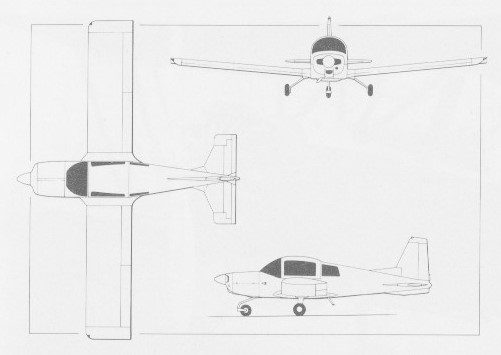
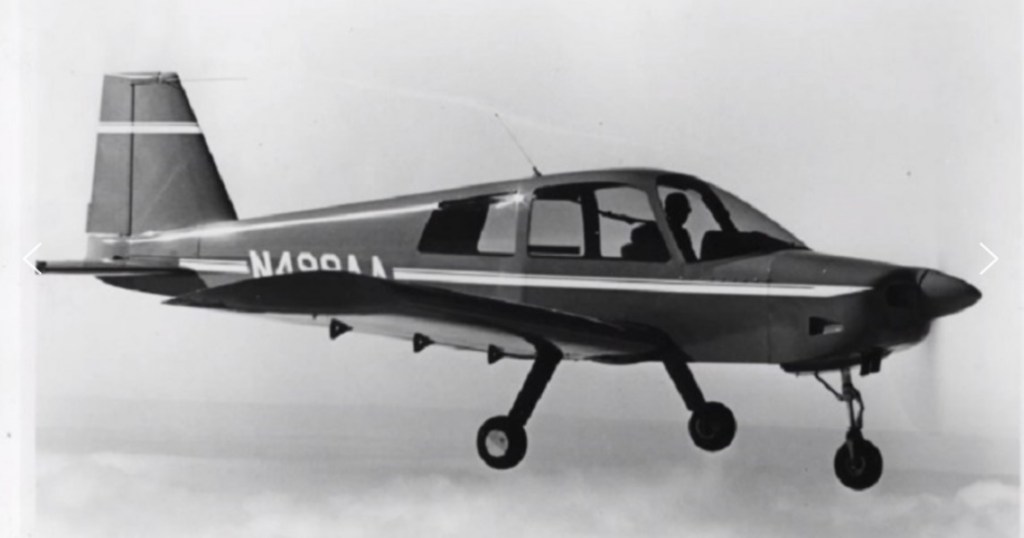
After the market success of the AA-1 Yankee Clipper American Aviation turned their attention to developing a four-seat aircraft in 1970-71. The American Aviation engineers started with a “clean sheet of paper” and designed a new aircraft. This aircraft was intended to be produced as the American Aviation AA-2 Patriot.
The resulting prototype bore very little family resemblance to the AA-1. The AA-2 was different from the AA-1 in that it had doors instead of the Yankee’s trademark sliding canopy and an oleo strut in place of the Yankee’s spring steel tube nose gear. The aircraft had provisions for retractable gear to be installed on a later version, although the prototype had fixed landing gear. The AA-2 was powered by a 180 hp (134 kW) Lycoming engine.
The prototype, registered “N488AA”, was completed in 1970 and test flying was commenced early in that same year. Aircraft performance during the test flying process fell far short of the design goals so the project was abandoned and the manufacturer eventually disassembled the prototype.

American Aviation made the decision to develop a stretched version of the AA-1 Yankee Clipper instead of pursuing the AA-2. This aircraft eventually was produced as the AA-5 Traveler and was later developed into the AA-5A Cheetah and the AA-5B Tiger.
The prototype has been recovered by members of the American Yankee Association.
Powerplant: 1 × Lycoming O-360-A1A, 180 hp (130 kW)
Wingspan: 30 ft 0 in (9.14 m)
Length: 23 ft 3 in (7.09 m)
Max takeoff weight: 2,400 lb (1,089 kg)
Useful load: 1100 lb
Maximum speed: 135 kn (155 mph, 249 km/h)
Cruise: 145 mph
Range: 613 nmi (705 mi, 1,135 km)
Crew: One
Capacity: Three passengers
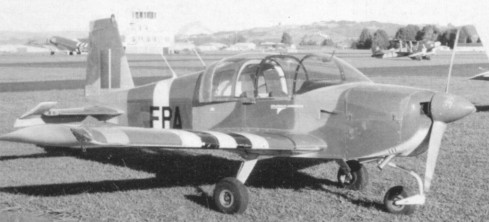
During 1964, the American Aviation Corporation was formed to bring new life to the promising BD-1 design. The prototype AA-1 Yankee N888M first flew on March 2nd, 1967. The AA-1 was a little larger than the original BD-1 with a more powerful 108hp Lycoming 0-235-C2C engine. It made use of metal-to-metal bonding of components, which was a technique not previously used to and great degree in general aviation aircraft. Also, the construction used a large amount of high-strength aluminium honeycomb material within the fuselage structure and fibreglass in the undercarriage legs.
Grumman-American AA-1 Trainer Article
The AA-1 Yankee introduced a new canopy and Hoerner wingtips which increased the span by 1 ft / 0.2m.
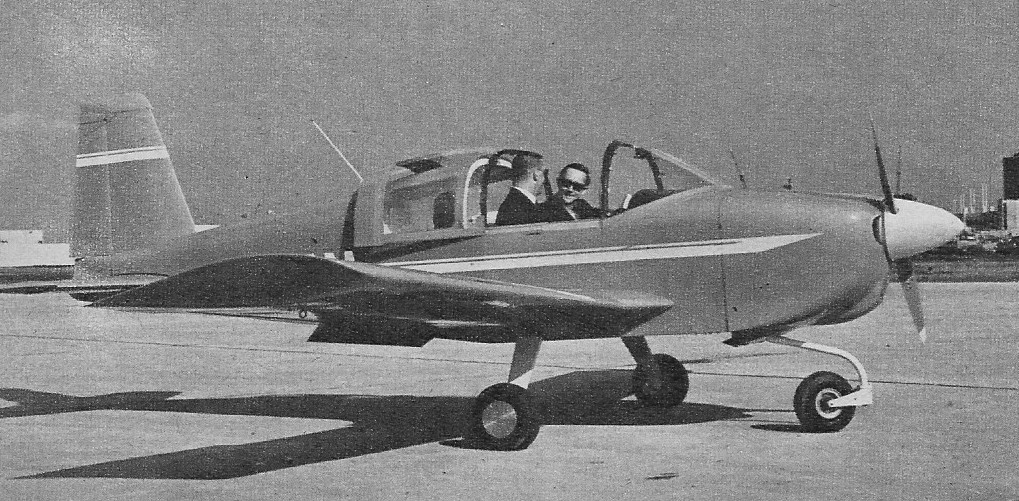
This side-by-side trainer first entered production in 1968 as the American Aviation AA-1 Yankee.
The type went into production at Cuyahoga County Airport, Cleveland, Ohio. In all production of the AA-1 Yankee (TC A11EA) totalled 461 units plus the prototype. They were initially priced at $7,295, rising to $7895 in 1971.
The American Yankee was followed by the 1970 American AA-1A Trainer (TC A11EA), which in-corporated a new wing section designed for more docile handling. First flown on 25 March 1970, 680 Trainers were built, priced at $8,340.
The AA-1 Yankee design was progressively developed into the AA-1B Trainer and the AA-1C Lynx.
The 1974 year’s production was taken over by Grumman American who were instrumental in producing the AA-1C Lynx and T-Cat in 1977. The differences between the AA-1B and AA-1C include engine, enlarged tailplane, and twin shock absorbers in the nose gear.
In 1977 Grumman-American were marketing an optional spin package for the AA-1C / T-Cat – basically a ventral fillet or strake under the tail.
The T Cat’s closest sibling, the Lynx, is nearly its twin. The only substantial difference between the two airplanes is the propeller: the former has a 52-in pitch Sensenich climb prop, which provides an extra 50 feet per minute; the latter has a 56-in pitch cruise prop, which offers an additional five knots at cruise.
The Tr-2 is a dual-role advanced trainer / sporting aircraft developed by Grumman American and based on the AA-1B. It did enter production.

Production of the type ceased in December 1978 after 211 Lynx were built.
American Aviation AA-1 Yankee
1968
Engine: 108hp Lycoming O-235-C2C
Wingspan: 24’6″
Length: 19’3″
Useful load: 560 lm
Max speed: 144 mph
Cruise: 135 mph
Stall: 65 mph
Range: 500 mi
Ceiling: 11,250′
Seats: 2
1971 Grumman American Trainer AA-1A
Engine: Lycoming O-235, 108 hp
TBO: 2000 hr
Fuel type: 100
Propeller: Fixed
Landing gear: Fixed nose
Max ramp weight: 1500 lb
Gross weight: 1500 lb
Max landing weight: 1500 lb
Empty weight: 1007lb
Useful load: 1007 lb
Payload, full fuel: 349 lb
Usable fuel: 24 USgal
Wingspan: 25 ft 5 in
Overall length: 19 ft. 3 in
Height: 6 ft. 8 in.
Wing area:100.9 sq. ft
Wing loading: 12.6 lbs./sq. ft
Power loading: 15 lb/hp
Wheel track: 8 ft. 3 in.
Seating capacity: 2
Cabin width: 41 in
Cabin height: 45 in
Baggage capacity: 100 lb
Cruise speed 55% power: 100 kt
Max range (w/ reserve) 65% power: 399 nm
Fuel consumption 55% power: 4.2 USgph
Stall speed (flaps up): 55 kt
Stall speed (flaps down): 51 kt
Best rate of climb: 765 fpm
Service ceiling: 13,750 ft
Takeoff ground roll: 700 ft
Landing ground roll: 395 ft
AA-1B Trainer
Engine: Lycoming O-235-C2C, 108 hp
Wingspan: 24 ft 6 in / 7.47 m
Length: 19 ft 3 in / 5.86 m
Empty weight: 980 lb / 445 kg
MTOW: 1560 lb / 708 kg
Max cruise 75% 3000ft/915m: 108 kt / 124 mph / 200 kph
ROC SL: 705 fpm / 215 m/min
Service ceiling: 12,750 ft / 3886 m
Range 75% 3000ft/915m no res: 378 nm / 435 mi / 700 km
Seats: 2
Rear baggage: 100 lb / 45 kg
Cabin length: 4 ft 6 in / 1.37 m
Cabin width: 3 ft 5 in / 1.04 m
Cabin height: 3 ft 9.25 in / 1.15m
AA-1B Trainer
Engine: Lycoming O-235-C2C, 108 hp
Wingspan: 24 ft 6 in / 7.47 m
Length: 19 ft 3 in / 5.86 m
Empty weight: 980 lb / 445 kg
MTOW: 1560 lb / 708 kg
Max cruise 75% 3000ft/915m: 108 kt / 124 mph / 200 kph
ROC SL: 705 fpm / 215 m/min
Service ceiling: 12,750 ft / 3886 m
Range 75% 3000ft/915m no res: 378 nm / 435 mi / 700 km
Seats: 2
Rear baggage: 100 lb / 45 kg
Cabin length: 4 ft 6 in / 1.37 m
Cabin width: 3 ft 5 in / 1.04 m
Cabin height: 3 ft 9.25 in / 1.15m
AA-1B TR-2 Trainer
Engine: Lycoming O-235-C2C, 108 hp.
Seats: 2.
AA-1C Lynx
Engine: 1 x Lycoming O-235-L2C, 115 hp.
Seats: 2.
Wing loading: 15.9 lb/sq.ft.
Pwr loading: 13.9 lb/hp.
Gross wt: 1600 lb.
Empty wt: 1066 lb.
Equipped useful load: 507 lb.
Payload max fuel: 375 lb.
Range max fuel/75% pwr: 326nm/2.7hr.
Range max fuel / 55% pwr: 350 nm/ 3.7 hr.
Service ceiling: 11,500 ft.
75% cruise: 117 kt.
55% cruise: 96 kt.
Stall: 52-54 kt. 1.3
Vso: 68 kt.
ROC: 700 fpm.
Min field length: 1590 ft.
Fuel cap: 132 lb.
AA-1C T-Cat
Engine: Lycoming O 235 L2C, 115 hp.
TBO: 2,000 hrs.
Prop: Sensenich fixed pitch, 72 inch diameter.
Length: 19 ft. 3 in.
Height: 7 ft. 7 in.
Wingspan: 24 ft. 5 in.
Wing area: 100.9 sq.ft.
Wing loading: 15.85 lb/sq.ft.
Power loading: 13.91 lb/hp.
Seats: 2.
Empty weight: 1,075 lbs.
Useful load: 525 lbs.
Payload with full fuel: 382 lbs.
Gross weight: 1,600 lbs.
Usable fuel capacity: 22 USG/132 lbs.
Maximum landing weight: 1,600 lbs.
Maximum rate of climb: 750 fpm.
Service ceiling: 11,900 ft.
Maximum speed: 125 kts.
Max cruise, 74% power (2,700 rpm) at 5,000 ft: 112 kts.
Econ cruise, 55 % power at 6,000 ft: 93 kts.
Duration at max cruise: 3.4 hrs.
Duration at econ cruise: 4.4 hrs.
Stalling speed, clean 57 kts.
Stalling speed, full flaps: 53 kts.