The Austrian Bruno Nagler began work in the rotory-wing field in 1929 when, with Raoul Hafner, he built his RI Revoplane at Aspern Airport, near Vienna. This was a single seat machine with a rotor driven by a 45 hp engine and had a vertical torque-balancing surface acting in the rotor downwash. This machine, and also similar RII machine of 1932, was successfully tested in Great Britain.
1 engine
Hafner Heliogyro
In 1934, Nagler brought out his Heliogyro which had a 90hp Pobjoy radial air-cooled engine, a two-blade rotor and a pusher propeller. The engine could drive the rotor for hovering, when torque was balanced by a vertical surface, or the propeller could be driven for forward flight leaving the rotor to generate lift by autorotation. This single-seat aircraft was tested in Great Britain in 1937.
Haerens F.F.9 Kaje
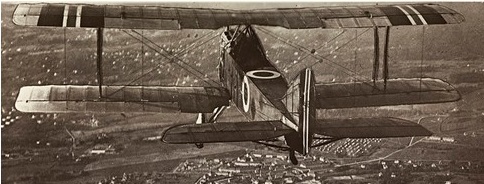
F.F.9 Kaje was the last in a series of own constructions in wood and canvas at Hærens Flyvemaskinfabrik at Kjeller. Designed and built by the Norwegian Army Air Service’s aircraft manufacturer Haerens Flyfabik, work on the FF9 Kaje trainer aircraft started in 1921. The aircraft body was designed in Norway, designed by Einar Sem-Jacobsen while the wing was licensed by German construction (Göttingen profile). The wings were made of wood paneling fabric covered.
The prototype was ready for test flight in November 1921.
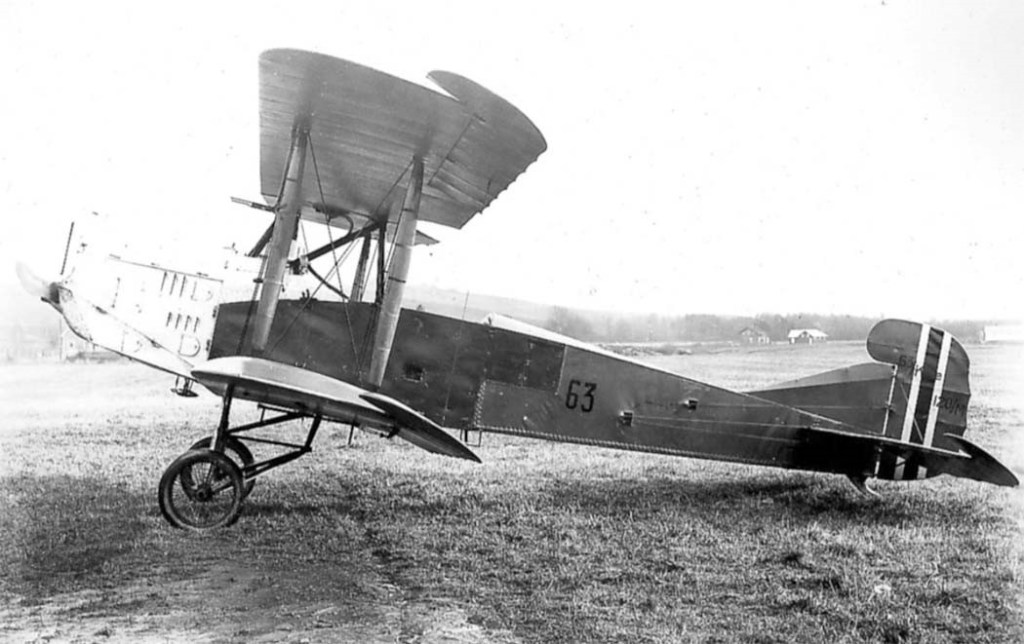
The aircraft replaced older school aircraft and became a robust and reliable machine with good flight characteristics. Until June 1924, the designation was for the aircraft type F.F.9, when it was decided that the aircraft should be referred to as “Kaje”.
It was built in three series: the Kaje I of which ten were built in 1921 and 1922, the Kaje II of which four were built in 1925 and five Kaje III in 1926. The models differed slightly in wing profile, wingspan and rudder surfaces, based on experience with the previous model.
Although primarily used as a training plane and for reconnaissance, the aircraft could also carry arms and was tested with radio equipment.
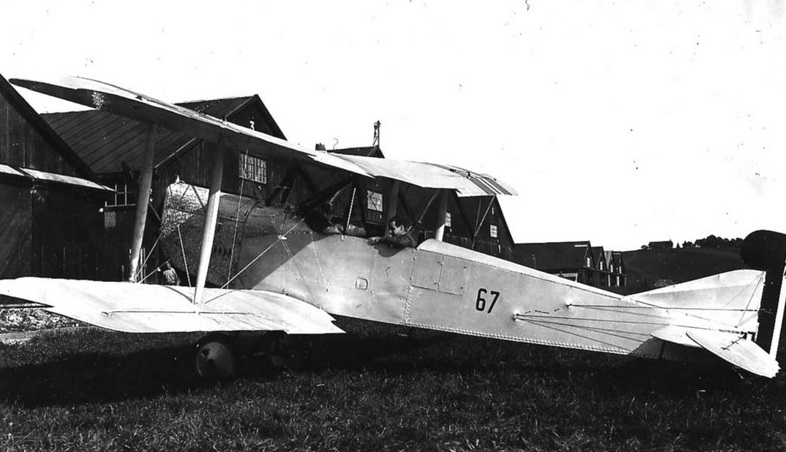
The aircraft was in use with the Norwegian Army Air Service from 1922 to 1935. A preserved example is at the Norwegian Aviation Museum in Bodø.
Variants:
Kaje I
Ten built.
Kaje II
Four built.
Kaje III
Engine: 1 × Marabini 6-cyl, 89 kW (120 hp) (license built Mercedes D.II)
Length: 8.4 m (27 ft 7 in)
Wingspan: 9.5 m (31 ft 2 in)
Height: 3.23 m
Max weight: 1060 kg
Maximum speed: 132 km/h (82 mph; 71 kn)
Range: 375 km (233 mi; 202 nmi)
Service ceiling: 3,200 m (10,500 ft)
Crew: two
Five built.
Kaje III
Engine: 1 × Marabini 6-cyl, 89 kW (120 hp) (license built Mercedes D.II)
Wing span: 10.37 m
Length: 8.10 m
Height: 3.30 m
Max T O weight: 1080 kg
Maximum speed: 135 km / h
Haerens FF.6
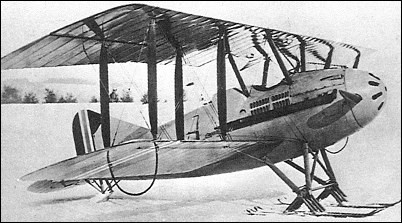
Acquisition from Spain of five 150hp Hispano-Suiza eight-cylinder Vee-type engines prompted the Norwegian Army Flying-Service (Haerens Flyvevaesen) to order the design of a single-seat fighter around this power plant.
Design was begun by Ing Hellesen at the Kjeller Flyfabrikk in the autumn of 1919, by which time the requirement had changed to that of a two-seat fighter-reconnaissance aircraft. Of wooden construction with a plywood monocoque fuselage and designated FF 6 by the factory and T.2 by the Army, the prototype was flown in 1921.
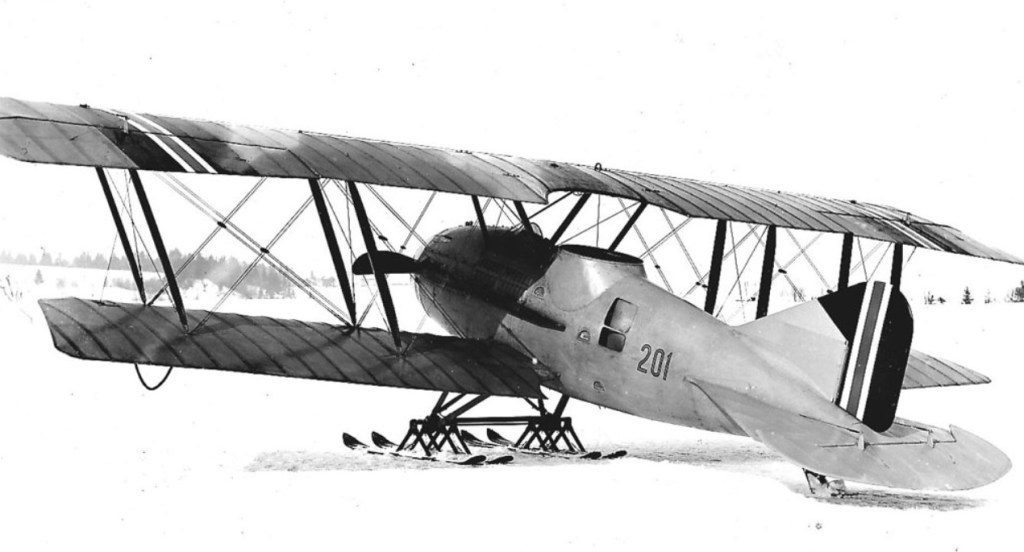
It immediately displayed unacceptable characteristics which were exacerbated by the fact that the Hispano-Suiza engine was found to develop only 103hp. A max speed of only 100km/h was attained compared with an anticipated maximum of 132km/h. Further development was therefore abandoned after the first test flight.
Engine: 150 hp Hispano-Suiza 8
Wingspan: 11.75 m / 39 ft 7 in
Length: 7.25 m / 24 ft 9 in
Height: 3.57 m / 12 ft 9 in
Haerens FF.4 Svane (Swan)
The Hærens Flyvemaskinfabrikk Aircraft FF.4 was an improved version of earlier series of 1920 Farman developments. Five were planned, but the prototype proved a failure.
Haerens F.F.1 Longhorn

The 1913 Hærens Flyvemaskinfabrikk F.F.1 Longhorn (or Langhorn) was a Maurice Farman MF.7 Longhorn copy.
Einar Sem-Jacobsen drew from memory after a Farman factory visit.
It was the first Norwegian aircraft, undertaking a trial run on 22 May 1913.
Haenlein Airship
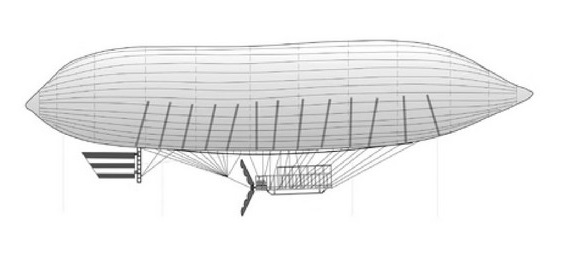
In 1860 Belgian Etienne Lenoir patented a gas engine fuelled by coal gas. Paul Haenlein employed a four-cylinder Lenoir engine producing 5 hp in his airship at Brunn in 1872.
The airship’s varnished silk envelope was filled with coal gas, which supplied the engine at a rate of 250 cu.ft of gas per hour, turning a large propeller at 40 rpm. Internal pressure was maintained by a ballonet supplied with air rom a mechanical pump, fitted to compnsate for the coal gas burned in flight. During the first trial at Brunn in December 1872, perceptible control and a degree of acceleration were evident, with the craft achieving 11 mph.
Despite the initial success of this and further trials, the early Lenoir engines suffered from a poor power-to-weight ratio and low power. Haenlein eventually abandoned his work, frustrated by the lack of suitable engine.
Envelope capacity: 72,000 ft
Length: 150 ft
Diameter: 30 ft
Height: 44 ft
Gross lift: 2.1 ton
Disposable load: 0.30 ton
Engine: 1 x Lenoir 4 cyl gass, 5 hp
Speed: 11 mph
Range: 10 mi
Crew: 1
Haeferlin Monoplane
The Haeferlin monoplane was designed and built by Haeferlin in Germany, circa 1911.
Hachiya OpenSky M-02 / M-02J / Aircraft Olympos M-02
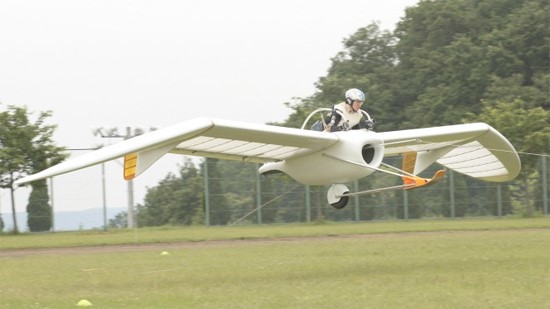
Designed by Satoru Shinohe, the OpenSky M-02 glider/jet-powered motor glider is based on the ‘Mehve’ glider seen in the 1984 anime film, directed by Hayao Miyazaki, Nausicaä of the Valley of the Wind. In the film, Nausicaa takes flight uses the Mehve – the name taken from the German “Möwe”, meaning ‘gull’ – to survey a toxic wasteland.
The M-02J is the work of Kazuhiko Hachiya, who has been working to produce a pilotable version of the aircraft since 2014. Like the animated version, Hachiya’s craft is built around a small jet engine, which is used to achieve take off, climb for a duration of 10 minutes, and attain gliding altitude.
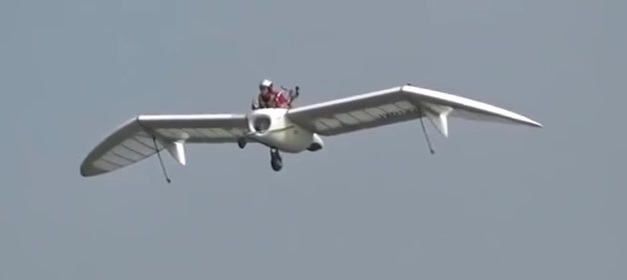
Hachiya’s Mehve, called the OpenSky, has been through several versions since 2003. The original version was radio-controlled, but Hachiya himself took to the sky on OpenSky 3.0. It was this model he planned to show to the public.

The craft boasts a 963cm wingspan and a 267cm fuselage. Like in the film, the pilot lies flat against the top pf the vehicle, and steers by shifting their weight around.
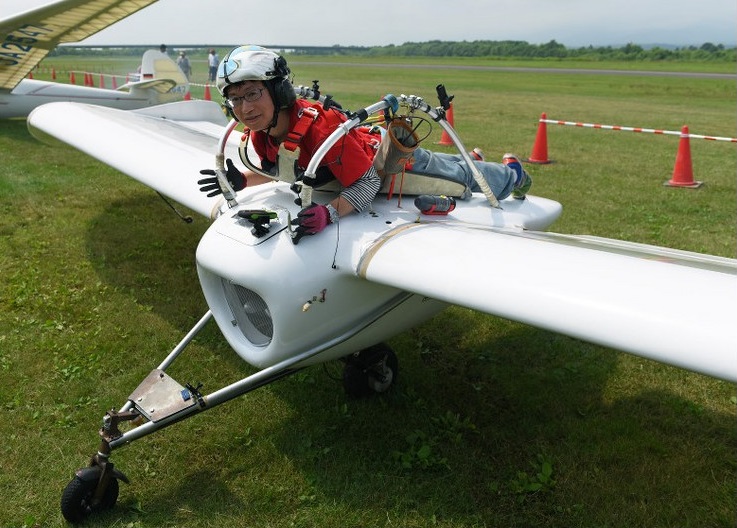
As of June 2006, two aircraft prototypes had been constructed, and one has successfully completed a series of 10 unpowered test flights where it flew 98 meters and achieved an altitude of 4 meters after being tow-launched by a tensed elastic cable. The project is led by artist Kazuhiko Hachiya and design by Satoru Shinohe and manufactured by Aircraft Olympos.
The Jet engine installed version, M-02J, had public demonstration flight in June 2016 at Takikawa, Hokkaido.
Hachiya – a pilot and artist, who conducted the flight in a helmet decorated with wings – hoped to improve stabilisation for future efforts.
Variants:
Möwe 1/2 (メーヴェ1/2) — sub-scale, radio-controlled development aircraft
M-01 — unpowered development aircraft
M-02 a total of 2 airframes of M-02 were built, 1 for preliminary gliding practice and 1 for installing Jet engine with no intention to mass-production.
M-02J
(14 June 2007) Modified M-02 airframe has had a Jet engine installed. (14 April 2010) Vehicle M-02 has undergone high speed taxi tests at Fukusima Sky Park runway, in order to evaluate stability and acceleration. More details of the jet engine assembly are available, and the engine has a considerable separation from the walls of the engine pod, in order to permit better cooling and prevent the wood and composite airframe from encountering an excessive fire risk.
M-02
Engine: 1 × (undisclosed engine), 40 kg (88 lbf)
Wingspan: 9.636 m (31.61 ft)
Wing area: 12.2 m² (131.3 sq ft)
Aspect ratio: 3.74
Airfoil: high forward camber, reflexed
Mean aerodynamic chord: 1.287 m (4.22 ft)
Length: 2.083 m (6.83 ft)
Height: 1.057 m (3.47 ft)
Empty weight: 50 kg (110 lb)
Useful load: 50 kg (110 lb)
Loaded weight: 105 kg (231 lb)
Max. takeoff weight: 115 kg (253 lb)
Fuel capacity: 10 L (planned)
Never exceed speed: 200 km/h (124 mph)
Maximum speed: 120 km/h (75 mph)
Cruise speed: (projected) 50–90 km/h (31–56 mph)
Stall speed: 36 km/h (23 mph)
Wing loading: 8.6 kg/sq.m (0.0122 lb/sq.in)
Thrust/weight: 0.36
Seats: 1
Gyro-Kopp-Ters Twin Eagle

Front Control Stick, Activated Electric Hydraulic Pump for the Pre-rotator & Electric Pitch Trim, Electric Rotor Brake, Dual Contols, Adjustable Front Seat, and a Rear Control Stick. Aluminum Seat Tank
Standard Equipment – Altimeter, Air Speed, Compass, Engine Tachometer, Oil Pressure, Water Temperature, Voltmeter, Hour Meter, Main Wheel Brakes, Tall Tail, & Seat Belts.
The complete kit unassembled cost in 2010 US$16,500. Assembled and tested, 2010 US$18,000.
Engine: Subaru EJ-22, 130 HP @ 5200 RPM, Multi- Point Fuel Injected, Electric Start
Reduction Drive: 1.88:1, Gates Polychain Belt; Prop RPM 2660@5000
Rotor Blades: Dragon Wings, 28′ x 7″
Prop: 68″, 4-Blade Ground Adjustable, Rotax Bolt Pattern
Static Thrust: 550 LBS @ 5,000 RPM
Prop RPM: 2660
Length: 14′ 8″ (176″)
Width: 5′ 3″ (63″)
Height: 9′ 1″ (109″)
Gross Weight: 1,210 Lb
Useful Load 460 LBS
Empty weight: 675-lbs
Fuel: 75-lbs
Front Pilot weight: 230-lbs
Rear Passenger weight: 230-lbs
Climb: 800 FPM Single; 600 FPM Dual
Minimum Speed: 35 MPH
Cruise Speed: 60 MPH
Top Speed: 90+ MPH
Never Exceed Speed: 120 MPH
Fuel Capacity: Max 16 USG
Fuel Burns: 4.5 USGPH

