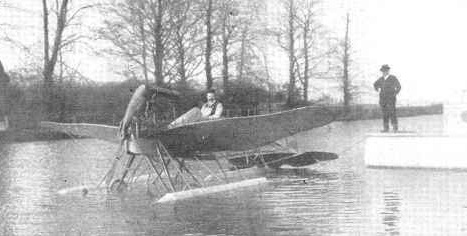
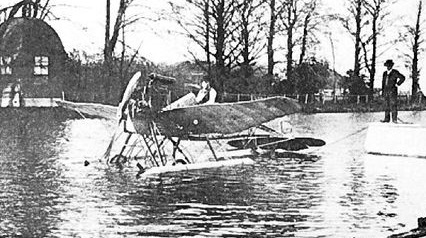
The picture shows the machine in a probably artificial seaplane basin at Warmond (quite a bit away from Scheveningen). Soon after this picture was taken the machine got into flames at the first flight. That was the end of the ‘Lygia’ hydro-aeroplane. The pontoons of this hydro-aeroplane does not look if it will ever go up, no steps are visble. The name ‘Lygia’ can be read on the rudder (on the original picture at least). The machine earned its (little known) place as being the first hydro-aeroplane in Holland, although it did not fly.
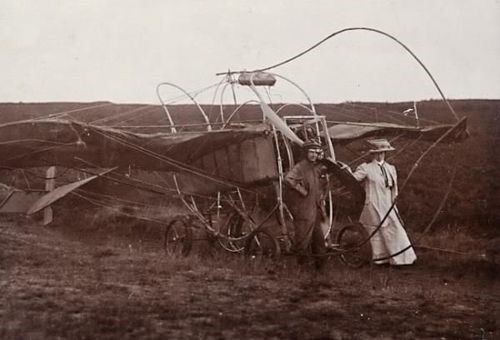
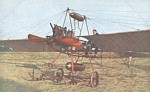
The Monnier Harper Type No.1 was modified from the original machine assembled in Rotterdam, as seen before its August 10, 1911 flight test on the plain, probably around Apeldoorn, Netherlands. Likely a memento taken just before; the couple may be Monnier Harper and his wife.
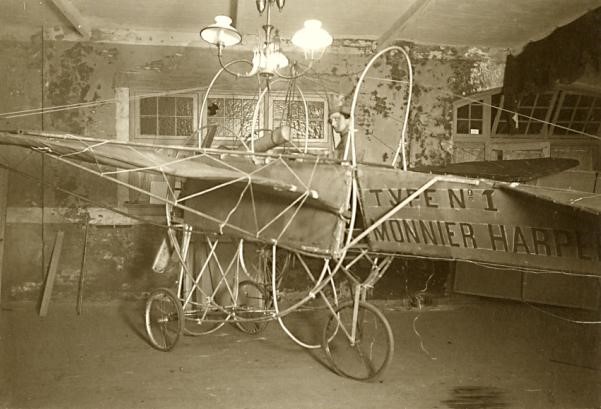
Monnier Harper at work on his Type No.1 monoplane, probably at Apeldoorn
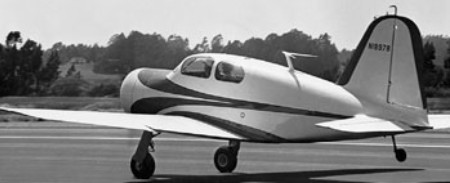
In 1941, a two-seat training version of the PJC-2 was produced under the designation of PC-5A. It differed mainly by having a narrower fuselage and a 165-hp Warner Super Scarab engine. PC-5A production lasted until 1942.
The Harlow Engineering Corp. of Alhambra, California, began production of the Harlow PJC-2 in 1938. In the following year, the company changed its name to the Harlow Aircraft Co. The Model PJC-2 was a fourseat cabin-monoplane of all metal construction and was fitted with retractable landing gear. The Harlow was under development for three years and submitted to over a year of flight testing before it was placed on the market. Production was continued in small numbers until 1941.
Seats 4. Gross wt. 2,600 lb Empty wt. 1,700 lb Engine 145-hp Warner Super-Scarab seven-cylinder radial. Top speed 150 mph Cruise 135 mph Landing speed 53 mph Initial climb rate 660 fpm Range 500 miles Ceiling 15,500 ft
Harlan, who had rented a shed to Max Schüler, took over the semifinished student model in 1910. His chief architect Karl Grulich improved it, finished it – and Harlan came out with it. This Harlan-Eindecker became a successful aircraft. On 29 December 1910, Grulich thus flew his aircraft license number 46. By the end of the year 1911 several versions of this pattern were built and sold. At the end of 1913, the Harlan works had three aircraft sheds, but in the spring of 1914 Harlan was financially deadlocked. He sold his company.
At the beginning of 1914, the “Bussard-Flugzeug-Werke GmbH” emerged from the sale of the remains of the Harlan-Flugzeugwerke GmbH and had its small workshop and flying school in the shed.
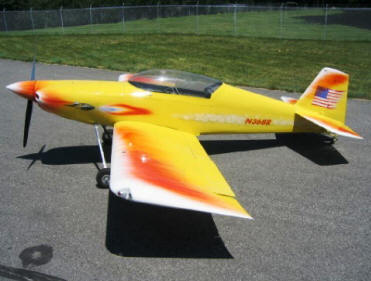
The Rocket II is a modified Van’s two place RV-4. The kit to build a Rocket II from John Harmon is an extension of RV-4 kit which is purchased from Van’s. With the intended use of bigger engines the altered fuselage is wider and the length 18 inches longer. The modified wing was tested by an independent engineering facility. A unique modification is titanium for the gear legs which provide a difference in feel when landing and also doesn’t shimmy during ground operations. The HR2 is not a quickbuild kit as many builders of the Rocket prefer to be more involved in the aircraft building process and express a preference of some minor fitting and trimming. An economy cruise speed of 215 mph at 55 is average for a Rocket II with a LYC.10-540 -C4B5/250 hp. 2575 rpm. while there is one Rocket that has a 340+ horsepower and can cruise at 275 mph.
Harmon Rocket II Engine: LYC. 10-540-C4B5/250 hp. 2575 rpm. Propeller: Hartzel 80 in. dia. Span: 21 ft. 10 in. Length: 21 ft. 6 in. Height: 5 ft. 7 in. Wing Area: 109 sq. ft. Wheel Track: 6 ft. 6 in. Empty Weight: 1200 lbs. Gross Weight: 2000 lbs. Useful Load: 800 lbs Power Loading: 5.9 lbs/hp. Wing Loading: 16.4 lbs/sq. ft. Fuel Capacity: 42 USgal. Seats: 2 Cruise Speed 75%: 230 mph. Econ. Cruise 55%: 215 mph. Vne: 275 mph. Rate of Climb (gross): 3100 fpm. Stall: 55 mph.
Harmon Rocket III Engine: LYC.10-540-400hp. Propeller: Hartzel 78 in. 3 Blade Span: 20 Ft. Length: 21 Ft. 6 in. Height: 5 Ft. 6 in. Wing Area: 99 sq. ft. Empty Weight: 1080 lbs Gross Weight: 1800 lbs Useful Load: 720 lbs. Power Loading: 4.5 lbs/hp. Wing Loading: 18 lbs/sq.ft. Fuel Capacity: 47 USgal. Seats: 1 Cruise Speed 75%: 260 mph Econ. Cruise 55%: 230 mph Vne: 310 mph Rate of Climb (gross): 3600 fpm. Stall: 58 mph.
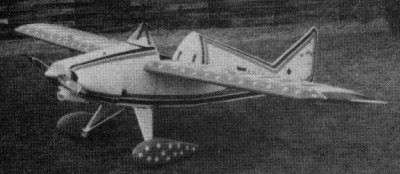
Harmon chose the long-established combination of a welded steel-tube fuselage and tail surfaces, with wood spar and rib wings. In addition, the wing may be easily removed for storage and towing. The entire aircraft can be built with hand tools except for the use of a welding rig. Mr. America’s powerplant is a nearly stock 1600-cc Volkswagen engine bored to 1650. The engine develops an honest 60 hp, to pro¬duce what is said to be rapid acceleration on takeoff to around 800 fpm at 90 mph during initial climb.
Gross Wt. 630 lb Empty Wt. 430 lb Fuel capacity 9 USG Wingspan 19’8” Length 15’2” Engine 60 to 70-hp Volkswagen. Top speed 125 mph Cruise 110 mph. Stall 48 mph. Climb rate 800 ft Ceiling 12,000 ft Takeoff run 200 ft Landing roll 300 ft Range 400 miles
The translation of this open-cockpit sport plane’s name is “The Thunderclap” It was the airframe of this plane which was used as the foundation for “Mr. America.” Both share similar wings, fuselage, tail unit and landing gear. The wings are a wire-braced, shoulder type with two simple beam spars. As with the Mr. America, seating is for one, behind a modified Volkswagen engine turning a two-blade wooden prop.
Gross Wt. 600 lb Empty Wt. 350 lb Fuel capacity 10 USG Wingspan 19’6” Length 14’6” Engine 73-hp Volkswagen Top speed 120 mph Cruise speed 110 mph. Stall speed 55 mph Climb rate 800 fpm Ceiling 10,000 ft Takeoff run 130 ft Landing roll 250 ft Range 500 mile
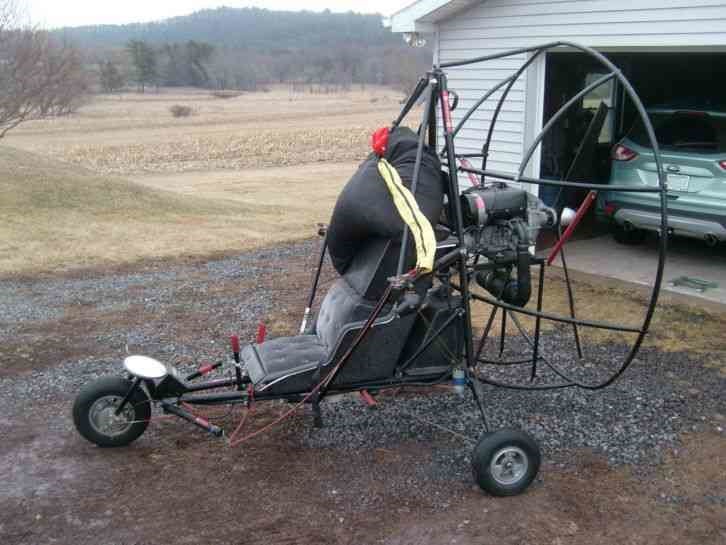
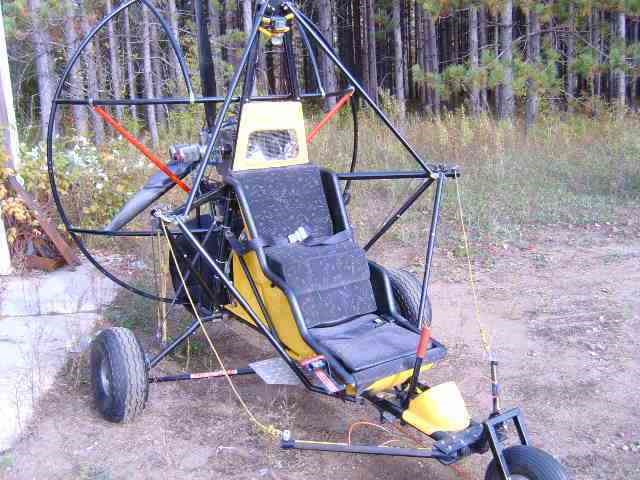
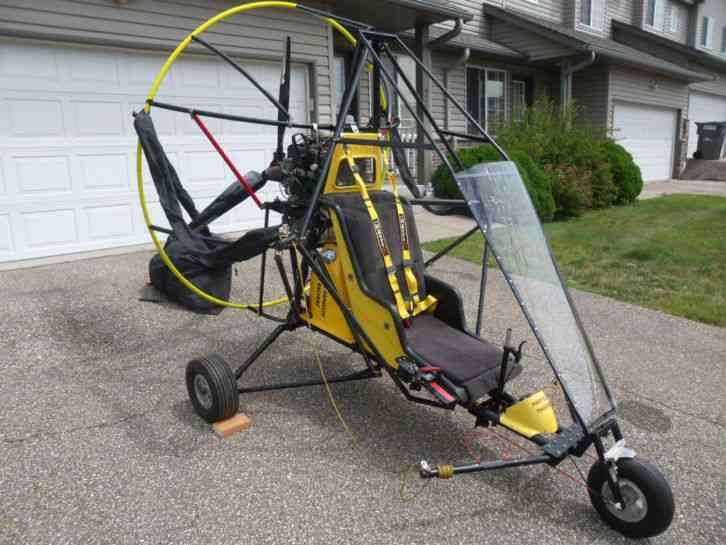
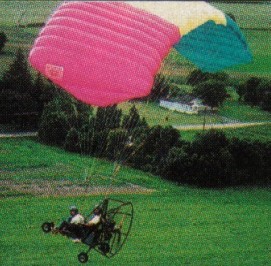
Introduced in 1988, the Harmening High Flyer powered parachute was designed to comply with the US FAR 103 Ultralight Vehicles rules, including the category’s maximum empty weight of 254 lb (115 kg). The aircraft has a standard empty weight of 247 lb (112 kg). The aircraft was designed to be a single-place or optionally two-seater. The base model High Flyer features an MK Superfit rip-stop nylon parachute-style high-wing, tricycle landing gear and a single 45 hp (34 kW) 2si 460-F engine in pusher configuration. Variants use other engines.
High Flyer Executive
The aircraft is built from a combination of bolted 6061-T6 aluminium, welded 4130 steel tubing and mild steel. In flight steering is accomplished via foot pedals that actuate the canopy brakes, creating roll and yaw. On the ground the aircraft has lever-controlled nosewheel steering. The main landing gear incorporates sprung steel suspension. The aircraft was factory supplied in the form of an assembly kit that required 30–40 hours to complete.
All kits were manufactured in the USA, and includes the engine and 3 blade propeller. FAR 103 legal, the High Flyer Standard converts from single to two place in 10 minutes.
By 1998 the company reported that 75 kits had been sold and 75 aircraft were completed and flying, the cost in 2001 was US$9,500.
High Flyer 503
The production by Harmening’s High Flyers of Genoa, Illinois, USA, ended when the company went out of business in circa 2008.
High Flyer Deluxe
High Flyer Premiere
Variants:
High Flyer Base model Engine: 2si 460-F, 45 hp (34 kW) Cost 2001: US$9,500
High Flyer Standard Engine: Rotax 503, 50 hp (37 kW) Height: 6.7 ft Length: 10 ft Empty weight: 247 lb Gross weight: 687 lb Fuel capacity: 5 USG Cruise: 26 mph Range: 20 sm Rate of climb: 450 fpm Takeoff dist: 50-150 ft Landing dist: 20-50 ft Service ceiling: 10,000 ft Cost 2000: US$9,395 Completed and flown: 25 by early 2000
High Flyer Deluxe Larger fuel tank Engine: Rotax 503 50 hp (37 kW) engine Cost 2000: US$9,895 Completed and flown: 25 by early 2000
High Flyer Premiere Engine: HKS 700E, 60 hp (45 kW) Cost 2000: US$14,980 Completed and flown: 30 by early 2000
High Flyer Executive Engine: Hirth 2706, 65 hp (48 kW) Wingspan: 39 ft (12 m) Wing area: 550 sq ft (51 m2) Length: 10 ft 0 in (3.05 m) Carriage Height: 7 ft 0 in (2.13 m) Empty weight: 280 lb (127 kg) Gross weight: 830 lb (376 kg) Fuel capacity: 9 U.S. gallons (34 L; 7.5 imp gal) Cruise speed: 26 mph (42 km/h; 23 kn) Rate of climb: 1,000 ft/min (5.1 m/s) Crew: one Capacity: optionally one passenger, if second seat fitted Cost 2000: US$11,999 Completed and flown: 30 by early 2000
High Five Engine: Rotax 582, 64 hp (48 kW) Cost 2005: US$12,250 Completed and flown: 10 by early 2005