Helicop-Air L.50 Girhel / L.51 Girhel

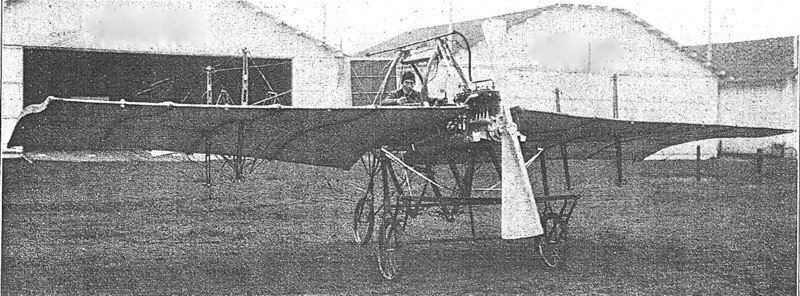
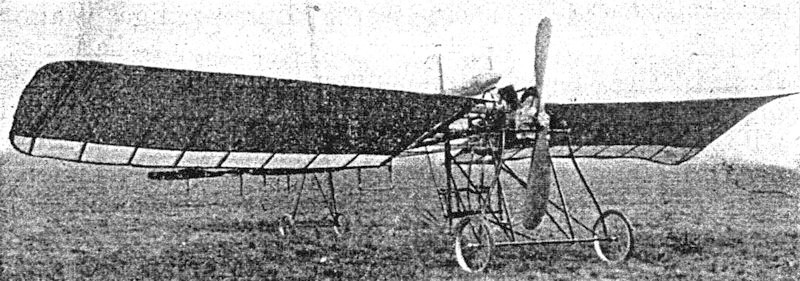
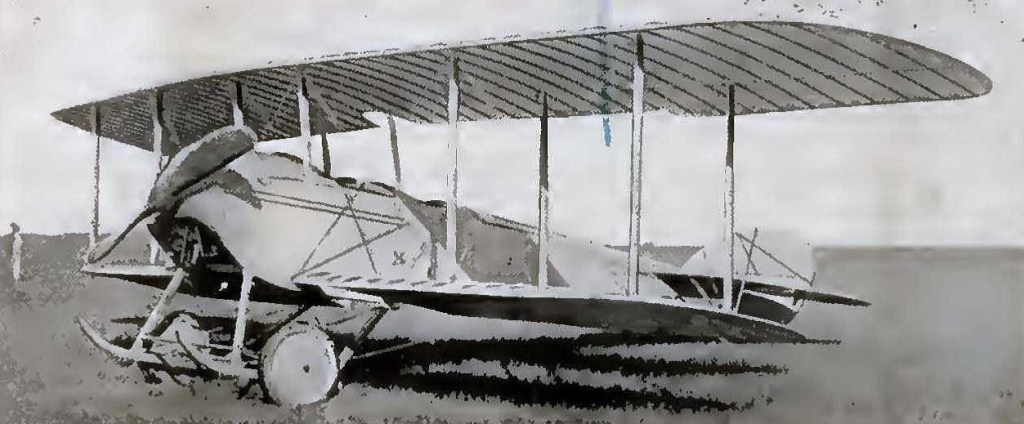
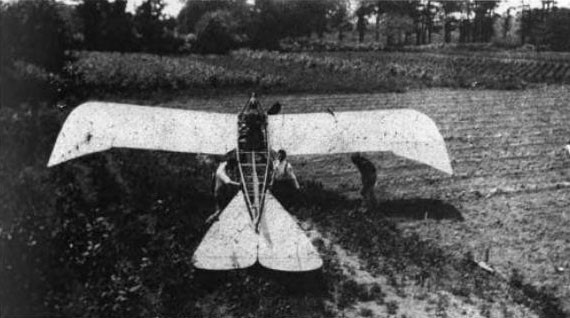
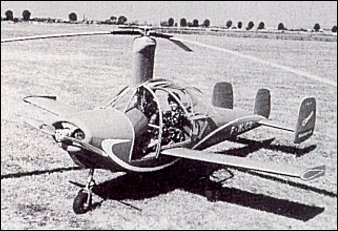
In France, Helicop-Air, produced the prototype of a two-seat light autogyro-type aircraft known as the Girhel.

The Girhel is a side-by-side two-seat light aircraft to which an autogyro rotor has been fitted. It was designed with the assistance of Ing. Georges Lepere.
For take-off the rotor can be set turning by engaging a clutch in a drive-shaft from the engine. In flight the rotor autorotates and the engine drives a tractor airscrew in the conventional manner. Most of the “lift” is contributed by the fixed wings in cruising flight, so that the rotor is heavily loaded only during take-off and landing. The three-blade rotor is of wood construction, with variable pitch. Starting is by a clutch and drive-shaft from engine. The wings are mid-wing cantilever monoplane with a single metal spar, wood covering, large ailerons, and end-plates at the tips.

The all-metal fuselage structure has a cantilever monoplane type tail unit, with conventional elevators, two fins and central rudder. All-wood structure. The landing gear is a non-retractable tricycle type. The nose-wheel is steerable and brakes are on the main wheels.

The two seats are side-by-side in the enclosed cabin. Dual controls are optional. Space for baggage is aft of the seats. There is provision for carrying a litter or agricultural spray-gear.
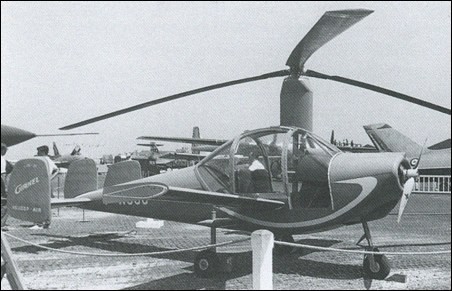
This was exhibited for the first time at the 1959 Paris Salon de l’Aeronautique.

It is not clear whether the prototype actually flew.

Two versions of the Girhel were offered:
Girhel L.50. 90hp Continental C90 engine with Ratier two-blade fixed-pitch airscrew.
Girhel L.51. With 150hp Lycoming O-320 engine with a variable-pitch airscrew.

Helicop-Air L.50 Girhel
Engine: Continental C.90, 65kW
Prop: Ratier two-blade fixed-pitch
Rotor diameter: 10.0m
Wngspan: 6.0m
Length: 6.10m
Height: 2.70m

Helicop-Air L51 Girhel
Engine: Lycoming O-320, 150hp
Prop: variable-pitch
Rotor diameter: 10.0m
Wngspan: 6.0m
Length: 6.10m
Height: 2.70m
Weight empty: 416kg
Weight loaded: 750kg
Max speed (est.): 215km/h
Cruising speed (est.): 180km/h
Min flying speed (est.): 22km/h
Range with pilot and 234kg payload (est.): 100km
Range with two persons and baggage (est.): 1000km
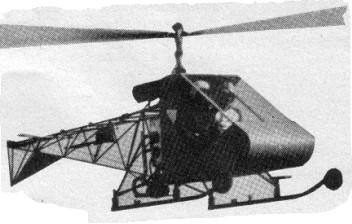
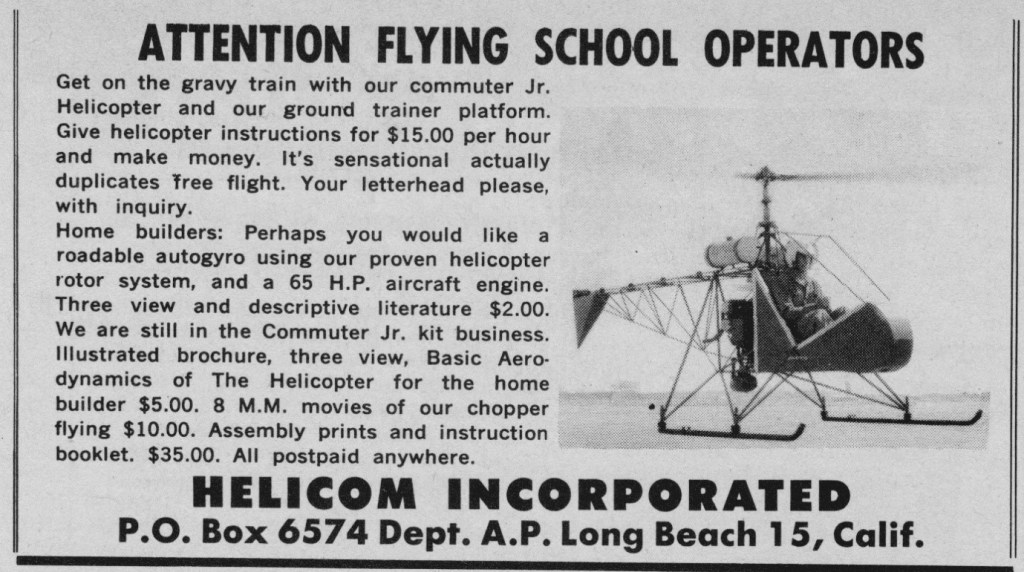
Helicom H-1 Commuter Junior

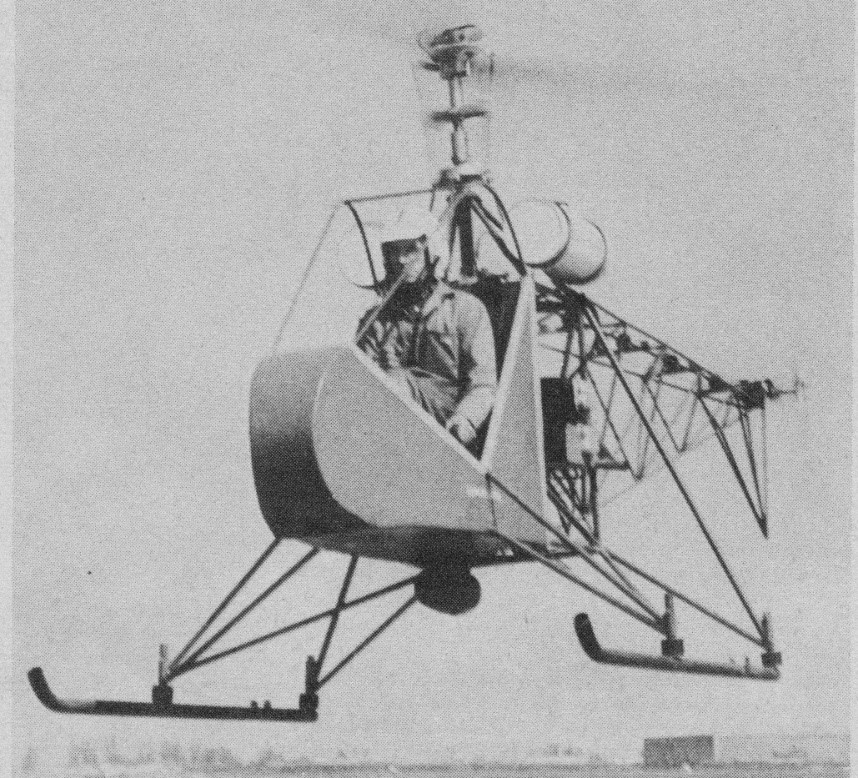
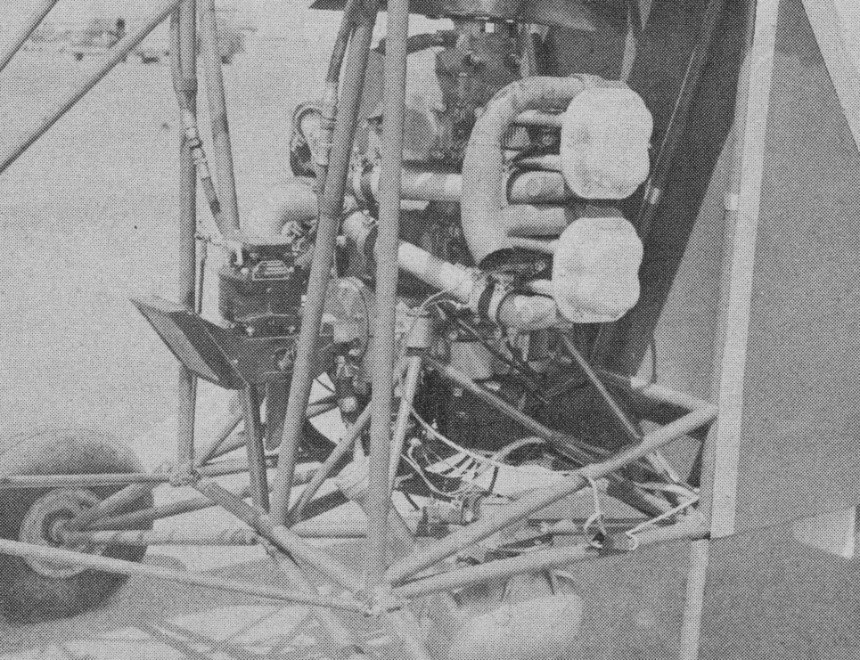
Harold E. Emigh founded the Helicopter Research Corporation in 1954 to develop and market a single-seat personal helicopter. Known as the Helicom Commuter Jr Model H-1 A, the prototype first flew in 1960, and was sold both in ready-to-fly form and as a kit for assembly by amateur constructors. A ground trainer version was developed also, mounted via a gimbal to a castoring base which was too heavy for the helicopter to lift from the ground.

Jan 65
Harold Emigh Sr 1964

The commercial rights were sold to Southern Pacific Aircraft Co and then to International Helicopter Inc of Mayville, New York, with the machine being refined along the way as the Commuter II.

Engine: Continental, 90 hp.
Gross weight: 950 lb
Fuel capacity: 2 x 6 USG
Cruise: 90 mph

Heldeberg Marathon / Blue Heron Marathon

The Heldeberg Marathon, also called the Blue Heron Marathon, was an American powered parachute, that was designed and produced by Heldeberg Designs of Altamont, New York.

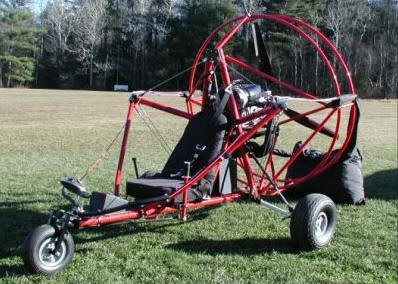
The Marathon was designed to comply with the US FAR 103 Ultralight Vehicles two-seat trainer rules and was marketed as a light-sport aircraft. The aircraft takes its name from its design goal of an aircraft with long range and endurance and features a range of 115 mi (185 km). It features a parachute-style high-wing, two-seats-in-tandem accommodation, tricycle landing gear and originally a single 50 hp (37 kW) Rotax 503 engine in pusher configuration. The 64 hp (48 kW) Rotax 582 was the standard engine used on later models.

The aircraft is built from a combination of bolted dural aluminium and stainless steel tubing. It features a double ring propeller guard that has been roll-over tested. The 10 U.S. gallons (38 L; 8.3 imp gal) fuel tank is made from aluminium. In flight steering is accomplished via foot pedals, or optionally a control stick, that actuate the canopy brakes, creating roll and yaw. On the ground the aircraft has lever-controlled nosewheel steering. The main landing gear incorporates gas strut suspension. The aircraft is factory supplied in the form of an assembly kit that requires 30–50 hours to complete.

Originally marketed by the factory under their own name, the aircraft was later marketed under the brand name Blue Heron, although the manufacturer remained the same. The selling price was US$21,995 in 2012, though production is now completed.

Blue Heron Marathon
Powerplant: 1 × Rotax 582, 64 hp (48 kW)
Length: 9 ft 8 in (2.95 m)
Wingspan: 39 ft 6 in (12.04 m)
Height: 6 ft 6 in (1.98 m)
Wing area: 500 sq ft (46 m2)
Empty weight: 308 lb (140 kg)
Gross weight: 850 lb (386 kg)
Fuel capacity: 10 U.S. gallons (38 L; 8.3 imp gal)
Cruise speed: 32 mph (51 km/h; 28 kn)
Range: 115 mi (100 nmi; 185 km)
Rate of climb: 900 ft/min (4.6 m/s)
Wing loading: 1.7 lb/sq ft (8.3 kg/sq.m)
Crew: one
Capacity: one passenger

Heldeberg Spirit 103 / Blue Heron Spirit 103

The Heldeberg Spirit 103, also called the Blue Heron Spirit 103, is an American powered parachute, designed and produced by Heldeberg Designs of Altamont, New York.

The Spirit 103 was designed to comply with the US FAR 103 Ultralight Vehicles rules, including the category’s maximum empty weight of 254 lb (115 kg). The aircraft has a standard empty weight of 205 lb (93 kg). It features a parachute-style high-wing, single-place accommodation, tricycle landing gear and originally a single 45 hp (34 kW) 2si 460 engine in pusher configuration. The 40 hp (30 kW) Rotax 447 and 50 hp (37 kW) Rotax 503 engines are used on current models.

Early models used a large sized 500 sq ft (46 m2) parachute, whereas current models use a smaller and faster 400 sq ft (37 sq.m) wing.

The aircraft is built from a combination of bolted 6061 T-6 aluminium and stainless steel tubing. It features a double ring propeller guard that has been roll-over tested. The 5 U.S. gallons (19 L; 4.2 imp gal) fuel tank is made from aluminium. In flight steering is accomplished via foot pedals, or optionally a control stick, that actuate the canopy brakes, creating roll and yaw. On the ground the aircraft has lever-controlled nosewheel steering. The main landing gear incorporates gas strut suspension. The aircraft was factory supplied in the form of an assembly kit that requires 30–50 hours to complete for US$12795 in 2012.

Originally marketed by the factory under their own name, the aircraft was later marketed under the brand name Blue Heron, although the manufacturer remained the same.

Blue Heron Spirit 103
Engine: 1 × Rotax 503, 50 hp (37 kW)
Wingspan: 39 ft 6 in (12.04 m)
Wing area: 400 sq ft (37 sq.m)
Length: 8 ft 6 in (2.59 m)
Height: 6 ft 0 in (1.83 m)
Empty weight: 235 lb (107 kg)
Gross weight: 580 lb (263 kg)
Fuel capacity: 5 U.S. gallons (19 L; 4.2 imp gal)
Wing loading: 1.45 lb/sq ft (7.1 kg/sq.m)
Power Loading: 11.3 lbs. per hp
Cruise speed: 32 mph (51 km/h; 28 kn)
Rate of climb: 450 ft/min
Take Off Distance: 150 ft
Landing Distance: 150 ft
Seats: one

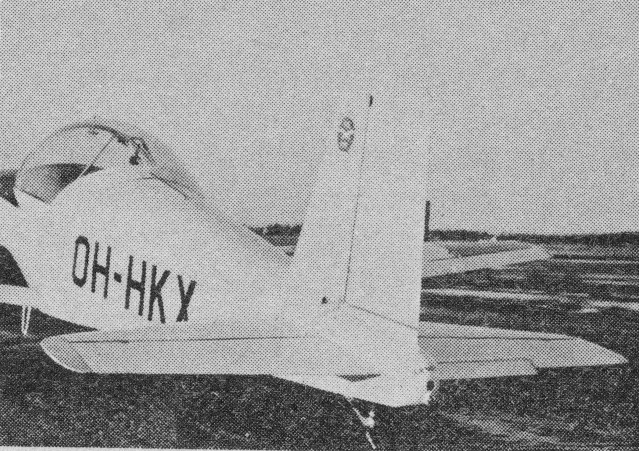
Heinonen HK-2

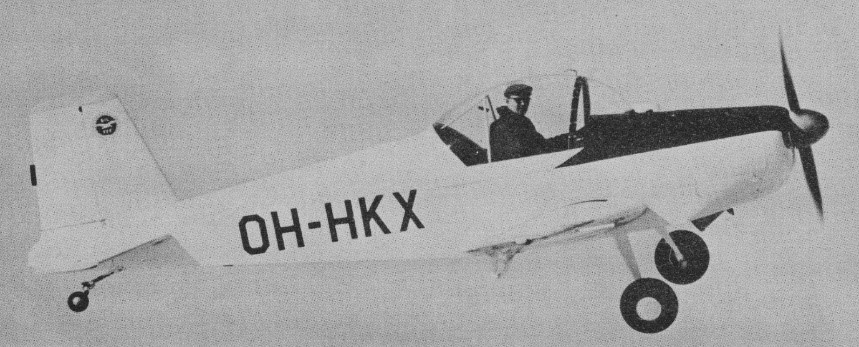
Juhani Heinonen produced the Heinonen HK-4 in 1964 for the Finnish Aeronautical Association.

Heinonen developed the two-seater with an all-wood wing, ailerons fabric covered. The all-wood fuselage has four main longerons and plywood covering. The tail is wood cantilever with fabric covered rudder and elevator. An elevator trim is adjustable from the cockpit.

The landing gear uses cantilever spring steel main legs attached to the wing, and the tail wheel is steerable.

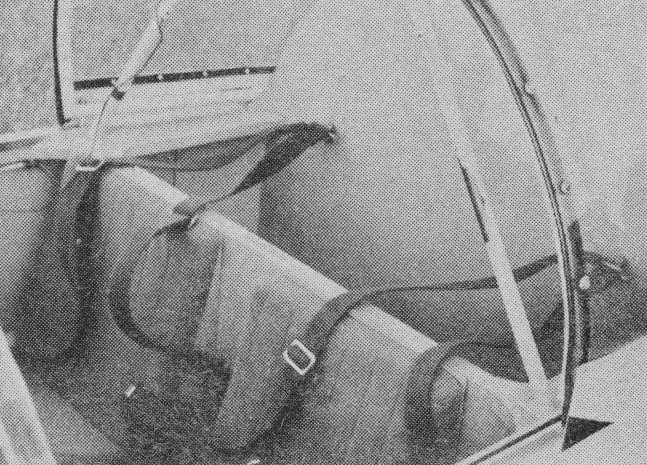
A baggage compartment is behind the seats.

Gallery

Engine: Lycoming O-235-C1, 115 hp
Wing span: 26 ft 0.5 in
Lengt: 20 ft 2 in
Height: 7 ft 1.5 in
Empty weight: 870 lb
MTOW: 1323 lb
Top speed: 148 mph
Cruise: 127 mph
Service ceiling: 15,400 ft