Hovey Delta Bird

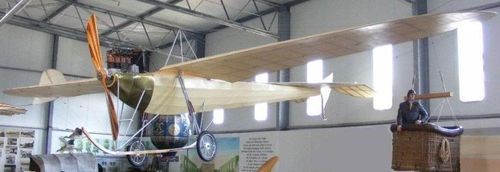
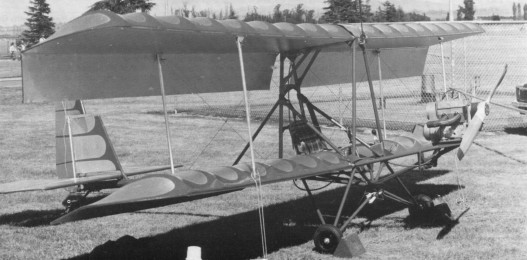
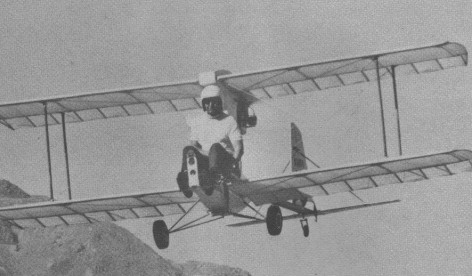
Single seat single engined biplane with conventional three axis control. Wing has unswept leading and trailing edges, and constant chord; conventional tall. Pitch control by elevator on tail; yaw control by fin mounted rudder; roll control by full span ailerons on upper wing; control inputs through stick for pitch/roll and pedals for yaw. Wing braced by struts and transverse X cables; wing profile; double surface. Undercarriage has three wheels in tail dragger formation. Push right go right tailwheel steering connected to yaw control. Aluminium tube framework, without pod. Engine mounted between wings driving tractor propeller. Tubing from 6061T6 aluminium; galvanised steel rigging; Dacron wing covering.
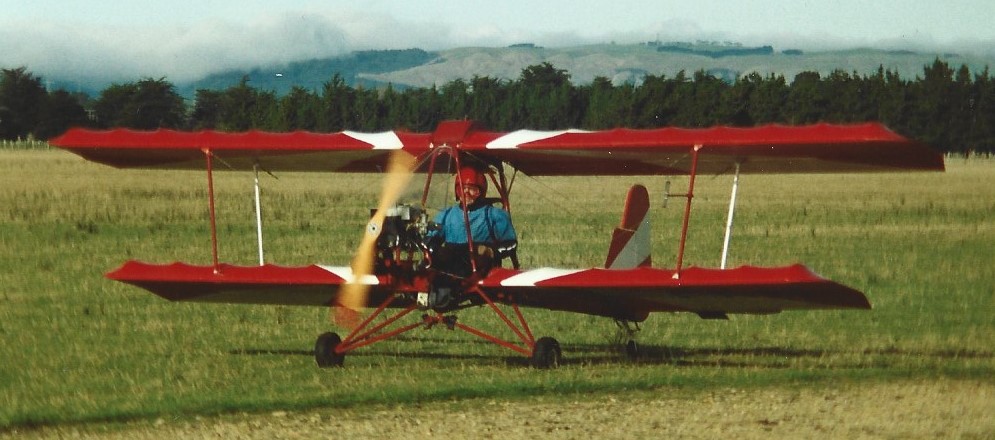
This three axis machine is a biplane which was revealed to the public at the EAA convention for amateur constructors, Oshkosh, in August 1982, where it was hailed as a modernised version of the Whing Ding II with a simpler structure and more power. The adoption of an aluminium tubular structure allowed Aircraft Specialties to offer the Delta Bird in plan form, as with the other two aircraft, but also as a kit requiring around 200 h for assembly. In place of the pusher common to the Beta Bird and the Whing Ding II, the motor is mounted as a tractor on a triangular framework at the front of the main framework. The exhaust pipe passes under this triangular section and finishes by the junction of the two triangular frameworks which support the main wheels, an arrangement designed to allow all terrain use. The machine retains conventional controls with ailerons on the trailing edges of the two top wings, a rudder hinging from the fin and the elevators from the horizontal stabiliser; they are all of generous proportions.
Engine: Cuyuna 430R, 30 hp at 5500 rpm.
Propeller diameter and pitch 54 x 27 inch, 1.37 x 0.69 m.
Belt reduction, ratio 2.0/1.
Power per unit area 0.20 hp/sq.ft, 2.1 hp/sq.m.
Fuel capacity 3.5 US gal, 2.9 Imp gal, 13.2 litre.
Length overall 15.0 ft, 4.57 m.
Height overall 6.0ft, 1.83m.
Wing span 24.0ft, 7.31m.
Constant chord 3.5 ft, 1.07 m.
Sweepback 0 deg.
Tailplane span 8.0 ft, 2.44 m.
Fin height 3.7 ft, 1.13 m.
Total wing area 152 sq.ft, 14.1 sq.m.
Fin area 9.0 sq.ft, 0.84sq.m .
Tailplane area 20.0 sq.ft, 1.86 sq.m.
Wing aspect ratio 6.9/1.
Wheel track 6.3ft, 1.92 m.
Main wheels diameter overall 15 inch, 39 cm.
Empty weight 218 lb, 99kg.
Max take off weight 450 lb, 204kg.
Payload 232 lb, 105 kg.
Max wing loading 2.96 lb/sq.ft, 14.5 kg/sq.m.
Max power loading 15.0 lb/hp, 6.8kg/hp.
Load factors +3.5, 3.5 design; +5.3, 5.3 ulti¬mate.
Max level speed 60mph, 97kph.
Never exceed speed 60mph, 97kph.
Max cruising speed 45mph, 72kph.
Stalling speed 26 mph, 42 kph.
Max climb rate at sea level 400 ft/min, 2.0 m/s.
Best glide ratio with power off 6/1.
Take off distance 250 ft, 75 m.
Landing distance 250 ft, 75 m.
Range at average cruising speed 50 mile, 80km.
Hovey Beta Bird

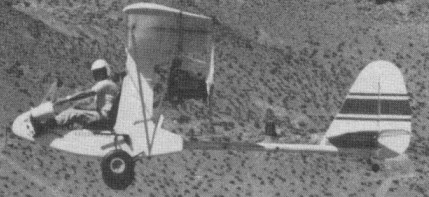
The Beta Bird, designed in 1977 but not flown until April 1979 at Mojave, California, is a high wing monoplane version of the Whing Ding II, with which it shares a common fuselage. Like the biplane, the conventional tailplane is carried on a tubular boom and there is a tailwheel undercarriage. Wing profile Hovey BB 14. Brakes on main wheels. Engine mounted below wing. The Beta Bird was initially known as the Bushwacker.
Flight handling characteristics are very good, with an extremely docile stall. Rugged reliability was proven in off-airport operations in high desert country. Single-place, single-engine, strut-braced monoplane followup to Whing Ding II biplane, using drooperons. Stick-and-rudder 3-axis controls. Nose cowl and instrument panel included. Landing gear: Two mains with large 600×6 wheels & tires (from Cessna 150) for rough-field operation, using individually operated hydraulic toe brakes. Tail-wheel non-swiveling, steered with rudder cable linkage. Powerplant: Converted VW engine, pusher mounted, direct drive to 54×24 prop. It is powered by a 1,385-cc converted VW engine and offers the homebuilder simplified methods of construction. The wings fold for transport or storage. The fuselage pod is plywood and spruce construction with a stiffened aluminum tail boom to support the tail. The wings are spruce in a two-spar configuration, and the ribs are single-piece aluminum tubes. The tail group is fabricated from aluminum tubing, pop-riveted together with gussets and covered with Dacron. Only 250 feet are needed for takeoff and landing, and the 7 1/2-gallon fuel tank is good for 180 miles.

Engine: Volkswagen 1385cc, 45 hp.
Power per unit area 0.52 hp/sq.ft, 5.6 hp/sq.m.
Length overall 16.5 ft, 5.02 m.
Height overall 6.0ft, 1.83m.
Wing span 25.5ft, 7.77m.
Sweepback 0 deg.
Total wing area 87 sq.ft, 8.1 sq.m.
Wing aspect ratio. 7.3/1.
Empty weight 405 lb, 184kg.
Max take off weight 650 lb, 295kg.
Payload 245 lb, 111kg.
Max wing loading 7.47 lb/sq.ft, 36.4kg/sq.m.
Max power loading 14.4 lb/hp, 6.6kg/hp.
Max level speed 85 mph, 137 kph.
Never exceed speed 95 mph, 153kph.
Cruising speed 70mph, 113kph.
Stalling speed 40 mph, 64 kph.
Max climb rate at sea level 400ft/min, 2.0m/s.
Take off distance 250 ft, 75 m.
Range at average cruis¬ing speed 130 mile, 209 km.

Engine: VW 1800cc
hp Range: 50-85
Length: 16.5 ft
Wingspan: 26 ft
Wing area; 110 sq.ft
Empty weight; 405 lb
Gross weight: 650 lb
Fuel cap: 7.5 USG
Cruise: 80 mph
Stall: 45 mph
Rate of climb: 750 fpm
Takeoff dist: 250 ft
Landing dist: 150 ft
Seats: 1
Landing gear: tailwheel
LSA: yes

Hotz Tiger

Single seat wood and fabric ultralight sailplane to FAR 103 specs. Cantilever midwing, monocoque fuselage, conventional 3-axis controls with spoilers. 1930’s looks and technology for that vintage feel. Construction time 1000+ hours, cost $1500 US. Plans not available, sized and built for designer.

Wing Span: 30 ft
Wing Area: 112 ftsq
Aspect: 7.5
Airfoil: NACA 63-621 modified
Empty weight: 150 lb
Gross weight: 325 lb
Wing Loading: 2.9 lb/ftsq
Structure: Wood/Fabric
Performance (estimated):
L/D Max: 12 @ 50mph
Min Sink: 5 fps @ 45 mph

Horton Ho XII

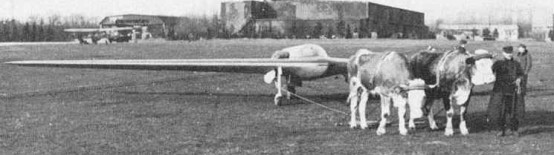
The H XII was a light side by side two seater with a 100 hp engine. It was intended as a private owners coupe but R.L.M. were interested in it as a trainer. The first of the type was built and flown at Gottingen (where it was found destroyed in June this year) as a glider; work was also in progress at Kirtorf (sp.) where a mock up of the power center section was found, badly damaged by fire.
The wing used a Mustang section at the root graded to a symmetrical section with Mustang fairing shape at the tip. Washout was 3 – 3.5 degrees.
Elevon controls were of H VII type with a 20% Frise nose. Plain flaps were fitted with a H IX center section spoiler and “trafficator” drag rudders.
The undercarriage was unusual in having two wheels forward and one main wheel aft taking 60% of the weight. All three wheels were retractable.
Little flying had been done, but it was found that the same troubles were arising as on the H IVb. The laminar flow sections were causing bad tip stalling and loss of control effectiveness at the stall.

Span: 10 m
Aspect Ratio: 8
Wing Area: 32 sp./m (345 sp.ft.)
Leading Edge Sweepback: 30 deg
Weight: 700 kg (1,550 lb.)
Wing Loading: 2.19 kg/sq.in. (4.5 lb/sq.ft.)

Horton H III

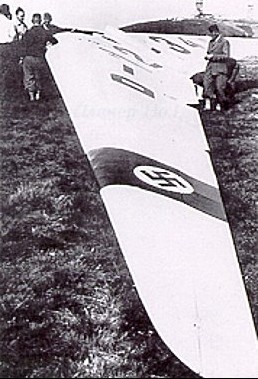
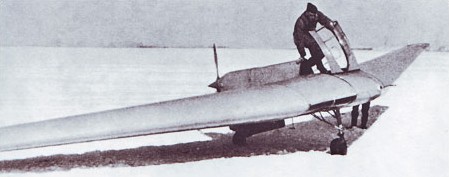
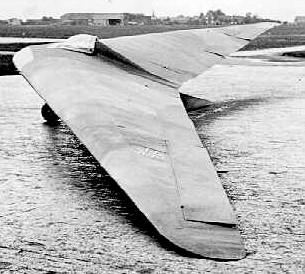
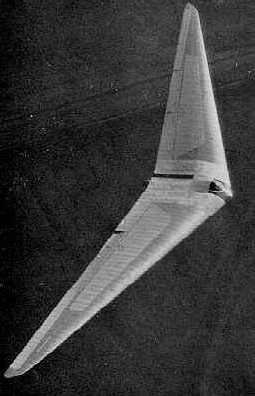
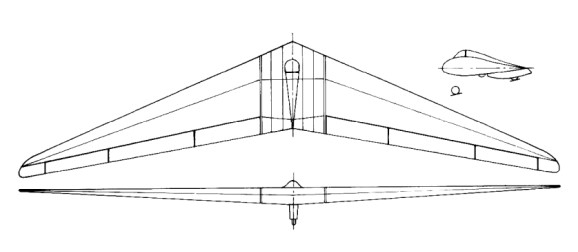
In 1938, with this official backing, the Hortens set up a facility at Berlin’s Tempelhof Airport, where they constructed the Ho III sailplane.
The first H III was built at Templehof Berlin in 1938 and the second (H IIIb) was built by Peschke Flugzeugban, also in Berlin. The main change from H II were increase span (20 m), reduce sweepback (23degrees) and modified lateral controls. The outer wing panels this time had three movable flaps. The innermost was again a landing flap, but the outer pair were geared so that the outer flap had a large range of upward deflection and, only slight downward movement and, the inner flap large downward movement and slight upward movement. This arrangement reduced unfavorable yawing moments due to aileron by making use of differential aileron movement, but avoided the change in longitudinal trim by the opposing differential of the inner flap pair. In high speed flight the nose down trim was provided mainly by the inner elevon section moving downwards, the outer flap deflecting only slightly; this had the advantage of relieving the tips of torsional loads at high speed. Aerodynamic balance was again by geared tab on sub types IIIa and b, but on IIId, f, and g the outer flap had a 20% Friese nose: out of balance aerodynamic loads on the elevators were trimmed by a rubber bungee trimmer.

Ho.IIId

Drag rudder design remained the same as for the H II.

The H III seems to have been a successful and useful type, for 14 were built altogether and several different sub-types developed. Production of some of the sub-types was still going on in 1945. The following variations on the original theme were produced:

IIIa – Original design

IIIb – Similar, but with outer elevon flap not extending to the wing tip.

IIIc –

Same as IIIa but with a fixed front plane. One of these was built, for the 1938 Rhon contest. Very little flying experience was obtained. The idea was to improve CLmax.

IIId – Standard wings fitted to a special center section with 32 hp Volkswagen engine and folding propeller. The idea was to produce a high performance sailplane with auxiliary engine for takeoff and climb, which could be shut off for soaring without impairing the performance as a sailplane.
Center sections (Opel engine with gear drive) were being produced at Tubingen at the rate of two a month. 12 partly finished were in the workshop in June 1945. Finished parts were sent to the Wornberg and assembled with wings made at Darnsdorf.
Performance with power was stated to be:
Ground run: 70 meters
Rate of climb: 2 m/sec.
Cruising speed: 110 kph
Max. speed: 130 kph
The engine installation was take straight from the Volkswagen complete with exhaust system and electric starter; it weighed 240 lbs.

IIIe – H III glider with waggle tips. On this aircraft, remains of which were found at Gottingen, the tips were operated directly by the pilot.

IIIf –

Same as the IIIb, but with prone position for the pilot. A specimen of this type was found at Gut Nierstein with modified controls. The outer flap had a Frise nose, (as on H IV), spoiler type drag rudders were fitted in place of the usual leading edge split flaps, and H IV type dive brakes installed.
The prone piloting position eliminated the need for the head fairing used on the other H III’s and gave the pilot a much better view.

IIIg – Special two-seater center section with tandem seats. Specimens were found at Zimmern and Hernberg. This type was used for training purposes.

H IIIh / Ho-229 – One built in 1944.

No independent opinions are available on the flying qualities of the H III series, but Reimar Horten was insistent that it was a very straightforward aircraft from the pilots point of view. He stated that any glider pilot with five hours experience could be safely sent off solo in an H III.

Horten H III a
Wing span: 20.4m
Wing area: 36sq.m
Empty Weight: 220kg
Payload: 80kg
Gross Weight: 300kg
Wing Load: 8.3kg/sq.m
Aspect ratio: 11.6
L/DMax: 28 60 kph
MinSink: 0.48 m/s 45 kph
Seats: 1

Horten H III c
Wing span: 20.4m
Wing area: 36sq.m
Empty Weight: 220kg
Payload: 80kg
Gross Weight: 300kg
Wing Load: 8.3kg/sq.m
Aspect ratio: 11.6
L/DMax: 28 60 kph
MinSink: 0.48 m/s 45 kph
Seats: 1

Horten H III f
Wing span: 20.5m
Wing area: 37.5sq.m
Empty Weight: 280kg
Payload: 80kg
Gross Weight: 360kg
Wing Load: 9.6kg/sq.m
Aspect ratio: 11.1
L/DMax: 28 63 kph
MinSink: 0.52 m/s 47 kph
Seats: 1

H IIIh
Wingspan 54 ft.
Length 16.4 ft.
Height 5.4 ft.
Empty weight 586 lb
Loaded weight 807 lb
Wing area 344 sq. ft.
Wing loading 2.25 lb/sq. ft.
Glide ratio 24:1
Aspect ratio 8.48
Max speed 143 mph
Best glide 45 mph

Hornet Microlights Invader 330 / Striker

The Invader 330 is a one plus one derivative of the Invader 440 (side by side one/two seat), using the smaller Robin EC34PM engine and a Flexiform Sky Sails Striker wing.

Engine: Robin EC34PM.
Toothed belt reduction.
Length overall 11.0ft, 3.35 m.
Wing span 34.5 ft, 10.52 m.
Sweep back 15 degs.
Total wing area 200 sq.ft, 18.6 sq.m.
Wing aspect ratio 7.5/1.
Wheel track 4.3 ft, 1.31 m.
Nosewheel diameter overall 16 inch, 41 cm.
Main wheels diameter overall 16 inch, 41 cm.