Engine: Rotax 912ULS, 100 hp
TBO: 1500 hr
Fuel type: 100/100LL
Propeller: 68 in./FP/3-blade Woodcomp
Wingspan: 32 ft. 6 in.
Overall length: 23 ft. 7 in.
Height: 8 ft. 7 in.
Wing area: 128 sq. ft
Landing gear: Tri./Fixed
Max ramp weight: 1278 lb
Gross weight: 1278 lb
Landing weight: 1278 lb
Empty weight, std: 695 lb
Useful load, std: 583 lb
Usable fuel, std: 17 USG
Usable fuel, opt: 25 USG
Payload, full std. fuel: 481 lb
Wing loading: 9.9 lbs./sq.ft
Power loading: 12.8 lbs./hp
Seating capacity: 2
Cabin width: 47.2 in
Cruise speed 75% power: 115kt
Fuel consumption 75% power: 5.3 USgph
Fuel consumption 55% power: 4.9 USgph
Vso (kts.): 33
Best rate of climb, SL: 1100 fpm
Takeoff ground run: 452 ft
Landing ground run: 495 ft
2010 Base price: $105,000
1 engine
Kappa KP 2 Sova / Rapid KP 2
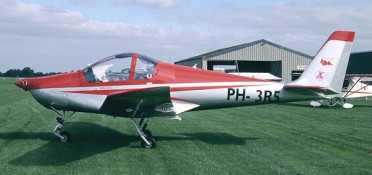
In 1994 the development of the all-metal UL aircraft KP-2U SOVA was started. Three prototypes were built: two for the test flights and one for the strength tests. The first test flight of the SOVA was done in May 1996. In September 1997 the aircraft obtained the type certificate by the UL-2 regulations from the Air Amateur Association of the Czech republic.
In June 1977, KAPPA77 a.s. was founded and the KP-2U entered serial production. After the KAPPA 77 a.s. was declared bankruptcy on 16 February 2005, the company Jihlavan airplanes, s.r.o. was founded on 2 March 2005 with the main objective – to proceed in the production of the ultralight aircraft KP 2U SOVA. On 1 April 2005, the Jihlavan airplanes, s.r.o. became the holder of the manufacture rights, intellectual properties, etc. of the KP-2U. Over 160 airplanes of the Kappa KP-2U versions were built. After Jihlavan took over the production of the aircraft it was renamed as the Rapid KP-2U.
The Kappa KP-2UR Sova is a side-by-side two-seat low-wing ultralight aeroplane, featuring variable-pitch three blade composite prop, retractable trailing link tricycle undercarriage and fowler flaps.
The all-metal aircraft is delivered in airworthy condition, with electro-retractable landing gear with hydraulic brakes, mechanically controlled Fowler flaps, removable wings with winglets, dual control and an elevator with electro-controlled trim tab. Both fabric-covered seats are adjustable, with four-point safety belts.
2009 Price: 49000 EURO
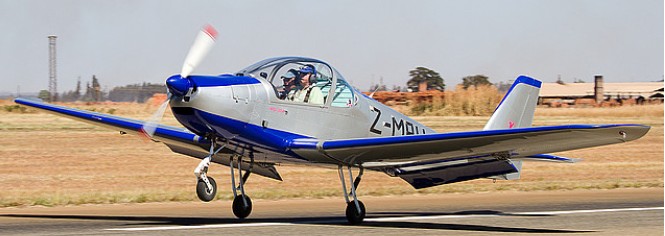
The KP 2V SOVA structure is entirely riveted dural tube. The side by side two seater is equipped with retractable undercarriage and Fowler flaps with a GAW 1 profile.
RAPID 200
Engine: Rotax, 100 hp.
Fuel cap: 64 lt.
Range nil res: 500 mile.
Stall: 26 kt / 30 mph / 48 kmh
Cruise: 113 kt / 130 mph / 210 kmh
VNE: 140 kt / 162 mph / 260 kmh
Empty Weight: 282 kg / 622 lbs
MTOW Weight: 450 kg / 992 lbs
Climb Ratio: 1300 ft/min / 6.5 m/s
Take-off distance (50ft obstacle): 330 ft / 100 m
Landing distance (50ft obstacle): 460 ft / 140 m
KP 2U SOVA
Engine: Rotax, 100 hp.
Fuel cap: 64 lt.
Range nil res: 500 mile.
Stall: 26 kt / 30 mph / 48 kmh
Cruise: 108 kt / 124 mph / 200 kmh
VNE: 143 kt / 165 mph / 265 kmh
Empty Weight: 285 kg / 628 lbs
MTOW Weight: 450 kg / 992 lbs
Engine: Rotax 912 UL, 80 hp
Wing span: 9.9 m
Wing area: 11.85 sq.m
MAUW: 450 kg
Empty weight: 260 kg
Fuel capacity: 64 lt
Max speed: 260 kph
Cruise speed: 185 kph
Minimum speed: 48 kph
Climb rate: 6.5 m/s
Certification: Cz
Seats: 2
Fuel consumption: 12 lt/hr
Price (1998): 100 000 DM
Kamov Ka-126 / Ka-128
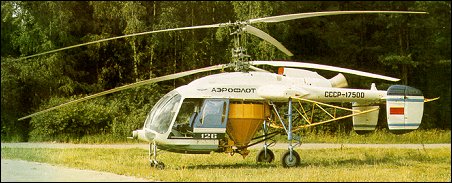
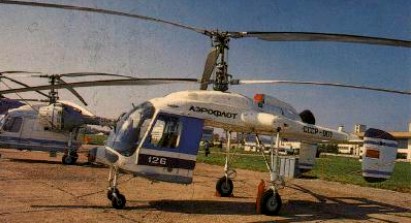
Development began 1984 with an early mockup with two small turboshafts above the cabin. A single TVO-100 turboshaft was subsequently adopted. In 1985 a Romanian-Russian agreement of co-operation for manufacturing a utility helicopter derived from the Ka-26 was signed. In 1986 the ICA Brasov factory started development and manufacturing preparation.
A ground test vehicle was completed early in 1986. The first flight of the prototype (SSSR-01963) was on 19 October 1988.
The first Romanian aircraft was flown on 22 December 1988 and, with a second, was delivered to the USSR for testing.Serial production was started with 15 completed.
The first of four Soviet-built preproduction Ka-126s first flew on 19 October 1988. A proposed Ka-128, differing only in a 722shp Turbomeca Arriel 1D1 turboshaft power plant and addition of an intermediate gearbox was abandoned.
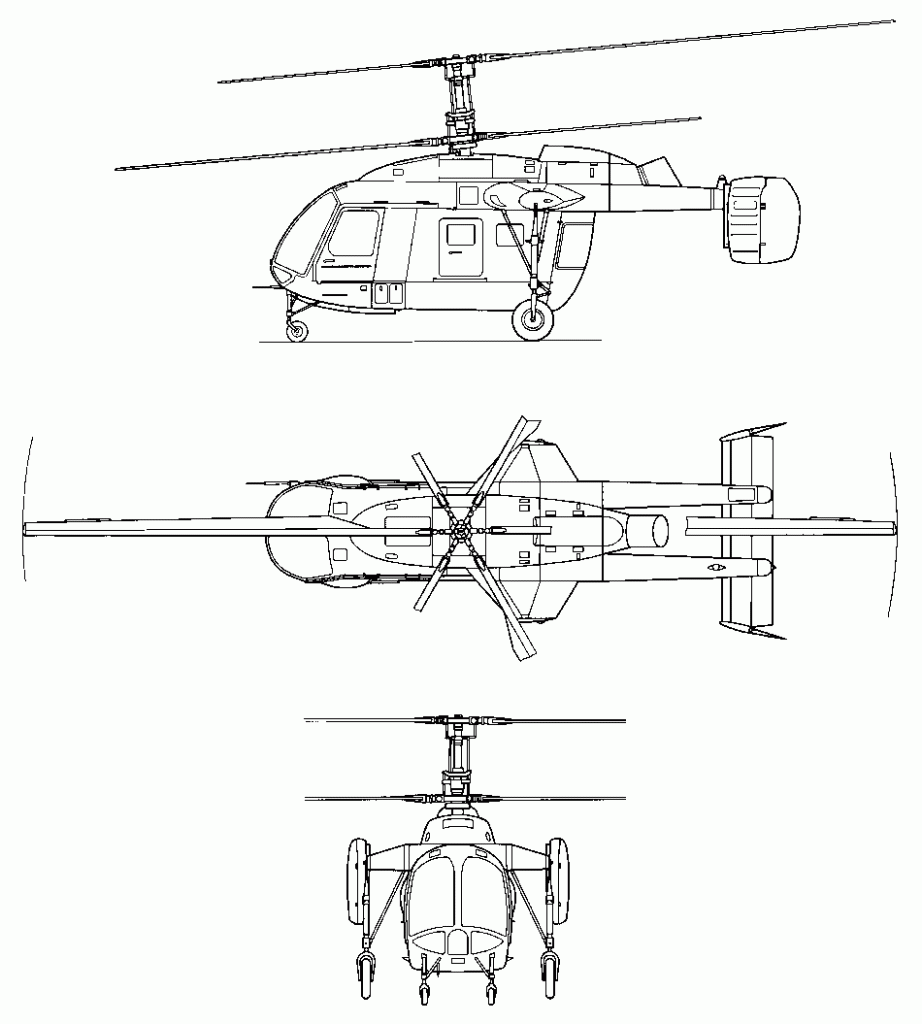
Featuring contrarotating coaxial three-blade rotors, a hinge rotor head with ‘rake’-type blade attachment, the Ka-26 blades of the initial series were to be succeeded by GFRP and CFRP blades with twin-contour spar, load-carrying rear section and electrothermal anti-icing. A rotor brake WAS standard, and non-folding blades.
There was a three-stage gearbox with planetary gear trains, of alloy steel and aluminium casting, flange mounted with four load-carrying bolts. Accessories included cooling fan, hydraulic pump and AC generator. The engine input was 6,000 rpm.
The flying controls were mechanical with irreversible hydraulic actuators. An automatic rotor constant-speed control, with a conventional four-channel control (longitudinal, lateral, cyclic and differential pitch). The two endplate fins and rudders are toed inward 15 degrees, with a non-controllable horizontal stabiliser.
Airframe materials are primarily aluminium alloys, steel alloys and composite sandwich panels of GFRP with honeycomb filler.
The landing gear is a non-retractable four-wheel type. Main units, at rear, are carried by stub-wings. All four units embody oleo-pneumatic shock-absorber, the forward wheels of castoring type, self-centring, with no brakes. The rear wheels have pneumatic brakes. Mainwheel tyres size 595 x 185 mm, pressure 2.45 bars; forward wheel tyres size 300 x 125 mm, pressure 3.43 bars. Skis optional. Provision for large inflatable pontoons, across front of aircraft forward of front wheels and under each mainwheel.
One 522kW Mars (Omsk) TV-O-100 turboshaft is installed centrally in a streamline fairing above the cabin. Electronic-hydraulic automatic two-channel control system, with manual control in case of electronic governor failure, is installed. A front driveshaft has a plate coupling to the gearbox. Fuel is in two forward and one aft tank, with a total capacity of 800 litres. There is provision for two external tanks, on sides of fuselage, total capacity 320 litres. A single-point main tank refuelling is on the port side of aft tank.
The fully enclosed cabin has a rearward-sliding door each side, and normal operation is by a single pilot. A second seat and dual controls are optional. The cabin is ventilated, and warmed and demisted by air from a combustion heater, which also heats the passenger cabin when fitted. An air filter is fitted on the nose of the agricultural version. Space aft of cabin, between main landing gear legs and under transmission, can accommodate a variety of interchangeable payloads. A cargo/passenger pod accommodates four or six persons on folding sidewall seats, with provision for a seventh passenger beside pilot. Two clamshell doors are at the rear of the pod, with emergency exit each side and a hatch in the floor. An ambulance pod accommodates two stretcher patients, two seated casualties and a medical attendant. For agricultural work, a chemical hopper (capacity 1,000 litres) and dust spreader or spraybars are fitted in this position, on the aircraft’s CG. The aircraft can also be operated with either an open platform for hauling freight or hook for slinging loads at the end of a cable or in a cargo net.
A single hydraulic system, with manual override, is for control actuators. The main electrical system is 27V 3kW DC, with a back-up 40Ah battery. A secondary system is 36/115V AC with two static inverters, and a 115/200V AC system with 16kVA generator (6kVA to power agricultural equipment and rotor anti-icing). Electrothermal rotor blade de-icing; hot air engine air intake anti-icing; alcohol windscreen anti-icing; electrically heated pitot. Pneumatic system for mainwheel brakes, tyre inflation, agricultural equipment control, pressure 39 to 49 bars.
After 1989 the project was cancelled.
Engine: 1 x Koptchencko TV-O-100.
nstant pwr: 537 kW.
Rotor dia: 13 m.
MTOW: 4250 kg.
Payload: 1000 kg.
Useful load: 1335 kg.
Max speed: 97 kts.
Max cruise: 86 kts.
Max range: 713 km.
HIGE: 3180 ft.
HOGE: 262 ft.
Service ceiling: 12,623 ft.
Crew: 1.
Pax: 7.
Kamov Ka-115
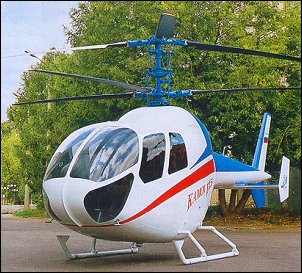
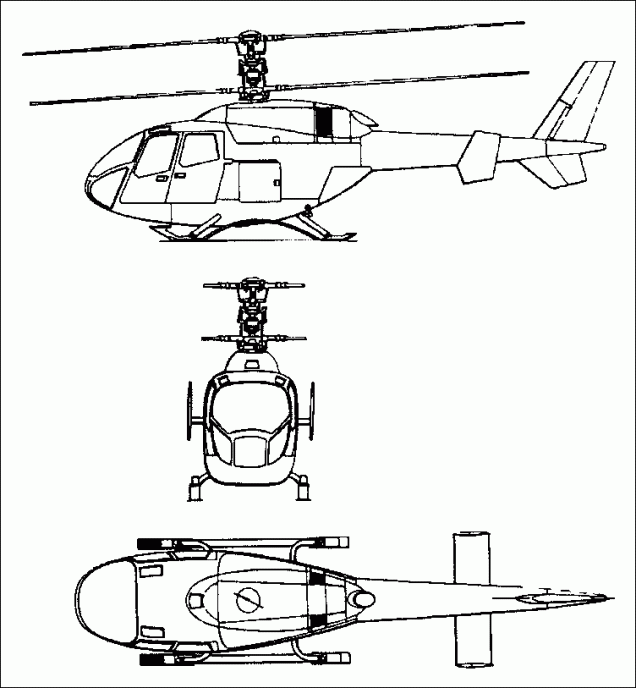
The Ka-115 is a light multi-purpose helicopter equipped with landing skids. It is powered by Pratt & Whitney/Klimov PW 206K/2 engine (Canada/Russia production), and features a large five-door cabin with large windows. In terms of payload-to-weight ratio the helicopter is comparable to its world counterparts.
The cabin is fitted with heating and ventilation systems.
High rotor system efficiency, absence of power losses for the tail rotor drive, combined with smooth aerodynamic shape of the airframe and economic engine give the helicopter fuel flow characteristic of less than 0.5kg per km at a cruise speed of 230km/h.
A de-icing system of the rotor blades, engine inlet particle separator and air conditioning system make the helicopter capable of operating in any climatic region within a 50 degree temperature range.
The helicopter complies with international standards on reliability, safety and comfortable conditions for pilot and passengers.
Ka-115
Engines: 1 x PW/K 206D turboshaft, 477kW
Rotor diameter: 9.5m
Fuselage length: 9.2m
Height: 3.6m
Width: 2.0m
Max take-off weight: 1850kg
Max speed: 250km/h
Cruising speed: 230km/h
Rate of climb: 11.5m/s
Service ceiling: 5200m
Range: 780km
Payload: 700-900kg
Crew: 1
Passengers: 5
Ka-115
Engine: 1 x P&W/Klimov PW206K/2.
Instant pwr: 410 kW.
Rotor dia: 9.5 m.
MTOW: 1850 kg.
Payload: 600 kg.
Useful load: 878 kg.
Max speed: 135 kts.
Max cruise: 124 kts.
Max range: 780 km.
HIGE: 10,164 ft.
HOGE: 7541 ft.
Service ceiling: 17,049 ft.
Crew: 1.
Pax: 4/5.
Kamov KA-56
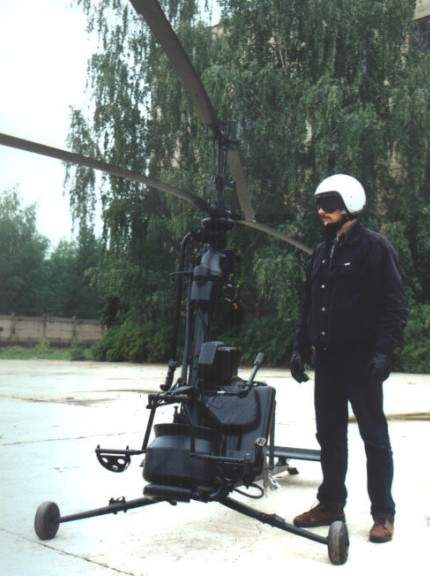
In 1971 Kamov Design Bureau was ordered to produce new ultralight helicopter for military service. Sergei Fomin, Deputy Chief Designer, was ordered to lead this project.
The special task for this helicopter was that it should be able to be transported in a cylinder container of 500 mm diameter. The reason was that Navy wanted to have an opportunity to pull the helicopter out of submarine’s torpedo tube.
Another point was that the helicopter should be able to be assembled for flying in only 15 minutes when unpacked from container.
Powerplant was 40 hp aircooled rotary engine which burned autofuel.
A full-scale mockup was built first, followed by a test plarform which included a real engine, rotor system, transmission and controls.
The only parts which were detachable from the helicopter for transportation were the four main rotor blades. All other parts were easily folded. The main rotor blades were attached by single shift each
No balancing was needed after assebling less rotor tracking. Time to assemble helicopter was only 10 min.
The Ka-56 wasn’t ever flown.
Empty weight: 110 kg
Take-off weight: 220 kg
Range (calculated): – 150 km
Cruise speed (calculated): 110 kmh
Ceiling (calculated): 1700 m
Kamov Ka-20
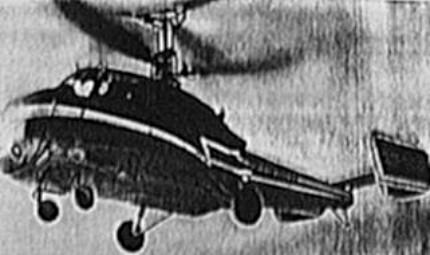
To meet a Soviet Naval Air Force specification in the late fifties for an antisubmarine helicopter for ship or shore-based use, the Kamov bureau developed a helicopter powered by twin turbines installed side-by-side above the cabin, with two three-bladed coaxial, contra-rotating rotors as on their other aircraft. It was first seen at the Tushino air display in July 1961 and was assigned the NATO reporting name Harp.
The Harp was characterized by a large radome under the nose and a fairing beneath the tail boom. The armament consisted of two fixed machine guns in the nose and two small missiles at the sides of the fuselage.

The Ka 20 was later developed as the Ka 25 shipboard and shore-based antisubmarine helicopter. Despite the small number of changes made in the transition from prototype to production standard, the reporting name Harp was not continued, the Ka 25 being allocated the name Hormone.
Rotor diameter: 15.74 m (51ft 8 in)
Length: 9.83 m (32ft 3 in)
Weight: 7300 kg (16 100 lb)
Powerplant: 2900 shp Glushenkov GTD 3 turboshafts
Range: 400 km (250 miles)
Maximum speed: 220 km/h (137 mph)
Kamov Ka-18
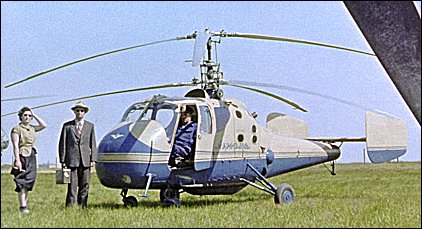
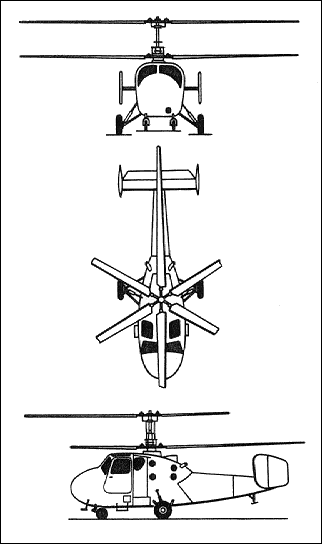
The Kamov Ka-18 (NATO reporting name Hog) was a four-seat development of the Ka-15M. Retaining the same engine, rotor, transmission, control systems and landing gear, the main changes were to the fuselage, which was stretched to make room for two passengers and a baggage compartment (up to 200kg). The doors hinged at the rear, and 176 litres of fuel was in floor tanks. De-icing of the blades and windscreen used alcohol, and an exhaust heater muff fed hot air on demand to the cabin.
The prototype was completed in 1956 and flight testing began early in 1957.
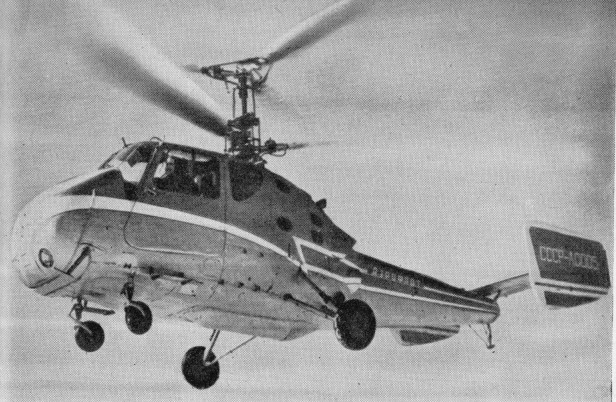
In 1958 the Ka-18 was awarded a Gold Medal at the World Exhibition in Bruxelles.
The Ka-18 was produced with blind-flying instruments and an optional 70-litre ferry tank for AV-MF, VVS and Aeroflot.
A limited number of the Ka-18 were built for use as air ambulances and for forestry patrol, geological survey and agricultural work. Towards the end of 1960, the production aircraft were given a 275hp AI-14VF engine (VF stands for Vertolet Forsirovannie meaning helicopter with turbocharger) instead of the AI-14V, thus enabling the payload to be increased by about 100kg and the ceiling by 300-500m. The chord of the end plate fins was also enlarged.
There was a Uka-18 dual control variant.
Approximately 200 were built.
Ka-18
Crew: 1
Passengers: 3
Engine: 1 x Ivchenko AI-14VF, 200kW / 280 hp
Rotor diameter: 10.0m
Length: 10.0m
Height: 3.4m
Max take-off weight: 1502kg
Max speed: 160km/h
Cruising speed: 130km/h
Service ceiling: 3500m
Range with max fuel: 450km
Range with max payload: 300km
Kamov Ka-15

Shipboard operations with the Ka-10 showed the necessity to start the construction of a new rotary-wing machine capable of lifting greater loads and less restricted by weather conditions. In 1950 AV-MF wrote an outline requirement for a larger two-seat helicopter with an enclosed cabin and much greater endurance.
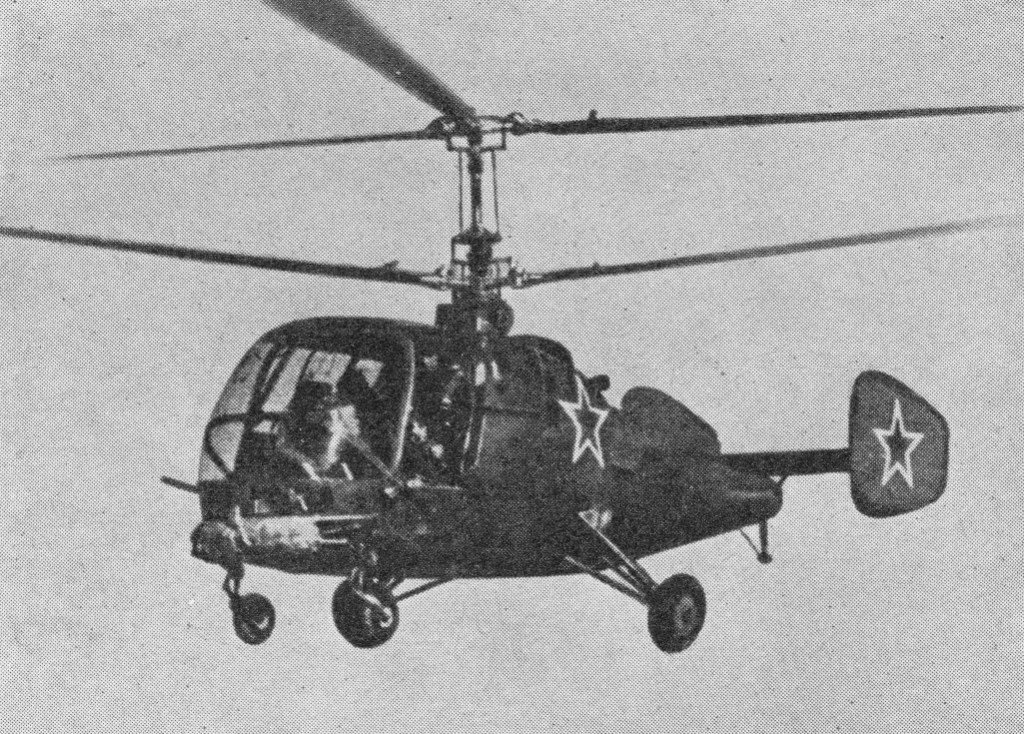
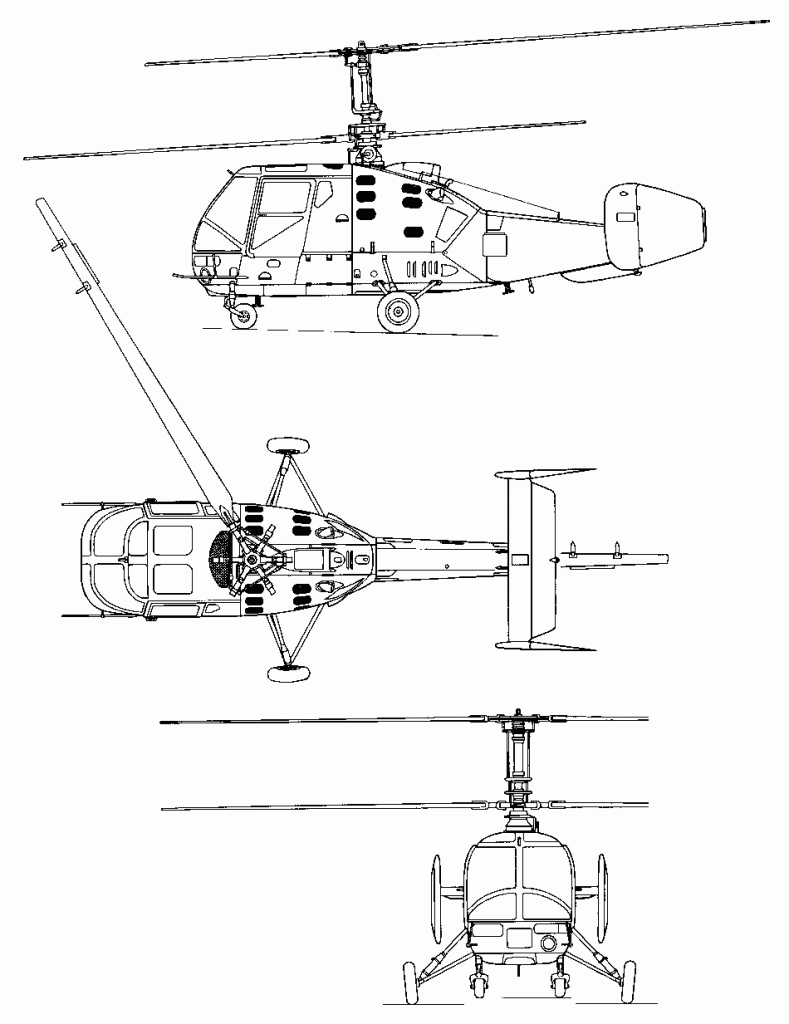
These requirements were met by the Ka-15 which, like its predecessors, featured the co-axial layout. It was a two-seat helicopter with side-by-side seating for the pilot and a mission equipment operator or a passenger.
The rotor hubs and blades were scaled up but compared with Ka-10M, the only significant change was low-density foam filling the blades between ribs and taper of blades towards the tip.
The airframe was welded steel tube, with a covering of ply or dural removable panels and thin plastic glazing and sliding side doors round side-by-side cockpit ahead of rotor, with the engine behind.
The powerplant was a 225hp AI-14V air-cooled radial engine installed at the center of the fuselage, but towards the end of 1960, most Ka-15Ms were given uprated 275hp AI-14VF engines. The engine was mounted with the crankshaft horizontal, driving a cooling fan, 90 degree angle drive to the rotor via over-running clutch, and DC generator starter. From the engine to tail was of stressed-skin dural construction, with a fixed tail comprising braced tailplane and two endplate fins toed in at front (parallel on some Ka-15s), with pedal-driven rudders for yaw control.
The Ka-15 made its first flight on April 14, 1953 at the hands of test pilot D.K.Yefremov. State acceptance trials were completed in 1955, and next year the helicopter entered production at aircraft factory No.99 in Ulan-Ude.
Most fitted with two main and two nose landing wheels, plus tail bumper. The nose wheels were castoring and the main wheels were braked. At least one had pontoons and one with three skis.
AV-MF used substantial number for liaison, ship-based recon and dual Uka-15 for training. Ship trials in 1954 included dripping sonar, but it was unable to carry the equipment needed for ASW missions. The leadership of the Soviet Navy ordered a fly-off between the Ka-15 co-axial helicopter and the Mil Mi-1 single-rotor helicopter, during which both types operated from the cruiser “Mikhail Kutuzov”. By virtue of its small size and manoeuvrability the Ka-15 successfully performed take-offs from and landings on the ship’s small helipad even in sea state 6 conditions. Conversely, the Mi-1 was considerably hampered by its long tail boom and tail rotor and could not operate when air turbulence and pitching and rolling motion of the ship were present. The results of the fly-off finally convinced the Navy that choosing the co-axial layout for a shipboard helicopter was the right decision.
The ASW version the Ka-15 was fitted with two RGB-N sonobuoys or with the SPARU-55 automatic airborne receiver unit. One of such helicopters dropped sonobuoys in the designated part of a sea, the other received information from them about the presence or absence of a submarine. Once a submarine was detected, a third Ka-15 equipped with the OPB-1R sight and two 50-kg depth charges entered service. The first units equipped with Ka-15 helicopters were formed in 1957-58. In 1958 work commenced on equipping the destroyer “Svetly” (Project 57) with a helipad. In 1960-1961 the Navy took delivery of eight Project 57 ships featuring helipads, support equipment for helicopter operations and accommodation for pilots and maintenance personnel.
The Ka-15 evolved into a number of specialized versions, including the multi-purpose Ka-15M, the UKa-15 dual-control trainer version and the four-seat Ka-18. In each case prototype construction began at factory No.82 in Tushino and was completed at the OKB’s own experimental shop near Ukhtomskaya railway station.
The Ka-15 and its versions remained in service for almost 20 years. Between 1958 and 1963, rotor blades of new design were developed, tested and introduced on the Ka-15M and the Ka-18. They were made of composite materials which improved the lift/drag ratio of the rotor and extended the service life of the blades. In 1958-59 test pilot V.V.Vinitsky established two world speed records on the Ka-15M (5 May 1959 170.455km/h over 500km). The Ka-15 marked the beginning of co-axial helicopters operations in the Navy and Civil aviation, the Soviet state airline. As was universally acknowledged, V.B.Barshevsky, M.A.Kupfer, N.N.Priorov, A.J.Vlasenko and D.K.Yefremov made major contribution to the development of the Ka-15.
From 1958 civil Ka-15M used for many roles including ag-spraying; Ka-15S equipped to carry two external stretchers.
The NATO reporting name for the Ka-15 is Hen.
Ka-15
Crew: 1
Passengers: 1
Engine: 1 x AI-14V, 188kW / 225 hp
Rotor diameter: 9.96m
Fuselage length: 6.26m
Height: 3.35m
Width: 2.85m
Max take-off weight: 1370kg
Empty weight: 968kg
Internal payload: 364kg
Max speed: 155km/h
Service ceiling: 3050m
Range: 350km
Kamov Ka-10 Hat
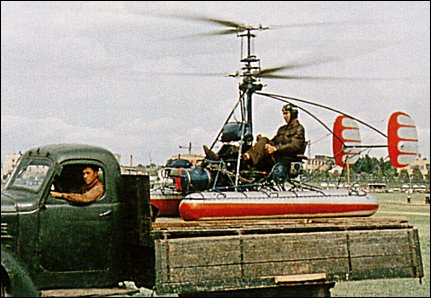
By 1948 Kamov had completed drawings an improved and enlarged (but still single-seat) machine. The structure was similar to the Ka-8 but refined. A co-axial helicopter for observation and liaison duties designated Ka-10, it was designed to meet a general operational requirement (GOR) submitted by the Naval Air Arm.
The rotor diameter was increased by 0.2m over the Ka-8, and blade camber was introduced. Significant changes were made to the helicopter’s control system.
The AI-4G engine was completely new, designed by Ivchenko for this application with two stages of reduction gearing, freewheel with centrifugal clutch and improved power split between rotors. It was fitted with electric start and engine-driven cooling fan.
The first Ka-10 was flown by D.K.Yefremov in September 1949. It was followed by three more prototypes and eight Ka-10M pre-production models; the latter were distinguished by the fact that they had a different rotor assembly and an endplate fin tail unit instead of the single fin of the Ka-10.
These helicopters were tested at length by AV-MF, and one made the first Soviet deck landing on 7 Dec 1950.
ASCC reporting name “Hat”.
Ka-10
Crew: 1
Engine: 1 x AI-4G, 40kW
Rotor diameter: 5.8m
Fuselage length: 3.9m
Height: 2.5m
Width: 1.97m
Max take-off weight: 370kg
Max speed: 90km/h
Service ceiling: 2500m
Range: 170km
Kamov Ka-8 Vertolet

Official disinterest in autogyro made Kamov switch to helicopters, and he decided to build one-man Vozdushnii Mototsikl (flying motorcycle) for civil or military use in 1946. It is reported to have taken 18 months before permission was granted to organize a small informal group and build the Ka-8.
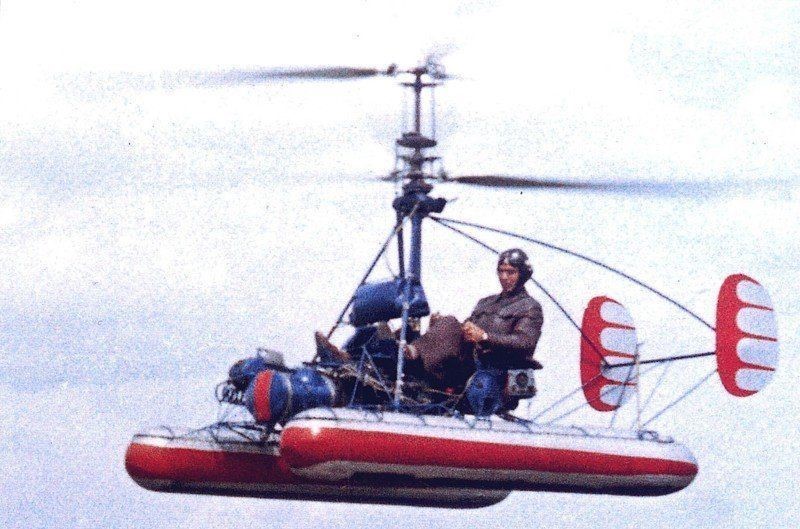
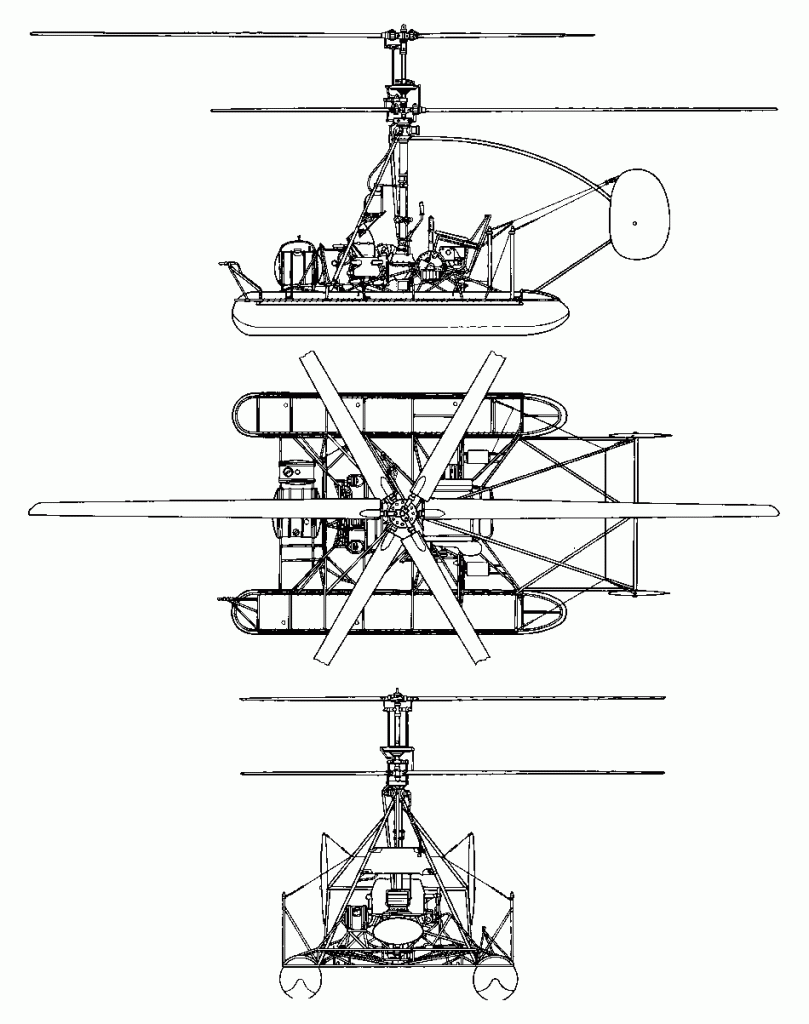
The design featured coaxial rotors, each with three built-up wooden (mainly spruce) blades of NACA-230 profile with glued construction and fabric covering. Metal root of the blades was held in the hub with drag and flapping hinges driven by superimposed swashplates moved directly by pilot. The rest of the airframe was welded steel tube, with the pilot and fixed fin at the rear and the engine and fuel tank at front, resting on two pontoons of rubberized fabric.
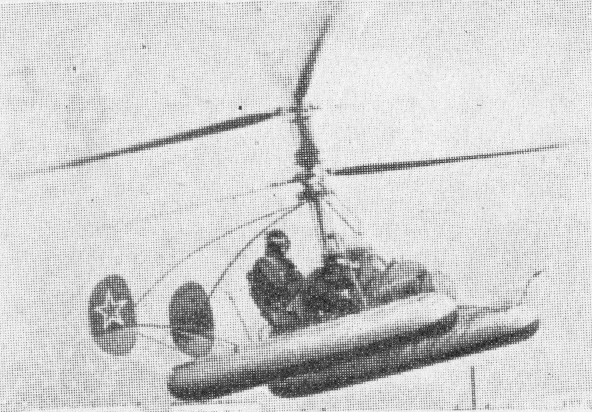
The Ka-8 was powered with a 27 hp motorcycle engine, boosted to 45 hp by using alcohol for fuel.
First flown in 1947, piloted by Mikhail Gurov, the low output of the two-cylinder motorcycle engine and its unsuitability for aeronautical use handicapped the aircraft.
The handlebar flight control was replaced by a vertical collective and cyclic levers, pontoons tapered front to rear, and the fin was changed to rudder driven by pedals.
It was the first single-place helicopter built in USSR.
The Ka-8 “Irkut” performed on July, 25, 1948 at the Tushino airfield in Moscow during the airforce parade.
Only three were built.
After this aircraft made its successful flights Nikolai Kamov was ordered to design the new helicopter for Soviet Navy.
Ka-8
Crew: 1
Engine: 1 x M-76, 20kW
Rotor diameter: 5.6m
Length: 3.7m
Height: 2.5m
Max take-off weight: 275kg
Empty weight: 183kg
Max speed: 80km/h
Service ceiling: 250m
Hovering ceiling: 40m-50m
Vertolet
Engine: 20 hp. Aubier-Dunne
Rotors: 2 x 3-blade co-axial.
Seats: 1

