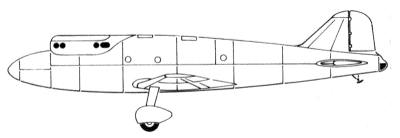
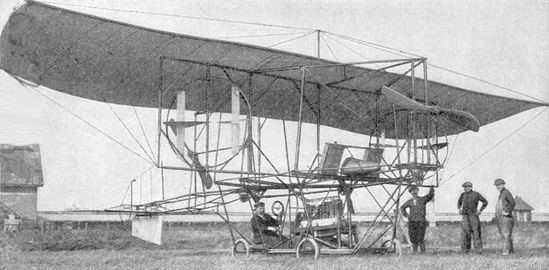
The Korolyev RP-1 was a powered version of the Cheranovsky BICh-11 experimental tailless glider, designed together with Friedrich Zander (Tsander) and other Korolev’s friends from GIRD (ГИРД – Jet Propulsion Research Group).
It was planned to be a rocketplane (therefore RP index) and the Zander OR-2 rocket engine (500 N thrust) was designed especially for it. Development of the engine was very difficult, and Zander didn’t achieve success; furthermore on March 28, 1933 he died of typhus in Kislovodsk. The two RP-1 prototypes were tested in 1932-33 only as “ordinary” powered gliders, each with a 25-hp Scorpion piston engine.
The first of them was flown on June 8, 1932 – Korolyev himself was a test pilot. Totally 34 flights were made by him, but only 5 with the engine powered up.
Engine: 25-hp Scorpion Wing span: 12.1 m Length: 3.81 m Wing area: 20.5 sq.m
After attending the Kiev Polytechnic Institute, Korolev went on to the Moscow Higher Technical University (MVTU). There he was involved in design and construction of an increasingly ambitious series of gliders, culminating in the powered SK-4, designed for record duration flights in the stratosphere.
The student of the graduate course of the Bauman Moscow Technical University Korolev passed the production practice at the Central Aerohydrodynamic Institute (TsAGI), at the Tupolev Design Bureau. At this time, he was already working at the aircraft factory in Fili. At the same time, in 1929, he was preparing a thesis project, deciding to design a light-engine twin aircraft SK-4 (his advisor was Andrei Tupolev).
The design of the SK-4 aircraft, designed for a record range of flight, turned out to be original, detailed and well designed. The project manager was Tupolev himself, signing it with the first presentation. This is not the case in the practice of students. The Tupolev approved single-engine two-seater SK-4 project was then built and tested.
The aircraft was designed for a 100-hp Shvetsov M-11, but it had just came to production and Korolev couldn’t obtain one. As an alternative one Walter NZ-60 engine, 5-cylinder radial, of 60 hp was used.
The SK-4 could be used as liaison and trainer aircraft, but Korolev planned to use it also for long-range air raids. He wanted to surpass the achievement of the Yakovlev AIR-3 in which pilot Filin, with journalist Koval’kov onboard, performed a non-stop flight from Minvody to Moscow on September 6, 1929 (during 10 hours 23 minutes they covered 1750 km – a world record for this category of aircraft, unregistered officially because USSR wasn’t FAI member that time).
The SK-4 was tested in late 1930 – early 1931 by Korolev’s good friend Dmitry Koshitz, and Korolev himself also participated in the tests. During one of test flights, the engine failed and the SK-4 crashed (Koshitz wasn’t seriously injured, and Korolev wasn’t onboard that time). The record flight was never attempted.
Engine: one Walter NZ-60, 60 hp Wingspan: 12,2m Wing area: 15.36 sq.m Length: 7,15m Height: 1,88m Empty weight: 500 kg Takeoff weight: 690 kg Maximum speed: 160 km/h Landing speed: 68 km/h Service ceiling: 4000 m Ceiling: 4000m Seats: 2 Flight endurance: 2 hours
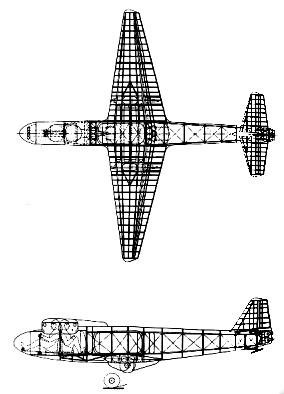
The RP-318 or RP-318-1 was Russia’s first rocket-powered aircraft or Rocket Glider (Rocketny Planer or Raketoplan) which “RP” stands for in Russian language. Beginning in early 1936 it was firstly known as RP-218-1 or “Objekt 218” before it was changed to RP-318-1 in 1938 due to inner reforms of Rocket Science And Research Institute.
According to the proposal of Marshall Tukhachevsky the Revolutionary Military Board established on 21 September 1933 a brand new institution – RNII. The activities of the new institute began on October 31 by merging of GDL and GIRD. In the beginning the works on a rocket-glider were not a part of RNII activities and also the development of rocket engines using a liquid propellant was also not in the focus of activities – the main activities were focused on military rockets, using solid fuel.
He understood well, that the idea of creation of the rocket plane simply by putting a rocket engine into usual airframe was wrong. He stressed, that there are differences in flight characteristics, trajectories and weights. The development of necessary airframes could be possible on condition, that there was a reliable and powerful rocket engine. These conclusions he pointed at the conference about utilizing of rocket-powered aircraft for use in the atmosphere, which was held on 2-3 March 1935 in Moscow.
The chief designer was S.P.Korolev and his deputy was E.S.Schetinkov. The original design was a single-seater and a pressurised cabin was not in consideration, instead the pilot was provided with a space suit. The empty aircraft was to be very light: 240kg airframe, 200kg fuel system, 200kg compressed air system (used for life support and to displace fuel components toward the engine), 50kg for engine. The rocket engine should have thrust of 19.6kN and the take-off should be assisted by solid fuel boosters. After a steep climb (at angle of 60°) to an altitude 32km, and the aircraft would glide at the speed of up to 2500km/h, covering 220km in 18min.
Some changes were introduced in the design. Now it was a two seater, high-altitude experimental aircraft with pressurized cockpit, equipped by a rocket engine (developed by the 1st department of liquid rocket engines, managed by V.P.Glushko). It was obvious that such a complicated aircraft can not be successfully built without simpler manned technology demonstrator. S.P.Korolev was ready for this: he already built a strengthened glider SK-9, specially intended to fly with a rocket engine. On June 16 1936 the board of RNII decided to proceed with a “supplement” to the Object 218. It would be an experimental aircraft equipped by a low-output rocket engine, named RP-318, essentially a SK-9 fitted with ORM-65 engine and fuel system. The engine selected, Glushko’s ORM-65, a nitric acid/kerosene engine capable of generating between 50 and 175 kg of thrust, was already under development for the 212 winged missile.
RP-318-1
Built in 1936 by Sergei Korolev as an adaptation of his SK-9 glider, it was originally designed as a flying laboratory to test rocket engines and ORM-65 (RDA-1-150) designed by Valentin Glushko was the one selected to be used. Arvid Pallo took the work on installation into the SK-9 rear fuselage, and the tanks for nitric acid and kerosene occupied the former rear cockpit. The whole powerplant weighed 136.8 kg, the fuel 75 kg. The engine could run for 112 seconds. Ground fire tests began at February 1939, until October more than 100 firings were done.
In late 1938, when both Korolev and Glushko were arrested in suspicion of Anti-Soviet activity, new RNII Director B.M.Slonimer transferred the “Rocket-Glider” project with remains of the team to the new department (head – L.S.Dushkin). A.V.Pallo was put in charge for the RP-318. Development of the RP-318-1 was continued by Alexei Scherbakov (Щербаков, Алексей Яковлевич) and Arvid Pallo (Палло, Арвид Владимирович), culminating in the first powered flight on Feb. 28, 1940 by test pilot Vladimir Fedorov. The rocketplane took off towed by a Polikarpov R-5; at 2800 m altitude it released, Fedorov set up 80 km/h speed and then fired the engine. After 5-6 seconds the speed increased to 140 km/h; Fedorov established climbing flight with 120 km/h speed and held it during all time the engine worked (110 seconds); he climbed 300 m during this time. The speed increase after engine start was smooth, vibrations didn’t appear. On March 10 and March 19, 1940 two more successful rocket flights were performed.
As it already occur several times in Soviet pre-WWII history, purges and re-organizations added new problems. RNII lost its Flight-Trials Grounds. There were no more experienced test-pilots (S.P.Korolev was in prison). It was necessary to find an organization within Aviation-Industrial complex capable to carry out flight trials of the aircraft. Help came from the OSK Factory N°1 NKAP. A.Ya.Scherbakov, head of the OSK was involved with “Project 218” as a designer of pressurized cabin. Glider-pilot V.P.Fedorov was invited as a test-pilot. The aircraft was carefully evaluated. Tail section (damaged by acid) was rebuilt. New landing ski was installed. Rigid tail skid got a shock absorber. New cowling for fuel tanks was developed.
Flight trials of RP-318-1 (designation of rebuilt RP-318) took place in November-December 1938 towed by R-5 biplane (pilot Fikson). The engine was replaced by its weight equivalent. First three flights were dedicated to the center of gravity studies: with empty tanks, 50% of fuel, 100% of fuel drained gradually to imitate its consumption by the engine.
After those flights RP-318-1 was installed in the L.S.Dushkin laboratory for engine installation and trials. Soon several problems with the ORM-65 engine were revealed. First of all, there were only three ORM-65s built, and two of them were allocated to the “Project 212” winged rocket (cruise missile). This brought some limitations on use of the engine for a RP-318: no provision for multiple start, overheating of the engine head, few unreliable sealings. Acceptable for a missile, ORM-65 needed to undergo serious modifications before it could be used on the manned aircraft.
Modified engine was designated RDA-1-150. It was 2kg lighter than the ORM-65, had improved cooling system. Number and design of injectors was changed. Intermediate ‘starter’ engine regime (fuel flow at 8…10% of normal) was introduced for the first time. Monitoring of the engine operation was improved. Though still very basic, it was a step forward from couple of ORM-65’s wires burned by flames and disrupting the electric current to lights on the pilot’s instrument panel.
Experiments with multiple ignition (additional air-hydrogen burner with electric start) were successful, but tight design limitations of the RP-318-1 created problems for its installation. Total number of engine firings was more than 100, including 16 after installation on the RP-318 (July 21, 1939). On October 3 A.Ya.Scherbakov sent to People’s Commissar of Aviation Industry a request for permit to fly RP-318-1 with the rocket engine fired.
KB-29 NKAP airfield at Podlipki (Moscow Region) was chosen for trials. In November 1939 the aircraft was installed on the edge of the field, partly covered by birch and fir trees. The team had to perform systems tune-up and to work with kerosene and concentrated acid under deep freeze conditions, with very basic fuelling equipment and rudimentary accommodations: wooden package box used to transport the aircraft served as a “field laboratory and workshop”.
More on-ground firings were performed and all were successful, but on January 3, 1940 supervising commission ordered more unpowered flights and demanded to perform more study of the airframe shape (the wooden SK-9 glider had been built in 1935). No damage or degradation of wooden parts were revealed, but speed was restricted by 150km/h.
Test pilot V. P. Fedorov (Владимир Павлович Фёдоров) was towed to 2,600 m and cast off at 80 km/h before firing the rocket engine and accelerating the aircraft to 140 km/h and an altitude of 2,900 m. In all, the RP-318 flew nine times before World War II ended development.
First flight with rocket engine fired at full power took place on February 28, 1940. It took since early morning until 5 p.m. to prepare the snow-covered airstrip, fuel the RP-318-1 (40kg of acid and 10kg kerosene), fill the nitrogen bottle to 130kg/m2, and check the fuel system for leakage absence. Flight crews were in cockpits: N.D.Fikson as a pilot of the R-5, A.V.Pallo as an observer and A.Ya.Scherbakov as a tag winch operator – in the rear cockpit of the R-5. V.P.Fedorov – pilot of the RP-318-1.
At 5:28 p.m. both aircraft took off, and 31 minutes later at altitude 2800m RP-318-1 was released. It took some time for N.D.Fikson to bring the R-5 into an optimal position for observation, and at altitude 2600m V.P.Fedorov fired the engine. First, grey smoke indicated ignition of the powder charge. Shortly its place was taken by blurred flame with brown smoke showing that the engine is running in the ‘start’ regime. And, finally – spear-shaped bright flame near 1.5m long with little smoke.
After gradual acceleration of the RP-318-1 left the observers far behind, and all efforts of the R-5 pilot to keep up with the experimental machine failed. Once it was out of sight, N.D.Fikson, A.V.Pallo and A.Ya.Scherbakov turned back to the airfield to meet the rocket-plane during its landing.
From V.P.Fedorov report: Start of the ZhRD was normal, the glider speed was 80km/h. In 5…6sec speed was increased to 140km/h. During following climb speed was reduced to 120km/h. Engine was working during 110sec. During the climb altitude increased from 2600m to 2900m. Climb rate was 3m/sec. Handling and stability of the rocket-plane with fired engine are good. Start of the ZhRD does not deteriorate handling of the aircraft. Acceleration is smooth. Noise in the cockpit from the ZhRD is not irritating is is more muffled than during ground trials. The feel of acceleration and flight with the ZhRD fired is more appealing than on a prop-driven aircraft with the engine boosted to maximum power.
On March 10 and 19 two more flights were performed without an accident. During those flights the engine start was filmed from the R-5 observer’s cockpit.
Than the Spring came. Melting snow made the airfield unusable and delivery of the acid to the plane virtually impossible. No more flights were performed. In the Fall of 1940 the RP-318-1 was transported back to the RNII and disassembled.
It was planned to continue trials with modified RDA-1-300 engine. Plans included rocket-powered takeoff using jettisonable wheel cart. But this project was pushed aside by RAS and RDD rockets. In 1941 priority was given to RDA-1-1100 engine for Bolkhovitinov’s BI rocket fighter.
In August 1941 RP-318 was burned. The Rocket Institute was preparing for evacuation, and old wooden airframe was worthless.
RP.218 1935 Powerplant: 1 × RDA-1-150 rocket, 0.98 kN (220 lbf) thrust 100 kgf Wingspan: 17.0 m (55 ft 9 in) Wing area: 22.0 sq.m (237 sq ft) Length: 7.44 m (24 ft 5 in) Empty weight: 570 kg (1,257 lb) Gross weight: 700 kg (1,543 lb) Maximum speed: 140 km/h (87 mph; 76 kn) Range: 220 km Endurance: 18min Ceiling: 32,000 m Crew: 1
RP.218 1938 Engine: 4900 to 9800kN Loaded weight: 1600 kg Endurance: 15 to 20min Ceiling: 50,000 m Crew: 2
RP318-1 Powerplant: 1x Dushkin RDA-1-150 rocket engine, 1500 N maximum thrust Wing span – 17.0 m Length: 7.44 m Wing area: 22 sq.m Normal takeoff weight: 637 kg MTOW: 700 kg Vne: 160 km/h (limited by strength reasons)
The Korean Air Chang-Gong 91 (English: Blue Sky 91) is a four-seat single-engined low-wing monoplane designed by the Korea Institute of Aeronautical Technology and built by the Aerospace Division of Korean Air.
Chang-gong-91 (meaning Blue Sky) was the first light plane prototype developed by Korean Air and other collaborative companies as a national policy research project led by the Ministry of Science & Technology.
Three prototypes were developed and the first flight was on 22 November 1991.
Due to low marketability forecast by Korean Air it was not put into production. It is now on static display at the Aviation Pavillion near Jeongseok Airport (RKPD).
Engine: 1 × Lycoming IO-360-A1B6, 149 kW (200 hp) Wingspan: 10.2 m (33 ft 5 in) Wing area: 14.86 m2 (160 ft2) Length: 7.74 m (25 ft 5 in) Height: 2.7 m (8 ft 10 in) Empty weight: 839 kg (1850 lb) Gross weight: 1225 kg (2700 lb) Fuel Capacity: 210 ltr Maximum speed: 339 km/h / 210 mph / 183 kts Cruise Speed: 119 kts Range: 1500 km / 932 miles / 600 nm Take Off Distance: 620 m Landing Distance: 270 m Absolute Ceiling: 16500 ft Service ceiling: 5025 m (16,500 ft) Maximum Climb Rate: 740 ft/min Seats: 4
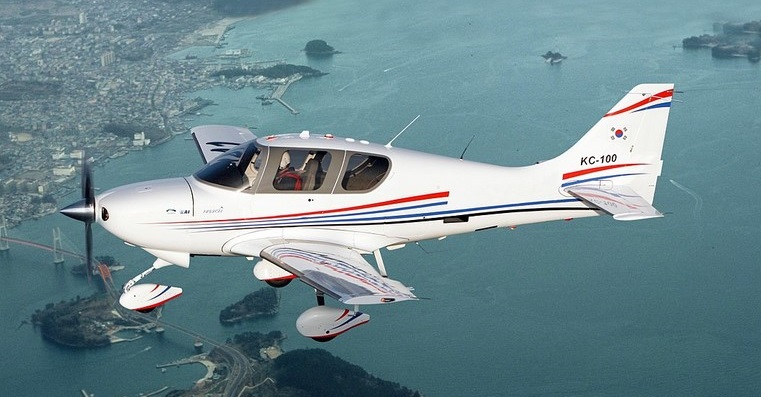
The KAI KC-100 Naraon is a four-seat, low-wing, single-engine light aircraft under development by Korea Aerospace Industries. Development began in June 2008 with a five-year development timeframe.
The KC-100 is built from carbon fibre and features gull-wing doors. The wing employs a laminar flow airfoil and winglets. The engine is a Continental TSIOF-550-K turbocharged 315 hp (235 kW) powerplant controlled by FADEC. A full-plane parachute system will be optional.
First flying on 20 July 2011, the name Naraon was chosen based on public input.
The company expected that deliveries would commence in mid-2013 at a forecast price of US$575,000.
In May 2014, the South Korean Air Force academy entered a memorandum of understanding to obtain a military trainer variant designated the KT-100, the first mass production contract for the aircraft. The KT-100 was to replace the 20 Ilyushin Il-103 aircraft at the academy to familiarize students with flying. The KT-100 first flew on 5 October 2015 and all expected to be delivered by the end of 2016.
KC-100 Naraon Powerplant: 1 × Continental TSIOF-550-K , 315 hp (235 kW) Wingspan: 37 ft 4 in (11.37 m) Airfoil: laminar flow Length: 27 ft 11 in (8.50 m) Height: 9 ft 5 in (2.87 m) Empty weight: 2,400 lb (1,089 kg) Gross weight: 3,600 lb (1,633 kg) Maximum speed: 210 kn (242 mph; 389 km/h) Range: 1,200 nmi (1,381 mi; 2,222 km) Crew: one Capacity: three passengers
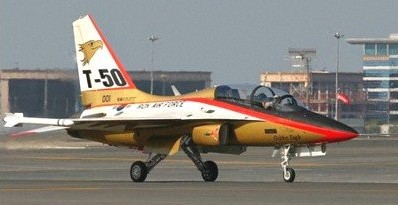
The T-50 Golden Eagle is a South Korean supersonic advanced trainer and light attack jet, developed by the Korean Aerospace Industries with Lockheed Martin, beginning in the late 1990s. The T-50 is South Korea’s first indigenous supersonic aircraft and one of the few supersonic trainers. 2002
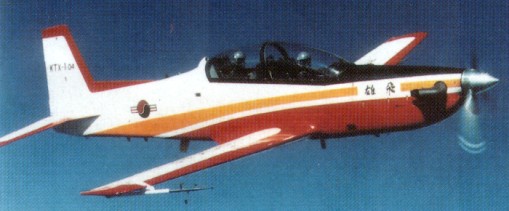
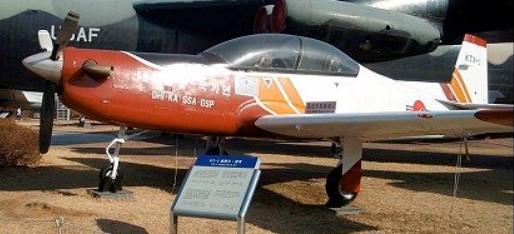
Development was initiated under the KTX program as a single-engined turboprop, basic training aircraft for the Republic of Korea Air Force in 1988 using the CATIA computer program to completely develop the aircraft, the first of its class. It was jointly developed by KAI and the Agency for Defence Development (ADD).
Nine prototypes were built on June 1991 with the first flight of the KT-1 occurring on November 1991 for static and fatigue testing. In 1995, the project was officially named ‘Woongbi’. In 1998 the final test flight was performed. The KT-1 is the first completely indigenous Korean aircraft ever developed. In 1999, a contract was signed for eighty-five aircraft with provisions for an additional twenty between Korea Aerospace Industries and the Republic of Korea. The first KT-1 Woongbi was handed over to the Republic of Korea Air Force in 2000 with the delivery of the eighty-five aircraft being completed in 2002. The Republic of Korea Air Force received 85 KT-1s and 20 KA-1s.
KT-1 can be equipped with either an analog or ‘glass’ cockpit configuration. Both types are employed by the Republic of Korea Air Force.
KAI exported seven KT-1Bs plus spare parts to Indonesia in April 2003 under a 60 million USD contract, and five more in May 2005. A KT-1B was lost during training 24-Jun-2010 .
In a press release held in Sacheon, South Korea on March 8, 2006, KAI stated that it will export more than 150 improved versions of the KT-1 to various countries in Central America and Southeast Asia. The improved export version of the KT-1 will be called KT-1C.
As of June, 2007, South Korea and Turkey have successfully negotiated for a contract of exporting 40(+15) KT-1, as well as modular armor technology of K2 Black Panther for Turkey’s future indigenous MBT, to Turkey for KRW₩500,000,000,000 (approximately US$540,000,000).
A statement published by Chungwadae, the South Korean Presidential website, on 26 January 2010, said that India and South Korea had agreed, as part of upgrading their partnership to a ‘strategic relationship’, form a joint committee in the first half of 2010. The statement added that this committee will facilitate an offer from Seoul to supply up to 60 KT-1 trainers to meet Indian Air Force requirements. However, India signed the contract with Pilatus to supply 75 PC-7.
On November 6th 2012, KAI and the Peruvian Air Force has successfully negotiated a $200 million contract for 20 KT-1Ps (10 KT-1 trainers and 10 KA-1 armed counterinsurgency variants) including some offset and technologies transfers for an approximate amount of US$208 millions. KAI will provide the first 4 airplanes by 2014 and the rest will be assembled at SEMAN (Maintenance air wing of the Peruvian Air Force).
Peru reported on 19 November 2013 having set up its KT-1 family assembly plant at Las Palmas Air Base in Lima, and plans to begin final assembly work on 16 planes beginning in March 2014. The first flight of a KT-1P for Peru took place on 19 Febuary 2014. Korean Aerospace Industries (KAI) announced on 21 May 2014 it started the production of the KT-1 Woongbi for the Peruvian Air Force.
Variants:
KTX-1 Yeo-myung Prototype primary trainer each with a different engine fitted, six built.
KA-1 An armed advanced trainer with light attack and forward air control capabilities. Several new features unique to the KA-1 are head-up-display and up-front control panel, MFD panels, and five hardpoints, two under each wing and one under the fuselage. The hardpoints may be equipped with rocket launcher, gun pods or AIM-9 Sidewinder missiles.
KT-1B Export version for Indonesia.
KT-1C Improved, armed export version equipped with a centreline forward looking infrared pod. The KT-1C may also be equipped with a 12.7 mm gun pod, chaffes, flares, training missiles, rockets or unguided bombs.
KT-1 Engine: 1 × Pratt & Whitney Canada PT6A-62, 950 hp (708 kW) Wingspan: 10.59 m (34 ft 9 in) Wing area: 16.01 sq.m (172.3 sq ft) Length: 10.26 m (33 ft 8 in) Height: 3.68 m (12 ft 1 in) Empty weight: 1,910 kg (4,210 lb) Max. takeoff weight: 2,540 kg (5,600 lb) Maximum speed: 574 km/h (310 knots, 357 mph) (IAS) Range: 1,333 km (720 nmi, 828 mi) at 7,620 m (25,000 ft), max internal fuel Service ceiling: 11,580 m (38,000 ft) Rate of climb: 16.2 m/s (3,180 ft/min) Endurance: 3 h Crew: 2 in tandem
Otto Koppen left Ford to join the faculty of MIT, and in 1938, he decided that the time was ripe for an easy to fly airplane, so while teaching at MIT, he designed and set up a company to produce the Skyfarer, a two seat, two control monoplane. Koppen felt the Skyfarer needed no rudder, since its large twin vertical stabilizers were widely spaced on the tail out of the slipstream. In the air, the ball stayed centered at all times. In fact, the Skyfarer was so easy to fly that a complete novice was once taught the basics during only 50 minutes in the airplane. Twenty five Skyfarers were built; then World War II began, the Government requisitioned aluminum and production stopped.
In 1913 Romanian émigré Alexander Kopcsa (often found written as Kopesa and Kopsca, his original Romanian name was Alexandru Copcea), living in Chicago, invented this large flying machine (span 50 feet and length 40 feet), intended to be used in an attempt to fly across the Atlantic Ocean. The 170 hp engine was to turn two vertical and two horizontal propellers.