Las Brisas Mohawk

The Las Brisas Mohawk is an American homebuilt aircraft that was designed and produced by Las Brisas Sales of Ozark, Missouri. When it was available the aircraft was supplied in the form of plans for amateur construction.

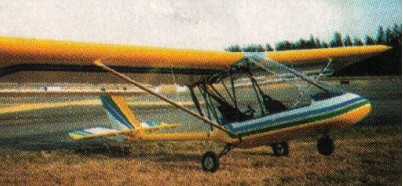
Based upon the Avid Flyer, which it greatly resembles, the Mohawk features a strut-braced high wing, a two-seats-in-side-by-side configuration enclosed cockpit accessed via doors, fixed conventional landing gear and a single engine in tractor configuration.

The aircraft is made from metal tubing, with its flying surfaces and fuselage covered doped aircraft fabric. Its 30.00 ft (9.1 m) span wing features Junkers flaperons, has a wing area of 124.5 sq ft (11.57 m2) and is supported by “V” struts with jury struts. The plans specify standard hydraulic brakes, a steerable tailwheel and wings that fold for ground transport or storage. The standard engine used is the 50 hp (37 kW) Rotax 503 two-stroke powerplant, which gives a standard day, sea level takeoff distance of 100 ft (30 m) and a landing roll of 150 ft (46 m).

The Mohawk has a typical empty weight of 450 lb (200 kg) and a gross weight of 1,000 lb (450 kg), giving a useful load of 550 lb (250 kg). With full fuel of 12 U.S. gallons (45 L; 10.0 imp gal) the payload for pilot, passenger and baggage is 478 lb (217 kg).

The manufacturer estimated the construction time from the supplied plans as 900 hours. In 1998 the designer indicated that the aircraft could be completed for US$6,500 excluding labor. In 1998, plans were sold for US$229.00 but by 2014 were no longer available.

Mohawk
Engine: 1 × Rotax 503, 50 hp (37 kW)
Propeller: 2-bladed wooden
Wingspan: 30 ft 0 in (9.14 m)
Wing area: 124.5 sq ft (11.57 m2)
Length: 18 ft 0 in (5.49 m)
Empty weight: 450 lb (204 kg)
Gross weight: 1,000 lb (454 kg)
Fuel capacity: 12 U.S. gallons (45 L; 10.0 imp gal)
Maximum speed: 130 mph (209 km/h; 113 kn)
Cruise speed: 85 mph (137 km/h; 74 kn)
Stall speed: 30 mph (48 km/h; 26 kn) flaperons down
Range: 320 mi (278 nmi; 515 km)
Service ceiling: 12,000 ft (3,700 m)
Rate of climb: 1,200 ft/min (6.1 m/s)
Wing loading: 8.0 lb/sq ft (39 kg/m2)
Crew: one
Capacity: one passenger
Larson Model C Speedbird

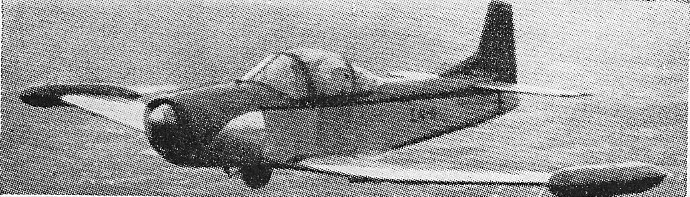
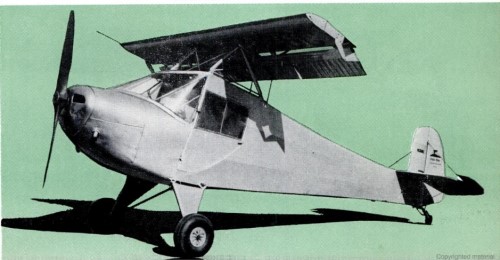
The Model C Speedbird (N38C or NX38C) by Merle Larson of Oakland, Ca. had a small wing (wingspan 12ft) designed to work within the slipstream of the propeller and featured very large flaps for lift.

The Speedbird aircraft was modified from a Taylorcraft BC-12.

The aircraft flew, but on that first flight on 7 December 1953 the engine stopped and the aircraft stalled. Larson escaped serious injury and later designed the (Larson-Holmes) D-1 Duster.

Larson F.12 Baby

The Larson F-12 Baby was a sports biplane built in the US in the early 1960s. It was intended to produce it ready to fly or homebuilt from kits or plans but only one was completed.

The Baby was a single bay single engine, single seat biplane with stagger. The wings were wooden structures with two spars and fabric covering; the upper wing had 1° of dihedral and the lower one 3°. There were ailerons on both wings, with aluminium frames and again fabric covered. The fuselage and empennage were fabric covered, welded steel structures. It had fixed conventional landing gear with rubber sprung main legs, aluminium wheels with brakes and a sprung tailwheel.

The Baby was powered by an 85 hp (63 kW) Continental C85, its fuel tank in the fuselage behind the engine and in front of the single seat, open cockpit, anf firdt flew in 1961.

Powerplant: 1 × Continental C85, 85 hp (63 kW)
Propeller: 2-bladed McCauley aluminium, fixed pitch
Wingspan: 17 ft 0 in (5.18 m) upper and lower
Wing area: 73 sq ft (6.8 m2)
Aspect ratio: about 7 on upper wing, 6 on lower
Airfoil: NACA 4412 modified
Length: 17 ft 0 in (5.18 m)
Height: 5 ft 6 in (1.68 m)
Empty weight: 500 lb (227 kg) weights estimated
Gross weight: 800 lb (363 kg)
Fuel capacity: 12 US gal (10.0 imp gal; 45 l)
Maximum speed est: 130 mph (210 km/h, 110 kn)
Cruise speed est: 110 mph (180 km/h, 96 kn)
Rate of climb est: 2,000 ft/min (10 m/s)
Crew: One

Larson D.1

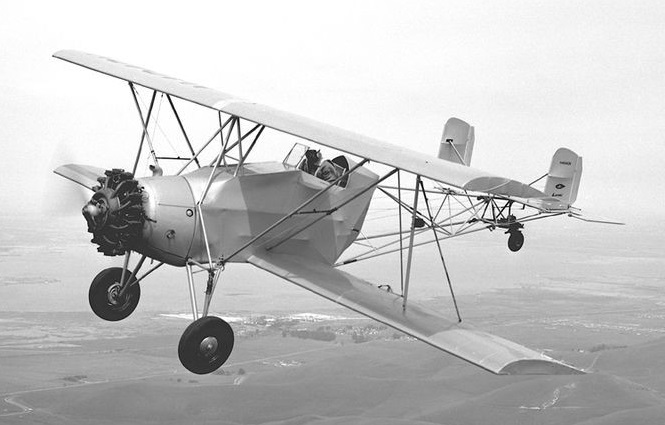
In 1955, Merle Larson designed the D-1 with updated features to improve cropdusting compared to the popular Boeing Stearman in use at the time. The aircraft used only 25 percent of the number of parts as a Stearman.

The biplane featured a steel tube fuselage, and aluminum covered wings. The fuselage was fabric covered only to behind the cockpit, leaving the rest of the tail structure exposed, preventing dust buildup in the tail. The aircraft had twin rudders mounted outboard of the spray trail. Each of these were all-moving with anti-servo tabs. Standard automotive wheels and tires were employed to reduce cost as low-cost World War II surplus was becoming too old, and new aviation tires cost nearly five times as much.

Powerplant: 1 × Lycoming R-680, 225 hp (168 kW)
or 220 hp (164 kW) Continental R-670
or 245 hp (183 kW) Jacobs R-755
Propeller: 2-blade McCauley ground-adjustable propeller
Upper wingspan: 30 ft 0 in (9.14 m)
Lower wingspan: 33 ft 0 in (10.06 m)
Wing area: 315 sq ft (29.3 m2)
Aspect ratio: 6
Airfoil: Göttingen 365
Length: 25 ft (7.6 m)
Height: 11 ft 00 in (3.35 m)
Empty weight: 1,700 lb (771 kg)
Gross weight: 3,600 lb (1,633 kg)
Fuel capacity: 30 US gal (25 imp gal; 114 l) fuel ; 4.4 US gal (3.7 imp gal; 16.7 l)
Cruise speed: 90 mph (140 km/h, 78 kn) at sea level
Landing speed: 40 mph (35 kn; 64 km/h)
Stall speed: 40 mph (64 km/h, 35 kn)
Rate of climb: 1,400 ft/min (7.1 m/s) at sea level, empty
Wing loading: 11.4 lb/sq ft (56 kg/m2)
Take-off run, empty, nil wind: <200 ft (61 m)
Take-off run, 1,000 lb (454 kg) payload, nil wind: 600 ft (183 m)
Crew: 1

Laron ½ Tun

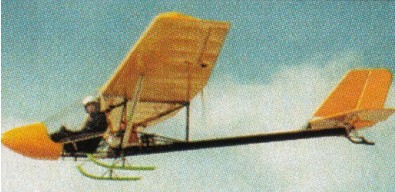
A Part 103 legal ultralight first flown in 1995, the wings are sheet dural.

Top speed: 65 mph
Cruise: 55 mph
Stall: 26 mph
Rate of climb: 1000 fpm
Takeoff dist: 150 ft
Landing dist: 100 ft
Service ceiling: 10,000 ft
Engine: Rotac 447, 30 hp
HP range: 30-40
Fuel capacity: 5 USG
Empty weight: 250 lb
Gross weight: 550 lb
Height: 4.5 ft
Length: 21 ft
Wing span: 26 ft
Wing area: 117 sq.ft
Seats: 1
Landing gear: tailwheel

Engine: Rotax 447, 40 hp
Wing span: 7.92 m
Wing area: 10.90 sq.m
MAUW: 249 kg
Empty weight: 113 kg
Fuel capacity: 19 lt
Max speed: 128 kph
Cruise speed: 80 kph
Minimum speed: 40 kph
Climb rate: 5 m/s
Fuel consumption: 7.5 lt/hr
Seats: 1
Kit price (1998): $4900

Laron Tundra

First flown in 1992.

Top speed: 100 mph
Cruise: 85 mph
Stall: 53 mph
Range: 140 sm
Rate of climb: 800 fpm
Takeoff dist: 200 ft
Landing dist: 200 ft
Service ceiling: 15,000 ft
Engine: Rotax 582, 65 hp
HP range: 48-80
Fuel capacity: 11 USG
Empty weight: 400 lb
Gross weight: 900 lb
Height: 6.5 ft
Length: 21 ft
Wing span: 32 ft
Wing area: 170 sq.ft
Seats: 2 tandem
Landing gear: nosewheel

Larkin Skylark KC-3

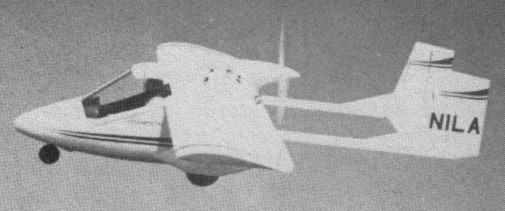
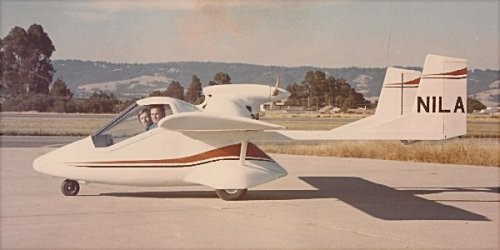
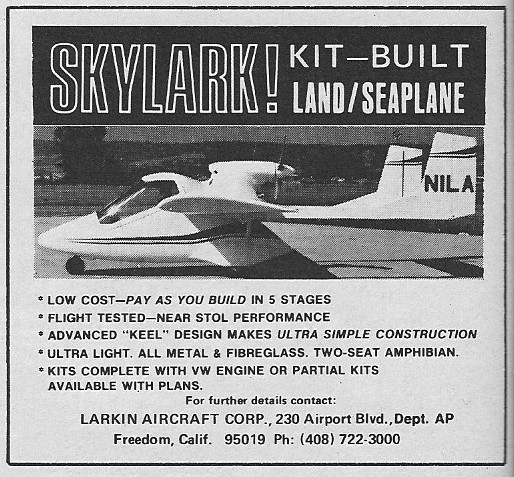
The Larkin KC-3 Skylark was a single-engine amphibious two-seater homebuilt aircraft, a pusher-style design with a single 100 hp Volkswagen air-cooled engine above and behind the fully enclosed cockpit. The booms are at¬tached to the wings and connected at the rear, between twin vertical stabilizers, by one single-elevator surface. One unique feature of the airplane’s structure is the use of a square tubular aluminum keel which is responsible for the loads from the landing gear and the main fuselage. The cockpit seats two occupants in side-by-side configuration, with a large Plexiglas canopy curving around both occupants. The landing gear is a tricycle arrangement with the nose gear positioned at the foremost point of the nose and the two main gear semi-recessed into teardrop-shaped fairings on the lower sides. For amphibious operations, there is an optional V-shaped lower hull of fiberglass which can be added.

The Skylark KC-3 first flew in 1972 and was registered N1LA.

Dec 1973

My father, Tony Austin, worked for Larkin Aircraft in the late 1960s-early ’70s. He collaborated on the engineering and fabrication of the fuselage and other structural components of the one prototype. I had opportunity as a boy to witness the Skylark’s construction and first flight, and have sat in the actual aircraft. I never flew in it as it was only ever piloted by the designer, Keith Larkin himself, to my knowledge.
Thad Austin

Engine 65-hp Volkswagen.
Wingspan 26’6”
Length 19’6”
Gross Wt. 1246 lb
Empty Wt. 790 lb
Fuel capacity 17 USG
Top speed 115 mph
Cruise 105 mph.
Stall 42 mph
Climb rate 550 fpm
Ceiling 12,000 ft
Takeoff run 600 ft
Landing roll 400 ft
Range 525 miles
Seats: 2