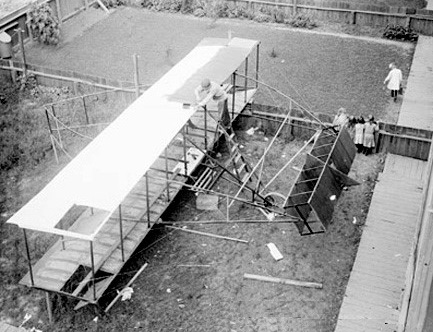
In 1910 J E Mair built a single seat copy of a Wright Flier in his back yard, but there is no record of it flying or if it even left the back yard.
In 1910 J E Mair built a single seat copy of a Wright Flier in his back yard, but there is no record of it flying or if it even left the back yard.
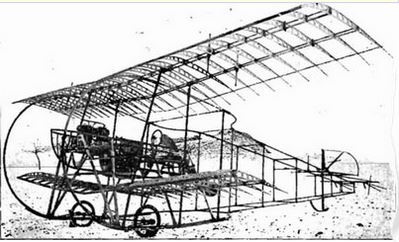
The Mainz Motor School airplane, known as the “One and a Half Decker” was built at the German Motor School at Mainz, Germany. The upper wing of this two-decker had 10 m span, the lower deck 7 m. The 50 hp Argus engine was placed in the front of the fuselage and drove the pusher propeller by means of a transmission. In the gondola-like cockpit there was space for the pilot and two passengers. Radiators were fixed on both sides of the fuselage.
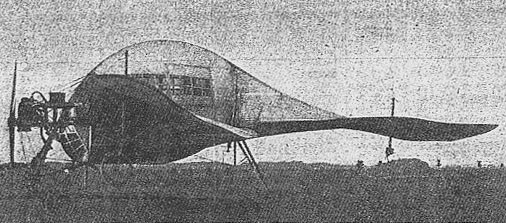
The Henri Mainguet La Dorade / Sea-bream of 1910 was intended to hold ten passengers in an enclosed cabin. Distinctive for its bulbous fuselage and lack of a stabilizing vertical tail fin, the pilot was seated outside, at the nose of the all-covered fuselage, the engine set out above him.
The passengers sat in the enclosed cabin with mica windows which made up the bulk of the streamlined guppy fuselage; aft, it tapered down to a long sweeping horizontal tail. No vertical surface appears to have been fitted. The oval somewhat drooping wings were mounted at a very high angle of attack, and had wheels set below the tips; the whole machine was resting on a long skid with two trailing wheels forward and one under the rear of the cabin. The engine seems to have been a 40 hp 3-cylinder Anzani. With a higher-powered engine, Mainguet at first succeeded at first only in running into the trees, and later in some prolonged hops.
Henri Mainguet built this tractor monoplane, in 1910 at Chartres: it appeared for the first time on 21 May.
It flew but without passengers.
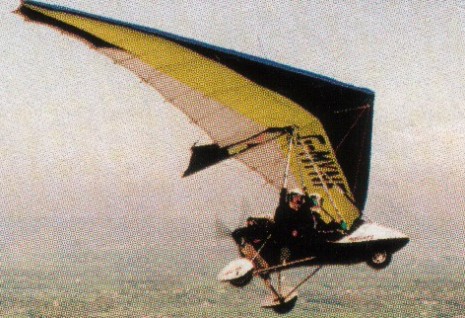
Mainair marketed the Mercury single- or two-seat flex-wing monoplane in assembled or kit forms to BCAR S.
Engine: Rotax 582, 64 hp
hp range: 50-80
Wing span: 36 ft
Wing area: 168 sq.ft
Empty weight: 380 lb
Gross weight: 858 lb
Fuel capacity: 11.6 USG
VNE: 89 kt / 102 mph / 165 kmh
Max speed: 85 mph
Cruise: 65 mph
Stall: 22 kt / 25 mph / 41 kmh
Range: 200 sm
Rate of climb: 850 fpm
Takeoff dist: 200 ft
Landing dist: 200 ft
Take-off distance (50ft obstacle): 600 ft / 184 m
Landing distance (50ft obstacle): 750 ft / 230 m
Glide Ratio: 1:8
Service ceiling: 15,000 ft
Seats: 2

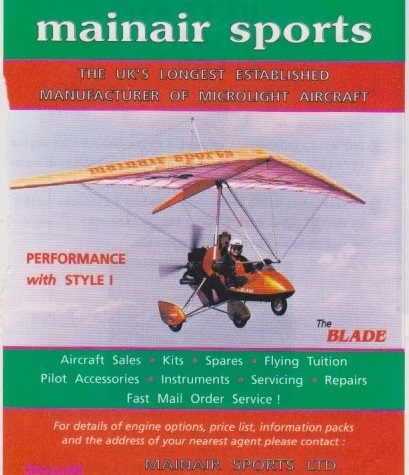
Mainair marketed the Blade tandem two-seat flex-wing microlight in assembled form to BCAR S.
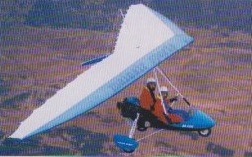
By 1998 the 582 was the mainstream model, with a 462 or 503 available. The Rotax 912 was available on the most expensive model. The model includes carb heat, and was originally available as an export only, before being made available for the UK market.
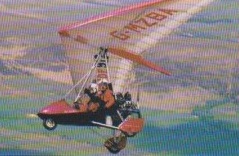
Max speed: 75 mph
Cruise: 55 mph
Range: 200 sm
Rate of climb: 550 fpm
Takeoff dist: 220 ft
Landing dist: 200 ft
Service ceiling: 10,000 ft
Engine: Rotax 503, 46 hp
hp range: 46-65
Fuel capacity: 11.6 USG
Empty weight: 330 lb
Gross weight: 814 lb
Wing span: 36 ft
Wing area: 167 sq.ft
Seats: 2
Blade 582
Empty weight: 173 kg
Wing span: 10.4 m
Wing area: 15.6 sq.m
Fuel capacity: 44 lt
Certification: BCAR S
Engine: Rotax 582, 64 hp
MAUW: 390 kg
Seats: 2
Max speed: 140 kph
Cruise speed: 106 kph
Minimum speed: 48 kph
Climb rate: 4.2 m/s
Fuel consumption: 10 lt/hr
Price (1998): £12,340
Blade 912
Empty Weight: 195 kg / 430 lbs
Wing span: 10.60 m
Wing area: 15.6 sq.m
Fuel capacity: 44 lt
Certification: BCAR S
Engine: Rotax 912 UL, 80 hp
MTOW Weight: 390 kg / 860 lbs
Seats: 2
VNE: 88 kt / 101 mph / 163 kmh
Max speed: 145 kph
Cruise: 59 kt / 68 mph / 109 kmh
Minimum speed: 26 kt / 30 mph / 48 kph
Climb rate: 1000 ft/min / 5 m/s
Take-off distance (50ft obstacle): 460 ft / 140 m
Landing distance (50ft obstacle): 640 ft / 195 m
Fuel consumption: 9 lt/hr
Price (1998): £19,618
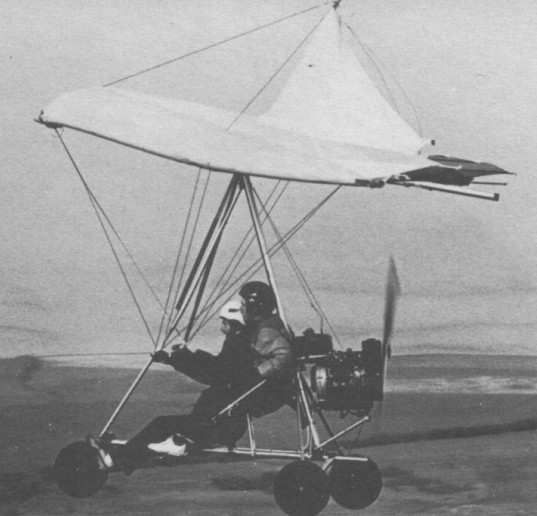
The Mainair/ Southdown Sailwings Puma MS is a tandem two seat single engined flex wing aircraft with weight shift control. Rogallo wing with fin. Pilot suspended below wing in trike unit, using bar to control pitch and yaw/roll by altering relative positions of trike unit and wing. Wing braced from above by kingpost and cables, from below by cables; floating cross tube construction with >75% double surface enclosing cross tube; pre-formed ribs. Undercarriage has three wheels in tricycle formation; no suspension on any wheels. Push right go left nosewheel steering independent from yaw control. Brake on nosewheel. Aluminium tube trike unit, with optional pod. Engine mounted below wing driving pusher propeller. All airframe tubing is bright anodised drawn seamless aluminium to British HT30TF specification. All bolts are aircraft quality AN series.
The Puma MS uses an identical trike unit to the Tri Flyer Two Seater/Dual Striker, but instead of the Flexiform wing a Southdown Sailwings Lightning DS is used.
The Puma Sprint MS is the same as the Puma MS except a 70% double-surface wing.
Puma MS
Engine: Robin EC44, 50 hp at 6800 rpm.
Propeller diameter and pitch 62 x 27 inch, 1.58 x 0.70 m.
Toothed belt reduction, ratio 2.3/1.
Max static thrust 275 lb, 125 kg.
Power per unit area 0.26 hp/sq.ft, 2.8 hp/sq.m.
Fuel capacity 2.6 US gal, 2.2 Imp gal, 10.0 litre.
Length overall 11.2ft, 3.41m.
Height overall 10.0ft, 3.05m.
Wing span 34.5ft, 10.52m.
Chord at root 8.0ft, 2.44 m.
Chord at tip 3.5 ft, 1.07 m.
Anhedral 1.5 deg.
Nose angle 130 deg.
Fin height 3.3ft, 1.01m.
Total wing area 195 sq.ft, 18.1 sq.m.
Wing aspect ratio 6.3/1.
Wheel track 6.0 ft, 1.83 m.
Wheelbase 6.0 ft, 1.83m.
Nosewheel diameter overall 16 inch, 406mm.
Main wheels diameter overall 16 inch, 406mm.
Empty weight 310 lb, 141kg.
Max take off weight 560 lb, 254kg.
Payload 250 lb, 113kg.
Max wing loading 2.87 lb/sq.ft, 14.0 kg/sq.m.
Max power loading 11.2 lb/hp, 5.0kg/hp.
Load factors +4, 2 design; +6, 3 ultimate.
Max level speed 50mph, 80kph.
Never exceed speed 60mph, 97kph.
Max cruising speed 50mph, 80kph.
Economic cruising speed 43mph, 69kph.
Stalling speed 25 mph, 40 kph.
Max climb rate at sea level 600 ft/min, 3.0 m/s.
Puma Sprint MS
Engine: Robin EC44, 50 hp at 6800 rpm.
Propeller diameter and pitch 62 x 27 inch, 1.58 x 0.70 m.
Toothed belt reduction, ratio 2.3/1.
Max static thrust 275 lb, 125 kg.
Power per unit area 0.28 hp/sq.ft, 3.1 hp/sq.m.
Fuel capacity 2.6 US gal, 2.2 Imp gal, 10.0 litre.
Length overall 11.2ft, 3.41m.
Wing span 34.5ft, 10.52m.
Chord at root 8.0ft, 2.44 m.
Chord at tip 3.5 ft, 1.07 m.
Anhedral 1.5 deg.
Nose angle 130 deg.
Fin height 3.3ft, 1.01m.
Total wing area 195 sq.ft, 18.1 sq.m.
Wing aspect ratio 6.3/1.
Wheel track 6.0 ft, 1.83 m.
Wheelbase 6.0 ft, 1.83m.
Nosewheel diameter overall 16 inch, 406mm.
Main wheels diameter overall 16 inch, 406mm.
Empty weight 310 lb, 141 kg.
Max wing loading 1.72 lb/sq.ft, 8.4 kg/sq.m.
Max power loading 11.2 lb/hp, 5.0kg/hp.
Load factors: >+6.0, 3.0 ultimate.
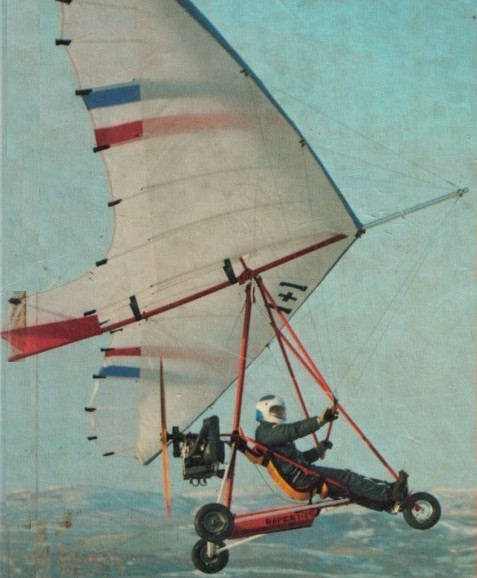
The Mainair/ Flexiform Sky Sails Rapier is a tandem one/two seat single engined flex wing aircraft with weight shift control. Rogallo wing with keel pocket. Pilot suspended below wing in trike unit, using bar to control pitch and yaw/roll by altering relative positions of trike unit and wing. Wing braced from above by kingpost and cables, from below by cables; bowsprit construction with >70% double-surface; pre formed ribs. Undercarriage has three wheels in tricycle formation; no suspension on nosewheel and rubber supension on main wheels. Push right go left nosewheel steering independent from yaw control. Brake on nosewheel. Aluminium tube trike unit, with optional pod. Engine mounted below wing driving pusher propeller. Trike unit tubing is epoxy sheathed drawn seamless aluminium to British HT30TF specification. All bolts are aircraft quality AN series.
Many people want to take up a passenger occasionally and yet find a full two seater weight shift machine rather heavy to handle. For these pilots Mainair has designed the Rapier, a ‘one plus one’ machine powered by a 330 Robin but capable of lifting a total of 280 lb (127 kg). The Rapier follows Mainair’s two seat practice in using a toothed belt drive and is the first production machine to use the company’s new undercarriage for the main wheels, which incorporates telescopic side struts with internal rubber suspension.
Like the Merlin, the Rapier is a joint venture, this time with Flexiform Sky Sails, whose Striker wing is produced in a special red and white colour scheme to match the epoxy paint on the trike unit. Allied to the elimination of rigging wires on the trike, (in favour of struts) and the underslung fuel tank (done for safety reasons), this gives the Rapier a distinctive appearance.
In 1998 Mainair revived the Rapier name with a new model, unrelated to the model of 15 years before, as an entry-level trike. The new Rapier uses the Blade wing but the trike unit is more basic with n suspension and only the Rotax 503 or 462 as options. It could be purchased in kit form.
Engine: Robin EC34PM, 35 hp at 6500 rpm.
Propeller diameter and pitch 54 x 30/34 inch, 1.37 x 0.761 0.85 m.
Toothed belt reduction. ratio 2.5/1.
Max static thrust 190 lb. 86 kg.
Power per unit area 0.18hp/sq.ft, 2.0hp/sq.m.
Fuel capacity 4.2 US gal, 3.5 Imp gal, 13.6 litre.
Length overall 11.0 ft, 3.35 m.
Height overall 10.5ft, 3.20m.
Wing span 34.5ft, 10.52m.
Sweepback 15 deg
Total wing area 200 sq.ft, 18.6 sq.m.
Wing aspect ratio 7.5/1.
Wheel track 5.5 ft, 1.68 m.
Wheelbase 5.8 ft. 1.77 m.
Nose¬wheel diameter overall 14 inch, 356 mm.
Main wheels diameter overall 14 inch. 356 mm.
Empty weight 224 lb, 102kg.
Max take off weight 525 lb, 238 kg.
Payload 301 lb, 137 kg .
Max wing loading 2.4 lb/sq.ft. 13.0kg/sq.m.
Max power loading 15.0 lb/hp, 6.7kg/hp.
Max level speed 58mph, 93kph.
Never exceed speed 69mph, 111 kph.
Max cruising speed 54 mph, 87 kph.
Stalling speed 23 mph, 37 kph.
Max climb rate at sea level 690 ft/min, 3.5 m/s.
Best glide ratio with power off 5/1.
Take-off distance 150ft, 45m.
Landing dis¬tance 92 ft, 28 m.
Range at average cruising speed 92 mile, 148 km.
Rapier 1998
Empty weight: 152 kg
Wing span: 10.4 m
Wing area: 15.4 sq.m
Fuel capacity: 44 lt
Certification: BCAR S
Engine: Rotax 462, 52 hp
MAUW: 370 kg
Seats: 2
Max speed: 136 kph
Cruise speed: 95 kph
Minimum speed: 50 kph
Climb rate: 3 m/s
Fuel consumption: 10 lt/hr
Price (1998): £10,836
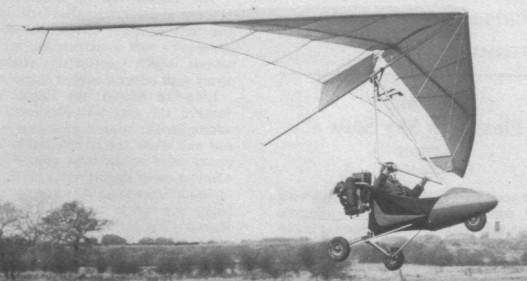
A single-seat single engined flex wing aircraft with weight shift control. Rogallo wing with keel pocket. Pilot suspended below wing in trike unit, using bar to control pitch and yaw/roll by altering relative positions of trike unit and wing. Wing braced from above by kingpost and cables, from below by cables; floating cross tube construction with >70% double surface enclosing cross tube; pre¬formed ribs. Undercarriage has three wheels in tricycle formation; no suspension on any wheels. Push right go left nosewheel steering independent from yaw control. Brake on nosewheel. Aluminium tube trike unit, with pod. Engine mounted below wing driving pusher propeller. A ball race assembly is used to support the front fork for the nosewheel steering. All airframe tubing is bright ano¬dised drawn seamless aluminium to British HT30TF specification. All bolts are aircraft quality AN series.
First shown in October 1982, the Merlin is Mainair’s top of the range single seat trike, and is produced in conjunc¬tion with Airwave. It was conceived as an entity and is marketed that way, complete with purpose designed wing, glass fibre and fabric pod, and instruments.
The Merlin’s most unusual feature is its wing connection, which is a modified form of the French connection often used in hang¬gliding. Developed specially by John Hudson for this application, it is designed to give very light roll control, while absorption bushes reduce torsional loads transmitted to the trike unit.
Standard instrumentation is a Diplex alti¬meter and a Winter ASI; spherical compass, tachometer, CHTG, EGTG and vario are all optional.
Structurally and mechanically the trike unit is similar to the Tri Flyer 330, though the main wheels’ undercarriage is strengthened by using two axle tie wires rather than one.
Engine: Robin EC34PM en¬gine, 35 hp at 6500 rpm.
Propeller diameter and pitch 54 x 30/34 inch, 1.37 x 0.76/ 0.85 m.
Toothed belt reduction, ratio 2.3/1.
Max static thrust 190 lb, 86 kg.
Power per unit area 0.21 hp/sq.ft, 2.3 hp/sq.m.
Fuel capacity 2.6 US gal, 2.2 Imp gal, 10.0 litre.
Length overall 11.5 ft, 3.51 m.
Height overall 10.5ft, 3.20m.
Wing span 33.0ft, 10.06m.
Total wing area 165 sq.ft, 15.3 sq.m.
Wing aspect ratio 7.0/1.
Wheel track 5.5 ft, 1.68 m.
Wheelbase 5.8 ft, 1.77 m.
Nose¬wheel diameter overall 14 inch, 356 mm.
Main wheels diameter overall 14 inch, 356 mm.
Empty weight 230 lb, 104kg.
Max take off weight 438 lb, 199kg.
Payload 208 lb, 94kg.
Max wing loading 2.65 lb/sq.ft, 12.9 kg/sq.m.
Max power loading 12.5 lb/hp, 5.6kg/hp.
Max level speed 45 mph, 72 kph.
Never exceed speed 55 mph, 88 kph.
Max cruising speed 38 mph, 61 kph.
Economic cruising speed 32 mph, 51 kph.
Stalling speed 25 mph, 40 kph.
Max climb rate at sea level 660 ft/min, 3.4 m/s.
Take off distance 80 120 ft, 25 35 m.
Landing distance 130 180ft, 40 55m.
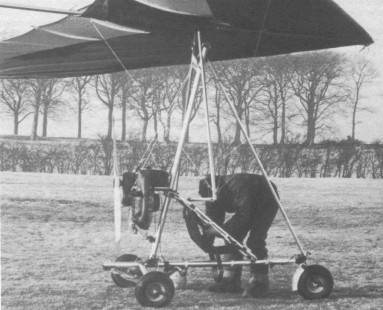
The Tri Flyer 250/ Demon is the simple single pole design from which the whole of the Mainair range has steadily developed. Low weight, low cost, simplicity and portability were the priorities in John Hudson’s mind when he produced the 250 Robin engined Tri Flyer in 1981.
The Tri Flyer 250 relies on its pneumatic tyres for suspension and has a simple tyre brake on the nosewheel. It normally has a manual start, with the pull handle situated within comfortable reach of the pilot; foot and hand throttles are provided. To minimise noise, the exhaust is directed into the propwash.
With easy release axles and folding seat frame, the trike unit folds into a very neat package, easily portable on a roof rack.
While the standard Tri Flyer 250 is a very basic machine, Mainair offers a full range of extras, including a glass fibre pod weighing only 6 lb (2.7 kg), instruments and a bigger fuel tank of 4.2 US gal (3.5 Imp gal, 15.9 litre). A reserve fuel tank is another option enabling the pilot to carry a further 1.2 US gal (1 Imp gal, 4.5 litre).
Like most Mainair trikes, the Tri Flyer 250 can be flown successfully with a variety of wings, but the Demon is probably the most popular.
A single seat single engined flex wing aircraft with weight shift control. Rogallo wing with keel pocket. Pilot suspended below wing in trike unit, using bar to control pitch and yaw/roll by altering relative positions of trike unit and wing. Wing braced from above by kingpost and cables, from below by cables; floating cross tube construction with 75% double-surface enclosing cross-tube; pre-formed ribs. Undercarriage has three wheels in tricycle formation; no suspension on any wheels. Push right go left nosewheel steering independent from yaw control. Brake on nosewheel. Aluminium tube trike unit, with optional pod. Engine mounted below wing driving pusher propeller. All airframe tubing is bright anodised drawn seamless aluminium to British HT30TF specification. All bolts are aircraft quality AN series.
The Mainair/Solar Wings Tri Flyer 330/Typhoon S single seat single engined flex wing aircraft with weight shift control has a Rogallo wing with keel pocket. Pilot suspended below wing in trike unit, using bar to control pitch and yaw/roll by altering relative positions of trike unit and wing. Wing braced from above by kingpost and cables, from below by cables; floating cross tube construction with 80% double surface enclosing cross tube; pre¬formed ribs. Undercarriage has three wheels
in tricycle formation; no suspension on any wheels. Push right go left nosewheel steering independent from yaw control. Brake on nosewheel. Aluminium tube trike unit, with optional pod. Engine mounted below wing driving pusher propeller. All airframe tubing is bright anodised drawn seamless aluminium to British HT3OTF specification. All bolts are aircraft quality AN series.
Introduced in early 1982, the Tri Flyer 330 trike unit is a logical progression from the 250 and is identical apart from certain localised strengthening and a much more powerful twin cylinder Robin engine. This trike unit is flown with a variety of wings, but the Solar Wings Typhoon S is a popular choice. It was with just such a combination that Bob Calvert broke the world altitude record for class Cl a/o in January 1982, reaching 16,168 ft (4928 m) over Lancashire, England. For its record flight, the Tri Flyer 330/Typhoon combination was fit¬ted with a pod, instruments, in flight mixture adjustment and carburettor anti icing system, but power output and wing were both unaltered. Options are as for Tri Flyer 250/Demon.
The Mainair/ Southdown Sailwings Tri Flyer Challenger/ Lightning DS is a single seat single engined flex wing aircraft with weight shift control. Rogallo wing with fin. Pilot suspended below wing in trike unit, using bar to control pitch and yaw/roll by altering relative positions of trike unit and wing. Wing braced from above by kingpost and cables, from below by cables; floating cross tube construction with >75% double-¬surface enclosing cross tube; pre formed ribs. Undercarriage has three wheels in tricycle formation; no suspension on any wheels. Push right go left nosewheel steering indepen¬dent from yaw control. Brake on nosewheel. Aluminium tube/glass fibre trike unit, partially enclosed. Engine mounted below wing driving pusher propeller. Later versions of this machine will use a carbonfibre+Kevlar/aluminium trike unit.
The Tri Flyer Challenger is a special one off high performance machine which, in conjunction with a South¬down Sailwings Lightning DS wing, intended for record breaking. Fully instrumented and equipped with an oxygen supply, it is powered by a 440 cc Robin twin more usually seen on two seaters.
The initial version of the aircraft exceeded 16,700ft (5090m) in the hands of factory test pilot Geoff Ball, thanks partly to a special high altitude prop.
Mainair/ Flexiform Sky Sails Tri Flyer Two Seater/Dual Striker is a tandem two seat single engined flex wing aircraft with weight shift control. Rogallo wing with keel pocket. Pilot suspended below wing in trike unit, using bar to control pitch and yaw/roll by altering relative positions of trike unit and wing. Wing braced from above by kingpost and cables, from below by cables; bowsprit construction with >65% double¬-surface; pre formed ribs. Undercarriage has three wheels in tricycle formation; no suspension on any wheels. Push right go left nose¬wheel steering independent from yaw control. Brake on nosewheel. Aluminium tube trike unit, with optional pod. Engine mounted below wing driving pusher propeller. All airframe tubing is bright anodised drawn seamless aluminium to British HT30TF specification. All bolts are aircraft quality AN series.
The Tri Flyer Two Seater/ Dual Striker was one of the first two seat trikes available in Britain, having been introduced early in 1982. While it uses the same single pole construction principle as the single seat Tri Flyers, it is naturally a much stronger and heavier machine, using 2 inch (51 mm) diameter main tubes, fully sleeved and bushed, and the 440 cc version of the Robin twin.
The wing is a Flexiform Sky Sails Dual Striker, which features that company’s distinctive bowsprit construction and pronounced ‘tail’. An identification point on all Tri Flyers is the aluminium nosewheel mudguard. Electric start is standard, the manual start being retained for emergencies, and there are foot and hand throttles. A hub brake for the nosewheel is an option; other options are as for the Tri Flyer 250/Demon.
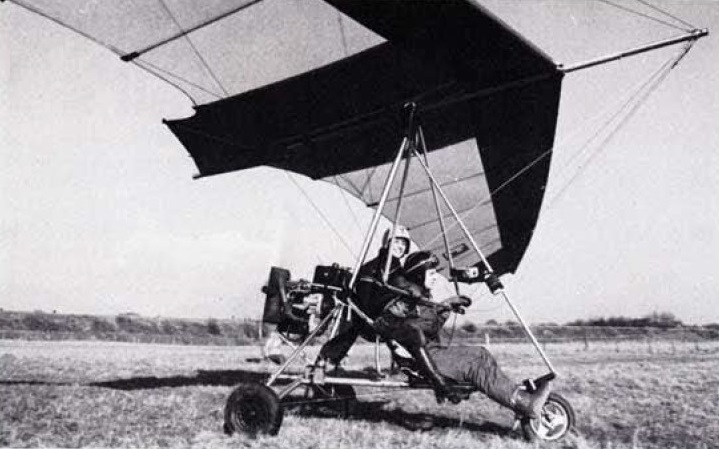
The two seat Robin 440cc powered Tri-Flyer designed for the Flexiform Striker two-seater wing or the Southdown Lightnng DS, was available as a kit for £1550 or ready to fly for £1950.
Tri-Flyer 250 / Demon
Engine: Robin EC25PS, 22 hp at 7000 rpm.
Propeller diameter and pitch 54 x 24/27 inch, 1.37 x 0.61/ 0.70m.
V belt reduction, ratio 2.3/1.
Max static thrust 125 lb, 57 kg.
Power per unit area 0.13hp/sq.ft, 1.4hp/sq.m.
Fuel capacity 2.6 US gal, 2.2 Imp gal, 10.0 litre.
Length overall 11.0 ft, 3.35 m.
Height overall 10.0 ft, 3.05m.
Wing span 32.0ft, 9.75m.
Chord at root 8.2ft, 2.50 m.
Chord at tip 3.5ft, 1.07m.
Dihedral 0 degs.
Nose angle 120 deg
Total wing area 175 sq.ft, 16.3 sq.m.
Wheel track 5.3 ft, 1.62 m.
Wheel¬base 5.9 ft, 1.80 m.
Nosewheel diameter overall 14 inch, 356 mm.
Main wheels diameter overall 14 inch, 356 mm.
Empty weight 190 lb, 86kg.
Max take off weight 370 lb, 168kg.
Payload 180 lb, 82kg.
Max wing loading 2.11 lb/sq.ft, 10.3kg/sq.m.
Max power loading 16.8 lb/hp, 7.5kg/hp.
Max level speed 40 mph, 64 kph.
Never exceed speed 50 mph, 80kph.
Max cruising speed 35mph, 56kph.
Economic cruising speed 30mph, 48kph.
Stalling speed 20 mph, 32 kph.
Max climb rate at sea level 350 ft/min, 1.8 m/s.
Take off distance 100ft, 30m.
Landing dis¬tance 150 ft, 45 m.
Tri Flyer 330 / Typhoon S
Engine: Robin EC34PM, 35 hp at 6500 rpm.
Propeller diameter and pitch 54 x 30/34 inch, 1.37 x 0.76/ 0.85m.
V belt reduction, ratio 2.5/1.
Max static thrust 180 lb, 82 kg.
Power per unit area 0.21 hp/sq.ft, 2.3 hp/sq.m.
Fuel capacity 2.6 US gal. 2.2 Imp gal, 10.0 litre.
Length overall 11.0 ft, 3.35 m.
Height overall 10.0 ft, 3.05 m.
Wing span 32.5 ft, 9.91 m.
Chord at root 8.0ft, 2.44m.
Chord at tip 3.3ft, 1.01m.
Dihedral 0 deg.
Nose angle 122 deg
Total wing area 166 sq.ft, 15.4 sq.m.
Wheel track 5.3 ft, 1.62 m.
Wheel¬base 5.8 ft, 1.77 m.
Nosewheel diameter over¬all 14 inch, 356 mm.
Main wheels diameter overall 14 inch, 356 mm.
Empty weight 210 lb, 95kg.
Max take off weight 410 lb, 186 kg.
Payload 200 lb, 91 kg.
Max wing loading 2.47 lb/sq.ft, 12.1 kg/sq.m.
Max power loading 11.7 lb/hp, 5.2kg/hp.
Max level speed 45mph, 72kph.
Never exceed speed 53mph, 85 kph.
Max cruising speed 35 mph, 56 kph.
Economic cruising speed 30mph, 48kph.
Stall speed 22 mph, 35 kph.
Max climb rate at sea level 600 ft/min, 3.0 m/s.
Take off distance 80 100 ft, 25 30 m.
Landing dist: 120 170 ft, 35 50 m.
Tri Flyer Challenger/ Lightning DS
Engine: Robin EC44.
Wing span 34.5ft, 10.52m.
Chord at root 8.0ft, 2.44 m.
Chord at tip 3.5 ft, 1.07 m.
Anhedral 1.5 degs
Nose angle 130 degs.
Total wing area 195 sq.ft, 18.1 sq.m.
Wing aspect ratio 6.3/1.
Tri Flyer Two Seater/Dual Striker
Engine: Robin EC44, 50 hp at 6800 rpm.
Propeller diameter and pitch 62 x 27 inch, 1.58 x 0.70 m.
Toothed belt reduction, ratio 2.3/1.
Max static thrust 275 lb, 125 kg.
Power per unit area 0.20 hp/sq.ft, 2.2 hp/sq.m.
Fuel capacity 2.6 US gal, 2.2 Imp gal, 10.0 litre.
Length overall 14.0 ft, 4.27 m.
Height overall 11.0ft, 3.35m.
Wing span 38.0ft, 11.58m.
Chord at root 9.0ft, 2.74 m.
Chord at tip 3.5ft, 1.07m.
Dihedral 2 degs.
Sweepback 15 degs.
Keel pocket depth 1.2ft, 0.37m.
Total wing area 250 sq.ft, 23.2sq.m.
Keel pocket area 3.5 sq.ft, 0.33 sq.m.
Wing aspect ratio 6.0/1.
Wheel track 6.0 ft, 1. 83 m.
Wheelbase 6.0 ft, 1.83 m.
Nose¬wheel diameter overall 16 inch, 406 mm.
Main wheels diameter overall 16 inch, 406 mm.
Empty weight 300 lb, 136kg.
Max take off weight 550 lb, 250kg.
Payload 250 lb, 113 kg.
Max wing loading 2.20 lb/sq.ft, 10.7 kg/sq.m.
Max power loading 11.0 lb/hp, 4.9kg/hp.
Load factors +4.5, 2.0 design.
Max level speed 58 mph, 93 kph.
Never exceed speed 65 mph, 105 kph.
Max cruising speed 55 mph, 88 kph.
Economic cruising speed 45 mph, 72 kph.
Stalling speed 25 mph, 40 kph.
Max climb rate at sea level 600 ft/min, 3.0 m/s.
Best glide ratio with power off 5/1.
Take off distance 150 160ft, 45 50 m.
Landing distance 160 200 ft, 50 60 m.
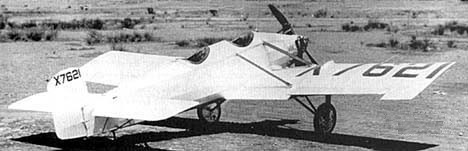
The 1928 X-1 Special aka Sportster experimental lightplane was designed by Don Hall and first flown in September 1928 (piloted by Red Harrigan, registered NX7621). Power was an 80hp Siemens-Halske.
Repowered with 90hp Warner Scarab as a 1929 Safety Plane entry with a variable-airfoil wing (“no two ribs are alike”) controlled by a lever in the cockpit. No fin or stabilizer, which were replaced by a large, moveable “stabilator” and a longitudinally adjustable 50 lb weight on a track to shift the c/g. All that resulted in enough stability problems to cancel the project.
Only the one was built, reportedly flown several times by Charles Lindbergh.
Wing span: 27’0″
Length: 22’0″
Max speed: 135 mph
Seats: 2

