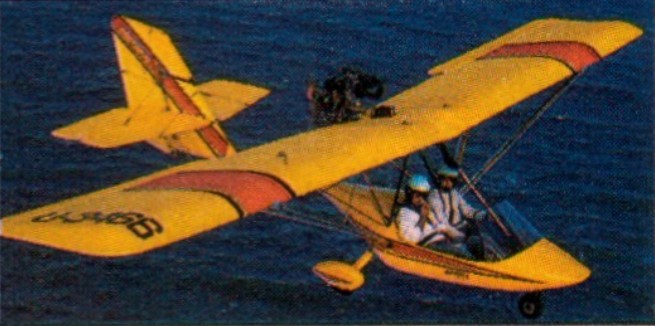
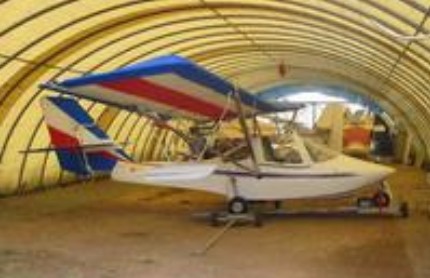
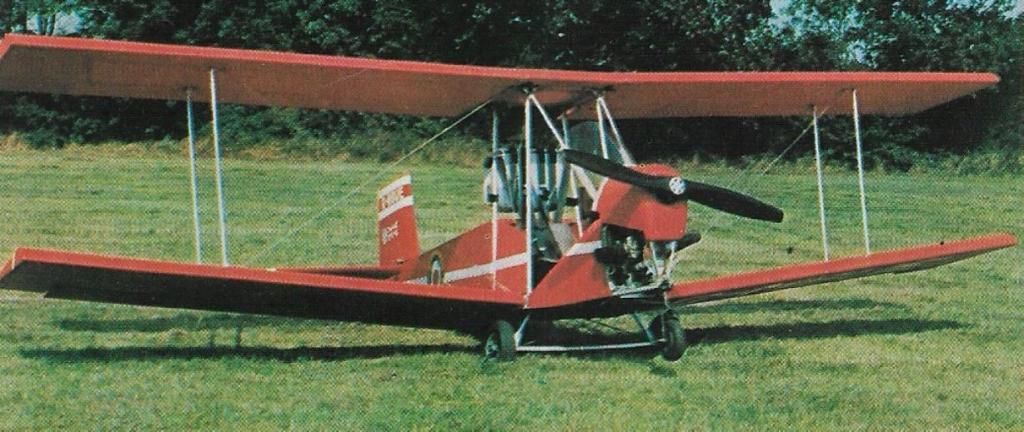
Midwest Microlights Tomcat Two-place

This side by side two¬-seater version of the HM 81 Tomcat was announced at the finish of the 1981 and appeared early in 1982.

Engine: Cuyuna 430R, 30 hp at 5500 rpm.
Propeller diameter and pitch 54 x 36 inch, 1.37 x 0. 91 m.
V belt reduction, ratio 2.0/1.
Max static thrust 250 lb, 113 kg.
Power per unit area 0.17 hp/sq.ft, 1.8hp/sq.m.
Fuel capacity 5.0 US gal, 4.2 Imp gal, 18.9 litre.
Length overall 12.0 ft, 3.66 m.
Height overall 10.0ft, 3.05m.
Wing span 30.0ft, 9.14m.
Chord at root 4.0ft, 1.22 m.
Chord at tip 3.0 ft, 0.91 m.
Main wing dihedral 0 deg.
Main¬ wing sweep back 0 deg.
Canard span 8.0ft, 2.43m.
Canard chord 3.0ft, 0.91m.
Total wing area 175 sq.ft, 16.3sq.m.
Main wing area 125 sq.ft, 11.6 sq.m.
Canard area 25 sq.ft, 2.3 sq.m.
Total dihedral wing area 25 sq.ft, 2.3 sq.m.
Main wing aspect ratio 7.2/1.
Wheelbase 7.0ft, 2.13 m.
Nosewheel diameter overall 10 inch, 25 cm.
Main wheels diameter overall 10 inch, 25 cm.
Empty weight 245 lb, 111 kg.
Max take off weight 605 lb, 274kg.
Payload 360 lb, 163 kg.
Max wing loading 3.46 lb/sq.ft, 16.8kg/sq.m.
Max power loading 20.2 lb/hp, 9.1 kg/hp.
Load factors +5.0, 3.0 design.
Max level speed 60 mph, 97 kph.
Cruising speed 45mph, 72kph.
Stalling speed 24mph, 38kph.
Max climb rate at sea level 350 ft/min, 1.8 m/s.
Best glide ratio with power off 7/1.
Take off distance 180 ft, 55 m.

Midwest Microlights HM-81 Tomcat Tourer / The Baron / Waspair Tomcat

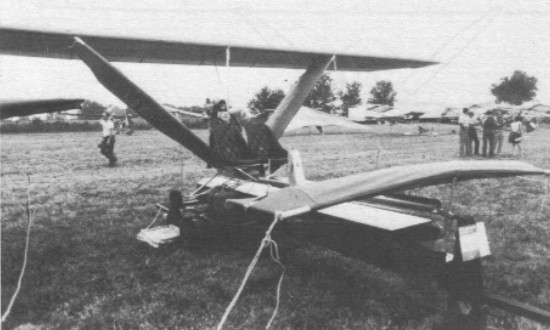
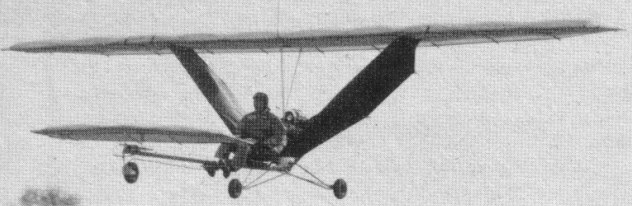
Single seat single engined high wing mono¬plane with additional dihedral wings; unconventional three axis control. main wing has unswept leading and trailing edges, and constant chord; no tall, canard wing. Pitch control by fully flying canard; yaw/roll control by control surfaces on dihedral wings; control inputs through stick for pitch/yaw/roll. Main wing braced from below by dihedral wings. Wing profile; double surface. Undercarriage has three wheels in tricycle formation; rubber suspension on main wheels. Push right go-right nosewheel steering independent from yaw control. No brakes. Aluminium tube framework, without pod. Engine mounted below main wing driving pusher propeller. Tubing in 6061T6 aluminium, anodized. Stainless steel cables. Dacron wing covering.

Waspair Tomcat Article

Robin Haynes, founder and president of the Waspair Corporation which originally produced the Tomcat, de¬signed this unique machine at the end of 1979. It only became the Tomcat after a succession of names, the first production models having been sold under the name The Baron.

At Oshkosh in 1981 the HM 81 won the EAA prize for the most outstanding new design. The aerodynamic configuration of this machine is very unusual and warrants some supplementary explanation. The Tomcat is made up of three lifting elements: the main wing (67% of the total lift), the two inclined structural wings angled at 45O and with 15O sweepback, (18% of the lift) and the canard (15% of the total lift). The main wing is fixed and devoid of control surfaces, while the inclined wings, Which he called dihedral wings, are two fixed surfaces carrying elevons, like a V tail. The canard angle of attack can be altered to control pitch, all control being by a single stick which acts as a mixer on the elevons and the canard.

At the beginning of 1982, Waspair Cor¬poration offered the standard version of the Tomcat fitted with the twin cylinder 430D 30hp engine and direct drive; with the 430R and 2/1 reduction drive, the machine was called the Tomcat Sport. However, by the end of 1982, the latter had become the standard version. Also appearing at the beginning of 1982 was a Tourer version for the heavier pilot with a heavy duty airframe and the Cuyuna 430R. It is this model on which the company is now concentrating and at the Sun ‘n’ Fun in Lakeland, in March 1983, the maker was marketing it as the standard version. In kit form it costs $4695 and pre built it costs an extra $1150.

Engine: Cuyuna 430R, 30 hp at 5500 rpm.
Propeller diameter and pitch 54 x 36 inch, 1.37 x 0. 91 m.
V belt reduction, ratio 2.0/1.
Max static thrust 250 lb, 113 kg.
Power per unit area 0.17 hp/sq.ft, 1.8hp/sq.m.
Fuel capacity 5.0 US gal, 4.2 Imp gal, 18.9 litre.
Length overall 12.0 ft, 3.66 m.
Height overall 10.0ft, 3.05m.
Wing span 30.0ft, 9.14m.
Chord at root 4.0ft, 1.22 m.
Chord at tip 3.0 ft, 0.91 m.
Main wing dihedral 0 deg.
Main¬ wing sweepback 0 deg.
Canard span 8.0ft, 2.43m.
Canard chord 3.0ft, 0.91m.
Total wing area 175 sq.ft, 16.3sq.m.
Main wing area 125 sq.ft, 11.6 sq.m.
Canard area 25 sq.ft, 2.3 sq.m.
Total dihedral wing area 25 sq.ft, 2.3 sq.m.
Main wing aspect ratio 7.2/1.
Wheelbase 7.0ft, 2.13 m.
Nosewheel diameter overall 10 inch, 25 cm.
Main wheels diameter overall 10 inch, 25 cm.
Optional floats, length 11.0 sq.ft, 3.35 m.
Optional skis, length 3.0 ft, 0.91 m.
Empty weight 235 lb, 107 kg.
Max take off weight 595 lb, 270 kg.
Payload 360 lb, 163 kg .
Max wing loading 3.40 lb/sq.ft, 16.6 kg/sq.m.
Max power loading 19.8 lb/hp, 9.0kg/hp.
Load factors +6.0, 4.0 design; +8.0, 6.0 ulti¬mate.
Max level speed 60 mph, 97 kph.
Never exceed speed 65 mph, 105 kph.
Max cruising speed 45 mph, 72 kph.
Economic cruising speed 40mph, 64kph.
Stalling speed 27 mph, 43 kph.
Max climb rate at sea level 800 ft/min, 4.1 m/s.
Min sink rate 250 ft/min at 30 mph, 1.3 m/s at 48 kph.
Best glide ratio with power off 8/1 at 30 mph, 48 kph.
Take off distance 90 ft, 27 m.
Landing distance 125 ft, 38 m.
Service ceiling 15,000 ft, 4570 m.
Range at average cruising speed 125 mile, 201 km.

Microwings Cubby / Tri-Cubby

The Cubby is 75% of the original J-3 Piper cub. With modern materials and technology the performance has been improved, and the Cubby uses automotive fuel as opposed to AVGAS.

The Cubby can be registered as a three axis micro-light or a non type certified light aircraft. The Cubby was available in tri-gear or tail dragger. The 2009 Price was dependable on the choice of engine. The option to have the Cubby interchangeable between tri-gear and tail dragger was also available on request as an option.

The factory is up to CAA standards. All upgrade and changes requested by CAA has been done and communicated to all Cubby owners. All correspondence of changes and upgrades are posted to Cubby owners with a newsletter.

Tri-Cubby

There were 26 flying in South Africa and 3 on order. The Cubby was available in kit form, fast built and basic kit, or as ready to fly or fully built but without engine, radio and instruments.

Cubby
Stall: 40 kt / 46 mph / 74 kmh
Cruise: 74 kt / 85 mph / 137 kmh
VNE: 113 kt / 130 mph / 209 kmh
Empty Weight: 260 kg / 573 lbs
MTOW Weight: 500 kg / 1102 lbs
Climb Ratio: 1200 ft/min / 6 m/s
Take-off distance (50ft obstacle): 660 ft / 200 m
Landing distance (50ft obstacle): 820 ft / 250 m

Tri-cubby
Stall: 45 kt / 52 mph / 83 kmh
Cruise: 100 kt / 115 mph / 185 kmh
VNE: 130 kt / 150 mph / 241 kmh
Empty Weight: 260 kg / 573 lbs
MTOW Weight: 500 kg / 1102 lbs
Climb Ratio: 1200 ft/min / 6 m/s
Glide Ratio: 10:1
Take-off distance (50ft obstacle): 330 ft / 100 m
Landing distance (50ft obstacle): 490 ft / 150 m

Microleve ML500

Basic ultralight, tricycle landing gear, with rigid wing. Now with a full closed cabin.

Stall: 26 kt / 30 mph / 48 kmh
Cruise: 78 kt / 90 mph / 145 kmh
VNE: 96 kt / 110 mph / 177 kmh
Empty Weight: 220 kg / 485 lbs
MTOW Weight: 500 kg / 1102 lbs
Climb Ratio: 1000 ft/min / 5 m/s
Glide Ratio: 12:1
Take-off distance (50ft obstacle): 330 ft / 100 m
Landing distance (50ft obstacle): 330 ft / 100 m

Microleve ML450

A two place, side by side with trigear or tail wheel. First flown in 1989.

Engine: Rotax 582, 65 hp
HP range: 55-74
Height: 6.9 ft
Length: 22.4 ft
Wing span: 33.8 ft
Wing area: 177.4 sq.ft
Empty weight: 484 lb
Gross weight: 980 lb
Fuel capacity: 17 USG
Top speed: 100 mph
Cruise: 70 mph
Stall: 20 mph
Range: 289 sm
Rate of climb: 1000 fpm
Takeoff dist: 200 ft
Landing dist: 100 ft
Service ceiling: 10,000 ft
Seats: 2
Landing gear: nose or tail

Microleve Corsario

Mk.V

A two place, side by side LSA amphibian with retractable trigear or tail wheel. First flown in 1989.

Mk.III
Engine: Rotax, 74 hp
HP range: 66-80
Height: 6.9 ft
Length: 22.4 ft
Wing span: 33.8 ft
Wing area: 177.4 sq.ft
Empty weight: 540 lb
Gross weight: 1100 lb
Fuel capacity: 17 USG
Top speed: 100 mph
Cruise: 75 mph
Range: 289 sm
Rate of climb: 800 fpm
Takeoff dist land: 260 ft
Takeoff dist water: 330 ft
Landing dist land: 220 ft
Landing dist water: 250 ft
Service ceiling: 10,000 ft
Seats: 2
Landing gear: nose or tail wheel

Mk.5
Engine: Rotax 912, 80 hp
HP range: 80-100
Length: 22.6 ft
Wing span: 33 ft
Wing area: 175 sq.ft
Empty weight: 685 lb
Gross weight: 600 kg / 1320 lb
Cruise: 85 mph
Stall: 42 mph
Fuel capacity: 20 USG
VNE: 120 kt / 138 mph / 222 kmh
Range: 460 sm
Rate of climb: 900 fpm
Glide Ratio: 10:1
Seats: 2
Cockpit width: 44 in
Landing gear: nose or tail wheel
2009 Price: US$17000

Microjet 200

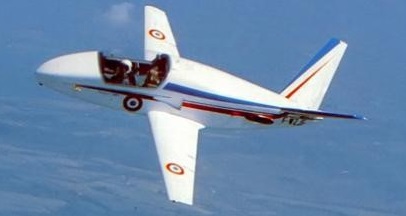
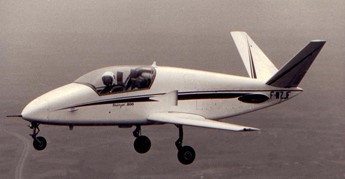
The aim of the Microjet 200 program was to offer economies in military pilot training by use of very small high-performance jet aircraft with comparatively low initial and operating costs.

Microjet 200 Article

A team was employed by Société Microturbo to developed this aircraft. The team included Jacques Grangette who was both leader of the team and in charge of development, Claude Fimbel, who conducted the study work and Jules Bernard, in charge of fabrication. Wind tunnel testing was executed at CEAT, Institut de Mécanique des Fluides de Lille (IMFL) for spin, and ONERA for flutter analysis.
Microjet was founded to develop and assemble Microjet 200 B two-seat very light trainer powered by two Microturbo turbojet engines (first flown 1980). Many components built by Marmande Aeronautique, later building complete pre-production aircraft.

The Microjet 200 is a side-by-side two-seater, initialy powered by two Microturbo TRS18-046, each rated at 1.08 kN (243 lb st.).

The Microjet 200 made its first flight from Toulouse-Blagnac on 24 June 1980. The aircraft flew for 40 minutes without problem, at an altitude of 1000 metres and a speed of 220 km/hr. Jacques Grangette was at the controls.

Propotype # 1 – FWZJF
Built entirely of wood. Only a few parts require special forming were made out of resin.

It still exists, and is kept in reserve a hangar flying club Marmande.

Prototype
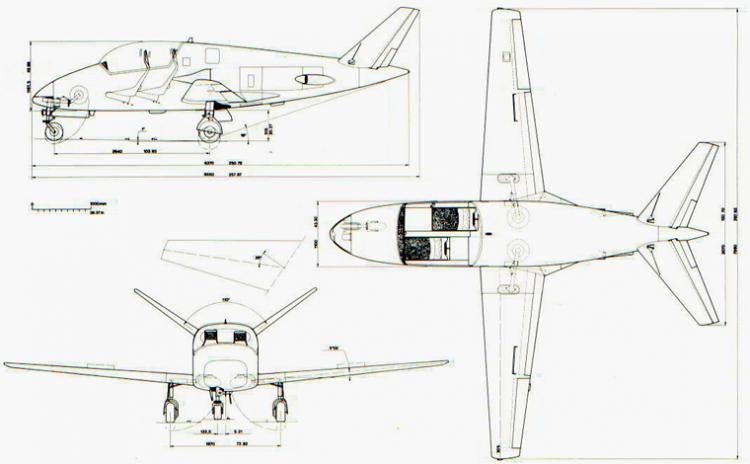
Wingspan: 7.38 m
Length: 6.05 m
Height: 1.80 m
Wing area: 6.12 m²
Empty weight: 600 kg
Max weight 930/1050 kg
Stall: 118 Km / h
Max cruise: 463 km / h

Microjet 200b – N ° 01
F- WDMT, it was the first copy of pre-series, any metal . This aircraft was damaged by Wed, March 13th, 1985 in the Bay of Saint- Brieuc, killing its pilot Domnique Monguillot.
A trawler at the time had recovered some pieces of the plane’s body. Dominique has never been found.

Microjet 200b – No. 02
F- WDMX, Second pre-series made its first flight January 5, 1985. Built by Marmande Aerospace. It was characterized by the presence of hardpoint on the wings for the carriage of weapons.

Microjet 200b – N ° 03
F- WDMT, Third pre-series aircraft, which carried the registration of the first 200b. Made its first flight Nov. 4, 1986. This unit was also built by Marmande Aerospace.

Micro Engineering (Aviation) Mistral

The Mistral two axis was a side by side two seat single engined flex wing aircraft. Wing has swept back leading and trailing edges, and tapering chord; no tail, canard wing. Pitch control by fully flying canard; yaw control by tip rud¬ders; no separate roll control; control inputs through stick for pitch/yaw. Wing braced from above by kingpost and cables, front below by cables; wing profile based on Pterodactyl; 60% double surface. Undercar¬riage has three wheels in tricycle formation; bungee suspension on all wheels. No ground steering. No brakes. Aluminium tube framework, without pod. Engine mounted below wing driving pusher propeller. Drawn aluminium tubing manufactured to British HT30TF specification. Terylene sailcloth wing.

The Mistral was in concept a two seater Pterodactyl, produced with Pterodactyl director Jack McCornack’s bles¬sing. Much of the design was scaled up from the American machine, including the wing profile, which is Pterodactyl derived.

Though neither fast nor elegant, the Mistral did prove quite robust and offered full dual controls, a combination which appealed to training schools. A total of eight two axis machines were built, of which the first three used Cuyuna 430R engines. Later aircraft were fitted with a Robin EC44, which is considerably more powerful.
The Mistral three axis is the same as the two axis Mistral except: conven¬tional three axis control (unconventional three axis optional). Roll control by spoilers; control inputs through stick for pitchlroll (pitch/yaw optional) and pedals for yaw (roll optional).

The original idea behind the three axis Mistral was to make the aircraft suitable for crop spraying, but though test pilot Graharn Andrews did extensive trials with spraying equipment, in fact no aircraft were ever sold for agricultural purposes.

Three aircraft were produced with three-¬axis control, of which two were conventional¬ly arranged, and the third had yaw and roll controls reversed, with the stick operating the rudders and pedals controlling the spoilers. All three aircraft used the Robin EC44 engine.

Two axis
Engine: Cuyuna 430R, 30 hp.
Propeller diameter 54 inch, 1.37 m.
Reduction ratio 2.0/1.
Power per unit area 0.12 hp/sq.ft, 1.3 hp/sq.m.
Fuel capacity 4.8 US gal, 4.0 Imp gal, 18.2 litre.
Empty weight 285 lb, 129kg.
Max take off weight 685 lb, 311kg.
Payload 400 lb, 182kg.
Max wing loading 2.74 lb/sq.ft, 13.4 kg/sq.m.
Max power loading 22.8 lb/hp, 10.4kg/hp.
Length overall 14.3 ft, 4.36 m.
Height overall 11.0ft, 3.35m.
Wing span 40.0ft, 12.19m.
Chord at root 6.6 ft, 2.01 m.
Chord at tip 5.5ft, 1.68m.
Dihedral 3 deg
Sweepback 10 deg approx.
Canard span 7.0ft, 2.13m.
Canard chord 1.5 ft, 0.46 m.
Total wing area 261 sq.ft, 24.2 sq.m.
Main wing area 250 sq.ft, 23.2 sq.m.
Canard area 11 sq.ft, 1.0 sq.m.
Total rudder area 6.0 sq.ft, 0.56 sq.m.
Wing aspect ratio 6.6/1.
Wheel track 7.0 ft, 2.13 m.
Wheelbase 7.0 ft, 2.13 m.
Nosewheel diameter overall 15 inch, 38 cm.
Main wheels diameter overall 18 inch, 46 cm.
Skis: standard adult skis, length reduced to 3 ft, 0.91 m.

Three axis
Engine: Robin EC44, 40 hp at 6000 rpm.
Propeller diameter 54 inch, 1.37 m.
Toothed belt reduction, ratio 2.3/1.
Max static thrust 280 lb, 127 kg.
Power per unit area 0.16hp/sq.ft, 1.7 hp/sq.m.
Fuel capacity 4.8 US gal, 4.0 Imp gal, 18.2 litre.
Empty weight 285 lb, 129kg.
Max take off weight 685 lb, 311kg.
Payload 400 lb, 182kg.
Max wing loading 2.74 lb/sq.ft, 13.4 kg/sq.m.
Max power loading 17.1 lb/hp, 7.8kg/hp.
Length overall 14.3 ft, 4.36 m.
Height overall 11.0ft, 3.35m.
Wing span 40.0ft, 12.19m.
Chord at root 6.6 ft, 2.01 m.
Chord at tip 5.5ft, 1.68m.
Dihedral 3 deg.
Sweepback 10 deg approx.
Canard span 7.0ft, 2.13m.
Canard chord 1.5 ft, 0.46 m.
Total wing area 261 sq.ft, 24.2 sq.m.
Main wing area 250 sq.ft, 23.2 sq.m.
Canard area 11 sq.ft, 1.0 sq.m.
Total rudder area 6.0 sq.ft, 0.56 sq.m.
Total spoiler area 1.5 sq.ft, 0.14 sq.m.
Wing aspect ratio 6.6/1.
Wheel track 7.0 ft, 2.13 m.
Wheelbase 7.0 ft, 2.13 m.
Nosewheel diameter overall 15 inch, 38 cm.
Main wheels diameter overall 18 inch, 46 cm.
Skis: standard adult skis, length reduced to 3 ft, 0.91 m.
Max level speed 45 mph, 72 kph.
Never exceed speed 55 mph, 88kph.
Max cruising speed 45mph, 72kph.
Economic cruising speed 40mph, 64kph.
Stalling speed 20 mph, 32 kph.
Max climb rate at sea level 400 ft/min, 2.0 m/s.
Best glide ratio with power off 9/1 at 35 mph, 56 kph.
Take off distance 200 260 ft, 60 80m.
Landing distance 200 260ft, 60¬80m.
Range at average cruising speed 80 mile, 129 km.
Micro Biplane Aviation Tiger Cub 440

Single seat single engined biplane with con¬ventional three axis control. Wings have un¬swept leading and trailing edges, and constant chord; conventional tail. Pitch control by fully flying tail; yaw control by fully flying rudder; roll control by full span ailerons; control inputs through stick for pitch/roll and pedals for yaw. Wings braced by struts and dupli¬cated transverse X cables; wing profile; 100% double surface. Undercarriage has three wheels in tail dragger formation; coil spring suspension on tailwheel and axle flex suspension on main wheels. Push right go-¬right tailwheel steering connected to yaw control. No brakes. Composite fuselage, partially enclosed. Engine mounted between wings driving tractor propeller. Patented composite wing structure using waterproof fabric covering with heat set backing adhe¬sive. Rigging wires of stainless steel. Airframe uses aluminium alloy seamless drawn tube and cadmium plated aircraft quality nuts and bolts.

The Super Tiger Cub 440 is the logical development of the Micro Bipe prototype, with the open framework replaced by a partially enclosed cockpit and the 250 engine discarded in favour of a 440. Wing span is increased to keep the wing loading of this heavier aircraft within the UK microlight definition. Although a nosewheel was retained for test work on the pre production prototype of the Super Tiger Cub 440, it is not fitted on production machines. Particularly noteworthy is the ease of rigging. Simply by removing three locking pins per side, the Super Tiger Cub 440 is made ready for trailer transport.

The aircraft is offered in three forms: part kits, full kits or ready to fly. Part kits are numbered one to eight and can be purchased one at a time as the builder’s finance permits, a system which also permits the manufacturer to keep costs down by producing each part kit in quantity. By 1982 over 150 of these aircraft were in the process of being built.

Gallery

Engine: Robin EC44 50hp at 7000rpm
Propeller diameter and pitch 54 x 33 inch, 1.37x 0.84 m
Toothed belt reduction, ratio 2.4/1
Max static thrust 220 lb, 100kg
Power per unit area 2.72 hp/sq.ft, 29.7 hp/sq.m
Fuel capacity 6.0 US gal, 5.0 Imp gal, 22.7 litre
Length overall 13.3 ft, 4.05 m
Height overall 5.5 ft, 1.68m
Wing span 21.0ft, 6.40m
Constant chord 3.0 ft, 0.91 m (bottom wing), 3.5 ft, 1.07 m (top wing)
Dihedral 5 deg (bottom wing), 0 deg (top wing)
Sweepback 0 deg
Tailplane span 7.0ft, 2.13m
Rudder height 2.9ft, 0.88 m
Total wing area 136 sq.ft, 12.6 sq.m
Total aileron area 13.8 sq.ft, 1.28 sq.m
Rudder area 6.3 sq.ft, 0.59 sq.m
Total elevator area 14.6 sq.ft, 1.36 sq.m
Wing aspect ratio 6.4/1
Wheel track 4.2 ft, 1. 28 m
Tailwheel dia¬meter overall 4 inch, 10cm
Main wheels diameter overall 13 inch, 33cm
Empty weight 265 lb, 120kg
Max take off weight 500 lb, 227 kg
Payload 235 lb, 107 kg
Max wing loading 3.68 lb/sq.ft, 18.0 kg/m
Max power loading 10.0 lb/hp, 4.5kg/hp
Load factors +6.0, 4.0 design; +9.0, 7.0 ulti¬mate
Max level speed 80 mph, 129 kph
Never exceed speed 85 mph, 137 kph
Max cruising speed 70 mph, 113 kph
Economic cruising speed 60 mph, 97 kph
Stalling speed 30 mph, 48 kph
Max climb rate at sea level 900 ft/min, 4.6 m/s
Min sink rate 500 ft/min at 36 mph, 2.5 m/s at 58 kph
Best glide ratio with power off 7/1 at 35 mph, 56 kph
Take off distance 60 ft, 20 m on short grass
Landing distance 80 ft, 25 m on short grass
Service ceiling 10,000 ft, 3050 m
Range at average cruising speed 115 mile, 185 km