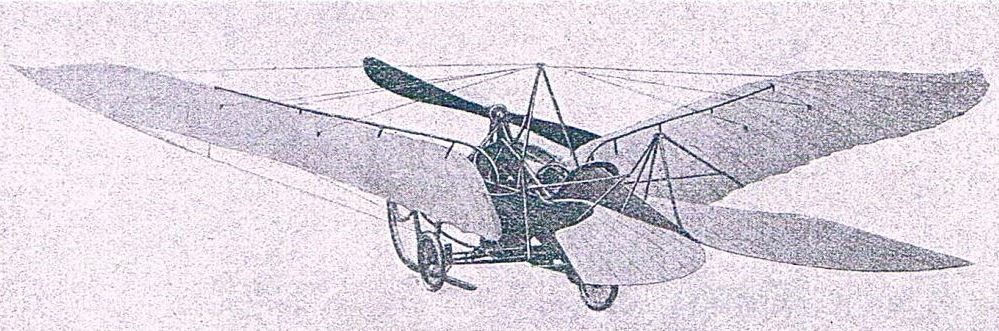
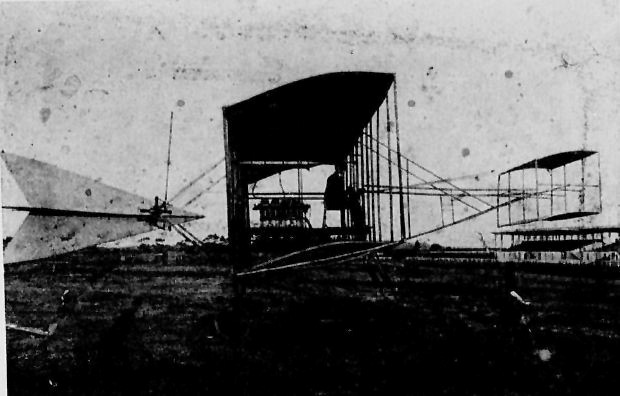
“Sport Eindecker ohne Seitensteuer” (sport monoplane without vertical tail plane), built by Bernard Mrozinski (of Polish birth), Berlin-Wilmersdorf. It flew in 1912.
Engine: 20 h.p. Anzani. Length 7 m Span 10 m Wing area 20 sq.m Weight 300 kg
Produced by the former J,Meaz works (Chocen plant) the M-3 Bonzo was designed by J. Mraz.
The M-3 Bonzo is a four-seat produced in prototype form only. Of all-wood construction, it is powered by a 160 hp Walter Minor 6-III engine. A retractable nosewheel undercarriage is fitted.
Engine: 160 hp Walter Minor 6-III Wingspan: 34 ft 9 in Wing area: 148.5 sq.ft Length: 25 ft 4 in Height: 7 ft 4.5 in Empty weight: 1278 lb Loaded weight: 2424 lb Max speed: 165 mph Cruise: 150 mph ROC: 708 fpm Ceiling: 16,400 ft Range: 620 mi
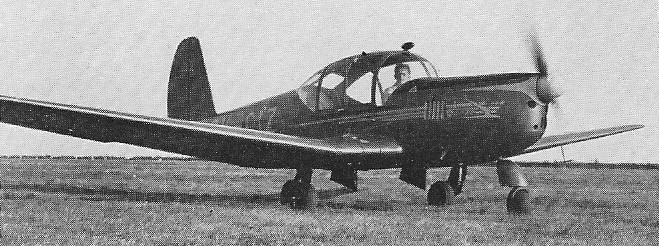
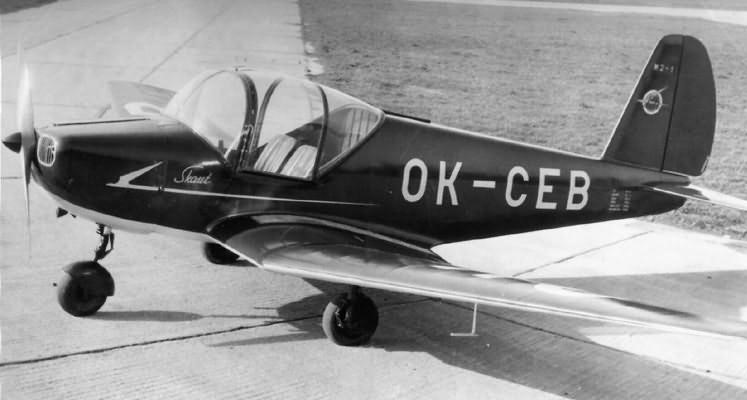
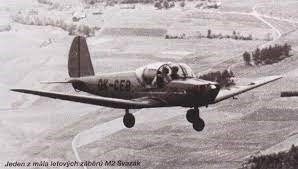
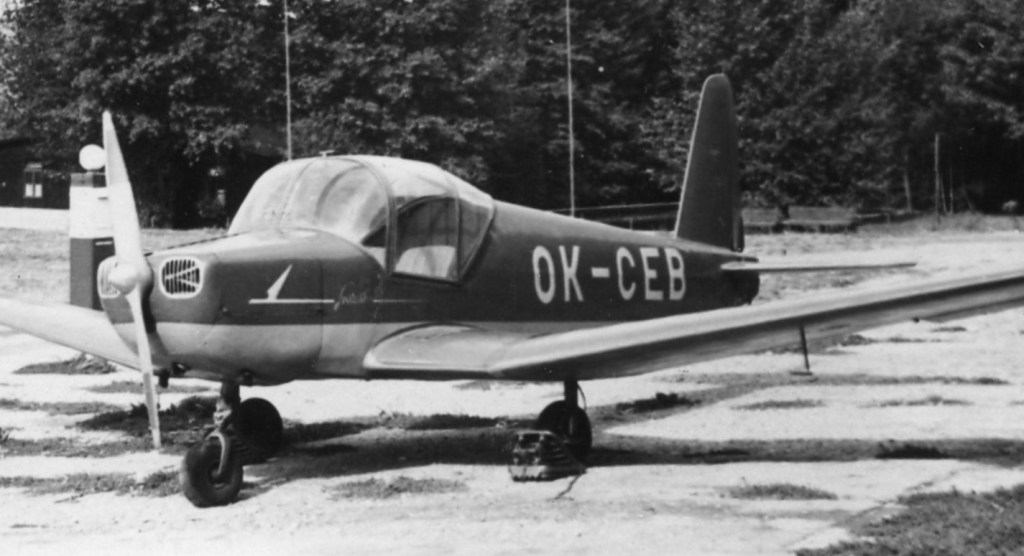
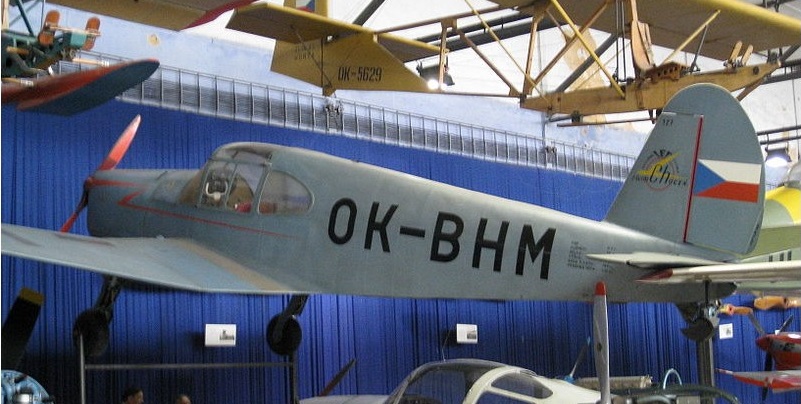
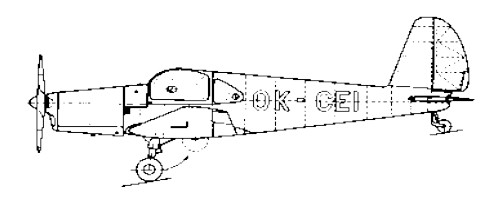
The Czechoslovak aircraft factory Mráz introduced several new sport aircraft after World War II. One of them was the M-2 Skaut, designed by Zdeněk Rublič. His aim was to design an easily flyable and reliable aircraft for basic club pilot training, with moderate operating costs and requiring little maintenance.
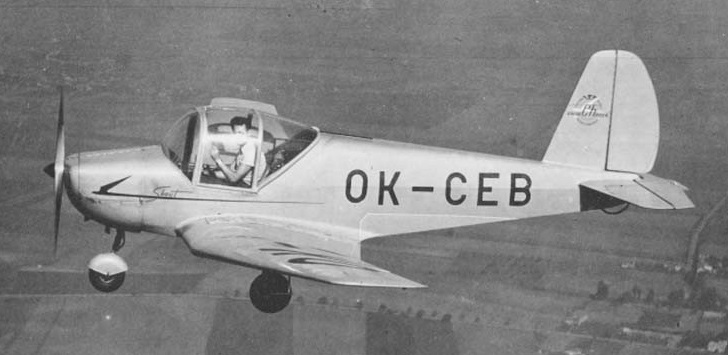
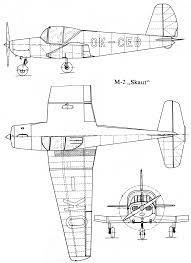
The Mráz M-2 Skaut was a wooden two-seat, single engine, low wing aircraft.
To simplify production, the wing and tail from his earlier, successful M-1C Sokol design was used. Like the Sokol, the Skaut was a wood framed, fabric covered aircraft. Their shared straight tapered wing had a swept leading edge but no sweep on the trailing edge They had marked dihedral beyond a very short centre section. The fin also had a swept leading edge and carried a rounded rudder. The tailplane was set well to the rear and near the top of the fuselage with a single piece elevator; the rudder moved above it. The Skaut had fixed tricycle landing gear.
The prototype, first flown in mid-1948, showed that the Skaut was a stable and safe aircraft, pleasantly controllable and with a good field of view. These characteristics together with a side-by-side cockpit and a tricycle landing gear made it a promising civil trainer aircraft. However, the new communist government nationalised the Mráz factory and directed it to produce military aircraft, so only the prototype Skaut was completed in the 20th century.
The only wooden prototype Skaut, OK-CEB Svazák, served at several flying clubs, mostly in Vrchlabí, and became very popular. There are rumours that it was flown solo by glider pilots without any previous experience of powered aircraft. In the early 1960s it was damaged during an emergency landing after an engine failure and was scrapped.
In 2005 the design was revisited, resulting in the metal framed, modernised Kubicek M-2 Scout which first flew in 2009 with plans for production and first deliveries in 2011.
Variation: Kubicek M-2 Scout
Powerplant: 1 × Praga D, 56 kW (75 hp) Propeller: 2-bladed fixed pitch Wingspan: 10 m (32 ft 10 in) Wing area: 13.8 m2 (149 sq ft) Length: 6.75 m (22 ft 2 in) Height: 1.9 m (6 ft 3 in) Empty weight: 370 kg (816 lb) Gross weight: 660 kg (1,455 lb) Fuel capacity: 70 L (18 US gal; 15 imp gal) Maximum speed: 185 km/h (115 mph, 100 kn) Cruise speed: 150 km/h (93 mph, 81 kn) Range: 700 km (430 mi, 380 nmi) Service ceiling: 4,200 m (13,800 ft) Rate of climb: 2.7 m/s (530 ft/min) Crew: 2
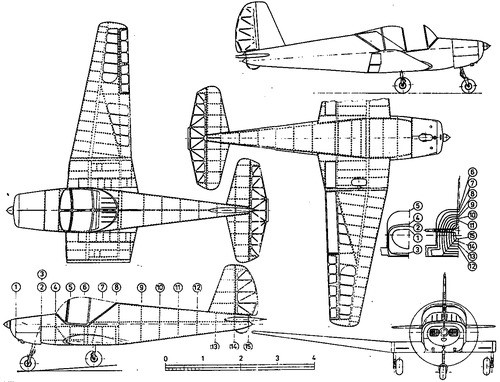
The Mráz M.1 Sokol (English: “Falcon”) was a light aircraft built in Czechoslovakia in the years following the end of the Second World War. Designed in secret by Zdeněk Rublič at the Beneš-Mráz factory during the German occupation.
The Sokol was a conventional, low-wing monoplane that took the pre-war Beneš-Mráz Bibi as its starting point. Two seats were provided side-by-side in an enclosed cabin, and the main units of the tailwheel undercarriage were retractable. Construction throughout was of wood.
M.1/1 prototype
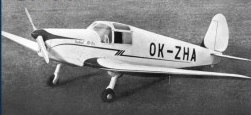
The prototype, then designated the M.1/1 and registered as OK-ZHA, first flew on 9 March 1946, following test flights the prototype was designated the M.1A as the two-seat-version. A re-engined two-seater was built designated the M.1B with a ZLAS Toma 4 engine, it first flew on 19 May 1946 but only one was built. The design was then modified as the M.1C with a third-seat in the rear and first flying on 16 February 1947. The M.1C became the main production variant and 183 aircraft were built.
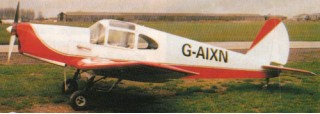
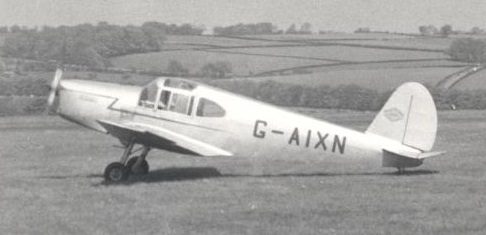
M1C Sokol G-AIXN at Leeds (Yeadon) in 1954, and was still airworthy in 2019
In 1948 the M.1C was further developed as the M.1D with an enlarged single-piece canopy and a revised rudder. The M.1D first flew on 4 October 1948 and 104 were built. One M.1D was fitted with locally produced floats and re-designated the M.1E, it first flew in September 1949. A minor variant was the Para-Sokol which was fitted with rearward sliding canopy to allow parachutists to leave the aircraft.
Some were operated by the Czechoslovakian National Security Guard and Egyptian Air Force.
Around 284 aircraft were built but the wooden-glued airframes were condemned in the early 1960s and withdrawn from use, under 20 were still in existence in the 2010s but only a few were flyable.
G-AIXN landing at its home base of Turweston Aerodrome in the United Kingdom in 2017
Some are on display at Museums in the Czech Republic, Hungary, Beijing, China, and Datangshan, China.
M-1A Original two-seat version Engine: Walter Minor
M-1B Similar to M-1A Engine: ZLAS Toma 1 built
M-1C Revised version, with longer fuselage and third seat, and swept leading edges on wing 183 built
M-1D Similar to M-1C with new, single-piece canopy and larger rear windows Engine: 1 × Walter Minor 4-III, 78 kW (105 hp) Wingspan: 10.0 m (32 ft 10 in) Length: 7.35 m (24 ft 1 in) Wing area: 13.8 m2 (149 sq ft) Height: 2.20 m (7 ft 3 in) (tail up) Empty weight: 425 kg (937 lb) Gross weight: 780 kg (1,720 lb) Maximum speed: 240 km/h (150 mph, 130 kn) Cruise speed: 212 km/h (132 mph, 114 kn) Range: 1,000 km (620 mi, 540 nmi) Service ceiling: 4,800 m (15,700 ft) Rate of climb: 3.0 m/s (590 ft/min) Crew: 1 Capacity: 2 passengers 104 built
M-1E Similar to M-1D but equipped with pontoons at least 1 built
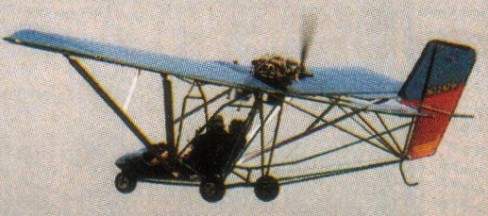
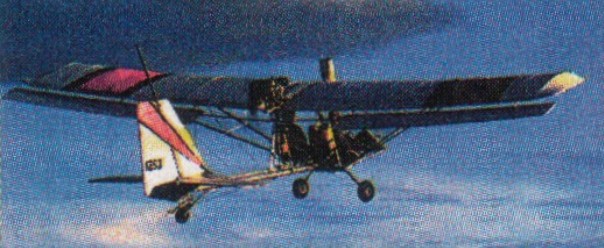
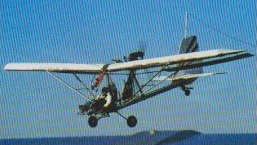
The main product from the LiteFlite stable is the Dragonfly. The Dragonfly is a three axis ultra light aircraft which takes off in a reasonably small area and lands in a reasonably small area. It has dual seating and dual controls.
Due to the slow flying speed, the Dragonfly is a favoured hang gliding towing aircraft and has been sold to 12 different countries. The Dragonfly provides a low cost form of aviation which can be flown almost anywhere and is really easy to learn.
The Dragonfly has been in production since 1990 and during this period, in excess of 100 aircraft have been manufactured.
The Dragonfly is constructed from 6061 grade aluminium tubing, is structurally supported by stainless steel wire and has fabric covered wings. It is powered by either a two stroke or four stroke engine. It has a range of options available depending upon your requirements and financial constraints.
Engine: Rotax 582, 65 hp Overall Length: 5.974 m / 19 ft 6 in Maximum Height: 2.316 m / 7 ft 6 in Wing Span: 10.363 m / 34 ft Wing Area: 15.8 sq.m / 170 sq.ft MTOW: 385 kg Gross Weight: 800 lb Empty Weight: 150 kg / 330 lb Fuel cap: 6 USG / 20 lt VNE: 57 knots / 100 kph VC at 5200rpm: 40 knots / 60 kph Stall: 14-17 kt Normal Landing Approach Speed: 26 kt ROC: 1400 fpm /16 m/s Take-off dist: 50 ft Take-Off Distance (To 50ft): 195 feet Landing dist: 100 ft Landing Distance (From 50ft): 363 feet Range: 100 sm Fuel consumption: 16 lt/hr Service ceiling: 16,000 ft Seats: 2 Kit price (1998): US$15,700 Landing gear: tail wheel
The Moy Aerial Steamer was an experimental 15-foot span tandem-wing monoplane, powered by a 3 hp steam engine driving two, 6-foot diameter pusher- propelling paddle wheels. Built by Englishman Thomas Moy, the unmanned flying machine was tested in the Spring of 1875, tethered to a pole, running on a circular track, at the gardens of the Hotel DeLuxe in south London. Spuriously reported to have left the ground and “flown” at a height of six inches, the Aerial Steamer may sometimes be claimed to be the first unmanned airplane to fly from level ground.
In October of 1910 at the Boufarik Racecourse, Algeria, Leon Mouraret flew his biplane for a distance of 200 meters on his first attempt. On his second attempted at flight the aircraft crashed and was damaged. Boufarik’s flying machine was distinguished by its unusual arrowhead-like tail and by the very high setting of the pilot and frame above the ground. The biplane was powered by a French 60 hp Mutel engine. Mouraret’s biplane was called a “Hydro-aeroplane” and could be fitted with two long floats.