Nagler NH 160

This version incorporates the lessons learnt from the NH 120, and while the general principle remains the same, i.e. the main rotor in the same alignment as the anti-torque rotor, their positions have been changed.

The two-bladed main rotor remains in its usual position, but the anti-torque rotor with three articulated blades is on the helicopter’s underside between the two skis acting as landing gear, and 1.83m away from the main rotor. The latter has cyclic and collective control and is mounted on an oscillating hub. In horizontal flight it turns at 400 r.p.m. and the lower rotor at 1.500 rpm, the latter consuming 55hp, the former 15hp of the engine’s total power.

Nagler has designed an unusual steering system: two disc brakes of the kind used in motor vehicles, one acting on the main rotor, the other on the shaft of the engine to which the anti-torque rotor is fixed. These brakes are pedal operated.

A fixed vertical surface at the end of the rudimentary fuselage ensures directional stability. The production model is planned to have an enclosed cockpit and fuselage.
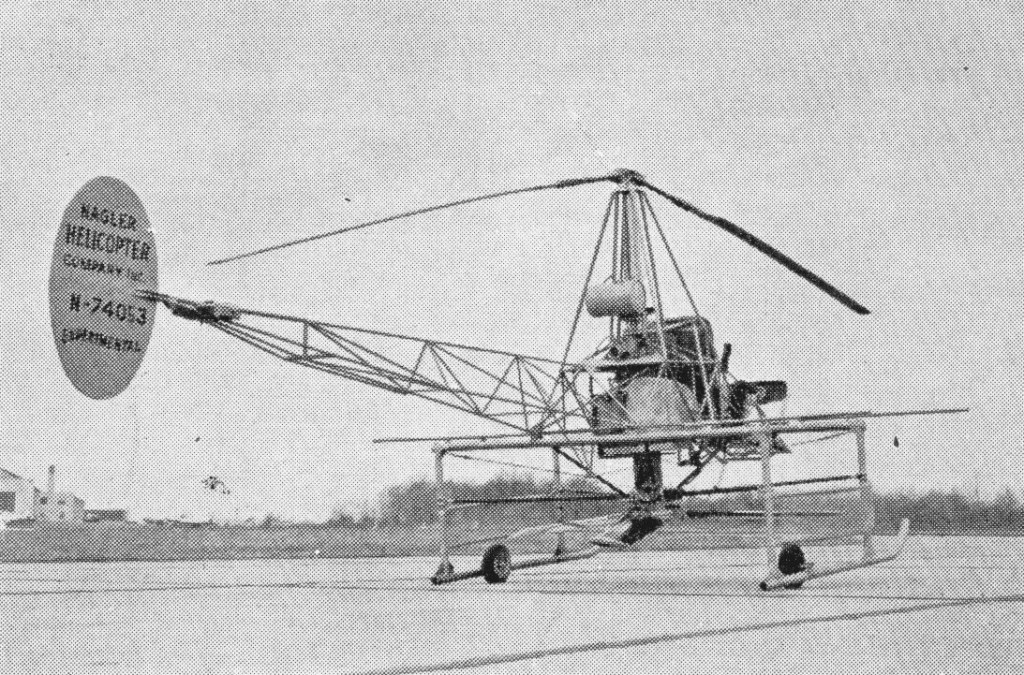
Nagler’s Model NH-160 single-seat helicopter first flew in 1955.

NH 160
Crew: 1
Engine: McCulloch 4 318, 70hp
Upper rotor diameter: 6.1m
Lower rotor diameter: 2.13m
Length: 3.66m
Weight empty: 190kg
Weight fully loaded: 399kg
Cruising speed: 192km/h
Nagler NH-120

This 1954 ultra-light single-seater has two rotors: one main rotor with collective and cyclic pitch control, the latter by a hanging stick, and one smaller anti-torque rotor. Nagler’s ingenuity in this design consists in placing the latter above the main rotor, which is thus surmounted by the driving engine directly above it and a two-bladed, much smaller diameter fixed-pitch rotor. This compact unit, two rotors with the engine between them, is supported by the helicopter frame made of tubes and containing the pilot’s seat with fuel tanks behind it. The 45hp engine originally planned for proved insufficiently powerful and has been replaced. The tricycle landing gear has three wheels held at the end of legs fitted with shock absorbers.
When folded this rotorcraft will go into a container measuring 0.77 by 2.13m.

NH 120
Engine: Nelson, 40hp
Upper rotor diameter: 2.13m
Lower rotor diameter: 6.1m
Length: 8 ft 2 in
Height: 2.74m
Weight empty: 127kg
Weight fully loaded: 340kg
Max speed: 80 mph
Cruising speed: 112km/h
Range: 210 mi
Endurance: 3h
Crew: 1

Nagler Convertocrapt 130

This 1954 convertiplane consisted of an Aeronca fuselage minus the wings and plus a two-bladed rotor powered by six solid fuel rockets placed three at the tip of each blade and each providing a 41-68kg thrust.

The airscrew used for forward flight was powered by a Continental reciprocating engine.
After the rocket power take-off, the Convertocraft flies forward with the rotor freewheeling.

Engine: Continental, and 6 rockets
Rotor diameter: 30 ft (9.14 m)
Weight fully loaded: 1,450 lb (658 kg)
Cruising speed: 80 m.p.h. (128 k.p.h.)
Number of seats: 2

Nagler XNH-I Heliglider / XNH-2 Heligyro

This, the first rotorcraft (1952) which Nagler designed after his arrival in the United States, was of the ‘strap-on’ variety. Its intended use was to cross rivers or other obstacles. The required height was to be reached by power from six solid-propellant rockets, fired in pairs and providing a 9kg thrust for about twenty seconds. Slow descent was ensured by the auto-rotation of the rotor. The six rockets could be replaced for later use.
The wearer’s legs were to be the landing gear.

With the addition of a 2 cylinder opposed engine driving a pusher prop also in 1952, the XNH-1 was re-designated XNH-2 Heligyro.

XNH-I Heliglider
Engine: 6 x 9 kg rockets
Weight empty: 29.5kg / 67 b
Crew: 1

XNH-2 Heligyro
Max speed: 60 mph
Crew: 1

NA Design NA-40 Bongo

Design work of the (formerly Unis, Obchodni Spol, Sro) Bongo began in 1992 followed by model tests in 1993 with construction of a technology demonstrator started in 1996.

A public debut was at Ârno International Machinery Fair 1997 (then called TINTS NA40 and with two-blade main rotor) by the first prototype, OK-CIU. The prototype began 70 hours of tethered hover flights in March 1998, and two further prototypes were completed by mid-1998.

NA Design planed Normal category certification to FAR Pts 27, 33, 34 and 36 by late 2003, subject to finding joint venture Western partner to share certification, manufacturing and marketing costs. In 2002 financial support of US$2.5 million was still being solicited. The project was put on hold in late 2002 while finance was sought but, despite this, a new version, the four-seat NA50, was announced in late 2002.

Nothing further had been heard by early 2003.

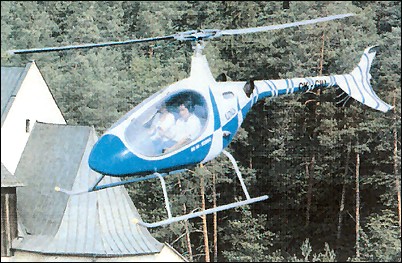
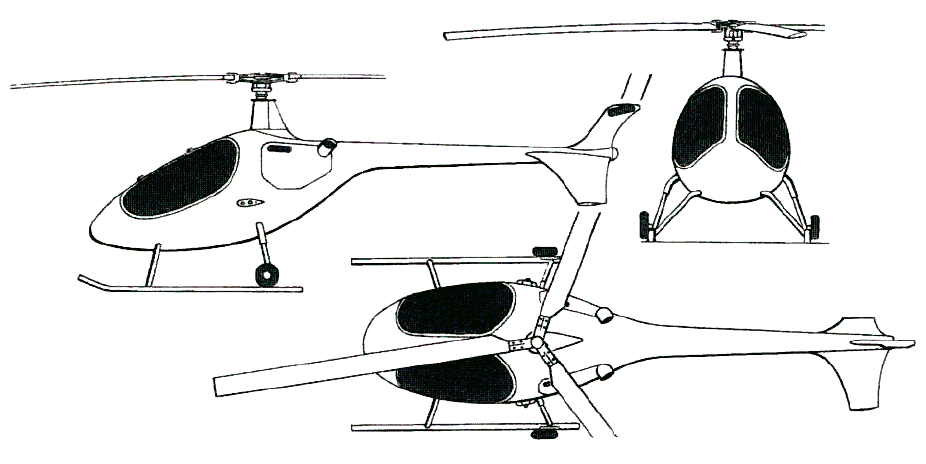
The NA Design NA 40 Bongo two-seat ultralight helicopter features a three-blade teetering rotor and pod and boom fuselage with an inverted Y-tail unit. A Cocomo patented anti-torque system eliminates the need for a tail rotor, reducing transmission complexity and operating noise level.

Flying controls were conventional cyclic and collective, with a ducted air anti-torque system. The structure is mainly composites, including the rotor blades. Some aluminium is in the fuselage, otherwise it is a double-curvature monocoque sandwich, with a laminated, vacuum-formed elastomeric rotor head. The landing gear is a tubular twin-skid gear with ground handling wheels. Inflatable permanent or emergency floats are optional.

Power is from two 86kW Prvni Brnenska Strojina PBS Velka Bites ÒÅ 50Â turboshafts, with FADEC and dual ignition. The engines are mounted side by side behind the cockpit with transmission via a combining gearbox. A single self-sealing fuel tank is beneath the engines, with a capacity of 210 litres.

A baggage space is aft of the two seats and gull-wing window/doors are on each side, hinged on the centreline and opening upward. A dual 27V DC electrical systems and external power receptacle are provided.

NA40 Bongo
Rotor diameter: 7.48m
Fuselage length: 6.15m
Height to top of rotor head: 2.35m
Empty weight, equipped: 480kg
Max load on external sling: 250kg
Max take-off weight: 950kg
Never-exceed speed: 280km/h
Max cruising speed: 250km/h
Econ cruising speed: 230km/h
Hovering ceiling IGE: 4,000m
Max range: 500km

MXR Technologies MX2

The MX2 is a purpose-built Unlimited Aerobatic aircraft developed from the highly-successful Giles G202/CAP222 aircraft. Built by MXR Technologies Inc. in Florida, it has an all carbon fibre monocoque airframe. During displays it burns two litres of avgas per minute and three litres per minute of smoke oil. The loading ranges from +8.5g to -6.5g during a display, in what is a state-of-the-art machine in the world of aerobatic aircraft.
 

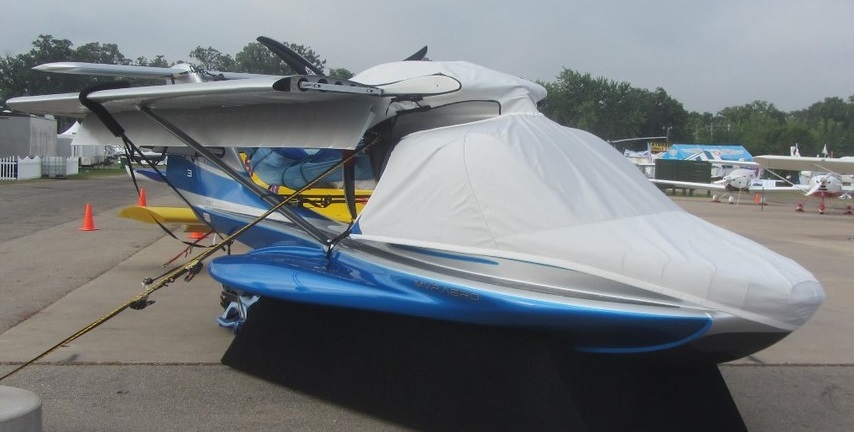
MVP.Aero Model 3

Designed by Mike Van Staagen, the MVP Model 3 is a prototype American “triphibian” light-sport aircraft, displayed in mockup form in 2014. The aircraft is under development by MVP.Aero Inc. of Delaware.

The MVP Model 3 is designed to operate on land, water, snow and ice. The floor panels can be rearranged to accommodate fishing or camping. The design will be marketed in several versions, including the E-AB, E-LSA, and S-LSA. The aircraft is a two-seats in side-by-side configuration with a pusher propeller and folding wings, which are constructed with carbon-fiber composite spars and covered with fabric. The balance of the airframe is constructed from a combination of carbon fiber and fiberglass. Electric thrusters help the aircraft manoeuvre in the water.

The design allows the canopy to be raised on a four bar system to sit above the engine cowling. This leaves the cockpit area open for fishing from and can also allow mounting of a tent for camping, with the floor panels inserted. With the canopy fully open the engine can still be run for water maneuvering.

The unit cost was US $169,000 as an Experimental and $189,000 as S-LSA.

Variants:
Model 3 E-AB
Model 3 E-LSA
Model 3 S-LSA

MVP Model 3
Engine: 1 × Rotax 914, 115 hp (86 kW)
Wingspan: 36 ft 0 in (10.97 m)
Length: 23 ft 9 in (7.24 m)
Length wings folded: 8.1 m (26 ft 7 in)
Width: 8 ft 0 in (2.44 m) wings folded
Fuel capacity: 26 US gal (22 imp gal; 98 l)
Cruise speed: 104 kn (120 mph, 193 km/h) at sea level
Stall speed: 41 kn (47 mph, 76 km/h) with full flaps
Rate of climb: 1,000 ft/min (5.1 m/s) at sea level
Wing loading: 11 lb/sq ft (54 kg/sq.m)
Crew: one
Capacity: one passenger