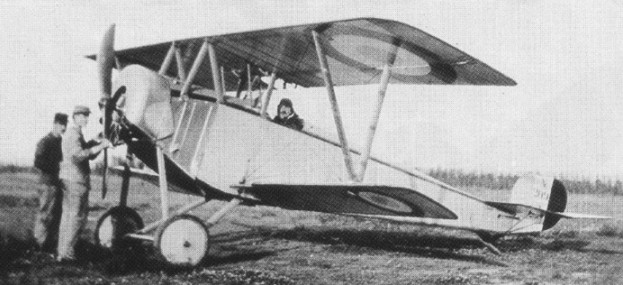
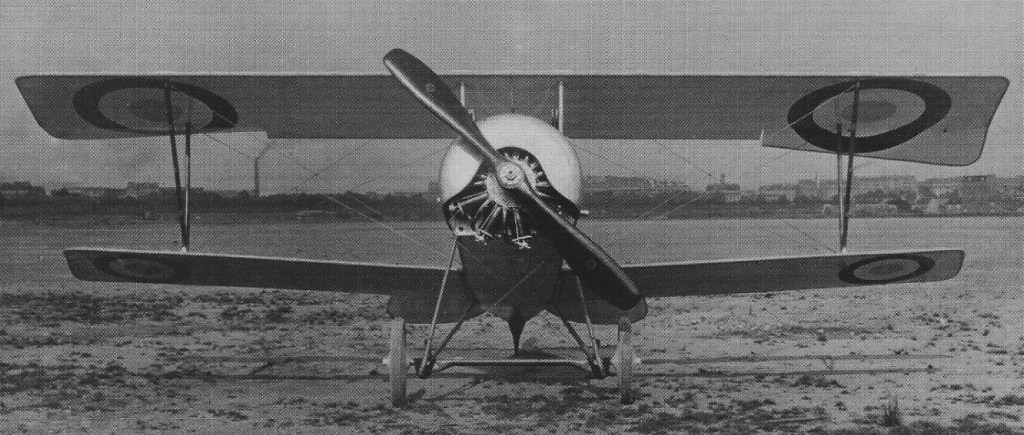
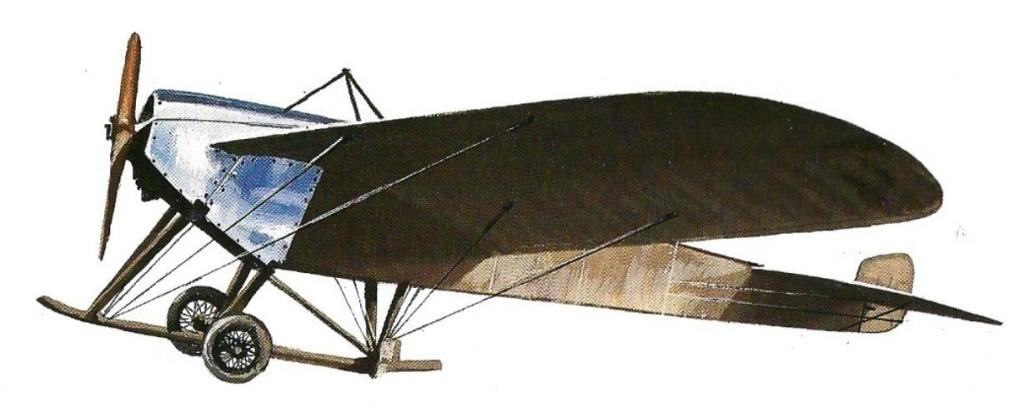
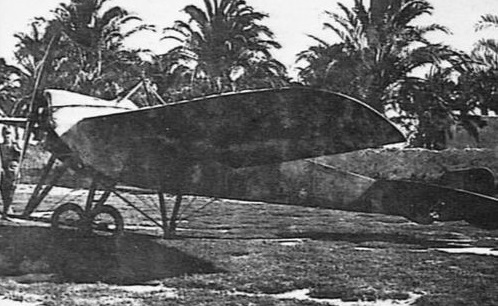
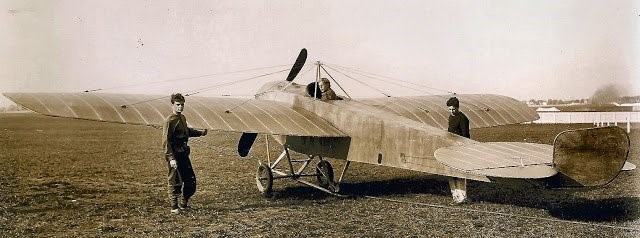
Originally designed for the 1914 Gordon Bennet Cup Contest and reshaped to become the Type 11. A successful fighter of 1916-17, the Nie. 11 (also known as the Nieuport Type 13, based on the wing area in square metres) was a sesquiplane with a half size lower wing. The upper wing with sweepback. Initially the lower wing would warp and sometimes break off in a high speed dive.
The fuselage was rectangular with bulkheads secured by four longerons and diagonally braced with wire. The top of the bulkheads were in the same plane but tapered together toward the rear of the fuselage becoming narrower and shorter. The top of the fuselage was faired into a turtledeck with light formers, longitudinal stringers and covered with plywood, and fitted with a headrest.
Steel tube was used in the cockpit and engine compartment and as needed for wing spar, strut and landing gear mounts. The wood longerons were sometimes made of ash, changing to spruce behind the cockpit. Spruce was also used in the vertical struts and cross members.
The engine bearer/forward bulkhead was heavy-gauge steel plate. There was no front support for the engine. The aluminium engine cowl had strengthening ribs, and sometimes enclosed the entire engine, sometimes had a gap at the bottom. There were two holes at the bottom right for exhaust and ventilation.
Early aircraft were powered by an 80 hp Le Rhone and had a Lewis machine gun mounted atop the wing. Later XIs were powered by 130 hp Clerget and had a synchronised Vickers machine gun firing through the prop arc.
Charles Godfrey’s Nieuport 11
Aluminium fairings merged the circular cowling into the flat-sided fuselage. Behind the cockpit the fuselage was fabric covered with plywood panels reinforcing the structure at the rear. In the front cockpit the fabric was attached with hooks and cord for easy access.
The top wing, rear spar was set directly above the lower wings single spar to optimise the load and eliminate the need for inter-strut drag wires. The bottom wings incidence could be adjusted on the ground for different payloads. The wings ribs had ash flanges and limewood webbing. Spruce strips were on the leading and trailing edges of the wings and trailing edges of the ailerons. Push-pull rods moved the ailerons. The tail was made from steel tube and fabric covered. The elevators and rudder used cables for control. A flat, curved spring steel on a reinforced mount served as a tail skid.
The undercarriage was a pair of streamlined drawn-aluminium tubing cross members in a V. An axle with rubber cord shock absorbers on each end spanned the spoked aluminium wheels, covered with aluminium plate. They were armed with a single Hotchkiss or Lewis machine gun mounted over the top wing. Reloading was by a Foster mount curved rail that allowed the gun to be slid back and down. There were also a number of stops so the gun could be fired upwards. It could also carry eight Le Pruir rockets on the wing struts for attacking balloons.
First introduced in July 1915, the Nie. 11 gained superiority over the Fokker E.III during the Battle of Verdun, ending the “Fokker Scourge”.
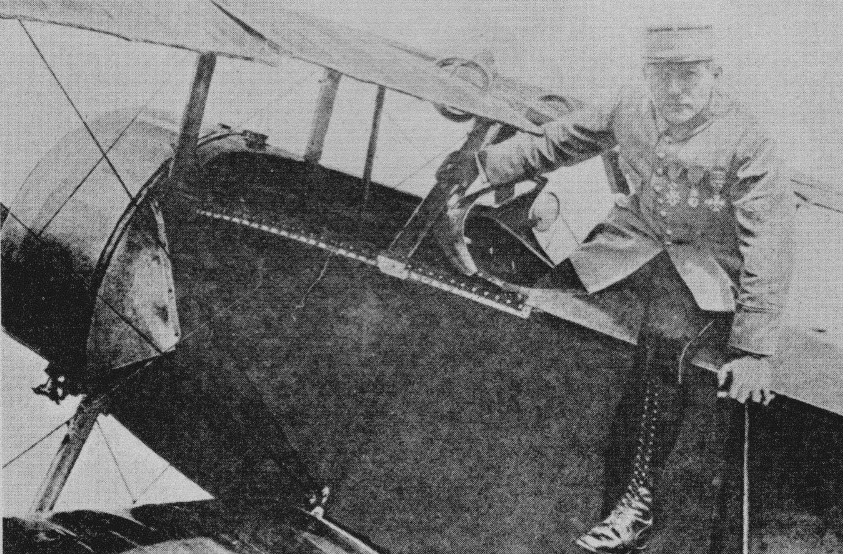
French ace Nungesser and Nieuport 11
They were used by many forces during WW 1, including France, the United States, England, Italy, Belgium, and Russia. At least one captured Nieuport 11 was operated in German markings.
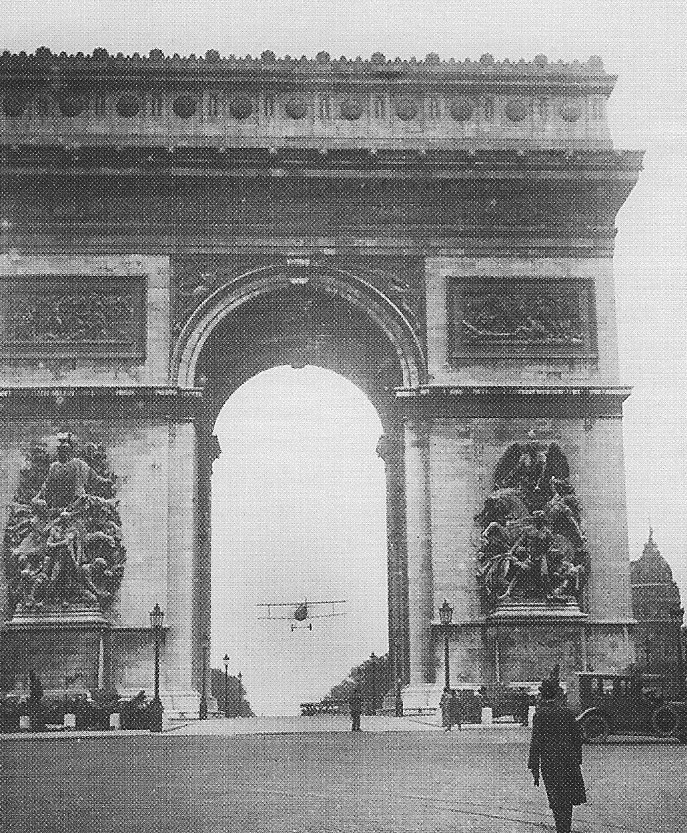
Charles Godfrey passing under the Arc de Triumphe
It was produced in England by Nieuport & General Aircraft Co Ltd, in Italy by Nieuport-Macchi as well as the parent company and many sub-contractors in France.
Ultralight replica: Circa Reproductions Nieuport 11 Airdrome Airplanes Nieuport 11
Replica: Pfeifer Nieuport 11
Nieuport 11 Bebe Engine: Gnome, 80 hp Wingspan: 24 ft 6 in Length: 19 ft 3 in Empty weight: 759 lb Top speed: 97 mph Landing speed: 30 mph Take-off dist: 100 ft
In Januaray 1914 Gustave Delage started as a new engineer and designed a sesquiplane with two wings a V-struts. This Nieuport 10B (B for biplane) was to be a two-seat observation/fighter with an observer in the front (as a Nie.10 AV (Avant, in front) or, behind the pilot as the Nie. 10 AR (Arriere, behind).
The single seat fighter appeared as the Nie. 10c1 and it is believed many of the two seat models were converted into the Nie. 10c1.
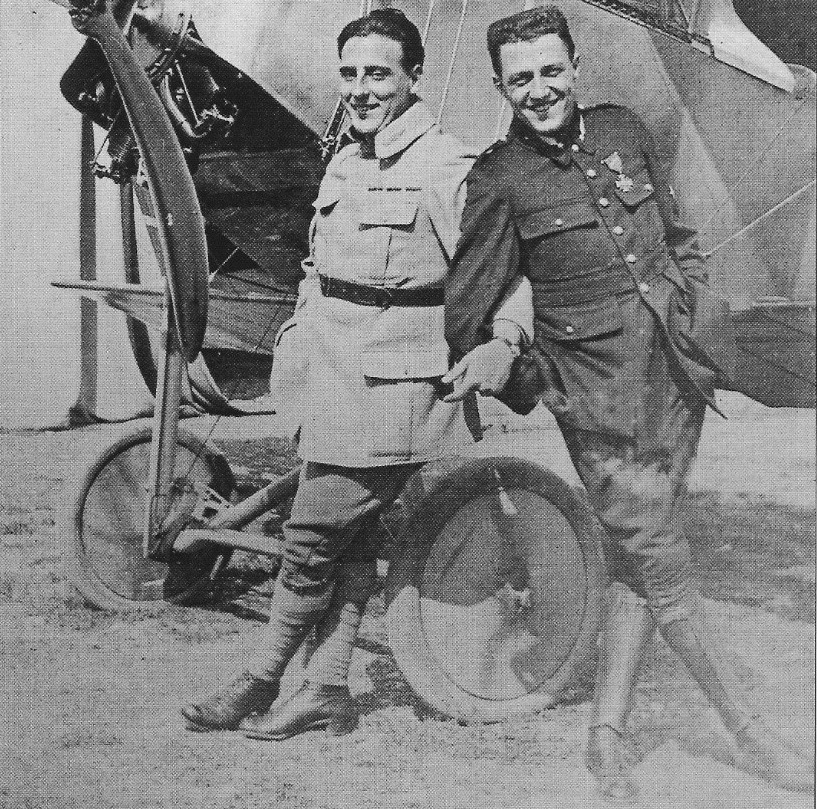
Jean Navarre and friend Sagaret with a Nieuport X
Nieuport 10/83 Engine: Clerget rotary, 130hp.
Nie.10c1 Engine: Gnome, 80 hp or Le Rhone 9C, 80 hp Wingspan: 24 ft 9 in Length: 19 ft 1/3 in Height: 8 ft 0.5 in Top speed SL: 97 mph ROC: 550 fpm Gross weight: 1060 lb Ceiling: 15,090 ft Endurance: 2 hr 30 min
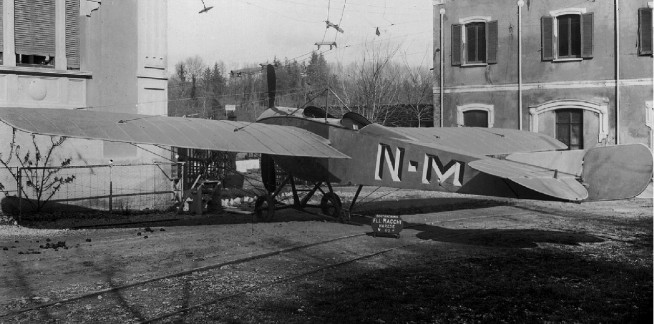
Nieuport VI, the first aircraft built by the new Limited Company F.lli Macchi from Varese in 1913
The Nieuport 6M was a 1914 Reconnaissance aircraft.
6M
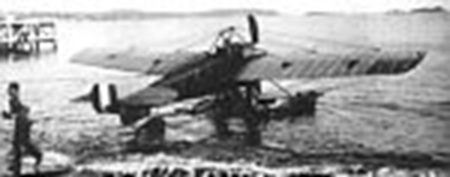
1913 Nieuport VI Tandem sea-monoplane
Nieuport 6M Engine: Gnome, 80 hp Wingspan: 36 ft / 10.97 m Length: 26 ft / 7.92 m Height: 8 ft 6 in / 2.59 m Weight: 1080 lb / 490 kg Max speed: 70 mph / 112 kph Endurance: 3 hr Seats: 1
1913 Nieuport VI Tandem sea-monoplane Length: 22’4″ Wing area: 14.8 sq.yard
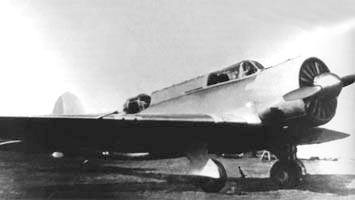
The idea of converting the Nieman R-10 into an attack aircraft led to the development by the Nieman collective of a new model airplane with the M-62 powerplant. The attack aircraft development process was divided into two stages. First, an experimental specimen called JAI-51 was developed in which the new systems and construction elements would be developed and tested. This copy was also to be used to polish all flight problems. The second stage would be called the Nieman JAI-52 (Russian: Неман ХАИ-52) and would be the final product, intended to serve as the basis for series production as a follow-up to the Nieman R-10.
Nieman assigned his best specialists to the attack aircraft project. The project was led by main builder LD Arson until his departure to prepare for production of the Nieman R-10 at the Saratov factory in January 1938, and he was succeeded by IP Zhiganov. At the beginning of 1937, of the 60 specialists in construction and calculations of the OKO-137, 37 were working on the new project and by November of that year practically all of them had joined.
Still without finishing the project, in August 1937, the construction of three copies began in the TsOM workshops, one JAI-51 and two JAI-52. The last plans for the JAI-51 were delivered to the factory in December 1937. The second example of the JAI-52 (known as JAI-521) was built with a new pine plywood, instead of birch.
The delivery of the JAI-52 to the tests could have allowed Nieman victory, but in December 1938 he was arrested.
The new general builder of the OKO-135, AA Dubrovin, did his best to continue modernization work on the Nieman R-10, with an emphasis on the JAI-52. Not having time to prepare the plans for the JAI-52, it was decided to build it using the plans for the JAI-51 with the direct introduction of the modifications.
At this time, on March 20, 1938, the VVS released new technical specifications for the JAI-52 in which a new top speed of 450 – 470 km/h was set instead of the original 390 – 400 km/h. This required significant modifications to the project, which resulted in new delays in the delivery of the model to the tests.
The JAI-52 attack aircraft were designed to use the 930 hp M-63 engine with a BISh-28 propeller. Maintaining the structure of the JAI-51, a duplicate flight control system was installed in the gunner’s cabin and the armament was reinforced. In addition to the four ShKAS machine guns on the wings, two new synchronized ShKAS were installed. Under the wings were installed mounts Der-31.
In this configuration and without having passed the tests yet, in January 1939 by decision of the NKAP, series production of the model was launched at Factory No.135. The Kharkov factory “Hammer and Sickle” also participated in the production of the first series of 10 copies, where wooden parts and components were prepared. The delivery of the first series copies was planned between August and September 1939. Preparation of the JAI-52 prototype was completed on March 15, 1939 (the commitment date had been December 1938). The M-63 engine was still not ready, so an M-62 with a BISh-26 propeller was installed.
On April 6, 1939 at 8:30 am, the factory test pilot, Colonel Darski, raised the JAI-52 on its first flight, which lasted 30 minutes. The behavior of the aircraft in the air was excellent, which allowed it to carry out a second, longer flight in the second part of the day. Engineer Semionov, the NKAP representative at the tests wrote: “Despite a large number of construction defects, this M-63-powered aircraft is truly modern and if a turbocharger is installed, the VVS will be able to have in service by 1940 a machine superior to that of our potential enemies.”
In spite of this, the direction of the Commissariat received an unexpected letter at the end of April where it was established to take the plane of the Nieman saboteur out of production and to begin production of the Sukhoi BB-1 model, which on April 6, 1939 had successfully completed the state tests. The M-87 engine fitted to the Sukhoi BB-1 did not fail the builders and the aircraft performed better than the JAI-52.
AA Dubrovin refused to continue the development of the JAI-52 and went to Moscow. The continuation of work on the JHA-52 was carried out by IP Zhiganov. The OKO-135 collective still had hopes of saving the JAI-52 and proving that it was superior to Sukhoi’s aircraft.
In May 1939, the JAI-52, during factory tests and with a weight of 3,220 kg, showed a maximum speed at sea level of 374 km/h and at 4,500 meters of 410 km/h. Ascent time to 5,000 meters was 16 minutes. These results allowed the model to be accepted for state tests, so the plane was prepared for its trip to Moscow.
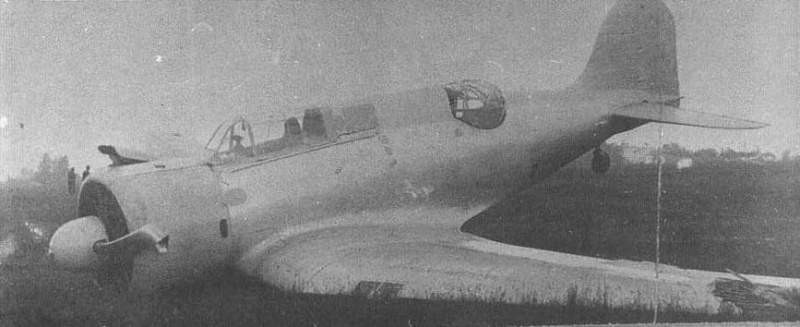
On May 18, the JAI-52, flown by Major Indyushkin, during a familiarization flight with the plane, lost speed at a very low altitude, dived over the wing and fell to the ground. The damaged plane was returned to the TsOM where, together with the repairs, they introduced new modifications. First of all, a freshly received M-63 engine from the Perm factory and a BISh-28 propeller were installed, which resulted in the redesign of a new cowl and propeller hub. To improve stability, the wingspan and wing area were increased.
In these modifications, two months of precious time were gone. Only on August 5, 1939, joint factory and state tests of the JAI-52 attack aircraft began. These tests were executed by the NII VVS test pilot AK Dolgov.
As a result, it was found that the new model was superior to the Nieman R-10 in terms of stability and had better visibility from the cockpit. As a negative point, the displacement of the center of weight forwards was highlighted. Airborne tests showed that not all of the problems had been fixed. With a takeoff weight of 3,376 kg, a speed at ground level of 356 km/h and at 4,500 meters of 410 km/h was reached.
The M-63 engine presented problems so that only 5 test flights could be carried out. The tests were interrupted and with this the history of the developments of the Nieman R-10 ended.
JHA-52 Powerplant: 1 x 930 hp M-63 Propeller: BISh-28 Wingspan: 9.60 m Wing area: 25.60 m² Length: 12,208 m Height: 3.80m Takeoff weight: 3376 kg Maximum speed sea level: 356 km/h Maximum speed 4500m: 470 km/h Armament: six 7.62 mm ShKAS machine guns with 500 shots each (4 in the wings and another two synchronous in the fuselage). A 600 round ShKAS 7.62mm machine gun in an MV-5 turret. 400 kg of bombs.
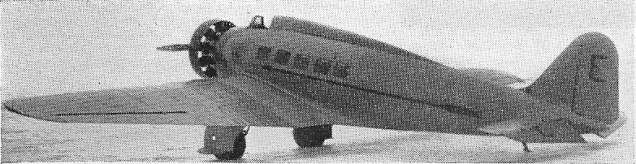
The KhAI-1 six passenger, one crew, airliner of 1933 was of all wood construction and designed by Newman at the Khar’kov Aviation Institute. It is credited with being the first Soviet aeroplane to have a fully retractable undercarriage.
Registrations included L-1351 and L-1367.
Engine: 480 hp M-22 Max speed: 190 mph AUW: 5732 lb Span: 40 ft approx.
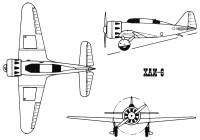
In parallel with the request for the development of a single-engine, scout aircraft, the collective led by Yosif Nieman received a request to develop a prototype aircraft: a high speed unarmed photographic reconnaissance aircraft and, named Nieman SFR (JAI-6) (Russian: Неман СФР (ХАИ-6) ) under the NIS JAI Projects Group. The main defense of this new type of aircraft would be its high speed. Officially the VVS designated the SFR model which corresponds to the acronym of Fast Photographic Reconnaissance Aircraft (in Russian: С коростной Ф отоР азведчик – СФР).
Delivery of the JAI-6 for testing was scheduled for September 1, 1934.
The concept project of the JAI-6 high-speed two-seat reconnaissance aircraft, with an air-cooled engine -58 (M-22U), was developed by the builder brigade S. Ya. Zholkovsky at the end of 1933. The general structure was similar to that of the JAI-1.
In January 1934 the project was handed over to the NII VVS for analysis, but it was quickly returned as the calculation data was considered extremely low and the M-58 engine was not available for production. On recommendations from SV Ilyushin, the project was modified to accommodate a 712 hp Wright Cyclone SGR-1820 F3 engine.
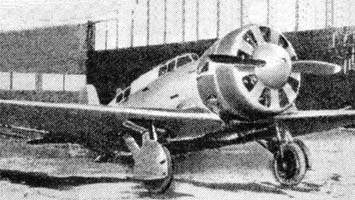
The JAI-6 was designed as an all-wood cantilever low-wing monoplane with an aerodynamically clean fuselage. The retractable type landing gear, manually retractable.
All rudders featured duralumin structure. The wings and stabilizer were made of plywood-clad wood, the aerodynamic brakes of aluminium.
Many elements in the plane were used by the builders for the first time. In order to obtain the highest possible speed, wing mechanization was increased, adding flaps, in addition to the ailerons. The wing was planned as an integral unit (consoles and centerplane in one whole). A curious feature was the use of wooden fuel tanks. During the Great Patriotic War this experience would be applied to the Yakovlev and Lavochkin fighter models with the aim of saving metal.
In the course of the development process of the JAI-6, the retractable landing gear had major problems. The retraction of the gear was done manually and the process was generally similar to that of the JAI-1, but in this case the construction of the gear was very complex. The development of this landing gear was the diploma work of 5th year JHA students PG Shishov and ID Kravchenko.
A methodology for calculating this type of complex landing gear had not yet been developed. All the calculations that were made did not show the necessary resistance and during the static tests in the JHA laboratory the undercarriage was destroyed because it could not support the fixing point. Nieman, after reviewing what happened, proposed a distribution of fixation points that should lead to a decrease in elastic deformation. Finally the wheels passed the physical resistance test, but no way was found to demonstrate the design mathematically. In the project submitted to the state commission these calculations were not included.
In the JAI-6 a photographic turret was located in the central region of the fuselage, behind the observer’s cabin. Hatches for the AFA-13 camera were located on the floor and on the sides. Through these hatches, photographs were taken at an angle of up to 80º and distances of up to 40 – 50 km to the sides. For the first time, a remote control system was also developed to rotate the camera and open the gates.
The military received the project with the new power plant in February 1934 and by May they approved a life-size wooden model, presented by the JAI. The calculations gave a speed of 450 km/h at 4,000 meters and 435 km/h at 2,000 m. The climb time to 5,000 meters was calculated at 8 minutes, the ceiling at 10,000 meters, and the range at 1,000 km. Those data were impressive for the time. The use of TsAP type aerodynamic brakes was foreseen in the wing.
Complications in development delayed the delivery date. The date was first moved from September 1 to November 1, 1934 and then to March 1, 1935, but for this date they were not yet ready.
In January 1935, the aircraft was delivered to production at the newly created TsOM JAI building (JAI Central Experimental Workshops, directed by Galietko. With the hope of being able to develop the static and resistance tests, the production of three copies was ordered in parallel. At the beginning of June 1935 the first prototype was ready and it was sent to the airfield of the Kharkiv Aviation Factory in Sokolniki for testing.
Everything was ready for the first flight when the aircraft mechanic SV Kieglievich received the information that the Wright Cyclone engine needed high octane gasoline. The JAI did not have it so they had to look for it in a military aviation unit. On June 15, test pilot BN Kudrin and designated test engineer Ye. I. Baru made the first flight.
The JAI-6 successfully passed the factory tests, reaching a speed of 429 km/h at an altitude of 2,500 meters, which can be considered a world record for this type of aircraft, although it was never registered.
Everything seemed to be going smoothly, but soon the problems began. The idea of an unarmed fast aircraft had its detractors within the VVS. During Nieman ‘s trip to the United States as part of a state commission, the VVS instruction was received to set up a defensive point in the observer’s cabin. From the NII VVS was sent, to the JAI, “Top Secret” blueprint of a new basket-shaped machine gun installation protruding from the fuselage. Builders were allowed to review plans only in a special department and under the supervision of security personnel. The calculations showed that the central fuselage of the JAI-6 was so narrow that it did not admit a normal machine gun installation, much less that enormous basket.
Soon the builders were informed of the early visit to the institute of the chief of armaments of the Red Army, Marshal MM Tukhachevki, with the aim of defining the fate of the JAI-6. On the morning of the day after the notification, Tukhachevsky arrived at the TsOM accompanied by the aircraft manufacturer AI Putilov, requesting to be shown the plane, the plans, the weapon installation model and the problems for its construction.
Next to the plane the marshal found the director of the JHA PP Krasilnikov, the chief builder LD Arson, the chief test engineer Ye. I. Baru and the head of the weapons brigade I. Dyachenko. About the installation of weapons on the JAI-6 personally stated the head of the project S. Ya. Zholkovsky. Putting a plywood sheet on the ground, Tukhachevsky took off his greatcoat and lay down under the aircraft. There he evaluated the different models and installation variants, reaching the conclusion that it was impossible to carry out any installation without affecting the speed advantages of the aircraft. Tukhachevsky got up, confirmed the builders’ proposals, congratulated them on his work, and left.
The change in military requirements crucified the future of the JAI-6. A few months after Tukhachevsky ‘s visit, the institute was visited by the head of the GUAP aviation department, SV Ilyushin, and reported that the VVS leadership refused to obtain an unarmed scout plane and that the purpose of his visit was to be able to confirm this decision.
At the beginning of November 1935, the JAI-6 prototype was delivered to the NII VVS, where tests were carried out, including the use of a ski undercariage. The test program was led by PM Stefanovski. With this, the issue of the JAI-6 was closed and its builders began to dedicate themselves entirely to the development of the JAI-5.
JHA-6 Engine: 1 x 712 hp Wright Cyclone SGR-1820 F3 Wingspan: 9.20 Wing area: 14.00 m² Length: 7.3m Empty weight: 1020 kg Maximum takeoff weight: 1730 kg Maximum speed: km/h 429 Practical range: km 980 Service ceiling: 9800 m Accommodation: 2
Nielsen & v. Lübcke G.m.b.H. in Altona-Elbe, near Hamburg, built at least six different monoplanes around 1910. The main business of the company appears to have been street lighting, but they also operated a flying school.