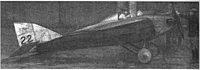
A 1922-23 moto-aviette (very light a/c) with “moteur auxiliaire” of conventional layout.
1 x nose-mounted 16 hp air-cooled upright inline 4-cyl Sergant A
The wings folded up on approach, Lympne trials 13 Oct 1923, Alexis Maneyrol killed
A 1922-23 moto-aviette (very light a/c) with “moteur auxiliaire” of conventional layout.
1 x nose-mounted 16 hp air-cooled upright inline 4-cyl Sergant A
The wings folded up on approach, Lympne trials 13 Oct 1923, Alexis Maneyrol killed
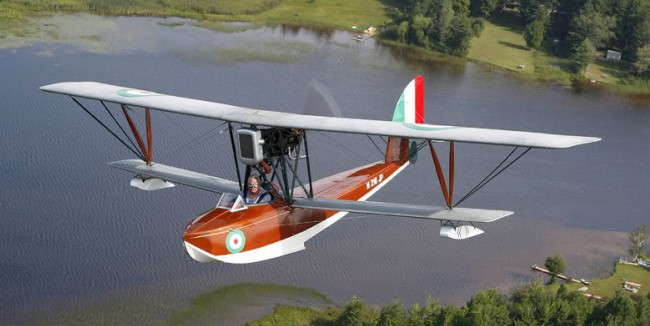
Jason Petroelje’s first project, an Emeraude RG, was a 1979 Oshkosh award winner and a feature in the May 1980 EAA Sport Aviation magazine. Other airplane projects included two World War I reproductions for a museum.
“I was building a SPAD replica for them, and they mentioned the Macchi,” Petroelje said. “I didn’t know anything about the type, but when I looked into it I decided I really liked it.”
Jason Petroelje built his beautiful Macchi M.5 flying boat using only his left hand – the one hand he had to use after a stroke 10 years earlier. “I built this thing after I had the stroke,” Petroelje said about his three-quarter scale Macchi M.5 flying boat. He added, “I built it with my left hand.” It didn’t stop him, however, worked about 5,000 hours, day and night, in the cramped workshop next to his home on Hazel Avenue, turning out everything from the wing struts to the tiniest of fittings.
Petroelje’s Macchi, a type used as a fighter by the Italian forces in World War I, has the appearance of a fine, classic watercraft with a natural Honduran mahogany skin and a solid Brazilian rosewood instrument panel. The woods are both adorned with a deep, high gloss marine finish.
The control stick has a hand-carved Madagascan ebony handle, and thrust comes from a hand-laminated, hand carved cherry-and-birch propeller.
His little flying boat is three-quarter scale for a good reason. The reason for building the airplane in 7/8 scale is unique to seaplanes. Hangers next to the water with easy access are very rare. Jason had a friend who used to have a Volmer Sportsman. He had sold the airplane, but the hanger remained. Jason had to scale down the airplane to fit in this existing hanger.
No original drawings of the Macchi existed, so Petroelje had to create his own designs from a set of dimensions and from photographs. “I just went more by the dimensions,” Petroelje said of the plans, which he secured years ago for $40 from “WWI Aero” magazine.
A variation drawn from experience was a decision to scale the tail to 80 percent instead of 75 percent. Petroelje said the 75-percent version was just too small.
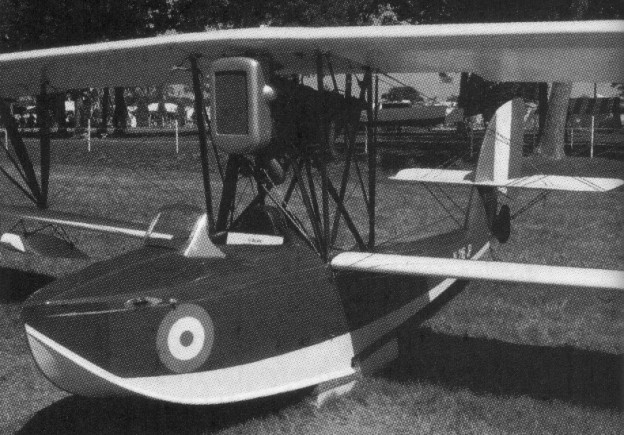
The hull of the seaplane varies from the original as well. Petroelje layered the bottom first with plywood, then foam, and finished it off with fiberglass. The modern bottom is more durable than the likely single-plywood layer of the original and should better tolerate the rigors of normal water operations. As for the mahogany finish, no color photos exist of the type, so that choice may well be artistic license on Petroelje’s part.
The wings of the plane fold back, a feature certainly not part of the original. But at three-quarter scale, the collapsed craft is only 8 feet wide, well within legal trailering limits. This has a more modern airfoil, a 4412 like on a Luscombe.
A modern air-cooled Lycoming powerplant provides the motive force. The radiator on Petroelje’s plane, necessary for the liquid-cooled powerplant on the original, is purely decorative.
The Macchi M.5 Italian fighter is mostly authentic, except for not sporting machine guns like those used during the plane’s heyday.
Registered as N216JP, to Jason Petroelje of Michigan, Eric Presten did the first three flights on the Macchi M-5.
The airplane performed well, but due to limited aileron travel, Presten was only able to do flights down the lake in ground effect on the first day. It has since been flown to altitude. It gets out of the water easily on only 125 hp. The missing outer struts are now installed. The landing gear shown is only a beaching gear, as the airplane is a true seaplane. Cruise speed for the craft is around 75 miles per hour.
The replica appeared at Oshkosh 2009.
Engine: Lycoming 125-horsepower
Fuselage length: 24 feet
Wing span: 31 feet
Weight: 940 pounds
Cruising speed: Up to 70 mph
Fuel capacity: 12 gallons
Hours to build: About 5,000
Size of workshop: 18 by 24 feet
In 1916, Major Stephan Petróczy von Petrócz of the Austro-Hungarian Army envisioned replacing hydrogen-filled observation balloons with tethered helicopters. These helicopters would have been used as static observation platforms. Compared to hydrogen balloons, the helicopters’ were much less likely to catch fire, presented a smaller target for the enemy, increased operational readiness, required fewer ground and support crew, and eliminated the need for hydrogen generating equipment.
To achieve his goal, Petróczy, along with Oberleutnant Dr. Theodor von Kármán and Ingenieurleutnant Wilhelm Žurovec, conceived the Schraubenfesselflieger (S.F.F) mit Elektromotor (captive helicopter with electric motor). This machine is now commonly referred to as the Petróczy-Kármán-Žurovec 1 (PKZ 1) helicopter. Built in 1917 and primarily designed by von Kármán and Žurovec, the PKZ 1 consisted of a rectangular frame with an observation basket in the middle. On each side of the basket were two lift rotors. All four rotors were powered by a single 190 hp (142 kW) Austro-Daimler electric motor.
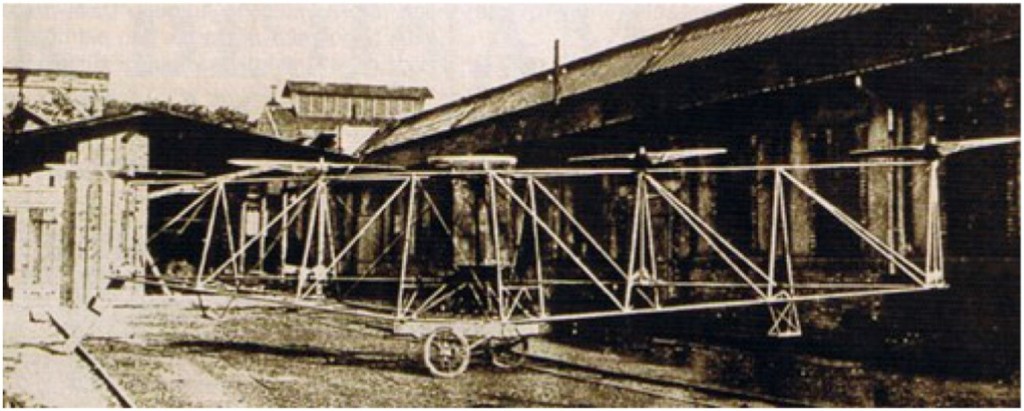
The PKZ 1 was flight tested and was able to lift three men to a tethered height of 20 in (50 cm). However, the electric motor generated 50 hp (37 kW) less than anticipated, and on the fourth flight, the straining motor gave out. Because of the scarcity of high-grade electrical copper and quality insulation, Daimler was not able to repair the motor. In addition, the PKZ 2, which was originally known as the S.F.F. mit Benzinmotor (captive helicopter with petrol engine), was nearing completion. No further work was done on the PKZ 1.
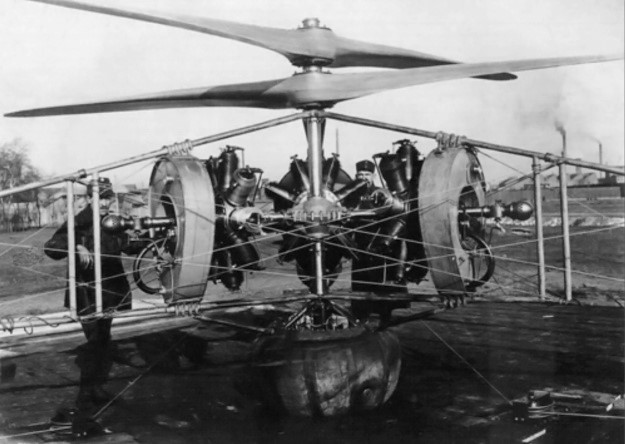
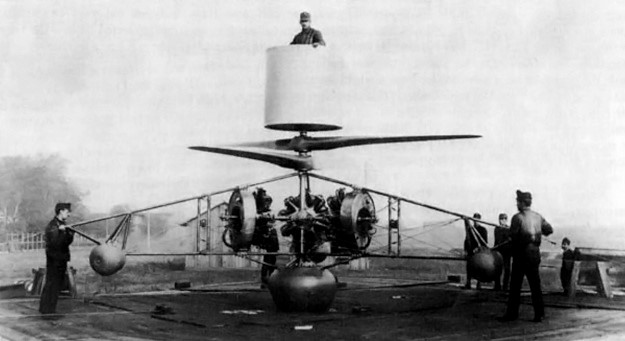
The PKZ 2 helicopter (for which he received German patent 347,578) was designed solely by Wilhelm Žurovec. The PKZ 2 was privately funded by the Hungarian Bank and the iron foundry / steel fabrication firm of Dr. Lipták & Co AG, who built the machine. The PKZ 2 utilized two two-blade contra-rotating rotors to cancel out torque and provide lift. The rotors, made of high-quality mahogany, were 19 ft 8 in (6.0 m) in diameter and were rotated at 600 rpm by three 100 hp (75 kW) Gnome rotary engines. A removable observation basket sat atop the rotors.

The craft had three outrigger legs; each supported one engine. All engines were connected to the rotors via a common gearbox. The PKZ 2 was supported by a central air cushion and three additional air cushions; one on each outrigger leg. These air cushions were filled by an air pump driven from the rotor drive. Attached to each outrigger was a tethering cable that was connected to the ground and controlled by an electric winch. With one hour of fuel, The PKZ 2 weighed 2,645 lb (1,200 kg).
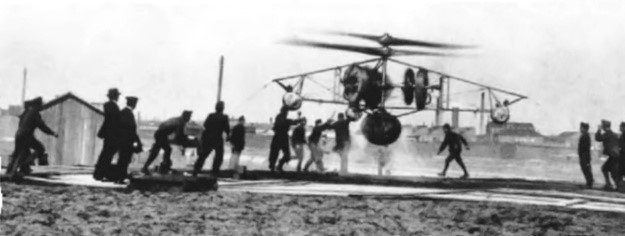
Tethered and unmanned, the PKZ 2 was test flown on 2 April 1918. After several flights, including one that lasted about an hour, tests were suspended on 5 April because of insufficient power from the Gnome engines. The engines were replaced by 120 hp (89 kW) La Rhône engine (that were captured and rebuilt) and, with a few additional modifications, tethered and unmanned flight tests resumed on May 17th. With the new engines and calm winds, an altitude of 165 ft (50 m) was achieved, and the PKZ 2 could lift 330–440 lb (150–200 kg). The craft would lose lift at higher altitudes, but the PKZ 2 was kept under control as long as tension remained on the tethering cables.

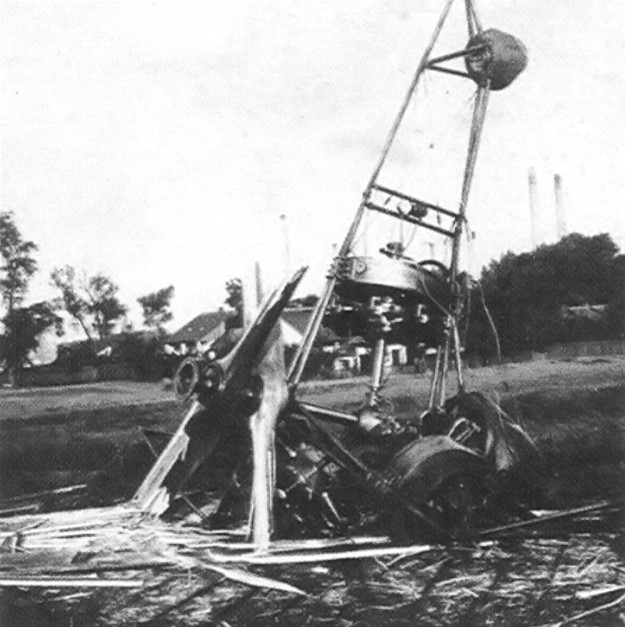
On 10 June 1918 the PKZ 2 was demonstrated for high ranking members of the military. A flight was made with the observation basket in place, but the engines were not running well and the craft became unstable. The basket was removed and another flight attempted. The wind had picked up, and as the PKZ 2 hovered at 40 ft (12 m) tethered to the ground, the craft began to rock. The overheating engines lost power, and the tether winch crew could no longer maintain control. The PKZ 2 crashed from a height of 6.5 ft (2.0 m), severely damaging the airframe and completely destroying the rotors.
Realizing the technical problems could not be overcome quickly, the government cancelled the project on 21 June 1918. However, Žurovec pressed on and began to design an individual cylinder water jacket to water-cool the rotary engines. The craft was being rebuilt to resume flight tests in November 1918 when the end of the war and revolution caused all development to cease. The PKZ 2 made over 15 tests flights, but it is doubtful any were manned.
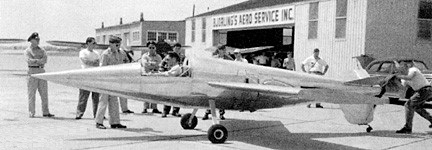
A 1948 single seat, all metal, pusher midget racer. Registered N5715N, and powered by a Continental C-85 85hp pusher, the aircraft was never competed.
The 180cu.ib racer was designed and built by George Petit and appeared at Detroit for Continental Trophy Races but never flew.
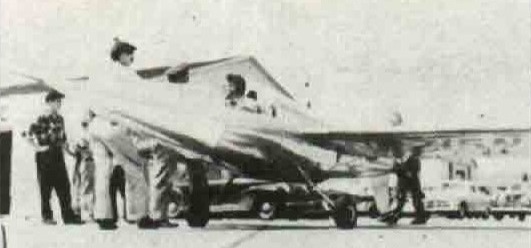
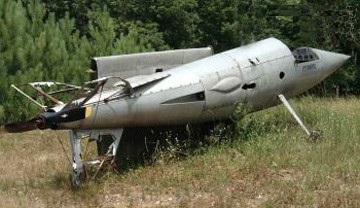
The Breezy is a high-wing monoplane with a standard tail. The Breezy takes 30 hp and has a tricycle type undercarriage. Sold as plans only.
Wingspan 30 ft
Wing area 150 sq.ft
Chord 5 ft
Aspect ratio 6:1
Length 15 ft
Empty weight 246 lbs
Pilot max weight 230 lbs
Cruise speed 38-40 mph
Stall speed 26 mph
Vmax 50 mph
Takeoff roll 175 ft
Climb rate 400 fpm
Lloyd H Peterson and Mark M Campbell
Los Angeles CA.
USA
In 1932 it was reported that Peterson & Campbell built a two-place, open cockpit, high-wing monoplane, powered by a 100hp Kinner K-5 engine.
Registered NX12273 c/n 1, Campbell had, on 2 January 1933, requested its Experimental license be cancelled as being “not fit to be flown.”
Owner Peterson later wrote CAA that he had no idea why the registration was cancelled. The two entered into a lawsuit, with the plane finally being sold 14 May 1935 to a R L McCreery with conditions that it would never again be sold, would never have a stress analysis or plans made, would never be licensed, and the wing and fuselage would be destroyed and junked.
McCleery notified CAA on 7 November 1935 that it had, indeed, been salvaged. He had ostensibly bought only an engine. CAA cancelled the registration on 7 November 1935.
It crashed on altitude record attempt and Peterson was killed.
In the early 1980s Todd Peterson, having built numerous Cessna 182-based Wren 460s, decided to certify a new aircraft to replace the Wren. The new improved machine is known as the 260SE/Stol and came on stream during 1988.
This model retains the high lift canard wing and is powered by the TCM IO-470F engine. Special attention has been given to reducing drag from the undercarriage, forward fuselage, cowl and engine baffles and the canard. The canard wing consists of a fixed horizontal stabiliser and a movable elevator, just like a conventional tailplane, but mounted on the side of the engine cowling just behind the propel¬ler. It is push rod actuated and works in conjunction with the normal tail elevator but in the opposite sense. As the rear elevator moves up to raise the aircraft nose, the canard elevator moves down. The end result is a marked handling improvement especially in the low speed range and short field performance.
Base price: US$80,000 (conversion only); US$200,000 (conversion and aircraft)
Engine: TCM IO-470-F, 260 hp@2700@SL
TBO: 1500 hr
Fuel type: 100LL
Propeller: McCauley CS
Landing gear type: Tri/Fixed
Max ramp weight: 2950 lb
Gross weight: 2950 lb
Landing weight: 2950 lb
Empty weight, std: 1800 lb
Useful load, std: 1150 lb
Payload, full std. fuel: 622 lb
Usable fuel, std: 88 USG
Oil capacity: 12 qts
Wingspan: 36 ft. 0 in
Overall length: 28 ft. 1.5 in
Height: 9 ft. 2 in
Wing area: 174 sq. ft
Wing loading: 16.9 lbs./sq. ft
Power loading: 10.6 lbs./hp
Wheel base: 9 ft. 1 in
Wheel track: 9 ft. 1 in
Wheel size: 6.00 x 6 in
Seating capacity: 4
Cabin doors: 2
Cabin width: 42 in
Cabin height: 48.5 in
Baggage capacity: 200 lb
Max level speed: 153 kt
Cruise speed 75% power @ 6,500 ft: 150 kt
Cruise speed 65% power @ 6,500 ft: 145 kt
Cruise speed 55% power @ 6,500 ft: 138 kt
Max range (w/ reserve) 75% power: 849 nm
Max range (w/ reserve) 65% power: 918 nm
Max range (w/ reserve) 55% power: 1018 nm
Fuel consumption 75% power: 13.2 USgph
Fuel consumption 65% power: 12.0 USgph
Fuel consumption 55% power: 10.5 USgph
Stall speed (flaps up): 42 kt IAS
Stall speed (flaps down): 35 kt IAS
Best rate of climb (fpm): 1380
Service ceiling: 19,500 ft
Takeoff ground roll: 390 ft
Takeoff over 50-ft. obstacle: 705 ft
Landing ground roll: 390 ft
Landing over 50-ft. obstacle: 600 ft
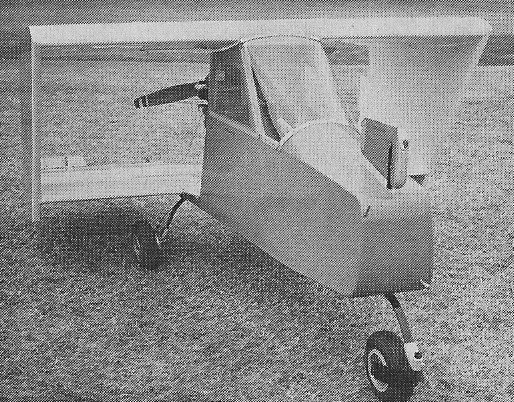
Roger F. Peterson built the Bijou in 1974 merely as a research vehicle to check out his theories. The all-wood single-seater has ground-adjustable stabilisers and variable-control elevons on the trailing edges of the lower wing, and ground-adjustable stabilisers on the upper wing.
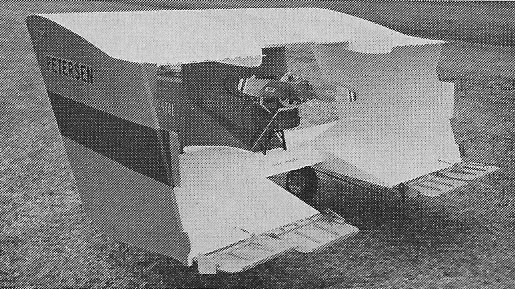
The side wing panels are to keep the air from washing out due to the short, 8 ft 9 in, wingspan, as well as to help directional stability.
Bijou is towable on its gear and is powered by a 40 hp German JLO snowmobile engine.
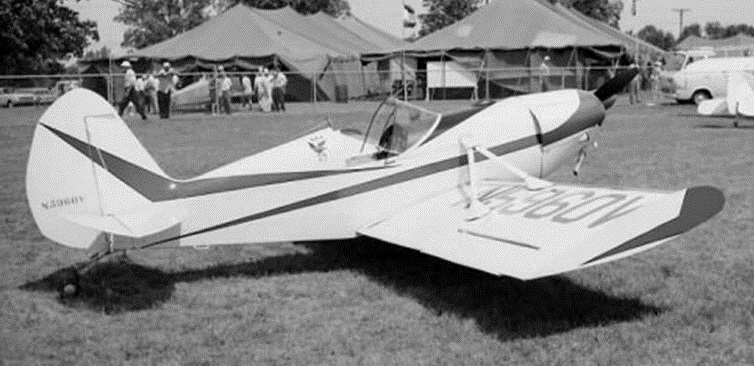
Peter Peterson of Davenport, Iowa, built this single-seater in one year at the cost of $1,800.
The Peterson Hi-Hopes N5960V was powered by an 85 hp Continental C-85 four-cylinder horizontal-opposed air-cooled engine, it was flown in September 1960. It had a wingspan of 20 ft. and was 17 ft. long.
Engine: 85 hp Continental C-85
Wingspan: 20’0″
Length: 17’0″
Useful load: 350 lb
Max speed: 135 mph
Cruise: 120 mph
Stall: 80 mph
Range: 360 mi
Seats: 1
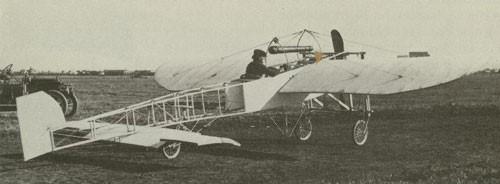
Canadian Edward C. Peterson piloting his own modified Blériot XI type copy across Kelly’s race track at Fort William, Thunder Bay, Ontario, near the corner of Edward and Arthur streets. Reportedly the first monoplane built in Canada, unfortunately on this occasion the plane failed to leave the ground. A later report in 1911 stated Peterson did make a successful flight over the fields at Mission Island.

