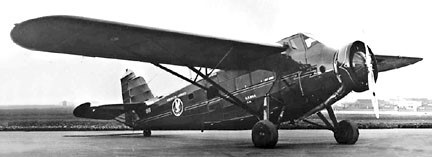
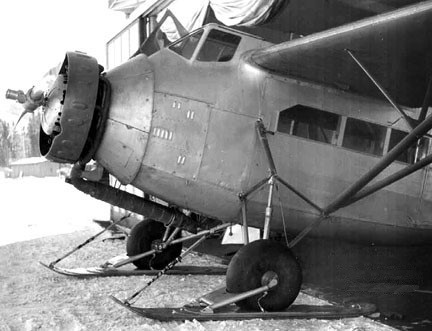
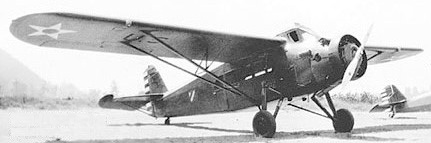
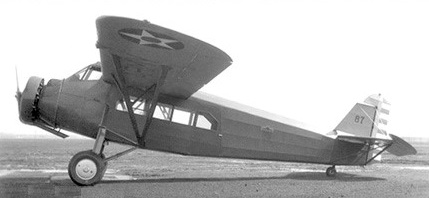
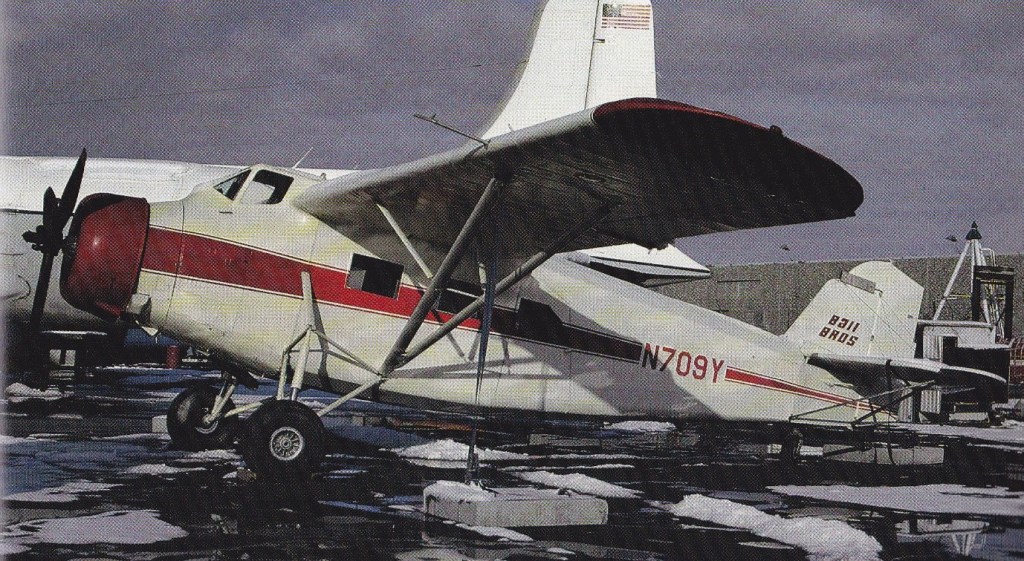
The 1931 Pilgrim KR-135 (ATC 415) was based on the Kreider-Reisner 21 series. Three were built; [NC248V, X311H, and NC963V. X311H was used as a test bed for Fairchild’s 100hp experimental Ranger 6-375 engine.
The 1931 Pilgrim KR-34 (ATC 2-372) was a modified Fairchild KR-34, three-place open cockpit biplane, powered by a 120hp General-Moore engine. Only one was produced.
Designed by Virginius E. Clark, the 1931 100, 100-A or American Pilgrim was essentially a Fairchild product, descended from Fairchild 100.
The Pilgrim 100-A received ATC 443, 2-365.
Pilgrim 100-B
The 1932 100-B was powered by Wright R-1820 Cyclone B engines and received ATC 470. Ten were built, of which six went to American Airways, and four to the Army as Y1C-24.
Priced at $28,750, sixteen P&W Honet-engined Pilgrim 100As and six Wright Cyclone-engined 100B were built, all of which went to American Airlines, later passing to Alaskan Airways.
100 / 100-A / American Pilgrim Engines: 575hp P&W Hornet B Wing span: 57’0″ Length: 38’1″ Useful load: 3388 lb Max speed: 136 mph Cruise: 118 mph Stall: 65 mph Range: 400-500 mi Seats: 10
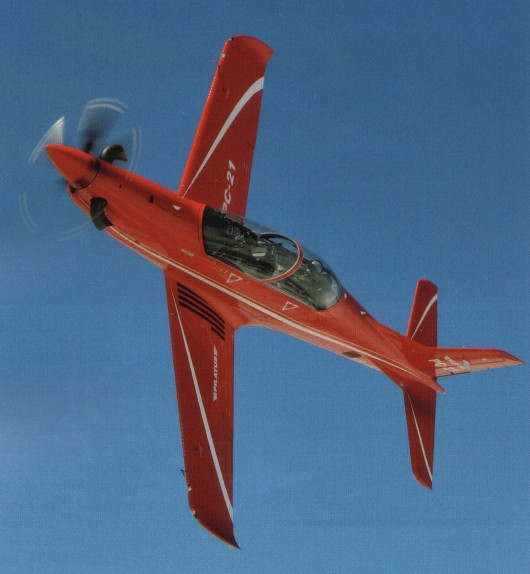
In January 1999 Pilatus launched the development of a completely new training system, the PC-21. The objective was to meet the expectations of modern air forces over the next 30 years both in terms of capability and life-cycle cost.
With this in mind, the PC-21 development specification focused on three core objectives: A superior aerodynamic performance when compared with any other turboprop trainer on the market, a more powerful, flexible and cost effective integrated training system than any other jet or turboprop trainer in the world, and a life-cycle support cost not to exceed current turboprop benchmarks.
The wingspan is 1.1m shorter than the PC-9 wing. The fowler are big enough to allow a stall speed of 81 kts when configured. The small ailerons are hydraulically boosted and are suppoorted by spoilers which begin to deploy at greater than 5 degrees of aileron deflection. The load limit is +8 to –4 G.
The aircraft has been designed to be fast for a turboprop with a maximum speed of 370 kts. The canopy is birdstrike resistant. The wing leading edge is designed to prevent a birdstrike from penetrating deeply into the wing structure by dissipating the energy span-wise. The zero-zero ejection seats are Martin Baker Mk 16s with selectable command ejection options. Oxygen is supplied from an onboard oxygen generation system. The air conditioning system is automatic.
The Pratt & Whitney Canada PT6A-68B 1600 shp / 1195 kW engine power is limited to 900 shp / 670 kW on the ground or below 90 kts. Above 90 kts the power is increased until the full 1600 shp / 1195 kW is reached at 200 kts and above. This is controlled automatically by the power management system.
PC-21 Engine: Pratt & Whitney Canada PT6A-68B 1600 shp / 1195 kW Wing span: 9.11 m Length: 11.23 m Height: 3.91 m Wing area: 15.2 sq.m Basic empty weight: 2280 kg Max take off weight (Aero): 3100 kg Max take off weight (Utility): 4250 kg Max external load: 1150 kg Max loading: +8 / -4 G Max operating speed: 370 KEAS Max operating Mach: 0.72 Max level speed (FL 100 ISA): 337 kt Useable cruise speed: 300 kt Stall: 81 kts
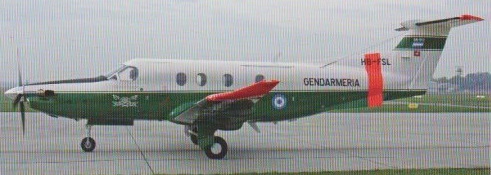
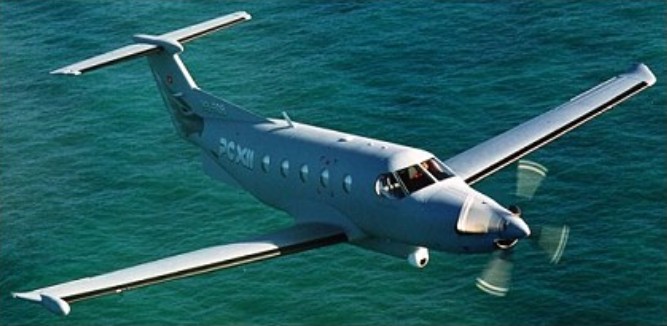
Announced in October 1989, the PC-12’s design has come about after analysis of various missions. Pilatus built two prototypes, the first flying on May 31, 1991, and it took just over 600 flight hours over three years to obtain Swiss certification. US FAA certification was awarded five months after this and the aircraft made its first sale to a US customer the very same day.
The PC- 12 has various internal configurations: a six-seat executive aircraft, a nine-seat corporate commuter, a “combi” carrying four passengers and 210 cu.ft of freight, an all-cargo version with its 330 cu.ft cabin area and the special mission aircraft. With a cabin over 5 metres in length, and a pressurisation differential of 5.75 psi giving a cabin altitude of 9,000 ft at 30,000 ft, the PC-12’s maximum operating certified altitude.
The PC-12’s Pratt & Whitney Canada PT6A-67B turboprop engine is de-rated to 1,200 shp for take-off and 1000 shp in the cruise. Pilatus has improved the engine governor system on the PC- 12 to the point where you simply push the power lever forward for take-off and confirm that the engine is indeed making full power. There is no propeller lever as the four-bladed, aluminium, fully reversible Hartzell propeller is governed to a constant speed of 1,700 rpm. With a diameter of 2.67 m, the propeller clears the ground by only 32 cm at minimum extension.
The digital engine in¬strument system panel, the EIS (engine instrument system), displays all the indicators for the engine, while the overhead panel contains the electrical power management controls and indicators.
PC-12 HB-FSL
The flight controls are conventional, using push-pull rods and carbon steel cables connected to the pilot’s and copilot’s control wheels and rudder pedals. Electric triple-trim systems assist the pilot in controlling the aircraft around pitch, roll and yaw axes and the aircraft has Fowler flaps that have four operating positions: 0 degrees (up), 15 degrees (take-off), 30 degrees (also take-off) and 40 degrees (landing), with intermediate positions able to be selected. The flaps will stop automatically if an asymmetric condition of more than 5 degrees is detected and the rudder has a yaw damper and an auto-trim system. The PC-12’s landing gear is a conventional tricycle arrangement and has been designed for both grass and rough field operations. The PC- 12 has a very simple fuel system with no fuel management required and the air¬craft has an automatic fuel balance feature. The 1,522 litres of total useable fuel, stored in four integral wing tanks, gives the pilot around eight hours of IFR endurance.
The PC-12 is the first single-engine aircraft to qualify for a stalling speed above 61 knots at a maximum take-off weight of 4,500 kg. The PC- 12 has a stick pusher, which applies 50 lbs of forward pressure, so the aircraft is highly unlikely to be unintentionally stalled. In the landing configuration with gear down and flaps extended, the shaker begins at 65 knots and the pusher at 59 knots. When the aircraft is “clean” the shaker comes in at 90 knots and the pusher at 85 knots. Before the pusher takes effect the two aircraft computers calculate how much the nose must be lowered to avert at stall. When the PC-12 is stalled, it is fairly typical in its behaviour.
Because the PC-12 is considerably electrically dependent it has two generators, which are able to back each other up, and a 43-amp battery. The battery can take the load of one nav/com unit and the GPS for at least an hour after lose of engine electrical power.
In 2000 PC-12 sales increased 25.5% with a total of 69 aircraft delivered.
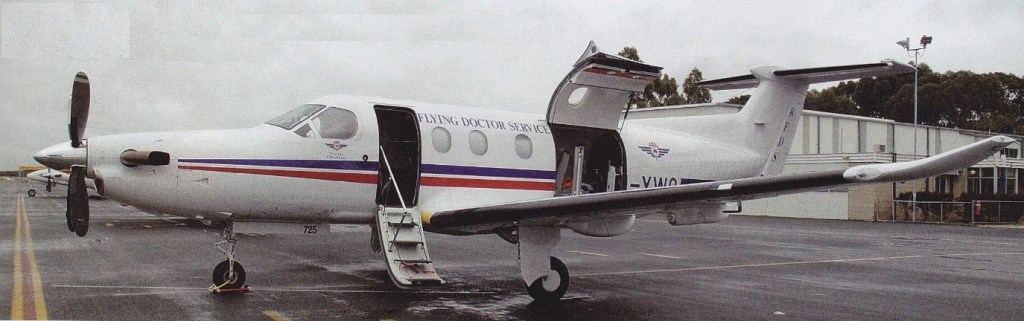
The PC-12/47 variant has increased maximum weight, modified winglets and other upgrades.
PC-12/47 VH-YWO Jandakot, Australia, November 2006
PC-12 Engine: Pratt & Whitney Canada PT6A-67B turboprop, (max) 1200 shp / 1327kW, (continuous) 1000 shp Wingspan: 53 ft 3 in / 16.23m Length: 47 ft 3 in / 14.4m Height: 14 ft / 4.26m Max ramp weight: 9965 lb Max take-off weight: 4000 kg / 8819 lb Empty weight: 2386 kg / 5260 lb Usable fuel: 1,522 lt / 402 USG Payload: 1150kg / 2535 lb Wing loading: 35.7 lbs./sq. ft Power loading: 8.2 lbs./shp ROC SL: 2000 fpm ROC FL200: 1500 fpm Service ceiling: 7620 m / 25000 ft Max certified alt: 30,000 ft Max operating speed: 240 kts Cruise speed: 497 km/h / 309 mph Max range: 2172 nm Range with 640 kg: 1600 nm Range with 1430 kg: 400 nm Takeoff distance: 1475 ft Landing distance: 945 ft Cabin volume: 330 cu.ft Crew: 1-2 Passengers: 9 Base price: $2,700,000
2009 Pilatus PC-12 NG Base Price: $3.8 million Engine: Pratt & Whitney PT6A-67P, 1200 shp Max Takeoff Weight: 10,450 lb Max Payload: 2866 lb Seats: 6–9 Rate Of Climb: 26.5 min to FL300 Max Certified Altitude: 30,000 ft Max Cruise Speed: 280 kt Fuel Flow @ Max Cruise: 491 lb/hr (73 gph) Takeoff Distance Over 50 Ft. Obstacle: 2650 ft
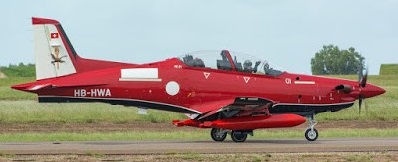
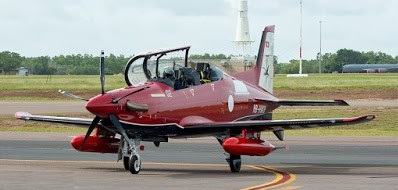
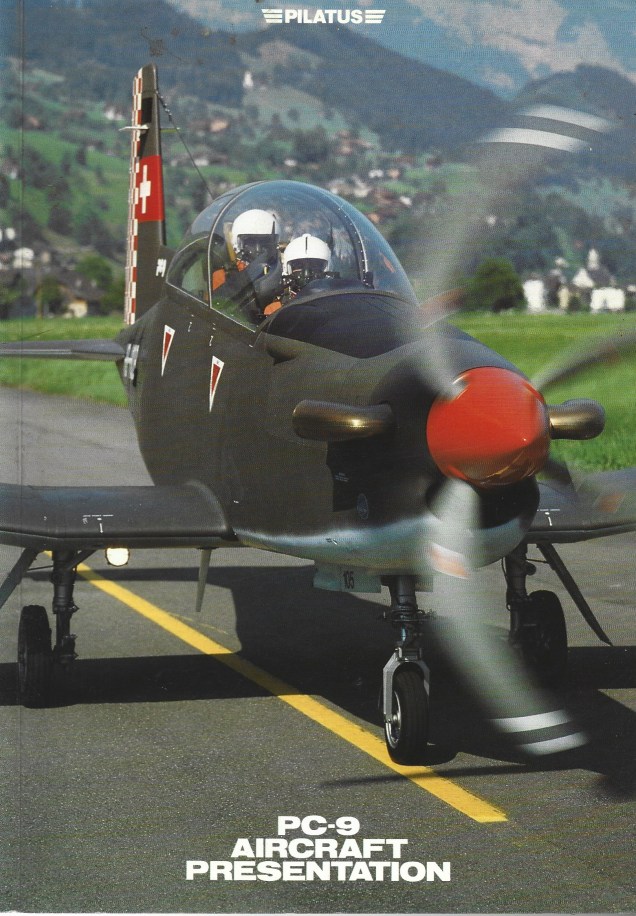
The prototype PC-9 flew on May 7, 1984, and was followed by a second aircraft, to production standard, on July 20, 1984. Although it bears a strong external resemblance to the PC-7, the PC-9 has only ten per cent commonality with the former. Major differences include a ventral airbrake, a reduced span wing with enlarged ailerons, a longer dorsal fin, and undercarriage doors. Compared with the PC-7, the PC-9 has an 857kW PT-6A-62 turboprop engine driving a four-blade propeller which, together with the structural changes, gives a significantly improved performance, including a maximum low-level speed of 496km/hr (268kt), an initial climb rate of 1,247m/min (4,000ft/min), and a time to 4,575m (15,00ft) of 4mm 30sec. Stepped tandem seating is fitted under a revised canopy, with Martin-Baker zero-zero ejection seats. Cleared for erect and inverted spinning.
Pilatus had completed the first PC-9 for Australia by June 1987. Two aircraft will be supplied complete, followed by six in kit form and components for 11 more. Hawker de Havilland and the GAF division of Aerospace Technologies of Australia assembled their first PC-9/A, of 67 PC-9/As for the RAAF, which first flew on 14 November 1987.
By late 1986 126 PC-9s had been sold to five customers.
Orders for more than 150 have been placed by 1990 by a number of air arms including those of Burma and Saudi Arabia. The PC-9 is fully acrobatic and has provision for underwing pylons for light stores.
Pilatus has continually upgraded the PC-9M to improve its operation, while maintaining low life-cycle and acquisition costs. Optimised power mapping and a trim aid device result in outstanding airborne handling. The introduction of large primary and secondary AMLCD flight displays has transformed the PC-9M into a true “glass cockpit” aircraft. The aircraft can also be equipped with a Head Up Display and Video Recording System, which enable the operator to expose students to today’s fighter technology at a very early stage of their training.
By 1993 a total of 140 aircraft were built.
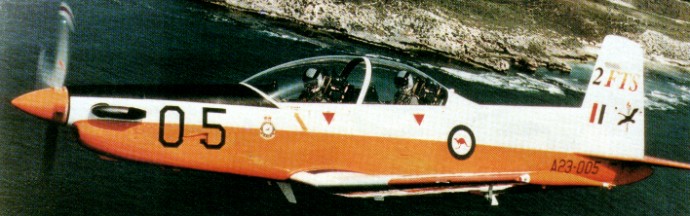
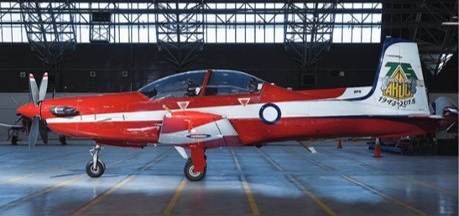
The Royal Australian Air Force’s Pilatus PC-9/A is the major basic training aircraft of the Australian Defence Force (ADF), introduced to the Air Force in 1987. Pilot training in the aircraft commenced in 1989. It was flown by the Central Flying School at RAAF Base East Sale, Victoria, where ADF fixed-wing flying instructors are trained, No 2 Flying Training School at RAAF Base Pearce, Western Australia, where ADF pilots are trained to ‘wings’ stage, and Forward Air Control Development Unit at RAAF Base Williamtown, near Newcastle, to train Joint Terminal Attack Controllers.
The PC-9/A is flown by the RAAF Roulettes in aerobatic displays at major events throughout Australia. Central Flying School pilots fly six aircraft that comprise the team as a secondary role to their instructional tasks. Central Flying School trains Navy and Air Force pilots to become flying instructors.
At RAAF Base Pearce, trainee ADF pilots, having successfully completed the Basic Flying Course at the ADF Basic Flying Training School at Tamworth, undertake the Advanced Flying Training Course with No 2 Flying Training School, during which they fly 130 hours in the PC-9/A. Upon successful completion, graduates are awarded their wings and posted to a flying squadron.
There are also four modified PC-9/A(F) aircraft in grey paintwork fitted with smoke grenade dispensers for target marking. These aircraft are based at RAAF Base Williamtown, near Newcastle, and are used to train ADF Joint Terminal Attack Controllers (JTACs, formerly forward air controllers), who coordinate air support to troops on the ground.
In 2020 eighteen retired RAAF PC-9A were placed up for auction at Avalon Airport, Victoria, Australia, with bids starting at $1 and no reserve.
PC-9 Crew: 2 Engine: 1 x Pratt & Whitney Canada PT6A-62 turboprop, 950 shp (708 kW) Wingspan: 10.12 m / 33 ft 2 in Length: 10.18 m / 33 ft 3 in Height: 3.26 m / 11 ft 8 in Wing area: 175.453 sq.ft / 16.3 sq.m Max take-off weight: 3200 kg / 7055 lb Empty weight: 1620 kg / 3572 lb Fuel internal: 508 lt Max. speed: 556 km/h / 345 mph Landing speed: 79 kt / 147 km/h Cruising speed: 270 kt / 500 km/h Max operating speed: 320kts IAS Initial climb rate: 3937.01 ft/min / 20.0 m/s Ceiling: 11580 m / 38000 ft Range w/max.fuel: 1642 km / 1020 miles T/O run: 240 m Ldg run: 260 m Endurance: 2 hr Crew: 2
Pilatus PC-9/A Engine: Pratt and Whitney PT6A-62 turboprop, 950 shp / 710kW Length: 10.18m / 33 ft 4 in Height: 3.28m / 10 ft 8 in Wingspan: 10.24m / 33 ft 2in Wing area: 175.3 sq.ft Basic weight: 2250kg MTOW: 2710kg Max speed: 320 kts Cruise speed: 270 kts ROC: 4100 fpm Range (with two underwing tanks): 1,850km Combat radius: 650km Ceiling: 25,000 ft Hardpoints: 2 Crew: 2
Pilatus PC-9/A (F) Engine: Pratt and Whitney PT6A-62 turboprop, 950 shp / 710kW Length: 10.18m / 33 ft 4 in Height: 3.28m / 10 ft 8 in Wingspan: 10.24m / 33 ft 2in Wing area: 175.3 sq.ft Basic weight: 2250kg MTOW: 3210kg Max speed: 320 kts Cruise speed: 270 kts ROC: 4100 fpm Range (with two underwing tanks): 1,850km Combat radius: 650km Ceiling: 25,000 ft Hardpoints: 2 Crew: 2
PC-9M Basic empty weight (typical) 1,725 kg (3,803 lbs) Maximum take-off weight 2,350 kg (5,181 lbs) Maximum external load 1,040 kg (2,292 lbs) Take-off ground roll 247m (810ft) Landing ground roll 352m (1.155ft) Rate of climb 3,880 ft/min Maximum operating speed 320 KCAS Maximum cruise speed 271 KTAS Maximum cruise speed at 10,000 ft 298 KTAS Stall speed – flaps and gear down 69 KCAS Maximum positive g-load +7.0 g Maximum negative g-load -3.5 g Sustained g-load +3.7 g Maximum range (clean) 860 nm Underwing stores 6
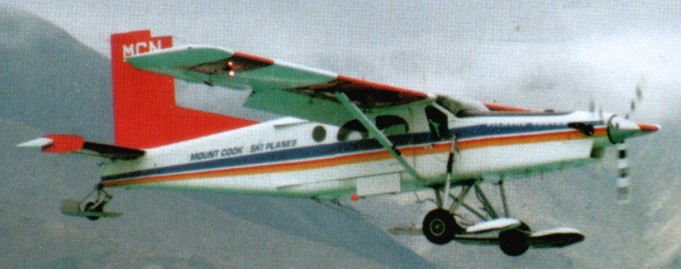
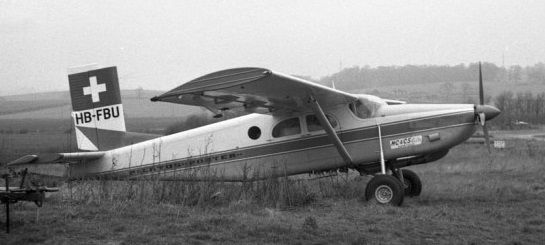
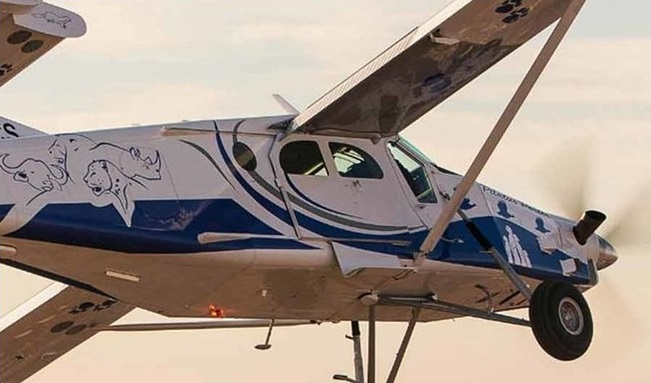
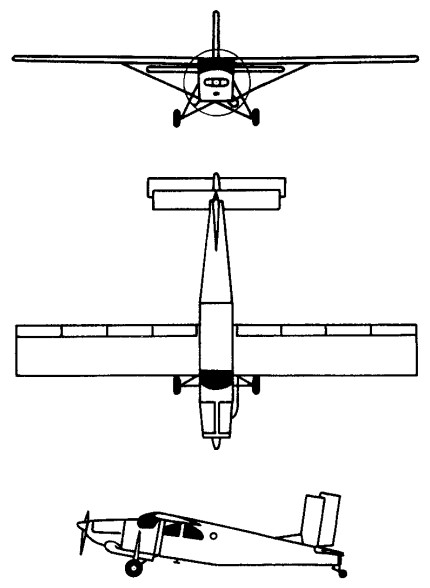
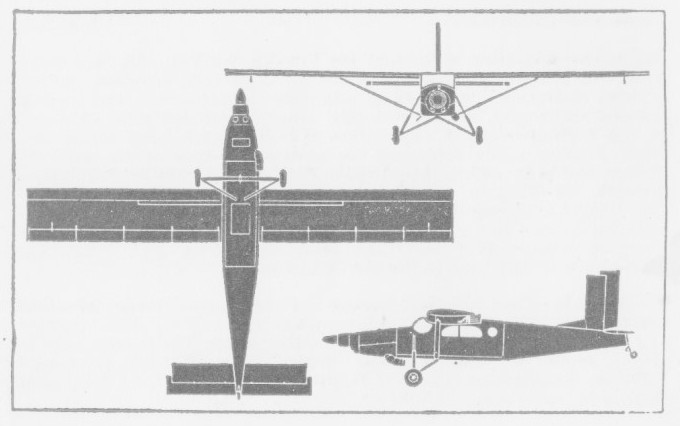
The Pilatus Porter PC 6 first flew on 4 May 1959 and remained in production in 2005. Once marketed as the “Heli Porter” by Fairchild in the US, this name more accurately describes the type’s abilities, although its true success came only after the turboprop engine was introduced to the design from May 1961 onward.
After the first of five prototypes flew on 4 May 1959, a pre-series of twenty aircraft was completed by mid-1961. A second series of twenty had been delivered by mid-1963. One was delivered to the Colombian Air Force.
The PC-6 was available with the 340 hp geared and super-charged GSO-480-B1A6 or the 350 hp geared TGO-540-B1A engines.
The Turbo-Porter development first flew on 2 May 1961, powered by a Astazou IIE turbo-prop.
Entering production in 1961, the Turbo-Porter light STOL utility transport, derived from the piston-engined Porter, has been built in substantial numbers for both civil and military applications. Identical to the earlier PC-6, except the engine, the PC-6A Turbo-Porter is equipped with a Turbomeca Astazou II 530 shp engine in place of the Lycoming GSO-480 of 340 hp. Cruise is 170 mph carrying eight passengers or an 1160 lb payload. Take-off distance is 425 ft and it can be equipped low-pressure tires for grass fields, skies or floats.
Production later changed to the improved Astazou IIG engine.
Fairchild possessed a US manufacturing licence for the Turbo-Porter, and in early 1964 was offering the type, re-engined with a Pratt & Whitney PT6A-6 turboprop. Two Astarzou-powered Turbo Porters were evaluated by the US Army during February-March 1964.
Operated by the US Army as the UV-20A Chiricahua.
In production since 1985, the 1987 production version of the Turbo-Porter was the PC-6/B2-H4, which has an increased payload. This was achieved by improving the aerodynamic efficiency of the aircraft by fitting new wing-tip fairings and an enlarged dorsal fin for increased weights, and is normally fitted with six quickly-removable seats in the main cabin. All PC-6s built since mid-1985 are of the H4 variant. Earlier PC-6/B1-H2s and /B2-H2s can be retrofitted to H4 standard if equipped with an electrical longitudinal trimming system. By mid-1986 456 PC-6s of all models had been delivered to civil and military operators, including those built under licence by Fairchild, as the AU-24 Peacemaker, in the USA.
The Credible Chase programme, an off shoot of Pave Coin, in which a number of aircraft were evaluated by the USAAF at Eglin AFB in order to come up with a new light-strike attack aircraft for the South Vietnamese Air Force, resulted in a 15 each order for the Helio Stallion and Fairchild Peacemaker. These aircraft, carrying the designa¬tions AU 24 and AU 23 respectively, are militarised versions of their commercial counterparts, but have increased gross weights, underwing and fuselage hardpoints and Gatling guns firing from the cabin doors.
Fairchild production of Pilatus Turbo-Porters begun June 1966; 15 of COIN version delivered to USAF as AU-23A Peacemaker, transferred to Royal Thai Air Force.
The PC-6/B1-H2 and B2-H4 were certified under Switzerland Federal Office for Civil Aviation FOCA F 56-10.
More than 480 PC-6s had been delivered by 1990.
As the certification of the PC-24 Super Versatile Jet got closer, in July 2017 Pilatus announced it was discontinuing the PC-6 Porter. The Porter has seen one of the longest continuous production runs of any airplane model since it first rolled off the line in Switzerland in 1959.
While the production line has been running for nearly six decades, the number of airplanes produced is nowhere near mass-produced. The Swiss manufacturer has delivered a little more than 500 of the multi-mission high-wing airplane and approximately another 100 Porters were produced in the United States under license.
Pilatus said orders have dropped in recent years. Pilatus will continue to take orders for the airplane until mid 2018 and will cease production in early 2019. Pilatus has also committed to supporting the existing fleet for at least the next 20 years. There will be no layoffs of employees as a result of the production termination. Instead, workers from the PC-6 product line will transfer to the PC-24.
PC-6 Porter Engine: Lycoming GSO 480, 340 hp Wingspan: 49 ft 10.5 in Length: 33 ft 5.5 in Height: 10 ft 6 in Wing area: 306.8 sq.ft Empty wight: 2360 lb Loaded weight: 4320 lb Max speed: 143 mph Max cruise: 135 mph Econ cruise: 125 mph ROC: 1025 fpm Service ceiling: 23,950 ft Max range: 750 mi
PC-6 Turbo-Porter Engine: 1 x P&WAC PT6A, 410 kW. Wing span: 15.87 m / 52.07 ft Wing area: 30.15 sq.m / 324.54 sq.ft Overall length: 10.90 m / 35.76 ft Height: 3.20 m / 10.50 ft Track: 3.00 m Empty wt: 1270 kg. MTOW: 2880 kg Payload: 960 kg. Fuel internal: 645 (+490) lt Capacity: 10 pax. Design diving speed (VD): 167 kt Never exceed speed (VNE): 151 kt Design cruising speed (VC): 119 kt Max. flap extended speed (VFE): 95 kt Stall speed (idle power) flaps up (VS): 58 kt Stall (idle power) flaps dn (VSO): 52 kt Max. operating altitude: 25,000 ft Service ceiling (at max. weight): 20,500 ft Max. rate of climb at sea level: 1,010 ft/min Max. rate of climb at 5,000 ft: 935 ft/min Take-off ground roll at sea level: 197 m / 646 ft Take-off dist to 15 m (50 ft): 475 m / 1,558 ft Landing ground roll at sea level: 127 m / 417 ft Landing distance from 15 m (50 ft): 315 m / 1,033 ft Take-off ground roll at sea level: 197 m / 646 ft Take-off distance to 15 m (50 ft): 440 m / 1,443 ft Max. Range at opt. speed, no reserves, at 10,000 ft: 500 nm Endurance at opt. speed, no reserves: 4 h 20 min Max range with underwing tanks: 870 nm Endurance with underwing tanks: 7 h 35 min Average fuel consumption: 148 litres/h (39 US gal/h)
PC-6A H2 Engine: Turbomeca Astazou IIE turboprop, 523 shp. Max speed: 170 mph Normal cruise 80%: 155 mph at 9800 ft ROC: 1700 fpm Service ceiling: 28,000 ft Max range: 620 mi Endurance: 4 hr 20 min Empty weight: 2248 lb MTOW: 4320 lb Wingspan: 49 ft 10.5 in Length: 36 ft 1 in Height: 10 ft 6 in Wing area: 306.8 sq.ft
PC-6-B1-H2 Engine: P&W PT6A-20, 550 shp.
PC 6 B2 Turbo Porter Engine : Pratt & Whittney PT A-27 Length: 36.089 ft / 11.0 m Height : 10.499 ft / 3.2 m Wingspan : 49.869 ft / 15.2 m Wing area : 310.003 sq.ft / 28.8 sq.m Max take off weight : 6107.9 lb / 2770.0 kg Weight empty : 2932.7 lb / 1330.0 kg Max. weight carried : 3175.2 lb / 1440.0 kg Max. speed : 132 kt / 244 km/h Initial climb rate : 1968.5 ft/min / 10.0 m/s Service ceiling : 32808 ft / 10000 m Wing load : 19.68 lb/sq.ft / 96.0 kg/sq.m Range : 721 nm / 1336 km Endurance : 6 h Crew : 1+7
PC-6/B2-H2 Engine: P&WAC PT6A-27, 550 hp / 507kW Wingspan: 15.87 m / 52 ft 1 in Length: 10.9 m / 36 ft 9 in Height: 3.2 m / 11 ft 6 in Wing area: 30.15 sq.m / 324.53 sq ft Wing loading: 15.57 lb/sq.ft Pwr loading: 8.8 lb/hp. Gross wt: 4850 lb Empty wt: 2680 lb. Equipped useful load: 1973 lb Payload max fuel: 851 lb. Range max fuel/cruise: 388 nm/2.9 hr Range max fuel / range: 461 nm/ 3.6 hr. Service ceiling: 30,000 ft Max cruise: 135 kt. Max range cruise: 130 kt Stall: 44-50 kt. 1.3 Vso: 57 kt ROC: 1270 fpm. Min field length: 770 ft Fuel cap: 1122 lb. Seats: 11.
PC-6-B2-H4 Engine: PT6A-27, 680 shp (508 kW) flat-rated at 550 shp (410 kW). Wing area: 29sq.m. MTOW Std: 4850 lb MTOW Special cat: 6000 lb Cruise: 120-135 kt Stall: 44-50 kt. TO run: 370 ft TO 50 ft: 780 ft Range (@4850 lb): 450 nm Payload: 2000 lb. Pax cap: 11
The Pilatus P-4 represented another attempt by the company to get into the market for civil aircraft, but this five-seat cabin monoplane had little more success than its SB-2 predecessor. Of braced high-wing monoplane configuration, with fixed tailwheel landing gear, a braced tail unit and a 142kW Avco Lycoming O-435 engine, the P-4 had accommodation for a pilot and four passengers. All passenger seats were removable easily so that the P-4 could be used as a cargo carrier, or as an air ambulance accommodating two stretchers and two medical attendants.
P-4 Engine: 1 x Avco Lycoming O-435, 142kW Max take-off weight: 1500 kg / 3307 lb Wingspan: 11.85 m / 39 ft 11 in Max. Speed: 245 km/h / 152 mph Crew: 1 Passengers: 4
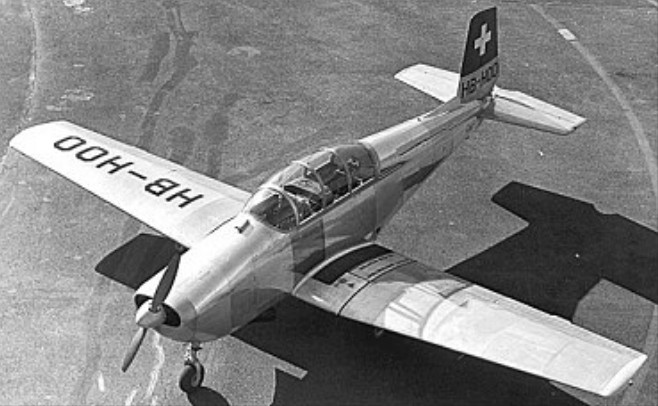
The success of the P-2 led to development of a new general-purpose trainer under the designation Pilatus P-3, the prototype of which was flown for the first time on 3 September 1953. Intended for use as both a primary and advanced trainer, the P-3 is of cantilever low-wing monoplane configuration and differs from its predecessor by being of all-rnetal construction. It has retractable tricycle landing gear, but as the P-3 was required by the Swiss air force for ‘all-through’ training, from the primary stage to the point of passing on to the de Havilland Vampire jet trainer, a lower-powered engine was adopted, the Avco Lycoming GO-435-C2A. Like the P-2 that preceded it into service, the P-3 has similar standards of equipment or weapons for comprehensive pilot training by day or night. A total of 72 P-3s was built for the Swiss air force, and in 1993 a handful of these remain in service.
A small number were supplied to Brazil, but these were superseded by indigenous trainers by 1993.
P-3 Engine: 1 x Avco Lycoming GO-435-C2A, 194kW Max take-off weight: 1500 kg / 3307 lb Loaded weight: 1110 kg / 2447 lb Wingspan: 10.4 m / 34 ft 1 in Length: 8.75 m / 29 ft 8 in Height: 3.05 m / 10 ft 0 in Wing area: 16.5 sq.m / 177.60 sq ft Max. speed: 310 km/h / 193 mph Ceiling: 5500 m / 18050 ft Range: 750 km / 466 miles Crew: 2
P3-05 Engine: Lycoming GO-435-C2A, 260 hp Propeller: Hartzell HC-83V20-2C, 3-blade