A tandem two-seat monoplane
1 engine
Pottier P.110TS
A three-seat monoplane
Pottier P.130 Coccinelle / Bleu Citron
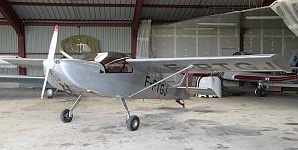
In 1966 Jean Pottier designed the P.30 Pétrel. It would have been a single engine, small, shoulder wing monoplane, but it was never built. Thirty years later Pottier produced a revised version seating two side-by-side and designated the P.130 Coccinelle. This venture was supported by the RSA’s Bleu Citron (English: Blue lemon) programme and the P.130 has sometimes been referred to as the Pottier Bleu Citron.
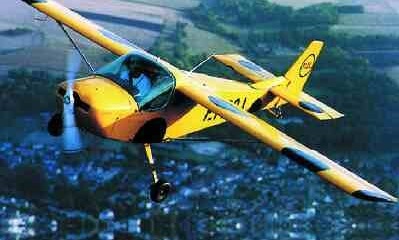
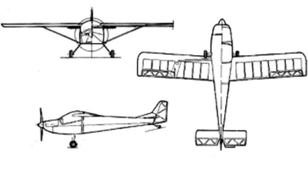
The Coccinelle is a simple wood framed, fabric covered monoplane, with shoulder mounted wings braced by a single strut each side from the lower fuselage longerons. The wings are essentially rectangular in plan, though with blunted forward tips, and have significant forward sweep. The balanced rudder is almost without a fin, though there is a shallow, triangular fillet in front of the rudder, which is large, straight edged and extends to the keel. The rectangular tailplane, mounted at the top of the fuselage, carries full span, rectangular plan elevators with a central cut-out to allow rudder movement.
The Coccinelle’s fuselage has a rectangular section throughout and its profile is straight edged except under the engine, where it curves upwards. The side-by-side seats are ahead of the wing leading edge and largely enclosed under a one piece, rear hinged, part bubble type canopy. Behind this are further transparencies which can vary from builder to builder but extend rearwards a little way into the wing. Most Coccinelles have a tail wheel undercarriage with front wheels on thin, steel cantilever legs, though a tricycle undercarriage is an option. Some builders have added spats.
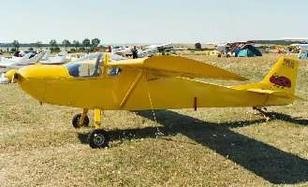
The Coccinelle was intended for home building from his plans. These allow a choice between the P.130UL, meeting the ultralight certification requirements, or the normal P.130L. The 2014 French register shows that the latter is usually preferred. A variety of engines are suitable, including the Volkswagen air-cooled flat four with powers between 48–75 kW (65–100 hp) and the 60 kW (80 hp) JPX.
The prototype first flew in 1998 and by 2001 more than 60 were under construction in France. The European 2014 civil aircraft registers show 23 P.130s, 21 in France and 2 in Spain.
Variants:
P.130L Coccinelle
meeting normal light aircraft certification requirements
P.130UL Coccinelle
meeting ultralight requirements
Specifications:
Engine: 1 × 1600 cc Volkswagen, 48 kW (65 hp)
Propeller: 2-blade
Wingspan: 5.28 m (17 ft 4 in)
Length: 6.9 m (22 ft 8 in)
Height: 1.98 m (6 ft 6 in)
Gross weight: 500 kg (1,102 lb)
Empty weight: 260 kg (573 lb)
Fuel capacity: 60 lt
Maximum speed: 195 km/h (121 mph; 105 kn)
Cruising speed: 181 km/h (112 mph; 98 kn)
Stall speed: 85 kph
Range: 480 km (298 mi; 259 nmi)
Rate of climb: 4 m/s (790 ft/min) initial
Seats: 2
Certification: CNRA
Pottier P.100TS
A two/three-seat monoplane (first flown 1980).
Pottier P.80S
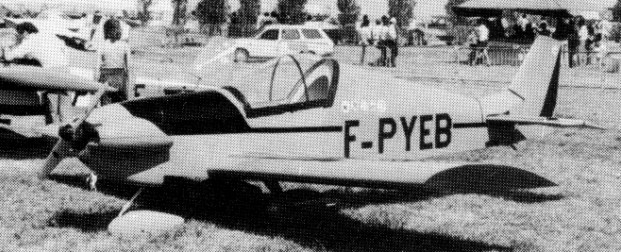
A single-seat monoplane of metal construction.
Seats: 1
Engine: VW
Span: 19’ 25”
Wing area: 79.5 sq.ft
Length: 16’9”
Max wt: 640 lbs
Empty wt: 397 lbs
ROC: 985 fpm
Cruise: 89 kts
Pottier P.70S
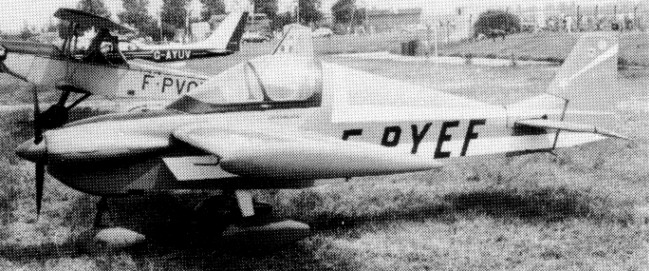
A single-seat monoplane. Metal construction.
Seats: 1
Engine: VW
Span: 19’2.25”
Wing area: 77.5 sq.ft
Length: 16’10.75”
Max wt: 716 lbs
Empty wt: 474 lbs
ROC: 1000 fpm
Cruise: 89 kts
Pottier P.60 Minacro
A single-seat aerobatic biplane
Pottier P.50 Bouvreuil

Single-seat monoplane (first flown 1979). Wood and fabric construction.
Seats: 1
Engine: 65-115 hp
Span: 20’4”
Wing area: 80.75 sq.ft
Length: 18’6.5”
Max wt: 882 lbs
Empty wt: 595 lbs
Cruise: 151 kts
Potez 600

Potez 453
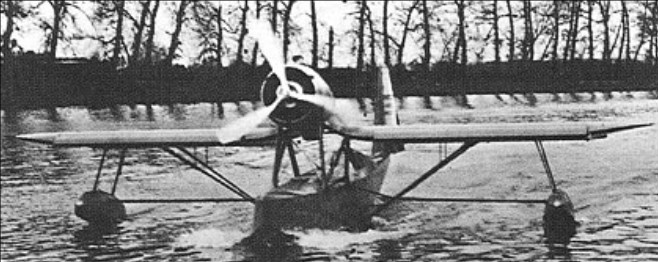
A contender to fulfil the 1933 Marine Nationale requirement for a single-seat float fighter suitable for catapult operation from 10,000-ton cruisers, the Potez 453 was based broadly on the design of the two-seat Potez 452 light observation flying boat. Competing with floatplanes tendered by Bernard (H.52), Loire (210) and Romano (R-90), the Potez 453 flying boat first flew on 24 September 1935. Of mixed construction, it was powered by an 800hp Hispano-Suiza 14Hbs radial engine and was intended to carry an armament of two 7.5mm machine guns. The engine was carried on bracing struts ahead of the wing, the thrust axis passing high above the CG of the flying boat with the result that, in view of the small dimensions of the aircraft, a considerable diving moment was induced at full throttle which could not be easily counteracted. Take-off was, in consequence, difficult and could be effected only by reducing engine power. Further development of the Potez 453 was therefore abandoned.
Max take-off weight: 1937 kg / 4270 lb
Empty weight: 1534 kg / 3382 lb
Wingspan: 11.20 m / 37 ft 9 in
Length: 10.20 m / 33 ft 6 in
Height: 3.45 m / 11 ft 4 in
Wing area: 19.00 sq.m / 204.51 sq ft
Max. speed: 318 km/h / 198 mph
Range: 540 km / 336 miles


