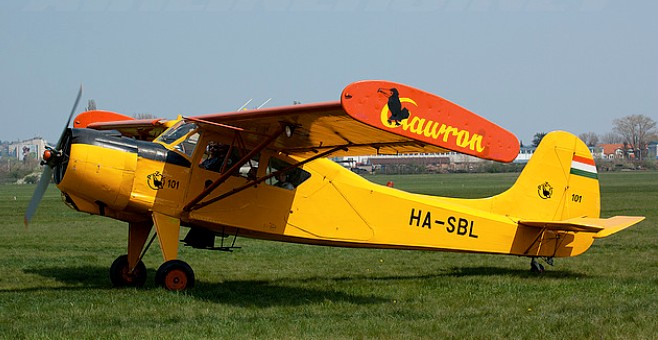
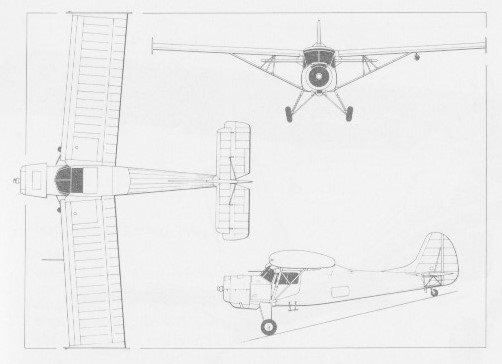
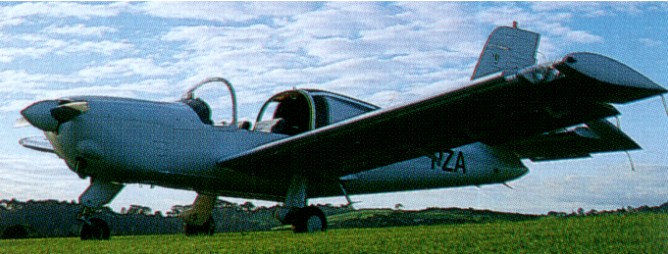
PZL Warszawa-Okecie PZL-101 Gawron

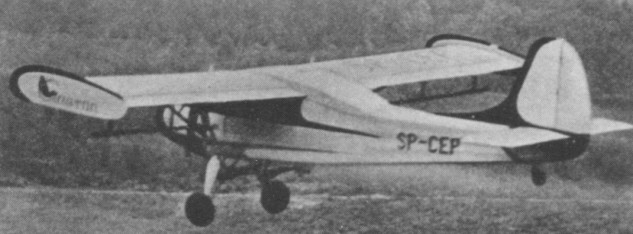
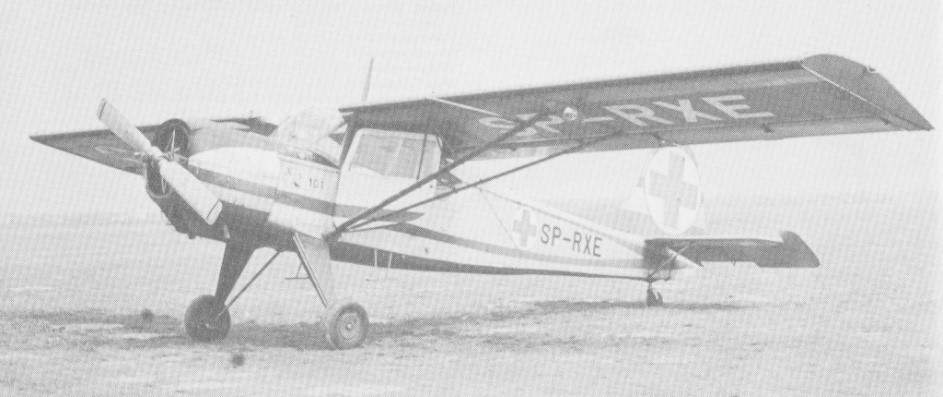
The PZL 101 was developed from the Yak-12M, which was licence-produced in Poland. The first prototype flew on 15 April 1958. Series production started in 1960.

Three basic versions were built; agricultural, ambulance and utility, with equipment according to role. Initially manufactured in two versions, the PZL 101G2 could accommodate four people.

Late production aircraft have laminar-flow wingtips instead of the original type fitted with endplates.

By 1968 a total of 325 Gawrons were built including 143 for export.

Production ceased in 1973 after more than 330 had been built.

PZL-Okecie PZL-101A Gawron

Engine: 1 x Ivchenko AI-14R radial, 260hp
Wingspan endplate tips: 12.68 m / 41 ft 7.5 in
Wingspan laminar tips: 13.03 m / 42 ft 9 in
Length: 9.0 m / 30 ft 6 in
Height: 3.12 m / 10 ft 3 in
Max take-off weight: 1660 kg / 3660 lb
Empty weight ag: 1025 kg / 2260 lb
Empty weight ambulance: 1068 kg / 2354 ln
Max. speed: 180 km/h / 112 mph
Cruise speed ag: 130 km/h / 81 mph / 70 kt
ROC ag: 162 m/min / 530 fpm
Service ceiling ag: 3280 m / 11,100 ft
Range int/fuel ag: 660 km / 410 miles / 356 nm
Range ext/fuel ag: 1140 km / 708 miles / 614 nm
Cabin volume: 2.55 cu.m / 90 cu.ft
Capacity: 4 seats / 500 kg / 1100 lb / 175 Imp.G / 800 lt / 660 lb / 300 kg

PZL 101 Gawron

PZL Warszawa-Okecie M-26 Iskierka

A 1986 single-piston-engined, retractable-gear design intended for military pilot selection and civilian pilot training, the M-2600 prototype flew on July 18, 1986, powered by a 153kW engine. Some assemblies from the M-20 Mewa (licence-built Piper Seneca) were used in the Iskierka’s wing, tail unit, landing gear, and electrical systems.

PZL Mielec M 26 Iskierka
Engine: Lycoming AEIO 540 L1B, 221 hp
Length: 27.231 ft / 8.3 m
Height: 9.843 ft / 3.0 m
Wingspan: 28.215 ft / 8.6 m
Wing area: 150.696 sq.ft / 14.0 sq.m
Max take off weight: 3087.0 lb / 1400.0 kg
Weight empty: 2072.7 lb / 940.0 kg
Max. weight carried: 1014.3 lb / 460.0 kg
Max. speed: 184 kts / 340 km/h
Landing speed: 59 kts / 110 km/h
Cruising speed: 167 kts / 310 km/h
Initial climb rate: 1574.8 ft/min / 8.00 m/s
Wing loading: 20.50 lb/sq.ft / 100.0 kg/sq.m
Range: 875 nm / 1620 km
Crew: 2

PZL Warszawa-Okecie PZL-110 Koliber

Koliber II

French production of the Rallye series stopped in the 1970s and PZL took it over, along with all production licences. Derived from the SOCATA MS884 Rallye, PZL did development of its own, with a softer trailing-arm undercarriage, some geometric changes on the flaps and more work on those distinctive leading edge slats, which now move in and out more gently and tend to stay there. Engineering changes also include better alloys and corrosion treatment. PZL made 500 or so Franklin-powered Koliber Is, then set about certifying the Koliber II under FAR Part 23 amendment 29. A four place, all metal factory built nose wheel aircraft.

Certification of the Koliber 150 is under European Aviation Safety Agency EASA A.091, and the PZL-Koliber 150A under FAA A69EU.

PZL-110
Engine: Franklin, 125 hp

Koliber 150A
Engine: Lycoming O-320E2A, 150 hp
Cruise: 107 kt
Stall: 37 kt

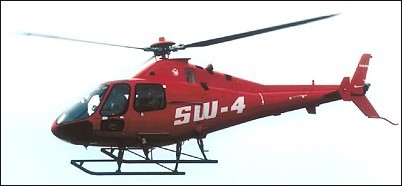
PZL Swidnik SW-4

A 4-5 seat civil helicopter of conventional streamlined appearance, development began 1985 with a full-scale mockup completed in 1987. A major redesign was undertaken 1989-90, using an Allison (now Rolls-Royce) 250 engine in a more streamlined fuselage with a modified tail unit. GFRP is used for approximately 20% of the airframe, and the remainder mainly of aluminium alloy. An all-metal monocoque fuselage.

Fitted with a three-blade GFRP main rotor; arrowhead tailfin on port side, with two-blade GFRP tail rotor to starboard; narrow tailplane with small endplate fins; skid landing gear. The landing gear is able to accommodate heavy landing sink rate, of 3.1m/s by elastic deflection of cross-tubes.

Accommodation is for one pilot and up to four passengers or one stretcher patient and a medical attendant. One front-hinged and one rearward-sliding door on each side of cabin.

The first flying prototype had one 450shp / 336kW Rolls-Royce 250-C20R/2 turboshaft. Transmission rating 336kW for T-O, 283kW maximum continuous; 30 minute run-dry capability. Standard fuel capacity 500 litres in tank below main gearbox.

Prototype (c/n 600102), rolled out in December 1994, and was a non-flying testbed for ground and equipment tests; ‘101 was a static test airframe, ‘103 and ‘104 were flying prototypes. The first flight made by 600103 (red overall; later registered SP-PSW) was on 26 October 1996 (‘official’ flight three days later).

Trials in 1997 demonstrated requirement for a new rotor head design, enlarged horizontal stabiliser and more robust hydraulic system. Following 70 hours of test-flying, SP-PSW was grounded in late 1997 for installation of SAMM-designed hydraulic flight control system, with which it was then due to return to flying in 1998. Second flying prototype (yellow overall), with improved skids, exhibited statically at Paris Air Show, June 1997; registered as SP-PSZ in October 1998, but not flown until early 2001.

Some 640 hours (total) were flown by July 2002, when certification programme almost complete; domestic certificate to JAR 27 awarded 14 November 2002.

The first five production aircraft were started during the first quarter of 1999. Deliveries of these were scheduled to take place in 2003. Second prototype shown at Paris in June 2001; first at Berlin in May 2002.

According to a mid-2003 report, Swidnik considering re-engineering SW-4 with Pratt & Whitney Canada PW200 turboshafts, assembled locally by PZL-Rzeszow. Alternative powerplant is 615shp P&W PW200/9.

The Polish Air Force requirement confirmed in mid-2002 for purchase of 47 by 2010, of which seven planned to enter service in 2005 and 14 in 2006; for use in training role. Two of first five production aircraft scheduled for Polish Air Force Academy were to be delivered in 2003; next three are purchase options for commercial customers. Other orders reported from three unidentified German customers.

Cost in 2002 was US$690,000.

PZL Swidnik SW-4
Engine: 1 x Allison 250-C20R/2 turboshaft, 270kW
Crew: 1
Passengers: 4
Main rotor diameter: 9.0m
Length with rotors turning: 10.55m
Fuselage length: 8.24m
Height: 2.93m
Max take-off weight: 1700kg
Empty weight: 730kg
Max speed: 245km/h
Rate of climb: 10m/s
Hovering ceiling, IGE: 3500m
Range: 600km
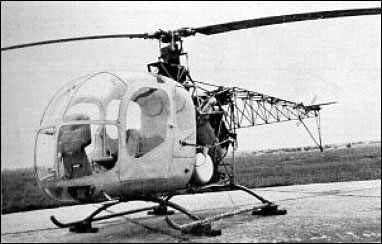
PZL Swidnik SM-4

Three-seat helicopter with enclosed cabin, open-frame rear fuselage, skid u/c, GRP main rotor and one 180hp Narkiewicz WN-6S six-cylinder horizontally-opposed air-cooled piston engine mounted at an angle behind cabin section. The only prototype of SM-4 Łątka (Latka) was built in 1962 and ground-tested, but was not flown, because its prototype engine 180 hp WN-6S was not fully tested and not approved for flight.

PZL Mielec M-24 Super Dromader

In 1985 construction began of five airframes of an improved M-24 Dromader Super, one intended as a static test specimen, two as flying prototypes with the 746kW ASz-621R engine, and another two with the 860kW P.Z.L. K9-AA engine. The first of these flew on 14 July 1987 and all were flying by November 1988.

The Super was fitted with longer wings, from 17.7 metres on the M-18 to 19.9 metres on the M-24. The fuselage was also stretched from 9.5 metres to 10.8 metres, in¬cluding a larger hopper.

Of the five built, one as a test airframe, with the remaining four flown, however, none were sold and all were with¬drawn from use by 1998 and stored engineless.

However, no production of the type was launched. The M-24T turboprop version, fitted with an 875kW PT6A engine in an extended nose, was planned, but only existed in mock-up form.

WSK-Mielec M 24 Dromader Super
Cropduster, Poland, 1987
Length : 35.433 ft / 10.8 m
Height: 12.467 ft / 3.8 m
Wingspan : 65.289 ft / 19.9 m
Wing area : 484.38 sqft / 45.0 sq.m
Max take off weight : 11025.0 lb / 5000.0 kg
Weight empty : 6328.4 lb / 2870.0 kg
Max. weight carried : 4696.7 lb / 2130.0 kg
Max. speed : 119 kts / 220 km/h
Landing speed : 59 kts / 110 km/h
Cruising speed : 103 kts / 190 km/h
Initial climb rate : 590.55 ft/min / 3.00 m/s
Service ceiling : 13123 ft / 4000 m
Wing load : 22.76 lb/sq.ft / 111.0 kg/sq.m
Range : 972 nm / 1800 km
Engine : PZL Kalisz 9 AA, 871 hp
Crew : 1-2

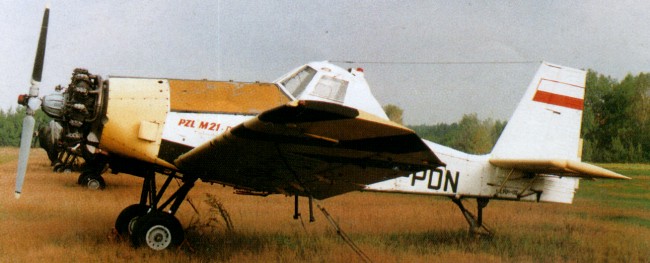
PZL Mielec M-21 Dromader Mini

Two prototypes of the scaled-down reduced-capacity M-21 Dromader Mini were flown, the first, 5P-PDM, powered by a 447kW P.Z.L.-3S engine on 18 June 1982 followed by the second, fitted with a geared PZL-3SR 599 hp version.
The aircraft had no centre wing section and the span was reduced to 14.51 metres and the length to 9.48 metres.

Although the type was provisionally certificated, no production has followed. Both examples of the M-21 were withdrawn in June 1990.

The even smaller Dromader Mikro, proposed in 1982, did not proceed further.

Engine: A PZL-35R radial, 599 hp
Wing span: 14.51m
Length: 9.48m