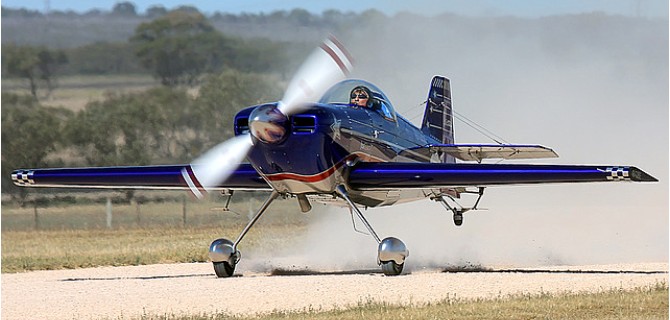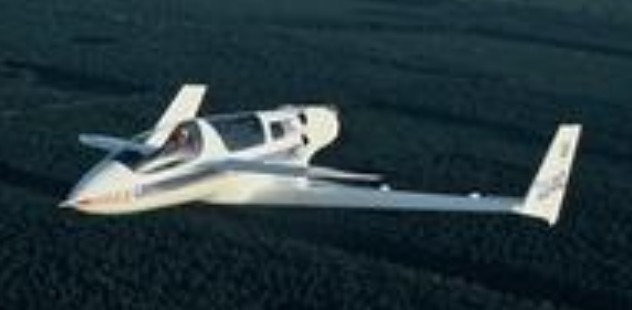
RMT Aviation Bateleur

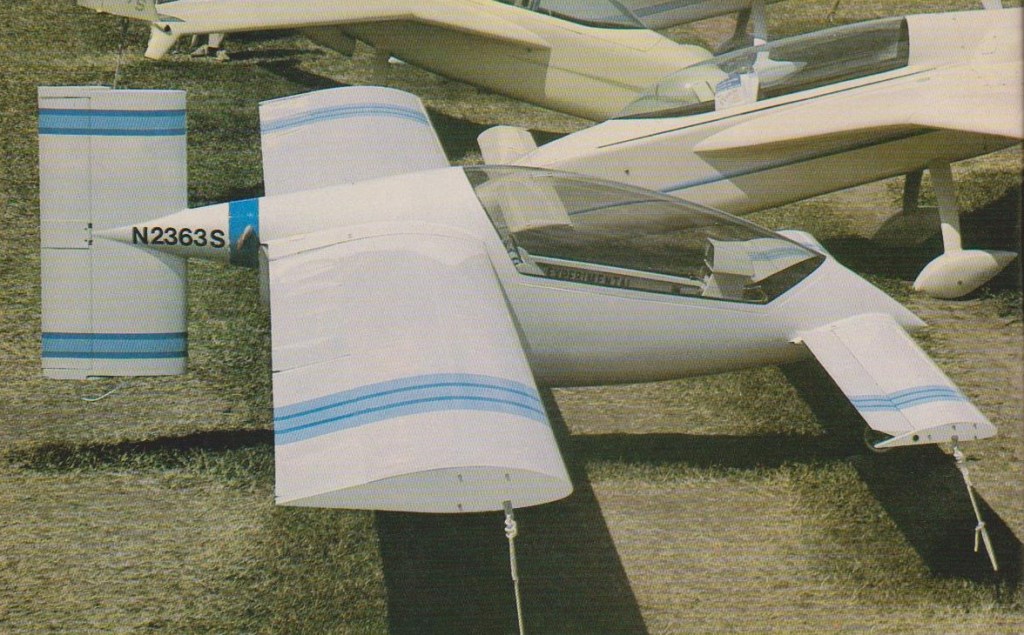
The configuration of the Bateleur brings numerous advantages compared to the conventional high or low winged aircraft. Its flight and handling characteristics remaining standard allows any pilot instant conversion.

The tandem seating for 2 people gives both pilot and passenger full view to both sides. The concept has proven to be stable in severe turbulence, comparable only to aircraft many times its weight making it very suitable as an aerial photographic or observation platform. The endurance and range in excess of 7 hours / 1000 km can be extended with auxiliary tanks by another 50%. As an Ultralight, the MTOW is 450 kg.

Bateleur 115 T
Stall: 35 kt / 40 mph / 65 kmh
Cruise: 149 kt / 171 mph / 276 kmh
VNE: 173 kt / 199 mph / 320 kmh
Empty Weight: 259 kg / 570 lbs
MTOW Weight: 599 kg / 1320 lbs
Climb Ratio: 1700 ft/min / 9 m/s
Glide Ratio: 18
Take-off distance (50ft obstacle): 500 ft / 152 m
Landing distance (50ft obstacle): 400 ft / 122 m
2009 Price: 92800 EURO

Bateleur 912 S
Stall: 35 kt / 40 mph / 65 kmh
Cruise: 140 kt / 162 mph / 260 kmh
VNE: 173 kt / 199 mph / 320 kmh
Empty Weight: 250 kg / 551 lbs
MTOW Weight: 600 kg / 1323 lbs
Climb Ratio: 1400 ft/min / 7.1 m/s
Glide Ratio: 18
Take-off distance (50ft obstacle): 720 ft / 220 m
Landing distance (50ft obstacle): 490 ft / 150 m
2009 Price: 78800 EURO
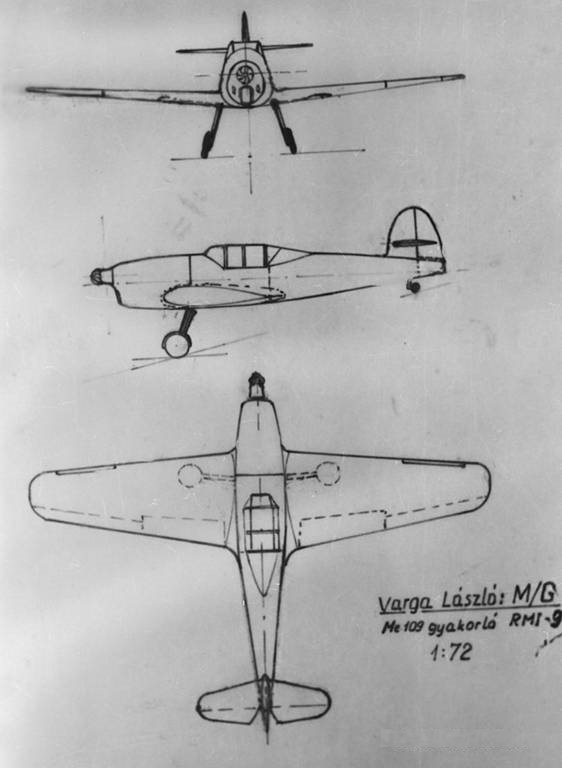
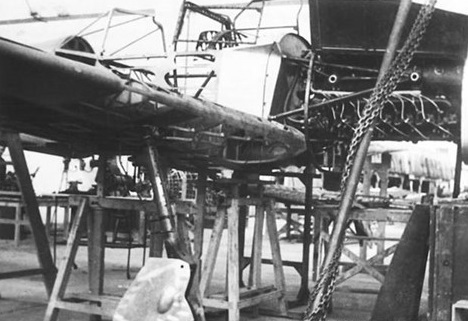
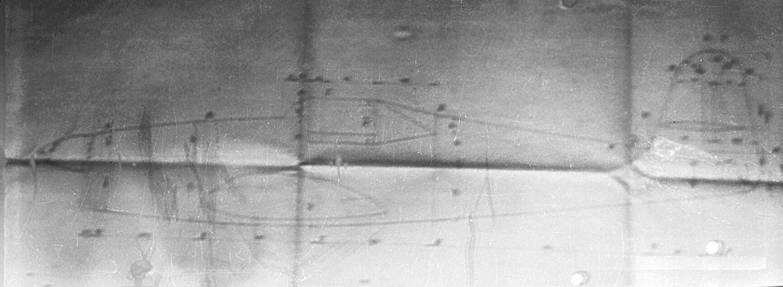
RMI RMI-9 M/G

From 1943 the Air Force was gradually getting the Bf-109 advanced jet fighters (F and G versions), but it was not easy to get used to the tight and narrow track undercarriage. The Aero Technical Institute created the RMI-9 M/G specifically for the Messerschmitt pilots in training. The machine was designed with slats, so as to better mimic the Bf-109 flight characteristics.

Designed by Varga László, the RMI-9 M/G [or Me/G] Bf-109 pilot trainer was built but destroyed by US bombing in 1944 in the Ferihegy experimental hangar.

Engine: Argus As-411, 480 hp
Wing span: 9.5m
Length: 7.2m
Height: 2.3m
Empty weight: 1,100 kg
T/O weight: 1,480 kg
Maximum speed: 350 km/h
Range: 700 km
Ceiling 9,200 m

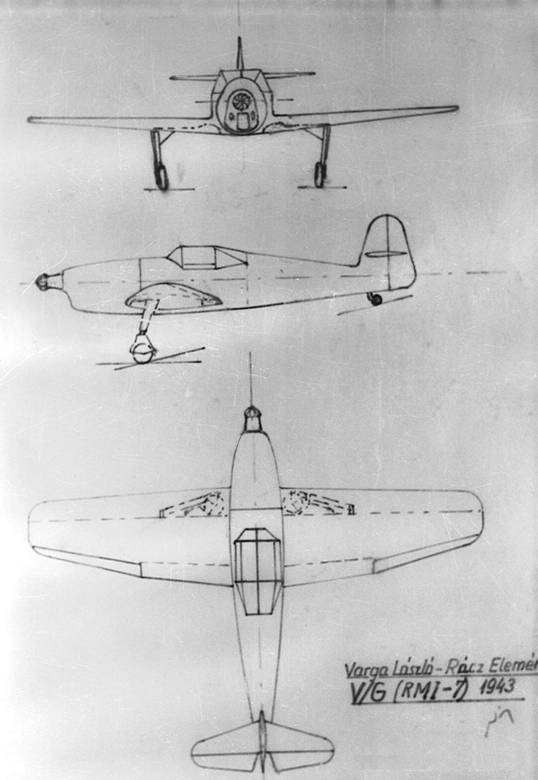
RMI RMI-7 V/G

The RMI-7 V/G was a side-by-side trainer powered by an Argus As.410, and equipped with retractable undercarriage. The mixed wood-built machine with torsion wings and hydraulic main landing gear had the same structure as the RMI Z / G.

The V / G was designed from the start serial production. Designed by Varga László and Rácz Elemér, a prototype was built in 1944. In 1944 the prototype was shipped to the Budaörs airport in order to fly but possibly never flew.

Engine: Argus As.410
Wing span: 9.54m
Length: 7.81m
Height: 2.5m
Empty weight: 1,200 kg
T/O weight: 1,680 kg
Maximum speed: 360 km/h
Range: 1,000 km
Ceiling: 8,000m

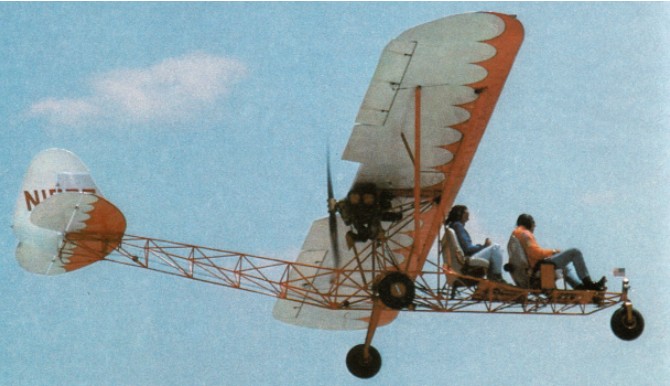
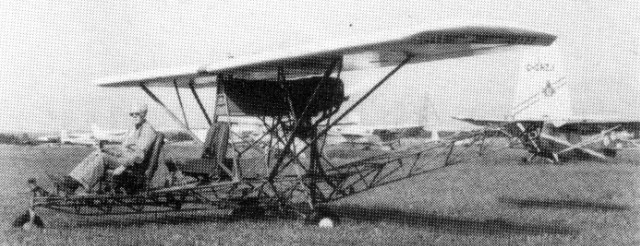
RLU RLU-1 Breezy / Breezy Aircraft RLU-1 Breezy

Designed and constructed by Charles Roloff, Carl Unger, and Bob Liposky, the Breezy was first introduced in 1965, and hailed as one of the most distinctive and unusual homebuilt designs to ever attend an EAA Fly-in.

RLU RLU-1 Breezy Article

The original Breezy was designed and built to accept a set of PA-12 wings. For that reason, there are no wing drawings with the plans. It is possible to substitute Champ, Taylorcraft, PA-14, PA-18, or J-3,4, or 5 wings. It’s also possible to order wing kits that replicate a J-3 wing. Breezy’s fuselage is an open framework steel tube truss. It is a three-place airplane with two seated abreast on the second seat, but it could easily be adapted as a single-seater or tandem two-seater.

Power for the prototype, which now hangs in the EAA Aviation Museum in Oshkosh, WI, is a Continental C-90. The original design utilizes a Piper Super Cruiser wing.

Plans could be purchased through:
Carl Unger, 8751 S. Kilbourn, Oak Lawn, IL 60456, USA.

Gallery

Engine 85-125hp
Span 33ft
Wing area 165 sq.ft
Length 22ft 5in
Max wt: 1200 lb
Empty wt: 700 lb
Fuel capacity 18 USG
Top speed 105 mph
Cruise 56kt
Stall 25 mph
ROC 500 fpm
Takeoff run 450 ft
Landing roll 450 ft
Range 250 mile
Seat: 2-3

Ritz Standard ‘A’

Strut-braced high wing monoplane, conventional tail, geodetic wing & tail construction. Landing gear: Tricycle. Price 1984: $2,495. Certified to PUMA standards.

Engine: 22 hp Zenoah
Wingspan 36’
Wing area 140 sq.ft
Empty weight 200 lb
Gross weight 500 lb
Cruise speed 30-50 mph
Stall speed 15mph
Vmax 65 mpg
Climb 400 fpm
Takeoff run 120 ft
Landing roll 200 ft
Setup time 15min

Riter Special

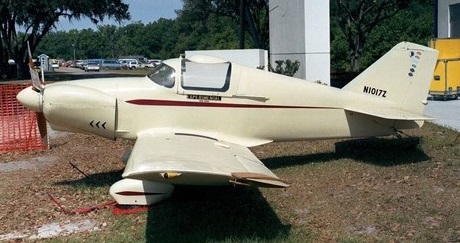
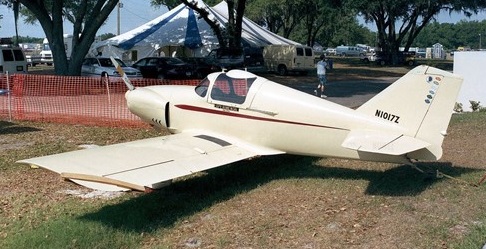
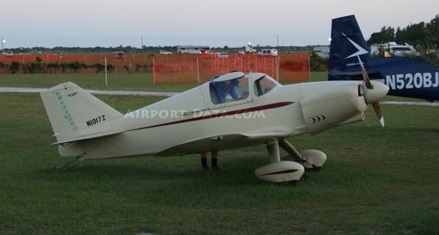
The Riter special is a single engine, low wing, single seat, retractable conventional landing gear aircraft. The wings fold upward for ground transport on a trailer. The landing gear is retracted by hand with a worm-gear mechanism.

First flown in 1961, the two seat aircraft was registered N1017Z Riter Special R.E.C. C/N 101.

Engine: Lycoming O-290 GPU
Maximum speed: 174 kn; 322 km/h (200 mph)
Cruise speed: 148 kn; 274 km/h (170 mph)
Crew: one

Rihn DR-109

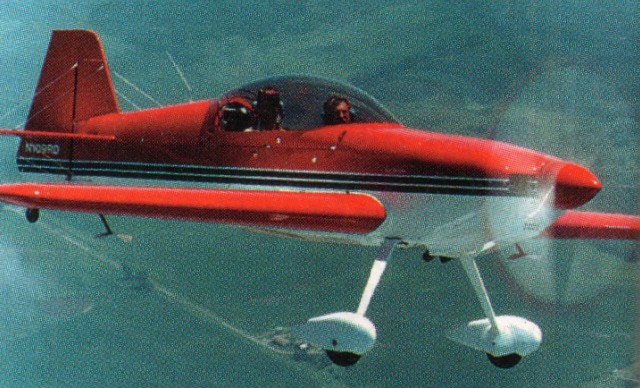
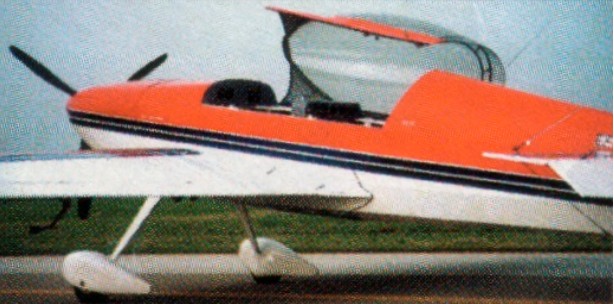
Dan Rihn’s Rihn 109 is a two-place tandem designed for aerobatic training, unlimited competition and airshow performances. Capable of handling Lycoming engines from 200 to 300 hp, the new design is said to feature excellent visibility, featherweight controls, a roll rate in excess of 360 degrees/second, and a load limit of +/- l0 G.

Construction of the DR-109 is a welded steel tube fuselage and tail group with fabric covering, fibreglass cowl, plywood covered wings, and a one piece spring steel gear. The wings feature Douglas Fir box spars and plywood ribs. The seats are adjustable in both the forward and rearward positions.

The Rihn 109 is designed with gyroscopic manoeuvres in mind.

Aircraft Spruce was selling the 109 in seven subkits. In 1996 the cost for the complete kit was US$50,000.

Engine: Lycoming, 200 hp
HP range: 200-300
Height: 5.5 ft
Length: 22 ft
Wing span: 24 ft
Wing area: 114 sq.ft
Fuel capacity: 30 USG
Empty weight: 1260 lb
Gross weight: 1950 lb
Top speed: 205 mph
Stall: 59 mph
Cruise: 168 mph
Range: 500 sm
Takeoff dist: 600 ft
Landing dist: 1500 ft
Seats: 2
Landing gear: tailwheel

Rihn One Design 107

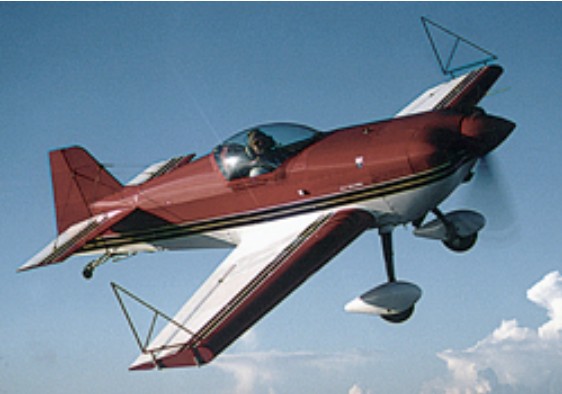
Designed by Dan Rihn as a plans built aircraft for single class competition aerobatics.

Created by Dan Rihn as an economical answer for pilots wishing to fly Basic through Advanced aerobatics, the One Design features quick, easy construction and excellent performance. Wings for the One Design are all wood, the fuselage is steel truss, covered with aluminum sheet from the firewall to the rear of the cockpit. The turtle deck is also aluminum and the lower half of the aft fuselage is fabric covered. The tail is fabric covered. A one piece aluminum spring gear is used for the main wheels and a steerable tailwheel is used.

Power for the One Design is obtained from a 0-360 and modified with an inverted oil system, high compression cylinders and fuel injection. Stressed for +/- 10 Gs, the One Design has a max. level speed of 184 mph, and cruises with a 75% power setting at 160 mph.

Aircraft Spruce & Specialty Company offers a complete set of plans for the single seat aerobatic aircraft.

Gallery

Engine: Lycoming AEIO-360, 180 hp
HP range: 150-200
Height: 5 ft
Length: 17 ft
Wing span: 19.3 ft
Fuel cap: 20 USG
Empty wt: 740 lb
MTOW: 1140 lb
Top speed: 195 mph
Cruise: 160 mph
Stall: 63 mph
Range: 350 sm
ROC: 2000 fpm
Seats: 1
Undercarriage: tailwheel

Engine: Lycoming AEIO-320
Wing span: 5.88 m
Wing area: 6.9 sq.m
MAUW: 517 kg
Empty weight: 336 kg
Fuel capacity: 76 lt
Max speed: 314 kph
Cruise speed: 257 kph
Minimum speed: 101 kph
Climb rate: 10 m/s
Seats: 1
Fuel consumption: 35 lt/hr
Plan price (1998): $300
Kit price (1998): $50,000