RWD RWD-2 / Warsaw University of Technology RWD 2

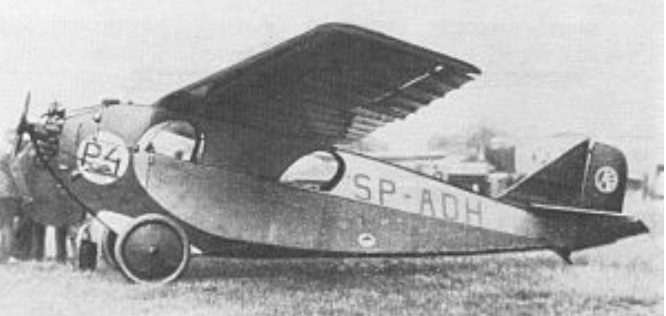
The RWD-2 was constructed by the RWD team of Stanisław Rogalski, Stanisław Wigura and Jerzy Drzewiecki in the Aviation Section of Mechanic Students’ Club of Warsaw University of Technology. It was a development of their first design RWD-1. Its feature was a unique, fish-shaped fuselage, with good aerodynamics, but without a direct view forward from the pilot’s seat. For this reason, they were later nicknamed: blind mice.

Wooden construction high-wing cantilever monoplane, conventional in layout. Fuselage rectangular in cross-section, plywood covered. Single-spar one-part wing of a trapezoid shape, covered with canvas and plywood in front. Cantilever empennage, covered with plywood (stabilizers) and canvas (rudder and elevators). Crew of two, sitting in tandem, with dual controls. The crew cabs were open on the sides in upper part, they had individual doors on the right side. Salmson 9Ad, 46 hp (40 hp nominal power), 9-cylinder air-cooled radial engine in front, driving two-blade metal propeller (wooden in the prototype). Conventional fixed landing gear, sprung by rubber rope, with a rear skid. Fuel tank 75 l in fuselage front (fuel consumption – 9.5 l/ flight hour).

The first prototype (registration SP-ACE) was completed and flown by the designer Jerzy Drzewiecki in July 1929. Since it appeared successful in sports flying, three more RWD-2s were built in 1930 (registration SP-ADJ, -ADG, -ADH).

In August-September 1929, Franciszek Żwirko and Stanisław Wigura flew the prototype across Europe, on the 5000 km Warsaw-Paris-Barcelona-Warsaw route (it was the first long foreign flight of the Polish-designed aircraft). On 16 October, 1929, Żwirko and Antoni Kocjan set an international FAI altitude record of 4,004 m (13,133 ft) in the light tourist plane class (below 280 kg / 616 lb empty weight).

Three serial aircraft took part in the Challenge 1930 international touring planes competition in July 1930. Stanisław Płonczyński took the 19th place, as the best Pole (for 35 qualified and 60 starting crews), and Edward Więckowski took the 21st place (the third Józef Muślewski was disqualified due to time exceeding, but he completed the rally off the contest). In the Challenge, RWD-2s won the trial of lowest fuel consumption (5.2 kg / 100 km). According to Flight, they “appear to possess particularly good air-sailing qualities”.

RWD-2s were also used in several Polish air competitions and other minor international ones, with some success. They were also used for training in the Polish Aero Club in Warsaw, Poznań and Vilnius. They were withdrawn in 1935 (one was bought by a private owner and flew for some time longer).

RWD-2
Engine: 1 × Salmson 9Ad, 46 hp (33.8 kW)
Length: 6.15 m (20 ft 2 in)
Wingspan: 9.8 m (32 ft 2 in)
Wing area: 13.6 sq.m (146.3 sq.ft)
Height: 1.9 m (6 ft 3 in)
Empty weight: 268 kg (590 lb)
Loaded weight: 450 kg (990 lb)
Useful load: 200-250 kg
Max. takeoff weight: 500 kg (1,100 lb)
Maximum speed: 155 km/h (96 mph)
Cruise speed: 130 km/h
Stall speed: 65 km/h
Range: 550 km (342 miles)
Service ceiling: 3,500 m (11,480 ft)
Rate of climb: 3 m/s, 180 m/min (590 ft/min)
Wing loading: 33 kg/sq.m (161.4 lb/sq.ft)
Take-off run: 120 m
Take-off run to 8.5 m: 260.5 m
Landing run from 8.5 m: 219 m
Crew: One, pilot
Capacity: One, trainee / second pilot
RWD RWD-1 / Warsaw University of Technology RWD 1

The RWD-1 was the first aircraft constructed by the RWD team of Stanisław Rogalski, Stanisław Wigura and Jerzy Drzewiecki in the Aviation Section of Mechanic Students’ Club of Warsaw University of Technology. It was designed in late 1927. The plane was built with a financial help of the LOPP organization. One prototype was built for static trials, and one flying prototype (registration SP-ACC), completed and flown by the designer Jerzy Drzewiecki in September 1928.

Wooden construction single-engine high-wing cantilever monoplane, conventional in layout. The fuselage rectangular in cross-section, narrowing in upper part, plywood covered. Single-spar one-part trapezoid wings, covered with canvas and plywood in front. Cantilever empennage, covered with plywood (stabilizers) and canvas (rudder and elevators). The crew of two sat in tandem. The crew cockpits were open on the sides in upper part, and had individual doors (first cockpit – on the right, second one – on the left). A 2-cylinder air-cooled 40 hp ABC Scorpion II boxer engine (34 hp nominal power) was in front, driving two-blade wooden propeller Szomański (1,5 m diameter). Conventional fixed landing gear, sprung with a rubber rope, with a rear skid. Fuel tank in fuselage front (fuel consumption 9 l/h).

Its unusual feature was a unique, fish-shaped fuselage, similar to early Messerschmitt’s designs (M17). Two crewmen sat in tandem inside the fuselage and had only side openings in its upper part. In front of the pilot’s head there was an upper part of the fuselage, supporting wings, limiting his view forward, though its profile was thin. This shape was repeated in following RWD designs. The aircraft was evaluated as a quite good design, with an original construction. It had high glide ratio of 12, and its payload was bigger than its empty weight. It was not built in any quantities, but gave a basis to further more successful RWD designs: RWD-2, RWD-3, RWD-4, RWD-7, and, partly RWD-5.

The prototype took part in the 2nd Polish Light Aircraft Contest in 1928, but did not complete it due to engine breakdown. In 1929 it undertook a raid around Poland. It was scrapped in winter of 1929/1930.
Description

RWD-1
Engine: 1 × ABC Scorpion II, 40 hp (53.6 kW)
Length: 6 m (19 ft 8 in)
Wingspan: 9.8 m (32 ft 2 in)
Wing area: 13.6 sq.m (146.3 sq.ft)
Height: 1.7 m (5 ft 7 in)
Empty weight: 206 kg (453 lb)
Loaded weight: 417 kg (918 lb)
Maximum speed: 135 km/h (84 mph/h)
Cruise speed: 115 km/h
Stall speed: 65 km/h
Range: 500 km (310 mi)
Service ceiling: 1,950 m (6,396 ft)
Rate of climb: 1.8 m/s, 108 m/min (354 ft/min)
Wing loading: 30.5 kg/sq.m (6.3 lb/sq.ft)
Take-off run: 100 m
Landing run: 130 m
Crew: One, pilot
Capacity: One, passenger / second pilot

Ruthenberg Schwingenflieger

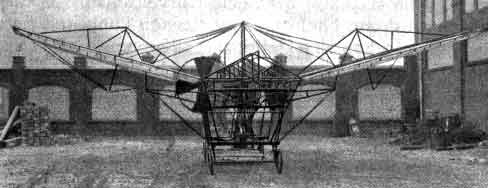
Ruthenberg built a flapping wing monoplane (‘Schwingenflieger’ in German) in 1909. In his complex construction the wings were moved (flapped) by rods moved by an engine which was mounted in the fuselage. The same engine also drove two pusher propellers in contrary motion. The undercarriage was fitted with a four wheel undercarriage. To make the tests of this machine less dangerous a small balloon was mounted in the fuselage, which as was said could lift the machine almost on its own. Tests revealed that the machine did not leave the ground.

Rutan SkiGull

Burt Rutan has designed and buil the SkiGull, his own light aircraft concept. The SkiGull is a small amphibious aircraft that fits in a single-car garage, after having folded its wings. The plane has a single engine located directly above the cockpit that is itself suspended from the wings in a gondola-like cabin.

The SkiGull has a retractable, flexible ski system. The skis provide five times the shock absorption deflection of a typical land plane, making it possible for the SkiGull to operate in considerably rougher environments than most other seaplanes. This includes the ability to perform water landings on beach waves and ocean crests.

Small wheels protrude from the bottom of the skis, making it possible to land on surfaces such as snow or grass.

According to Rutan, the SkiGull’s all-composite structure means he can avoid conventional structural design and fabrication methods. No specific details have been made available yet, he does give a hint: “For now all I can say is that its structure is more like nature than conventional.”

“It will be the last time I design and build an airplane, since I want to enjoy this one for myself,” said the 72-year-old Rutan.

Rutan SpaceShipTwo

The six passenger SpaceShipTwo is carried aloft by WhiteKnightTwo.

Virgin Galactic’s SpaceShipTwo made its second successful powered flight on 5 September 2013 from Mojave Air and Space Port in California.

SpaceShipTwo, funded by billionaire Richard Branson, was carried to an altitude of 42,000 feet attached to the “mothership” and then climbed to 69,000 feet under its own power before descending back to Mojave.

“In addition to achieving the highest altitude and greatest speed to date, the test flight demonstrated the vehicle’s full technical mission profile in a single flight for the first time … All of the test objectives were successfully completed,” the company said.

Rutan SpaceShipOne

Burt Rutan leads one of 27 teams from seven countries competing for the US$10 million (NZ$16 million) X Prize, to be given to the first private entrepreneur who can put three people into sub-orbital space and do it again with the same equipment within two weeks by the end of 2004.

The team is funded by Microsoft co founder Paul Allen.

SpaceShipOne will piggyback aboard a mother aircraft known as the White Knight, to an altitude of 48,000 feet (14,600 metres). On release, SpaceShipOne’s 18,000 lb thrust rocket engine burns for 80 seconds, accelerating the aircraft at three times the force of gravity to reach Mach 3.2 (3860kph) by the time the engine burns out at 160,000 ft (48,700m). Coasting the rest of the way, losing power and slowing down. At 200,000ft, the pilot and passengers in the future experience weightlessness, which lasts three to four minutes as the spacecraft attains its maximum altitude of 340,000ft, virtually stops, then falls back to 200,000ft (60,000m), when it begins to feel the atmosphere once again. The key is to decelerate gently in the upper atmosphere by controlling the angle during descent and maximising drag, making for a much safer and more comfortable ride.

SpaceShipOne, the rocket plane funded by Microsoft cofounder Paul G Allen, appeared to top its required altitude within minutes of firing its rockets in 2004. The plane took, off from a desert runway slung to the belly of a carrier plane with a test pilot at the controls. It was released at about 13,800m and fired its rockets to climb to an altitude of 100km.

Rutan Solitare

Rutan’s canard self-launching sailplane attracted much attention when it won the Sailplane Homebuilders Association Design Contest in 1982. The engine, with electric starter for air starting, erects from and retracts into a bay in the forward fuselage by means of electro-hydraulic power. The canard configuration is intended to make the ship virtually stall-proof as the canard stalls before the main wing, causing the ship to pitch nose-down and preventing the main wing from stalling. That, however, does not mean that mishandling cannot cause very high sink rates. The main wing has trailing edge flaps which also operate as spoilers by the leading edge coming above the top surface of the wing when deploying. The effective spoil flap trailing edge surfaces provide good glidepath control.

The Solitaire is a single-place, self-launching canard sailplane developed for recreational soaring, Landing gear is tandem wheels with wingtip rollers. It features a KSM 107-E. 22-hp engine and a retractable propeller. Its structure is all-composite, with prefab molded fuselage shells. Task Research was the manufacturer of the composite moldings kit for the Solitaire.

By 1990 the Rutan design stable of VariEze, LongEze, Defiant and Solitaire were no longer offered for sale.

L/D Max: 32 93 kph / 50 kt / 58 mph
Min Sink: 0.75 m/s / 2.5 fps / 1.48 kt
Wing span: 12.7 m / 41.75 ft
Wing area: 9.52 sq.m / 102.44 sq.ft
Empty Weight: 172 kg / 380 lb
Payload: 109 kg / 240 lb
Gross Weight: 281 kg / 620 lb
Fuel capacity: 5 USG
Wing Load: 39.52 kg/sq.m / 6.05lb/sq.ft
Aspect ratio: 10.78
Airfoil: wing inboard, Roncz 517, outboard 515
Min. flying speed 32 kts
Vmax 115 kts
L/D 32:1 @ 50 kts
Sink rate 150 fpm @ 40 kts
Takeoff run 960 ft
Landing roll 500 ft
Seats: 1

Rutan 40 Defiant / 74 Defiant

Sn 003

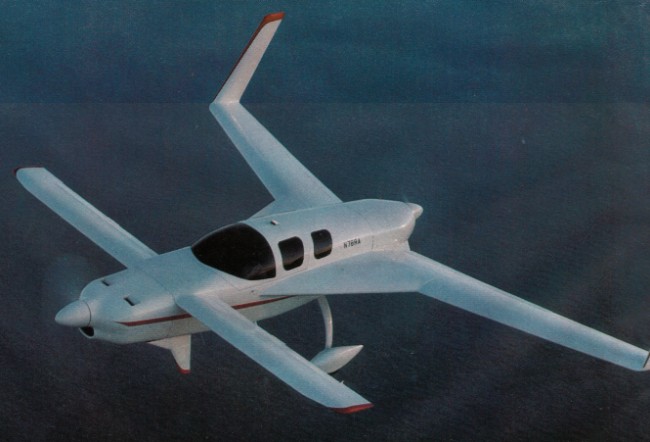
The Model 40 is the first of Rutan’s de-signs intended for the commercial market. It is an overgrown push-pull version of the VariEze, seating four plus baggage (or plus two children), using two Lycoming engines of 160 hp with fixed-pitch propellers. As on the VariEze, the Model 40’s main landing gear is fixed, but the nosewheel retracts. An all-flying rudder protruding from the bot-tom of the nose is connected in a very sim-ple manner to the turn-and-bank gyro and provides wing-levelling.

The prototype of this research aircraft, Rutan Model 40 Defiant s/n 001 N78RA, flew first on 30 June 1978. The Defiant was intended as a proof-of-concept of a very safe light twin design, requiring little trim change and no pilot action in case of engine failure, and with good single engine performance. In 1979, the Rutan Aircraft Factory announced they would proceed with certification of a Model 40 Defiant based light twin. Adequate financing was not secured for this project, and the design was modified for homebuilt construction as the Model 74.

In a significant gesture, Rutan presented his twin to the public not at Oshkosh, where his other designs made their de-buts, but at the National Business Aircraft Association meeting. Rutan has had to insist that the Defiant now flying is a “proof of concept,” composite construction prototype rather than a preproduction prototype. Some features that would be necessary in a marketable airplane, such as doors and entry steps, have been omitted in favor of a structurally simple hinged canopy. This free-blown canopy, furthermore, is semi-circular in section and hat, imposed that shape upon the top half of the fuselage, which in a production airplane would have a more squared-off section for better headroom. The cabin, which in fact is as wide and long as any light twin’s, though shallower, is very hard to get into and out of; and, because of the incorrect roof shape and a not very astute placement of armrests and consoles, it is less than comfortable to sit in. If its present empty weight of about 1,500 pounds rose to 1,700 in a production airplane, the Defiant would continue to perform superbly.

The Defiant has fixed landing gear, fixed- pitch props and no flaps; when an engine fails, the pilot merely goes on flying as before. The whole problem of fast reaction of identifying the bad engine, feathering, retracting gear and flaps and of precisely holding a certain airspeed disappears. The wings are swept in order to move their center of lift aft with respect to the rear engine, and to put the vertical sur-faces as far aft as possible for considerations of general arrangement, in short, not aerodynamic refinement.

To this add cruising speeds of over 170 knots at economy settings, astonishing rates of climb and excellent hands-off stability, as well as a useful load that can handle both full cabin and full fuel, and you have an airplane that promises to do everything well. You also have a potentially powerful competitor in the light-twin market, and one that demonstrates convincingly an alternative to conventional airplane design. The Defiant could por-tend a revolution comparable in importance to the abandonment of the biplane in favor of the monoplane.

What makes the Defiant a performer is its light weight and small size. Its span loading (the quotient of weight and wing-span, and a powerful determinant of climb rate) is about the same as that of the Cougar, Duchess and Seminole; but, with the same engines and a gross weight 1,000 pounds lower, the Defiant climbs better than they do on two engines (it takes it 11 minutes to go from sea level to 12,000 feet at gross weight) and at least as well on one. With centerline thrust, like the Cessna Skymaster’s, the Defiant escapes the asymmetry problems of conventional twins. Its power loading is good even on one engine: at moderate weights, in fact, it is that of a 172. Fixed-pitch props mean that you get the best performance at high altitudes.

The Defiant is economical not only in flight performance, but also in design and construction. The choice of fixed-pitch wooden propellers, fixed gear and extremely simple systems is part of Rutan’s ruling philosophy of design: less is more.

There are two separate electrical systems – two batteries, two alternators and two busses – for true redundancy. The fuel system is simple, and the last 45 minutes of fuel are measured and reported with extra accuracy. The control system is as simple as they come: the actuating rods for the elevators (on the front wing, or canard) and the ailerons (on the main wing) are contained mostly within the fuselage.

Model 74 Defiant

Work began on production Defiant Model 74 in 1982.

Rutan had been saying he would never release the Defiant as a homebuilt but Fred Keller arrived at the 1983 Oshkosh in his homebuilt Defiant.

Plans were offered in mid-1984.

By 1990 the Rutan design stable of VariEze, LongEze, Defiant and Solitaire were no longer offered for sale.

Gallery

Engines: 2 x Lycoming O-320, 160 hp
TBO: 2,000 hr
Props: wood, fixed-pitch, 69-inch diameter
Length: 23 ft
Height: 1.9 ft
Wingspan: 29 ft
Wing area (total lifting surface): 127 sq. ft
Wing loading (total lifting surface): 23 lbs. per sq. ft
Power loading: 9 lbs. per hp
Seats: 4
Empty weight: 1,525 lb
Useful load: 1,375 lb
Payload with full fuel: 835 lb
Gross weight: 2,900 lb
Usable fuel capacity: 90 USG/540 lb
Maximum landing weight: 2,900 lb
Maximum rate of climb: 1,650 fpm
Single-engine rate of climb: 330 fpm
Single-engine climb gradient at 85 knots (Vyse): 233 ft. per nm
Single-engine service ceiling: 7, 100 ft
Maximum speed: 196 kt
Max cruise, 70% power (2,800 rpm) at 9,500 ft: 188 kt
Econ cruise, 55% power at 12,000 ft: 170 kt
Duration at max cruise: 5 hr
Duration at econ cruise: 6.5 hr
Stalling speed, clean: 64 kt

Rutan 61 Long-Ez

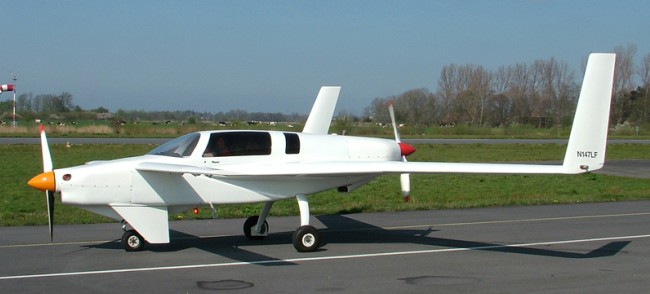
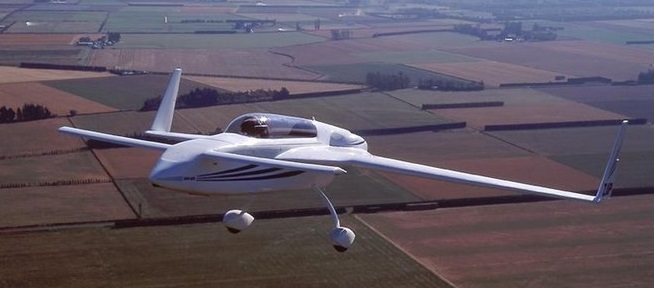
Rutan’s Long-EZ is a larger, heavier version of the VariEze built around the 115-hp Lycoming engine. The airframe will accept 115 to 180 hp. It has over four feet more wingspan and nearly half again the wing area of the VariEze. It takes off in 100 feet less distance and lands in only slightly more than half the distance of the original VariEze. While identical in length — 100 inches — the Long-EZ version is two inches wider.

Final flight-testing of No. 1 Long EZ, N79RA, was done in December 1979.

During one record flight, Dick Rutan logged 52.2 hours on a two-week round trip to Florida from Mojave, averaging a 183 mph airspeed. The Rutan factory estimates that the Long-EZ can be built by relatively competent builders in 800-1000 man-hours or nine months of spare time.

None of the VariEze series has been designed for training purposes. The back seat has a slide control stick, and that was all. There were no rudder pedals or brakes, no throttle, no mixture control, no radio and no intercom in back.

The capabilities of the Long-EZ are indicated by two class records established by Dick Rutan, the designer’s brother: a closed-circuit distance record of 4800.3 miles (7725.3 km) and a straight-line distance record of 4563.7 miles (7344.56 km).

In 1980 cost was US$198,50 at the RAF (Rutan Air Factory) for a set of homebuilder’s plans. In the first five months since long EZ plans have been available, more than 300 sets have been sold.

By 1990 the Rutan design stable of VariEze, LongEze, Defiant and Solitaire were no longer offered for sale.

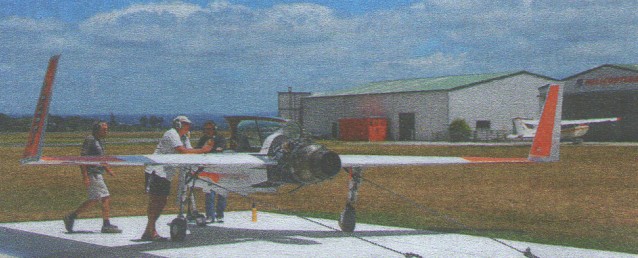
A rocket powered version of the Long-Ez flew at Mojave in 2002 (see XCOR Aerospace EZ-Rocket).

A 2000 lb thrust jet engine Longeze achieves and initial climb rate of 10,000 fpm.

Longeze jet

Variation:
Shaw Twin-Ez
Task Vantage / Sneeky Pete

Rutan Long-EZ
Engine: Lycoming O-235, 108 hp
Fuel type: 80
Propeller makellype: fixed-pitch, wood
Landing gear: fixed main, retractable nose
Gross weight: 1325 lb
Max landing weight: 1300 lb
Empty weight std: 700 lb
Useful load std: 625 lb
Payload full Std. fuel: 313 lb
Fuel capacity std: 52 USG
Wingspan: 26.3 ft
Wing area: 94.8 sq.ft
Wing loading: 14.0 lb/sq.ft
Power loading: 12.3 Ibs/hp
Seating capacity: 2
Cabin doors: Opening conopy
Cabin length: 100 in
Cabin width: 24.2 in
Max level speed: 190 kt / 220 mph
Never exceed: 190 kt / 220 mph
Cruise speed Best Power 75 % power 8500 ft: 161 kt / 185 mph
Cruise speed Best Power 60 % power 12,500 ft: 148 kt /170 mph
Cruise speed Best Power 40 % power 12,500 ft: 127 kt / 146 mph
Max range w/res 75 % power 8500 ft: 1130 nm / 1298 sm
Max range w/res 60 % power 12,500 ft: 1460 nm / 1677 sm
Max range w/res 40 % power 12,500 ft: 1848 nm / 2125 sm
Fuel consumption 75 % power 8500 ft: 6.7 USgph
Fuel consumption 60 % power 12,500 ft: 4.9 USgph
Fuel consumption 40 % power 12,500 ft: 3.4 USgph
Estimated endurance 60 % power: 10:37 hr
Stall speed flops up, gear up: 68 mph
Stall speed flops down, gear down:: 66 mph
Best rate of climb: 1150 fpm
Absolute ceiling: 26,900 ft
Service ceiling: 17,000 ft
Takeoff ground run: 775 ft
Takeoff over 50-ft obstacle: 1600 ft
Landing ground roll: 780 ft
Landing over 50-ft obstacle: 1800 ft

Rutan 31 Varieze

The same basic concept of the model 27 was retained in the Model 31 VariEze. The type was designed in 1974, and the construction of a prototype GRP two-place tandem design took Rutan just 10 weeks to complete. Rutan built two prototypes in succession; the second incorporated several major changes. When the larger O 200 engine was installed on the second prototype (the first had a VW), the additional torque produced an unpleasant wing heaviness under power. So Rutan added an electric trim tab on the right wing, rudder trim, a fuselage mounted drag brake, and a pair of small inboard spoilers on the rear wing roots that both quicken the roll response and eliminate the unwanted pitch. With a manually retractable nosewheel, its handling and approach qualities are now more or less conventional, with a bit more reliance on rudder for roll, and a bit less concern with keeping the ball centered, than we’re used to.

Rutan 31 VariEze Article

A lot of experimental work was necessary, but the VariEze is a radical departure from conventional methods in aerodynamic and structural design. An alteration was the replacement of the VariViggen’s electrically retracted tricycle landing gear arrangement by a tricycle arrangement with a mechanically retracted nose unit and fixed main units with glassfibre legs. The nose unit can be retracted on the ground, a feature that eases access to the cockpit, provides greater propeller clearance for manual starting, and removes the need for chocks. The complete airframe is made of unidirectional glassfibre over a foam core.

This sleek, fast, lightweight homebuilt is capable of achieving a top speed of 210 mph with Continental’s 100-hp engine. The unusual aircraft combines the use of a NASA GA (W)-1 airfoil with Whitcomb winglets and was actually the first aircraft to fly with the latter. The wing is a nonlaminar flow airfoil optimized for good lift and stall qualities. The ship’s low induced drag lets the pilot negotiate steep, 90-degree banks with strong spiral stability. First flew, in prototype form, in May 1975. In its refined form, with its retractable nose leg which had to be retracted to gain cabin entry, could cruise comfortably at 140 mph when propelled by 100 horsepower.

Rutan claimed that a VariEze could be built in 600 hours. By contrast, 2,000 to 3,000 hours had always been the average for completing a conventional homebuilt. Structural strength was provided by epoxy fiberglass skins and spars that were laid up over cores of light plastic foam. The wings consisted of several foam cores cut from blocks with an electrically heated wire and joined end to end. A chunk the shape of the box spar was cut out of the assembled wing core, and the spar webs laid up around it. Then the still wet spar core was reinserted in the wing core, the multilayer spar caps laid down, and the wing skins laid down over the whole works. One side of a wing was skinned and allowed to cure. Then the wing was flipped over and the other side laid up. Rather than conventional plans, Rutan put out an instruction book in which verbal instructions replaced blueprints, and the builder was led, step by step, from the beginning of the project to the end.

First offered to homebuilders in the summer of 1976, VariEze plans were bought by more than 2,000 prospective homebuilders within six months; and in that same period, the first buyer built airplanes were already flying.

In the meantime, several companies put portions of VariEze kits on the market.

By 1979, of the 3,000 buyers of plans, 1,800 have bought some sort of kit; about 100 VariEzes were flying, and hundreds more are near completion.

The hot wire cut polystyrene foam cores used for flying surfaces were easy to work with, though a few errors in the plans did lead to irritating minor discrepancies in final assembly. These were corrected piecemeal in Rutan’s frequent newsletter.

The VariEze’s performance is not a free lunch. You pay for it in somewhat peculiar handling qualities. The seating is comfortable but quite supine; that plus a narrow bubble canopy makes it difficult to turn your head. The pi¬lot, who sits in front and commands the only controls, can barely communicate with the passenger, even using simple ideas and loud shouts.

The pilot’s controls in the first of the two prototypes were uniquely simple: a small side stick on the right armrest was connected directly to movable surfaces on the canard to provide both pitch and roll control. There were no movable surfaces on the main wings. Rudder pedals controlled outward going rudders on each wingtip; pressed farther, they activated wheel brakes as well. A simpler, lighter control system could not be devised. But the plane was hard to fly; its glide was so flat and it floated so far in experienced hands that it required a 3,500 foot runway; roll response was liable to be nullified completely by a touch of the wrong rudder and apt to include a bit of unwanted pitch in the bargain.

By 1990 the Rutan design stable of VariEze, LongEze, Defiant and Solitaire were no longer offered for sale.

Gallery

Prototype N7EZ
Propeller type: fixed pitch wood
Wingspan: 21 ft
Useful load: 481 lb
Fuel capacity: 14 USG
Cruise (75 %): 173 mph
Stall: 76 mph
Max tinge (75 %): 580 sm
Best climb rate: 1100 fpm
Service ceiling: 14,000 ft
Wing loading: 14.9 lb/sq.ft
Landing gear type: fixed main, ret. nose
Seats: 2

Engine: Rolls Royce 0200A
Prop: Hendry 56×70
Cruise: 130-150 kt

Engine: 1 x 100-hp (74.5kW) Continental 0-200-B
Seats: two seated in tandem.
Maximum cruising speed 195 mph (313 km/h) at optimum altitude
Initial climb rate 1600 ft (487 m) per minute
Range 850 miles (1368 km)
Empty weight: 580 lb (263 kg)
Maximum take-off 1050 lb (476 kg)
Wingspan 22 ft 2.5 in (6.77 m)
Length 14 ft 2 in (4.32 m)
Wing area 53.6 sq.ft (4.98 sq.m)
Canard foreplane area 13 sq.ft (1.21 sq.m)
Fuel capaci¬ty 26 USG
Takeoff run 900ft
Landing roll 900ft
Range 700miles

Engine: Lycoming O 235
Max speed: 180 kt at sea level
ROC: 800 fpm
Gross wt: 1,050 lb

Engine: Lycoming O 320
Empty weight: 772 lb
Gross wt: 1,350 lb