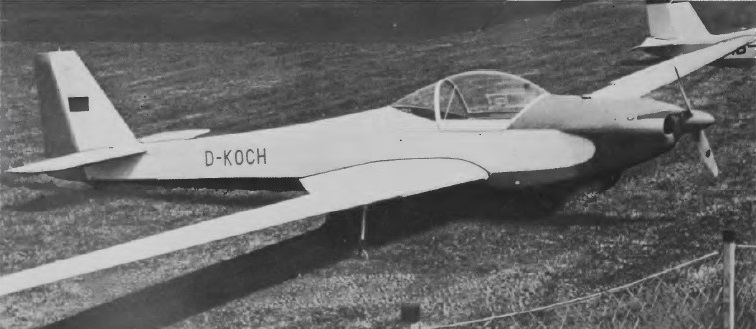
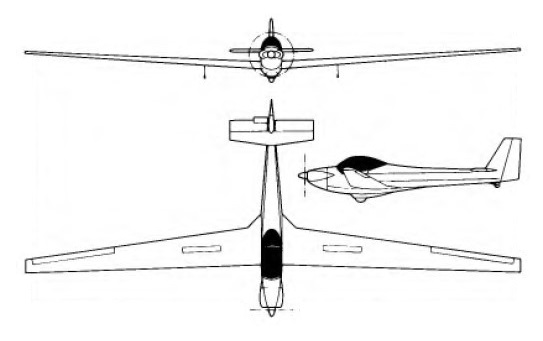
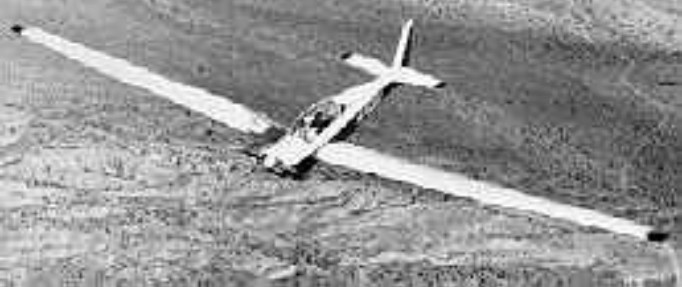
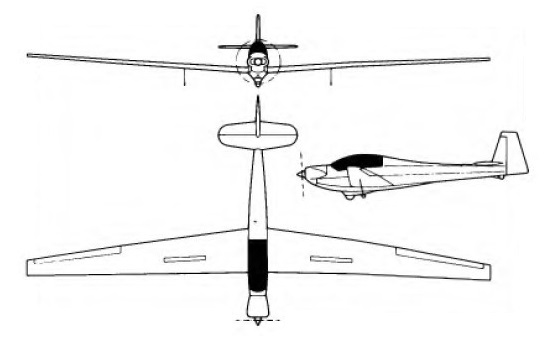
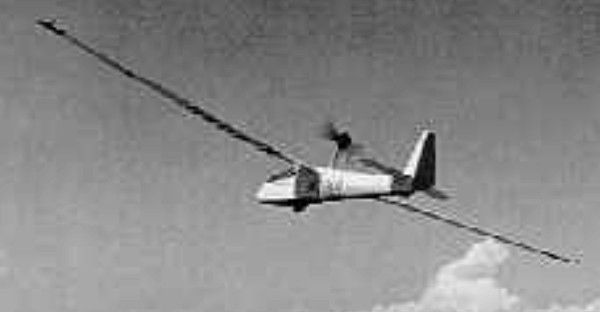
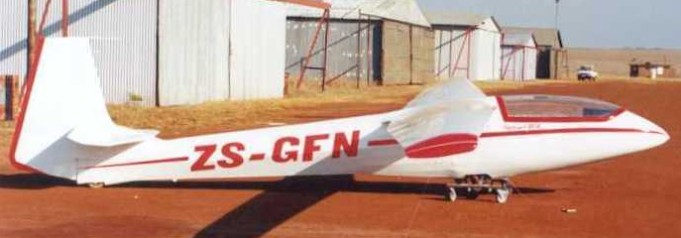
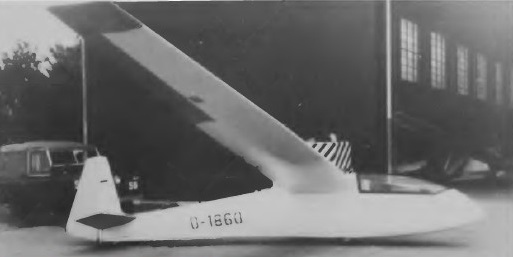
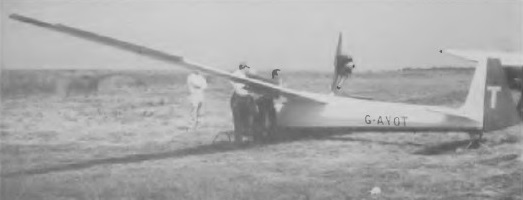
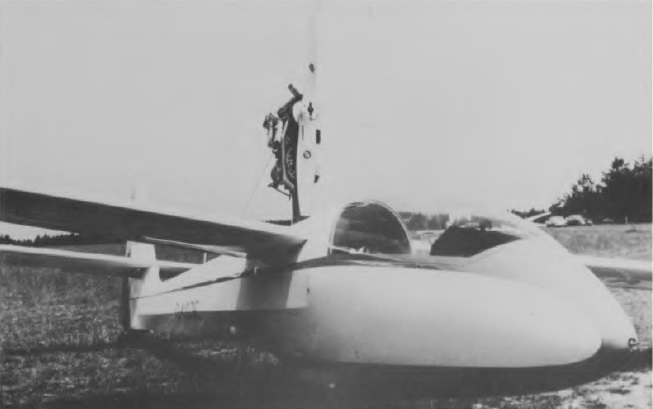
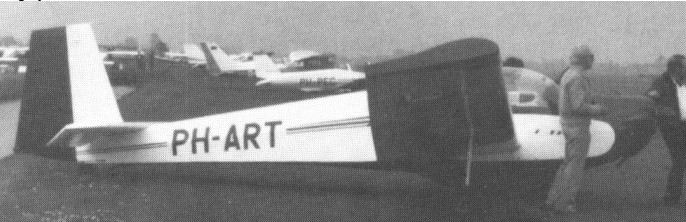
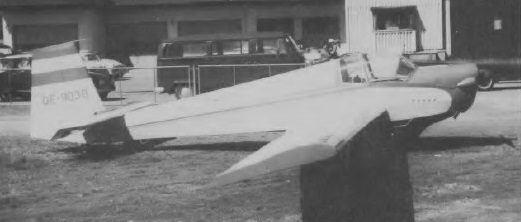
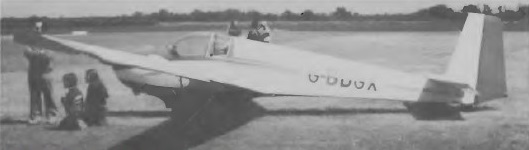
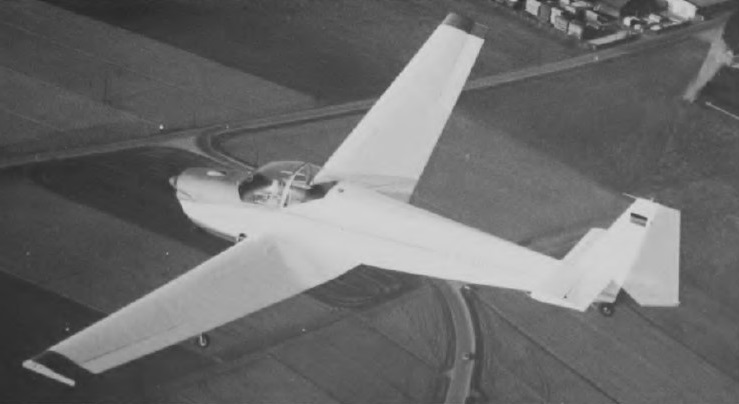
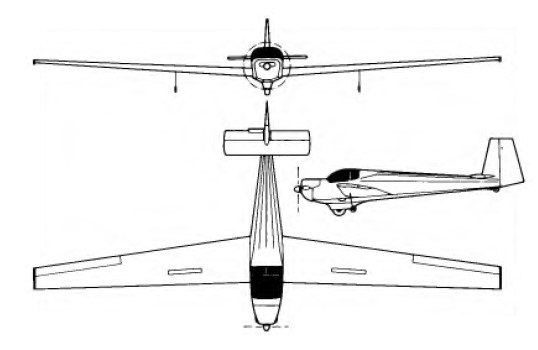
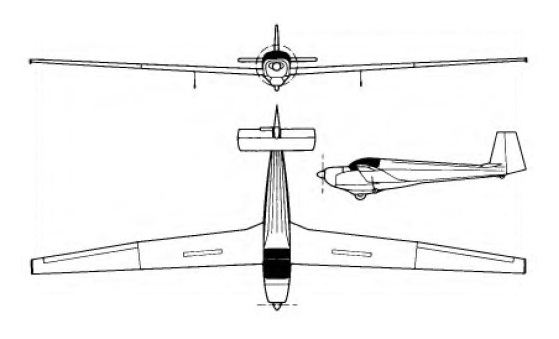
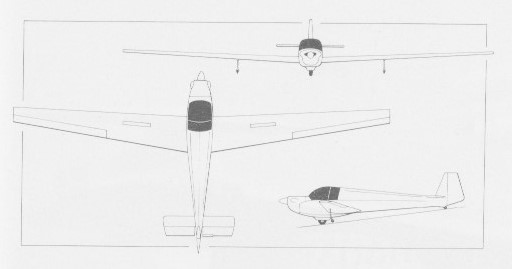
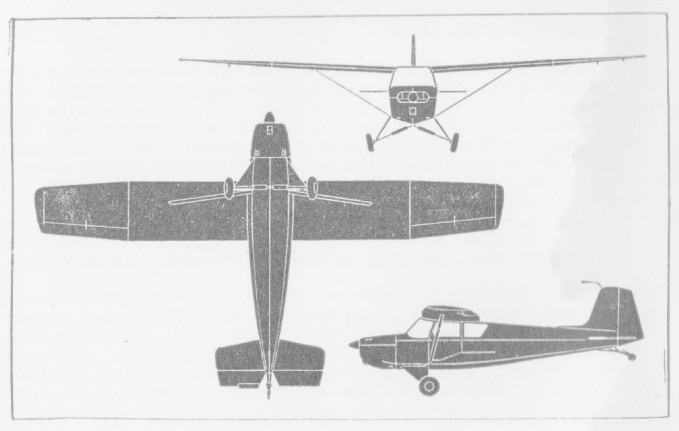
This single-seater motor glider was developed from the earlier SF-29 and is intended especially for training and powered cross-country flying, and for use by clubs as well as private owners.
It made its first flight in 1977, and although it did not go into production it was aimed at filling the gap between the two-seater SF-25 Falke variants and the higher performance single-seat powered gliders such as the PIK-20E and Nimbus 2M; it was also designed for ease of handling by the less experienced pilot. Like the earlier SF-25 Falke variants which it resembles, the SF-33 is a cantilever low-wing monoplane of basically wooden construction; the fuselage is a steel tube framework covered with plywood and fabric, and the engine cowling panels are of glassfibre reinforced plastic. The two-piece wings have plywood leading edges and wooden ailerons, and there are spoilers in the wing upper surfaces. The wooden tail unit has a trim tab in the starboard elevator. The landing gear consists of a fixed monowheel, a steerable tailwheel linked to the rudder for taxying, and two detachable outrigger wheels under the wings. The pilot sits under a large blown canopy that opens sideways to starboard and gives excellent all-round visibility. Powerplant is a 900cc BMW two-cylinder motorcycle engine derated to 35hp and driving a Hoffman two-blade variable pitch propeller; total fuel capacity is 4.8 Imp gallons.
The SF-33 is self-launching, and its gliding performance is claimed to be comparable to that of the Schleicher Ka 8.
Engine: BMW 900 cc, 26 kW (35 hp) Span: 15.0 m / 49 ft 2.5 in Length: 6.75 m / 22 ft 1.75 in Height: 4 ft 9 in Wing area: 12.5 sq.m / 134.5 sq.ft Aspect ratio: 18.0 Wing section: Scheibe Empty weight: 300 kg / 661 lb Max weight: 410 kg / 904 lb Water ballast: None Max wing loading: 32 kg/sq.m / 6.55 lb/sq.ft Max speed: 106 mph / 92 kt / 170 km/h (in smooth air, power off) Max cruising speed: 93 mph (power on) Stall speed: 36 kt / 67 km/h Min sinking speed: 0.85 m/sec / 2.79 ft/sec at 50 mph / 43 kt / 80 km/h Best glide ratio: 29:1 at 47 mph Take-off run: 150-200 m / 490-655 ft Rate of climb: 150 m/min / 492 ft/min Range with max fuel: 186 miles / 300 km / 162 nm
The Tandem-Falke is a development of the SF-25C Falke wth the two seats in tandem positioned over the wings under a lengthened one-piece perspex canopy, instead of the side-by-side layout of the earlier Falke series. The Tandem-Falke can be flown solo from the front seat, with space for up to 198lb of baggage on the rear seat.
Design work on the SF-28 began in 1970 and the prototype, registered D-KAFJ, made its first flight in May 1971, powered by a 45hp Stamo MS 1500 modified Volkeswagen engine. The production SF-28A has a 65hp Limbach SI 1900EA1 engine, the same as fitted to the SF-25C Falke but fitted to drive a Hoffman two-blade variable-pitch feathering propeller; a fixed-pitch prop was available as an option and the fuel capacity totals 8.8 Imp gallons. Full electric system and starter were standard equipment.
Scheibe SF-28A Tandem-Falke
The type has the same basic wooden construction with fabric covered welded steel tube fuselage as the SF-25 Falke series; both wing span and length are slightly greater than the SF-25C’s, the fin and rudder are now unswept. The single-spar wooden wings have spoilers in the upper surfaces and no flaps; there is an outrigger stabilising wheel on a nylon leg under each wing, as well as a faired non-retractable monowheel with internal brake and a steerable tailwheel. There is a trim tab in the elevator.
Altogether 112 Tandem-Falkes had been built by January 1980 and the Tandem-Falke has competed in the German Motor Glider Competition. In 1973, SF-28A’s took the first four places in the two-place class of the international motorglider contest at Burg Feuerstein in Germany. One flown by Peter Ross set up two United Kingdom records for motor gliders in 1976.
Scheibe’s first postwar essay into the high performance field was the Zugvogel (or Migratory Bird) single-seat sailplane which had laminar flow wings of NACA 63-series section and with a forward sweep of 2.5°. This made its competition debut when it was flown by veteran test pilot Hanna Reitsch into the winning place in the 1955 German National gliding championships. It had the traditional Scheibe fabric-covered steel tube fuselage (with a fiberglass nose section) and wooden single-spar wing and tail surfaces, all-flying tail, the wing span being 16m (52 ft 6 in) with an aspect ratio of 18.3 and area of 150.16 sq ft. The Sf-27A has Schempp-Hirth type dive brakes and semi-reclining seating. The wing ribs are spaced only 4 inches apart and heavy plywood skins cover 85 % of the surface in order to help maintain the laminar profile.
Next version as the Zugvogel-II, which had an unswept wing of simpler construction, a simplified control system and various other changes over the initial version. This was developed into the Zugvogel-III, which first flew in prototype form in April 1957 and which differed from the Mk II only in having the wing span increased to 17m (55ft 9in) and a larger fin and rudder, the aspect ratio now being 20.0 and wing area 155.9sq ft. Further versions were the Zugvogel-IIIA and IIIB, the latter version, the prototype of which was completed in June 1962, having a redesigned nose and cockpit canopy, the stepped canopy of earlier versions being replaced by a longer flush fitting one-piece plastic canopy blending into a shorter, more pointed nose. The high cantilever wings have Schempp-Hirth aluminium air brakes, and depending on the degree of surface polishing the best glide ratio can be improved from 36:1 at 62 mph to 39:1.
Helen Dick flew a -3B to set the following U.S. national feminine single-place records: Distance (492.2 km./ 305.84 miles), goal (364.6 km/ 226.57 miles) and Out & Return (400.00 km./ 248.82 miles) between 1964 and 1967.
Zugvogel-III
The SF-27 Zugvogel V, the prototype of which first flew on 12 May 1964, is a single-seat Standard class development of the Mk IIIB with cantilever shoulder instead of high wings of 15m (49 ft 2.5 in) span and Wortmann aerofoil sections; the tailplane is now an all-moving surface and more glassfibre is used in the fuselage structure. The wings have a single laminated beechwood box spar and plywood ribs, with a leading edge torsion box; the outer halves of the wings are plywood-covered, and the inboard halves are ply-covered to just behind the spar, the rest of the wings being part plywood- and part fabric covered. The wooden ailerons are ply-covered and the Schempp-Hirth air brakes are of glassfibre and metal. The welded steel tube fuselage has the nose section back to the wing trailing edge covered with moulded glassfibre shell, and the rear section fabric covered over wooden stringers. There is a moulded glassfibre fairing over the wing/fuselage junction. The cantilever tail unit is of wood, with a ply- and fabric-covered tailplane, the fin is plywood-covered and the rudder fabric-covered; there is an antibalance tab in the tailplane. Landing gear consists of a non-retractable and unsprung monowheel ahead of the eg, with a brake, and a tailwheel. The pilot sits in an inclined seat under the moulded Plexiglas canopy, and there is a baggage compartment behind the seat.
Scheibe SF-27 Zugvogel V
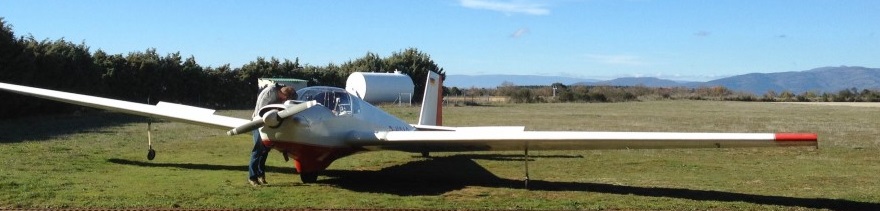
The SF-27M, designed in 1967, is a single-seater powered version of the SF-27 Zugvogel V, and was an early example of the completely retractable powerplant installation, the 26hp Hirth Solo vertically-opposed four-cylinder engine being mounted just aft of the wings and retracting backwards into the centre fuselage behind closed doors. This retractability gives the SF-27M about the same soaring performance as the Zugvogel V, and makes it capable of self-powered take-off as well as normal launching by winch or aero-tow; the engine installation weighs only about 88lb, so its effect on soaring performance is minimised.
Scheibe SF-27M
The SF-27M is structurally similar to the Zugvogel V except that the fuselage centre section has been modified to take the engine, increasing the overall length, and the wings and control surfaces have been strengthened internally; the main wheel tyre size has also been increased. The engine is raised into position and retracted manually by a crank-driven draw chain pushrod system, swinging up into its operating position; raising and lowering it is very simple, requiring only 3.5 turns on the crank and being completed in five seconds. The doors over the engine and propeller bay open and close automatically while this is being done, the two-blade propeller of about 4ft 5in diameter being stopped in the vertical position for retraction. Engine starting is by a hand-operated cable, and a specially-designed ignition system facilitates easy starting. A fuel tank of 4.4 Imp gallons capacity is mounted in the fuselage behind the pilot.
The first Distance Diamond award for a powered sailplane flight was granted by the German Aero Club to Willibald Colle, who flew his SF-27M a distance of 334 miles from Elz to Le Rabot airfield, France, on 28 July 1968. Colle took off under his own power just before 11am, climbed to about 3,000ft and switched off and retracted the engine; he covered the distance to Le Rabot in about eight hours at between about 2,500 and 6,000ft, and the special barograph installed confirmed that the flight had been made without assistance from the engine. The SF-27M also won the single-seater class at the German Motor Glider competitions held in 1970 and 1971.
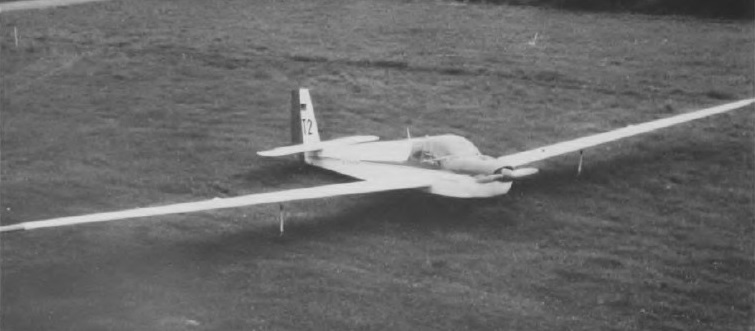
About 30 SF-27Ms were built. It was succeeded by the SF-32, also a single seater, which first flew in prototype form in May 1976 and is basically very similar, being powered by a 40hp Rotax 642 ‘flat twin’ two-stroke driving a fixed-pitch two-blade wooden propeller, and mounted on a pylon and retracted into the fuselage in the same way as the SF-27M’s but electrically instead of manually. The cantilever shoulder wings, which are built in two parts, are of 17m (55ft 9.25in) span instead of the SF-27M’s 15m span, and are basically the same as the Swiss Neukom Elfe 17’s, with an aluminium alloy main spar and a glassfibre and plywood/foam sandwich skin. There are Schempp-Hirth air brakes in the upper surfaces but unlike the Elfe 17 – no provision for water ballast. The fuselage is very similar to the SF-27M’s and Zugvogel V’s, being a welded steel tube structure with the nose section covered with a moulded glassfibre shell back to the wing trailing edge, the rear section being fabric-covered. The tail unit is very similar to the SF-27M’s, with a geared anti-balance tab in the all-moving tailplane. Only the prototype SF-32 was built.
Scheibe SF-32
The Zugvogel V is built under licence in France by Lorraine Aviation as the Loravia LA-11 Topaze, this company having taken over production of the type from SLCA, which had built nine SF-27s under the designation SLCA-10 (now LA-10). The LA-11 has the monowheel lowered by 80mm and first flew on 15 October 1973; 18 LA-11s were built by SLCA and Loravia had built 30 by early 1976.
Zugvogel V Span: 49 ft 2.5 in Length: 23 ft 3.5 in Wing area: 129.9 sqft Aspect ratio: 18.6 Empty weight: 474 lb Max weight: 728 lb Min sinking speed: 2.10 ft/sec at 46 mph Best glide ratio: 34:1 at 55 mph
Scheibe SF-32 Engine: Rotax 642, 30 kW (40 hp) Span: 17.0 m / 55 ft 9.25 in Length: 7.0 m / 22 ft 11.5 in Height: 1.25m / 4 ft 1.25 in Wing area: 13.3 sq.m / 143.2 sq.ft Wing section: Wortmann FX-61 -163/60-126 Aspect ratio: 21.73 Empty weight: 340 kg / 750 lb Max weight: 450 kg / 992 lb Water ballast: None Max wing loading: 33.8 kg/sq/m / 6.92 lb/sq ft Max speed: 136 mph / 119 kt / 220 km/h Stall speed: 36.5 kt / 68 km/h Min sinking speed: 0.65 m/sec / 2.1 ft/sec at 50 mph / 43.5 kt / 80 km/h Best glide ratio: 37:1 at 56 mph / 48.5 kt / 90 km/h Max rate of climb at S/L: 120m/min / 394 ft/min Take-off run: 200 m / 656 ft Range: 186 miles / 300km / 162nm
Following the successful development of the SF-24 Motorspatz powered glider from the L-Spatz-55 and L-Spatz-III single-seater sailplanes, it was a logical step to produce a two-seater motor glider based on the Bergfalke III. This emerged as the SF-25 Motorfalke which, in its original A-model form, had a cantilever high-set wooden wing with Schempp-Hirth air brakes similar to that of the Bergfalke III but, unlike the sailplane, was a side-by-side rather than a tandem two-seater. The two-place self-launching SF-25 Falke features spoilers, a steerable tail wheel and wing outrigger wheel for taxiing. The engine is mounted forward of the cockpit in conventional tractor style.
Powerplant was a 28hp Hirth-built Solo ‘flat four’ air-cooled two-stroke engine in an installation very similar to the SF-24B Motorspatz, and with a fuel tank of 5.5 Imp gallons capacity. The fuselage aft of the cockpit was very similar to the Bergfalke III’s, being the traditional Scheibe fabric-covered welded steel tube structure, and the wooden tail unit and fixed monowheel landing gear were also similar to the Bergfalke’s. The two pilots have dual controls as standard and the Motorfalke went into production, a total of 25 having been built by early 1966. First flying in 1963, although it had certain flaws, 50-odd were produced over the next few years.
Later versions of the SF-25, now known simply as the Falke (or Falcon), had low-set two-piece cantilever wooden wings developed from the Motorfalke’s with air brakes in the upper surfaces and slight forward sweep.
SF-25B Falke
The 1967 SF-25B’s span was now 50ft 2.5in and aspect ratio 13.4, compared with the Motorfalke’s 54ft 5.5in span and aspect ratio of 16. A more powerful engine was fitted, the forward fuselage underside fairing for the fixed monowheel with brake was revised in shape and outrigger stabilising wheels were fitted under each wing, so that the SF-25B was almost a different aeroplane to the Motorfalke, although just as suitable for basic and advanced training. Its powerplant was a 45hp Stamo MS 1500-1 modified Volkswagen ‘flat four’ engine which also incorporated some Porsche parts; this was started on the ground or in the air by a pull-cable starter in the cabin, with an electrical starter available as an optional extra and the fuel capacity was 8.5 Imp gallons. Scheibe lowered to wing to the bottom of the fuselage, incorporated supporting wheels under the wings to allow for independent takeoffs. Another optional extra for the SF-25B is a tow-hitch for winch-launching. The tail unit is of wooden construction and there is a steerable tailwheel; dual controls are standard. The maximum all-up weight was also increased to 555kg. Nearly 400 B-Falkes were built before the C-version was released in the early 70s.
Scheibe SF-25B Motorfalke
About 200 SF-25Bs had been built by Scheibe, about 10 more by Aeronautica Umbra Sppp in Italy, plus 35 by Vickers-Slingsby, who are producing a modified verison of the B as the T61E Venture T Mk 2 for the Air Training Corps. The SF-25 Motorfalke was licence built from 1970 by Slingsby Sailplanes Ltd in UK as Type 61 Falke. Slingsby developed a composite sparred model for the Royal Air Force, which acquired 40 Slingsby T. 61 E Venture T. Mk. 2’s for its air cadet program.
Venture T Mk.2
The Scheibe SF-25C is an improved version of the side-by-side two-seat SF-25B powered sailplane, to which it is structurally similar. The primary difference lies in the use of a more powerful engine, giving improved performance. By August 1979 a total of 285 SF-25C Falkes had been built by Scheibe, with a further 50 being built by Sportavia.
The SF-25C-S is a further improved variant of the SF-25B with an optional Hoffman feathering propeller, adjustable engine cowl flap and slightly modified fuselage, and 20 of this version had been built by January 1980. Power was a 45 kW/ 60 hp Limbach SL 1700EA modified Volkswagen ‘flat four’ engine driving a two-blade propeller; an electric starter is fitted and the single fuselage fuel tank has a capacity of 9.9 Imp gallons, or 12.1 Imp gallons optionally. Further optional features include an additional exhaust outlet and a slower-turning propeller, these reducing the noise level to less than 60 dB. Optional wing folding was also available, reducing the span to 31ft 2in for easier hangar storage.
The Falke ’76 was an improved model and featured a number of design improvements, including a domed cockpit canopy, an enlarged fin and smaller rudder with greater sweepback, a coating of laminated glassfibre for the forward section of the fuselage, some engine and exhaust modifications and an alternative twin-wheel main landing gear with wheel spats, which was offered as an option to customers. The non-retractable monowheel is normally unsprung, but a rubbersprung monowheel was also offered as optional.
Falke ’79 models incorporate a number of design improvements. These include a domed canopy, enlarged fin and smaller rudder with increased sweep, a front fuselage coating of laminated glassfibre, several engine and exhaust modifications, and an optional twin-wheeled main landing gear with streamlined wheel fairings. The two-piece wooden wings are swept forward and are joined at the centre with two bolts. Spoilers are fitted to the upper surfaces and optional wing folding is available. The powerplant is a 44.7 kW (60 hp) Limbach SL 1700 EA modified Volkswagen engine, driving a two-blade propeller. An electric starter is fitted. Fuel capacity is 45 litres (9.9 Imp gal) standard, 55 litres (12.1 Imp gal) optional.
The C-Falke ’80 production version became the SF-25K K-Falke ’80 with fully-folding wings. Later versions of the SF-25C had an 80hp Limbach L2000 ‘flat four’ engine (the SF25C-2000 model), an electric starter and some other minor changes.
The SF-25C received its type certification in September 1972 and by January 1980 a total of 295 of this version had been built by Scheibe, plus another 50 built under licence by Sportavia in Germany, who also built 80 SF-25Bs.
The SF-25-2000 has an 59 kW/ 80 bhp Limbach L 2000 EA, and is offered with a conventional powered aircraft two wheel landing gear instead of a single sailplane type main wheel.
In the mid-70s, the C-Falke received another design overhaul with a more bubble-shaped hatch, a suspension system for the main wheel, and a more streamlined tail. From the 80s, conventional landing gear with a steerable tail wheel, and even tricycle landing gear were offered. The aircooled VW-based Limbach and Sauer motors were eventually dropped in favour of the watercooled Rotax, with 80, 100 and 115hp variants being certified. Max all up weight has kept climbing steadily, from 580kg to 650 and finally up to 690kg in the latest versions. The SF25-C in all its variants is by far the most common Motorfalke model. In its Turbo-Rotax form it is used mainly as a glider tow rig. The powerful Rotax motors allow safe towing of even heavy modern 2-seater gliders with a max all up weight of 800-850kg, representing a true alternative to thirstier, traditional tow planes.
The D-model is essentially a factory-converted B-Falke with a more powerful 60hp Limbach engine, which necessitated strengthening the fuselage and slightly shortening the wings (to 14.7 instead of 15.3m). This came about when the then-new C-Falke was released and many owners of the older, underpowered Bs wanted to upgrade. In practice it is hard to detect much difference between a D and C-Falke in cruise or glide. All up weight was increased to 580kg, which means the useful load tends to be better on the D than many other Falkes.
By the end of 1969 some 360 Falkes of types A, B and C had been built by Scheibe, 90 B and C models produced under licence by Sportavia-Putzer, and 30 had been built by Slingsby. At the First German Motor Glider Championships, in June 1970 at Burg Feuerstein, three SF-25B Falkes were among the first five.
SF-25E
The SF-25E Super-Falke is basically an SF-25C-S with a wing increased in span to 18m (59ft 0.75in); the fuselage aft of the wing has a wider section than that of the C-S to improve airflow at the wing root, and the fairing for the non-retractable monowheel, which is now rubber-sprung as standard, is now larger. Production aircraft also have a tailwheel, Schempp-Hirth air brakes in the wing upper surfaces and a cabin heater fitted as standard. The same 48 kW/ 65hp Limbach SL 1700EA engine as in the SF-25C is fitted, driving a two-blade feathering propeller, which substantially increased the glide (around 28 as opposed to 22), there is a 12 volt battery and alernator for electrical engine starting, and the engine cowl flap is adjustable. Wing folding of the outer panels is optional, as on the SF-25C-S, and the same outrigger stabilising wheels are fitted under each wing. The wingtips can be folded inwards, thereby reducing the wingspan to 10m to facilitate hangerage, similar to a Fournier RF5B. The Super-Falke made its first flight in June 1974, and the type took first place in the advanced two-seater class at the First International Motor Glider Competiton; a total of 52 Super-Falkes had been delivered by January 1980. The type is structurally the same as the SF-25C-S, and has the same side-by-side seating with dual controls; like the SF-25C, optional folding wings were available for easier hangar stowage.
The SF25-K is a version with foldable wings – in this case with wings that fold back completely to dramatically reduce the required hangar space. The “K” stands for “Klappfluegel” – “folding wings”. Very few of this variant were produced, as the folding mechanism was complicated and added a fair amount of weight.
Scheibe SF25E Super-Falke
Falkes were built under license by equivalents of the SF-25B and -25C with a Rollason-Volkswagen 36 kW/ 48 bhp 1,600 engine, without and with electric system respectively.
Postwar production by Umbra concentrated on licence manufacture of the Scheibe SF-25B Motorfalke motor glider for the Italian and North African markets.
Slingsby Sailplanes began production under licence of the Scheibe SF-25B Falke two-seat motor glider as the T61, construction of the first Slingsby-built example beginning in April 1970; a total of 35 were built. The T61 and T61A have the 45hp Stamo MS1500-1 engine with manual starter as fitted to the SF-25B, whereas the T61C has the Stamo MS1500-2 with electric starter. With Slingsby’s long record of supplying gliders for the needs of the Air Training Corps, it was not surprising that the possibilities of a motor glider such as the T61 for ATC training should be considered, especially its time-saving potential in being able to dispense with winch launches and retrieving vehicles, and its ability to continue flying in weather when unpowered sailplanes were grounded. A prototype Slingsby-built T61 serialled XW983 was evaluated as the Venture T Mk 1, and this led to an order for 15 of a special version, the Venture T Mk 2, by the Ministry of Defence (Air) for Air Training Corps use.
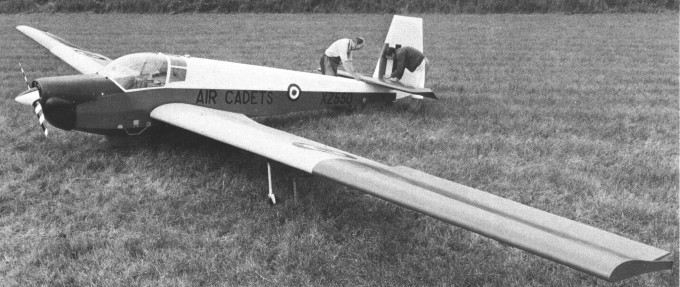
The first production T Mk 2, serialled XZ550, made its first flight on 2 July 1977 and deliveries began that autumn. A total of 19 T61F Venture T Mk 2s had been completed by the beginning of 1980. The T Mk2 differs from previous Slingsby- and Scheibe-built SF-25Bs in having a special glassfibre spar encased in plywood and many other glassfibre components are employed. Use of this material in the spars and elsewhere both reduces the empty weight and increases the maximum permissible take-off weight, and hence payload. New glassfibre seats are also featured of improved comfort and designed to reduce the hazard of loose articles slipping under the seat into the control area. The powerplant is a 45hp Rollason Ardem ‘flat four’ of 1,600cc driving a two-blade fixed-pitch propeller; this is a version of the Volkswagen car engine modified by Rollason Aircraft and Engines Ltd of Shoreham, Sussex, and has single ignition and an electric starter.
SF-25C
Slingsby Sailplanes began production under licence of the Scheibe SF-25B Falke two-seat motor glider as the T61, construction of the first Slingsby-built example beginning in April 1970; a total of 35 were built. The T61 and T61A have the 45hp Stamo MS1500-1 engine with manual starter as fitted to the SF-25B, whereas the T61C has the Stamo MS1500-2 with electric starter. With Slingsby’s long record of supplying gliders for the needs of the Air Training Corps, it was not surprising that the possibilities of a motor glider such as the T61 for ATC training should be considered, especially its time-saving potential in being able to dispense with winch launches and retrieving vehicles, and its ability to continue flying in weather when unpowered sailplanes were grounded. A prototype Slingsby-built T61 serialled XW983 was evaluated as the Venture T Mk 1, and this led to an order for 15 of a special version, the Venture T Mk 2, by the Ministry of Defence (Air) for Air Training Corps use.
The first production T Mk 2, serialled XZ550, made its first flight on 2 July 1977 and deliveries began that autumn. A total of 19 T61F Venture T Mk 2s had been completed by the beginning of 1980. The T Mk2 differs from previous Slingsby- and Scheibe-built SF-25Bs in having a special glassfibre spar encased in plywood and many other glassfibre components are employed. Use of this material in the spars and elsewhere both reduces the empty weight and increases the maximum permissible take-off weight, and hence payload. New glassfibre seats are also featured of improved comfort and designed to reduce the hazard of loose articles slipping under the seat into the control area. The powerplant is a 45hp Rollason Ardem ‘flat four’ of 1,600cc driving a two-blade fixed-pitch propeller; this is a version of the Volkswagen car engine modified by Rollason Aircraft and Engines Ltd of Shoreham, Sussex, and has single ignition and an electric starter.
The T61G Falke is a civil development of the Venture T Mk 2, with a 60hp Limbach SL 1700EA ‘flat four’ engine driving a Hoffman two-blade fixed-pitch propeller (a variable-pitch one can be fitted if desired).
The Scheibe SF25 Motorfalke was probably the first practical touring motorglider. It is certainly one of the most built types (around 1500 in total).
Scheibe Flugzeugbau GMBH, the original manufacturer, eventually closed its doors in 2006, partly because of the lack of a successor for Egon Scheibe, but probably also due to the increasingly difficult trading conditions after the boom of Ultralight/Microlight aircraft that have taken over a large portion of the market for fun, relatively cheap, and easy to fly recreational aircraft – and arguably also the unwillingness of the company to embrace modern glass-fibre construction techniques, preferring to stick to the traditional mixed construction style (fabric-covered wooden wings and steel tube fuselage). The Motorfalke design was subsequently taken over by the newly formed Scheibe Aircraft GMBH based in Heubach (Germany), which has certified the Turbo-Rotax powered version with the glider towing market in mind.
SF-25C / C-S Falke ’76 Span: 50 ft 0.25 in Length: 24 ft 9.25 in Height: 6 ft 0.75 in Wing area: 195.9 sqft Aspect ratio: 13.8 Empty weight: 826 lb Max weight: 1,345 lb Max speed: 112 mph (power on) Max cruising speed: 99 mph Min sinking speed: 3.28 ft/sec at 43.5 mph Best glide ratio: 23:1 Take-off run: 590 ft Range with max fuel: 466 miles
SF-25C-S Falke ’79 Engine: Limbach SL 1700 EA, 44.7 kW (60 hp) Wing span: 15.25 m (50 ft 0 in) Length: 7.55 m (24 ft 9 in) Wing area: 18.2 sq.m (195.9 sq ft) Wing section: Mu (Scheibe) Aspect ratio: 13.8 Empty weight: 375 kg (827 lb) Max weight: 610 kg (1,345 lb) Water ballast: None Max wing loading: 33.5 kg/sq.m (6.86 lb/sq ft) Max level speed (powered): 97 kt (180 km/h) Stalling speed: 35 kt (65 km/h) Min sinking speed: 1.0 m (3.3 ft)/sec at 40.5 kt (75 km/h) Best glide ratio: 24 at 37.5 kt (70 km/h) T-O run (approx): 180 m (591 ft) Max rate of climb at S/L: 138 m (453 ft)/min Range (45 litres fuel): 600 km (324 nm)
SF25-2000 Engine: 59 kW/ 80 bhp Limbach L 2000 EA Seats: tandem two-seat
Scheibe SF25E Super-Falke Engine: Limbach SL 1700, 48 kW/ 64 bhp Wing span: 18m / 59 ft 0.75 in Length: 7.6 m / 24 ft 11.75 in Height: 6 ft 0.75 in Wing area: 17.4 sq.m / 187.3 sq.ft Wing section: Mu (Scheibe) Aspect ratio: 17.8 Empty weight: 410 kg / 904 lb Max weight: 630 kg / 1,389 lb Water ballast: None Max wing loading: 35 kg/sq.m / 7.16 lb/sq ft Max speed: 112 mph / 97 kt / 180 km/h Max cruising speed: 99 mph Cruise: 93 mph Stalling speed: 37.5 kt / 70 km/h Rate of climb 144 m/min / 472 ft/min Min sinking speed: 0.85 m/sec / 2.79 ft/sec at 47 mph / 40.5 kt / 75 km/h Best glide ratio: 29: 1 at 53 mph / 46 kt / 85 km/h Take-off run: 150-200 m / 490-655 ft Range: 600 km / 324 nm Endurance: 4 hours
Slingsby T.6IE Falke Engine: Rollason-Volkswagen 1,600 cc, 35.8kW / 48 hp Wing span: 15.3 m / 50 ft 2.5 in Length: 7.6 m / 24 ft 9 in Wing area: 17.5 sq.m / 188 sq ft Wing section: Scheibe Aspect ratio: 13.4 Empty weight: 375 kg / 827 lb Max weight: 612 kg / 1,349 lb Water ballast: None Max wing loading: 33.63 kg/sq.m / 6.88 lb/sq.ft Max level speed: 80 kt / 148 km/h Stalling speed: 33 kt / 61 km/h Min sinking speed: 1.0 m/sec / 3.28 ft/sec Best glide ratio: 22 T-O run: 200 m / 650 ft Rate of climb: 122 m/min / 400 ft/min Range: 400 km / 216 nm
T. 61 E Venture T. Mk. 2 Span: 50 ft 0.25 in Length: 24 ft 9.25 in Height: 6 ft 0.75 in Wing area: 195.9 sqft Aspect ratio: 13.8 Empty weight: 827 lb Max weight: 1,350 lb Max level speed: 92 mph Min sinking speed: 3.28 ft/sec Best glide ratio: 22:1 Take-off run: 650 ft Range: 248 miles
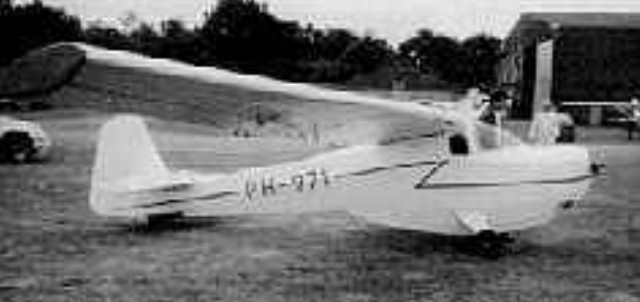
The SF-24 Motorspatz was developed in 1957 as a powered version of the L-Spatz-55 and L-Spatz-III single-seater trainer or competition sailplanes; the Spatz (or Sparrow) had first flown on 12 March 1952. Designed by Egon Scheibe, the single-place self-launching Motorspatz was first flown in 1960, with the -24A and -24B models appearing subsequently. Approach control is with spoilers.
The Motorspatz is very similar structurally to its unpowered predecessor, with a fabric-covered welded steel tube fuselage and wooden single-spar cantilever high-set wings with plywood and fabric covering; the inset-hinged ailerons are also fabric-covered and there are Schempp-Hirth airbrakes in the upper surfaces. The wooden tail unit is also covered with plywood and fabric, and the landing gear consists of a fixed monowheel partly faired into the bottom of the fuselage, plus a rubber sprung tailskid; there are no outrigger balancer wheels under the wings to maintain the aircraft upright on the ground. A disc brake is mounted with the main landing wheel. The pilot sits under a one piece blown canopy. Both seats offer adjustable rudder pedals and backrests.
The initial production version of the Motorspatz was the SF-24A with a 21 hp Zink-Brandl ZB300-S two cylinder horizontally-opposed air-cooled two-stroke mounted in the nose in a conventional tractor installation; the SF-24B was powered by a 25hp Hirth-built Solo 560A ‘flat four’ air-cooled two-stroke driving a two-blade fixed-pitch wooden propeller, and this version had a better performance than the SF-24A. Both versions had a fuel tank of 3.3 Imp gallons capacity in the fuselage behind the wing spar. About 70 examples of both versions were built altogether.
Engine: Hirth Wing span: 14 m / 45.9 ft Wing area: 11.87 sq.m / 127.1 sq.ft Empty Weight: 225 kg / 496 lb Payload: 120 kg / 265 lb Gross Weight: 345 kg / 761 lb Wing Load: 29.21 kg/sq.m / 5.94 lb/sq.ft Airfoil: Mu MinSink: 1.0 m/s / 3.3 fps / 1.96 kt Seats: 1 No. Built: 50 Structure: steel-tube/ fabric fuselage, wood/ fabric wings and tail.
SF-24B Span: 46 ft 1 in Length: 20 ft 0 in Height: 4 ft 5 in Wing area: 127 sqft Aspect ratio: 16.7 Empty weight: 485 lb Max weight: 760 lb Max speed at sea level: 93.5 mph Min sinking speed: 3.28 ft/sec Rate of climb: 394 ft/min at sea level Take-off run: 426 ft
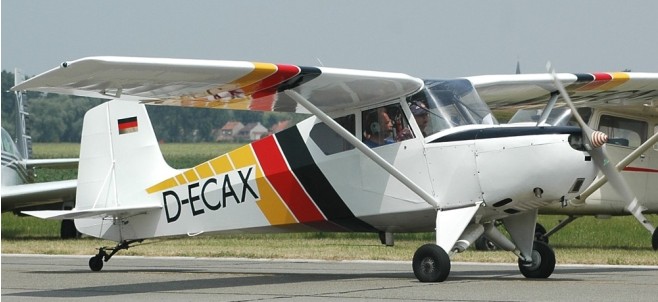
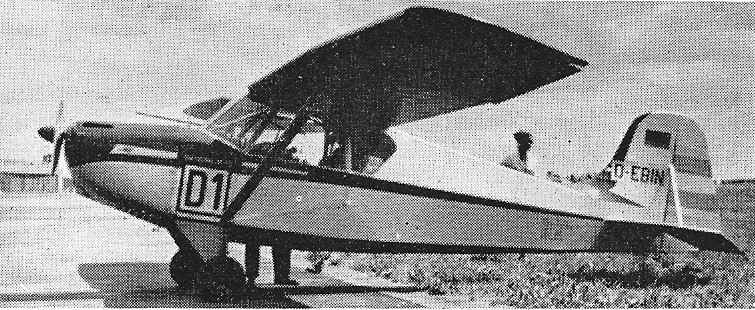
The Scheibe Sperling two-seat light high-wing monoplane first flew August 1955, and was developed with new wing and tail as SF-23A and built in numbers until 1963.
SF-23 D-EBIN
Designed by Egon Scheibe, the prototype was powered by an 65 hp Continental A-65-8 and first flew on 8 August 1955. Production machines, the SF-23A, had either 65 hp or 85 hp Continental and the predicted price was £1400.
The fuselage is fabric covered steel tube and the wings are single-spar wood with fabric and plywood covering.
The SF-23B was powered by a 100 hp Continental O-200-A.
The SF-23C, powered by a 115 hp Lycoming O-235, was suitable for glider towing.
Production was completed in 1963.
Engine: 85 hp Continental C85 Wingspan: 32 ft 4.5 in Wing area: 99.35 sq.ft Empty weight: 661 lb Loaded weight: 1146 lb Length: 19 ft 8.25 in Max speed: 112 mph Cruise: 98-104 mph Seats: 2
SF-23A Engine: 100 hp Continental O-200-A Wing span: 32 ft 4 in Length: 20 ft 4 in Height: 7 ft 2 in Wing area: 130.9 sq.ft Empty weight: 1014 lb Loaded weight: 1609 lb Max speed: 125 mph Cruise: 60%: 99 mph ROC: 690 fpm Service ceiling: 16,400 ft Range: 400 mi
SF-24C Engine: 115 hp Lycoming O-235 Wing span: 32 ft 4 in Length: 20 ft 4 in Height: 7 ft 2 in Wing area: 130.9 sq.ft Empty weight: 1058 lb Max speed: 130 mph ROC: 770 fpm Service ceiling: 18,000 ft Range: 370 mi
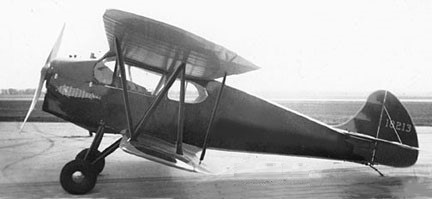
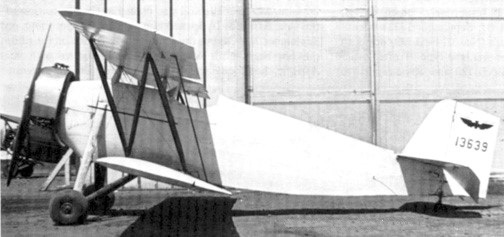
The 1935 Schauss-Lampman Sport was designed and built by Ed Lampman and Al Schauss as a two-place cabin biplane, powered by an 85hp Ford V-8 engine. Fitted with truss wing struts, it was registered N18213, the maximum speed was 120 mph and cruise was 105 mph.
There was a plan to put a few into production but the financial backer passed away and the plan stalled.
It was rebuilt in 1937 as a three-seater powered by an 85hp LeBlond engine.
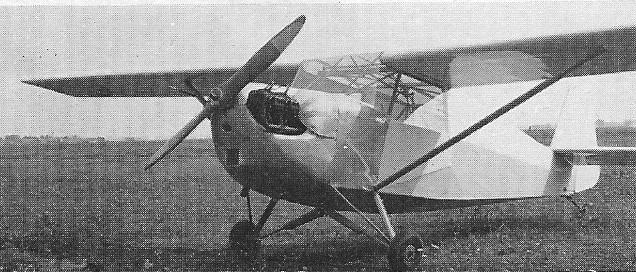
Designed and built by Al Schauss in 1931, the two place, open cockpit high wing monoplane was scratch-built with no prior knowledge or experience (even the hand-carved propeller).
This was also the parasol in which Schauss learned to fly (after its test flight by flight instructor Wally Neuman). Powered by a 120hp Salmson 9 engine and registered N10599, it was destroyed in a hangar fire.
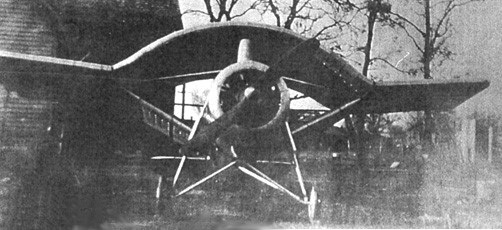
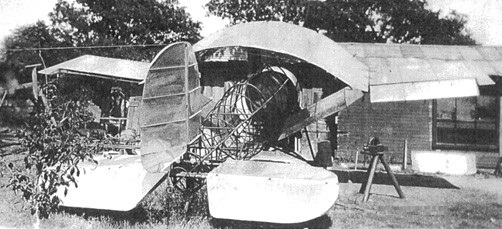
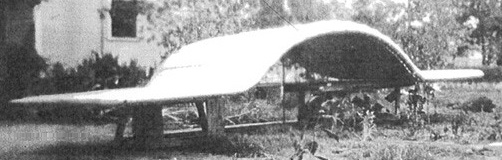
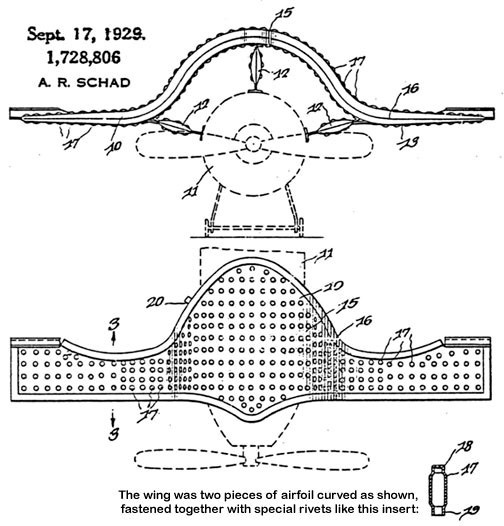
Built by German emigrate Schad, with partners Stacy Ashcraft, J C Bradley, Oscar Ford, Joe Kavecki, and (Mrs) A T Quattlebaum, to prove his unique, patented (#1,728,806) wing design based on Schad’s research, as a baker-turned-boilermaker, of tubular strengths.
Built circa 1927, the aircraft was a single-place with a steel-tube frame covered with dural, with a war-surplus 80hp Le Rhône rotary engine.
The construction site was Schad’s back yard and the date of the first flight is unknown, but the pilot was Cal Murray. It was flown successfully by Schad and others from Cleburne’s Bluebonnet golf course and, later, Meacham Field, where on its second flight there the tail was broken. Unable to afford a much-needed more powerful engine, no repair was made on the plane and it was stored on a farm, finally dismantled and sold for scrap in 1941.
In 1942 the US government purchased the 1929 patent for possible use in the war, but what if anything came from it is unknown, as are data and performance specs for the ship.