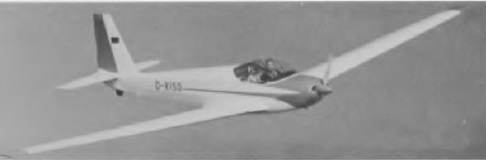
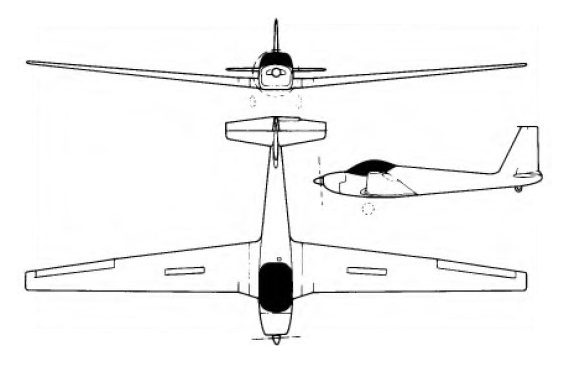
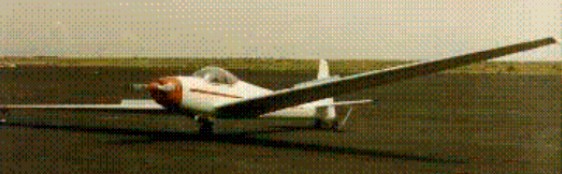
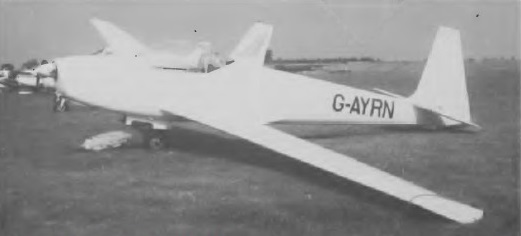
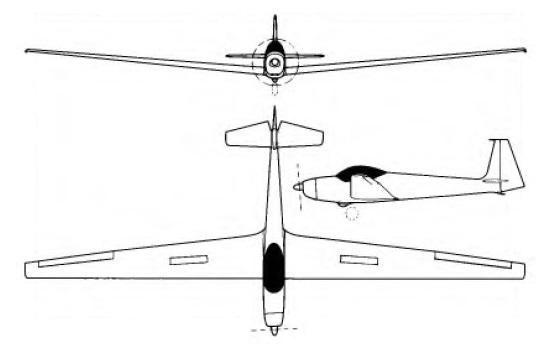
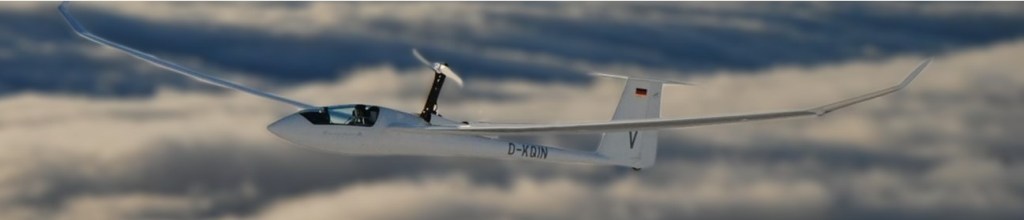
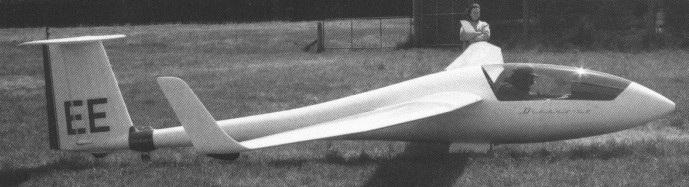
The AS-K 16 is a side-by-side two-seater motor glider, with dual controls. The type is of mixed construction with a welded steel tube fuselage covered in fabric, plywood and glassfibre. The cantilever single-spar low-set wooden wings are fabric-covered with glassfibre tips and spoilers in the upper surfaces. The tail unit is of wooden construction with fabric covering, with combined trim and anti-balance tabs in the port elevator. The AS-K 16 has main wheels retracting inwards into the bottom of the fuselage, and a fixed tailwheel; the main wheels have rubber shock absorbers and Tost drum brakes. The pilots sit under a one-piece blown canopy that hinges sideways to open. Powerplant is a 72hp Limbach SL 1700EB1 modified Volkswagen ‘flat four’ engine driving a Hoffman HO-V 62 two blade variable-pitch propeller.
It first flew in prototype form on 2 February 1971 and first appeared in public at the second German Motor Glider Competition at Burg Feuerstein in June that year, but it did not compete.
An AS-K 16 flown by Hans Werner Grosse and Ing R. Kaiser took third place in the First International Motor Glider Competition in 1974.
By January 1976 38 AS-K 16s had been built, but it is now out of production.
Engine: VW Limbach, 75 hp Wingspan 49 ft 2 in Length 21 ft 10 in Gross 1,540 lb Empty 1,010 lb Useful 530 lb Fuel 60 lb Wing loading 7.1 lbs/sq ft Wing aspect ratio 17.1 Max airspeed 110 kt Rough air speed 110 kt Stall 40 kt Lift to drag 25 at 50 kt Sink 3 fps at 45 kt Wingspan 53 ft Length 24 ft Seats 2
Engine: Limbach SL 1700 EB1, 53.7 kW (72 hp) Span: 52 ft 6 in / 16.0 m Length: 24 ft 0.25 in / 7.32 m Height: 6 ft 10.75 in / 2.10 m Wing area: 204.5 sq ft / 19.0 sq.m Aspect ratio: 13.5 Wing section: NACA 63618/Joukowsky 12% Empty weight: 1,036 lb / 470 kg Max weight: 1,543 lb / 700 kg Water ballast: None Max wing loading: 37.0 kg/sq.m / 7.57 lb/sq ft) Max speed: 124 mph / 108 kt / 200 km/h Stalling speed: 37 kt / 69 km/h Min sinking speed: 3.28 ft/sec / 1.0 m/sec at 46 mph / 40 kt / 74 km/h Best glide ratio: 25:1 at 58.5 mph / 51 kt / 94 km/h Take-off run: 755 ft / 230 m Rate of climb at S/L: 150 m/min / 492 ft/min Range: 310 miles / 500 km / 270 nm
This single-seater motor glider was originally known as the Ka 12 and was designed by Ing Rudolf Kaiser but, to avoid confusion with the AS-W 12 high performance sailplane which was also built by Schleicher, it was redesignated AS-K 14.
Of conventional wooden construction, it has what is basically a Ka 6E’s semimonocoque fuselage with plywood covering married to low-set cantilever wood and fabric wings with 5° dihedral, similar to the Ka 6E’s and with the same aerofoil section; the single-spar wings have spoilers in the upper surfaces and plywood-covered ailerons. The pilot sits under a large one-piece blown Plexiglas canopy that hinges sideways to starboard, and the landing gear consists of a manually retracted monowheel on a leg tall enough to give adequate ground clearance for the propeller, plus a tailskid. Powerplant is a 26hp Hirth F10 K19 ‘flat four’ two-stroke engine in a conventional tractor installation driving a two-blade Hoffman feathering propeller; starting is manually. The tail unit is of wood/plywood/fabric construction, with a low-set all-moving tailplane.
The prototype made its first flight on 25 April 1967, and the type took second, third and fourth palces in the first at Burg Feuerstein in the German Motor Glider Competition, which was held in 1970; in the sixth of these competitions, in 1976, the AS-K 14 was still good enough to take second and third places.
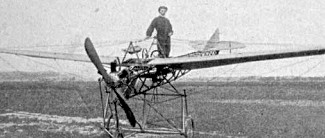
Robert Schlageter of Luzer, Switzerland, was born in 1887. He quit his technical studies in Burgdorf to devote himself to aviation. After first tests with gliders, he began to build, with the help of two friends, his first monoplane, with a triangular-section fuselage and an Anzani engine, in 1909. Then he built in four months, for a company in Mainz, another monoplane of the same type. His planes flew only in good wind conditions, but he won a prize at a fair in Chemnitz in 1911. He had to quit aviation for economic reasons, was forced to sell his planes and spare parts.
In 1917 Schiefer & Sons Aeroplane Co built the RS, designed by N B Robbins. A Pursuit trainer based somewhat on French V-strutted Nieuport design, it first flew on 9 December 1917.
The sole example was bought for a reported $11,000 and tested by the Army, but rejected as not being as good as Orenco or Thomas-Morse.
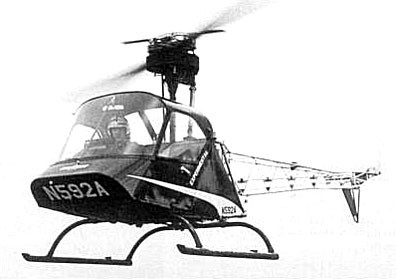
The 1963 Scheutzow Helicopter Flexhub was described “test-bed” version of Model B N564A, the blades were set on rubber bushings instead of conventional ball- and roller-bearings..
Webb Scheutzow formed Scheutzow Helicopter Corp in the early 1960s by to build a light helicopter with special rotorhead (blades carried on rubber bushings). The Bee side-by-side two-seater flew 1968 and three prototypes were built.
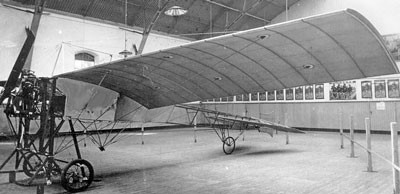
The Emile de Schepper and Hubert Hagens “Helpman I” monoplane was exhibited in the bicycle school of Fongers in Groningen (Netherlands) in May 1911. It had an open fuselage aft of the pilot seat and triangular-section fuselage and was powered by a 5-cylinder Anzani, rated at 50 hp. The monoplane was designed and built by Emile de Schepper and Hubert Hagens. Hagens was the mechanician of the famous Belgian flyer Jan Olieslagers and Emile de Schepper was the son of the Belgian E. J. de Schepper, who was a wealthy billiard manufacturer in Helpman (a separate village then, now a part of the town Groningen), hence the name “Helpman I”.
The Open Class Quintur 23 m wingspan is a very thin, high aspect ratio wing, with a maximum of 250 liters of water ballast, allowing for a potential wing loading between 39 and 58 kg/m².
Lange Aviation and Professor Loek Boermans were involved in the conception and design of the wings, with nine exact interacting wing airfoils that provide laminar flow over 95% of the lower and 75% of the upper wing surfaces and are based on a super-elliptical wing geometry. The concept of the outer wing panel with winglets were from Professor Mark Maughmer.
Structural design, ballasting and the patented, extremely light control design were provided by Lange Aviation.
A self-launch optimized fuselage has been designed for the Quintus, providing not only aerodynamic improvements but also details such as bug wiper “garages”. A forward-opening canopy makes getting in and out comfortable. Cockpit blends in either visual carbon or carbon-kevlar hybrid fibre, Alcantara lining, and engraved flap position indicator.
The Quintur M engine start-up is straightforward and automatic. To engage the engine, the pilot only needs to switch on the ignition and press the start button once the engine has been fully extracted. The engine’s start setup is always optimized by a microprocessor to match the current environment.
After switching off the ignition on the Ilec engine control unit, the control unit automatically stops and fixes propeller in the correct upright position and the engine gets retracted.
A rudder-integrated tail wheel supports precise steering for taxiing.
Wing span: 23m / 75.46 ft Wing area: 14.7 m² / 158.23 ft² Aspect ratio: 36 Fuselage length: 7.82 m / 25.66 ft Empty weight: 500 kg / 1102 lb Max. all-up weight: 850 kg / 1874 lb Wing loading: 38.8 – 57.8 kg/m² / 7.95 – 11.84 lb/ft² Max. permitted speed: 270 km/h / 146 kts / 168 mph
The Arcus was developed using an all-new wing design with full-span flaperons mated to the “L” cockpit design, as used on the Duo Discus XL. Designed by Tilo Holighaus and Christoph Wannenmacher, the Arcus first flew on 7 April 2009 at the Hahnweide airfield.
The Schempp-Hirth Arcus is a flapped two-seat 20m racing class glider of all composite construction, with optional water ballast. This two seater is as agile as a single seater and equipped with flaps.
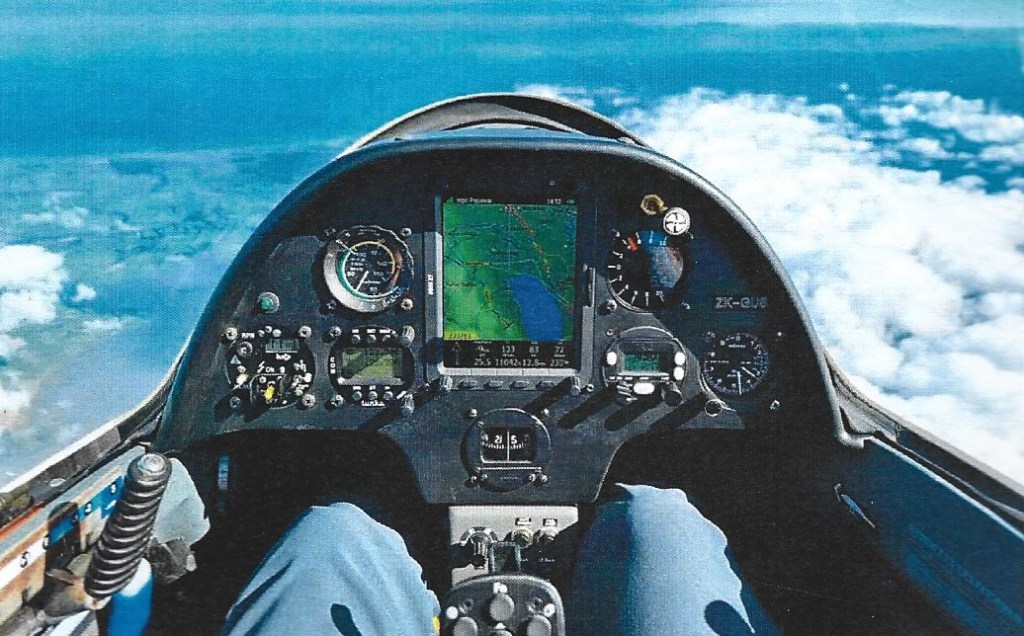
Schempp-Hirth Arcus T ZK-GUS
It is available as a pure glider, a sustainer version Arcus T using the retractable Oehler-Turbo (Solo 2350) engine, and as a self-launching glider Arcus M using the Binder (Solo 2625) powerplant system.
Type certificate: EASA Type Certificate Data Sheet EASA.A.532 Issue 04 dated 08 October 2014 – Arcus T approved 17 May 2011 – Arcus M approved 20 June 2013 – Arcus approved 31 July 2014
Arcus MCTOW 750 kg [1653 lb.] – with Water Ballast Max. No. of Seats: 2
Arcus T Engine: Solo 2350 D Propeller: OE-FL 5.110/83 av MCTOW 800 kg [1763 lb.] – with Water Ballast Max. No. of Seats: 2
Model: Arcus M Engine: Solo 2625-02 (modified per SB 4600-3) Propeller: Technoflug KS-1G-160-R-120 MCTOW 800 kg [1763 lb.] – with Water Ballast Max. No. of Seats: 2
The Schempp-Hirth Standard Class Discus was the successor to the Standard Cirrus, and dominated numerous World Championships between 1985 and 1995 (6 world titles in succession). The Standard Class Discus A first flew in 1984 using the fuselage and tail unit of the original Ventus with a new unflapped wing. The wing planform is noteworthy as being the first production sailplane to have the now common distictive shape where the leading edge sweepback increases towards the tip, establishing a worldwide trend in wing planforms.
Approach control is by top surface double panel schempp- hirth airbrakes. There is a 5kg / 11 lb water ballast tank in the fin for trimming purposes when the main wing mounted ballast tanks are used.
The Discus B incorporates the longer fuselage (about 23 cm/ 9 in) and roomier cockpit of the Ventus B.
The sustainer engined Discus bT, which first flew in 1988, has a retractable mast mounted15kW/ 21 bhp Solo engine with a Oehler folding prop. The T (for Turbo) model incorporates an engine, with no starter, choke and throttle. It is started by wind-milling the multi-blade folding prop. Once started, the engine runs at full power until switched off and then is automatically retracted. Over 150 of the Discus bT were built. The turbo-drive system also equips a successor the Nimbus-4DM.
Whilst the production of the single seat Nimbus-3 had to be discontinued after a fire in one of the production halls, this enabled the production of the Racing Class glider Ventus to be increased, allowing the increase in demand for its motorized variant Ventus-bT to be satisfied.
The self-launching Discus bM has a Rotax engine in the fusealage (in co-operation with Walter Binder) with a retractable mast mounted prop and was manufactured only in small numbers.
The Discus won the first three places in the Standard Class at the 1985 World Championships at Rieti, Italy, 12 out of the first 15 at the 1987 Worlds at Benalla, Austria, and again the first three places at the 1989 Worlds at Wiener Neustadt, Austria. Up to 1995 the Discus won all first places in the world championships.
The Discus CS is built under license in the Czech Republic by Orlican. The winglets (WL) is an option that was developed for further improvement of the climb performance.
After approximately 570 copies weere manufactured in Kirchheim/Teck (including Discus bT and Discus CBM), the Discus A and Discus b production stopped now in favour of the Discus-2. The design Discus CS, identical in constructed with the Discus b, was produced by Schempp Hirth vyroba letadel, at Chocen, CR.
The Discus 2 airfoil is thin (about 14.5 percent), incorporating studies by K.H. Horstmann and Dr. Wuerz (wing) and Luc Boermans (tail). The 5″ wheel with a hydraulic brake keeps the fuselage far away from the ground. The tail and cockpit are completely new designs. Empty weight of the prototype is about 240 kg. There is a tail ballast tank.
During stalls in clean configuration (flaps and gear not extended) buffetings on the airspeed indicator begins at about 77 km/h IAS (vortices of the upper fuselage hitting the airspeed probe that was mounted on the vertical tail), followed by a slight vibration at about 73 km/h IAS. The stall ocurred at less than 70 km/h IAS, the airplane vibrating and the airspeed indicator trembling between 65 and 80 km/h.
The Duo-Discus was designed specifically by Klaus Holighaus for two seat high performance flight. With its wingspan of 20m, the two seat fixed profile glider first flew on the 11.03.1993 on the Hahnweide. Despite limited production opportunities, over 150 aircraft were already in service around the world by the end of 1997.
In April 1998, the maiden flight of the first prototype of the Discus 2, registrated D-6111, took place. In 1998 the Discus-2 gained first place in the Hahnweide competition and also National Championships in Germany and England. In late summer 1998, the 250th Discus-CS delievered from Chocen.
1999 brought the maiden flight of the “Duo-Discus-Turbo” and Gunther Stahl became the “Junior World Champion” in the Standard Class with a “Discus-2b”.
The Duo Discus was conceived as an advanced trainer with good cross country ability. It has a four piece unflapped wing with a modified Discus wing. The fuselage is derived from that of the two-place Janus. Approach control is by top surface airbrakes.
With the title of European Champion in all three classes, in 2000 two new motor gliders were announced. The Discus-2T, and the Nimbus-4M with an internal lying Solo 2625-02 engine as copied from the Nimbus-4DM.
The World Championships were successful in Mafeking 2001, with a renewed title for the Discus-2 and the Ventus-2ax in the 15m class, a variant sporting a drag reduced tail section and Maughmer winglets. These modifications (which improved the flight characteristics at lower speeds and higher wing loadings) were carried through to the Ventus2-bx, along with a newly designed outer contour and cockpit area shape.
Additionally, the Ventus-2cT won the 18m class at the FAI World Air Games in Lillo/Spain. Mid May 2002 saw the delivery of the first ballistic chute “total recovery system“ fitted to a Ventus-2bxR which was designed by the neighbouring company Glasfaser-Flugzeug-Service GmbH in Grabenstetten and tested in a Discus.
2002 saw the delivery of the 1000th Discus (all variants) as well as the completion of the 1000th Ventus (all variants).
The 18m Discus-2C, first flown on the 16.09.2004, integrates of the “Turbo“ sustainer and shorter outer panels, allowing the Discus-2C to be used in standard class competitions.
Discus b Span 15.0 m Wing area 10.58 sq.m Wing aspect ratio 21,3 Fuselage length 6.58 m Unloaded weight approx. 230 kg Gross weight 525 kg Wing loading 29.5-49.6 kg/sq.m Max water ballast 180 lt Maximum speed 250 km/h Maneuver speed 200 km/h Leastst sink approx. 0.59 m/s Best lift/drag ratio 43