SIAI Marchetti S.211

Probably the first trainer to employ a supercritical wing section, the intention of the private venture design was to combine low unit cost with advanced technology and utilising the PWC 1T15D turbofan.

SIAI Marchetti S.211 Article

The first prototype of SIAI Marchetti’s S.211 two-seat basic trainer powered by a single Pratt & Whitney JT15D4C turbofan of 2,500 lb (1134 kg) was flown on 10 April 1981 at Milan-Malpensa airport with Siai Marchetti’s chief test pilot, Cmdte Alessandro Ghisleni, at the controls. Five further flight tests were made during the following week.

The type was being developed as an “attack optimised” trainer with a light¬weight HUD and navigation computer in association with the Republic of Singapore Air Force.

Also under test in a production S.211 was the 5 version of the JT15D, offering 3190 lbs thrust with a dry weight 50 kg more than the -4C fit.

An S.211A was test flown with a PWC JT15D 5 turbofan, providing 3200 lbs of thrust (2500 lbs from the 4C) for an additional 50 kgs of dry weight. As well as the 28 percent in¬crease in thrust, designed to make the S.211A more competitive with close contender MB339 at the top end of the scale, the aircraft has a stronger wing and a greater fuel capacity, boosted to 1440 lbs. The reinforced wing structure is to +7.33 and 3G’s.

Singapore Aircraft Industries (SAI) continues to assemble S.211 single-turbofan two seat basic trainers for the Rebublic of Singapore Air Force, which has ordered 30 aircraft, in 1987. Six of these were delivered in CKD form for reas¬sembly by SAI, while the remainder are being delivered in kit form for complete assembly in Singapore. Haiti is the only other confirmed customer for the S.211.

Siai-Marchetti (as part of the Agusta group) teamed with Grumman as a contender for the USAF’s PATS (Primary Aircraft Training System) requirement for a lightweight, low-cost basic trainer and attack aircraft.
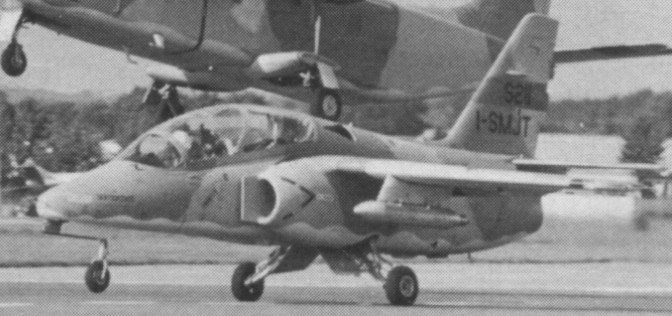
Customers to 1990 were the Philippines (18), where the type is being assembled by PADC, Singapore (30), where a similar arrangement involves SAI, Haiti (4) and Uganda (4).

In 1990 the PADC in the Philippines started assembling S 211s, followed by SF 260 TPWs and SF 600 Canguro in agreement with SIAI Marchetti of Italy.

It can carry external loads of four underwing pylons although the difference between clean gross weight and maximum take off weight is only 1323 lb with the -4C engine.

S.211
Engine: 1 x Pratt & Whitney Canada JT15D-4C turbofan, 2,500 lb st (1134 kgp)
Span: 8.43 m / 28 ft 8 in
Length: 9.5 m / 31 ft 7 in
Wing area: 12.6 sq.m / 135.63 sq ft
Height: 3.8 m / 12 ft 6 in
Empty wt: 1645 kg
MTOW: 3100 kg
TO wt clean: 6000 lb
Warload: 660 kg
Max speed: 452 kt, 667 kph / 413 mph
Initial ROC: 1280 m / min
Ceiling: 12,200 m / 40000 ft
T/O run: 390 m
Ldg run: 360 m
Fuel internal: 800 lt
Range/Endurance: 2480 km / 3hr 50min
Combat radius hi-lo-hi: 550 km
Hardpoints: 4
Loading limit: 3.5G
Fuel burn: 700 lbs/hr
Ejection seat: zero/zero
Crew: 1-2
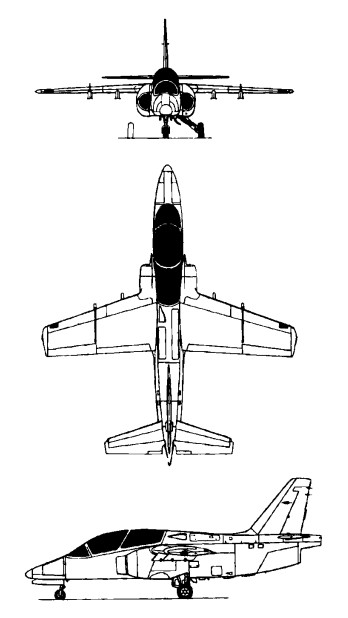
SIAI-Marchetti S.211

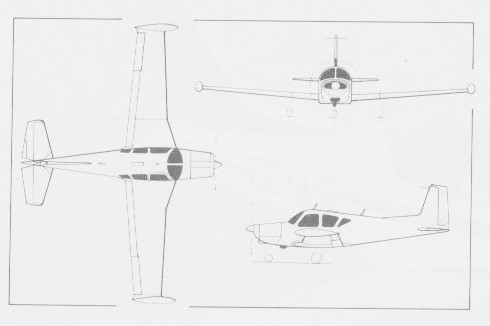
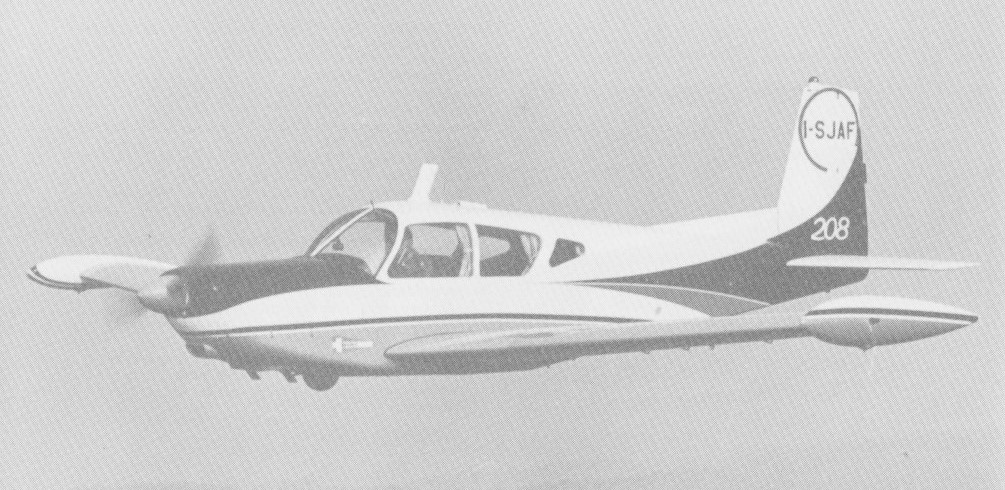
Savoia-Marchetti S.208

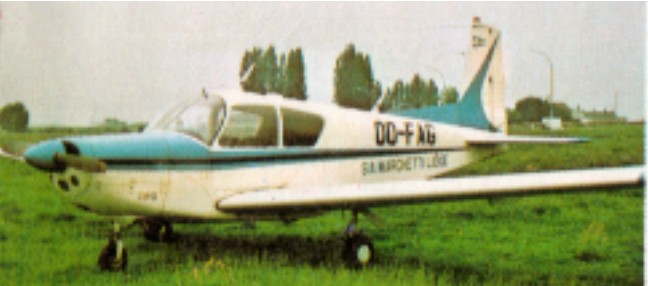
First flying in 1967, in 1968 the S.208 version became available, produced basically as a five-seat, more powerful version of the S.205, with some 60% of its structural components in common.

Savoia-Marchetti S.208 Article

By February 1973, approximately 80 S.208s had been delivered to customers in Europe and Africa, including 44 S.208Ms to the Italian Air Force for liaison and training duties.

A version for general duties, including agricultural and ambulance work, was developed as the S.208AG.

S.208
Engine: Lycoming O-540-E4A5. 260 hp
Wingspan: 35 ft 7.5 in / 10.86 m
Length: 26 ft 3 in / 8.00 m
Empty weight equipped: 1720 lb / 780 kg
MTOW: 3307 lb / 1500 kg
Max cruise: 162 kt / 187 mph / 300 kph
Range, internal fuel: 647 nm / 746 nm / 1200 km
Range Max fuel/tiptanks: 1085 nm / 1250 mi / 2000 km
Seats: 5
Cabin length: 5 ft 10.25 in / 1.78 m
Cabin width: 3 ft 8,25 in / 1.14 m
Cabin height: 4 ft 4 in / 1.32 m
Cabin volume: 88.0 cu/ft / 1.5 cu.m

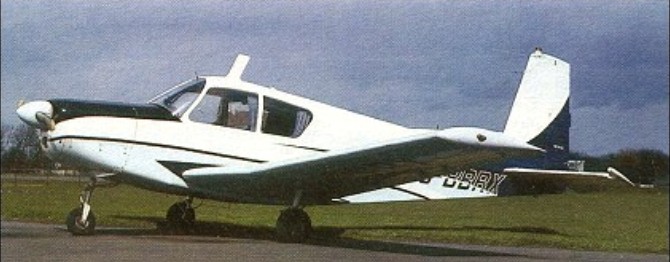
Savoia-Marchetti S.205 / Waco Vela II / Taurus

A four-seat development of the SA.202 Bravo, design of the S.205 four-seat all-metal light monoplane was started in March 1964, first flying in 1965, and by April of 1965 three examples had been completed. Each had a 134kW Lycoming engine fitted, but a wide range of versions subsequently became available with different engines and equipment.

Savoia-Marchetti S.205 Article

The S205/22R was never a trainer. It was the retractable version of the 205 with a franklin engine. We also had a 205R which was the same airplane with a Lycoming. The left door was a factory option.

Waco Aircraft Co [2] was founded in 1966 to build Savoia-Marchetti S.205 (as Waco Vela II and Sirius) plus turbosupercharged Taurus derivative

S.205-22/R

S.205
Max take-off weight: 1350 kg / 2976 lb
Empty weight: 750 kg / 1653 lb
Wingspan: 10.86 m / 36 ft 8 in
Length: 8 m / 26 ft 3 in
Height: 2.89 m / 10 ft 6 in
Wing area: 16.09 sq.m / 173.19 sq ft
Max. speed: 295 km/h / 183 mph
Ceiling: 6200 m / 20350 ft
Range: 1325 km / 823 miles

S.205 18F
Engine: Lycoming O-360-A1A, 180 hp
Undercarriage: fixed

S.205 18R
Engine: Lycoming O-360-A1A, 180 hp
Undercarriage: retractable

S.205 20F
Engine: Lycoming O-360-A1A, 200 hp
Undercarriage: fixed

S.205 20R
Engine: Lycoming O-360-A1A, 200 hp
Undercarriage: retractable

S.205-22/R / Waco S.220 Vela
Engine: Franklin 6A-350-C1, 220 hp
Undercarriage: retractable

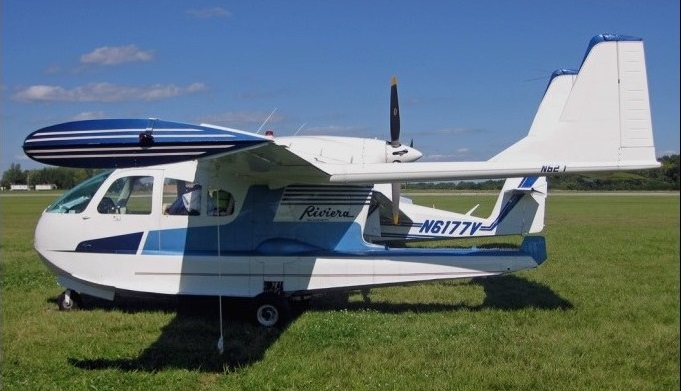
SIAI-Marchetti FN-333 Riviera / Nardi FN-333

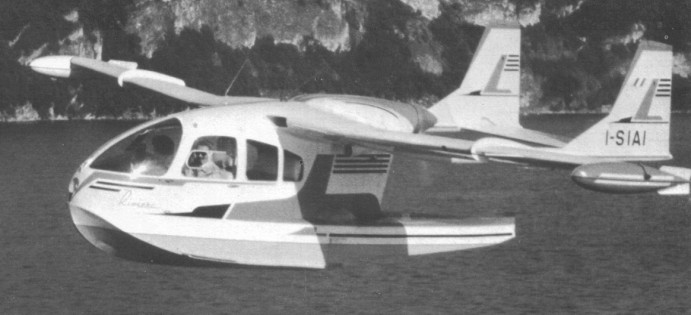
The three-seat prototype of the amphibian FN-333 flying boat, designed and built by Nardi S.A., flew first on 4 December 1952. Two more prototypes were built by Nardi through the decade. In the wake of the second Nardi prototype, Fiat of Italy also built two FN.333 prototypes, but did not continue with the exercise.

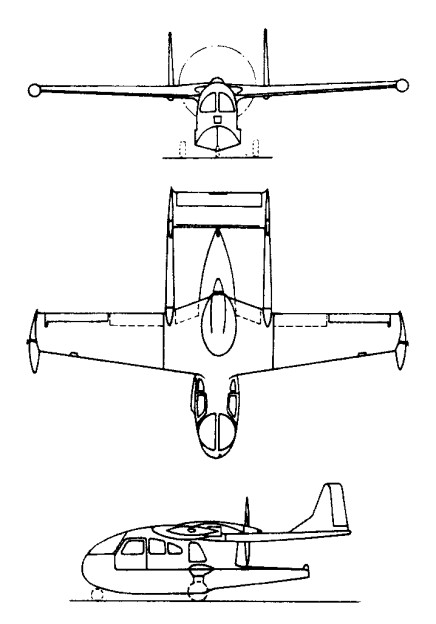
The initial prototype had “guitar-pick” style tailfins, and was powered by a Continental engine with 110 kW (145 HP); there had been thought of fixing the floats to the wingtips and then folding the wing downward after water landing, but the idea didn’t survive close examination.

Following the third Nardi prototype, an exclusive manufacturing licence for the FN-333 was obtained by SIAI Marchetti in March 1959. SIAI Marchetti called the aircraft “Riviera”.

SIAI-Marchetti placed a slightly enlarged four-seat variant in production which had flown in prototype form on 8 December 1954. The first of ten pre-production Rivieras was flown in February 1962.

The Riviera used a tricycle landing gear with the nose gear tucking up into the forward hull, the main gear hinging up to be stowed in the fuselage, as well as retractable floats, hinging up to mate with the wingtips, and no wing bracing. The twin tailfins were of trapezoidal configuration and had forward fillets. Powerplant was a Continental IO-470-P air-cooled flat-six engine with fuel injection, providing 185 kW (250 HP) and driving a two-bladed propeller.

Initial production was devoted to fulfilling orders from the USA were sales were handled by the Lane Aircraft Company which purchased the airframes for assembly by Southwest Airmotive. The first four were delivered to the USA bu mid-January 1963 and more than fifty had been sold by the middle of the year.

About 24 Rivieras were built through the 1960s, the exact number being hard to determine because of double-counting of serials.

Engine: 1 x Continental IO-470-P, 185kW
Wingspan: 10.4 m / 34 ft 1 in
Length: 7.4 m / 24 ft 3 in
Height: 3.2 m / 11 ft 6 in
Wing area: 15.0 sq.m / 161.46 sq ft
Empty weight: 1030 kg / 2271 lb
Max take-off weight: 1485 kg / 3274 lb
Max. speed: 285 km/h / 177 mph at SL
Cruise 70%: 264 km/h / 164 mph
Econ cruise: 137 mph
ROC: 1220 fpm
Service ceiling: 5600 m / 18350 ft
Range w/max.fuel: 1300 km / 808 miles
Range w/max.payload: 1000 km / 621 miles
Crew: 4

Nardi FN.333

S.I.A. Roma

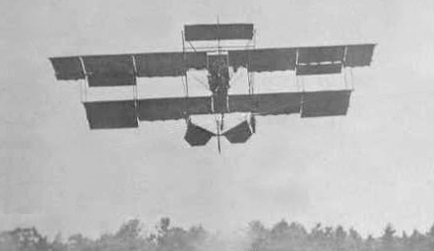
Enrico Luzzatto was a Milan lawyer who owned a typographic industry. After building a couple of planes he formed the “Società Italiana degli Aeroplani” (S.I.A.). In 1913 he designed and built a two-seater, called “Roma”. On May 27, 1913, piloted by Francis Deroy and with a passenger on board, it flew from Milan to Rome in less than six hours, winning the Coppa Ponti. Entered in the first Italian military competition, the “Roma” placed very well in all tests, but an error in flight route between Turin and Milan eliminated it from the competition.

Short T.5 / S.45 / S.48 / S.49 / S.50

S.45

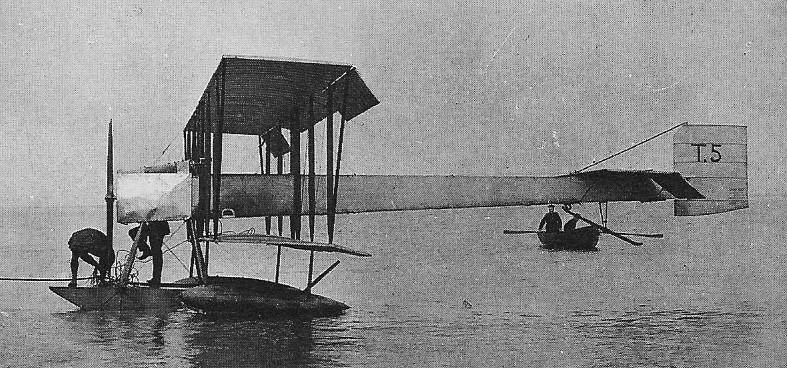
The Short S.45 — also known as the Short T.5 after its naval serial number — was a training biplane built for Britain’s Royal Navy by Short Brothers in 1912. It was the forerunner of another three identical aircraft (designated S.48, S.49, and S.50 by Shorts) delivered to the Royal Navy and Royal Flying Corps during 1912 and 1913. The Royal Naval Air Service was still operating the type when World War I broke out in 1914.

The design was similar to that of the Short S.36, a sporting biplane built for Frank McClean which he lent to the Navy Flying School, Eastchurch. Cdr Charles Rumney Samson and Capt Eugene Gerrard test-flew the aircraft early in 1912. The pleasing performance of the S.36 led to an order by the Admiralty for two aircraft of similar configuration, but differed in the engine fitted. in March that year. Shorts delivered these as the S.41 and the S.45.

The S.45 was an unequal-span two-bay biplane with a fuselage of square-cross section with the two seats in tandem in open cockpits . The wire-braced wings were unstaggered, and the fuselage was mounted partway between them. Ailerons were fitted only to the upper wing. The tail was cruciform in shape and the undercarriage was designed to be interchangeable to allow the S.45 to be flown as a seaplane or landplane. The machine was powered by a single rotary engine in the nose, turning a two-blade propeller. In seaplane configuration, the undercarriage consisted of a single broad pontoon mounted beneath the fuselage, with airbags on short struts under each wing. A third airbag was later fitted under the tail to keep it out of the water while the aircraft was under tow.

The S.45 flew for the first time on 24 May 1912 as a landplane with Lt Spencer Grey at the controls, and was accepted for Navy service with the serial number T.5 (“T” signifying “tractor”). Together with the S.41, the aircraft participated in the Naval Review at Portsmouth in July. It was soon joined in service by the S.48 (serial 413), which Capt Gerrard delivered to the Central Flying School at Upavon on 10 October. Although evaluated by Capt John Salmond as underpowered, it flew regularly until damaged beyond repair in a landing accident on 3 December when it stalled on approach.

Meanwhile, the S.45 underwent considerable modification, including a new engine cowling, a built-up coaming around the cockpits, revised ailerons, and upper wings of greater span. The wing extensions were braced with a kingpost and wires. Its serial was changed from “T.5” to simply “5” when army and navy aircraft serials were merged into one system in late 1912. In 1913, the S.45 was stationed at Carlingnose, near Rosyth, where it suffered a landing accident and capsized on 4 October.

At the start of 1913, the Central Flying School received two further examples of the type: Capt Gerrard delivered the S.50 (serial 424) on 17 February and the S.49 (serial 423) on 22 February. Not long after, these aircraft disappeared from the records when their serial numbers were reassigned to two Royal Aircraft Factory B.E.8s. Eventually, stripped of their engines and identities, the War Office declared the two airframes to be surplus to requirements, and transferred them to the Admiralty in August 1914. In Royal Naval Air Service hands, the aircraft were re-engined with 100-hp (75-kW) Clerget rotary engines and assigned serial numbers 1268 and 1279. The RNAS operated them at the Navy Flying School and they remained in service at the outbreak of World War I.

S.45
Powerplant: 1 × Gnome Gamma, 70 hp (52 kW)
Wingspan: 42 ft 0 in (12.80 m)
Wing area: 450 sq ft (42 m2)
Length: 35 ft 6 in (10.82 m)
Empty weight: 1,080 lb (490 kg)
Gross weight: 1,500 lb (680 kg)
Maximum speed: 60 mph (97 km/h, 52 kn)
Endurance: 5 hr
Crew: two, pilot and instructor

Short 1911 Monoplane

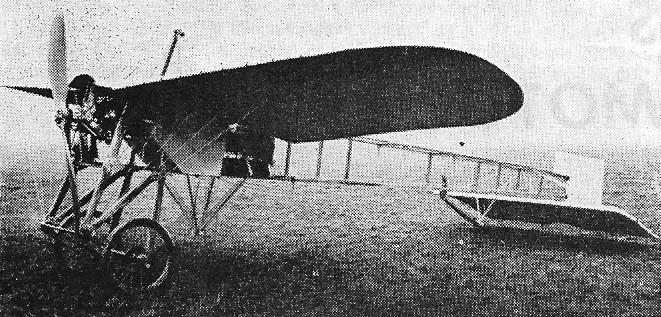
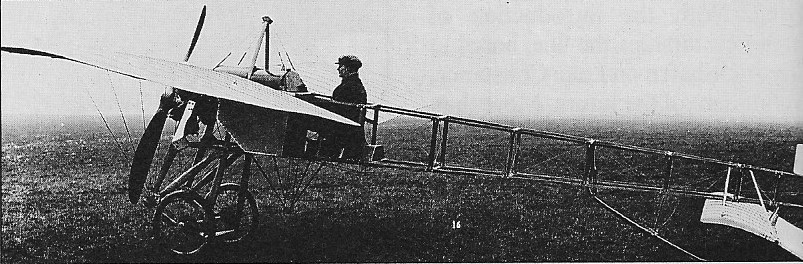
The single-seat Short Monoplane was designed and built at Eastchurch in 1911.

Looking like the earlier Bleriot types, the Short brothers stressed their monoplane to withstand hard use.

Commander C.R. Samson, RN, undertook the first flights in February 1912.

Engine: Gnome, 50 hp
Propeller: two blade Chauviere
Span: 29 ft 3 in
Length: 25 ft
Max speed: 60-65 mph

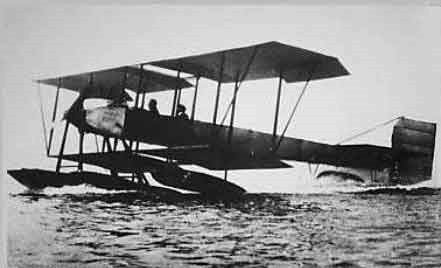
Short S.41 Hydro-Aeroplane

Prototype pilot C.R.Samson

The original version of the S.41 was converted to a landplane and flown by Cdr R. Samson – also the pilot of its maiden flight – during the Army manoeuvres of September 1912. Built at Eastchurch, Isle of Sheppey.

With its floats restored, it started flying from the temporary seaplane station at Carlingnose on October 2nd 1912. In January 1913 it underwent an overhaul during which the centre section gap was covered.

In September 1913 it was overhauled again and the aircraft emerged completely different in shape, fitted with folding wings of greater span and a new rudder. In 1914 it was refitted with a 140 hp Gnôme and assigned to the Eastchurch flying school. In 1915 the S.41 was sent to the Aegean theatre and in 1916 was spotted at Inbros.

It was not included in the March 1916 list of naval aircraft and may have been destroyed prior to that month.

Engine: 100 hp Gnome
Max speed: 60 mph
Endurance: 5 hr

Short SB.5

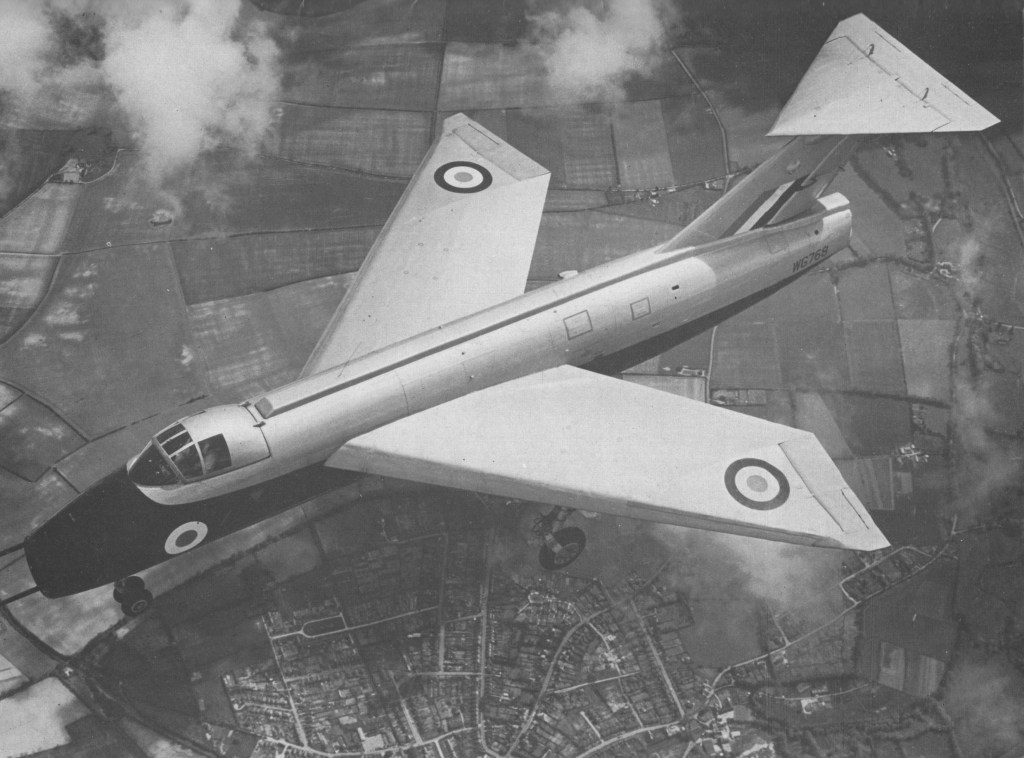
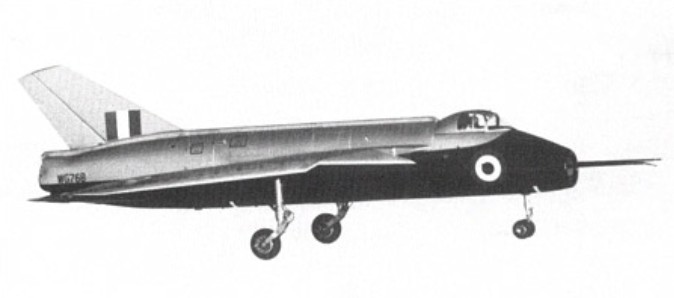
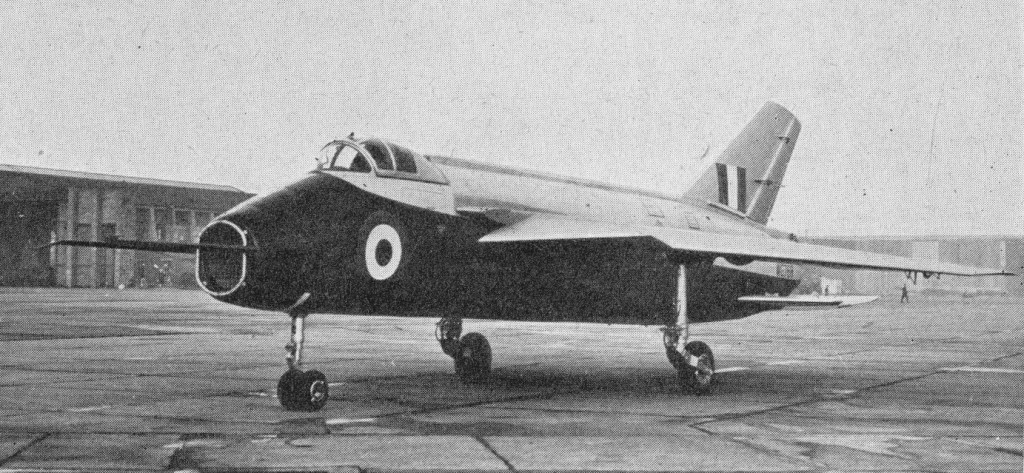
The S.B.5 was a test bed to examine flight characteristics using highly swept wings. The single example S.B.5 (WG768) first flew in December 1952 on the 3500lb (1588-kg) thrust of its Derwent turbojet, and piloted by Roland Beaumont. Though modelled aerodynamically on the Mach 2 English Electric P.l., was intended to investigate the low-speed handling qualities of swept wings. The aeroplane was fitted with wings whose sweep could be adjusted on the ground at angles of 50 degrees for use with a T-tail, 60 degrees for use with a conventional tail or a T-tail, and 69 degrees for use with a T-tail.

Short SB.5 Article

The variable incidence tailplane was later set at the bottom of the fuselage, as on the P.1.

On the S.B.5 wing there is an unusual fixed “droop snoot” on a small portion of the centre section leading edge.

1958 tests included a 69 degree sweepback and a Bristol Orpheus engine.

Gallery

Short SB.5
RR Derwent
Span 30 ft 6 in
Sweep 60 deg
Length 45 ft 9 in