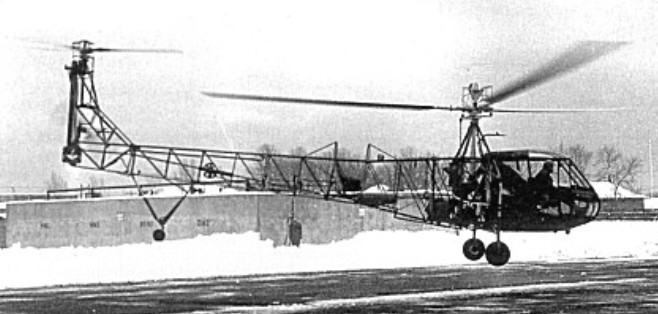
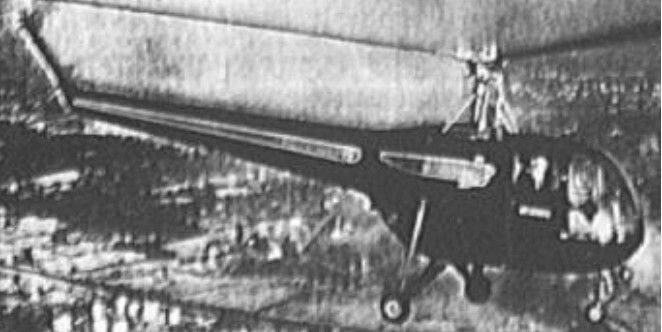
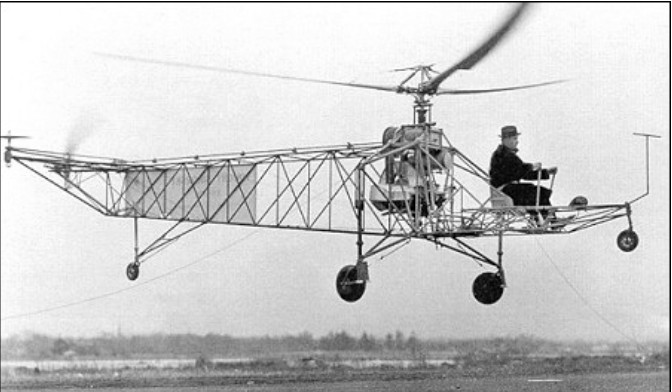
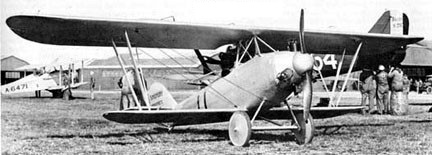
After losing to Piasecki’s tandem-rotor configuration, Sikorsky bought back an R-4B from the US Air Force and modified it to the ‘sesqui-tandem’ configuration once tested on the VS-300, with an observer’s seat added aft of the main rotor. The resulting S-54 was first flown on 20 December 1948 and logged 4 hours 25 minutes flying time before being abandoned in early 1949.
Sikorsky considered that at cruising speed the tail rotor did not absorb any more power than that lost owing to rotor interference with twin rotors.
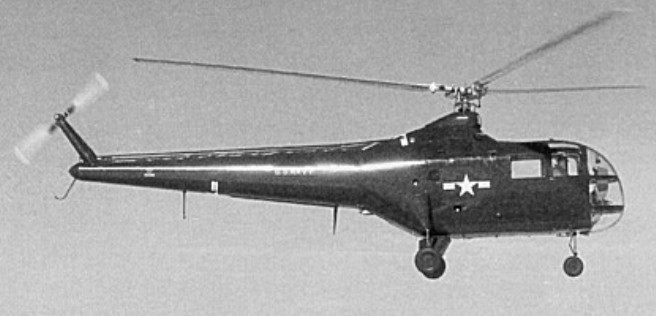
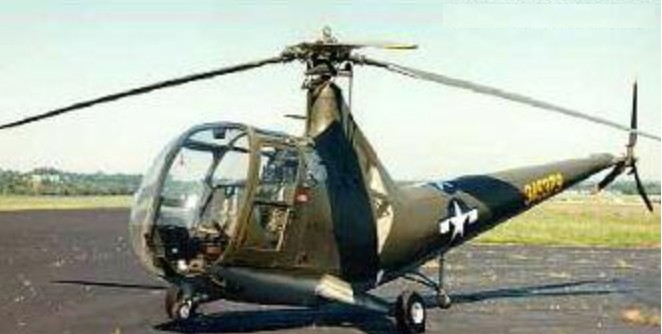
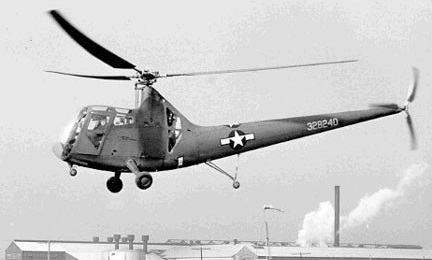
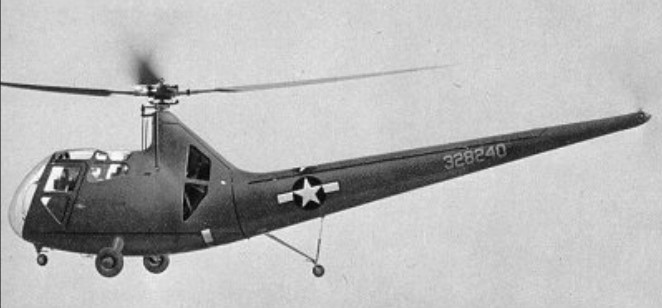
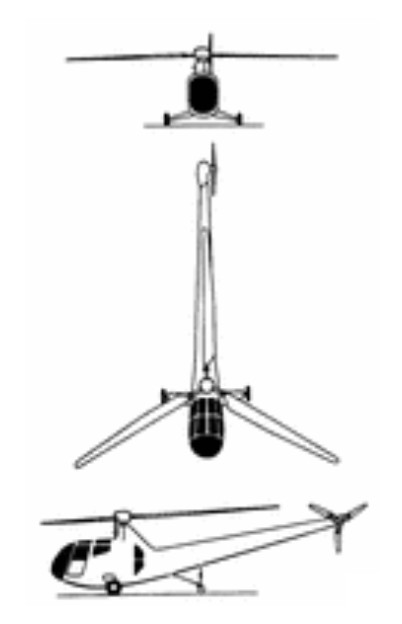
The Sikorsky S-53 was a development of the S-51 series and was designed specifically for utility, observation, and rescue duties aboard aircraft carriers, battleships, and cruisers.
The S-53 featured a fuselage and rotor system very similar to that of the S-51, but with some modifications: the tail rotor was raised above head-height for safety, the landing gear was strengthened for operations from a pitching deck, and the three-bladed main rotor was fitted with a folding mechanism. Amphibious landing gear was optional. A trapdoor in the cabin floor permitted the installation of a camera or a hoist for the transfer of bulky cargo by means of a sling.
The prototype, Bu. 30368, first flew on 22 September 1947.
Two prototypes of this three- to five-place aircraft were procured in 1948 by the U.S. Navy as the XHJS-1 (30368 and 30370), but no production contract resulted.
Additional attempts to market the S-53 were unsuccessful, and the model was developed no further.
XHJS-1 Engine: one 525hp Continental R-975-34 Rotor diameter: 49’0″ Max speed: 110 mph Seats: 3-4
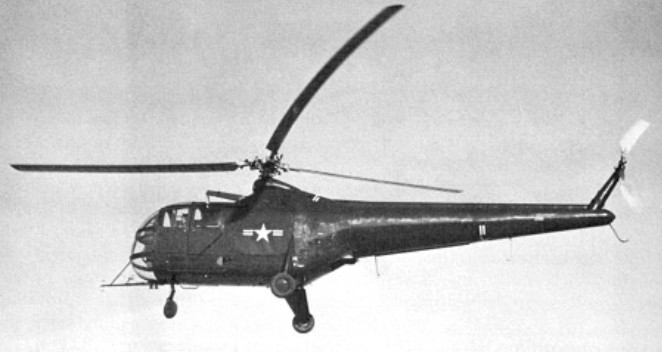
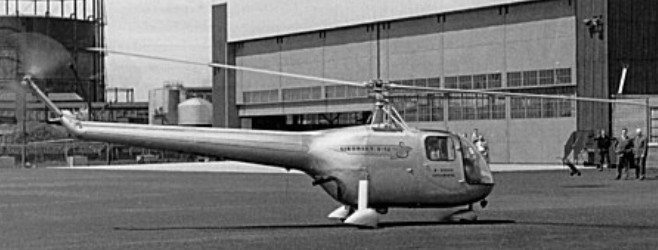
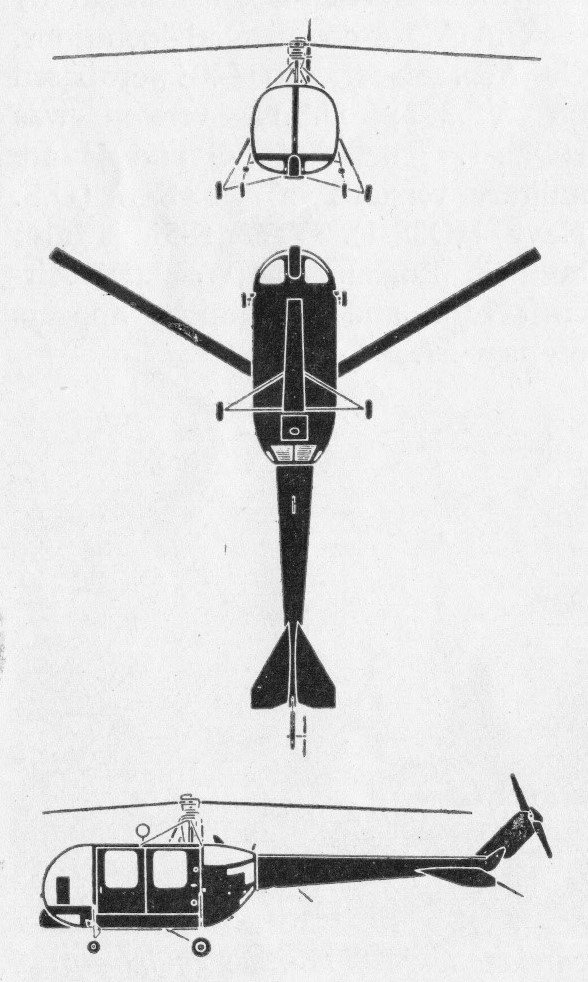
Design work on the Sikorsky Model S-52 began in late 1945, and the craft made its first flight in the summer of the following year. The first American helicopter to be equipped with all-metal main and anti-torque rotor blades, the S-52 had a semi-monocoque, pod-and-boom type fuselage, a single 175hp Franklin engine, quadricycle wheeled landing gear, and a fully-enclosed cabin that could seat up to three people. The machine’s performance was impressive by the standards of the day. The commercial S-52 set three international speed and altitude records in 1948. These 1948 records were 208.57km/h over a 3-kilometer course, 197.55km/h over a 100-kilometer course, and 6468 metres absolute height.
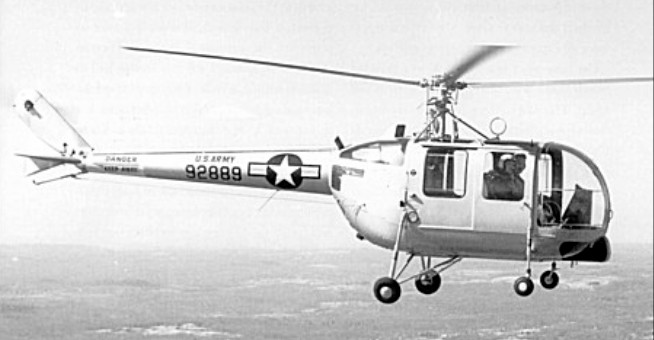
A two-seat helicopter, featuring all-metal rotor blades. The two-seat S-52 (YH-18 Serial number 49-2888) first flew on Feb 12, 1947, powered by a 133kW Franklin engine.
Shortly after gaining the speed record, the little two-seater demonstrated its manoeuvrability, during the course of a routine test flight, by performing a series of successive “loops,” gaining height slightly after each in the approved manner. The pilot was Harry Thompson of Sikorsky’s flight-test department, and the date was May 9th, 1949. Later he repeated the performance – carrying Ralph Alex, then project engineer, as passenger.
The S-52’s performance was a factor in the Army’s 1949 decision to purchase four examples of the slightly modified Model S-52-2 for service test and evaluation. It is the H-18 that holds the distinction of being the first Sikorsky helicopter to be procured for service evaluation by the Army Ground Forces, as distinct from the USAAF.
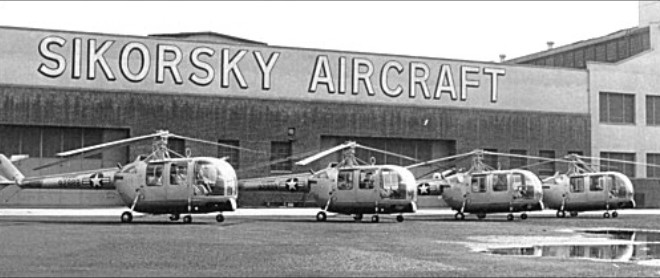
The Army’s four YH-18As (serials 49-2888 through -2891) were essentially similar to the standard commercial S-52, differing primarily in their ability to carry a fourth passenger. Extensive testing showed the YH-18A to be quite capable in the light utility and observation roles, but the Army ultimately decided not to procure the type in quantity. Two were converted as XH-39/-39A test-beds.
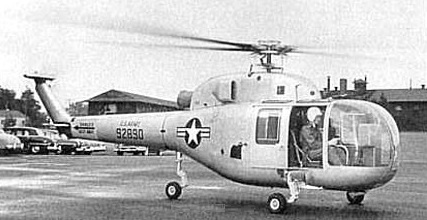
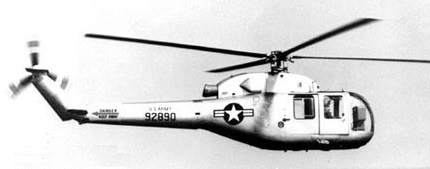
Sikorsky H-18 Turbine version 49-2890
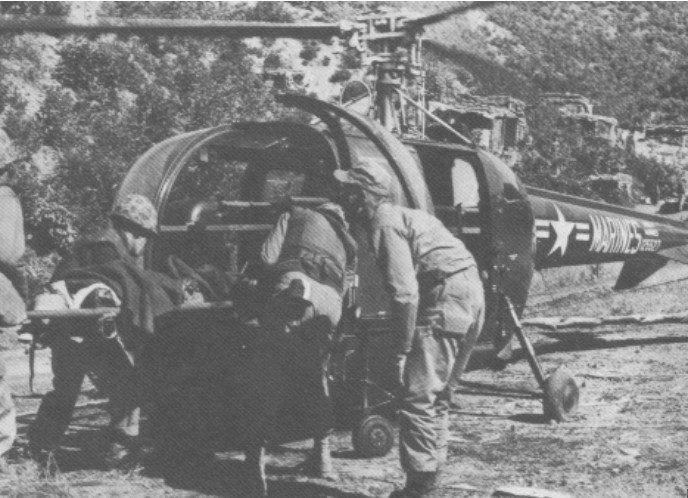
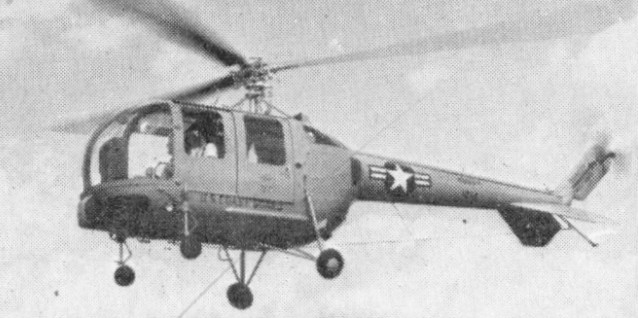
The S-52-2, a three/four-seater with a 183kW Franklin O-425-1 engine which was ordered by the US Marine Corps as a replacement for the HO3S. Deliveries of the HO5S-1 began in March 1952, and eight served also with the US Coast Guard as the HO5S-1G (1244 to 1251).
The use of a high-speed rotor allows a wide range of permissible rotor revolutions in flight, which is of particular advantage in the autorotative-landing case. Where an engine-off landing with zero forward speed is desired, it is possible, by using the kinetic energy stored in the rotor, to hover the machine momentarily in the flare-out before touching down. The touch-down itself is perfectly steady with the quadricycle landing gear.
The rotor blades were originally incorporated on the S-52-1 and the main spar is an alloy extrusion which is itself the leading edge of the blade. The trailing edge is made up in sections, each of which is attached to the spar individually. Thus the sections towards the blade tip are relieved of carrying the centrifugal load exerted on the inner sections, resulting in greater overall strength. The blades are fully interchangeable and their uniformity is a considerable contribution to the smoothness of the machine in flight.
S-52-2
The enlarged version, designated S-52-2, was granted its C.A.A. certification in the early part of 1951. A few civil machines were built, but the main production up to the present has been for the U.S. Navy; the type has been designated HO5S-1. Seventy-nine HO5S-1 went to the USN; 125516 to 125527, 126696 to 126705, 128601 to 128620, and 130101 to 130137. The machine is officially classified as a “three-place” helicopter but a fourth occupant can be carried on shorter flights. The large fuel-tankage capacity allows for 227 litres.
With a pilot and three passengers aboard sufficient fuel can be carried for a flight of approximately one-and-a-half hours – or a distance of between 193 kilometres and 225 kilometres at the cruising speed of 153km/h. With only three occupants the fuel tank may be filled, giving an endurance of 3.5 hours and a range, with fuel reserves, of 530 kilometers. This “built-in alternative” increases the machine’s versatility and has been proved to be of much practical value in the field. For delivery flights, auxiliary fuel tanks may be fitted to provide for a maximum distance of 1287 kilometres with pilot only aboard.
In its role as a rescue helicopter the S-52-2 normally carries two stretcher cases alongside the pilot. The canopy opens forward, in a manner reminiscent of the Bristol Freighter, to allow ease of loading and unloading.
Improvements in stability have been effected by the addition of large ventral stabilizing fins to the tail boom. These fins are fixed surfaces, as they have recently been so made on the American S-55. In earlier versions of the S-55 the fins were adjustable by the pilot to provide fore-and-aft trimming in flight, but this is no longer necessary. Additional vertical fin area has also been provided by an extended fairing on the tail-boom elbow to compensate for the increased keel surface forward of the rotor pylon with the longer nose.
The U.S. Navy purchased 89 S-52-3s as the HO5S-1 for general utility duties, all of which were delivered by 1953.
Sikorsky H-18 Turbine version 49-2890
One aircraft was later converted into the sole H-39 turbine-powered research helicopter and the S-52-2 eventually served the Navy, Marine Corps and Coast Guard as the HO5S.
In all its flight history, the S 52 3 only had one AD (Airworthiness Directive) released, relating to re torqueing of the flywheel bolts on the Franklin engine.
On Jul 24, 1953 the S-52T (YH-18B) turbine powered version of the S-52 was first flown. It used a french Turbomeca Artouste I engine. A developed version designated YH-18B and powered by a T51-T-3 (Artoustc) turbine is now re-designated XH-39, and has set up an international helicopter speed record of 156 mph.
Sikorsky YH-1S Engine: 245 h.p. Franklin Rotor dia: 33 ft Weight: 2,400 lb Max Speed: 110 mph
HO5S Engine: Franklin O-425-1 Main rotor: 33’0″ Length: 28’4″ Max speed: 100 mph Seats: 4
HO5S-1G Engine: 1 x Franklin O-425-1, 183kW Main rotor diameter: 10.06m Fuselage length: 8.79m Height: 2.64m Max take-off weight: 1218kg Empty weight: 744kg Max speed: 177km/h Cruising speed: 148km/h Service ceiling: 4815m Range: 576km Crew + passengers: 1+3
S-52-2 Engine: Franklin 6V6-245-BI6F, 245 hp Rotor diameter: 33 ft Rotors: 3-blade main; 2-blade tail Fuselage length: 27 ft 5 in Loaded weight: 2,700 lb Max speed: 110 mph Ceiling: 22,200 ft Typical range: 415 miles at 95 mph Seats: 3-4
H-18 Engine: Franklin O-425-1, 245hp Rotor diameter: 33’0″ Length: 28’10” Useful load: 1050 lb Max speed: 100 mph Cruise speed: 92 mph Range: 358 mi Ceiling: 15,800′. Seats: 4
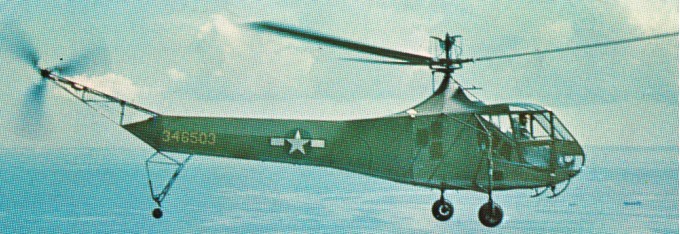
The development of the XR-5 officially began when the British Air Commission placed an order for two “large” (compared to the diminutive XR-4) prototype Vought-Sikorsky helicopters on April 29, 1942. At this time, German U-boat wolfpacks remained a considerable threat to the lifeline of trans-Atlantic convoys that sustained Great Britain. The convoys were particularly vulnerable in mid-Atlantic, beyond the range of shore-based anti-submarine patrol aircraft. There were also very few aircraft carriers available to sail with the convoys and provide air cover. A helicopter that could carry bombs or depth charges and operate from the decks of escort vessels or even merchant ships appeared to offer an ideal solution to the U-boat problem.
The US Army Air Forces caught on to the possibilities of an upgraded XR-4 and quickly submitted a request on May 8, 1942, for an upgraded design, a “workhorse” helicopter with a useful load of over 495 kg (1,100 lb). The request stated, “it is urgently desired to develop a helicopter with greater useful load, endurance, speed, service ceiling, which would have greater utility than the XR-4.” On May 27, the Air Material Command issued Technical Instruction 1124. This order released funds for the construction of four helicopters of the “workhorse” type, designated XR-5. The requirements of the AAF and the British were similar enough that a single design could probably fulfill both needs. Two of the four machines described in TI 1124 were earmarked for Britain to be paid for using Lend-Lease funds.
The XR-5 came about as a direct result of lessons learned from Sikorsky’s development of the R-4. While the R-4, and its developmental cousin, the R-6, saw operational service in World War II, they were underpowered, difficult to fly, and required excessive maintenance, which led to a limited service life. The production R-5s and their civilian counterpart, the S-51, overcame these difficulties and played an important role in establishing the helicopter as an indispensable aircraft for military and civilian operators.
The design process for the XR-5 was already well under way by the time TI 1124 was issued. More than six months earlier, Igor Sikorsky had anticipated a military request for a purpose-built observation helicopter. The Platt-LePage XR-1 had already won the AAF contract for development of an observation helicopter, but Sikorsky knew it would never become a practical service machine. Well ahead of actual events, he launched a program to develop a more practical design called the VS-327 (V for Vought and S for Sikorsky. Vought, like Sikorsky, was one of several companies owned by the holding company United Aircraft). Development began on September 26, 1941, and William E. Hunt was named project manager. When the Technical Instruction for the XR-5 was issued, the VS-327 handily met the requirements.
Work on the design progressed quickly, but when construction began on the first prototype, the pace slowed. As chief designer, Igor Sikorsky had a pivotal role to play but the demands of other projects distracted him. There was also considerable difficulty obtaining certain strategic materials such as aluminum to build the helicopter. The AAF considered helicopters interesting and promising, but gave conventional warplanes a higher priority. Sikorsky had to build certain sections of the helicopter, such as the tailcone and fuselage panels, from non-strategic materials, such as wood. This increased the aircraft’s weight, reduced structural integrity, and delayed the project. Aluminum versions replaced these wooden components when the predicted shortages failed to materialize. The 450hp Pratt & Whitney R-985 Wasp Junior engine chosen for the XR-5 was also a source of trouble. At that time, this power plant was used in Vought’s OS2U Kingfisher naval floatplane. To speed construction, Sikorsky retained the Kingfisher engine mount arrangement in the XR-5 but during ground runs, the helicopter overheated badly. A fan was needed to force more cooling air through the engine compartment, but there was not enough space to install it within the Kingfisher engine mount. Revising the mount and adding the fan further delayed the program.
Sikorsky was aware that the box-top fuselage of the XR-4 obstructed airflow from the main rotor and reduced the rotor’s lifting capacity. He also knew that visibility out of this earlier design could be much improved and these two design goals drove the overall layout of the XR-5. The fuselage was more streamlined and slimmer in profile, and nearly the entire nose of the helicopter was covered in Plexiglas windows. The observer occupied the front seat of this “fishbowl,” while the pilot occupied the seat directly behind him. The XR-4 used a tricycle undercarriage supplemented by a strut and wheel extending attached beneath the rear fuselage to prevent the tail rotor from striking the ground during flight-testing. Sikorsky dispensed with this wheel and strut on the production models.
Each of the three rotor blades resembled the fixed-wing of a conventional airplane. A laminated wooden spar supported wooden ribs and the whole assembly was covered with fabric. These blades were difficult to build, hard to balance, and easily damaged by rain. Sikorsky replaced the wooden spars with steel tubes in production versions of the XR-5 and this resulted in safer, more durable blades. However, he had to retain the fabric covering. It was not yet possible to build a rotor blade skinned with metal that was also flexible enough to flap and flex in flight. The S-51 had a three-blade rotor which had flapping and drag hinges and could be folded to facilitate storage. The early machines had manual control for the rotor pitch, later replaced by hydraulic servo-controls with power from a hydraulic pump driven by the tail transmission shaft.
Company chief test pilot Les Morris carried out the first flight of the XR-5 (s/n 43-28236) on August 18, 1943. Following adjustments to blade tracking and lead-lag dampers, flights soon exceeded 30 minutes. On September 13, the XR-5 lifted a pilot, observer, and eight passengers perched on the landing gear strut fairings, and exceeded the military useful load requirement by 270 kg (600 lb).
Testing progressed well until October 12. With Sikorsky’s nephew, Jimmy Viner, at the controls, the tail rotor failed at an altitude of 23 m (75 ft). Viner crash-landed and neither he, nor his observer were injured, but the aircraft suffered significant damage. Production on the next XR-5 (s/n 43-28237) was quickly stepped up and test flying resumed the last week of November 1943.
AAF leaders authorized series production of the XR-5 on March 24, 1943, to commence whenever the final development phase of the XR-5 was complete. This contract specified a production run of 250 aircraft, 100 of them earmarked for Great Britain. The contract soon increased by 150 helicopters for the AAF, and the Navy ordered 50 more. The development process had continued at a steady but relatively slow pace, as much of Sikorsky’s effort was focused on series production of the R-4 and R-6. These helicopters had met their contract requirements while the XR-5 was still struggling through the test program. Great Britain cancelled two XR-5s on March 25, 1944, because aircraft carriers and long-range patrol aircraft had filled the antisubmarine role originally envisioned for the R-5. The AAF quickly moved to take over this order, as Lt. Col. Frank Gregory, head of the AAF helicopter program, remained enthusiastic about XR-5. He considered it more advanced than any other American helicopter developed up to that time. Flight tests began on the fifth and final XR-5 at the Sikorsky plant in Bridgeport, CT, on January 17, 1944. The AAF accepted this aircraft and transferred it to Wright Field for further development on September 30, 1944.
That this dawn of a new technological era remained perilous for both man and machine is graphically illustrated by the fate of the XR-5s. The third (s/n 43-28238) was destroyed on November 4, 1944. The fabric covering one of the rotor blades tore loose and in the ensuing crash, the helicopter rolled over. The second XR-5 suffered a fatal crash at Gainesville, Florida, on December 2, 1944, when welds in one of the steel collars holding the blades to the rotor mast failed. As a result, a different welding technique was adopted on the assembly line. The first XR-5 suffered an engine failure while flying to a war bond rally in Nebraska. The pilot crash-landed but the airframe was too damaged to repair it was scavenged for spare parts. The AAF continued to test the last XR-5 (s/n 43-47954) until 1946, when the service handed the helicopter over to the National Air Museum (later the Smithsonian National Air and Space Museum).
By March 29, 1945, the AAF declared the XR-5 development program complete and service planners cleared the R-5A for series production. The AAF designated the first 26 aircraft off the line as YR-5A service test aircraft, but these helicopters did not otherwise differ from production R-5As. Two were assigned to the Navy under the designation HO2S-1 (75689 and 75690). In 1946 they were handed over to USCG as HO2S-1G. Trouble returned to the program after the R-5A began flying. Poor aerodynamic analysis by the National Advisory Committee for Aeronautics (NACA) caused Sikorsky to turn out unbalanced rotor blades, and the company was forced to correct the flaw with makeshift repairs that hurt performance of the production aircraft. When World War II ended, the AAF cancelled or reduced a number of aircraft contracts, including the R-5A, and Sikorsky completed 60 YR-5A and R-5A aircraft, of which, only nine were delivered before V-E Day. Ironically, the cancellation allowed the designer to further refine the aircraft, and to develop it for the civil market. This work produced the R-5F and its civilian counterpart, the S-51. In these models, the rear-seat cockpit was converted into seating for three and the observer seat became the pilot’s position.
Of the five XR-5, 43-28236/28239 to -47954, two were fitted with British equipment and redesignated as XR-5A.
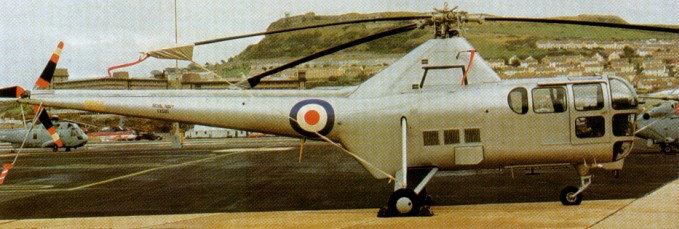
Royal Navy Westland-Sikorsky S-51 Dragonfly – 1952
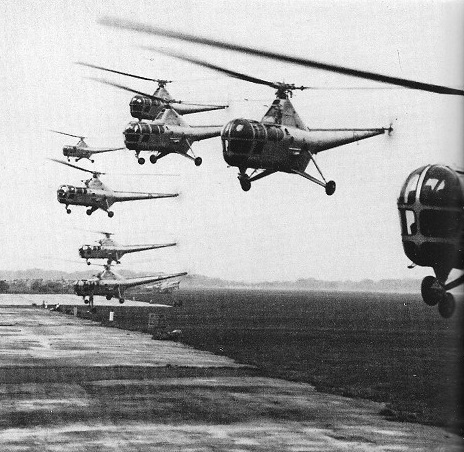
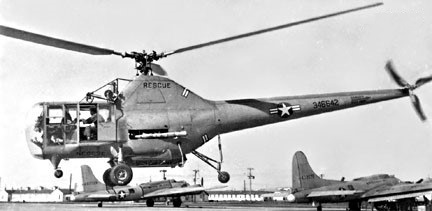
While production of the R-5A was getting under way (34 built, 43-46626 to -46659), five pre-series aircraft, 43-46611 to 46615, were converted into the R-5E, which had dual control. The YH-5E were redesignated as YH-5E in 1948. Twenty-one modified R-5As, 43-46606 and -46640 to -46659, were later given new, 600hp Wasp Junior engines and redesignated R-5D, then H-5D in 1948. The R-5D featured with nose wheel, rescue hoist, and external fuel tank. From the latter, the S-51 was developed, with a slightly enlarged four-seat cabin and a tricycle landing gear. The R-5A were fitted with external litters for SAR duty.
Sikorsky YR-5D 43-46642
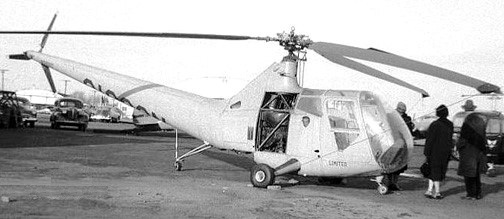
Modified from a military design for the civil market (TC H-2), the S-51 was the world’s first commercial helicopter, inaugurated Philadelphia’s Helicopter Air Transport service. With a three-blade main rotor the S-51 first flew on 16 February 1946, and went to the USAF as R-5F, and USN as HO3S-1. Eleven of the 1948 R-5F were built, 47-480 to -490, basically a four-place military S-51 (with nose wheel). Licensed production in Great Britain as Westland-Sikorsky Dragonfly (with 520hp Alvis). The S-51 was a prototype for S-53.
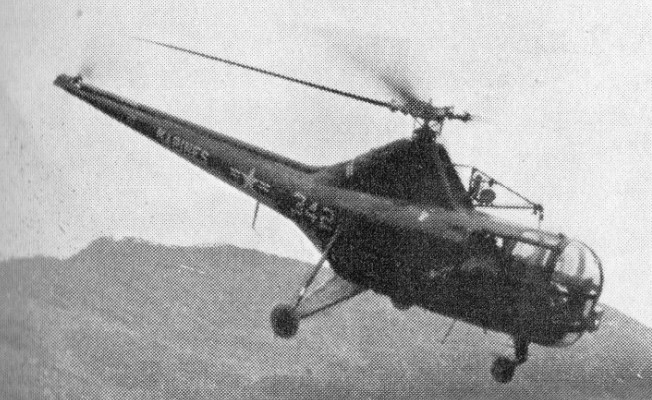
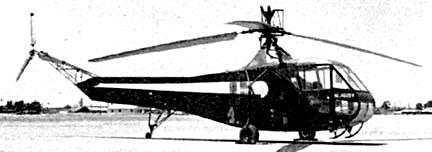
Ninety-two of the 1946 HO3S-1 were built (57995 to 57998, 122508 to 122529, 122709 to 122728, 123118 to 123143, and 124334 to 124353). Nine HO3S-1s were used by the US Coast Guard as HO3S-1Gs (1230 to 1238). HO3S-1s served with distinction in the Korean War with Squadron HU-1. In 1950 Sikorsky built and tested a single XHO3S-3 with a redesigned rotor head and blades.
HO3S-2 was a designation reserved for a USN version of the H-5H but not used.
One HO3S-1 was fitted with a different rotor in 1950 as the XHO3S-3.
Although the AAF accepted R-5A helicopters before the end of World War II, these never reached operational units and service interest in the aircraft appeared to be waning. Sikorsky believed that without military customers, the civilian S-51 held the key to continued growth of the helicopter market and he promoted it vigorously.
On November 29, 1945, an S-51 dramatically rescued two seamen from a foundering barge off the coast at Bridgeport during severe weather. This event renewed military interest and a number of R-5 variants served until after the Korean War. Before the arrival of Bell’s H-13 (Model 47) into the Korean combat zone in 1951, military pilots flying the H-5 (H for helicopter replaced R for rotorcraft) conducted most of the thousands of medical evacuation (medevac) missions flown during that war. The H-5 and the H-13 reduced the fatality rate among wounded soldiers during the Korean War by more than 50 percent, however, the narrow center of gravity range on the H-5 soon made it obsolete compared to newer helicopters. Sikorsky attempted to extend the longevity of this classic design by offering the U. S. Navy a new five-seat version, the XHJS-1, but the helicopter lost out to Piasecki’s tandem-rotor HUP-1.
In 1950 Sikorsky built and tested a single XHO3S-3 with a redesigned rotor head and blades. The R-5B, R-5C and HO3S-2 were planned variants later cancelled.
8ikorsky H-5
Thirty-nine of the 1948 H-5G SAR version with hoist were built: 48-524 to -562.
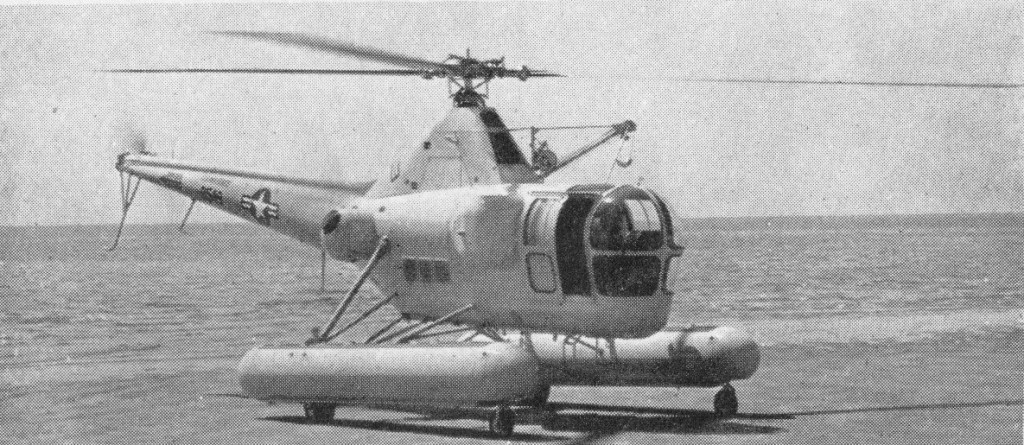
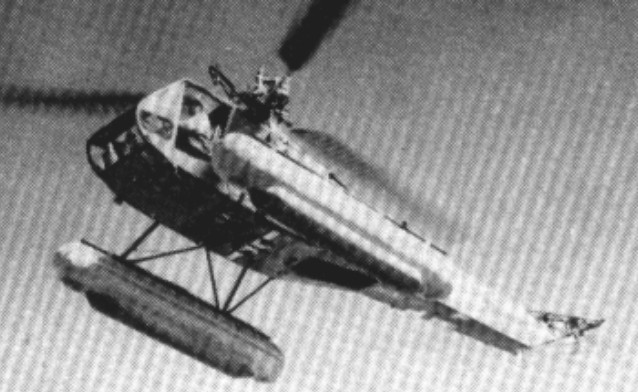
Sixteen of the 1949 H-5H combination wheel and pontoon gear variant were built: 49-1996 to -2100.
Sikorsky H-5H
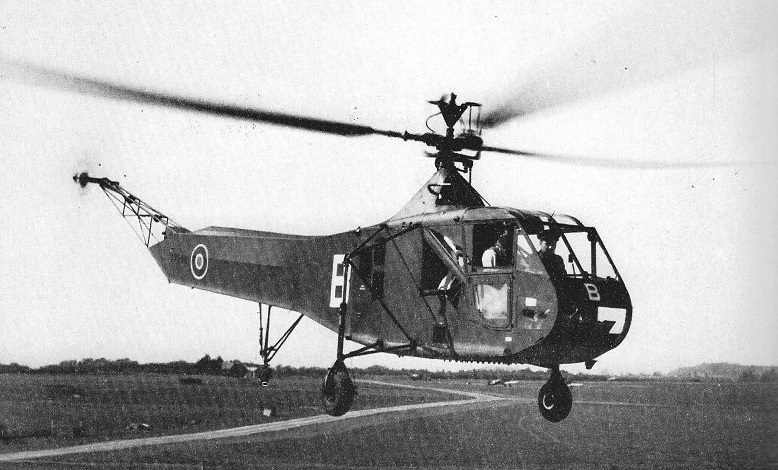
As the H-5 disappeared from the U.S. military inventories, Westland Aircraft Limited of England continued to build the aircraft, under license, as the HR.1 Dragonfly. These aircraft served with the Royal Air Force and Royal Navy throughout most of the 1950s. The British built version has a 520 hp Alvis Leonides radial engine installed with the crankshaft vertical, and having all metal rotor blades.
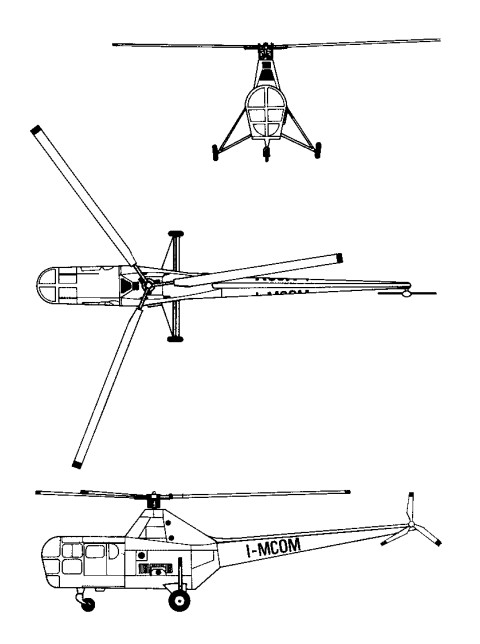
In December 1946 Westland Aircraft of Yeovil purchased a licence to build the S-51 in Britain. When they ceased production in 1953 they had built 139 machines. The Dragonfly, as the British-built machine was known, had a 520hp Alvis Leonides engine, a redesigned cabin for four passengers plus the pilot, and a three-blade rotor.
Basically similar to the US-built aircraft, the type was assembled from British-built components and in all but one variant was powered by the Alvis Leonides engine. The first civil Westland/ Sikorsky WS-51 was flown on 5 October 1948 and on 24 July 1951 the type became the first British-built helicopter to gain a certificate of airworthiness. Before that, in 1950, a version designated Dragonfly HR.Mk 1 equipped the Royal Navy’s first helicopter squadron, No. 705 formed at RNAS Gosport.
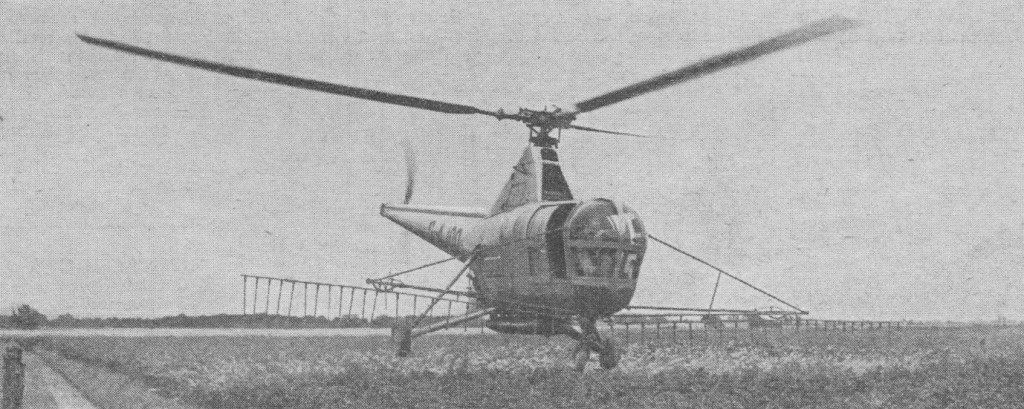
Pest Control Westland Sikorsky – 1949
Commercial versions are the Mk. 1A with Alvis Lconides and Mk. 1B with Wasp Junior engine, as in the American model. In the British services the type is known as the Dragonfly: the H.R. Mk. 1 (composite blades) and H.R. Mk. 3 (metal blades) are used by the Royal Navy; similar models in service with the R.A.F. are designated H.C. Mk. 2 and H.C. N1k. 4 respectively.
Westland WS.51 Dragonfly NR.1
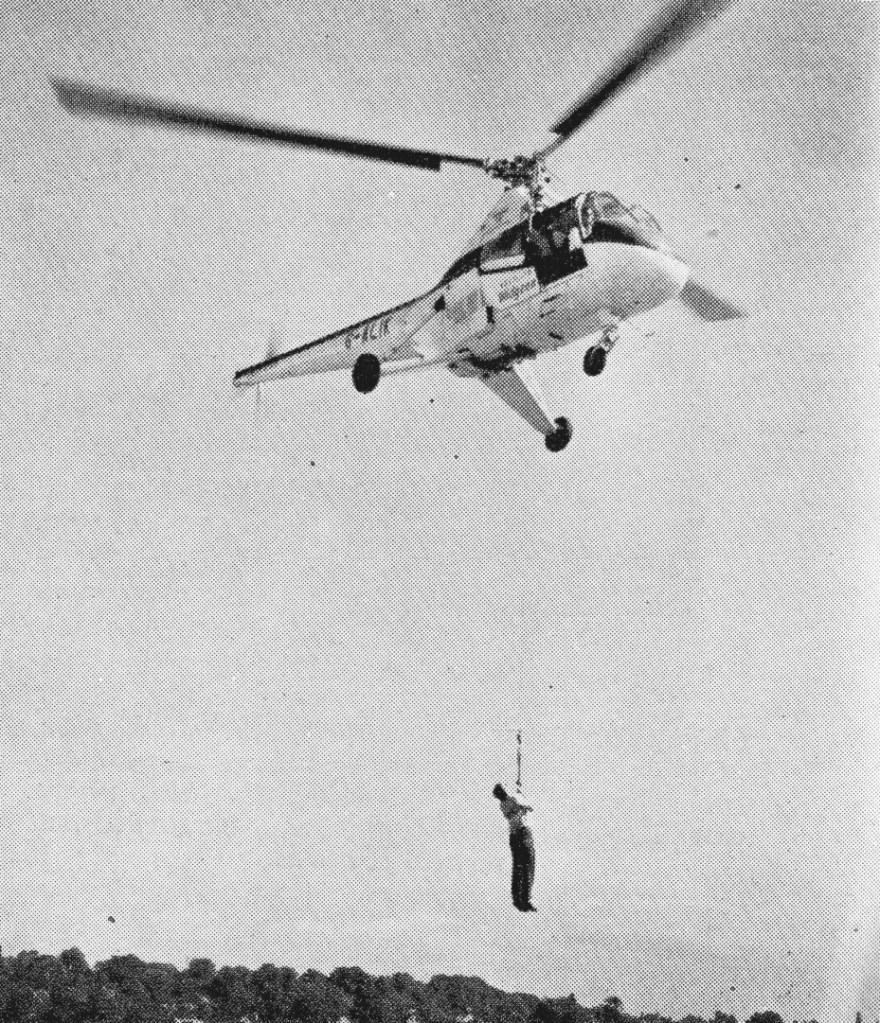
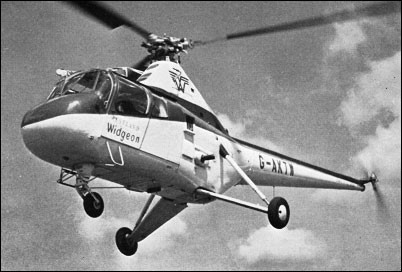
Built to a total of 133, the Dragonfly was followed by a developed version, the Westland Widgeon, the prototype of which was a conversion of a Dragonfly to provide five-seat capacity and which benefited from the introduction of the improved rotor of the Sikorsky S-55. It had a four-blade main rotor with a 520hp Leonides 521 engine. The Widgeon original airframe was given a new front fuselage for a pilot and four passengers in a two/three arrangement, and small clamshell nose doors. The first Dragonfly converted to Widgeon standard, first flew on 23 August, 1955, for 30 minutes, at Yeovil, piloted by Roy Dradley.
During 1957, the five seat Widgeon obtained a Type Certificate of Airworthiness.
Westland produced 15 Widgeons and sold them to Ceylon, Jordan, Brazil and the Hong Kong police department. The Widgeon used an S-55 rotorhead which employs an offset flapping-hinge system, thus allowing more latitude in the centre of gravity and the position of cargo or passengers.
Westland sold their UK-built helicopters to Belgium, Ceylon, Egypt, France, Iraq, Italy, Japan, Thailand and Yugoslavia. At least one model was equipped for rescue operations with an external hoist capable of lifting up to 455kg. The bulk of these sales were for military use, but Belgium became a European pioneer in the civil field when Sabena bought three. The S-51 had a three-blade rotor which had flapping and drag hinges and could be folded to facilitate storage. The early machines had manual control for the rotor pitch, later replaced by hydraulic servo-controls with power from a hydraulic pump driven by the tail transmission shaft.
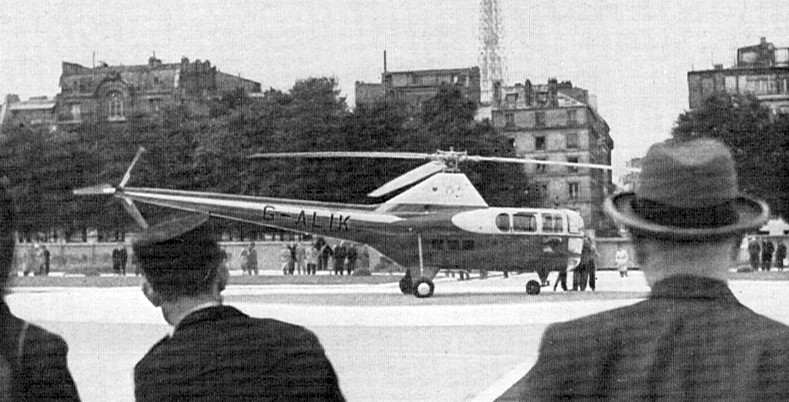
1949 London-Paris service, pilot Alan Bristow landing at Les Invalides
Westland Widgeon
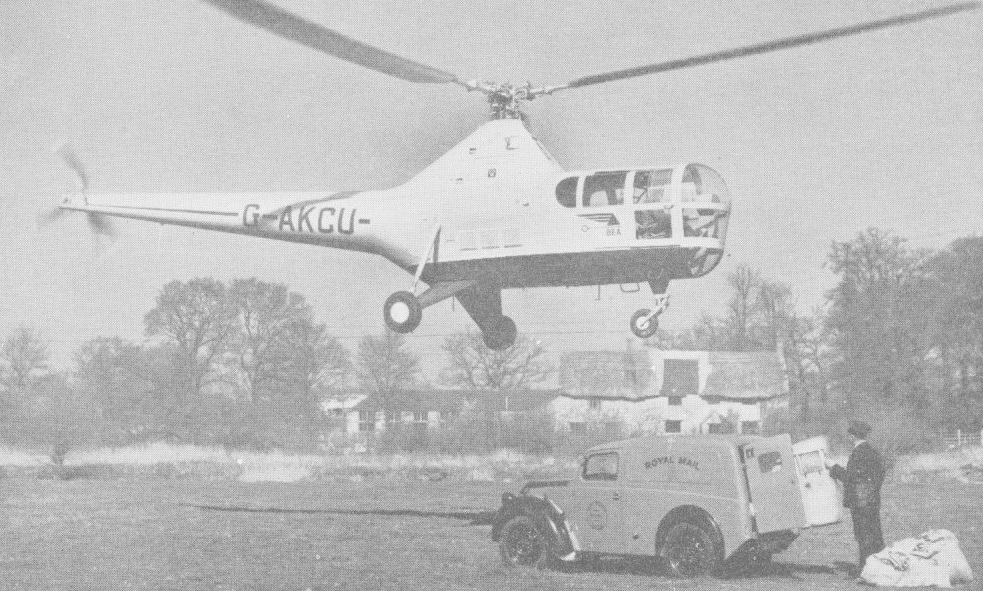
B.E.A. commenced helicopter operations on 21 February 1949 with S-51s. BEA ran a trial helicopter service between Cardiff and Liverpool during 1950-51 and later, a service between Birmingham and London using the Sikorsky S-51.
BEA S-51
Helicopter Air Transport (HAT), based in New Jersey, became one of the first commercial helicopter operators when it took delivery of several S-51s in 1946. The operating cost of these aircraft proved too high for HAT’s primary business, flight training, and the company went bankrupt. A number of airlines and other companies experimented in the late 1940s and early 1950s with the S-51 for passenger, freight, and mail service but again, the costs of operating and maintaining the helicopter were simply too high for any of these enterprises too succeed. The S-51 failed to develop into a commercially viable aircraft but it proved that civilian helicopters could perform useful jobs, and it paved the way for more advanced designs. However, no helicopter airline has survived without massive government subsidies.
The S-51 has the distinction of being the first helicopter in the world to fly a regular service, and it did so in the United Kingdom. It flew in British European Airways’ colours between Liverpool and Cardiff in June 1950.
Dragonfly HR.Mk 1 Initial air/sea rescue (ASR) version for Royal Navy with the Alvis Leonides 50 radial engine
Dragonfly HC.Mk 2 Similar to Dragonfly HR.Mk 1 but equipped as casualty evacuation aircraft for the RAF
Dragonfly HR.Mk 3 Major production ASR version for Royal Navy (58 built); generally as Dragonfly HR.Mk 1 but introduced all-metal rotor
Dragonfly HC.Mk 4 Casualty evacuation version for RAF, similar to Dragonfly HR.Mk 3
Dragonfly HR.Mk 5 Final ASR version for Royal Navy, similar to Dragonfly HR.Mk 3
Westland/Sikorsky Mk 1A Civil version with 388kW Alvis Leonides 521/1 engine; most used as civil transports, but small numbers to Japan for rescue, and to Italian and Thai air forces
Westland/Sikorsky Mk 1B Civil version similar to Mk 1A but with 336kW Pratt & Whitney R-985-B4 Wasp Junior engine
Sikorsky XR-5 / VS-327 Rotor Diameter: 14.6 m (48 ft) Length: 13.71 m (44 ft 11.5 in) Height: 3.9 m (13 ft) Weight empty: 1,656 kg (3,650 lb)
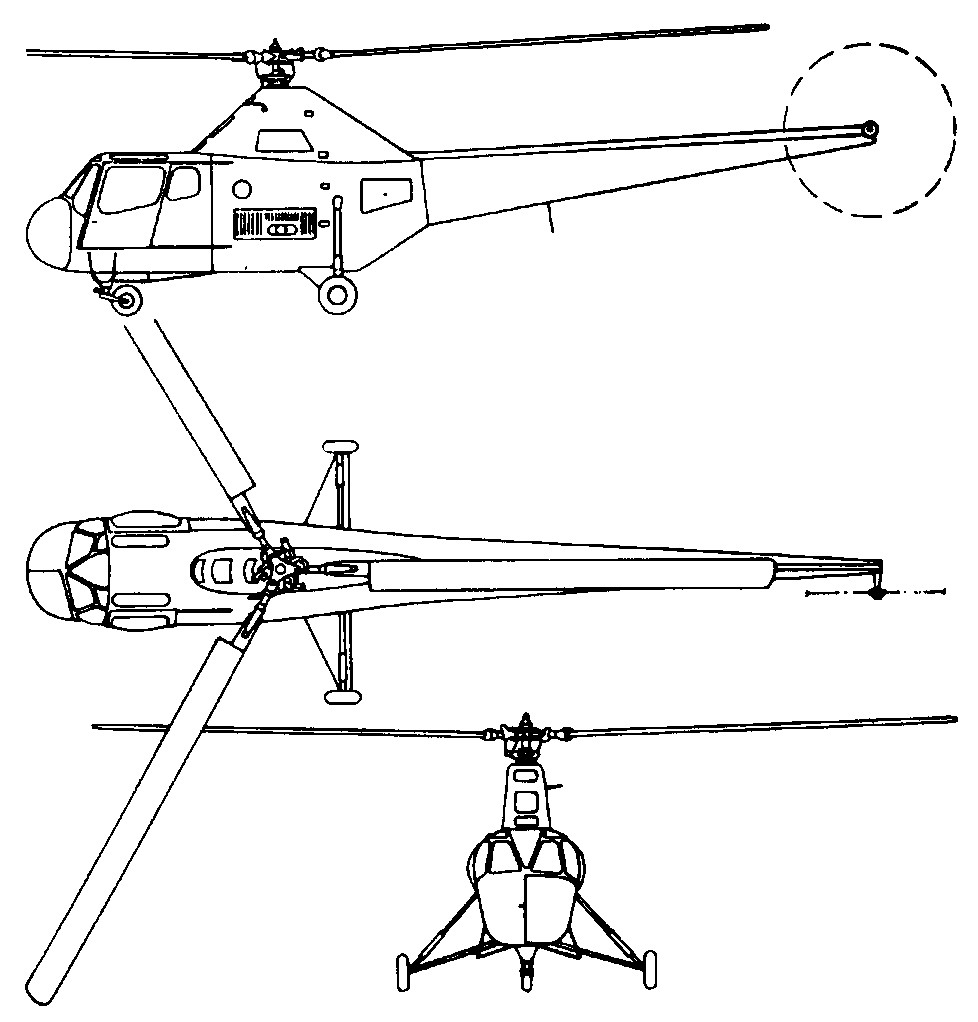
Sikorsky S-51 DragonFly (H-5) Engine: One P&W R-985-AN-5 Wasp Junior, 450 hp / 336kW Rotor diameter: 14.63 m Length rotors turning: 13.70m Fuselage length: 12.45 m Height: 3.96 m Weight: Empty: 1715 kg Max take-off weight: 2263kg Speed: Max: 171 km/h Range: 579 km Service Ceiling: 4389 m Crew: 1 Passengers: 3
H-5 Engine: 450 h.p. Pratt & Whitney R985-5 or -7 Wasp Junior Rotors: 3-blade main; 2-blade tail Rotor dia.: 49 ft Fuselage length: 44 ft 11.5 in Loaded weight: 5,500 lb Max. Speed: 103 mph Ceiling: 13,500 ft Typical range: 260 miles at 85 mph Seats: 4
HO3S-1 Engine: 450 hp P&W R-985-AN-5 Rotor: 49’0″ Length: 41’1″ Max speed: 105 mph
Westland WS.51 Dragonfly HR.5 Engine: 520 hp Alvis Leonides radial Main rotor diameter: 14.99m Cruising speed: 142km/h
Westland WS.51 Dragonfly NR.1 Engine: 520 hp Alvis Leonides radial Main rotor diameter: 14.99m Cruising speed: 142km/h
Westland Widgeon Engine: 520hp Leonides 521 Rotor dia: 49 ft 2 in Length overall: 57 ft 7.5 in Height: 12 ft 11.5 in Empty weight; 4424 lb MTOW: 5900 lb Max payload: 1108 lb Range max payload: 20 nm Max range: 262 nm. Max speed: 83 kt Normal cruise: 70 kt ROC: 970 fpm Service ceiling: 10,500 ft HIGE: 7500 ft Seats: 5
Westland Widgeon 5 Engine; Alvis Leonides Major Empty weight: 5262 lb MAUW: 8000 lb Max speed SL/ 95 kt ROC: 825 fpm Service ceiling: 12,500 ft HIGE: 7,000 ft Range: 300 nm Max range; 1214 nm
Westland Dragonfly Engine: 520 h.p. Alvis Leonides 50 Rotors: 3-blade main; 3-blade tail Rotor diameter: 49 ft Fuselage length: 57 ft 0.1 in Loaded weight: 5,870 lb Max speed: 103 mph Ceiling: 14,200 ft Typical range: 300 miles at 85 mph with full load Seats: 4.
The Sikorsky R-6 was developed parallel with the improved R-5. Ordered in 1943, the Sikorsky VS-316B or XR-6 prototype (43-47955) made its maiden flight on 15 October 1943. It was essentially a refined and developed version of the R-4, and the same rotor and transmission system was used in both types. A 225hp Lycoming O-435-7 engine provided the power, and the fuselage was transformed into a highly streamlined, metal-skinned unit with a one-piece moulded plexiglas cabin for the 2 crew members, and a four-wheel landing gear arrangement
First flown on Oct 15, 1943, Les Morris, was the Chief Test Pilot on the Sikorsky VS-300 starting in March, 1941 (and on the XR-4, XR-5 and XR-6 which followed).
On a March 1944 the XR-6 set new helicopter distance, endurance and altitude records when it made a non-stop flight of 623km from Washington, D.C, to Dayton, Ohio, in 4 hr. 55 min, climbing to 1524m over the Allegheny Mountains en route.
The XR-6 was followed by five 2-seat service test XR-6A’s for the USAAF (43-28240 to 28244) of which three, 46446 to 46448, went to the U.S. Navy (as XHOS-1), built by Sikorsky with 240hp Franklin O-405-9 engines.
Sikorsky XR-6A 43-28240
Twenty-six generally similar pre-production YR-6A’s, 43-45316 to 45341, were built by the Nash-Kelvinator Corporation under license from Sikorsky. Sikorsky Co, heavily involved in F4U production, contracted Kelvinator—then a licensee of Pratt & Whitney building airplane engines—to take over production of the R-6A. Redesignated as YH-6A in 1948. Kelvinator had an available plant in Detroit, and the tooling for the project was moved there. Kelvinator carried out the production of the one hundred and ninety-three R-6A’s (43-45342 to -45534) built from 1945. Thirty-six of these were delivered to the U.S. Navy as the HOS-1, 75589 to 75624 and 75729 to 75730, and formed the equipment of that service’s first helicopter squadron, which commissioned in July 1946. Twenty-seven were later were handed over to the USCG as HOS-1G. Those remaining in service in 1948 were redesignated as H-6A. One hundred and fifty went to the RAF in 1946 as Hoverfly II.
Forty R-6A’s were supplied to Britain under Lend-Lease, these being named Hoverfly II in British service. Fifteen of them were allocated to the Fleet Air Arm for communications and training in 1946; others served with No.657 (AOP) Squadron RAF and the Airborne Forces Experimental Establishment.
Like the R-4, the R-6 could be fitted with pontoons as an alternative to a wheeled landing gear, and was employed on a variety of duties including air/sea rescue, casualty evacuation and observation.
Beginning with the R-6, helicopters flown by the U.S. Coast Guard had Navy designations with the suffix letter G (as HOS-1G) until the 1962 redesignation of U.S. military aircraft.
Its career was, however, a short one: it was frequently beset by engine difficulties, and soon gave way to the more reliable R-5 and its derivatives. A proposed Lycoming-powered R-6B version by Nash-Kelvinator was cancelled.
R-6 Engine: One Lycoming O-405-9, 235 hp/168kW Rotor diameter: 11.58 m Length: 11.60 m Height: 3.4 m Max take-off weight: 1317kg Empty weight: 923kg Cruise Speed: 110 km/h Max speed: 161km/h Range: 565 km Rate of climb: 4.0m/s Service ceiling: 3050m Passengers: 1 Crew: 1
R-6A / H-6A Engine: Lycoming O-435 Main rotor: 38’0″ Length: 38’3″ Max speed: 96 mph
HOS Engine: Franklin O-405-9 Main rotor: 38’0″ Length: 38’3″ Max speed: 105 mph
In 1941, the Vought Sikorsky Division of United Air¬craft was awarded a development contract for an experimental helicopter, designated XR 4. With an uncovered fuselage, it featured the first tail rotor configuration.
Designed by Igor Sikorsky and Michael Gluhareff, the prototype VS-316A first flew on 14 January 1942. The sole prototype (41-18874) was the first helicopter built expressly for military service (USAAF).
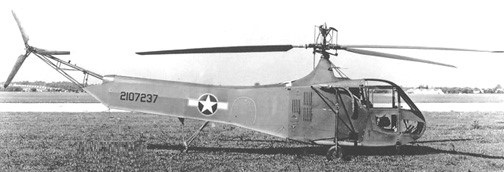
Sikorsky XR-4 41-18874
The XR-4 was delivered by air with Sikorsky along as a passenger. During the trip, they hovered low to read highway signs and once asked an astonished motorist for directions to the Army airfield. It arrived at Wright Field, Ohio, on 18 May 1942, having completed, in stages, the 1225km trip from Bridgeport, Connecticut, in 16 hr 10 min flying time.
It became XR-4C in 1943.
Sikorsky VS-316 NX28996
The Sikorsky R-4, or VS-316A, was a definitive development of Igor Sikorsky’s successful pre-war VS-300. Like the VS-300, it had a framework of heavy-gauge steel tube, and all but the extreme rear end of the fuselage was fabric-covered, as were the 10.97m diameter main rotor blades. It retained the single three-¬blade rotor and anti torque rotor of the VS 300, driven through transmission shafts and gearboxes. A completely new feature was the fully-enclosed cabin, with side-by-side seating and dual controls for the 2-man crew.
Sikorsky VS-316A
Les Morris, was the Chief Test Pilot on the Sikorsky VS-300 starting in March, 1941 (and on the XR-4, XR-5 and XR-6 which followed).
An experimental R-4 was fitted with a tilting tail rotor.
Later in 1942 an order was placed for three service test YR-4A’s (42-107234 to 107236) with 180hp R-550-1 engines and main rotors of 11.58m diameter, and similar changes were made to the XR-4 in 1943, after which it was redesignated XR-4C.
These were generally similar to the XR-4 except for an enlarged cabin, and were used inter alia for winterisation and tropical trials in Alaska and Burma. The first helicopter in the history of warfare were used during Operation Thursday, Burma, in 1944. They were Sikorsky R-4Bs. With a range of about 75 miles and cruise of 75 mph, they were used to transport wounded Chindits out of the stronghold.
Other 1943 developments included the first-ever landing by a helicopter on a ship at sea (by Colonel Frank Gregory on 7 May 1943) on the tanker Bunker Hill in Long Island Sound, USA, and the production of twenty-seven pre-series YR-4B’s for further evaluation by the USAAF, the U.S. Navy (three), U.S. Coast Guard (three) and the RAF (seven). The Navy designation was HNS.
RAF R-4 1945
Thirty production machines (YR-4As and YR-4Bs) were ordered in total.
In 1944 the R-4 became the first helicopter in the world to be placed in series production.
Twenty-seven YR-4B were produced, 42-107237/107248, 43-28223/28235, -28247, -47953, of which 3 to USCG and 7 to Great Britain as Hoverfly I. Additionally, 15 were produced for USN as HNS-1. They were fitted with bomb racks for anti-sub duty.
Three YR-4Bs and 22 R-4Bs were transferred from the USAAF as HNS-1 (39033 to 39052, 46445, 46699 to 46700, and 75727 to 75728).
Sikorsky YR-4B 42-107237
One hundred production R-4B’s were built, 43-46500 to 46599, similar to the YR-4B except for a more powerful engine; thirty-five were delivered to the USAAF for observation and liaison duties, and twenty to the U.S. Navy as HNS-1 reconnaissance and air/sea rescue aircraft. Twenty or twenty-two went to USCG as HNS-1 and 45 to RAF. The US Navy established its first helicopter squadron, VX-3, at Floyd Bennett Field NAS.
The YR-4B were redesignated as YH-4B in 1948.
HNS-1
The remaining forty-five were supplied to Great Britain under Lend-Lease, most of them going to the Royal Navy. The R-4B was known in British service as the Hoverfly I. In the RAF the Hoverfly I replaced the Rota (Cierva C.30A) autogiros of No.529 Squadron from August 1944, and some were supplied to the Helicopter Training School at Andover early in 1945. By the end of the year the type had passed out of RAF service, some aircraft being allocated for radar calibration work with the Telecommunications Research Establishment; others undertook snow and flood reporting duties, and one was allocated to the King’s Flight to carry mail and freight. The Joint Experimental Helicopter Unit, established in 1954, was equipped initially with R-4B and R-6A helicopters handed on from the Royal Air Force and Fleet Air Arm.
A U.S. Navy HNS-1 was flown by the Coast Guard, which was given responsibility for Navy helicopter development and operations during World War II. A float-equipped HNS-1 operated the icebreaker Northwind (AG-89) during Rear Admiral Richard E. Byrd’s 1947 expedition to the Antarctic.
USCG Northwind March 1947 Wellington New Zealand – Grumman J2F-6 Duck & Sikorsky HNS-1 BuNo 39043, the first helicopter to fly in New Zealand
It was not long before Sikorsky’s predictions about the lifesaving capabilities of the helicopter came true. U.S. Coast Guard Cdr. Frank Erickson flew the R-4 on the first helicopter mercy mission in January 1944, delivering blood plasma for injured sailors after an explosion occurred aboard a U.S. Navy destroyer outside of New York City’s harbor.
The first helicopter rescue during combat occurred in March 1944. Army Air Corps Lt. Carter Harman flew an R4 in Burma to rescue four men from behind enemy lines.
A Navy-Coast Guard HNS-1 was “stuffed” into a C-54 transport of the Air Transport Command at the Coast Guard air station in Brooklyn, N.Y. The helicopter was flown 1,000 miles on 29 April 1945, to Goose Bay, Labrador. It was then reassembled and rescued 11 Canadian airmen from two separate crashes in rugged territory, carrying them to safety one man per flight.
The first civilian helicopter rescue took place in November 1945, in Long Island Sound near Fairfield, Conn. An Army R-5 flown by Sikorsky pilot Viner rescued two men from an oil barge during a storm. The R-4 did not enjoy a long service career, either in Britain or the United States, being supplanted in the early post-war years by the Sikorsky S-51 and its British-built equivalent, the Westland Dragonfly. Those still in American service were redesignated H-4B in 1948.
By the time production switched to the improved R-5/S-51 series, a total of 130 Sikorsky R-4s had been built.
VS-316A / XR-4 Engine: 165hp Warner R-500-3 Main rotor: 36’0″ Length: 35’5″ Max speed: 102 mph Cruise: 85 mph
XR-4C Engine: 180hp R-550-1
YR-4A Engine: 180hp R-550-1 Main rotor: 38’0″ Length: 35’5″ Max speed: 75 mph
YR-4B / YH-4B 1943 Engine: 180hp R-550-1 Main rotor: 38’0″ Length: 48’2″ Useful load: 515 lb Max speed: 75 mph Range: 130 mi Ceiling: 8,000′
R-4B / H-4B Engine: Warner R.550-3, 180 hp / 134kW Rotor dia: 38 ft (11.58 m) Fuselage length: 10.35 m Length: 48 ft 2 in (14.68 m) Height: 12 ft 5 in (3.78 m) Empty weight: 952kg Max TO wt: 2535 lb (1150 kg) Max level speed: 75 mph (121 kph) Max speed @ 1150 kg: 65 kts Rate of climb: 3.3m/s Seats: 2
HNS Engine 180hp Warner R-550-3 Main rotor: 38’0″ Length: 35’5″ Max speed: 77 mph
Russian-born Igor Sikorsky built his first helicopter, powered by a 25hp Anzani engine, in 1909. It would not leave the ground, and a second machine, completed in 1910, was little better; it did rise a short distance, but was incapable of lifting a pilot, and Sikorsky turned his attention to fixed-wing aeroplanes. After the 1917 Revolution he left the country, settling in the United States some two years later, and soon entering the aircraft industry of his new country.
As the era of flying boats faded, lgor Sikorsky revived the idea of developing the helicopter. Once again he was involved in “advanced pioneering work . . . where extremely little reliable information and no piloting experience whatever were available.” By the late 1930s changing requirements for military and commercial air transport forecast the termination of the large flying boat, and Sikorsky returned to his first love, the helicopter. The essential aerodynamic theory and construction techniques that had been lacking in 1910, however, were now available. In a memo to the general manager of Vought-Sikorsky (the new name of the company) dated Aug. 10, 1938, he wrote:
“Besides having considerable possibilities as a privately owned aircraft, the direct-lift ship [helicopter] will be a very important service type for the army and navy. For the army, this type of ship would render excellent services for communication, fire control, short-range reconnoitering and bombing operations. For the navy, the ship would be extremely useful as the only aircraft that could take off and land without catapulting from any surface vessel….”
Even though an official manufacturing order had not been issued to begin work on a “new” type of aircraft, helicopter development continued throughout the fall of 1938. lgor Sikorsky and a handful of engineers and production personnel spent lunch breaks and off hours sketching, designing, fabricating and testing various components and systems for what would become known as the VS-300 (“V’ for Vought, “S” for Sikorsky and “300” for Sikorsky’s third helicopter design).
Rotor tests were encouraging enough for Sikorsky to request a meeting with Eugene Wilson, a senior vice president of United Aircraft, at which he received the go-ahead to construct a prototype helicopter. Sikorsky’s argument for building the rotorcraft had been compelling.
“So important is this development to the future of society that it becomes our responsibility to undertake it. While admittedly radical, and possibly ‘impossible,’ the helicopter is wholly rational. Like no other vehicle, it will operate without regard to prepared landing surfaces. Thus, it will free us of the serious handicap to progress imposed by fixed-wing aircraft-airport limitations. It is not competitive with the airplane, but complementary to it. If Sikorsky does not create this craft of the future, another [company] will. By training and expedence, we are best equipped to do it. And finally, unlike the airplane, the helicopter will be used not to destroy but to save lives!”
Early in 1939, with a well trained engineering group at his disposal, he started the construction of the VS-300 helicopter. As he said later, “There was a great satisfaction in knowing that, within a short period of time, good engineering along a novel line produced encouraging results.”
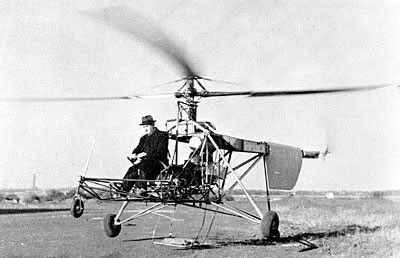
Sikorsky VS-300 First flight
On September 14, 1939, the plane lifted off the ground on its first flight. Its designer was at the controls; during his entire career Sikorsky always insisted on making the first trial flight of any new design himself. At this stage the aircraft was still tethered to the ground and had weights suspended underneath it to help keep it stable.
It was powered by a 4-cylinder Franklin engine of 75hp, had full cyclic pitch control for the 28’0″ three-blade main rotor and a single anti-torque tail rotor at the end of a narrow enclosed tailboom which also supported a large under-fin.
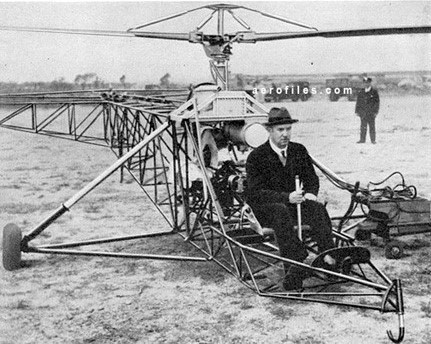
The VS-300 had a three-bladed main rotor, 28 ft / 8.53 m in diameter, a welded tubular steel frame; a power transmission consisting of V-belts and bevel gears; a two-wheel landing gear arrangement and a completely open pilot’s seat. A single foot pedal controlled the antitorque tail rotor.
The cyclic control was not fully satisfactory, however, and by the time the VS-300 made its first free flight on 13 May 1940, 3 feet off the ground for 10 sec with 35 foot long ropes. By now powered by a 90hp Franklin motor, the configuration had changed to an open-framework steel-tube fuselage with outriggers at the tail end. Each of these mounted a horizontally-rotating airscrew to provide better lateral control; the vertical tail screw was retained. Sikorsky tried 19 different configurations before he was satisfied with the final design of the VS-300.
By mid-1940 the VS-300 was staying airborne for 15 min. at a time. Various modifications were made during 1940-41 with three tail rotors, and the replacement of the tail outriggers in June 1941 by a short vertical pylon carrying a single horizontal tail rotor, and the reinstatement in December of a now fully satisfactory cyclic pitch control for the main rotor. Other alterations concerned the arrangement of the main undercarriage and the fitting of nose and tail wheels in place of skids.
On July 18, 1940, a 15-min. flight was made during which the ship hovered. On Jan. 10, 1941, the VS-300 made a flight that lasted more than 25 min., which was believed to be the longest flight ever made by a helicopter in America at that time.
During 1940, Sikorsky removed the cyclic pitch control, which varies the pitch angle of each blade as it rotates so that the helicopter can be manoeuvred, and substituted two small horizontal ro¬tors on outriggers for pitch and lateral control. The modifications proved successful, and on May 6, 1941, this version of the VS 300 had surpassed the Focke ¬Achgelis’s duration record with a flight of 1 hr. 32 min. 26.1 sec. Able to climb vertically, fly sideways and backward, it could not safely fly forward until 1941. For publicity photos, mechanics changed wheels on the hovering VS300A.
Les Morris, was the Chief Test Pilot on the Sikorsky VS-300 starting in March, 1941 (and on the XR-4, XR-5 and XR-6 which followed).
On Apr. 17, 1941, the VS-300 recorded another first by making the world’s initial helicopter water landings by fitting pneumatic flotation bags under the main undercarriage wheels.
Sikorsky VS-300A NX28996
In its final form the VS-300 had a 150hp Franklin engine, a fabric-covered fuselage and a tricycle undercarriage.
During its lifetime, the VS-300 logged more than 100 hr. of flight time and demonstrated the concepts and principles that were later utilized in the design of the Sikorsky R-1, the worlds first production helicopter.
In 1943 the VS-300 was delivered to the Henry Ford Museum in Dearborn, Michigan, where it is still housed.
The general manager of Sikorsky Aircraft, Lee S. Johnson, summed up its contribution twenty years later when he said: ‘Before Igor Sikorsky flew the VS-300, there was no helicopter industry; after he flew it, there was.”
VS-300 Engine: 75hp Franklin Rotor: 28’0″ three-blade Seats: 1
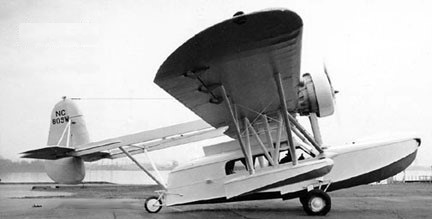
Sikorsky downsized the basic S-38 design to create the S-39. The original prototype, NX813M / NX963M, was experimentally converted to two tractor-mounted 115hp Cirrus Hermes Mk I engines, was test flown in mid-1929 but crashed later that year after an engine failure.
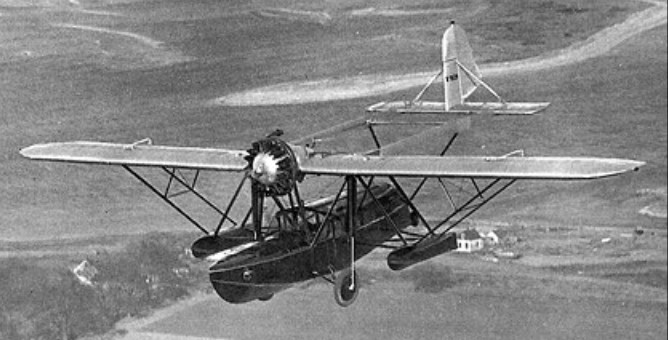
Sikorsky followed with the S-39-A, flown in early 1930, with a single R-985 Wasp Junior engine mounted directly to the wing. The S-39-A was the first US aircraft to be certified with the R-985.
Sikorsky S-39-A NC804W
Twelve S-39-As (NC42V, NC802Y, NC803W/809W, NC887W), marketed at an average price of US$17,500 with ATC 340, were sold to civil owners by the end of 1930.
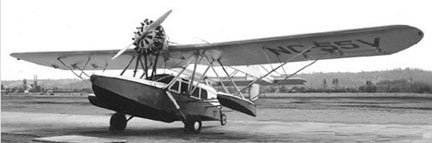
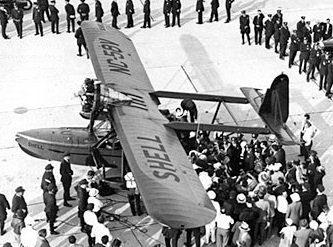
The S-39-B (ATC 375), introduced in 1931 with a larger fin and rudder, sold eight examples (NC50V and 51V, NC53V to 55V, NC58V, NC888W, and NC896W) to private owners at $20,000, plus one to the US Army Air Corps as the YIC-28 32-411, plus 9 conversions from S-39-A.
Sikorsky S-39-B NC55V
Sikorsky S-39-B NC58V
Two S-39-B, refitted with 400 hp R-1340 Wasp engines, were re-certified as S-39-C.
Sikorsky S-39-C NC809W
The final example, an S-39-CS Special named “Spirit of Africa”, was built in 1932 to an order from explorers and photographers Martin and Osa Johnson. In a giraffe paint scheme, the Spirit of Africa covered more than 60,000 miles across Africa and East Indies.
Several civilian S-39s were operated by the Civil Air Patrol during World War II on search and rescue missions.
A total of 21 were built.
S-39-A
S-39 / S-39-A Engine: Pratt & Whitney R-985 Wasp Junior, 300 hp Prop: 2 blade, ground adjustable, metal Wingspan: 52 ft 0 in Length: 38 ft 11 in Wing area: 320 sq.ft Empty weight: 2678 lb MTOW: 4000 lb Max speed: 115 mph Cruise: 97 mph Ceiling: 18,000 ft Range: 375 miles Seats: 4
S-39B Engine: Pratt & Whitney R-985 Wasp Junior, 300 hp Prop: 2 blade, ground adjustable, metal Wingspan: 52 ft 0 in Length: 38 ft 11 in Wing area: 320 sq.ft Seats: 5
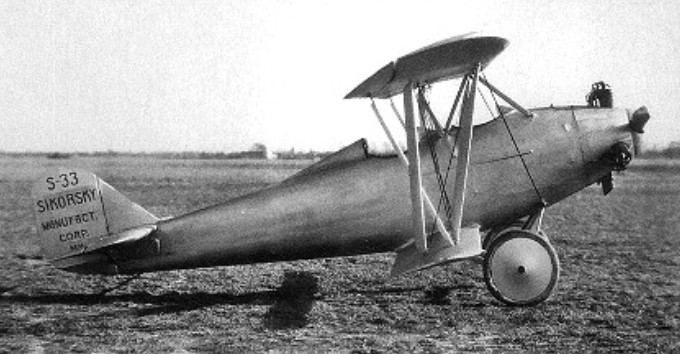
Two S-33 Messengers were built, the first in 1926 as a racing aircraft with a 60hp Wright Gale aircooled engine, the second in 1927 as a two-seat utility aircraft with a 60hp Lawrence. The racer was flown by Al Krapish, one of the company’s earliest employees and a passenger on the first unhappy flight of the S-29A. It spanned 9.75m and had a speed of 165km/h.
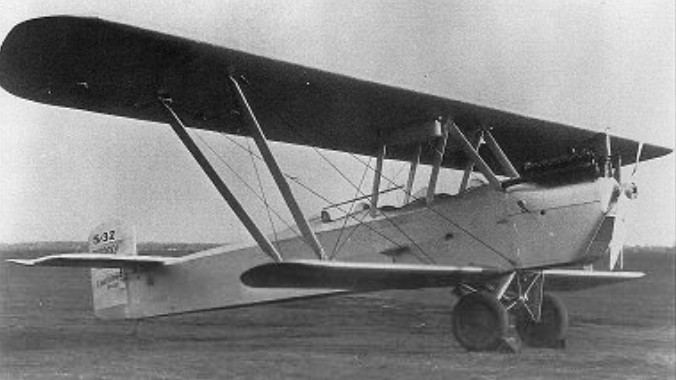
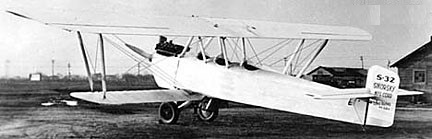
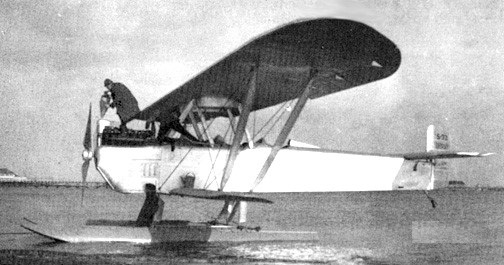
The 1925 one-off S-32 was a large fabric-covered metal biplane, with a 400hp Liberty engine, built for the Andean National Corporation, a subsidiary of Standard Oil Company, for extra-heavy duties in Colombia.
It carried the pilot in the rear cockpit and two pairs of passengers in the forward cockpits. In landplane form it had a top speed of 215km/h and endurance of more than four hours, but was flown mainly on floats.
Sikorsky S-32 on floats
Engine: 400hp Liberty 12 Wingspan: (upper) 58’4″ / 17.78m Wingspan (lower): 38’0″ Length: 36’0″ Maximum weight: 2450 kg Useful load: 2100 lb Max speed: 133 mph Stall: 40 mph Ceiling: 16,000′ Seats: 5