Sindlinger Hawker Hurricane

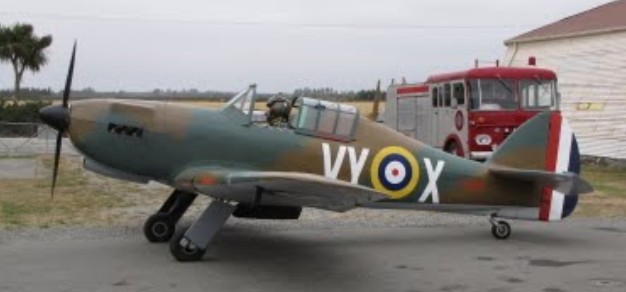
Designed by Boeing engineer Fred Sindlinger in the late 1960s, the prototype was built ahead of any drawings, subsequently put on paper by two draughtsmen – one in metric and the other in imperial. Sindlinger’s 5/8-scale version of the British Hawker Hurricane first flew in 1972. Both the wings and fuselage are constructed of wood with a fabric covering. The powerplant turns a metal constant-speed prop and is fed by a main fuel tank just aft of the firewall, with a. capacity of 14 gallons. Optional 10-gallon tanks can be built into the wing root. The landing gear is a steerable tailwheel type with the main gear retracting into the wings. The pilot sits under a sliding canopy.
Gallery

Engine: 180-hp Lycoming
Gross Wt. 1375 lb
Empty Wt. 984 lb
Fuel capacity 32 USG
Wingspan 25 ft
Length 19 ft 8 in
Wing area: 101 sq.ft
Top speed 200 mph
Cruise 143 kts
Stall 62 mph
Climb rate 1850 fpm
Ceiling 21,000 ft
Takeoff run 490 ft
Landing roll 550 ft
Range 575 miles
Seats: 1

Engine: Lycoming 0-320, 160 hp
Cruise 65%: 143 knots/165 mph
Max speed: 174 knots/200 mph
ROC SL: 1850 fpm
Design limit: +6.5G -0G

Engine: Mitsubishi 6G74 200hp
PSRU: Belt Drive 1:1.6 ratio
Wingspan: 25 ft 0 in
Wing area: 102 ft2
Length: 19 ft 8 in
Height: 5 ft 10 in
Empty weight: 1239 lb
Maximum speed: 165knts
Cruise speed: 130knts mph
Rate of climb: 1800 ft/min
Stall 35knts (Flaps & Gear down)
Endurance: 2 hours
Retractable: Electric

Engine: 150hp Lycoming O-320
Wingspan: 25’0″
Length: 19’8″
Useful load: 370 lb
Max speed: 200 mph
Cruise: 165 mph
Range: 625 mi
Simunek / Kamaryt SK-1 Trempik

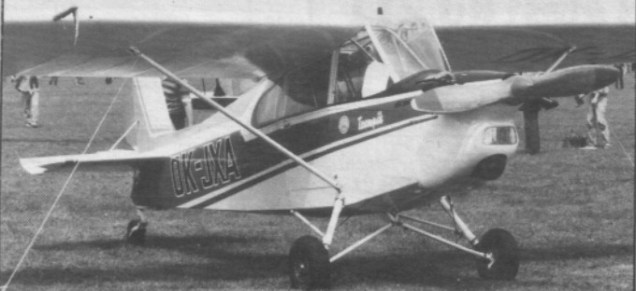
The Simunek/Kamaryt SK 1 dates from 1968, when Jan Simunek began to design the Trempik (Little Tramp). Construction started in his apartment in the following year. He was joined by Jaroslav Kamaryt, who assisted with design and stress calculations. In 1975 manufacture was transferred to the Rudy Letov agricultural equipment factory at Prague. The aircraft flew for the first time in October 1979.

The Cub like machine has a welded steel tube forward section with a wooden semi-monocoque rear fuselage. Trempik’s two spar wing has a birch plywood leading edge, glass reinforced plastic wingtips, wooden ailerons, and a fabric covering. Tailplane and elevator are wooden, and the rudder is fabric covered light alloy tube.
The 75 h.p. Praga D 1 powerplant drives a two-blade, fixed pitch propeller taken from a Praga E 117 Air Baby.

SK 1
Wing span: 30ft 6in
Length: 19ft 5.5in
Height: 7ft 53in
Empty weight: 785 lb (356kg)
Max payload: 386 lb (175kg)
MTOW: 1267 lb (575kg)
Max IAS at SL: 116kt/133 mph
Cruise speed SL: 86kt
Stalling speed: 43kt
Service ceiling: 14,775ft (4,500m)
Take off run: 394ft (120m)
Landing run: 492ft (150m)

Simpson Midwest Ultralights Little Bi

Single seat single engined biplane with con¬ventional three axis control. Wing has un¬swept leading and trailing edges, and constant chord; cruciform tail. Pitch control by fully flying tail; yaw control by fully flying rudder, with additional fin; control inputs through stick for pitch/roll and pedals for yaw. Wings braced by struts and trans¬verse X cables; wing profile; double¬surface. Undercarriage has three wheels in tricycle formation; glass fibre suspension on nosewheel and suspension on main wheels. Push right go right nosewheel steering. Aluminium tube framework, without pod. Engine mounted level with top wing driving tractor propeller.

The aim of the Little Bi is to provide a simple lightweight fun biplane, rather than a machine with pretensions to high performance. Its framework is con¬structed of aluminium tubing, while the wings are made from styrofoam with glass fibre ribs and non porous Dacron covering.

Though initially flown with a Yamaha KT100S engine, the aircraft was sold as an engineless kit and it is up to the builder to supply a power plant. The 215 cc Cuyuna 215R with 20hp driving a 54 inch (1.37m) propeller is recommended, but a 22hp Zenoah or the Yamaha are listed as alterna¬tives, each working through a reduction drive.

Two kits are offered, neither of which involves any tube bending or welding: the fast build kit for $2845 (50 60 h) or an economy kit for $1825 (100 120 h) in 1982, the latter requiring the builder to purchase some basic materials locally. Neither kit covers anything more than the structure of the aircraft, items like seat and fuel tank being extras, for $49.95 and $65 respectively. For the builder who wants to spread the construction cost over a period, five part kits were available.

Engine: Yamaha KT100S, 15 hp
Propeller diameter 48 inch, 1.22m
Belt reduction
Max static thrust 75 lb, 34 kg
Power per unit area 0.08 hp/sq.ft, 0.9hp/sq.m
Fuel capacity 4.3 US gal, 3.5 Imp gal, 16.1 lt
Upper wing span 24.0 ft, 7.32 m
Lower wing span 20.0 ft, 6. 10 m
Sweepback 0 deg
Total wing area 178sq.ft, 16.5 sq.m
Empty weight 190 lb, 86kg
Max take off weight 430 lb, 195kg
Payload 240 lb, 109kg
Max wing loading 2.42 lb/sq.ft, 11.8 kg/sq.m
Max power loading 28.7 lb/hp, 13.0kg/hp
Max level speed 50mph, 80kph
Cruising speed 40mph, 64 kph
Stalling speed 20 mph, 32 kph
Take¬off distance 125 ft, 38 m

Simplex Aircraft Corp R-2-D Red Arrow Dual Plane / Simplex Racer

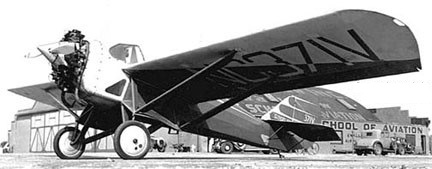
The 1929 Simplex R-2-D Red Arrow Dual Plane was a convertible monoplane/biplane. The top shoulder wing was permanent, and 24’0″ lower wings could be easily added for increased lift and load-carrying.

The one built, NR43M, was flown as monoplane Simplex Racer with a 225hp Wright engine in the 1929 Nationals events with clocked pylon speeds of more than 220mph. It was piloted by Dick Myhres.

Monoplane
Engine: 165hp Wright J-6
Wingspan: 32’9″
Length: 21’0″
Useful load: 700 lb
Max speed: 140 mph
Cruise: 125 mph
Stall: 50 mph
Range: 600 mi
Seats: 1

Monoplane
Engine: 225hp Wright J-6
Wingspan: 32’9″
Length: 21’0″
Max speed: 165 mph
Cruise: 150 mph
Stall: 50 mi
Range: 550 mi
Seats: 1

Biplane
Engine: 225hp Wright J-6
Wingspan: 32’9″
Length: 21’0″
Max speed: 150 mph
Cruise: 135 mph
Stall: 45 mph
Range: 650 mi
Seats: 1

Simplex Aircraft Corp S-2 Kite / Sioux Kite

A monoplane called the S-2 Kite was developed in 1931. Designed by Omer Woodson, it was a probe into the inexpensive, ultralight aircraft market.

It had an uncovered, girder-like fuselage, and thick, cantilever wing. One was built, NX489M c/n 1002.

Simplex failed to get anywhere with the project, but the idea went with Woodson and company test pilot Myhres when they left in 1930 to form Cycloplane Co.

Sioux Aircraft Corporation built aircraft under the name Sioux Kite.

S-2 Kite
Engine: Szekely SR-3, 40hp
Seats: 1