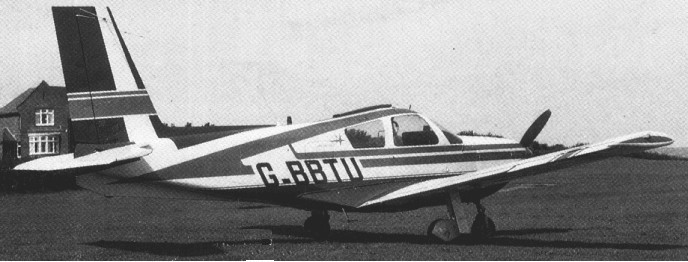
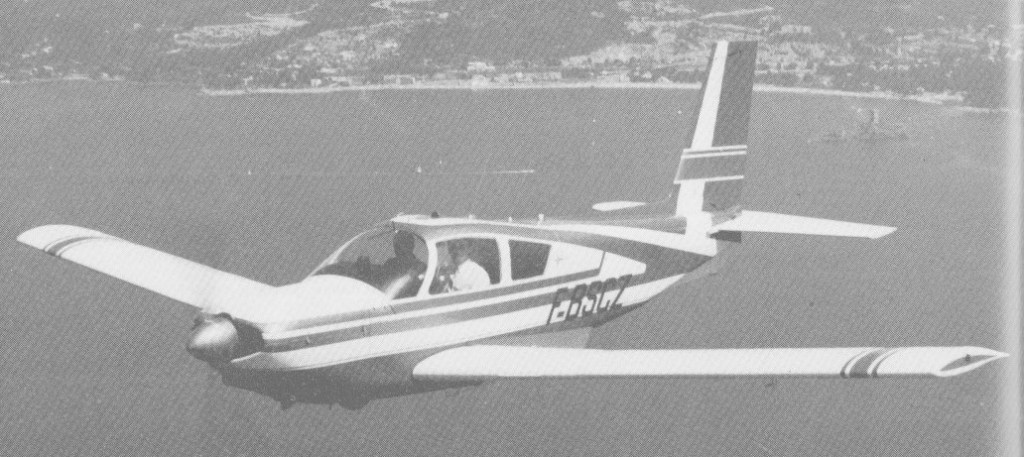
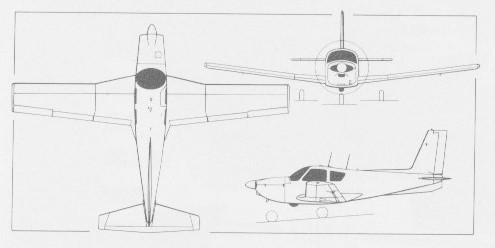
From the all-metal GY.80 Horizon SOCATA developed an improved model that first flew in November 1967 with a lengthened fuselage, a redesigned cabin, a modified tail unit, a more powerful engine and revised landing gear. This last adopted main units that retracted inwards into the undersurfaces of the wings, while the nosewheel unit retracted to leave about one-quarter of the wheel exposed. Initially designated Super Horizon 2000 and then Provence, the type eventually became the ST.10 Diplomate by the time production deliveries began at the end of 1969. Despite the fact that it offered a usefully higher level of performance than the Horizon, the type failed to attract any real sales enthusiasm and SOCATA ended production in 1975 after delivery of only 56 examples.
ST.10 Diplomate Type: four-seat sport and touring lightplane Powerplant: 1 x Avco Lycoming IO-360-C1B, 149kW (200 hp) Span: 9.70m (31ft 9.75in) Length: 7.26m (23 ft 9.75 in) Empty weight: 1594 lb / 723 kg Max TO weight: 1220 kg (2,690 lb) Max speed: 174 mph at sea level Max cruise 75%: 143 kt / 165 mph / 265 kph ROC: 1003 fpm / 306 m/min Service ceiling: 16,400 ft / 5000 m Operational range: 860 miles / 746 km / 1385 km Baggage capacity: 154 lb / 70 kg Cabin length: 7 ft 3.75 in / 2.25 m Cabin width: 3 ft 8.75 in / 1.14 m Cabin height: 4 ft 1.25 in / 1.25 m
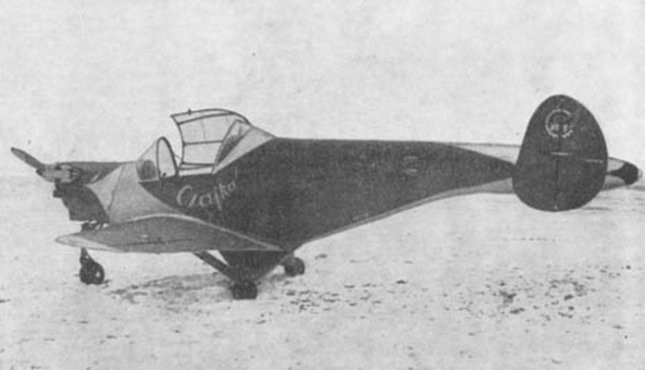
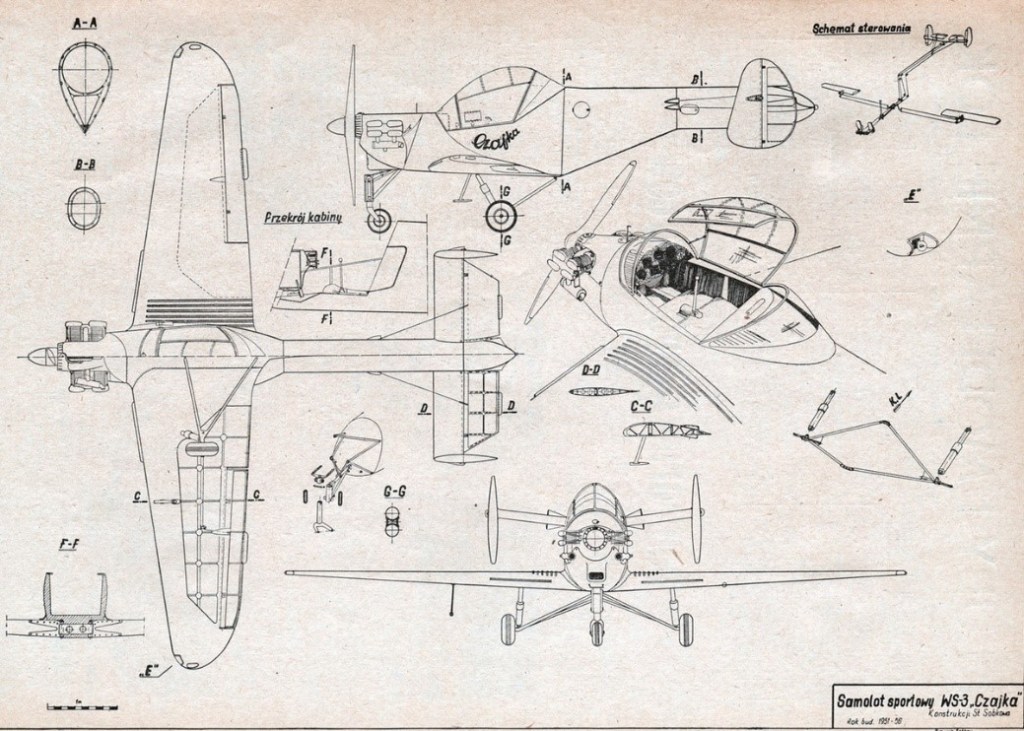
In 1949, Stanisław Sobkow started to construct an amateur plane, which he called WS-3 “Czajka”.
Single-seat, self-supporting low-wing wooden structure. The wing is divided, with a trapezoidal contour, with rounded ends and with a slant backwards, the end of the wings is elliptical. The wing had a working caisson and two girders. The rear part of the wing is covered with canvas, at the fuselage and at the ends of the wings with plywood. Slotted ailerons, covered with linen. The wooden fuselage had a rectangular cross-section in the front part, passing into a rounded tail part. Half-shell frame and longitudinal structure covered with plywood. Covered cabin. Horizontal control with a rectangular contour with a rise. Covering the fins with plywood, the rudders with cloth. The spreading of the rudders made them act as aerodynamic brakes. Three-wheeled chassis with a front wheel, fixed.
The construction was started in 1951. The woodwork was made in the carpentry workshop of Spółdzielnia Rzemieślnicza in Kielce, Poland, and metal details were made by the workshops of the Kielce Aeroclub, at the airport in Masłów, where the construction of the airframe was completed in mid-April 1956. The engine received from the Board of the League of Friends of the Soldier. Although “Czajka” was an amateur construction, only aviation materials were used for its construction. During the assembly of the plane of his idea, S. Sobkow used many ready-made structural elements from the glider and the factory plane. The works were completed on April 15, 1956.
After the taxiing tests carried out in the spring of 1956, on August 26, 1956, WS-3 “Czajka” made its first flight. The plane was also demonstrated at air shows, once at the Aeroclub in Kielce, once at the Workers’ Aeroclub in Mielec, arousing the understandable interest of the public, and above all, aviation hobbyists. This amateur, light and small plane was the first, thoroughly successful structure of this type, built in Poland after World War II. It was proved easy to fly, and of simple construction.
Up to 1959, “Czajka” spent about 20 hours in the air in about 70 flights. The constructor tried to legalize his activity, but the Institute of Aviation he did not respond to applications and letters for approval. The documentation sent there has not been checked. As a result, the designer was forced to stop using his plane, which was pushed behind the hangar.
In 1960 “Czajka” was completely destroyed. At that time, the construction and piloting of own aircraft were strictly forbidden in Poland. That is why a commission burned down the structure, which – apart from arsonists – was convinced by all to be successful. The structure that Stanisław Sobkow had been building for 6 years, putting 15,000 man-hours into it, was thoughtlessly destroyed.
Engine: Praga D, 55 kW (75 HP) max, 44 kW (60 HP) nominal Span: 8.2 m Wing area: 10.0 m2 Length: 6.4 m Height: 2.2 m Empty weight: 320 kg MAUW: 470 kg Useful load: 150 kg Max speed: 195 km / h Cruising speed: 150 km / h Stall speed: 80 km / h ROC: 3.3 m / s Ceiling: 3300 m Range: 450 km Endurance: 3 hr
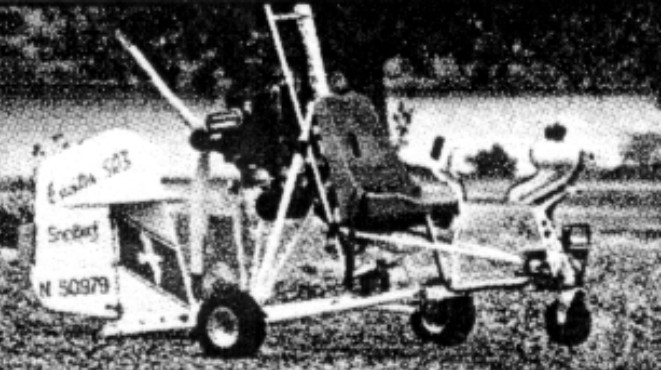
Single seat single engined flex wing aircraft with weight shift control. Rogallo wing. Pilot suspended below wing in trike unit, using bar to control pitch and yaw/roll by altering relative positions of trike unit and wing. Undercarriage has three wheels in tricycle formation. Nosewheel steer¬ing independent from yaw control. Aluminium tube trike unit, without pod. Engine mounted below wing driving pusher propeller.
The main activity for Soarmaster is trike unit manufacture, its product being simply known as the Trike.
The company is proud of the fact that the trike unit has withstood a static load of 1145 lb (519 kg) applied to the seat, though it has to be said that there are other trike units around which could comfortably exceed this figure. What this translates to in terms of load factors does of course depend on the wing used, which can be any suitable Rogallo.
Various engines are available, ranging from Chrysler units to a 15hp Solo single (with or without a tuned exhaust) and a twin cylinder Lloyd producing 23hp. The Lloyd has the unusual feature of being provided with both manual and electric start, and all three use belt reduction drives and Soarmaster’s own propeller, made from 6061T6 aluminium and featuring replaceable blades. Main wheels diameter overall 20 inch, 51 cm.
Price for the Lloyd engined trike unit in October 1982 was $1595.
Engines: Lloyd LS400, 23 hp Solo, 15 hp Chrysler Belt reduction Fuel capacity 1.2 US gal, 1.0 Imp gal, 4.5 litre in main tank Optional res fuel: 1.2 US gal, 1.0 Imp gal, 4.5 litre
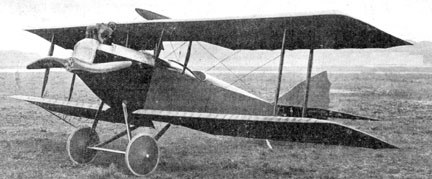
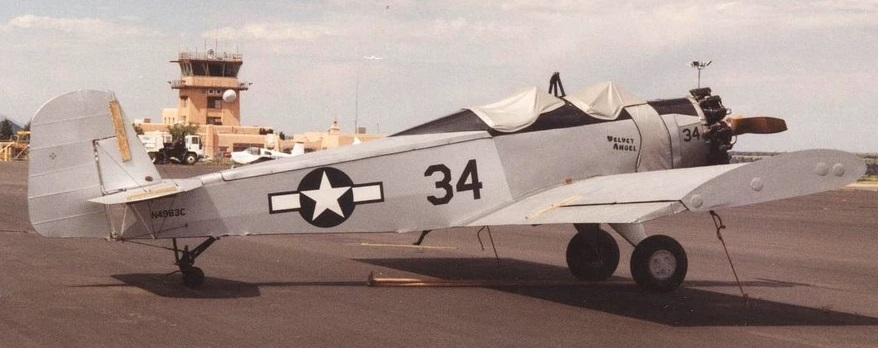
The 1921 Snyder-Macready Baby Bomber designed by O H Snyder was a single-place, open cockpit biplane, powered by a chain-driven 18hp Indian engine The Indian motor which had previously been in the builder’s motorcycle. The propeller was driven through a chain and sprocket reduction gear.
The landing speed was 20 mph and the plane usually stopped within 40 feet after touching the ground.
Of all-wood construction, it was popular with home-builders of the time, with plans published in magazines.
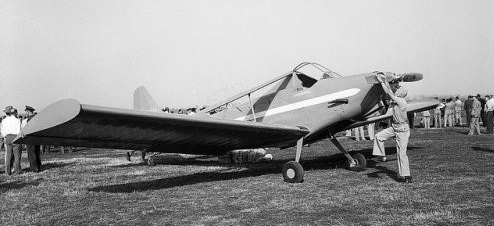
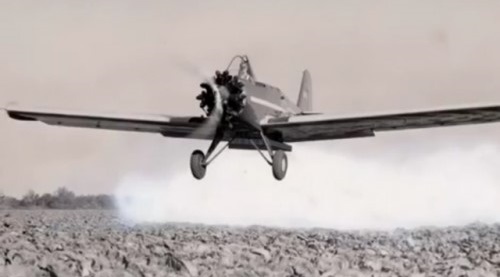
By 1955 plans were under way for the S2 model, to be joined by the S2B, a 450 hp version, with the pilot sitting behind the hopper. This first flew in August 1956. The smaller model, the S2A, was fitted with the Continental W670-6A radial engine of 220 hp and 74 of these were built by the Snow Aeronautical Corporation. Only 17 of the larger 450 hp S2B were built and this was followed by the Snow S2C-450, still an open cockpit aircraft with distinctive overturn protection incorporating a larger hopper and a wing span increased to 44 feet, 7 inches. The empty weight was 2940 lbs and loaded, 5700 lbs. Some 215 were built, at least half with the 600 hp P&W R-1340-AN1 which increased the loaded weight to 6000 lbs.
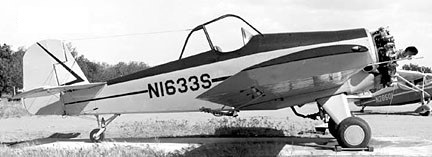
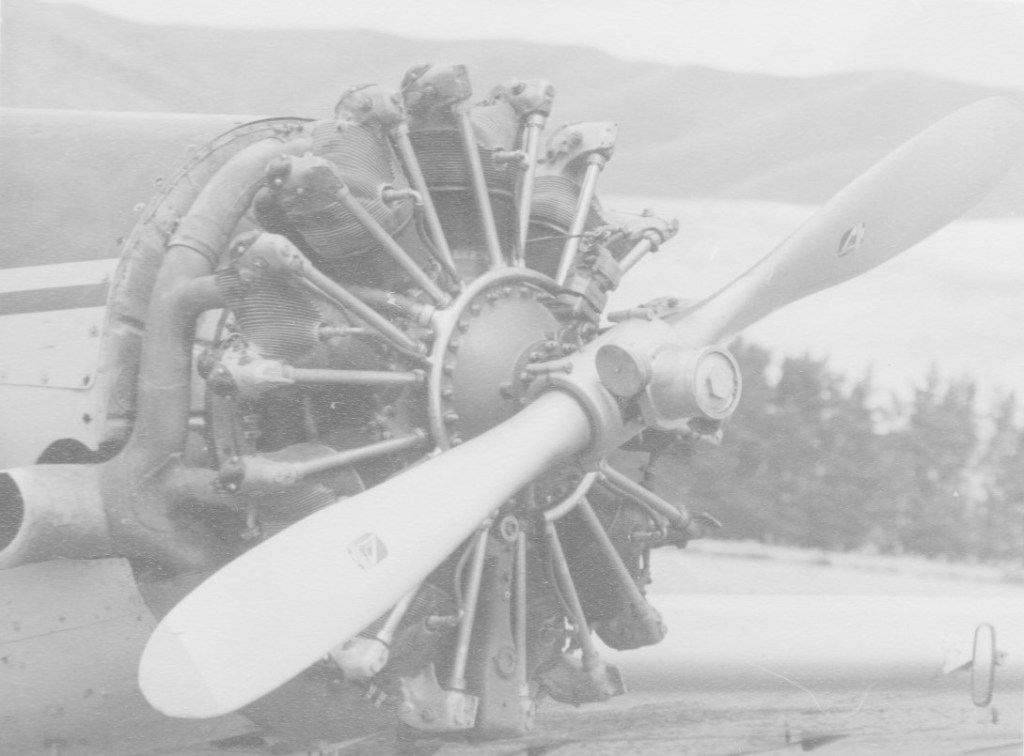
The first Snow S2C appeared in 1960, a follow-on aircraft to the similar Snow S2B of which nineteen were produced. Both were powered by the 450-hp R-985. At that time Snow were also building the S2A which was produced until 1962. A smaller aircraft, the pilot sat in front of the hopper. Some S2C aircraft had the wingtips removed and were fitted with large end plates.
Snow S-2C N1633S
Around 260 Snow S2Cs were built, firstly powered with a 450hp P&W R-985-AN-1, first flying on 12 April 1961, a 600-hp P&W R-1340-AN-1 version first flying on 12 May 1961. From 1962 until production was superseded by the Aero Commander-Snow S2D-600 in 1965. Until this point all aircraft were built with open cockpits.
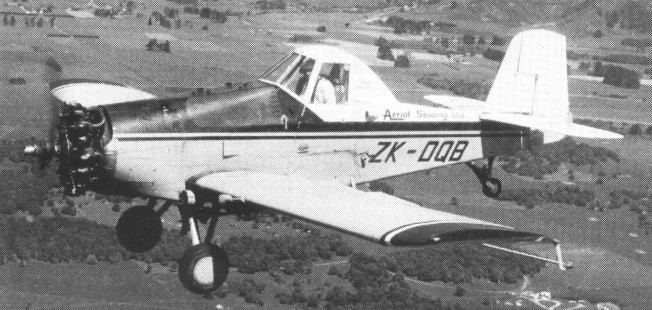
In 1965 the Snow Corporation was taken over by Aero Commander and a new model, the S2D-600, was flown in 1965. It was the first with the new enclosed cockpit, setting the lines for the later Thrushes and with a larger hopper. Snow also modified the aircraft to incorporate a loader driver seat directly behind the pilot’s and facing rear.
Aero Commander built 105 S2D-600’s. The S2D was fitted with an even larger hopper suitable for rice sowing and fertiliser spreading and this became the Rockwell S2R-600 Thrush in 1968.
Rockwell Thrush Commander
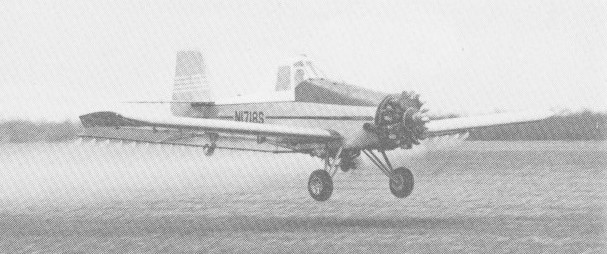
Re-engining became popular. Besides the R-1340 version, Rockwell introduced the S2R Thrush 800 fitted with a Wright R-1300B1 radial of 800 hp. In 1975 two US Ag operators, Marsh in Arizona and Ayres in Georgia, fitted Garrett and Pratt & Whitney turbines to Thrush aircraft. Marsh had previously fitted a Garrett TPE-331 Pre-Century of 575 shaft horse power to an open cockpit 1965 model Snow S2C and it was first flown on 9 July 1973. It is the first known conversion, known as the Marsh S2R-T Turbo-Thrush, of an agricultural aircraft in the United States; N1674S, #600-1250C (the 250th ag¬plane built by Snow), was later sold to Plexico as XB-ETQ. Another conversion by Serv-Aero Engineering was to fit the 1200 hp Wright R-1820-71 piston radial. In 1977, the Ayers Corporation, of Albany, Georgia, purchased the Thrush Commander line and continued to build the S2R, with the same constructors serial sequence, finally ending at 2582R.
A new sequence was started by Ayres with the 750 hp P & W PT6A-34AG with constructors numbers beginning with 6001, and incorporating one major change, the fitting of a 500 US gallon hopper. The 5000 sequence was used for the 100 or so 800 hp Wrights built by Rockwell.
Once Ayres had taken over, one of the new versions was named the Bull Thrush, powered with a 1200 hp Wright R-1820-97 and fitted with a 500 US gallon hopper. One of the new features was a Dual Cockpit variant, being denoted by a DC at the end of the constructor’s number. From this time Ayres were to start a whole new series of constructors numbers, prefixed by S2R, followed by engine model fitted and then a number, in most cases, starting at -001. As example, S2R-1340-… (600 hp), S2R-1820-… (1200 hp), S2R-RS3-… (PZL R83, 595 hp) and S2R-T34-… (750 hp).
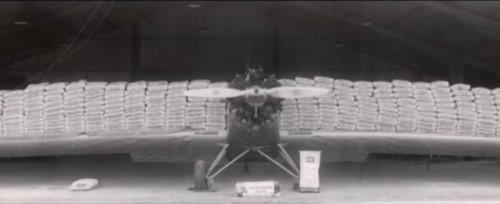
Snow began designing his first aerial application aircraft, the S-1, in 1951 when he was 21 years old.
In August, 1953, the S1 flew for the first time, powered by a 190 hp Lycoming. Unusually for a US ag-plane, the pilot sat between the engine and the hopper, and, unlike later Snow models, the aircraft had wing struts.
The aircraft was successful, enough for Snow to take it to Nicaragua for a season the following year.
To give it more power, it was fitted with a Continental radial of 220 hp. The radial engined S-1 lost its wing struts.
Dam¬aged by a thunderstorm in 1958, this aircraft was destroyed in a warehouse fire a few years later.
That airplane remained in production until 1957, after which Snow introduced the S-2A and S-2B models.