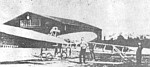
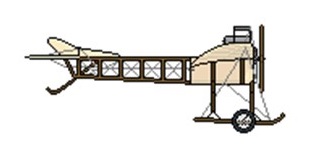
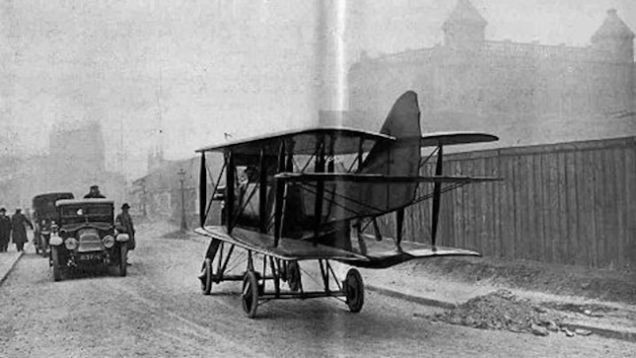
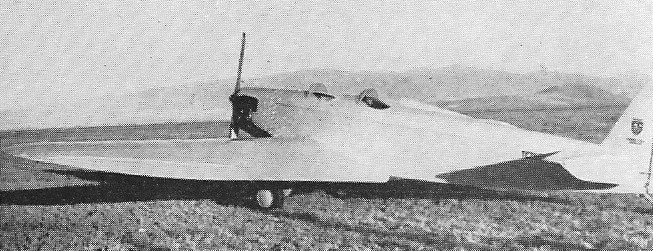
In 1909 Czesław Tański started design works on an aircraft with longitudinal axis steering done by change of the angle-of-attack of the whole wing. Construction lasted until 1911 and in autumn of that year, the airplane, named Łątka (Dragonfly) underwent trials at Warsaw’s Mokotów airfield. Unfortunately, Tański, witnessing numerous undercarriage failures on other aircraft, designed very heavy one for his aircraft, which resulted in aircraft – powered by relatively weak Anzani engine – never managed to take off the ground.
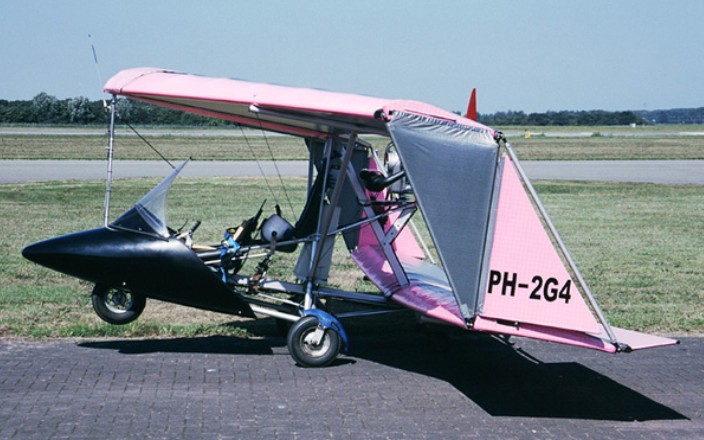
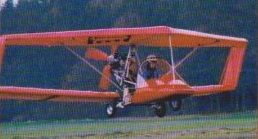
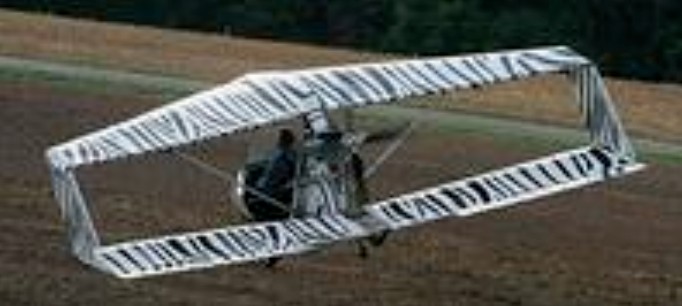
The Sunny is a tube and fabric design ultralight aircraft that was designed by Dieter Schulz. The aircraft complies with the Fédération Aéronautique Internationale microlight category rules. It features an unusual diamond-shaped biplane, strut-braced closed wing layout, a two-seats-in-tandem enclosed or open cockpit, fixed tricycle landing gear and a single engine in pusher configuration. The upper wing is swept back, while the lower wing is straight, but mounted further aft. The two wings are joined by swept tip rudders. The elevons are mounted to the lower wing only.
The aircraft is made from bolted-together aluminum tubing, with its flying surfaces covered in Dacron sailcloth. Standard engines available include many models of Hirth, Rotax, BMW and Verner 133M powerplants, ranging from 65 to 80 hp (48 to 60 kW).
A side by side trainer, production of the Sunny Sport UL-biplane was started by Dieter Schulzs company, Tandem Aircraft KG of Saulgau, Germany, in 1989. In the first year 25 Sunnies were sold, however the sale figures of the Sunny went down over the years. About 150 examples between 1989 and 1999. Finally in 1999 Tandem Aircraft KG became bankrupt.
Alexander Dewald bought the rights in 1999 and it was then produced by Dewald Leichtflugzeugbau Gmbh of Bad Schönborn, Germany and more recently by Airkraft Gmbh Leichtflugzeugbau of Beringen, Switzerland, who seem to have gone out of business in about 2011 and production ended after 250 were built.
Originally supplied ready-to-fly, later the aircraft was supplied as a kit for amateur construction or as a complete ready-to-fly-aircraft. Both the tandem-seat Sunny Sport and the side-by-side versions were produced by Dewald. Both versions feature a number of small, but significant, design changes.
The price in 2009 was €13499, and €21,000 (assembled, 2011).
Variants:
Sunny Light Version with open cockpit Engine: 1 × Rotax 582, 48 kW (64 hp) Wingspan: 7 m (23 ft 0 in) Wing area: 17 sq.m (180 sq ft) Empty weight: 220 kg (485 lb) Gross weight: 450 kg (992 lb) Fuel capacity: 44 litres (9.7 imp gal; 12 US gal) Optional fuel capacity: 80 litres (18 imp gal; 21 US gal) Maximum speed: 145 km/h (90 mph; 78 kn) Cruise speed: 100 km/h (62 mph; 54 kn) Stall speed: 55 km/h (34 mph; 30 kn) Rate of climb: 4 m/s (790 ft/min) Seats: 2
Sunny Sport Two seat tandem version with enclosed or semi-enclosed cockpit
Sunny Side-By-Side Version with side-by-side configuration seats
Sunny Targa Fully enclosed version.
Sunny Amphibian Version with amphibious floats
Engine: Rotax 582, 65 hp HP range: 50-90 Height: 6.42 ft Length: 12 ft Wing span: 23 ft Wing area: 184 sq.ft Fuel cap: 14 USG Weight empty: 396 lbs Gross: 816 lbs VNE: 76 kt / 87 mph / 140 kmh Speed max: 80 mph Cruise: 62 mph Range: 220 sm Stall: 31 mph ROC: 1180 fpm Take-off dist: 130 ft Seats: 2 Landing gear: nose wheel
Engine: Hirth 2706, 65 hp Wing span: 7 m Wing area: 17 sq.m MAUW: 450 kg Empty weight: 170 kg Fuel capacity: 50 lt Max speed: 150 kph Cruise speed: 120 kph Minimum speed: 65 kph Climb rate: 5 m/s Certification: VZ Seats: 2 Fuel consumption: 12 lt/hr Price (1998): 37,000 DM
Tampier developed also for the French Army a two-seat reconnaissance aircraft designated T.4, which also featured a two-cylinder auxiliary engine. This was not only intended for main engine starting, but was also used to power a generator in flight to provide essential electrical services, and in particular to make possible the use of early air-to-ground communication equipment.
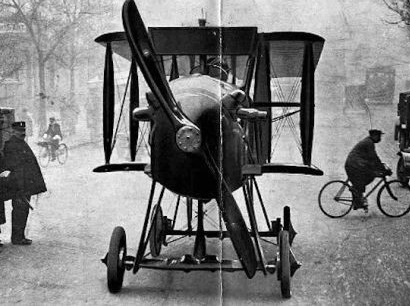
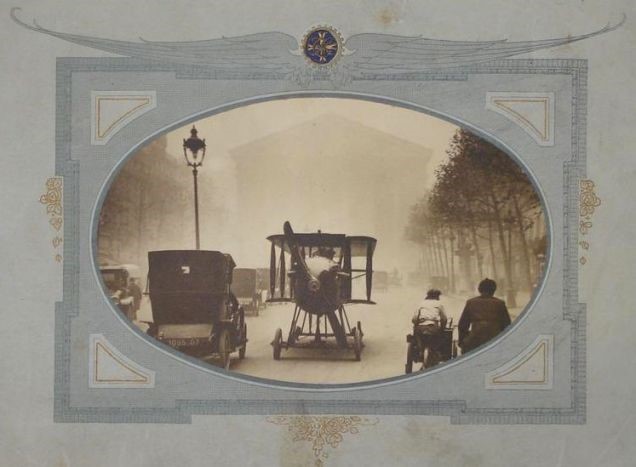
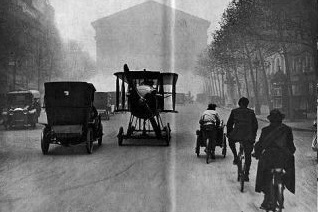
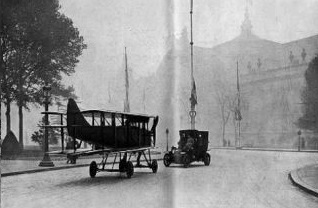
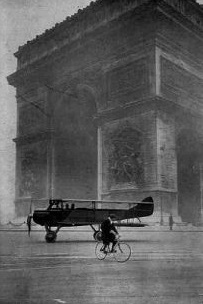
Frenchman Rene Tampier started up again after World War I and successfully built a four-wheeled bi-plane with foldable wings. Tampier first drove his Avion-Automobile in October 1921 and exhibited it at the 1921 Paris Salon, after a two-hour drive in the city. It flew two weeks later.
Tampier opted for two separate powerplants: a small four cylinder motor driving the vehicle’s rear axle, and a 300 hp Hispano Suiza V 12 aero engine to get it airborne. The biplane wings folded back alongside the fuselage for motoring. The pilot sat facing the tail when driving.
Between 1922 and 1925 Tampier built several different versions of the Avion Automobile, all of which he drove and flew, but as a vehicle it was cumbersome and awkward and the idea was never adopted commercially.
In 1966 Tallmantz Aviation built the Phoenix specially for the motion picture, “Flight of the Phoenix”. Based on a Fairchild C-82A, with North American AT-6 and other parts, power was a 450hp P&W R-985.
Built for filming in “The Flight of the Phoenix” the aircraft was not sufficiently strong nor the engine powerful enough for an actual landing and take-off on the desert floor. Instead, Paul would simulate takeoff and landing with low approaches and climb outs.
On July 6, Paul made his first attempt to film the scenes. Shortly after take-off from Yuma, he returned with an overheating engine. He tried again the next day, and in the relative cool of daybreak he flew the Phoenix to Buttercup Valley in the desert for the first time. Crouching just behind Paul in a makeshift crew position was stuntman Bobby Rose, with three plywood cut-outs of men attached on top of the wings near the fuselage, to depict ‘passengers’.
On that early morning he flew the requested low approaches in front of three widely-spaced motion picture cameras and returned safely to Yuma before the air got too hot and thin. Only later did the second unit director decide the cameras were set up too close to the scene and requested a repeat the next morning.
Before the sun broke above the horizon, Paul and Bobby again clambered up the ungainly Phoenix and strapped themselves in. They took off shortly after 05:00 for the short flight westward. Paul rolled into the shallow valley, sun rising behind him, descending to just feet above the desert floor, gunning the Pratt & Whitney R-985 and, with exaggerated effect for the cameras to depict the struggling Phoenix reaching for the sky, barely cleared a ridge of sand dunes. The director was pleased with what he knew his cameras had captured but called for an “insurance shot” just to make sure what he needed was in the can.
Paul knew the routine. He was heard over the radio vowing to “give them a good one” and brought the Phoenix around one more time. During the second approach it was obvious the descent rate was far too high and whatever Paul was doing to correct it wasn’t enough. The Phoenix hit the desert hard on its makeshift landing gear, right in front of a camera.
Quickly recovering, Paul struggled to pull the Phoenix back into the air. But the jarring impact had neatly snapped the aircraft just aft of the wing where the wooden fuselage joined the centre section. With the fuselage disintegrating and out of balance, the nose dropped and the propeller dug in to the desert causing the engine to shear off. The resulting wreckage tumbled across the desert floor.
Within the billowing cloud of dust and wreckage, Paul was killed instantly. Mantz might have survived the crash, as the cockpit section was relatively undamaged but, instead of a crash helmet, he was requested to wear a soft hat like actor James Stewart wore in the film. Bobby was thrown clear, miraculously surviving the crash, but with serious injuries.
The movie, of course, remained in production, but key scenes planned for the ending remained unshot. The footage from Buttercup Valley was usable, up until the accident anyway, but it amounted to a minute or less of film.
With no aircraft to film, the film crew packed up and moved back to Hollywood while other plans were considered. As the impending release date approached, Twentieth Century Fox finally came up with a makeshift replacement. A stubby North American O-47 belonging to The Air Museum at Ontario, California, was hurriedly modified to fill in as the Phoenix, at least for distant shots. The landing scenes were awkwardly deleted from the script but the end of the film was essentially as planned, with the survival of the eight men from their desert ordeal.
Tallmantz footage depicting the take-off amounted to about 18 seconds in the completed film, with the replacement O-47 sequence occupying about the same time in later scenes. The completed film, released in December 1965, does the best with what it has, but the loss of the flying Phoenix early in the filming is obvious.
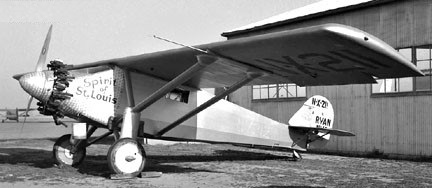
In 1955 Paul Mantz and Frank Tallman built a flying replica of Lindbergh’s Spirit of St Louis, N7212 c/n 159, built up on a Ryan B-1 fuselage frame, for use in the 1957 film, “Spirit of Saint Louis”.
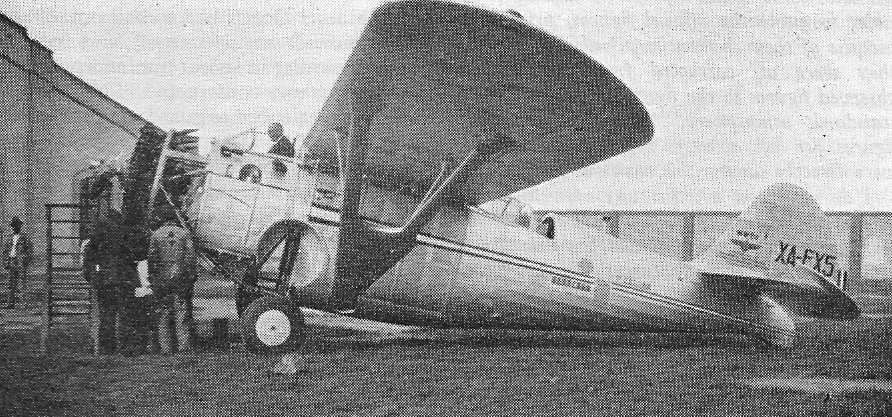
In June 1933 the Mexican Government decided to send one of Mexico’s best pilots, Francisco Sarabia, non-stop from Mexico to Seville, Spain, in a Mexican built aircraft.
Th task was given to Angel Lascurain, Juan Guillerme Villasana, Adrian del Pase, Juan Brelivet and Michael Watters.
The plane was built in the Talleres Nacionales de Constructcienes Aeronauticas. Built in 1934 it was powered by a Pratt & Whitney Wasp of 550 hp and had a retractable undercarriage. The aircraft incorporated the first Watter Cowling.
The registration was XA-EX5, model designation MWT-1, and named ‘Barberan y Collar’ after famous Spanish fliers. The red, white, and green striping was after the colours of the Mexican flag.
Due to a weak landing gear, the plane had a slight accident on 16 June 1934, when it ground-looped during landing and take-off tests at Mexico City Central Airport. Pilot Sarabia and passenger Watter were not injured.
For various political reasons the entire project collapsed and the plane was put in storage. The engine was sold to a high officer in the Mexican Air Force.
Engine: Pratt & Whitney Wasp, 550 hp Wing span: 16.68 m Chord: 2.3 m Incidence: 3 deg Length: 9.85 m Height: 2.80 m Empty weight: 1620 lb MAUW: 5597 lb Fuel capacity: 5000 lt / 3380 kg Oil capacity: 284 lt / 255 kg Crew: 2 Baggage capacity: 190 kg Max speed: 270 kph Cruise: 200 kph Landing speed: 130 kph Ceiling: 2000 m Endurance: 70 hr Range: 11,600 km
September 1942, a new Mexican primary trainer, the Tezuitlan designed by Antonio Sea and making extensive use of mahogany ply in its construction, commenced flight testing.
Powered by a 125 hp Lycoming engine. The Teziutlan was designed to operate from Mixico’s high-altitude airfields and utilised 95% nationally-produced materials. Construction is all-wood.
Forty five were ordered for the FAM, but, in the event, the considerable infusion of training aircraft from the USA that commenced at this time rendered the Tezuitlan surplus to requirements, only five being completed.
Engine: 125 hp Lycoming Wingspan: 38 ft 5 in Length: 23 ft 10.5 in Height: 6 ft 2.75 in Empty weight: 986 lb Loaded weight: 1633 lb Max speed: 108 mph Cruise: 102,5 mph ROC: 1380 fpm Service ceiling: 22,960 ft
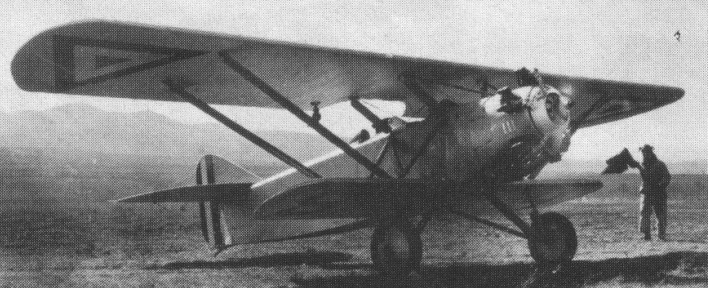
In 1928, the National Aviation Shops produced two sesquiplanes to the designs of Brig Gen Juan F Azcarate, who had assumed command of Mexican Army Aviation, these, the Azearate OE 1 light bomber and recon-naissance aircraft and the Azearate E trainer, both entering limited production at Balbuena, three of the former and 10 of the latter being built in 1929.
In 1928, the National Aviation Shops produced two sesquiplanes to the designs of Brig Gen Juan F Azcarate, who had assumed command of Mexican Army Aviation, these, the Azearate OE 1 light bomber and recon-naissance aircraft and the Azearate E trainer, both entering limited production at Balbuena, three of the former and 10 of the latter being built in 1929.
The Azcarate E is primarily of wooden construction, the cew of two in tandem with full dual controls. A single 0.30in machine gun was mounted in the rear cockpit.
Serveral squadrons were equipped with the type until the mid-1940s, still serving with the Mecican School of Military Aviation.
Engine: Wright J-5, 220 hp Max speed: 100 mph Cruise: 82 mph