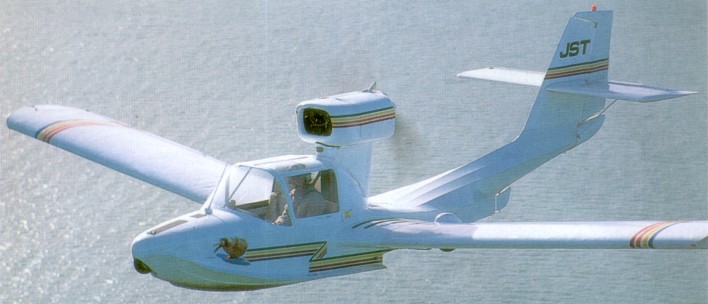
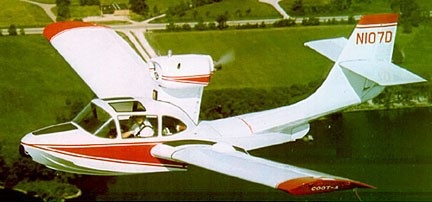
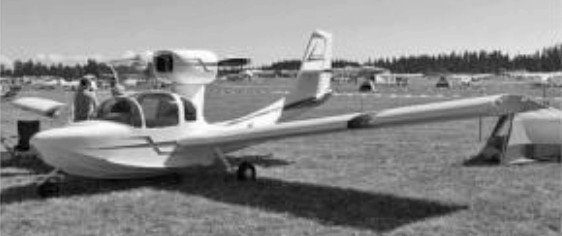
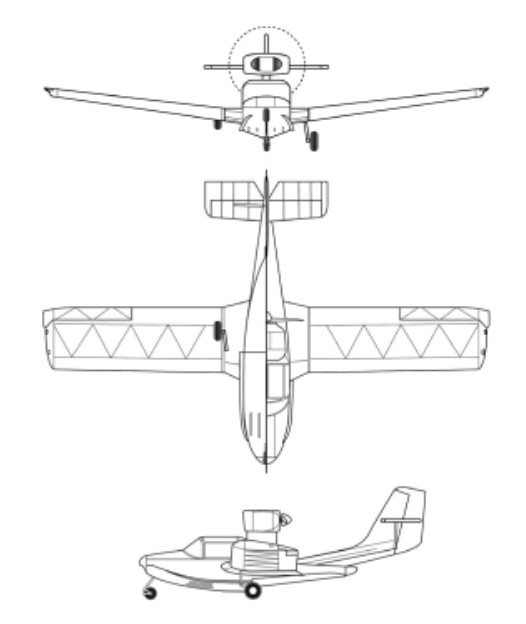
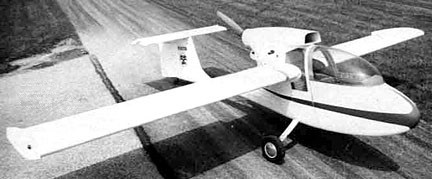
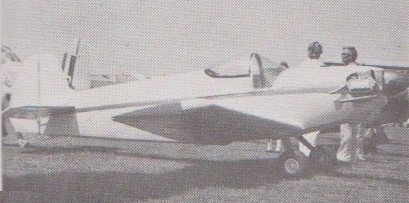
Molt Taylor developed his Coot Amphibian from a World War II Marine assault glider design that featured the unique low “Float-wing” common to both Coot A and Coot B models. The former features a fiberglass hull, the latter a twin-boom tail. Both prototypes have been flying for a number of years. The Coot Floatwing design eliminates the need for tip floats for lateral stability, provides a “deck” to step on for hand-cranking the propeller, protects the engine and propeller from spray, and provides ground-cushion effect for shorter takeoffs. Taylor considers the optimum engine to be the Franklin 180-hp Sport Six, which permits a smooth-water takeoff at 1950 pounds gross in six to eight seconds from a standing start though power can be supplied by any engine from 150 to 220 hp with a controllable propeller. A deep-V hull design permits rougher water operations than possible with twin-float designs, and a low thrust-line offers optimum elevator response for faster water liftoff. The Coot is a comfortable two-place ship with side-by-side seating and dual controls. The folding wings make road towing and home storage possible. With all his aircraft designs Molt Taylor emphasizes that performance and specification figures are greatly dependent on such variables as engine size, fuel capacity, etc.
The first Coot-A flew in 1969. Two prototypes were built, Coot A with a single tail, and Coot B with twin tail booms. Sooper-Coot Model A was a series version of the former.
Sooper-Coot A N1070
The Sooper-Coot-A two place amphibian price in 1982 was $12,000 (Excludes engine and instruments). Units delivered to June 1982: 100.
Coot A
Over 400 reportedly were being constructed by home-builders by 1977 with various 100-180hp engines.
Extensive development was undertaken to enhance flight and road performance. Accumulated road travel on six Aerocars exceeded 200,000 miles (321,865 km) and more than 5,000 flying hours.
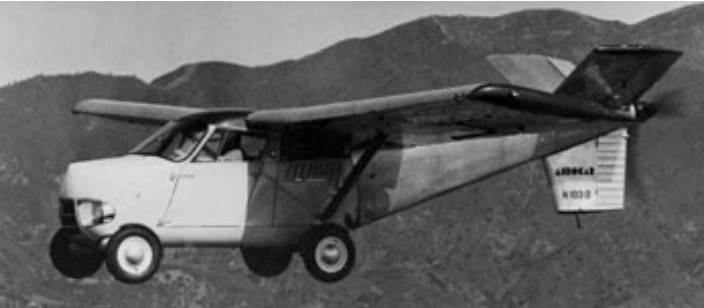
One prototype was built in 1949 (N31214/N4994P), sold to B F Goodrich Co c.1952 for $10,000. In 1956 production under 4A16 totalled 5 (N100D/103D), plus 1 unlicensed for testing. Certification was in 1956.
With business recessions in the 50’s and 60’s, a war priorities in Korea and Vietnam, the Aerocar was never put into large scale production.
The most famous was NC102D, serial number 4, sold to actor/pilot Bob Cummings who used it on his long running TV show, as well as for everyday transportation. That machine was specially fitted and certified with a 135hp O-290 Lycoming. The other Aerocars were powered with 143hp versions of the O-320.
The Aerocar II Aeroplane aka 1-A of 1964 was a four seat non-roadable tri-gear version of the original Aerocar using many of its components and with a fiberglass cab. Power was a135hp Lycoming O-290-D2 pusher. The project was considered by Ford Motor Co but never pursued. The Model II first flew in August 1953.
Taylor Aerocar II
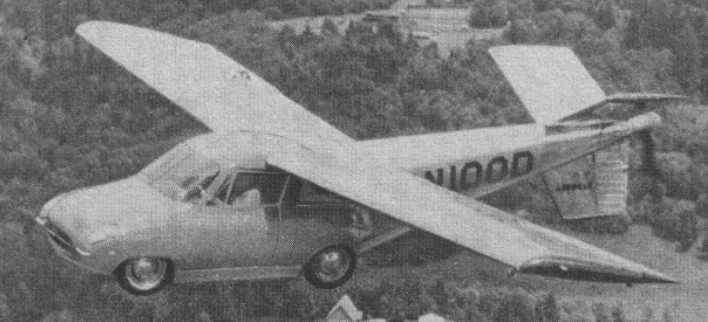
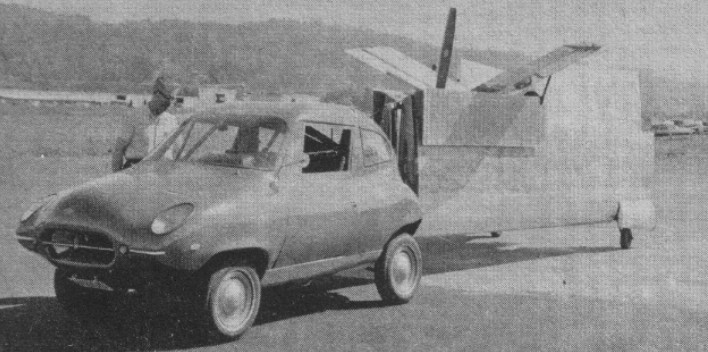
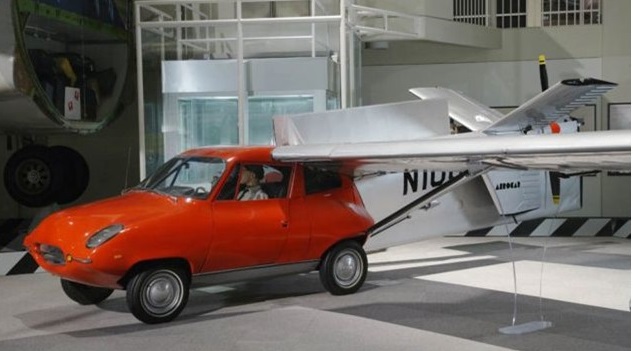
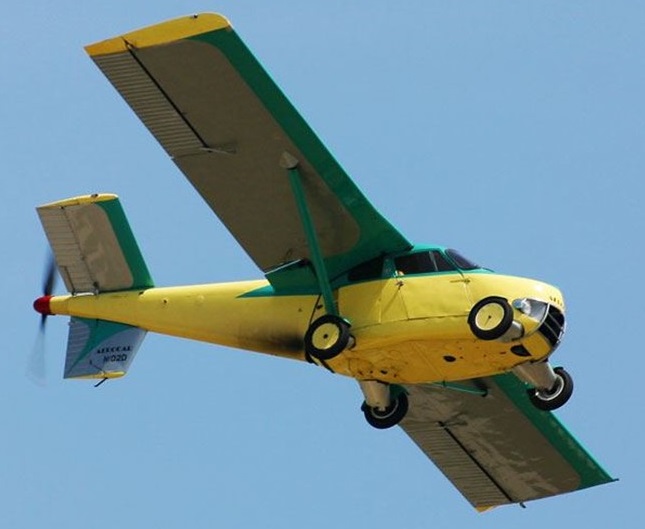
The Aerocar (TC 4A16) was developed through three models, and the two place Aerocar III, aka 1-C, first flew in 1968. A small, streamlined red car about the size of a Honda Civic, with a pair of bucket seats, deep pile carpet and a woodrim steering wheel. It has a 143 hp Lycoming engine with a fluid drive system for its retractable road wheels and dry fluid drive for the Hartzell ground-adjustable pusher propeller mounted behind the aircraft’s distinctive Y shaped tail unit. In the air it would cruise at 217 kph (135 mph), at 97 kph (60 mph) on the road, and go 24 km (15 miles) for every 4.55 litres of fuel burned, flying or driving. The car is 11 feet long and five feet wide. The wings and tail fold to only eight feet wide for highway travel. When it turns into an Aerocar, the plane is 23 feet long. Possibly was the one advertised as Sky Car in a non-flying version.
The most famous was NC102D, serial number 4, that was sold to actor/pilot BobCummings who used it on his long running TV show, as well as for everyday transportation. That machine was specially fitted and certified with an O-360 Lycoming. The other Aerocars were powered with versions of the O-320.
With business recessions in the 50’s and 60’s, a war priotites in Korea and Vietnam, the Aerocar was never put into large scale production.
Extensive development was undertaken to enhance flight and road performance. Accumulated road travel on six Aerocars exceeded 200,000 miles (321,865 km) and more than 5,000 flying hours.
The Aerocar was developed through three models, and the Aerocar III first flew in 1968. A small, streamlined red car about the size of a Honda Civic, with a pair of bucket seats, deep pile carpet and a woodrim steering wheel. It has a 143 hp Lycoming engine with a fluid drive system for its retractable road wheels and dry fluid drive for the Hartzell ground-adjustable pusher propeller mounted behind the aircraft’s distinctive Y shaped tail unit. In the air it would cruise at 217 kph (135 mph), at 97 kph (60 mph) on the road, and go 24 km (15 miles) for every 4.55 litres of fuel burned, flying or driving. The car is 11 feet long and five feet wide. The wings and tail fold to only eight feet wide for highway travel. When it turns into an Aerocar, the plane is 23 feet long.
Model III
The Model II Aerocar was a pure aeroplane (non-roadable) that used the Aerocar I wings, tailcone and tail plus some fuselage parts. It has a tricycle gear instead of the Aerocar I’s 4-wheel landing gear. Molt sold this maching to Ed Sweeney (who also owned Bob Cummings machine).
The Aerocar III was an updated version of the Aerocar I with a more modern shape for the car body that incorporated an improved fiberglass body and retractable wheels. The machine is displayed at the Museum of Flight in Seattle.
Aerocar III
Aerocar I serial number 2, registered N103D was owned by Gary Norton.
Molt Taylor donated the prototype of his flying automobile, the Aerocar, to the EAA Aviation Foundationn. A complete restoration was commenced at Hales Corner. This halted during the move to Oshkosh. The Buehler Foundation then provided a grant to provide the financial resources and the skilled manpower to complete the restoration. Molt Taylor was providing photographs, documentation, and his knowledge to assist.
Ford Motor Company wanted to build Aerocars, but the Federal Aviation Administration said no way did they want the sky full of flying automobiles. They were going to build 25,000 of them the first year and with their dealer organization they figured they could sell them. It never happened.
In 1963 Merton Taylor built a single place low-wing cabin monoplane Tater Bug registered N1052Z. Using an NACA 4309 – NACA 4309 wing, the first flight was in Febuaray 1963.
In 1963 Merton Taylor built a single place mid-wing cabin monoplane Topper registered N9063C. The first flight was in October 1956. Only the one was ever built.
Circa 1980 Clarence Gilbert Taylor and son Bruce built the two place, mid wing ‘Bird’, registered N303TB, with a 75hp Subaru pusher (converted auto engine). Single tail boom with T-tail.
An update of the original Bird that appeared at Oshkosh in 1976.
The Taylor JT.2 Titch was designed in 1964 to meet Rollason’s Midget Racer competition, placed second overall. A prototype built by John Taylor was first flown at Rochford on 22 January 1967 with a Continental C85-12F engine. It crashed in May 1987, killing Taylor. The plans then being sold by his widow.
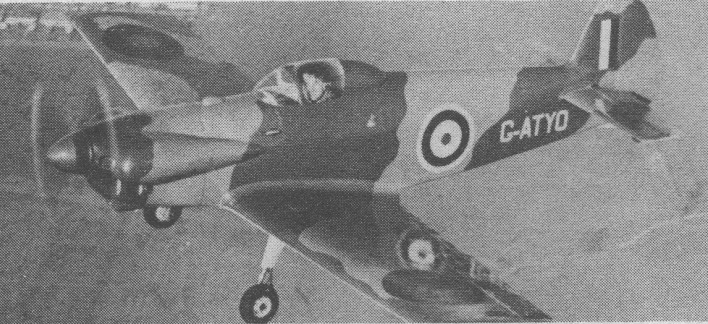
Titch G-BCSY at Sywell 1975
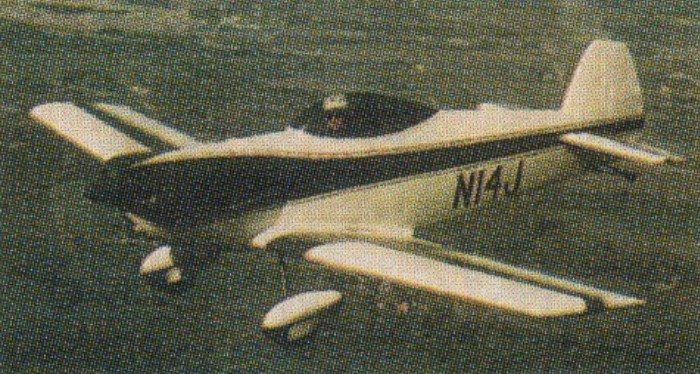
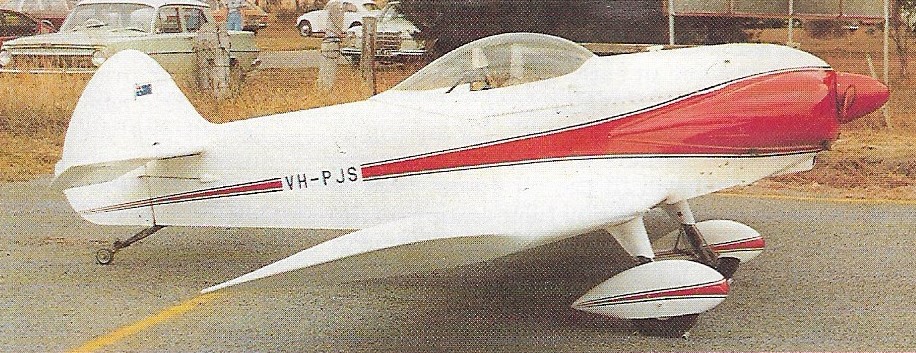
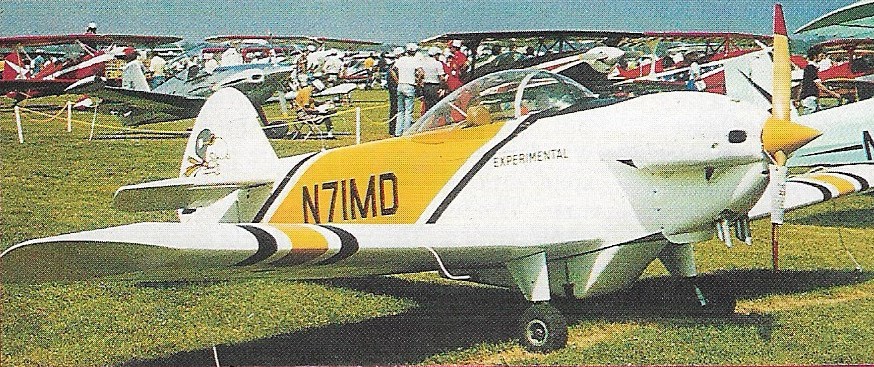
The Taylor Titch has a reputation as a pleasant-to-fly aerobatic plane. Its stall occurs at a very high angle of attack and is straightforward, with no wing drop and a height loss of only 50 feet. This single-place monoplane features all-wood wings with plywood and fabric covering. Its fuselage is also an all-wood structure that includes double-curvature plywood covering and aluminum cockpit side panels. When the low-powered Taylor Monoplane became known in the United States, requests were made for permission to fit larger engines than the design permitted. This led to the introduction of the Titch. The Titch is stressed for any engine from 40 to 90 hp, the only provision being a reposition of the engine bulkhead for engines of 65 hp or more. This allows for the use of VW, Lycoming or Continental powerplants.
Engine: Continental, 85 hp HP range: 60-100 Speed max: 200 mph Cruise: 160 mph Range: 380 sm Stall: 48 mph ROC: 1600 fpm Take-off dist: 350 ft Landing dist: 900 ft Service ceiling: 18,000 ft Fuel cap: 10 USG Weight empty: 500 lbs Gross: 760 lbs Height: 4.8 ft Length: 16.7 ft Wing span: 18.9 ft Wing area: 68 sq.ft Seats: 1 Landing gear: tail wheel
Engine: VW 2100 Cruise: 115 mph ROC: 800 fpm Range: 250 sm Span: 18 ft 9 in Length: 16 ft 1.5 in Empty wt: 455 lbs Max wt: 710 lbs
Designed by John Taylor, the Monoplane is a single seat, cantilever, low wing. acrobatic aircraft built with the object of producing an airframe for not more than £100 Sterling. The wing is a constant chord structure with an RAF 48 aerofoil section, and consists of a centre section and outer panels. Each panel has two spruce and plywood spars, wooden ribs and a plywood covered leading edge D nose, the remainder of the wing being fabric covered. Split trailing edge flaps are fitted. The fuselage is a conventional wooden structure hav¬ing spruce longerons and frames and plywood covering. The wing centre section is built integral with the fuselage. The fin and tailplane are plywood covered wooden structures, while the rudder and elevators are fabric covered wooden structures. The main undercarriage consists of cantilever legs fitted with coil springs for shock absorption. The wheels have Avro Anson tailwheel tyres. A leaf spring tail skid with a steerable skid pad is fitted. A 6 Imp. gallon fuel tank is installed behind the firewall. The prototype flew with a 37 h.p. JAP engine, but converted Volkswagen engines are also suitable. Since the first prototype flew in June 1960, no modifications of any kind have been incorporated.
Engine: JAP, 38 hp Wing span: 21 ft 0 in (6.4m) Wing Area: 72 sq. ft Length: 15 ft 0 in (4.57 m) Height: 4 ft 10 in (1.47 m) Empty Weight: 400 lb Max TO wt: 610 lb (276 kg) Wing Loading: 8.5 lb/sq.ft Max level speed: 105 mph (169 kph) Cruise Speed: 92 mph Stall Speed: 34 mph Climb: 650 fpm Range: 230 miles
In 1976 Donald E Taylor built the ‘Tinker Toy’, two place cockpit, highwing monoplane, registered N5DT. Firs flown on 6/16/74, power was a 102hp Chevy Corvair Monza pusher.