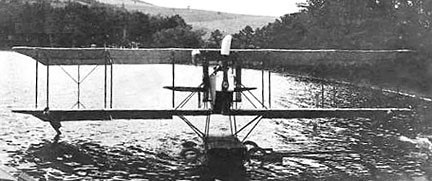
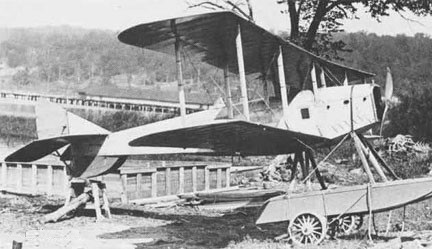
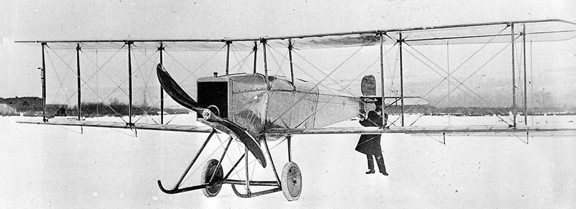
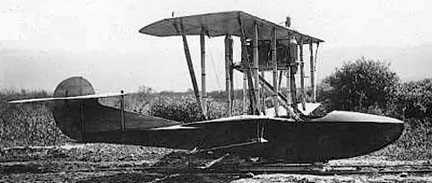
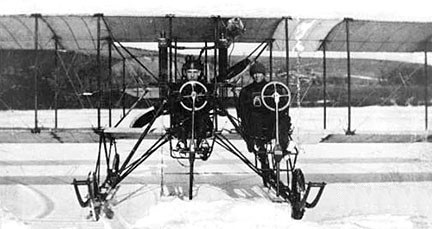
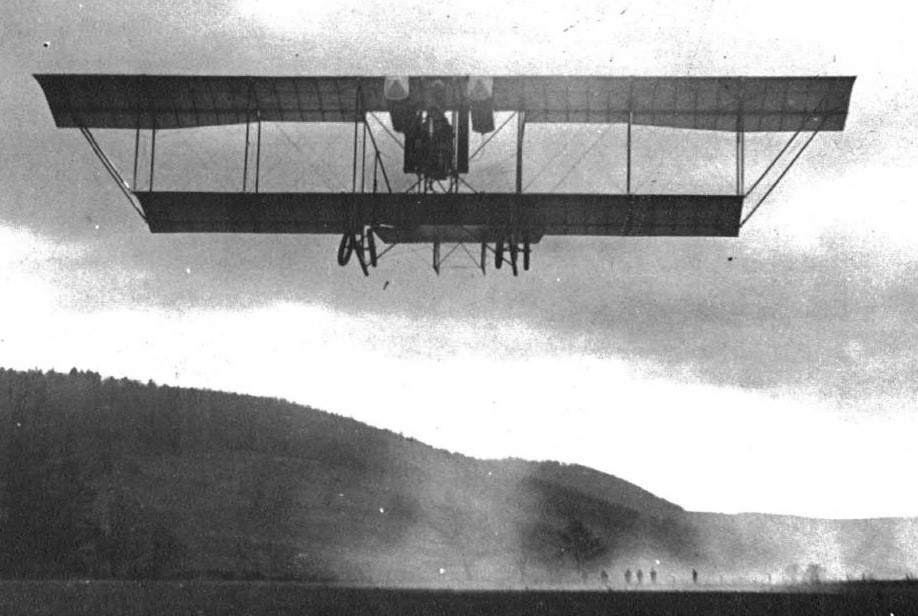
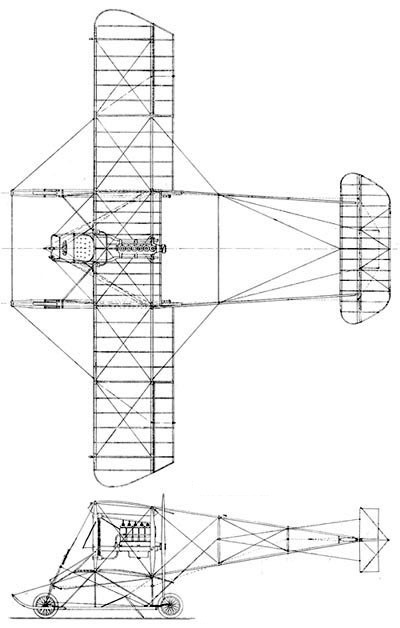
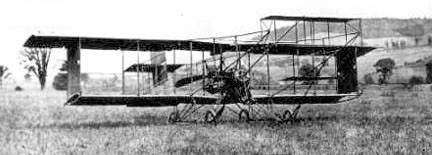
The Thomas TA was the second Thomas product. Fitted with four trailing-edge ailerons, and nacelle fuselage, early seaplane models had tubular wing floats.
At least two TA model were built, plus perhaps others built with varied motors of 65-90hp. The first was the 1910 model with exposed cockpit and interplane ailerons, which set an endurance record of four hours in 1912, piloted by Walter Johnson. One was tested as a single-float tractor version in 1912, but results were inconclusive.
The sole TA Tractor of 1912 had a partially-covered fuselage. It was probably a single-float conversion from a TA, but proved lacking in performance compared to the pusher.
The 1913 TA Hydro was the first all-metal hull in the USA.
The 1915 D-2 civil trainer was designed by Benjamin D Thomas (no family relation; principal designer for most Thomas and T-Ms) as an improved T-2.
As a two-seat observation biplane, two D-2 were ordered by the US Navy as model HS. Both were involved in crashes before delivery and were rebuilt in 1916 with 48’6″ wing and 135hp Sturtevant for use as trainers as A57 and A58.
Thomas HS
The D-5 of 1916 were re-motored D-2 with 135hp Thomas 8 engines. Two, AS114 and AS115 were used for Army observation.
The T-2 biplane was designed by Benjamin D Thomas in 1914, based on his Curtiss J design. Twenty-four with 90hp Curtiss OX were exported to Great Britain in 1915.
Built in 1912, the 2-3 seat B-3 and B-4 had a wooden hull covered with galvanized iron sheeting. A 1914 version incorporated streamlining, and 1915 model was a three place “luxury cruiser” with a mahogany hull.
In 1914, the Thomas Company advertised aviation for sport, war and business. Their earlier models, the B-4 and B-5 were used as trainers for civilian pilots seeking thrills, speed and fortune.
The 1913 Thomas Standard Biplane was a design modification of the 1912 tractor TA with open cockpit, a nacelle fuselage, twin tails, and underslung lower wing.
The 1912 Thomas Biplane was a single place open cockpit tractor version of the TA. Only one was built and further development was abandoned in favour of pusher versions.
The Thomas Biplane first appeared in 1911 and was possibly the first dual-control trainer. Early versions had a four wheel undercarriage, which was changed during the time to a two double wheel and skid undercarriage.
This Thomas Biplane with 65 hp Kirkham C6 engine was used in this configuration for record flying of which the most famous one is the US Endurance record flown on October 31, 1912.
Referred to in contemporary literature as Thomas Headless biplane and Thomas 65.
Designed by William T Thomas, the 1910 Thomas biplane was originally powered by a chain-driven 22hp Kirkham V-8 pusher engine. First flown on 25 June 1910, piloted by Bert Chambers, it was equipped with a quad landing gear with bamboo skids. It was later modified with twin rudders and direct-drive motor.