Vickers EFB.1

On 19 November 1912, Vickers received a contract from the Admiralty for an experimental fighting biplane armed with a machine gun. Various configurations were investigated before the desirability of placing the gunner in the extreme nose of the aircraft, in order to achieve a clear field of fire, led to choice of a fuselage nacelle carrying at its rear an engine driving a pusher propeller. This nacelle was mated with an unequal-span heavily-staggered biplane configuration, the tail surfaces being carried by paired and vertically disposed booms attaching to the upper and lower rear wing spars on each side of the engine.

Designated E.F.B. (Experimental Fighting Biplane) 1 and dubbed “Destroyer”, the Vickers aircraft was armed with a single 7.7mm Maxim machine gun on a mount affording 60 degrees elevation and traverse. The airframe of the E.F.B.1 was primarily of metal construction, the nacelle accommodating the pilot and gunner, and carrying an 80hp Wolseley eight-cylinder Vee-type engine, being of steel tube with duralumin skinning. Wing warping was employed for lateral control.

Prior to its first flight, the E.F.B.1 was displayed at the Aero Show held at Olympia, London, in February 1913.

The gun was fitted for the first flight test, made at Joyce Green, but this rendered the aircraft so nose-heavy that it briefly left the ground, then nosed down, struck the ground and turned over.

Max take-off weight: 1207 kg / 2661 lb
Empty weight: 798 kg / 1759 lb
Wingspan: 12.19 m / 40 ft 0 in
Length: 8.38 m / 28 ft 6 in
Height: 3.63 m / 12 ft 11 in
Wing area: 35.77 sq.m / 385.02 sq ft
Max. speed: 113 km/h / 70 mph
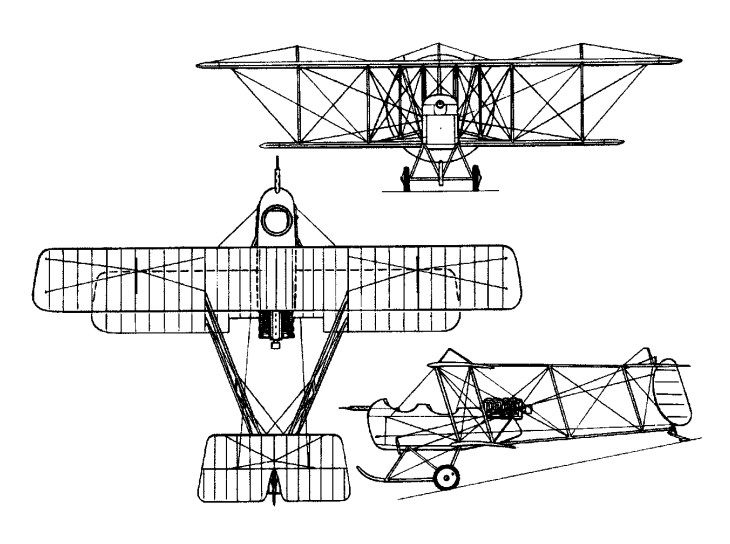
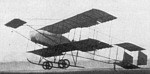
Vickers E.F.B.1

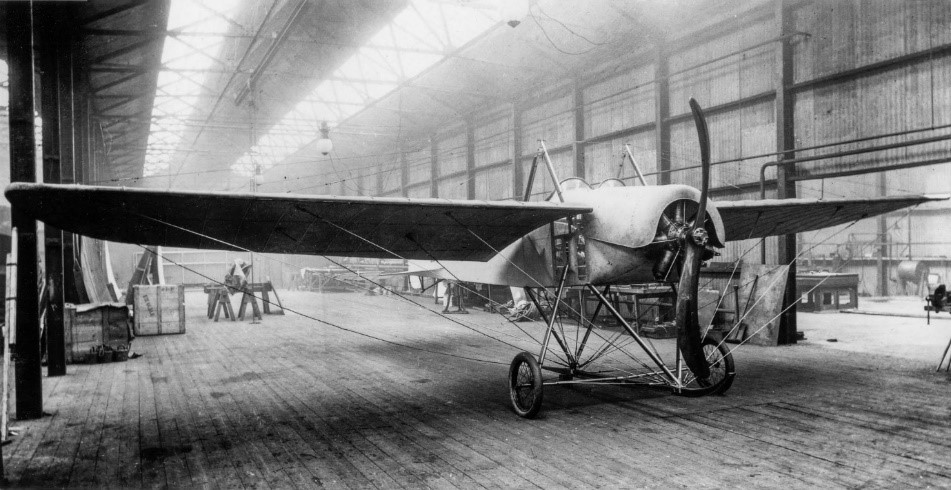
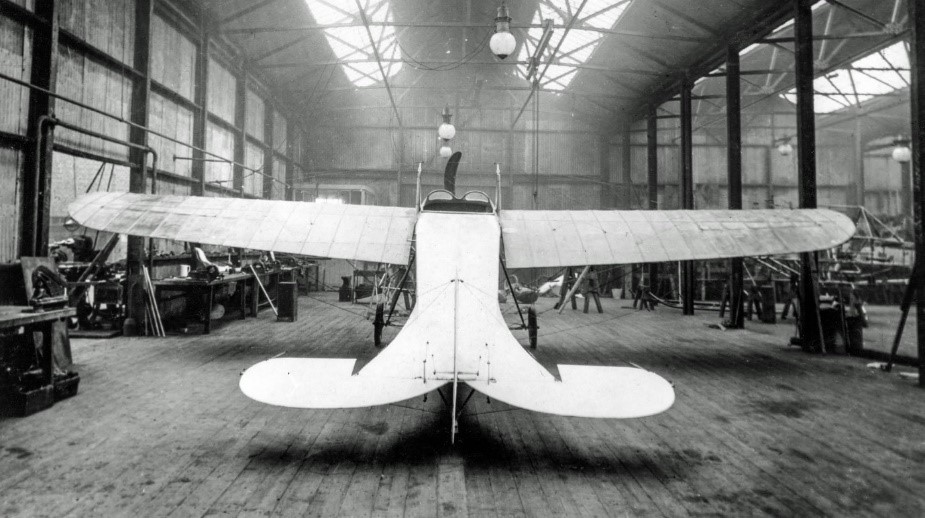
Vickers No.VIII monoplane

In the Vickers’ works at Erith.

The Vickers No.8 Monoplane was built at Erith and displayed at the Fourth International Aero Show at Olympia, in February 1913. This aircraft resembled the No.6 Monoplane and seated its two occupants side-by-side and had a twin wheel undercarriage with a single central skid.

The elevators were aerodynamically balanced and the triangular fin and rudder resembled that used on the No.7 Monoplane. The 70 hp Gnome engine, with front and rear plate mountings, drove a two-blade propeller and was cowled over the upper part of the engine.

Performance figures were also quoted with an 80 hp Gnome fitted. As with the other Vickers monoplanes, the fuselage structure was of steel tube construction. Transparent ‘Cellon’ panels were provided in the lower cockpit sides and floor to improve the crew’s view of the ground. The cockpits were also provided with small transparent windshields.

The tailplane was formed by splaying out the rear longerons. The machine was designed to fold, allowing it to be transported by road mounted on a wooden trailer.

The No 8 monoplane packed for road transport, being towed behind a Napier car.

Only one was built.

Powerplant: One 70 hp Gnome rotary
Span: 34’6″
Empty weight: 700 lb
Speed: 45-69 mph
Endurance: 3 hours 30 min
Capacity: Pilot and passenger
Price: £1300

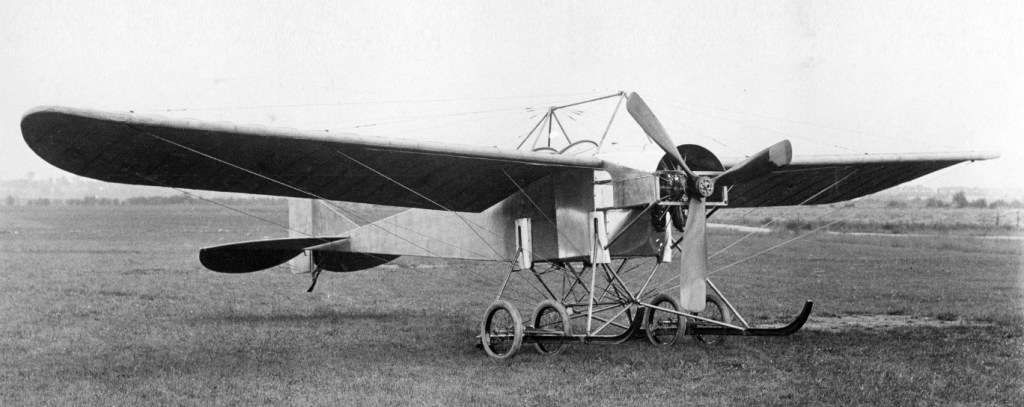
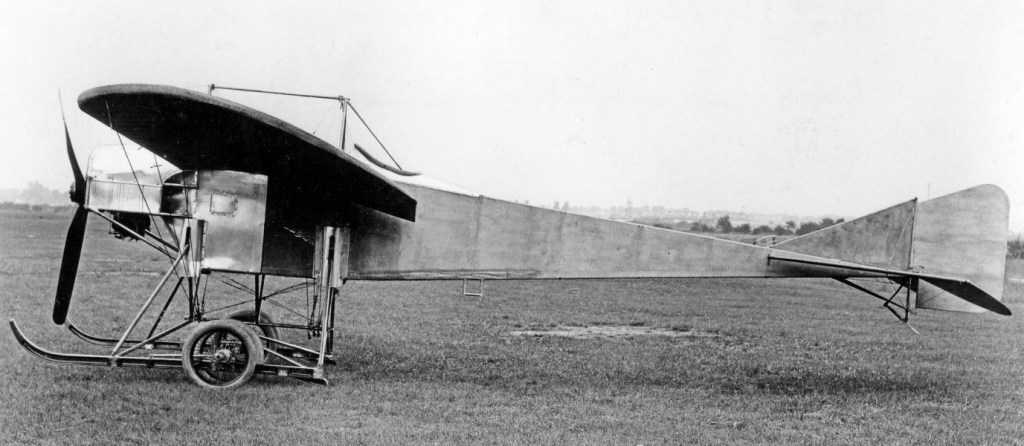
Vickers No.VII monoplane

The Vickers No.7 Monoplane returned to the same configuration as the No.5 Monoplane. It accommodated the two occupants, seated in tandem and featured two-skids and a four-wheel undercarriage as used on the earlier machines. Power was provided by a 100 hp Rolls-Royce Gnome rotary engine driving a three-blade propeller.

The tail surfaces were again modified, with a fixed fin ahead of a re-shaped, unbalanced rudder. The Gnome engine was supported by a front mounting, with the upper part of the engine being cowled, presumably to prevent hot oil being thrown into the face of the front seat occupant.

The Vickers No.7 Monoplane was flown for the first time by Robert Barnwell at Brooklands on 1st January 1913. However, this aircraft was later reported to have been turned over by a student pilot on 4th October 1913, after which nothing more is heard of it. It is assumed that the company decided not to repair it for further use.

Engine: 100 hp Gnome
Span: 34’6″
Length: 25′
Weight all-up: 1200 lb
Speed: 70 mph
Range: 350 miles
Seats: 2

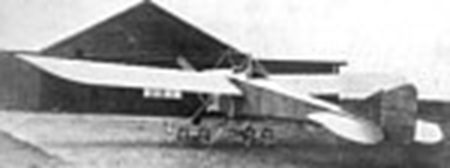
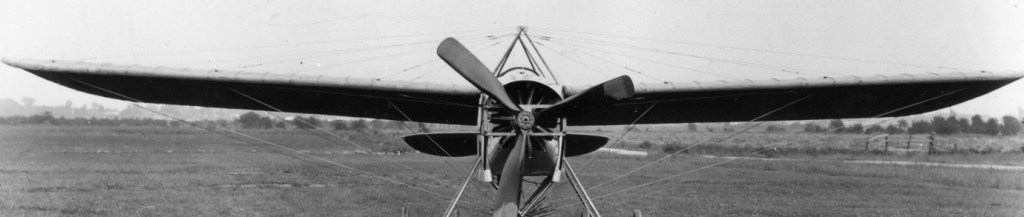
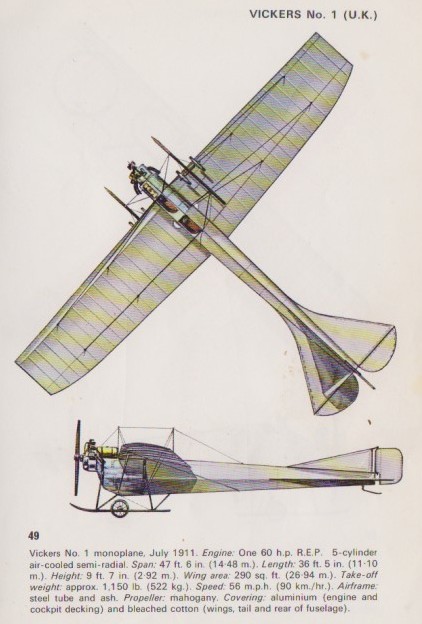
Vickers No.1

The 1911 Vickers No. 1 monoplane was designed and built by Vickers Aircraft in the UK

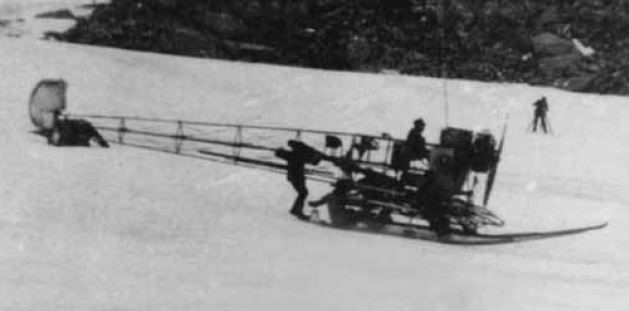
The Vickers No 1 was based on a REP design, but used originally designed wings. It was powered by a 5-cylinder, air cooled REP engine developing 60 h.p. The second airframe was sold to Douglas Mawson for possible use in an Antarctic expedition, but was badly damaged in a crash landing at Adelaide in October 1911. The remains (the fuselage and engine) were used by the expedition as a motorized sledge or “air tractor”, but engine problems made it more or less useless. The remains are buried in the ice at Cape Denison, where efforts have been made to retrieve it.

Span: 47’6″
Weight: 1000 lb
Speed: 56 mph

Vickers Aircraft Co Wave

The Vickers Aircraft Company Wave is a two-seat, side-by-side configuration, high wing amphibious aircraft under development by the Vickers Aircraft Company of Hamilton, New Zealand.

The fuselage and wings are constructed from a combination of aluminum and carbon fibre composite materials. An automatic folding wing mechanism and ballistic parachute are planned to be integrated. The standard engine is the 180 hp (134 kW) Continental Titan 340 four-stroke powerplant, mounted in a pusher configuration.

It was introduced at the Sport Aviation Expo in Sebring, Florida in 2014, intended for the US light-sport aircraft category.

Wave
Engine: 1 × Continental Titan 340, 180 hp (130 kW)
Propeller: 3-bladed Catto
Wingspan: 30 ft 10 in (9.40 m)
Wing area: 149.3 sq ft (13.87 sq.m)
Length: 24 ft 7 in (7.5 m)
Height: 7 ft 6 in (2.29 m)
Empty weight: 928 lb (421 kg)
Gross weight: 1,430 lb (649 kg)
Fuel capacity: 50 U.S. gallons (190 L; 42 imp gal)
Maximum speed: 120 kn (138 mph, 222 km/h)
Cruise speed: 120 kn (140 mph, 220 km/h)
Range: 720 nmi (830 mi, 1,330 km)
Wing loading: 10.2 lb/sq ft (49.7 kg/sq.m)
Crew: 1
Capacity: 1 passenger

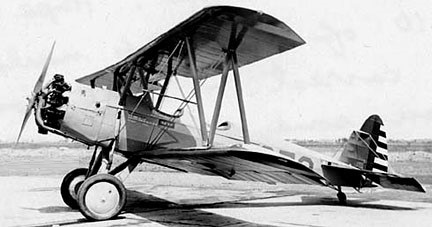
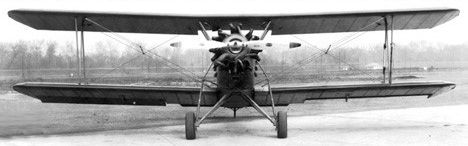
Verville PT-10 / Training Plane

Verville YPT-10

The 1931 PT-10 was an AT model foe Army Air Corp evaluation as YPT-10. Four were built as YPT-10 (31-519-522), first one was as “Training Plane” in prototypical stage (N479Y). The Training Plane first flew in February 1931.

Verville Training Plane Prototype N479Y
Verville PT-10C 31-521

There was one conversion, 31-521, to a PT-10C. converted in 1931, it was powered by a Lycoming R-680.

One conversion to YPT-10D was completed in 1931, powered by a Kinner C-5.

Verville YPT-10D

PT-10
Engine: 200hp Lycoming R-680
Wingspan: 33’0″
Length: 25’0
Useful load: 642 lb
Max speed: 108 mph
Cruise: 80 mph
Stall: 52 mph
Seats: 2