Construction of FVA25 (ultralight canard aircraft) began in 1983.
1 engine
Aachen FVA-19 “Auslegung eines Schleppflugzeugs”
The FVA-19 was a study of the efficiency and design of an efficient towplane. With the following consideration: Scale is the generally accepted winch launch operation, economy would be better with aerotow if the total expenses are equal to or less at the same efficiency. Capturing all the factors that make up the term economy as a whole, was by evaluating all the statistical material possible.
Statistical considerations included a comparison of the cost of the tow plane towing to height, which incurred expenses such as overhauls, usual minor repairs. et al and depreciation are included.
After extensive calculations, it was clear that the power requirement of the optimum towing aircraft must be well above 175 hp. For a comparison, the costs and benefits achievable in the winch towing operation had to be known. For this purpose , the fixed costs of a glider per year were collected , as well as that of the wind, and from the Annual Report of the National Association of North Rhine-Westphalia DAeC the years 1959 – 1961 taken from the middle tee times . This was followed by a gliding hourly rate of 90, – DM at 60 hours per glider and year down to 70, – DM at 80 hours per glider and year. The last statement (80 h / year) seemed the performance of the winds to be exhausted. Assuming a flight time of 25 minutes per start a drag start at the same annual total flight time of 80h year and the same hour flight price could cost 4.75 DM . That was the cost of the winch to let the glider fly 25 minutes. For this purpose, on average just over two winch launches were necessary). With sufficient utilization of the towing aircraft such start-up costs are possible.
This can be reached by aerotow, with more than 80h / year per glider, so even higher towing rates may still be economical. The glider hour is the same price for both types of launch when the glider has reached 60hr per year by winch, and 95hr year by aerotow, and this with a towing price of 15 , – DM (again, for an average flight time per launch 25 minutes according to a towing height of n = 750m) .
A summary of this study was published in the trade press which great interest in gliding circles. Since the construction and flight testing of the ” Crow ” the FVA still aero-towed until the end of the 60s and in 1963, a Piper Super Cub was purchased as a tow plane. Construction of FVA-19 began in 1965, but acquisition of the Super Cub made construction superfluous.
With the help of some old masters of the FVA this study went to Bremen where it was constructed by the flight Scientific Working Group Bremen, This single-seat aircraft was equipped with a 180 hp engine, and with the type designation ESS 641 was first flown on September 17, 1971.
Aachen FVA-18 “Primitivkrähe”

At the end of the fifties the FVA wanted each aviation student, after completing his studies, to have also private pilot’s license. It was decided to develop an inexpensive powered airplane, easy to fly, for training.
American engines were too expensive, so a Pollmann flight engine that was developed from the VW and gave a continuous output of 30PS at 3200 rpm was obtained. By selection of the propeller, it was possible to bring the propeller efficiency to 0.78%. It was necessary to give the propeller a comparatively large diameter of 2.15m.
It was necessary to reduce the speed of the engine to 1100 rev min. This was to be done by a V-belt reduction provided by the Pollmann, but this proved to be unusable. A transmission was developed by the FVA, with a reduction of 2.85 : l delivered by a helical spur.
Construction of the FVA18 “Primitive Krähe” (Primitive Crow, later Silver Crow) began in 1960. In the conventionally designed steel tube fuselage and one-piece wing was an extreme lightweight construction. It had a 250 kg empty weight for a two-seater powered aircraft with a wingspan of 10.50 m and a length of 6.70 m. The power plant took the flying weight to 430 kg. The plan was to only 400 kg.
The wings stems were examined at the Institute for Building Research on buckling strength.
The fuselage width of the FVA-18 was only 0.67 m. It turned out later that with this hull width a passenger, in tandem behind the pilot came in contact with the rudder pedals.
Aileron and elevator loading tests and suspension drop tests completed the test series.
The FVA-18 was built to CAR Part 3 Normal category. First flown in 1965, the flight tests were conducted under the provisions of “Civil Aeronaurics Manual (CAM)” and after “Flight Test Report Guide”. Here, every attitude and flight situation were subjected clearly defined requirements.
The self-designed gear had to be disassembled at fixed intervals to determine wear or replace bearings and oil seals leaking.
It soon became apparent that the propeller pitch was set too low. A new propeller was added at Hoffmann.
The first flights were destined to determine the normal behavior of the FVA-18. After a few minutes of flight, the oil temperature rose above the permissible level. Moreover, it was splashed on the front panel through the vent of the transmission oil.

The transmission made loud noises was at engine speeds below 1,800 rev / min, which, as it turned out, were also due to engine misfire. Metal shavings were found in the oil thrown out and the gearbox was disassembled after 20 minutes of flight time. The helical involute gears were shifting by 4 mm and beat against each other on a spacer. A newly designed additional spacer ring then prevented migration of the gears against each other, and the transmission was much quieter. Additional baffles enhanced oil cooling for level flight at a constant temperature of 90°C.
With a weight of 380 kg following flight performance were flown:
Cruising speed:
100 km / h at 3200 rev / min
90 km / h at 3000 rev / min
Lift-off distance:
40 m
Take-off distance 15m:
approximately 120 m
Rate of climb:
2.10 m / s
Altitude reached:
2500 m
Fuel consumption:
9 l / h
Range:
380 km
The first spin tests at medium gravity position could be recovered by normal control deflections and discharged again. The FVA -18 turned 1/4 to 1/2 turn. The spin was hardly different from a steep circle with minimum speed.
Flight testing was Dr. Mr. Professor. AW Quick performed the framework of the thesis of Freddy Schliewa at the Institute of Aerospace.
In 1971, she was presented in flight at the meeting of the Oskar Ursinus Vereinigung (OUV) in Egelsbach. where a lot of attention:
“The next day the representatives of the FVA Aachen presented their” primitive crow. “- Before FVA-18 from the flight characteristics of this bird that bears his name because of its simple construction with a right to all interested parties were able to convince themselves by relying on the stick translated and with the Crow Conclusion went into the air the idea of the aircraft from Aachen:… Everybody talks about the club aircraft to reproduction – we are only interested in (still) not sure “
(556 from German Aerokurier, Issue 8 71, p report on OUV-Meeting)
In particular, the low minimum speed of 55 km h and the harmless stall characteristics impressed. The simple construction aroused the interest of amateur aircraft builder. In the following years, numerous requests were answered and ten sets of drawings were delivered to interested parties.
At the end of 1971, a crashed Rf 5 Limbach engine was left. After some weighing, measuring and sketching it became clear that a transplant of the power plant was possible. Then the reconstruction was done in around 600 working hours in winter 1972/73 by Max Schörner and Erhard Schneider. The engine system and propeller had the first run-ups in April 1972.
The Crow flew for the first time on 17 May 1972. The old authorization expired, and now FVA-18b called Crow got a provisional airworthiness certification for testing. Acceleration at the start improved and short take-off run was now around 80 – 100 yards.
The following improvements and flight performance were achieved :
- Electric start – before by hand
- Vehicle electrical system 12 V, 240 W
- Increased rate of climb of 1.6 m / s to 2.3 m / s at 450 kp
- Increase the cruising speed of 108 km / h to 128 km / h
- Less noise from the exhaust system
- No gearbox, thereby simplified maintenance and less noise and vibration
- Increased ground clearance of the propeller
The FVA fully met the technical target with an intermediate stage. Through the development of the two-seater motor glider and the procurement of one for the FVA saw no further need for a powered aircraft. The Crow was sold to an OUV member.
Aachen FVA-17 “Nurflügler” / Horton Ho-33

In 1954, the FVA took a research commissioned by the Federal Ministry of Transport for the purpose of operating the type certification of the Horten Ho-33 V1 flying wing powered aircraft.
The aircraft was already designed with a view to later use it as powered aircraft.
Since the VI had first flown as a glider, the proposed engine weight was installed as ballast.
Design approval for the tailless Ho33-V1 powered aircraft was achieved in 1955.
The first two test samples of Ho 33 were built by Alfons Pützer KG in Bonn. The first calculation of the data used were the following:
Wingspan: 19.20 m
Chord at the root: 3.25m
Wing area: 35,60sq.m
Net weight: 430kg
Flying weight: approx 650kg
Wing loading: 18kg / sq.m
The hull was like the wings, made of wood construction with two seats in tandem. In the rear fuselage space for the engine was provided.
Tandem undercarriage with a steerable tail wheel and two retractable support wheels, about in the inner third of the half span were fitted.

The fuselage was transferred by Pützer to Aachen in the FVA workshop, where work was started for the engine installation. The powerplant was a Zündapp “Z 9-092”.
Power: 50 hp at 2300 rev / min
Consumption: 210285 g / hp-hr
Weight: approx 65 kg
This work took about four months to complete. The fuselage was returned to Bonn and transferred to Aachen after some trial launchs at Bonn again. While at the same weight for the purpose of determining the center of gravity, it turned out that the weights were far exceeded. With an empty weight of 620 kg the flying weight was about 850 kg.
It was prepared the launch in Merzbrück some difficulties. The Horten was transported for further testing in flight 33 at Noervenich. The entire aircraft was re-measured in almost all parts. The sparse drawings not agree with the construction.
The test flights at Noervenich proved, among other things, that behavior and the start was not satisfactory.

The regulations and guidelines of CAR Part 3 were applied and the new flight weight of about 900 kg; the geometrical data remained unchanged. As might be expected, the air loads were significantly higher than the original. The loads were set up as part of a student research project at the Department of Aviation.
The strength analysis was performed on the basis of newly data obtained during the survey of the aircraft resulting in air loads for the main components. The aircraft was undersized for the stresses occurring in some parts.
In particular, the suspension was of insufficient dimensions. More flights did not appear advisable because of the lack of strength. The changes required meant such an effort would exceed the financial resources so the job could not be continued. The aircraft was returned to Bonn leading to the abandonment of the project.
Later converted with a 75 hp Porsche engine.
Pützer-Horten Ho 33 V2 (001) D-EGOL suffered damage taxying at Bonn in June 1957 (owner and operator being LSV Bonn at the time). It had received a Permit to fly on 6 July 1956. The wings went to Fa.Frosch at Lutherbeck near Unna, the central fuselage to Rüdiger von Elm. The remaining parts were used to rebuild D-EJUS as engineless hybrid in the museum at Wasserkuppe.
Aachen FVA 6

After re-authorization of powered flight, in 1926 Ilse and Theodor Kober designed the FVA-6, a two-seater biplane. The FVA-6 was a biplane had two seats in tadem, and was powered by an English ABC engine with 30hp. The FVA-6 was built in the workshop of the former “Aachener Segelflugzeugbau GmbH”, which was acquired by Junkers.
For the test-flying the FVA-6 Ludwig Pfitzner had been chosen. He was one of the few new FVA – generation and just made his pilot’s license.
The two-seater biplane was completed before the end of 1926 and has done test flights to Dusseldorf – Lohausen because Aachen was still occupied by the Belgians. The FVA-6 totally destroyed during the first flight when entering Dusseldorf. The designers of the FVA-6 were no longer in Aachen, as the aircraft was completed. The new students who could fly hardly knew what to do with a new untried design.
A2 CZ Ellipse Spirit
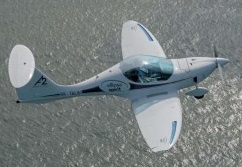
The Czech A2 CZ Ellipse Spirit was designed to comply with the Fédération Aéronautique Internationale ultralight aircraft rules. It features a cantilever low wing, a two seats in side-by-side configuration cockpit, tricycle landing gear and a single engine in tractor configuration.
The aircraft of all-composite construction. Its 8.0 m (26.2 ft) span elliptical wing employs rounded wingtips and fixed slots in the outer portion of the wing and dive brakes. Optional fuel capacity is 100 litres (22 imp gal; 26 US gal) giving a range of 1,730 km (1,075 mi). The standard engine is the ULPower 260iS four-cylinder, four-stroke aircraft engine of 107 hp (80 kW) and other engines available include the 100 hp (75 kW) Rotax 912S and 912iS, plus the 100 hp (75 kW) Lycoming IO-233.
Designed and produced by A2 CZ and first flown in July 2011, the aircraft was introduced at the Aero show in 2011 and was supplied complete and ready to fly or as a kit for amateur construction. The unt cost was € 75,000 in 2011.
The basic fixed gear Ellipse was undergoing development in 2011 into a retractable gear version as well as versions for the US light-sport aircraft category.
Ellipse Spirit
Engine: 1 × ULPower 260iS, 80 kW (107 hp)
Wingspan: 8.00 m (26 ft 3 in)
Wing area: 8.48 sq.m (91.3 sq ft)
Empty weight: 272.5 kg (601 lb)
Gross weight: 472.5 kg (1,042 lb)
Fuel capacity: 100 litres (22 imp gal; 26 US gal)
Maximum speed: 280 km/h (170 mph, 150 kn)
Cruise speed: 250 km/h (160 mph, 130 kn)
Stall speed: 60 km/h (37 mph, 32 kn)
Rate of climb: 7.5 m/s (1,480 ft/min)
Crew: one
Capacity: one passenger
76th Fighter Squadron Inc
1996: 3604 Galley Rd, Colorado Springs, CO 80909, USA.
3xtrim 3X55 Trener / 3X47 Ultra / Navigator 600
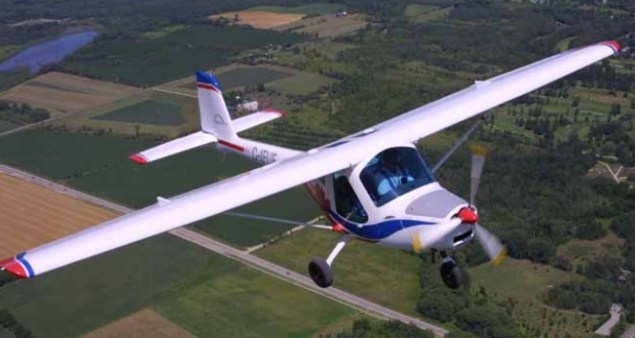
First flown in 1996, the 3X55 Trener (English: Trainer) and 3X47 Ultra are a family of ultralight civil aircraft produced in Poland by the 3Xtrim Aircraft Factory. Both are two-seat, high-wing, strut-braced monoplanes with fixed tricycle undercarriage and available only as completed aircraft. There are also 450 Ultra and 495 Ultra Plus sub-variants of the 3X47 Ultra, with gross weights adjusted for national ultralight regulations.
Former SZD sailplane engineer Adam Kurbiel designed the predecessor of 3X55, the EOL-VLA, to conform to European JAR-VLA rules. That plane was modified through the years to meet Canadian Advanced Ultralight and US Light Sport Aircraft rules. The 3X47 version is specifically for the European market to meet those standards.
The designation 3X55 means “3Xtrim Aircraft – 550 kg gross weight” while the 3X47 refers to its 470 kg gross weight.
The US light sport aircraft version of the 3X55 is known as the Navigator 600 and has a 1320 pound maximum gross take-off weight.
The European versions feature extensive structural use of carbon fibre to achieve lightness, while the 3X55 is predominantly of fibreglass construction. Otherwise the two aircraft are similar in appearance and performance.
The 3X55 powerplant options are the 80 hp (60 kW) Rotax 912UL, the 100 hp (75 kW) 912ULS or the 80 hp (60 kW) Jabiru 2200. The 3X55 can be equipped with either a three-bladed, fixed pitch Czech-made Woodcomp wood/fibreglass SR 200 propeller or an electrically adjustable Woodcomp SR 2000 propeller, with an optional constant speed unit.
The fuselage and vertical tail of the 3X55 is a one-piece structure made from fibreglass. The firewall is a Fiberfrax ceramic/aluminium sandwich. The cockpit is 47.5 inches (1.21 m) wide at the elbows. Crew access is via a door on each side of the cockpit that hinges upwards and is supported by a gas strut.
The control sticks are located conventionally in front of each seat. The standard throttle arrangement is one panel-mounted centre throttle, but a second throttle located on the left side of the panel is optional, allowing the left-seat pilot to fly with either hand on the throttle or stick.
The wings are strut-braced with a single spar and are made from fibreglass and foam with a 15.5% TsAGI.R3 airfoil. The wing has a span of 31 .5 feet and an area of 127.4 sq ft (11.84 m2), which gives it a wing loading of 9.5 lbs/sq ft at gross weight. The aircraft has removable wings, with single locking pins and quick-disconnect controls which can be easily hooked up and inspected from inside the cockpit.
The wings have conventional Frise ailerons and slotted flaps. The elevator and rudder are also conventional. Ailerons and elevator are controlled by dual centre-mounted sticks through push-pull tubes, while the rudder is controlled by cables. The rudder cables attach to the rudder by wrapping around the wide bottom diameter of the rudder itself. The pitot tube is mounted in the left-hand strut.
The flaps are operated by a ceiling-mounted flap handle with detents for 0, 15 and 30 degrees of deflection. The flaps are controlled directly with the handle attached to a flap centre-section behind the fuselage and the wing flaps plug into the flap centre-section. Flaps are normally set to 15 degrees for take-off and 30 degrees for landing.
The fuel tank is located behind the right-hand seat. The quantity can be read directly through a sight gauge behind the seat. The standard tank is 70 litres (18 US gallons) with 87 litres (23 US gallons) optional. The standard fuel is premium auto fuel, but it can run on 100LL as well. Behind the left-hand seat is a small baggage compartment, with additional baggage space above and behind both seats.
The main landing gear consists of sprung fibreglass gear legs with 5X5.00 tires as standard on graphite wheel rims. Larger 6X6.00 tires are optional. The nose gear is a single-fork design also made from fibreglass. Nose gear suspension is a compressed rubber donut system. The plane comes in one colour – white, but owners can add their own vinyl decals to finish the plane as desired.
The 3X55 first flew in 1996 and by the summer of 2006 about 60 aircraft of both types had been produced with a base price of US$99,900.
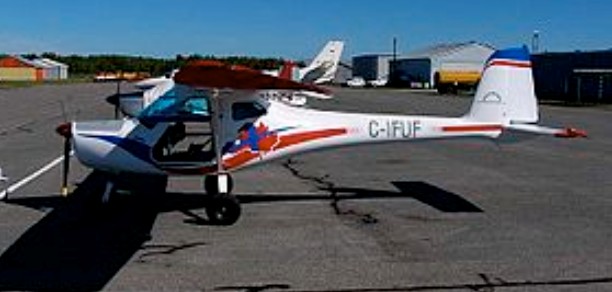
Krzysztof Wieczorek won the 16th FAI World Precision Flying Championship in 2004 and took the 3rd place in the 14th FAI World Rally Flying Championship in 2004 flying 3Xtrim aircraft. In the 17th FAI World Precision Flying Championship in 2006, 3Xtrim took the 1st (Krzysztof Wieczorek) and 3rd (Krzysztof Skrętowicz) places.
Specifications:
550 Trener
Engine: 1 × Rotax 912, 73.4 kW (98.6 hp)
Wingspan: 10.03 m (32 ft 11 in)
Length: 6.87 m (22 ft 6½ in)
Height: 2.40 m (7 ft 10¾ in)
Wing area: 12.40 sq.m (133.5 sq.ft)
Empty weight: 325 kg (717 lb)
Max. takeoff weight: 550 kg (1,212 lb)
Never exceed speed: 220 km/h (118 knots, 136 mph)
Cruise speed: 170 km/h (91 knots, 106 mph)
Stall speed: 70 km/h (38 knots, 44 mph)
Range: 750 km (405 nmi, 466 mi)
Service ceiling: 4,000 m (13,120 ft)
Rate of climb: 4.5 m/s (886 ft/min)
Crew: 1
Capacity: 1 passenger
3X55 Trainer
Engine: Rotax 912 ULS
Wing span: 9.60m / 31.5ft
Length: 6.87m / 22.5ft
Height: 2.4m / 7.9ft
Wing area: 11.84sq.m / 127.4sq.ft
Cabin width: 1.2m / 47.2in
Wing load: 46.5 kg/sq.m / 9.52lbs/sq.ft
Max. take-off weight: 550kg / 1212 lbs
Empty weight: 325 kg / 716lbs
Useful load: 225 kg / 496lbs
Fuel tank capacity std: 18.5Impg / 23.2 US gal
Never Exceed Speed (IAS) VNE: 109kts
Cruise speed max. cont. Power (IAS): 100kts
Cruise speed 75% power (IAS): 88kts
Stall speed (IAS) Vso: 39kts
Manoeuvering Speed (IAS) VA: 75kts
Maximum Flap Extended Speed (IAS) VFE full flaps: 62kts
Maximum Flap Extended Speed (IAS) VFE take-off flaps: 74kts
Maximum climb rate: 1000ft/min / 62kts IAS
Take-off distance 50ft obstacle: 918ft / 280m
Range: 388NM / 720km
3xtrim EOL-VLA
Former SZD sailplane engineer Adam Kurbiel designed the predecessor of 3X55, the EOL-VLA, to conform to European JAR-VLA rules. That plane was modified through the years to meet Canadian Advanced Ultralight and US Light Sport Aircraft rules. The 3X47 version is specifically for the European market to meet those standards.
3xtrim 450 Ultra / 3xtrim 495 Ultra Plus
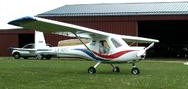
The 3Xtrim is a single-engine, two-seater monoplane with braced high wing, conventional controls and fixed three-wheel landing gear. The front-mounted engine is coupled to a two-blade or three-blade (depending on version) adjustable pulling propeller. A heated and ventilated cockpit with seats in one row and a large baggage compartment make the airplane comfortable, silent and well furbished. Doors are on each side, opening upwards, and are supported in this position by gas springs. Fixed three-wheel landing gear with castoring front wheel, composite main spring and hydraulic disc brakes, allows for safe take-off and landing on all types of airport surfaces, grass included. The Ballistic Rescue System (BRS5) provides protection for the passengers and aircraft at altitudes above 30 m and speeds up to 235 kmph (145 mph). The entire aircraft structure is fabricated from composites based on epoxy resin with glass and carbon fibre, reducing necessary maintenance work to pre-flight inspection and cleaning. The aircraft fully complies with the JAR-VLA requirements and has a Type Certificate of Very Light Airplane. Flight characteristics make this aircraft suitable for primary training, cross-country, and recreation. The aircraft is also suitable for patrol flights and aerial photography. A three-year manufacturer’s warranty is standard. The aircraft is manufactured in three versions: ULA – Ultra Light Aircraft; ULA – Advanced Ultra Light Aircraft; VLA – Very Light Aircraft.
The 450 Ultra and 495 Ultra Plus are sub-variants of the 3X47 Ultra, with gross weights adjusted for national ultralight regulations.
Stall: 34 kt / 39 mph / 63 kph
Cruise: 94 kt / 109 mph / 175 kph
Vne: 117 kt / 134 mph / 216 kph
Empty Weight: 265 kg / 584 lbs
MTOW: 450 kg / 992 lbs
Take-off dist (50ft): 740 ft / 225 m

