1995: R.R.#1, London, ONT N6A 4B5, Canada.
1997: 3645 Bostwick Rd. N. London, ON. N6P 1G9, Canada.
1995: R.R.#1, London, ONT N6A 4B5, Canada.
1997: 3645 Bostwick Rd. N. London, ON. N6P 1G9, Canada.
Albert C & Fred G Essig built one monoplane in 1928 described as “a typically German low-wing monoplane with a plywood wing, and a welded steel fuselage”.
A low wing two place monoplane with a full cantilever wing.
Engine: 125hp Siemens SH-14
Wingspan: 34’0″
Length: 26’0″
Useful load: 500 lb
Max speed: 125 mph
Cruise speed: 110 mph
Stall speed: 35 mph

The 1919 K-1 biplane was designed by Alexander Klemin (Professor of Aeronautical Engineering, NYU) and N W Dalton. The prototype had a Ford T motor. The K-1 featured four “self-aligning” I-struts and all-wood frame. The landing gear was fitted with a skid with the rear end turned down to act as a brake in landing.
Manufactured at the ACE Flying Field in New York City’s Central Park, it was one of the first planes to be built on an assembly line, primitive as it was. Final assembly and flight tested at Central Park (Bethpage) Flying Field. Its engine was built in Queens. The aircraft performed well for its day, it was fully aerobatic and sold for $2500, eight were built. One made the national press when it landed on Clay St in Oakland CA as a publicity stunt on 1 December 1920.

The 1920 version was modified with beefed-up struts, redesigned fuselage with enclosed motor, and folding wings. These sold for $3,000.

Circa 1920 the inventory and manufacturing rights to ACE K-1 were acquired by Horace Keane, (sales office) 280 Madison Ave, NYC, (plant) North Beach, Long Island NY. Photos of the plane appeared in some Keane ads.

In 1931 Ace produced two, with Salmson AD-9, N952Y c/n 1, and LeBlond 5D, N953Y c/n 2, registered as Ace 300 and 200 respectively. One located and restored in California 1955, N69097. A sole surviving example is in a museum.

Engine: Ford T / Keane “Acemotor”, 40hp / 30 kW
Wingspan: 28 ft 4 in / 8.64 m
Length: 19′ 2″
Weight: 600 lbs
Useful load: 225 lb
Max speed: 63 mph / 101 km/h / 55 kn
Cruise: 55 mph
Stall: 30 mph
Range: 160 mi / 139 nmi / 257 km
Seats: 1
1920 K-1
Engine: ACE Ford T, 40hp
Wingspan: 25’0″
Wingspan folded: 10’
Useful load: 235 lb
Max speed: 80 mph
Stall: 32 mph
Ace 200
Engine: LeBlond 5D
Registration N953Y
c/n 2
Ace 300
Engine: Salmson AD-9
Registration: N952Y
c/n 1

A tandem, two-seat kitbuilt, of composite construction. Only a prototype was produced before the company closed. Engine: Diamond, 105 hp.

Constructed entirely from Duralumin, the ACAZ C.2 was a two seat fighter reconnaissance aircraft.
All four wings were identical and interchangeable.
The C.2 was evaluated by the Aeronautique Militaire Belge in early 1926.
On 9 March 1928 an attempt was made to fly it to the Belgian Congo.
The aircraft was written off on 25 January 1933.
The design was not put into production.

Engine: 1 x Hispano-Suiza 12.Ga, 450 hp / 336 kW
Propeller: Levasseur-Reed metal
Wing span: 41 ft / 12.50m
Length: 27 ft / 8.25 m
Height: 11 ft 2 in / 3.40m
Wing area: 436.58 sq.ft / 40.56 sq.m
Empty weight: 2778 lb / 1260 kg
MTOW: 4563 lb / 2070 kg
Max level speed: 155 mph / 250 kph
Climb to 19,685 ft / 6000m: 35 min
Service ceiling; 24,606 ft / 7500m
Endurance: 3.5 hr
Armament: 1 x .303 Vickers mg & 2 x .303 Lewis mg
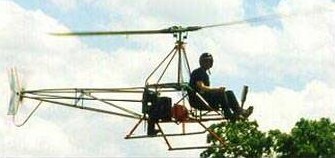
A single-seat open-frame helicopter, Doug Schwochert’s adaptation of the Adams-Wilson design included a re-designed main and tailrotor-swash plate and main frame. Plans include over 100 pages of CAD drawings and photos. The rotor blades are from A-B Helicopter, and are all aluminum extruded spar with full length aluminum skins bonded and riveted.
The A/W 95 features of true helicopter vertical take-off & landing, and forward, backward, sideward & hover flight, with standard helicopter-type control system.
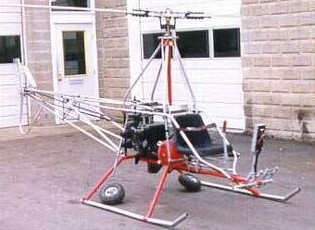
Improvements on the original Adams-Wilson design include a higher power-to-weight engine, improved, more durable swash plate and tail rotor system and updated airframe design. Now powered by a Rotax 503, the drive of the rear rotor has been redesigned and the rotor head reinforced to take extruded dural blades.
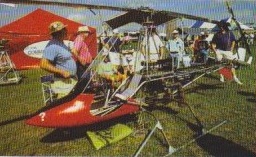
Now powered by a Rotax 503, the drive of the rear rotor has been redesigned and the rotor head reinforced to take extruded dural blades.
Engine: Rotax 503, 52 hp
Rotor span: 5.94 m
Blade area: 0.178 sq.m
MAUW: 222 kg
Empty weight: 120 kg
Cruise speed: 97 kph
Minimum speed: 0 kph
Fuel consumption: 15 lt/hr
Seats: 1
Plan price (1998): $79
Engines: 52 hp Rotax 503 or larger (2-cycle only)
HP range: 50-75
Engine rpm: 6200-6500
Rotor Diameter: 19 ft 5 in / 5.94m
Rotor blade chord: 7 in / 17.78cm
Airfoil: .0012
Main rotor rpm: 435-450
Tail rotor diameter: 3 ft 4 in / 102 cm
Tail rotor rpm: 2800
Min Speed: Hover
Cruise: 55-60 mph
Top Speed: 65 mph
Empty Weight: 272 lb / 123 kgs
Useful Load: 225 lbs / 102 kg
Gross Weight: 497 lb / 222 kg
Width: 5 ft 9 in / 175 cm
Height: 6 ft 5 in / 196 cm
Length: 15 ft / 4.57m
Fuel capacity: 5 USG
Endurance: 1 hr
Ceiling: 10,500 ft
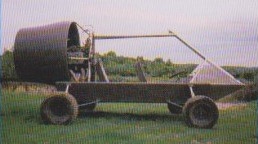
An all-terrain amphibious machine with a guarded prop, the Aerolight can fly with a paraglider or hang glider wing.
Empty weight: 300 kg
Wing span: 10 m
Wing area: 17 sq.m
Engine: Arrow 1000, 120 hp
MAUW: 500 kg
Seats: 2
Max speed: 120 kph
Cruise speed: 90 kph
Minimum speed: 65 kph
Climb rate: 5 m/s
Fuel consumption: 20 lt/hr
Price (1998): 480 000 Fttc
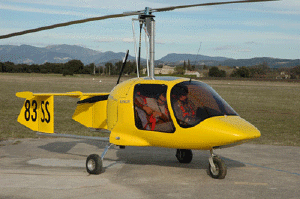
Xenon was designed by French aircraft designer Raphael Celier and was manufactured in Poland to the French Ultralight category standards. Celier Aviation established its reputation with the two-seat side-by-side configuration Celier Xenon 2 series of autogyros. By 2011 over 100 of these were flying.
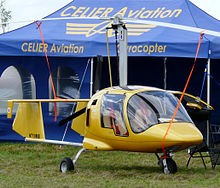
This high performance ultralight autogyro was available as a kit or ready to fly. Registered as an LSA.
Delivered fully factory built starting at $61,000 in 2009.
The composite structure is the airframe, providing lightness and incorporating a full roll cage to protect the occupants. The cabin is 10″ wider than a Cessna 172 and the two pilots are separated by a 10″ console and arm rest. Behind the seats is a very large luggage compartment. The Aircopter rotor blades are aluminum yet use titanium for strength and tip weighting for higher inertia. The DUC R propeller features a spoon blade with a wider tip and built in feathering. It is carbon forged under high pressure and a carbon fiber spinner is fitted.
The box tail section is directly in the propeller slipstream and is on a long lever arm for effectiveness with or without engine power. The 28″ high cabin is soundproofed, with interior carpeting and heated leather bucket seats, and the Xenon meets European noise standards.
The Xenon is available with a choice of 3 different engines. The standard model comes with a Rotax 912S Engine that delivers 100 horsepower. The 914 Model features a Rotax turbo that delivers 115 horsepower for up to 5 minutes after which the engine delivers a continuous 100 horsepower. The high altitude or extra climb ability model is the 912 RST version which has a Rotax 912 sporting a custom designed Mitsubishi turbo delivering 122 horsepower for take-off followed by a continuous 110 horsepower with full time turbo boost.
The doors are removable for flight, leaving a full wrap around optical windshield with overhead windows and foot well windows, allowing near unobstructed viewing. The instrument panel is shock mounted to be vibration free and includes full instrumentation for flight performance and engine monitoring. Flight instruments include: altimeter, airspeed indicator and vertical speed indicator. Rotor tach and fuel are separate gauges while graphic digital engine monitor uses colored LEDs to keep track of engine tach, CHT and EGT gauges, volt/amp meter, oil pressure and temperature, fuel flow, turbine temperature and manifold pressure. There is a 12 volt power plug for the portable GPS or MP3 player. Options include intercoms, VHF radio and transponder with altitude encoder.
The console arm rest puts the throttle and 280 rpm pre-rotator under one hand. Circuit breakers control the panel and landing lights and overhead heat vents are fitted.
Options vary depending on the model but your Xenon is available with propeller spinner, special metallic paint, cabin and blade covers, larger rotors, removable joystick, adjustable pedals, heated leather seats or a ballistic parachute.
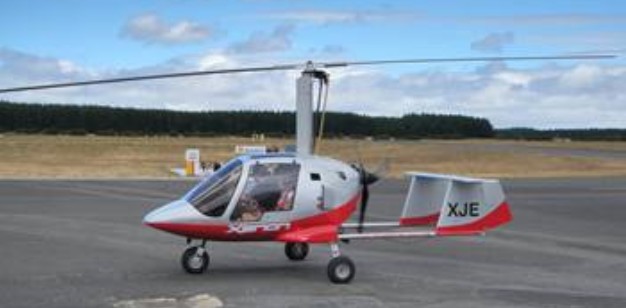
Engine: Rotax 912S, 100 hp
Propeller: 3 Blade DUC Windspoon 68.5 in
Max TO weight: 1,155 lbs.
Empty Weight: 583 lbs
Payload: 462 lbs
Rotor blades: Type 8H12 Aircopter Extruded Aluminum
Rotor Diameter: 27.55 ft
Dics Area: 596.1 sq. ft
Total Width: 86.6 in
Total Length: 192.9 in
Total Height: 110.23 in
Cabin Width: 49.2 in
Pre-rotator: Mechanical 280 RRPM
Wheel Diameter: 400×4
Vne: 108 kt / 124 mph / 200 kph
Minimum Speed: 19 mph
Cruise 75%: 75 mph
Max speed: 105 mph
Climb Rate: 600-1200 fpm
Glide Ratio: 3:1
Service Ceiling: 15,000 ft
Endurance: 4 hr + res
Take off Dist: 100-300 ft
Landing Dist: 15 ft
Fuel Capacity: 22 USG
Fuel Burn @ 65% pwr: 4.8 USGPH
Endurance: 4 hrs + res
Engine: Rotax 914, 115 hp
Empty Weight: 616 lbs
Propeller: 3 Blade DUC Windspoon 68.5 in
Max TO weight: 1,155 lbs.
Rotor blades: Type 8H12 Aircopter Extruded Aluminum
Payload: 484 lbs
Rotor Diameter: 27.55 ft
Dics Area: 596.1 sq. ft
Total Width: 86.6 in
Total Length: 192.9 in
Total Height: 110.23 in
Cabin Width: 49.2 in
Pre-rotator: Mechanical 280
Wheel Diameter: 400×4
Vne: 108 kt / 124 mph / 200 kph
Minimum Speed: 19 mph
Cruise 75%: 87 mph
Max speed: 115 mph
Climb Rate: 600-1200 fpm
Glide Ratio: 3:1
Service Ceiling: 15,000 ft
Endurance: 4 hr + res
Take off Dist: 100-300 ft
Landing Dist: 15 ft
Fuel Capacity: 22 USG
Fuel Burn @ 65% pwr: 4.8 USGPH
Endurance: 4 hrs + res
Engine: Rotax 912 RST, 122 hp
Empty Weight: 605 lbs
Propeller: 3 Blade DUC Windspoon 68.5 in
Max TO weight: 1,155 lbs.
Rotor blades: Type 8H12 Aircopter Extruded Aluminum
Payload: 550 lbs
Rotor Diameter: 27.55 ft
Dics Area: 596.1 sq. ft
Total Width: 86.6 in
Total Length: 192.9 in
Total Height: 110.23 in
Cabin Width: 49.2 in
Pre-rotator: Mechanical 280 RRPM
Wheel Diameter: 400×4
Vne: 108 kt / 124 mph / 200 kph
Minimum Speed: 19 mph
Cruise 75%: 99 mph
Max speed: 121 mph
Climb Rate: 600-1200 fpm
Glide Ratio: 3:1
Service Ceiling: 15,000 ft
Endurance: 4 hr + res
Take off Dist: 100-300 ft
Landing Dist: 15 ft
Fuel Capacity: 22 USG
Fuel Burn @ 65% pwr: 4.8 USGPH
Endurance: 4 hrs + res
A biplane built by Abric and Calas in 1909, in France.
Span: 36’1″ Weight: 1190 lbs gross
In 1927, Abrial built a two-seater airplane powered by a 40 hp engine, the A-3 “Oricou”.

