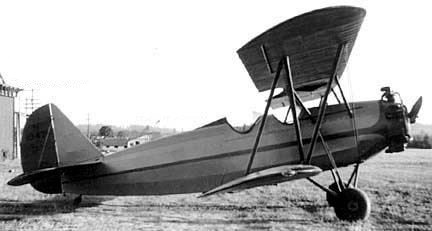
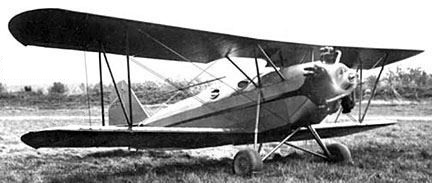
The 1931 Adcox Cloud Buster was a two place, enclosed monoplane, powered by a 40hp Salmson AD-9.
Only one was built, as a student project and registered NC10644.
The craft was repowered in 1936 with 65hp LeBlond.
This appears in some regs as a product of Bidwell-Yale Aviation Co. As the Adcox A-100, it was sold to Groat Aeronautical, who sold it to Shirley P Yale Air Service, who in turn sold it to William B Bidwell on 20 Agust 1931, at which time it was called Cloud Buster Junior. It then went through several other owners before being scrapped in 1938.
The Adaridi AD 3 was a wooden aircraft designed by Russian engineer Boris Adaridin, who lived in Finland. The sole manufactured Adaridi, ordered by the Finnish Air Force in 1923, is in a Finish museum.
An aircraft style spaceframe fuselage forms the basis of the Baffo 11, in which a low-mounted inline four cylinder BMW K 100 drives a prop through a long toothed belt.
Empty weight: 188 kg Wing span: 10 m Wing area: 15.5 sq.m Engine: BMW R 100 RS, 90 hp MAUW: 450 kg Seats: 2 Max speed: 140 kph Cruise speed: 110 kph Minimum speed: 55 kph Fuel consumption: 8 lt/hr
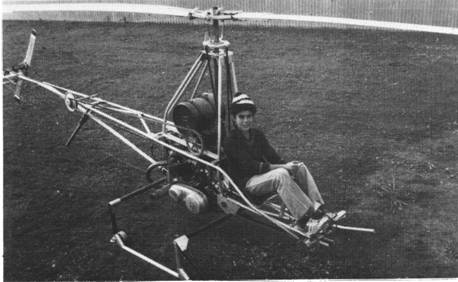
This company was formed by Mr. T.G.Adams and Mr. Paul Wilson to market plans the single-seat helicopter named the HobbyCopter, of which they have built a prototype, N23P, with a 34 hp engine. The company also supplies kits of parts for the Hobby-Copter sold as a kit to amateurs as the Model 101 Hobbycopter, offered in kit (US$900) or plan (US$35) The subsequent Model 102 had a strengthened structure, 50hp Triumph engine and fibreglass cockpit shell. First flown in November 1958, this single seat fully fledged helicopter was powered by a motor cycle engine, rubber mounted and fitting into the frame with no modifications – including starting procedures. Powered by a 40-46hp Triumph 650cc motorcycle engine, the engine, as in its original mount, is kick-started. Fuel is in a single tank above engine with a capacity of 11.4 litres. Oil capacity is 3.8 litres. When the run-up is complete and ready for takeoff, the pilot engages gear through the motorcycle gearbox — the power being transmitted through a one-way drive to the main rotors and by a vee-belt to the tail rotor. An open air machine, the helicopter utilises skids and features a 22 foot laminated spruce wooden main rotor of NACA 0012 aerofoil section (chord 0.20m) and a formed aluminium two ¬bladed tail rotor. Cyclic and collective pitch are controlled by a swash-plate. The rotor drive involves engine-to-gearbox by chain; gearbox-to-main rotor by direct shaft; gearbox-to-tail rotor by belt. The main rotor rpm in flight is 360, and tail rotor rpm in flight 1,800. The fuselage is all aluminium tube structure, bolted together, with tubular skids, with retractable ground-handling wheels. A single fiberglass bucket seat is ahead of the rotor drive shaft. The plans are all to aircraft specifications and the structure is bolted together. The main lift bearing is designed to take six tons.
XH-1 HobbyCopter Engine: 850cc Norton Main rotor dia: 22 ft / 6.55m Tail rotor dia: 0.94 m Fuselage length: 4.27 m Width: 1.52m Height: 1.83m Empty wt: 335 lb MAUW: 600 lb / 252kg Weight empty, equipped: 161kg Max speed: 72 mph / 96km/h Max cruise: 72km/h Econ cruising speed: 64km/h Service ceiling: 2440m Max range: 193km Fuel burn: 1.5 USG/hr Seats: 1