The George IV Royal Coronation Balloon rose from Green Park, London, on 19 July 1821; in this and subsequent balloons which Green designed between 1821 and 1854, he made altogether 524 ascents.
Balloon
Green, Charles
Charles Green (1785 1870) was one of the great showman of the balloon age. His George IV Royal Coronation Balloon rose from Green Park, London, on 19 July 1821; in this and subsequent balloons which he designed between 1821 and 1854, he made altogether 524 ascents.
Goodyear Explorer II
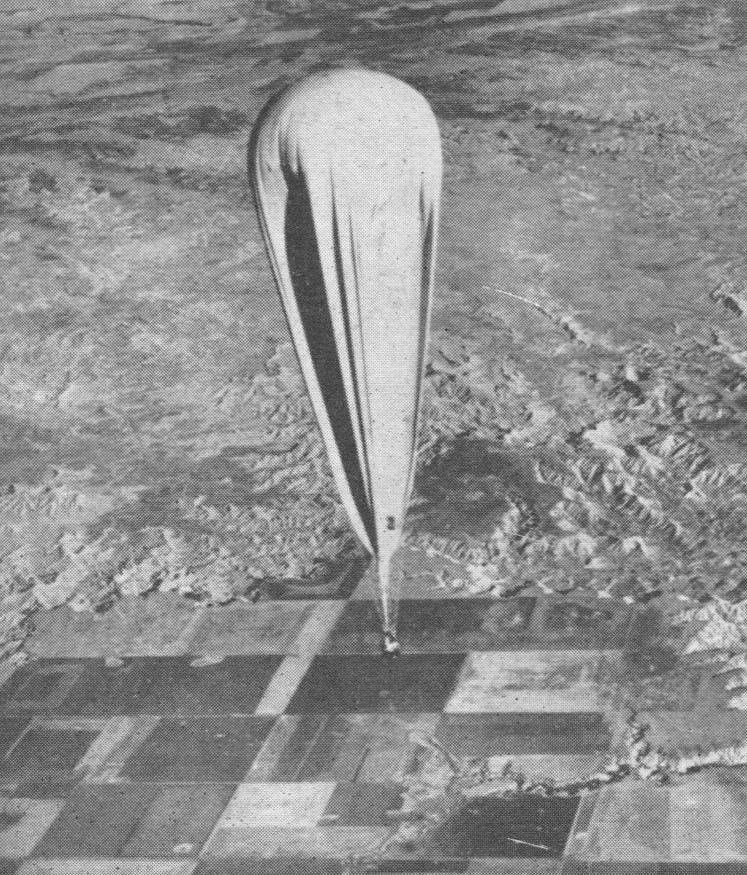
The crash of Explorer I resulted in a national embarrassment, leading Captain Albert W. Stevens, the scientific observer on board the Explorer balloon, to lobby for another attempt with an improved balloon to be named Explorer II. But news of the fatal crash of a Russian stratospheric attempt in 1934 left President Gilbert H. Grosvenor of the NGS sobered by the risk. A review of the crash by the National Bureau of Standards (NBS) was held between July and September, revealing that the balloon had not opened symmetrically during the ascent, causing stresses that led to the fabric tears. A month-long delay prior to launch had allowed the rubberized cotton to stick together, which created the uneven expansion. The hydrogen explosion followed when the gas in the bag mixed with the oxygen in the atmosphere.
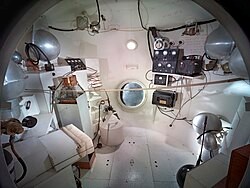
Despite the concerns, in 1935 the NGS and Army Air Corps decided to make another attempt. To eliminate the hazard of the hydrogen lifting gas, it was decided instead to use helium—to which the United States had a monopoly. The lower lifting efficiency of helium gas meant that a larger balloon would be needed, so Goodyear-Zeppelin increased the volume to 100,000 cu.m (3,700,000 cu ft). Dow Chemical Company assembled a larger, lighter gondola made of “Dowmetal”—a magnesium-aluminium alloy—that would carry a two-man crew with a reduced amount of scientific instrumentation. The cabin was 2.7 m (9 ft) in diameter with a mass of 290 kg (640 lb) and could transport a 680 kg (1,500 lb) payload. It was manufactured from a single, large plate that was cut up into form that could be reshaped and welded into a sphere. In order to make crew escape easier, the portholes were made wider than on the Explorer I. The atmosphere in the interior of the capsule was supplied from liquid air instead of liquid oxygen in order to reduce the fire hazard. The modified balloon was ready by the spring of 1935 and the first launch occurred July 10, 1935. Unfortunately, this too proved a failure with the balloon rupturing at liftoff.
Following a review by the NBS, the balloon was prepared for another attempt after Goodyear strengthened the material. Examination of climatological data for the Stratobowl collected over the previous fifteen years was examined, and it was determined that the month of October typically had periods of good weather that would last sufficiently long for a flight attempt. A team of meteorologists was assembled at the Stratobowl in early September and they proceeded to put together a weather station. The meteorological requirements for the launch was for clear skies—with no precipitation—lasting for the duration of the flight, as well as surface wind speeds that were not to exceed 23 km/h (14 mph).
With a cold front approaching, on the night of November 10, 1935, the balloon was prepared for launch. The temperature dropped to −14 °C (6 °F) overnight, so the 10,762.4 m2 (115,845 sq ft) of fabric was kept warm and pliable through the use of stoves. The task of inflating the balloon with helium from the 1,685 steel cylinders took eight hours, during which the team needed to repair a 5.2 m (17 ft) long tear that formed in the fabric. Once inflated, the balloon stood 96 m (316 ft) tall. The gondola was kept anchored to the earth by a team of more than 100 soldiers holding cables. Preparations were complete by 7:01 am the following morning and the conditions were deemed suitable for a launch.
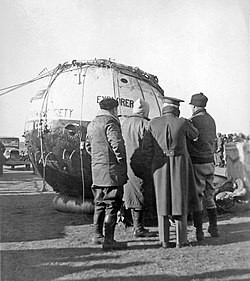
The crew of the Explorer II consisted of Captain Albert W. Stevens, in command of the mission, and Captain Orvil A. Anderson. A crowd of around 20,000 viewers gathered to watch the event. (The local residents had raised and contributed $13,000 for the mission.) Lift-off occurred at precisely 8:00 am with the release of 34 kg (75 lb) of ballast made of fine lead shot. A few moments after liftoff, wind shear propelled the balloon into a side canyon, but thereafter it ascended normally.
The Explorer II reached a peak altitude of 22,066 m (72,395 ft) at 12:30 pm and remained there for 80 minutes. This set a new world altitude record, and one that would last for nearly two decades. The crew became the first humans to document the curvature of the Earth. Unfortunately, the fan that was to be used to rotate the gondola proved ineffective at that altitude, so they were unable to avoid the Sun’s glare. This made viewing from one side of the capsule nearly useless. Despite this, Captain Stevens reported seeing details of the Earth’s surface for hundreds of miles. They were too high up to be able to view any movement on the ground, but their photography showed the potential of high-altitude reconnaissance balloons.
Explorer II included communications equipment, and constant radio contact was maintained throughout the flight with the signal being broadcast across the U.S. and in Europe. The onboard instruments collected data on cosmic rays, the ozone distribution and electrical conductivity of the atmosphere at different altitudes, the atmospheric composition of the stratosphere, and the luminosity of the Sun, Moon and Earth. In addition, microorganisms were collected from the stratosphere. Mold samples were carried along to determine the effects of cosmic ray exposure. Stevens took along a camera to take pictures, including the first ever motion pictures shot from the stratosphere. The collected data showed that the ozone in the upper atmosphere was effective at blocking most of the ultraviolet radiation from the Sun. It was also found that the percentage of oxygen at the peak altitude was about the same as that at sea level.
Finally, the descent was begun and it proceeded normally. At an altitude of 300 m (1,000 ft), the crew began releasing scientific instruments that would descend by their own parachutes. This was done to protect the data in case the gondola had a rough landing. The precautions proved unnecessary as the balloon landed gently in an open field near the town of White Lake, South Dakota at 4:13 pm.
Goodyear Explorer I
In January 1934, the National Geographic Society (NGS) and the U.S. Army Air Corps decided to collaborate on a program to build and launch a manned balloon to the then record altitude of 24 km (15 mi). This vehicle would be capable of carrying a crew of three in an airtight capsule, along with a laboratory of instruments. The hydrogen balloon, named Explorer, was completed by July at a cost of around $60,000; equivalent to $1,410,299 in 2024 currency.
The balloon was launched from a canyon in the Black Hills of South Dakota—dubbed the Stratobowl—on July 28, 1934 and reached a near-record altitude of 18,475 m (60,613 ft) before tears in the fabric led the crew to begin reducing their altitude. A rupture in the balloon resulted in a precipitous descent, followed by a spark that caused the hydrogen to ignite and destroy what was left of the balloon, leaving the capsule to plummet toward the ground at terminal velocity. The crew just managed to escape using their parachutes, with the last man bailing out at 500 feet (150 m) above the ground. Their capsule was almost completely destroyed upon impact.
The crash resulted in a national embarrassment, leading Captain Albert W. Stevens, the scientific observer on board the Explorer balloon, to lobby for another attempt with an improved balloon to be named Explorer II.
Glidden and Stevens Boston
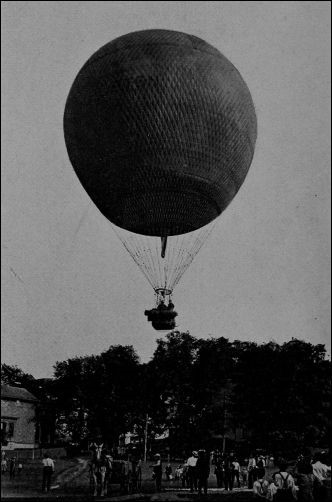
On 19 June 1908 the balloon Boston made its initial flight, landing shortly after 7pm on a mountain between Putney, VT., and Dammerston, VT., near the Vermont-New Hampshire boundary line.
The start of the trip was made a little after 4pm. In order to avoid electric light wires, it was necessary to unload about 60 lb of ballast just after starting.
The thermometer registered 103 degrees in the sun, and the wind blew in puffs, at a varying rate of from 25 to 40 mph. The puffs of wind and changing directions of the various air currents encountered frequently caused the balloon to revolve. The highest elevation reached was 6100 ft.
While passing over the northeast Brattleboro, VT., the gas bag was struck by two rifle bullets. The bullets glanced off without penetrating the silk covering but the course of the bullets was indicated plainly by two dark coloured streaks across the silken covering.
The landing was made in a pasture on top of a mountain 2000 ft high, and the descent was from an elevation of more than 2000 ft.
Charles J. Glidden of Boston, owner of the balloon, and Leo Stevens had an exciting trip. In addition to being the target for rifle bullets during the flight, Glidden and Stevens landed in a pasture where a young bull was confined. The animal charged the aeronauts after they had stepped from the basket and they were forced to run and scramble over a barbed wire fence. Both aeronauts stated that all things considered, it was the most thrilling balloon trip either of them had undertaken.
The pair made the farmhouse of W.W.Burnett just before midnight. The next day preparing to ship the balloon to Steven’s factory for repairs.
Giffard Le Grand
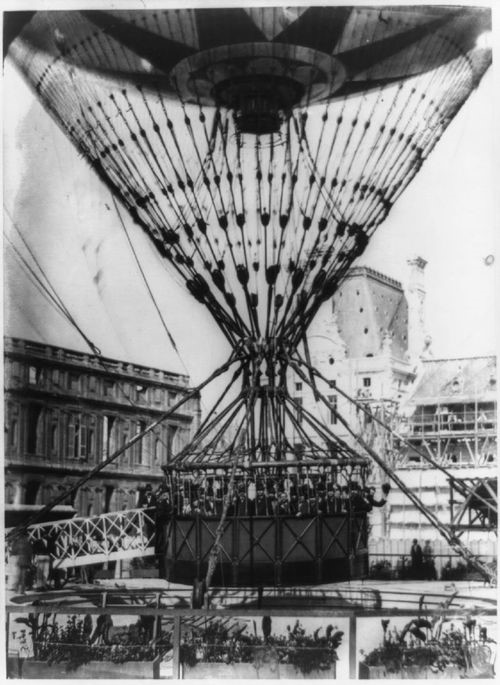
A captive balloon of 25,000 m³ built for the Universal Exhibition of Paris of 1878, Le Grand ballon captif à vapeur (The Large Steam Tethered Balloon) of Henry Giffard was capable of carrying 40 passengers.
Located at the courtyard of the Tuileries in Paris, it was one of the main attractions of the exhibition, making up to ten ascents per day to an altitude of 500-600 m. Using mechanical winches, its first ascent took place on July 19, 1878 and would eventually lift over 35,000 passengers on more than 1000 ascensions made.
Fossett Solo Spirit
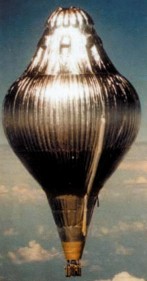
Steve Fossett floating at 25,000ft at an average speed of 38km/hr was on his sixth attempt to fly solo round the world by balloon. The flight started from Perth, Australia, in his craft, Solo Spirit.
Forlanini / Società Leonardo da Vinci Forlanini
Enrico Forlanini was born to Francesco Forlanini, a physician and director of the Ospedale Fatebenefratelli in Milan. After elementary school he attended one of the three Milan Regie Scuole Tecniche, in 1863 he entered the Military College of Turin.
In 1866 he enrolled at the Military Academy of Turin, and become a Lieutenant of Engineers. Enrico enrolled in the Scuola di Applicazione Artiglieria e Genio (Application School of Artillery and Engineers) in Turin in 1868.
Upon graduation in 1870, he was assigned to Casale Monferrato, where he was able to work in the police station’s workshop. He began working on a systematic testing of propellers. He subsequently studied at Politecnico di Milano and graduated in Industrial Engineering.
In 1877, he developed an early helicopter powered by a steam engine. It was the first of its type that rose to a height of 13 meters, where it remained for some 20 seconds, after a vertical take-off from a park in Milan.
Later he designed and built a series of dirigibles, notably, designed in 1901 and launched in 1909, the Leonardo da Vinci that he dedicated to the Renaissance inventor and, in 1912, the Città di Milano, dedicated to his beloved home town. The latter showed exceptionally good characteristics of stability and controllability that won Forlanini international renown. A further four airships were constructed: F3, F4, F5 and F6. A seventh, named Omnia Dir was only completed after his death in 1930.
Flores 1840 Balloon
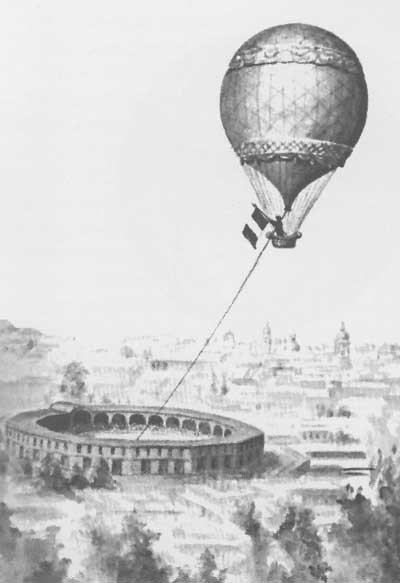
Jose Maria Flores, (also Florez, 1820?–1848), was an obscure 19th century balloonist who made first ascensions in many South American countries, including Chile, Peru, Ecuador and Colombia, as well as being a pioneer aeronaut in Guatemala and Mexico – although ironically, he never flew in his native Argentina.
The first balloon ascension made in Peru, which took place in Lima on September 24, 1840 at the Plaza de toros de Acho, the oldest bullfighting arena in the Americas. Still standing today, its construction dates back to 1766. Flores died accidentally during an ascension on January 30, 1848.
Fisher Stoddard-Dayton
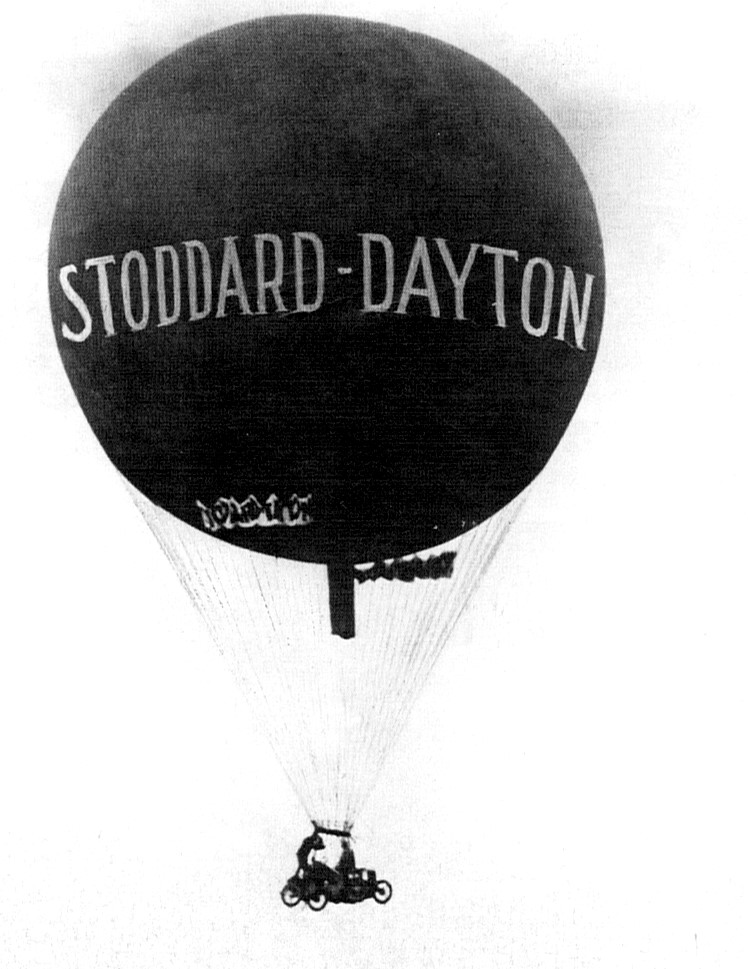
Carl Fisher was the owner of the first American automobile dealership in Indianapolis; he is seen here piloting a balloon over the city’s downtown area with a Stoddard-Dayton motorcar suspended beneath it. Unbeknown to people on the ground, to save weight the car was without an engine, but, on landing, Fisher drove a similar car back to town claiming that it was the one seen in the air. He then ran an advertising campaign claiming, ‘The
Stoddard-Dayton was the first automobile to fly over Indianapolis. It should be your first automobile too’.
 All Aero