Grahame-White Lizzie / Tea-tray

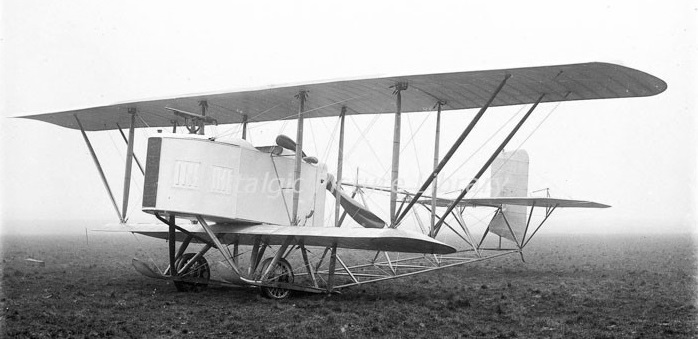
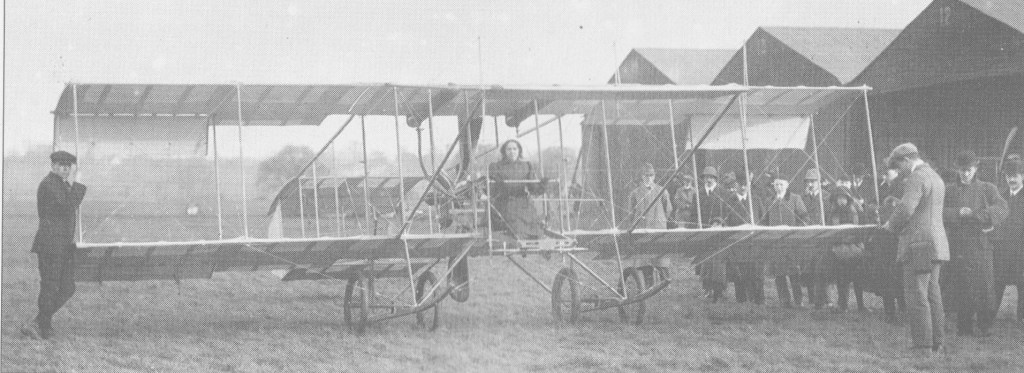
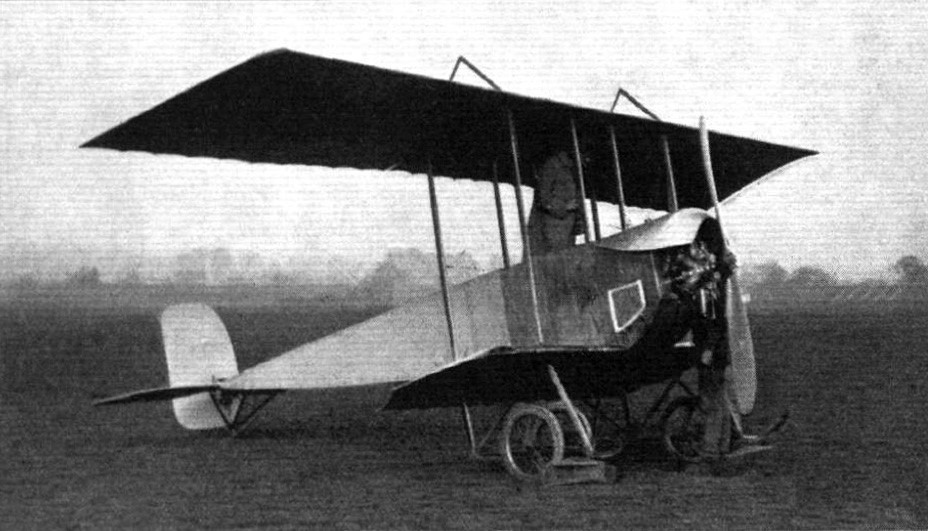
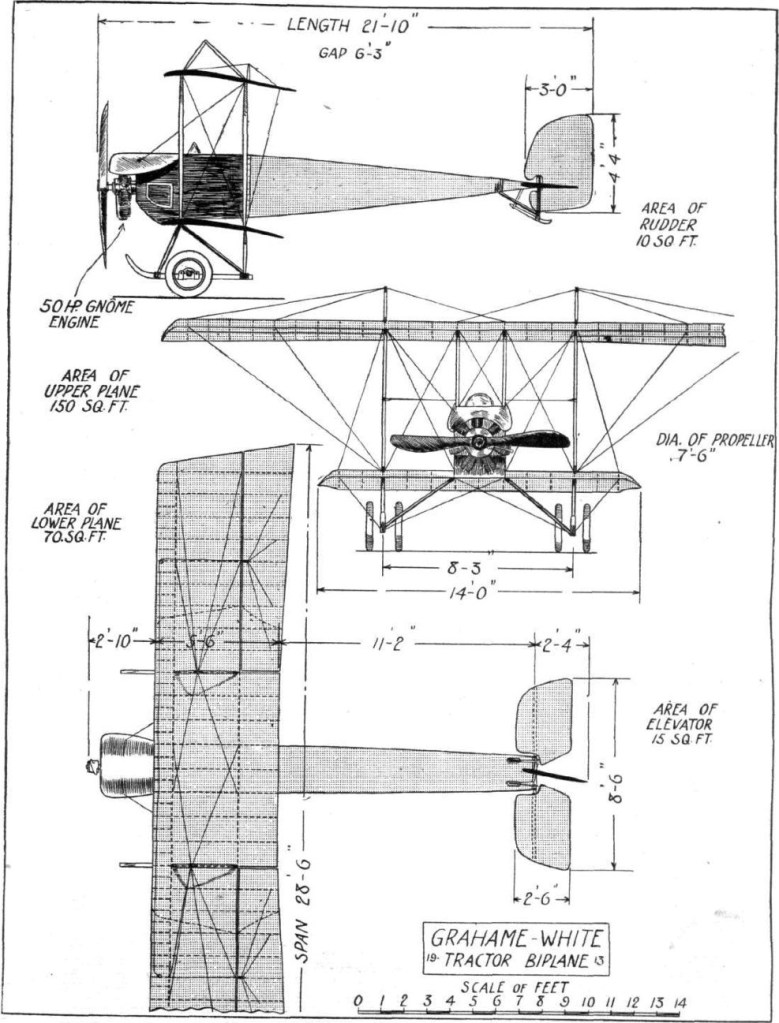
The 50-h.p. Grahame-White tractor biplane, “Lizzie” at Hendon, London, UK.

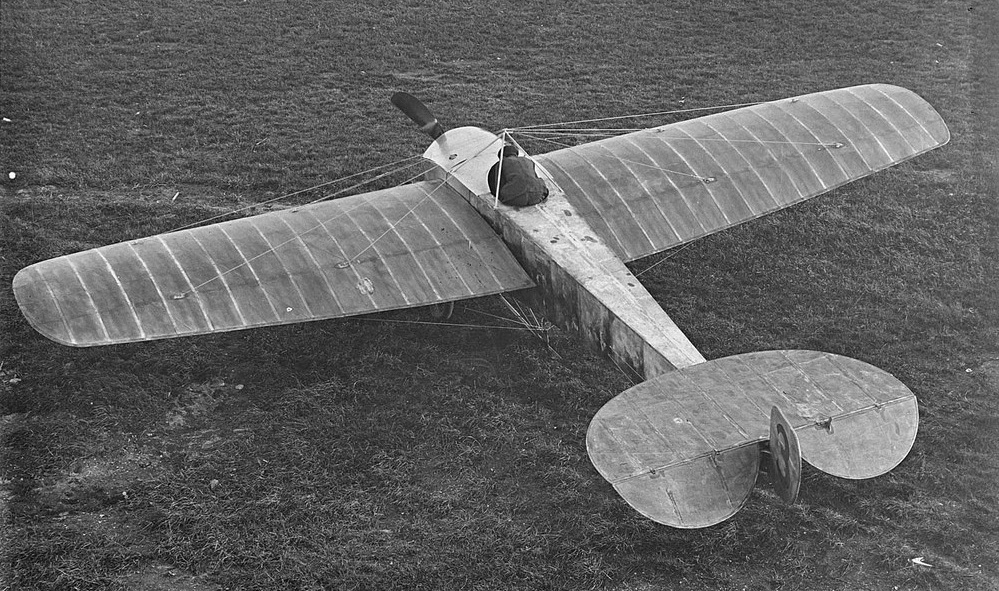
The Grahame-White Lizzie was a 1913 Sesqiplane tractor aircraft mating the wings of a Popular built on a Morane-Saulnier fuselage. Also known as the Tea-tray
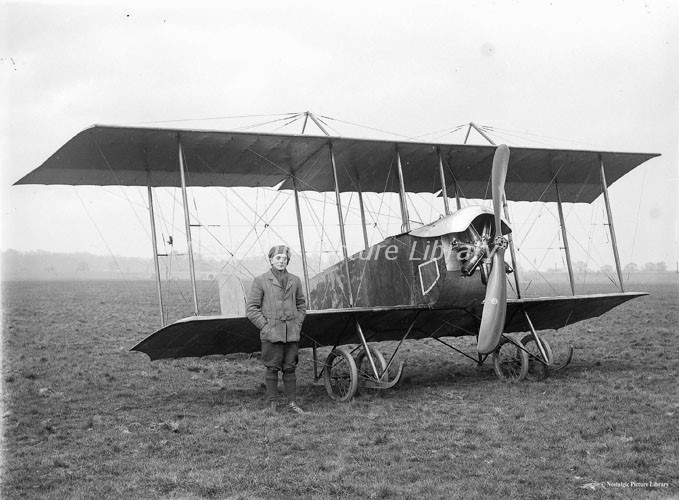
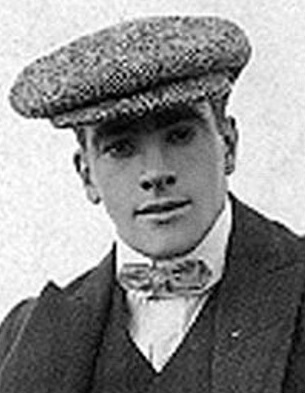
R Carr at Hendon c 1913

Recognized by its very short lower wings, but a modified version appeared in 1914 with two bay wings, giving it a more “conventional” look.
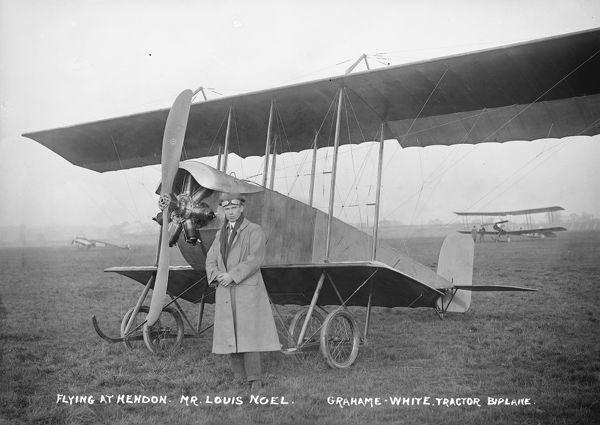
Louis Noel flying at Hendon and his Graham White tractor biplane 18 June 1921

A new, hopeful aviator purchased a veteran plane, a 50-h.p. Grahame-White tractor biplane that carried the moniker, “Lizzie”, at Hendon, near London. The year was 1914, and his intention was to teach himself to fly. His name was Mr. Charles Walter Graham, the son of Mr. C. K. Graham of 9, Kitson Road, Barnes, Southwest London, England.
Soon Mr. Charles W. Graham was out on the field taxiing around to get familiar with the handling of the biplane, no doubt intending to remain on the ground. “Lizzie”, however, had other ideas, as related in the November 27, 1914, issue of Flight, the newsletter of England’s Royal Aero Club:
It appears that a certain enthusiast has bought “Lizzie” with the object of teaching himself to fly, and that last Saturday was to be the dress rehearsal.
Starting off from the corner at the top of the ex-half-crown enclosure, a very neat straight roll was accomplished in the direction of No. 4 pylon, with the tail well up. After some prancing about on the bad ground out by No. 4, “Lizzie” was persuaded to turn back in to the wind, and before anybody had realised what was happening, she shot up in the air at an angle of about 450, the pilot switching on and off all the while. By some kind whim of fate, which the newspaper correspondents would probably have described as superhuman efforts, “Lizzie” just managed to avoid a tail slide, and proceeded on a comparatively even keel towards No. 1 pylon, whisking her tail from side to side in the friskiest of ways. The pilot evidently considered this the moment appropriate for coming down, a performance which he seemed likely to accomplish in quite good style, for he descended in a pretty good glide switching on and off, but unfortunately he spoilt it at the last moment by not flattening out sufficiently and by keeping his engine running all out after touching the ground. The result was that “Lizzie” took matters into her own hands and did a loop the wrong way round, finishing on her back, whilst the pilot was seen to drop out of his seat on to the top plane. He was up again in a second, however, waving his hands to show the anxious onlookers that he was none the worse for his “spill.” As a fact, the only damage done was a broken propeller and a bent shaft. It is to be hoped that “Lizzie” will soon be out of hospital again, since her owner is evidently made of the right stuff, and should, with a little patience, turn out a good pilot. Most initiates would certainly have made a worse job of it than he did.
On Christmas Day in 1914, Flight carried yet one more mention of “Lizzie” and Mr. C. W. Graham, who was attending a flight school at that point, having abandoned the idea of teaching himself:
At the Hall school several new machines will be put into commission shortly, among others a two-seater biplane that will have dual controls. This firm has been repairing “Lizzie,” after her little spill recently, and she is now almost ready to take the air again, and looks as well as ever. While awaiting her return from “hospital,” “Lizzie’s” owner is getting a little preliminary experience on the dual-control two-seater Caudron biplane of the Ruffy school, so as to get used to the handling before taking “Lizzie” out again.

Gallery

Span top: 28’6″
Span bottom: 14″
Length: 21’10”
AUW: 850 lb
Speed: 65 mph
Grahame-White Type VII Popular

The Graham-White Type VII “Popular” designed by J. D. North was built with the intention of producing a low-cost aircraft to popularize aviation.

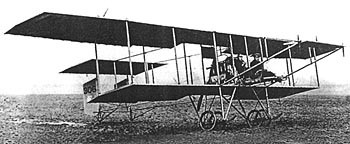
The aircraft was a pusher biplane with a square section nacelle mounted between the upper and lower wings, which were of two-spar construction, the spars being ash I-sections. To maintain the leading edge section there were half-ribs between each rib, these extending from the leading edge to the main spar. A single horizontal tailplane with a split elevator and a rudder divided into two part, half above and half below the tailplane, were carried on ash booms behind the wing, the booms being connected by hollow wooden vertical struts and tubular steel horizontal members. The booms were spindled to an I-section except at the points of attachment of the cross-members. The upper wing was double the span of the lower and had wide-span ailerons occupying the whole trailing edge outboard of the tail booms. The wings were connected by a single pair of struts on either side, the outer section of the upper wing being braced by wires leading to inverted-V kingposts. The wide-track undercarriage consisted of a pair of long laminated wood skids each bearing pair of wheels on a short axle. No tailskid was fitted.

First flown in 1913, it was initially produced with a 35 hp Anzani 3-cylinder Y configuration engine and offered for sale at a price of less than £400. The Type VII was built in both single and two seat versions and some were fitted with the 50 hp (37 kW) Gnome Omega engine, which would have increased the price considerably as well as improving performance, since this engine cost around £500.

Two very different versions of the Popular were marketed: a single-seater and a two-seat model (though the latter was apparently not built).

In March 1913, the British War Office, in an attempt to boost the numerical strength of the Royal Flying Corps announced the purchase of seven aircraft from the Grahame-White company, including two Type VII Populars and one two-seat VIIc Popular Passenger Biplane (which despite the name was unrelated to the single-seat Type VII). Although the purchase of two of the single-seat type VIIs was announced, it appears that only one was taken on charge. While allocated the serial number 283, the aircraft saw little if any use by the RFC.

Engine: 1 × Anzani 3-cylinder, 35 hp (26 kW)
Propeller: 2-bladed wooden propeller
Upper wingspan: 28 ft (8.5 m)
Lower wingspan: 14 ft (4.3 m)
Wing area: 205 sq ft (19.0 m2)
Airfoil: Eiffel 13 bis
Length: 23 ft 6 in (7.16 m)
Gross weight: 600 lb (272 kg)
Maximum speed: 50 mph (80 km/h; 43 kn)
Endurance: 4 hours
Crew: 1
Capacity: 1

Grahame-White Type VI

Hendon c 1913

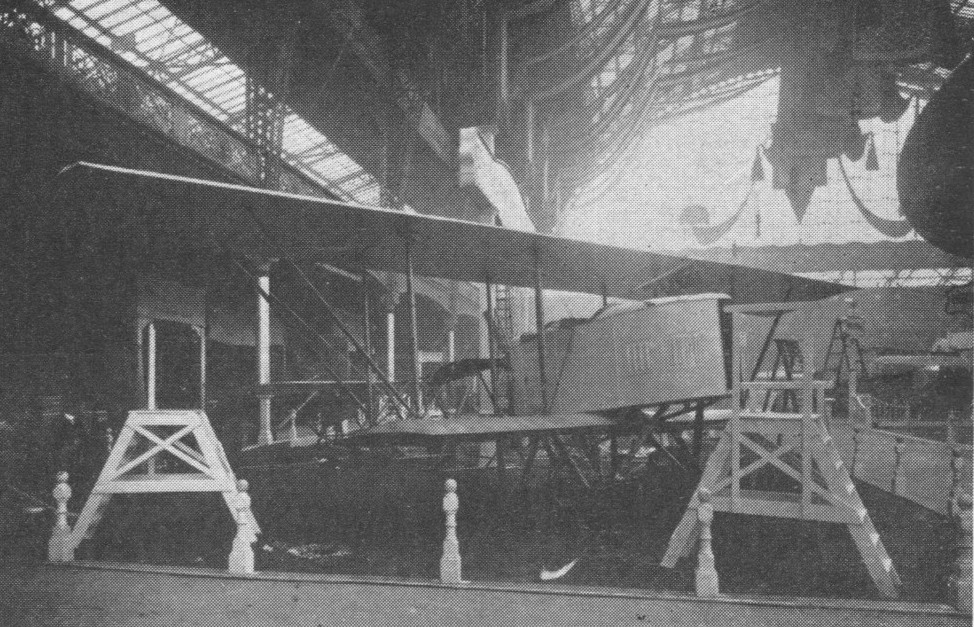
Designed by J.D. North, the Grahame-White Type VI was a pusher configuration unequal-span biplane. The tail surfaces were carried on three steel tube booms, with the single upper boom passing through the propeller shaft and the lower pair to the rear of the undercarriage. The propeller was driven by a large-diameter tubular driveshaft and a duplex chain, the propeller being mounted at the top of the rear of the nacelle. There were no centre-section cabane struts, the upper wing being supported solely by the interplane struts. The engine was mounted at the front of the rectangular section nacelle behind a specially made curved radiator. The two crew members were seated either side, the pilot seated behind them.

The control wires for the tail surfaces were carried inside the upper boom, an arrangement credited to Horatio Barber, for whose Aeronautical Syndicate Ltd North had worked. The aircraft was armed with a Colt .30-calibre machine gun on a flexible mounting at the front of the nacelle.

First type to officially carry a number in catalogues and publications of the time.

While it was originally intended to be powered by a 120 hp (89 kW) Austro-Daimler 6 cylinder inline, it was shown at the 1913 Olympia Aero Exhibition fitted temporarily with a 90 hp (67 kW) Austro-Daimler instead.
Only one attempt was made to fly the Type VI. The underpowered aircraft only just managed to clear the hedge at the boundary of the airfield, and made a forced landing in the next field. North went on to design a broadly similar aircraft with a more conventional four-boom mounting for the tail surfaces, the Grahame-White Type XI.

Engine: 1 × Austro-Daimler 6-cyl., 90 hp (67 kW)
Propeller: 2-bladed Chauvière, 10 ft (3.0 m) diameter
Upper wingspan: 42 ft 6 in (12.95 m)
Lower wingspan: 23 ft 0 in (7.01 m)
Wing area: 390 sq ft (36 m2)
Airfoil: Eiffel plane No. 8
Length: 33 ft 9 in (10.29 m)
Empty weight: 2,200 lb (998 kg)
Gross weight: 2,950 lb (1,338 kg)
Maximum speed: 70 mph (113 km/h; 61 kn) at sea level
Endurance: 2¾ hours
Crew: 3
Armament: 1 Colt .30-calibre machine gun on flexible mounting

Grahame-White New Baby

Mrs J.V.Martin at Hendon April 1911

The 1911 New Baby was developed from the Baby and built by Grahame-White. Contrary to the Baby, it had no rigid enclosure.

Both the Baby and New Baby appeared on the racing circuit at the same time, being variously piloted by Grahame-White or other pilots.
The New Baby was later modified with a single rudder that was split on either side of the elevator.

Grahame-White Baby / Burgess Model E

The Grahame White Baby was a single-seat biplane pusher, of the then orthodox “Farman” layout, with a frontal elevator and a rear-mounted empennage consisting of a biplane horizontal stabilisers with single elevator mounted on the top surface and a single central rudder. As the name suggests, it was considerably smaller than most contemporary aircraft of a similar layout, having a wingspan of only 27 ft (8.2 m). In comparison, the wingspan of a standard Bristol Boxkite was 34 ft 6 in (10.5 m). An unusual feature of the aircraft was the mounting for the 50 hp (37 kW) Gnome rotary engine, which was mounted on a pair of angled beams so that the engine was midway between the upper and lower wings.

It was built by Burgess to Grahame-White’s order and never produced in the United States. The Burgess Company in the United States purchased a licence to build it as the Model E.

First flying in 1911, about six were built in total.

Engine: 1 × Gnome, 50 hp (37 kW)
Wingspan: 27 ft 1 in (8.25 m)
Length: 31 ft 9 in (9.68 m)
Height: 8 ft 6 in (2.59 m)
Gross weight: 655 lb
Maximum speed: 55 mph
Endurance: 4 hours
Capacity: 1

Burgess E Baby
Span: 36’10”
Length: 31’8″
Seats: 1-2

Grahame-White

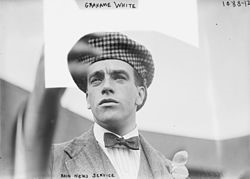
Claude Grahame-White (1879 – 1959)

Grahame-White was born in Bursledon, Hampshire in England on 21 August 1879, and educated at Bedford Grammar School. He learned to drive in 1895, was apprenticed as an engineer and later started his own motor engineering company.

Grahame-White Article

Grahame-White’s interest in aviation was sparked by Louis Blériot’s crossing of the English Channel in 1909. This prompted him to go to France, where he attended the Reims aviation meeting, at which he met Blériot and subsequently enrolled at his flying school.

Founded by Claude Grahame-White in 1909, the company began operations with flying school at Pau, France.

Grahame-White was one of the first people to qualify as pilot in England, becoming the holder of Royal Aero Club certificate No. 6, awarded in April 1910. He became a celebrity in England in April 1910 when he competed with the French pilot Louis Paulhan for the £10,000 prize offered by the Daily Mail newspaper for the first flight between London and Manchester in under 24 hours. Although Paulhan won the prize, Grahame White’s achievement was widely praised.

On 2 July 1910, Claude Grahame-White, in his Farman III biplane, won the £1,000 first prize for Aggregate Duration in Flight (1 hr 23 min 20 secs) at the Midlands Aviation Meeting at Wolverhampton. In the same year he won the Gordon Bennett Aviation Cup race in Belmont Park, Long Island, New York, for which he was awarded the Gold Medal of the Royal Aero Club.

On 14 October 1910 while in Washington, D.C. Grahame-White flew his Farman biplane over the city and landed on West Executive Avenue near the White House. Rather than being arrested Grahame-White was applauded for the feat by the newspapers.

Claude Grahame-White in 1910

He is known for activities related to the commercialisation of aviation, and he was also involved in promoting the military application of air power before the First World War with a campaign called “Wake Up Britain”, also experimenting with fitting various weapons and bombs to aircraft. During the war itself he flew the first night patrol mission against an expected German raid on 5 September 1914.

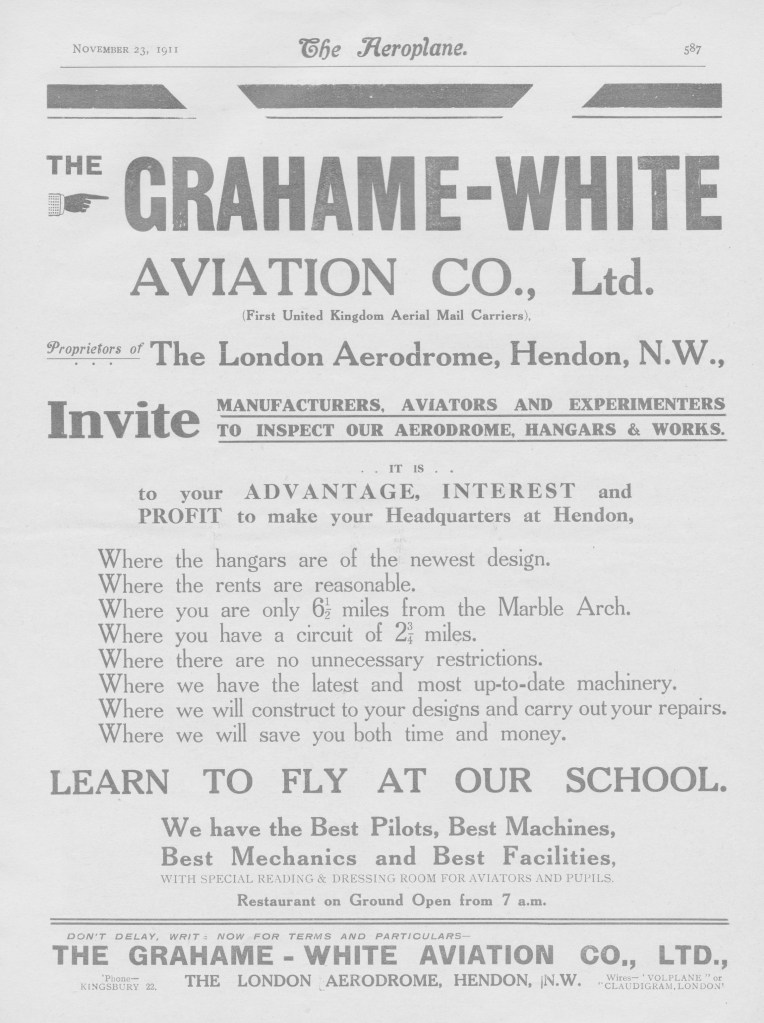
Moved to England, acquired Hendon Aerodrome in 1911 and built factory. One of the designers, John Dudley North, became Boulton & Paul’s chief designer. In 1911 he established a flying school at Hendon Aerodrome. By now White had made a fortune and he invested it in 220 acres of pasture at Hendon, turning it into London’s first aerodrome. For 3 years up to the outbreak of WW1 the weekend flying displays there were the greatest attraction in London and the aircraft he designed, which were Boxkite, formed the backbone of his Flying School. They were also used for the first demonstration of aerial bombing, straffing and pioneering night flying.

In 1912 Grahame-White gave H.G. Wells his first flight.

Acquired agency in 1913 for Morane-Saulnier monoplanes and built these for War Office. Also built own design pusher biplane in 1914, adopted by Admiralty as standard school machine. On the outbreak of WWI Grahame-White joined the Royal Naval Air Service and took part in attacks on German held ports before resigning to manage his business, whose staff had increased from 20 to 1000 due to war contracts. The Aerodrome was lent to the Admiralty (1916), and eventually taken over by the RAF in 1919.

Three-engine Ganymede bomber of 1918 had two tractor and one pusher propeller with twin fuselages.

Grahame-White was out of favour by the end of the war and was forced to go to France looking for contracts. Company stopped producing aircraft in 1919.

Grahame-White was a co-founder of Aerofilms Limited in 1919.

Eventually he became so disillusioned by Britain that he sold Hendon to the Air Ministry and immigrated to California where he was a realtor. In 1959 he died in Nice on his 80th birthday.

Publications
As well as his success in aviation, Claude Grahame-White was a published author whose works include:
The Story of the Aeroplane
The Aeroplane, Past, Present, and Future, 1911
The Aeroplane in War
Aviation, 1912
Learning to Fly, 1914
Aircraft in the Great War, 1915
Air Power, 1917
Our First Airways, their Organisation, Equipment, and Finance, 1918
Books for Boys
Heroes of the Air
With the Airmen
The Air King’s Treasure
The Invisible War-Plane
Heroes of the Flying Corps Flying, an Epitome and a Forecast, 1930
He also contributed to newspapers, reviews, and magazines, dealing with aeronautics in the military and commercial fields.

Grahame-White’s aerodrome was purchased by the RAF in 1925, after a protracted legal struggle. After this he lost his interest in aviation, eventually moving to Nice in his old age, where he died on 19 August 1959 (aged 79) having made a fortune in property development in the UK and US.

White had been married twice, to Dorothy Caldwell Taylor (1912, dissolved 1916), and Ethel Levey (1916).

Hendon Aerodrome later became RAF Hendon but after flying ceased there in the 1960s it was then largely redeveloped as a housing estate which was named Grahame Park in tribute to Grahame-White. An original World War I Grahame-White aircraft factory hangar was relocated a few years ago to the Royal Air Force Museum London, where it houses the museum’s World War I collection and is named the Grahame White Factory.