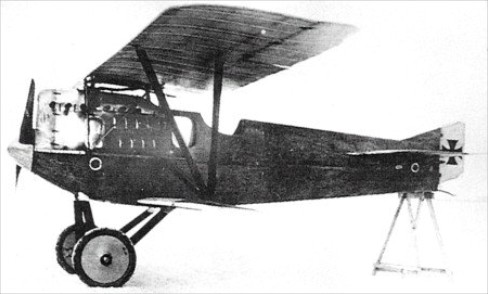
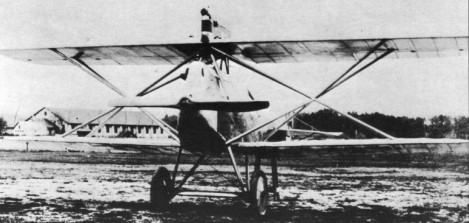
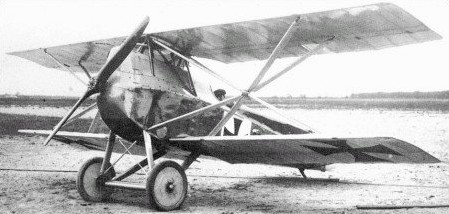
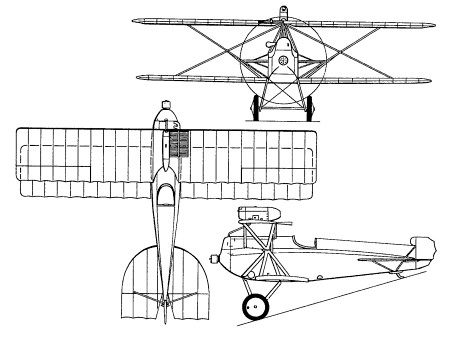
A derivative of the KD (D.I) with larger overall dimensions, simplified interplane bracing and a 200hp Hiero six-cylinder water-cooled engine, the L.14 single-seat fighter was evaluated by the Austro-Hungarian air arm in 1917, but was not accepted for series production. Two prototypes were built and flown, these differing primarily in the arrangement of the interplane bracing struts employed, and intended armament was twin 8mm Schwarzlose synchronised machine guns.
Max take-off weight: 940 kg / 2072 lb Empty weight: 740 kg / 1631 lb Wingspan: 10.20 m / 33 ft 6 in Length: 7.05 m / 23 ft 2 in Max. speed: 180 km/h / 112 mph
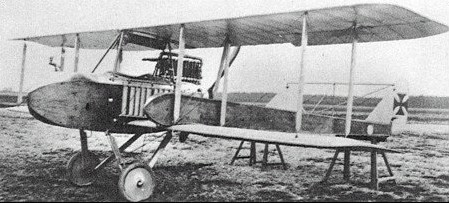
The first fighter to be designed by Ernst Heinkel as chief designer for the Hansa- und Brandenburgische Flugzeug-Werke, the KF two-seater appeared early in 1916, and was a two-bay, twin-boom biplane powered by a 150hp Benz Bz III six-cylinder water-cooled engine installed as a pusher and driving a two-bladed pro-peller between the tailbooms. The KF was of wooden construction with plywood-covered fuselage nacelle and tailbooms, and armament was intended to consist of a single 7.92mm Parabellum machine gun on a flexible mounting in the forward cockpit. Work on the KF was discontinued as it offered no advance in performance over the similarly-configured Ago C.I which served in the reconnaissance role.
Max take-off weight: 1290 kg / 2844 lb Empty weight: 760 kg / 1676 lb Wingspan: 11.60 m / 38 ft 1 in Length: 8.48 m / 28 ft 10 in Wing area: 38.6 sq.m / 415.49 sq ft Max. speed: 140 km/h / 87 mph
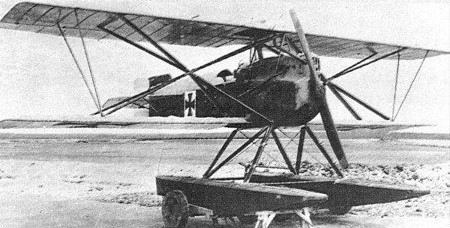
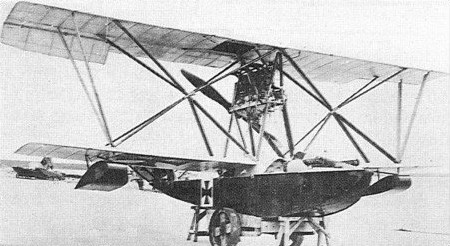
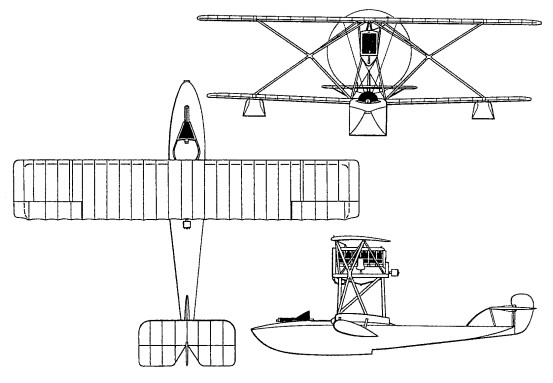
The KDW twin-float single-seat fighter seaplane was essentially a 1916 conversion of the land-based KD (D.I) to provide an interim aircraft for floatplane station defence. The only major change introduced on the prototype apart from provision of a twin-float chassis was some slight extension of the wings, but the fin area was later increased to compensate for the increased keel area resulting from the addition of the floats. The prototypes were fitted with the 150hp Benz Bz III six-cylinder water-cooled engine, but apart from a preproduction batch of 10 similarly-powered aircraft, all subsequent examples of the KDW had the 160hp Maybach Mb III six-cylinder water-cooled engine. The first production series was armed with a single synchronised 7.92mm LMG 08/15 machine gun mounted on the starboard side of the nose, but the final batch of 20 delivered between October 1917 and February 1918 had a gun mounted on each side of the cockpit and additional Vee-type interplane bracing struts. A total of 58 KDW float fighters was delivered.
KDW Engine: 1 x 160hp Maybach Mb.III Max take-off weight: 1039 kg / 2291 lb Empty weight: 759 kg / 1673 lb Wingspan: 9.30 m / 31 ft 6 in Length: 7.86 m / 26 ft 9 in Height: 3.35 m / 11 ft 0 in Wing area: 29.15sq.m / 313.77 sq ft Max. speed: 171 km/h / 106 mph Cruise speed: 154 km/h / 96 mph Ceiling: 3500 m / 11500 ft Rate of climb: 145 m/min / 500 ft/min Armament: 2 x 7.92mm Crew: 1
Designed by Ernst Heinkel for the Austrian army in 1916, the KD (Kampf Doppeldecker), later designated Hansa¬Brandenburg D.I, single seat fighter aircraft was known variously as the Spinne (spider) and ‘Star Strutter’. Each nickname referred to the unusual interplane strutting, comprised of four small V struts joined together in a star shape between each upper and lower wings. Flown as a prototype with the 160hp Mercedes D III six-cylinder water-cooled engine, the KD was manufactured in series as the D.I in two versions Series 28, with a 160 hp Austro Daimler engine, built by the Austrian firm of Phonix Flugzeugwerke; and Series 65, powered by a 185 hp Austro-Daimler, built by Ufag. Due to lack of a suitable synchronization gun gear, the D.I was armed with one machine gun in a ‘baby coffin’ housing above the upper wing centre section. Despite its shortcomings, the ‘Star Strutter’ was extensively flown in combat by most leading Austro Hungarian fighter pilots, who gained many victories in the type. Of wooden construction with fabric wing skinning, plywood fuselage skinning and having steel-tube interplane strutting, the D.I was armed with a single unsynchronised 8mm Schwarzlose machine gun which was enclosed by a fairing on top of the cabane and fired over the propeller. The D.I was reputedly difficult to fly, suffered inadequate directional stability owing to the rudder being blanketed by the deep fuselage, and had poor spin recovery characteristics. A number of Phonix-built Brandenburg D.Is survived World War I to serve briefly with the Deutschosterreichische Fliegertruppe.
Entering first line service in 1917, the D.I was found to have poor lateral control, and was difficult to land safely due to the pilot’s forward view being virtually obscured by the bulky engine installation. Such was the D.I’s high accident rate that it became nicknamed the Sarg (coffin) by front line pilots. Until its gradual replacement by Austrian built Albatros Ds and Berg D scouts in late 1917, however, the ‘Star Strutter’ bore a large burden of fighter combat. Austria’s leading fighter pilot, Godwin Brurnowski, commander of Fliegerkompagnie (Flik) 41J, had its Brandenburgs all doped in a red finish with a white skull on a black field as a unit mark.
Hansa-Brandenburg KD (D.I) Series 28 Engine: 160 hp Austro Daimler Span: 8.50 m (27 ft 10.5 in) Length: 6.35 m (20 ft 10 in) Wing area: 23.95 sq.m / 257.80 sq ft Max take-off weight: 920 kg / 2028 lb Empty weight: 672 kg /1482 lb Max. speed: 187 km/h / 116 mph Service ceiling: 5000 m (16400 ft)
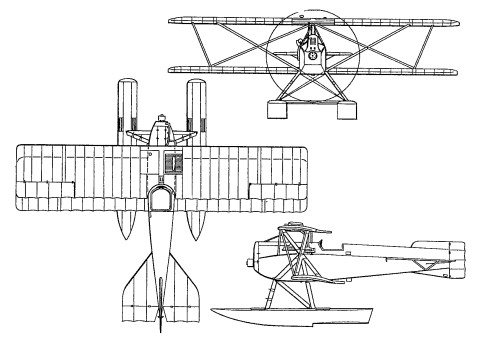
Intended primarily for use by the Austro-Hungarian Navy, the CC single-seat fighter flying boat (the designation was derived from the initials of Camillo Castiglioni, the financier of the Hansa- und Brandenburgische Flugzeug-Werke) was a single-bay biplane of wooden construction which appeared in prototype form in mid-1916. Retaining the “star” interplane bracing strut arrangement introduced by the KD (D.I), the CC was supplied to the Austro-Hungarian Navy with both the 160hp Austro-Daimler and 180hp Hiero six-cylinder water-cooled engines, armament consisting of a single 8mm Schwarzlose machine gun projecting through the windscreen. A total of 37 fighter flying boats of this type was delivered to the service. The CC was also adopted by the German Navy, which received a total of 36, with deliveries commencing in February 1917. These were powered by the 150hp Benz Bz III, the engines of some examples being semi-cowled. The CC initially carried an armament of one 7.92mm LMG 08/15 machine gun, but late production examples had two such weapons fixed to fire forward in the upper decking of the hull nose, and the hull was lengthened to improve flying characteristics. In July 1917, the German Navy grounded the CC until all aircraft were provided with extra (Vee-type) interplane bracing struts to dampen severe wing vibration. The CC was employed extensively and with considerable success over the Adriatic by the Austro-Hungarian Navy. One example was completed experimentally as a triplane, the extra wing being placed at the intersection of the “starstruts”. It was delivered to the Austro-Hungarian Navy for evaluation on 11 May 1917, but was written-off in a landing accident on the following 19 September. One CC was modified and tested in the summer of 1918 as the W 22, with broad sponsons replacing the outrigger stabilising floats. This experimental model, which crashed during testing, was intended solely to evaluate the sponson concept as part of the Staaken Rs IV development programme.
Max take-off weight: 1080 kg / 2381 lb Empty weight: 800 kg / 1764 lb Wingspan: 9.30 m / 31 ft 6 in Length: 7.69 m / 25 ft 3 in Height: 3.57 m / 12 ft 9 in Wing area: 26.52 sq.m / 285.46 sq ft Max. speed: 175 km/h / 109 mph Range: 500 km / 311 miles
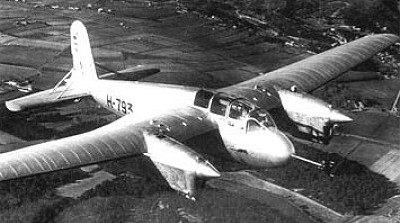
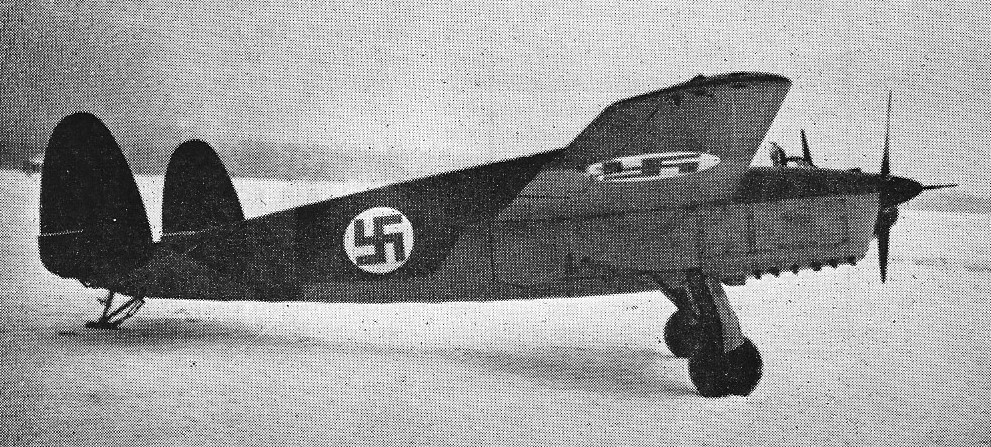
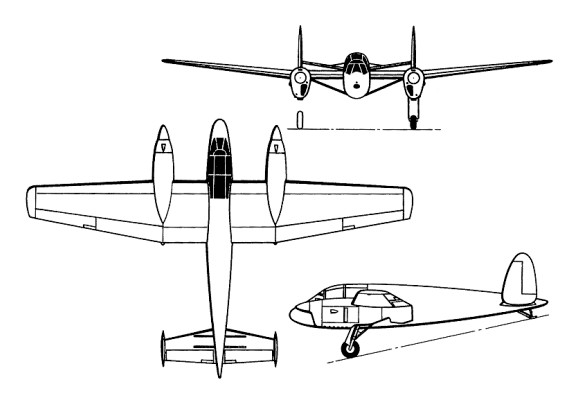
The H.230.01, service serial H.790, flew for the first time in June 1937. It was an advanced two-seat trainer which had a general resemblance to the H.220 but was of much lighter construction. Power was provided by two 127kW Salmson 6AF-00 engines and its configuration included a short crew canopy faired into the upper decking of the rear fuselage and a conventional . strut-braced tail unit, and the fixed main landing gear units incorporated spatted wheel fairings. During further tests it was decided to introduce considerable dihedral at the wingtips to improve stability, but the H.231.01 which followed in May 1938 had dihedral increased over the whole wing span, and the unusual wingtip arrangement of the modified H.230 was eliminated. Twin fins and rudders were introduced and power increased with 172kW Salmson 6AF engines. The Hanriot H.232.01 reverted to a single fin and rudder and had 164kW Renault 6 Q-o engines plus retractable landing gear. The H.232.02, first flown in August 1938, introduced a redesigned cockpit; it was tested officially between October 1938 and May 1939. The type was then given a twin fin and rudder tail assembly and was flown in this new configuration in December 1939, then redesignated H.232/2.01.
An order for 40 aircraft had already been received from the French air ministry, and this was increased to 57 examples shortly afterwards. By then known as the NC.232/2, they incorporated minor improvements including redesigned rudders and engine cowlings. Full navigational equipment was installed. Three reached Finland. Two were from Germany, and these were not taken into service until the Winter War 1939-40 with the Soviet Union was over. Deliveries to the Armee de I’Air started in February 1940, 35 being taken on charge up to the June 1940 Armistice. The NC.232/2s were,used by the training sections attached to the 51th and 54th Escadres, which were equipped with Breguet 691and 693 attack bombers. Twenty aircraft found on airfields when the German forces occupied Vichy, France, in 1942 were reduced to scrap.
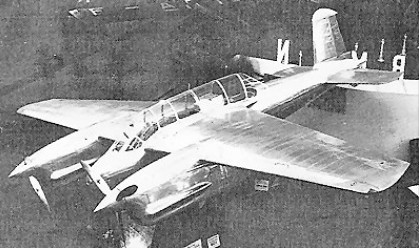
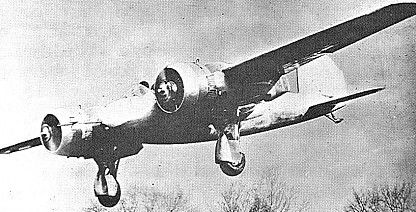
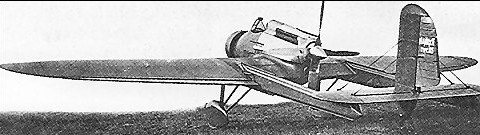
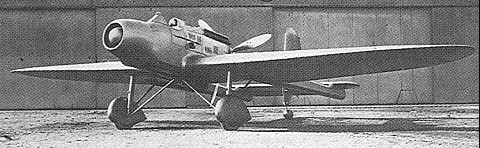
Included among exhibits at the Salon de l’Aeronautique held in Paris in November 1936 was a striking all-metal twin-engined three-seat fighter. It had a somewhat abbreviated oval-section monocoque fuselage, a shoulder-mounted semi-cantilever wing carrying split trailing-edge flaps over its entire span and two 450hp Renault 12Roi 12-cylinder inline air-cooled engines projecting ahead of the fuselage nose. This, the H.220, had been designed to a C3 requirement prepared by the Service Technique de l’Aeronautique and issued in October 1934. Other contenders were the Breguet 690, the Potez 630, the Loire-Nieuport 20 and the Romano 110. As it became evident that the H.220 would be underpowered, the Renault engines were discarded in favour of 680hp Gnome-Rhone 14M 14-cylinder radials, and, with these installed, the first flight test was made at Avord on 21 September 1937.
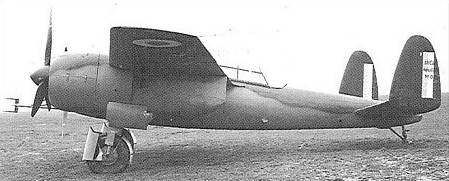
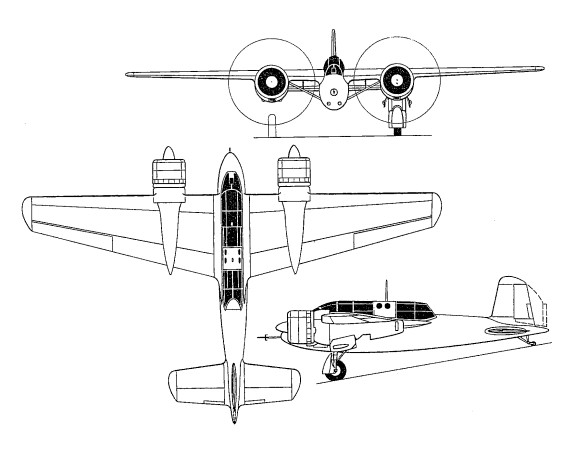
The intended armament of the H.220 comprised two forward-firing 20mm cannon and two aft-firing 7.5mm MAC 1934 machine guns on a flexible mounting, but, in the event, no armament was fitted. On 17 February 1938, the prototype made a forced landing at Avord after losing the starboard propeller following a failure in the reduction gearbox. The poor stability evinced during flight testing of the H.220 (which had resulted in progressive changes in the contours and size of the vertical surfaces), coupled with inadequate internal capacity and some lack of sturdiness revealed by the forced landing (as a result of which the fuselage was irreparable), dictated major redesign, resulting in the H.220-2. After the partial destruction of the H.220, major redesign was initiated by the Societe Nationale de Constructions Aeronautiques du Centre, or SNCA du Centre, which had absorbed the Hanriot facility at Bourges on 1 February 1937. The oval-section monocoque fuselage of the original H.220 was discarded in favour of a fuselage built as two half shells mated by a central keel. An entirely new tail assembly with twin endplate vertical surfaces was fitted and the Gnome-Rhone 14M radial engines were enclosed by low-drag nacelles. These features were mated with the wing of the original H.220 to result in the H.220-2, which was first flown (as the H.220 No 02) on 17 March 1939. Four months later, in July 1939, this prototype was to be displayed statically as the NC 600 No 01 multi-seat fighter at the Salon de l’Aeronautique. In fact, the genuine NC 600 was to differ from the H.220-2 in several major respects.
H.220-2
H.220 Max take-off weight: 3700 kg / 8157 lb Empty weight: 2673 kg / 5893 lb Wingspan: 12.80 m / 41 ft 12 in Length: 7.87 m / 25 ft 10 in Height: 3.40 m / 11 ft 2 in Wing area: 21.16 sq.m / 227.76 sq ft Max. speed: 520 km/h / 323 mph Range: 850 km / 528 miles
H.220-2 Max take-off weight: 3850 kg / 8488 lb Empty weight: 2820 kg / 6217 lb Wingspan: 12.80 m / 41 ft 12 in Length: 7.87 m / 25 ft 10 in Height: 3.40 m / 11 ft 2 in Wing area: 21.16 sq.m / 227.76 sq ft Max. speed: 532 km/h / 331 mph Range: 770 km / 478 miles
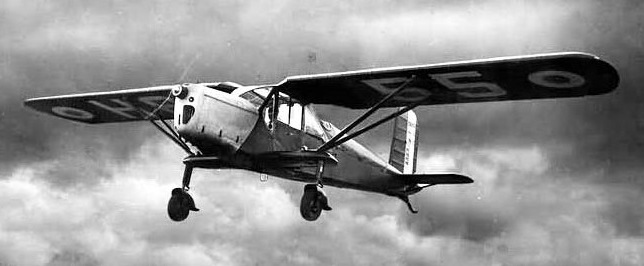
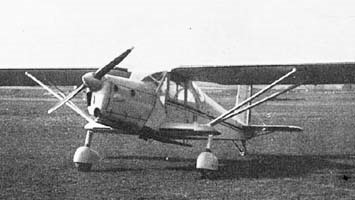
The Hanriot H.170, H.180, and H.190 were a family of light utility aircraft designed by Montlaur and produced in France in the 1930s. First flown in 1934 and all introduced in 1934, they appeared side-by-side at the Paris Air Show that year, the model numbers distinguishing between versions powered by Salmson, Renault, and Régnier engines respectively.
H.180
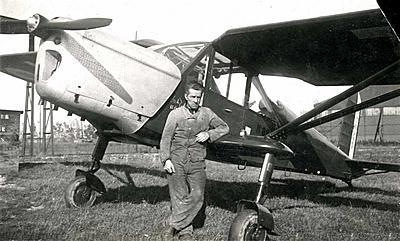
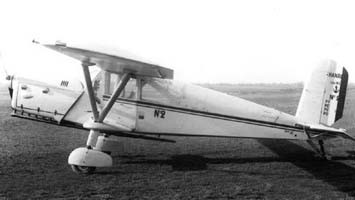
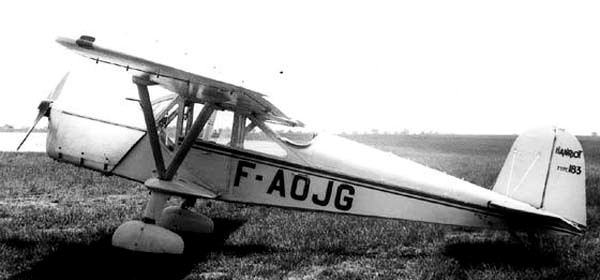
In basic construction, the different variants were otherwise almost identical, as largely conventional monoplanes with high, strut-braced wings and fixed, tailskid undercarriage. The pilot and one or two passengers sat in an extensively-glazed, enclosed cabin.
Although usually described as a monoplane, this family of aircraft all featured small, stub wings at the bottom of the fuselage. These carried the fuel tanks and served as a mounting point for the wing struts and undercarriage. An interesting feature was that the upper portion of the rear fuselage was a removable module, allowing it to be replaced with alternative modules for different roles, for example to carry a stretcher, or a second, open cockpit for pilot or gunnery training.
H.170/175
The H.182 was the major production version, accounting for 346 out of the total of 392 aircraft built. Most of these were produced as part of a government order for machines to equip the Cercles Aériens Régionaux reserve flying units, with 172 aircraft still operational at the Fall of France in 1940.
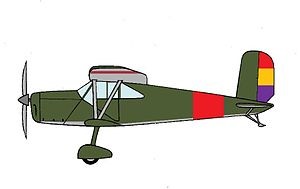
Ten more were purchased by the Second Spanish Republic for use in the Spanish Civil War, and 50 aircraft originally ordered by the French government were diverted to Turkey as part of a military aid agreement.
Variants: H.170 – two-seat military observation version with Salmson 6Te engine (1 built) H.171 – three-seat civil tourer version of H.170 (1 built) H.172 H.172B – two-seat trainer (1 built) H.172N – three-seat tourer (7 built) H.173 – aerobatic trainer version (1 built) H.174 – three-seat trainer (1 built) H.175 – liaison aircraft for French Navy (10 built) H.180 H.180T – three-seat tourer with Renault 4Pdi engine (1 built) H.180M – two-seat military observation version with Renault 4Pei engine (1 built) H.181 – air ambulance version of H.180T (1 built) H.182 – main production version as trainer aircraft for French reserve aviation units. H.183 – aerobatic trainer with Renault 438 engine (1 built) H.184 – trainer version with uprated version of Renault 4Pei engine (1 built) H.185 – two-seat liaison version for French navy (6 built) H.190 H.190M – two-seat observation aircraft with Régnier 60-01 engine (1 built) H.191 – three-seat tourer (1 built) H.192 H.192B – two-seat trainer (1 built) H.192N – two-seat civil trainer with Régnier 6Bo.1 engine (9 built) H.195 – two-seat liaison aircraft with Régnier 6Bo.1 engine (1 built)
Operators: French Air Force French Navy Spanish Republican Air Force Turkish Air Force
Specifications:
H.182 Engine: 1 × Renault 4Pei, 104 kW (140 hp) Wingspan: 12.00 m (39 ft 5 in) Length: 7.22 m (23 ft 8 in) Height: 3.15 m (10 ft 4 in) Wing area: 19.0 m2 (204 ft2) Empty weight: 604 kg (1,331 lb) Gross weight: 887 kg (1,955 lb) Maximum speed: 190 km/h (120 mph) Range: 600 km (370 miles) Service ceiling: 5,500 m (18,400 ft) Crew: Two, pilot and instructor
Hanriot H.182 trainer of the Spanish Republican Air Force
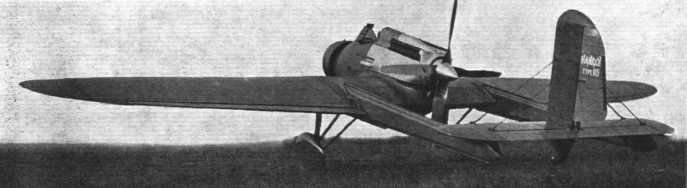
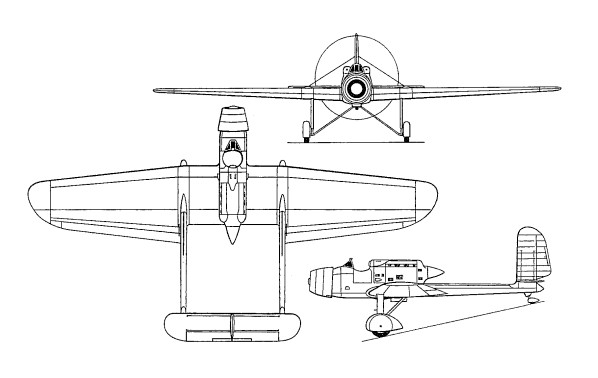
After its return to Hanriot’s Bourges factory, the H.110 was fitted with a redesigned fuselage nacelle and an uprated Hispano-Suiza 12Xbrs engine offering 690hp. A 33mm APX cannon was mounted in a bulged housing beneath the central nacelle and a four-bladed propeller supplanted the three-blader. With these modifications, the fighter re-emerged as the H.115 and was flown for the first time in April 1934. Further modifications were undertaken by the factory from November 1934, and, in June 1935, the H.115 was submitted to Villacoublay for official evaluation. Flight testing ended on 16 August. At this time it was concluded that, in view of its radical configuration, the H.115 was of no more than academic interest.
Max take-off weight: 1786 kg / 3937 lb Empty weight: 1428 kg / 3148 lb Wingspan: 13.50 m / 44 ft 3 in Length: 7.60 m / 24 ft 11 in Height: 2.69 m / 8 ft 10 in Wing area: 24.00 sq.m / 258.33 sq ft Max. speed: 390 km/h / 242 mph
Debuting in April 1933, the H.110 fighter was designed by Jean Biche. It was a contender in the C1 competition promoted initially by the Service Technique de l’Aeronautique in 1930 and upgraded in January 1931 by a supplement to the specification. The H.110 was a single-seat fighter in which the pilot and engine occupied a central nacelle, and twin parallel booms attached to the extremities of the wing centre section carried the tail assembly. Of all-metal construction, the H.110 was powered by a 500hp Hispano-Suiza 12Xbrs geared and supercharged liquid-cooled engine driving a three-bladed pusher propeller. A ring-type radiator was mounted in the nose of the nacelle and embodied an adjustable cone to regulate the airflow. Largest and heaviest of the contending fighters, the H.110, which carried an armament of two fixed 7.5mm MAC machine guns, proved slower and less manoeuvrable than most of its competitors. In March 1934, it was returned to the Bourges factory for modifications, re-emerging as the H.115.
Max take-off weight: 1750 kg / 3858 lb Empty weight: 1260 kg / 2778 lb Wingspan: 13.50 m / 44 ft 3 in Length: 7.96 m / 26 ft 1 in Height: 2.70 m / 8 ft 10 in Wing area: 24.00 sq.m / 258.33 sq ft Max. speed: 355 km/h / 221 mph Range: 600 km / 373 miles