Harbin Aircraft Manufacturing Corp

Created in 1952 from the Mansyu Hikoki Seizo Kabushiki Kaisha of Manchuria. Began the H-6 bomber program in 1957, initially assembling two Tu-16s from Soviet supplied components, the first flying in September 1959, but in 1961 this program was transferred to Xi’an. Manufactured the H-5 jet bomber from 1966 to the 1980s, based on the Soviet llyushin II-28. Developed and still produces the Y-11 (first flown about 1975) and Y-12 (first flown June 1984) general-purpose transports and Z-9 Haitun twin-turboshaft helicopter as license-produced Eurocopter Dauphin 2. Was pursuing development of a new helicopter in 1999, and is a partner in the Colibri EC 120 B helicopter program . Also produced two prototype (one static) and five production SH-5 anti-submarine amphibians (one civil, tested as a firebomber).

In 1998, the core company of Harbin Aircraft Industry Group (HAIG) was under under AVIC II and occupied a 514 ha (1.270 acre) site, including 350,000 sq.m of workshop space. The workforce in 1998 numbered approximately 18,000.

Harbin partnered with Eurocopter and Singapore Technologies Aerospace in the Eurocopter EC 120 Colibri programme, for which it builds the cabin.
Hants and Sussex Aviation / HAS Antoinette

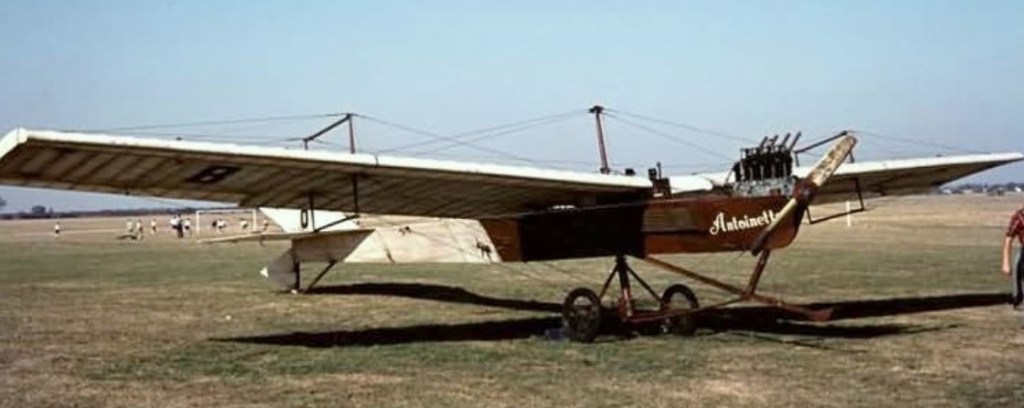
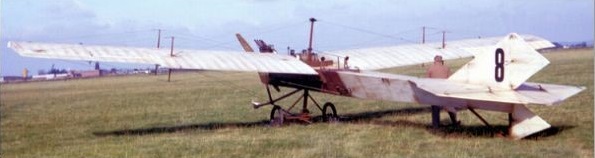
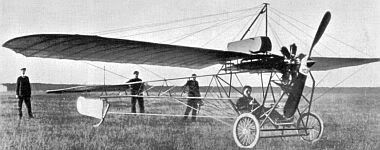
In 1964 Hants & Sussex Aviation was contracted to build three Levavasseur Antoinette IV monoplane replicas of 1910 vintage for the film ‘Those Magnificent Men in Their Flying Machines’. The Antoinette IV movie model closely replicated the slim, graceful monoplane that was very nearly the first aircraft to fly the English Channel, in the hands of Hubert Latham, and won several prizes in early competitions. When the Hants and Sussex Aviation Company from Portsmouth Aerodrome undertook its construction, the company followed the original structural specifications carefully, although an out-of-period de Havilland Gypsy I engine was used.

They were built in wood but the Antoinette’s wing structure proved, however, to be dangerously flexible, and lateral control was very poor, even after the wing bracing was reinforced with extra wires, and the original wing-warping was replaced with “modern” ailerons (hinged on the rear spar rather than from the trailing edge, as in the “real” Antoinette). The final configuration was still considered marginal in terms of stability and lateral control.

Both of the flying examples (one was static only) are thought to still exist. The first machine was noted in a hanger at Fairoaks in 1972 and the second machine was undergoing a rebuild in Geneva, Switzerland.

Hants and Sussex Aviation / HAS Herald

Hants and Sussex Aviation Ltd was an aircraft manufacturer based at Portsmouth Airport, Hampshire, England. It is still in business in the aircraft components industry.

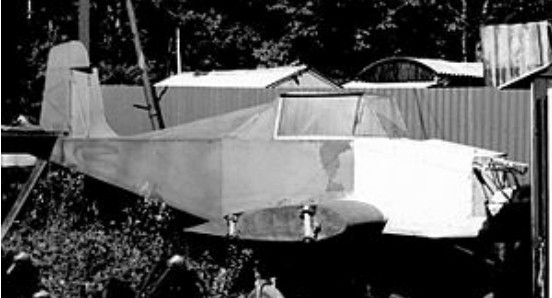
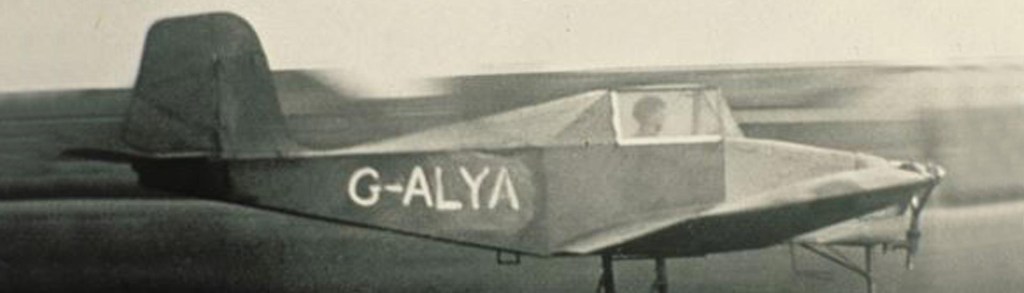
In 1953, HSA designed its first aircraft. This was the H&S Herald. The Herald was a single-seat ultra-light aircraft with a fixed tricycle undercarriage and powered by a 40 h.p. Aeronca-JAP J-99 piston engine.
Aircraft Registration: G-ALYA
Construction Number: HA/AC/001

The Herald made flight tests at Portsmouth Airport in 1953, but these revealed that it had a poor performance and the aircraft was grounded and dismantled in 1955.

Powerplant: 1 × Aeronca-JAP J-99, 40 hp (30 kW)
Wingspan: 29 ft 0 in (8.84 m)
Length: 21 ft 6 in (6.55 m)
Empty weight: 580 lb (263 kg)
Gross weight: 900 lb (408 kg)
Maximum speed: 92 mph (148 km/h, 80 kn)
Cruise speed: 82 mph (132 km/h, 71 kn)
Crew: 1

Hants and Sussex Aviation / HAS

Hants and Sussex Aviation (HSA) was formed in 1946 at Portsmouth Airport, Portsmouth, Hampshire, England, by the Hawes family (A.H.Hawes, W.E.Hawes, A.E.Hawes & F.G.Lewis) and initially worked on component manufacture and repair for military aircraft.

The first Hants and Sussex office was located above the archway of what was then the Bailey family business of builders and estate agents in Bognor Regis. The company’s first workshop was in Fratton, Portsmouth and comprised of an estimated 1,500 square feet. They relocated to the edge of what was then Portsmouth Municipal Airport in 1947 and have been here ever since.

In 1953, HSA designed its first aircraft. This was the H&S Herald. The Herald was a single-seat ultra-light aircraft with a fixed tricycle undercarriage and powered by a 40 h.p. Aeronca-JAP J-99 piston engine. The Herald made flight tests at Portsmouth Airport in 1953, but these revealed that it had a poor performance and the aircraft was grounded and dismantled in 1955.

HSA were contracted in 1965 to build one of the pre-World One flying replica aircraft for the film Those Magnificent Men in their Flying Machines. HSAs aircraft was the Antoinette IV which they powered by a de Havilland Gypsy I engine.

HSA then concentrated on work on the overhaul, modification and repair of aircraft engines and components. In late 1976 the firm advertised its work on the overhaul and repair of Continental piston engines for aircraft. By September 1986 HSA were overhauling and modifying Rolls-Royce Dart and Pratt and Whitney PT-6 turboprop engines. HSA still carry on trading within the aviation support industry in 2008.

Hanson WH-1 Thunderchicken / Sump’n Else

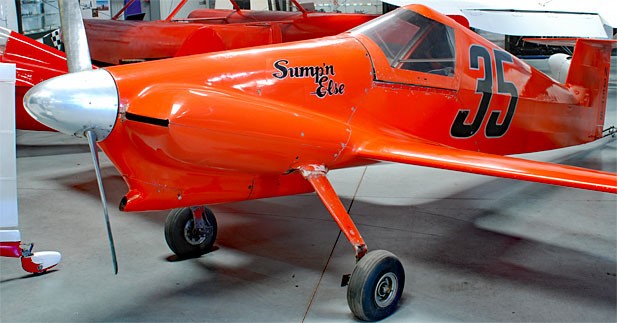
William Hanson’s WH-1 Formula 1 racer N35TS, Race 35, began life with the name of “Thunderchicken.” The fuselage is of welded tubular steel construction, with the cockpit and engine areas covered with sheet aluminum, and the area aft of the cockpit covered with fabric. The tail surfaces were constructed similarly to the aft fuselage. The wings were made of wood spars and ribs with plywood covering.

The aircraft, wearing the name “Thunderchicken,” qualified at the Cleveland Air Races in 1972, flown by Ken Haas. However, due to failure of the windshield, the aircraft failed to place. The same year, Tom Cooney flew finished in fifth place in the Formula 1 Silver Race at Reno, with a speed of 202.74 mph.

The WH-1 was renamed “Sump’n Else,” retaining race number 35, and repainted for the 1974 Reno Air Races, but did not qualify. In 1975, Thomas Summers flew “Sump’n Else” to a third-place finish in the Silver Race at Reno with a speed of 204.69 mph.

Engine: Continental 0-200
Span: 18 ft. 8 in
Length: 18 ft. 3 in
Height: 6 ft. 2 in
Maximum Speed: 225 mph
Crew: 1