IMPA initiated an aircraft production line continued with the prototype IMPA RR-12D-13D RR IMPA, IMPA Your Sa, IMPA Plover, the Impita, and in 1944 opened an office in the town of Quilmes dedicated to this production.
Aircraft
IMPA RR-12D-13D RR IMPA
IMPA initiated an aircraft production line continued with the prototype IMPA RR-12D-13D RR IMPA, IMPA Your Sa, IMPA Plover, the Impita, and in 1944 opened an office in the town of Quilmes dedicated to this production.
IMPA Tu-Sa / LF-1
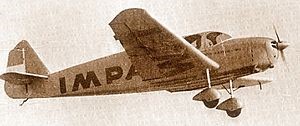
The IMPA Tu-Sa, (IMPA – Industrias Metalúrgicas y Plasticas Argentinas S.A.), or Impa Tu-Sa-O, was a civil trainer developed in Argentina in the 1940s for aeroclub use. It was a conventional, low-wing monoplane with wide-track fixed tailwheel undercarriage. Frst flown on 17 April 1943, approximately 25 were built as LF-1 during 1943-1944. Derived directly from the RR-11, the Tu-Sa (or Tu-Sa-O) initially had the same 65hp Lycoming O-145-B2 engine but that was later upgraded to a 80hp Continental.
In service, the aircraft demonstrated a number of serious and fundamental design flaws that led to a series of accidents and pilots joking that Tu-Sa stood for Todo Un Sarcófago Aéreo (“Altogether an aerial coffin”). When it became apparent that the defects could not be corrected without a complete redesign of the aircraft, they were withdrawn from use.
IMPA Chorlito
Products included a prototype Chorlito light single-seat trainer in 1943.
IMPA RR-11
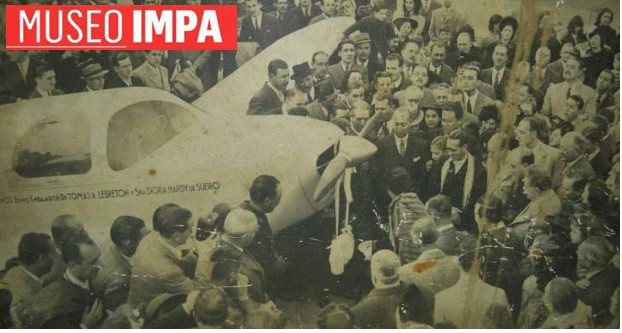
IMPA products included a prototype RR-11 two-seat cantilever low-wing cabin monoplane. The sole example of this was built in 1942 by its designer Alfredo Davinz Ferrer.
The initiative had come from the founder of IMPA, Eng. Jose Mario Sueiro, who amidst the backdrop of the Second World War, decided to enter the aviation industry. Davins Alfredo Ferrer designed the RR-1 and oversaw its construction that took place in the 4th floor of the factory
IMPA workers not only developed the body of the plane, but the instruments: speedometers, tachometers, compasses, etc. It was noted that there was no way out to the street, a neighbor recalling they even broke one of the walls of the factory to remove.
Sueiro made the maiden flight of July 25, 1942 at the airfield of Pacheco, accompanied by sr. Ciro Comi, which made headlines in major Argentine newspapers. The event was attended by members of the company; national authorities, as the director of Military Industries, Colonel Savio and the director of Civil Aviation, Dr. Samuel Bosch; and the president of the UIA, Luis Colombo.
Lycoming O-145-B2, 65 hp
Wingspan: 11.05 m
Length: 7.42 m
Wing area: 13 m²
Maximum ceiling: 5,000 m
Maximum speed 162 km / h
Power performance speed: 155 km / h
Cruising speed: 143 km / h
Endurance: 5 hr
IMPA
Argentina
Industria Metalurgica e Plastica SA, a munitions factory, opened an aircraft department in September 1941. The initiative had come from the founder, Eng. Jose Mario Sueiro, who amidst the backdrop of the Second World War, decided to enter the aviation industry.
For it he contracted Spainard Davins Alfredo Ferrer, whom he had met in Paris, and who already had experience in the French aviation industry. Ferrer designed the prototype and oversaw its construction that took place in the 4th floor of the factory. Working steadily, IMPA workers not only developed the body of the plane, but his instruments: speedometers, tachometers, compasses, etc.
A new factory opened at Quilmes Airport, Buenos Aires, in December 1944. Products included prototypes of RR-11 two-seat low-wing cabin monoplane (1942) and Chorlito light single-seat trainer (1943). Only production aircraft was the Tu-Sa (or LF-1), of which 25 were built 1943-1944.
The RR-11 IMPA “fully built in our country, with raw material and Argentine workers” as he liked to say ing. Sueiro was a “feel” for the time and his maiden flight of July 25, 1942 at the airfield of Pacheco, made headlines in major Argentine newspapers.
The event was attended by members of the company; national authorities, as the director of Military Industries, Colonel Savio and the director of Civil Aviation, Dr. Samuel Bosch; and the president of the UIA, Luis Colombo. Besides the pilot sr. Ciro Comi made the opening round.
Thus, IMPA initiated an aircraft production line continued with the prototype IMPA RR-12D-13D RR IMPA, IMPA Your Sa, IMPA Plover, the Impita, and in 1944 opened an office in the town of Quilmes dedicated to this production.
IMCO / Intermountain Manufacturing Co
Intermountain Manufacturing Company acquired at public auction the former Callair Inc., developing from the well-known Callair series of agricultural aircraft an improved model designated IMCO Callair A-9. A scaledup version, the B-1, first flew on January 15,1966. IMCO sold the Callair assets to Rockwell-Standard Corporation in December 1966 which continued production of these aircraft at Afton, Wyoming, under the banner of Aero Commander.
In 1965 Rockwell-Standard acquired Snow Aeronautical, continuing to produce agricultural aircraft at Olney as Snow Commanders (as division of Aero Commander), and acquired Intermountain Manufacturing Company (IMCO) 1966.
Imbert and Latour 1909 monoplane
The 1909 IAL monoplane was designed and built by Imbert and Latour in France.
Ilyushin Il-114
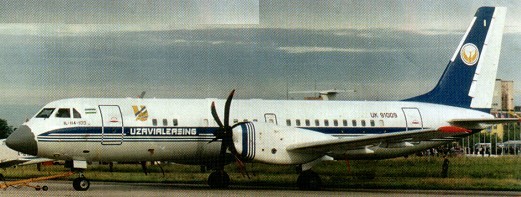
First flying on 29 March 1990, the IL-114 twin-turboprop transport ordered with production and marketing by Uzbekistan-Russian consortium.
The IL-114’s two engines are 2,500 shp (1,860 kW) TV7-117 turboprops driving six-bladed propellers. Composites feature strongly in the aircraft’s structure and represent ten per cent of empty weight.
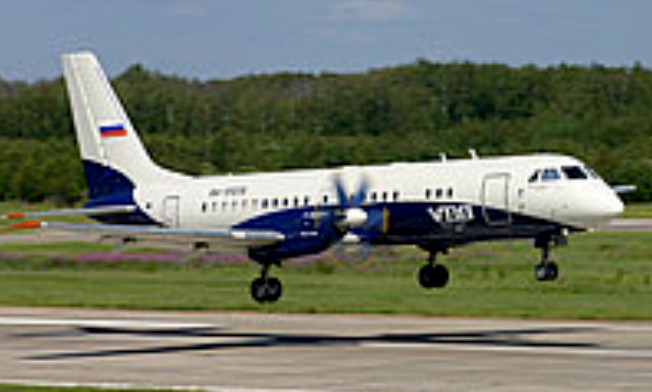
Special electronic versions of IL-114 were developed for “Open Skies” missions and Russian Federal Border Guard patrol.
Il-114-100
Engines: TV7-117 turboprops, 2 x 2,500 shp (1,860 kW).
Pax seats: 64.
Ilyushin Il-112
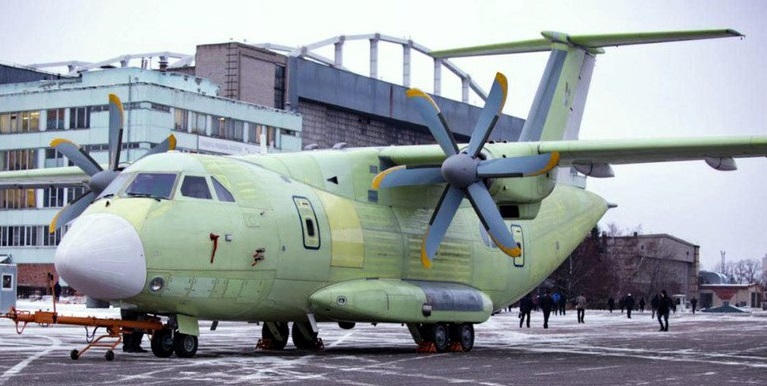
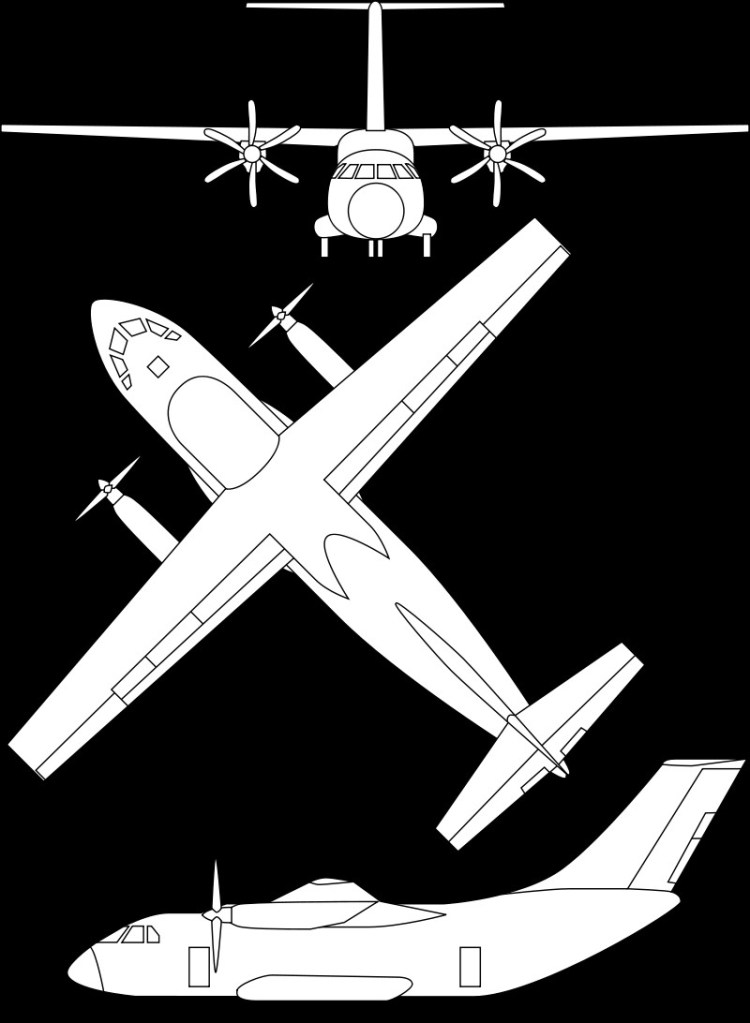
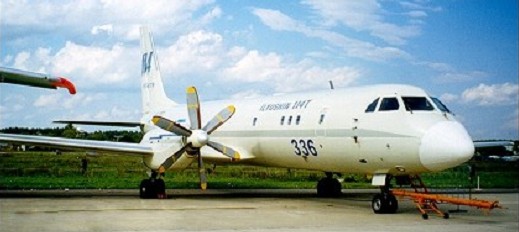
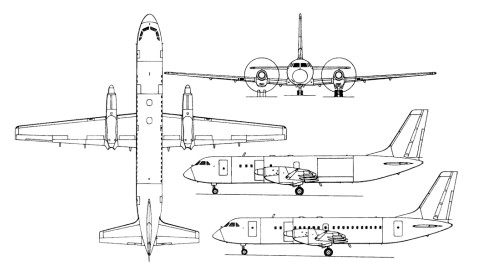
The Ilyushin Il-112 is a high-wing light military transport aircraft developed by Ilyushin Aviation Complex (JSC IL) for air landing and airdrop of military air cargoes, equipment and personnel. The aircraft is being manufactured by Voronezh Aircraft Production Association.
The Il-112 has similar weights and dimensions to the An-26 it is intended to replace but differs by having a notably larger cabin cross-section, allowing it to accommodate 44 armed soldiers instead of 38. Thanks to the engine’s reduced specific fuel consumption, which is down by 38 percent, the Il-112 has twice the ferry range, at 5,200 km (2,808 nm). The crew is reduced from six to two thanks to modern avionics and onboard equipment. All aviation information as well as information on the operation of aircraft systems is displayed on six LCD monitors.
The aircraft was designed to operate in adverse weather conditions and is expected to meet all current ICAO noise and emissions requirements.
In May 2011, the Russian Defense Ministry decided to abandon the military transport version of the Il-112 and purchase seven Antonov An-140T cargo planes.
In January 2013 it was announced that in late December, the Main Commander of the Russian Air Force presented the Minister of Defense Sergei Shoigu the case for a resumption of the Il-112 project. On 24 June 2013 it was reported that the Il-112 is considered as a replacement for the Antonov An-26, and on 26 June, that the Ilyushin Design Bureau sent JSC Klimov a request for the establishment of a new turboprop engine. In August 2013, the general designer of Ilyushin, Viktor Livanov, citing the First Deputy Defense Minister Yuri Borisov, confirmed that work on the aircraft has been resumed.
On 18 January 2018, the first prototype of the IL-112V was shown at the Voronezh Joint Stock Aircraft Manufacturing Company (VASO). It has two improved Klimov TV7-11ST turboprop engines, with 2,610 kW (3,500 hp) each, each powering 6-bladed AV-112 constant-speed reversible pitch propellers. It is fitted with a monolithic, single piece wing. The aircraft is 25.15 m long, with a height of 8.89 m and a wing span of 27.6 m.
The first prototype of the Il-112V was rolled out on 27 November 2018. It is intended for performance and flight handling trials. Taxi trials had begun by the end of December.
Powerplant: 2 × Klimov TV7-117ST turboprop, 2,610 kW (3,500 hp) each
Propellers: 6-bladed constant-speed reversible pitch propellers
Wingspan: 27.6 m (90 ft 7 in)
Wing area: 65 m2 (700 sq ft)
Length: 24.15 m (79 ft 3 in)
Height: 8.89 m (29 ft 2 in)
Empty weight: 10,000 kg (22,046 lb)
Max takeoff weight: 21,000 kg (46,297 lb)
Fuel capacity: 7,200 l (1,600 imp gal; 1,900 US gal)
Capacity: 5,000 kg (11,000 lb)
Crew: 2