Junkers / Junkers-Fokker-Werke AG / Junkers Flugzeugwerke AG / Junkers Flugzeug und Motorenwerke AG

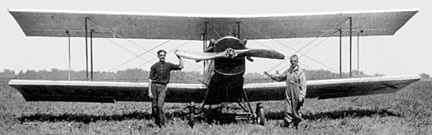
Professor Hugo Junkers (1859-1935) became enthusiastically interested in aircraft development and worked for several aero-engine manufacturers. Convinced that all metal structure was the ultimate answer to successful aircraft design, he produced the experimental J.1 “Blechesel” (Tin Donkey) to exemplify his 1910 patent for a cantilever all-metal wing. The J.1 flew on December 12, 1915, giving unexpectedly stable performance.

Hugo Junkers Article

Six J 2s were then built, but when J 4 ground-attack biplane was ordered for German Army, he was not geared for mass production. Thus, Junkers-Fokker-Werke was formed at Dessau on October 20,1917, with equal shares held by Junkers and Anthony Fokker. Conflicts of personality caused Fokker and Junkers to separate in 1918, and the Junkers re-formed following April as Junkers FlugzeugwerkeAG at Dessau April 24,1919, first concentrating on all-metal civilian transports such as F13 four-passenger monoplane (more than 350 built).

Representatives of the Junkers Flugzeugwerke (Jfa), the German Government (Reichswehrsministerium, RWM) and the Soviet Government (Trotsky) signed a final agreement on November 26, 1922, and a former motor car factory at Fili, situated south of Moscow, was taken over by Jfa and expanded. Back in the Dessau design office headed by Dipi Ing Emst Zindel, work had begun during 1922 on three new military types intended for production at Fili the J20 two seat low wing reconnaissance floatplane and the J21 two seat reconnaissance and J22 single seat fighter parasol wing aircraft. The parasol wing configuration of the two last mentioned types turned out to be a failure, even though the J21 was built in quantity at Fili.

Junkers established a Swedish subsidiary, AB Flygindustri, near Malmo, and formed Junkers Motorenbau GmbH for production of aero engines. After death of Hugo Junkers the company became state-owned and, amalgamating with the aeroengine firm, became Junkers Flugzeug und Motorenwerke AG in 1936, then the largest aviation company in the world. For German rearmament program, Junkers built factories in many other parts of Germany, and in Czechoslovakia and France.
Avions Metalicos Junkers was founded at Madrid in 1923 to provide facilities for the construction of Junkers aircraft in Spain. A two-seat all-metal monoplane was in production in 1924.

Major types produced included G24 and G31 airliners of 1925/1926: W33 and W34 cargo transports, used also as trainers by Luftwaffe; the G38 “flying wing”of 1928 (prototype flew November 6,1929; production models carried 34 passengers plus seven crew). Some used as military transports in early stages of Second World War. On October 13,1930 came the first flight of famous Ju 52 cargo transport. Three-engined Ju 52/3m based on latter used in wide variety of roles before and during Second World War, production totalling more than 4,850. Prewar production continued with Ju 60 and Ju 160 airliners, Ju 86 bomber, transport and trainer, and Ju 87 dive-bomber in many versions. The 87 was followed by the Ju 88/188/388 family of twin-engined bombers. The Ju 90/290/390 family began as four-engined 38/40-seat airliners, converted as heavy transport/reconnaissance types in Second World War. Junkers was among first companies to produce military jet aircraft. Two prototypes of its Ju 287 with forward swept wings were captured by Russians in 1945.

After Second World War aircraft production ended, Junkers joined with Messerschmitt in 1966, and with absorption of small aero-engine plant by Messerschmitt group in 1975, the Junkers name disappeared entirely.
Juge & Rolland Ornithoptère

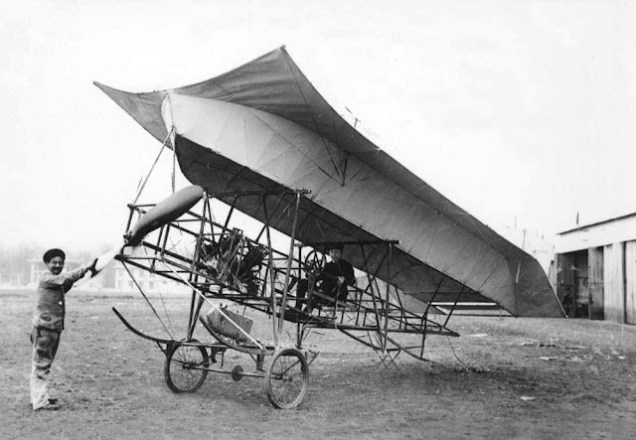
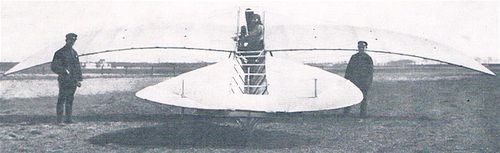
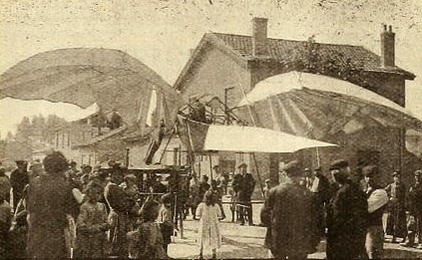
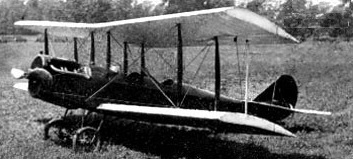
Thr Ornithopter of Jean-Baptiste Juge and Paul Rolland was designed and realized during 1907 through 1909. In a January 1909 magazine article written by Paul Rolland in “L’Aérophile” about the machine, Rolland begins with a plea to the editor of “L’Aérophile” for a more powerful engine (40 hp), as the one available had insufficient power. In the last paragraph he mentions that the first tests were made without any publicity given. Additionally, he states that the first wing flaps or “coups d’ailes” rather, “have given us every satisfaction.” Jean-Baptiste Juge had filed a French patent on September 28, 1907 (published November 28, 1908) for an “Aviateur”, which is remarkably similar to the finished model. That this patent has only Juge as inventor, gives the impression at least, that he was the driving intellectual force behind the design of the machine.

JPM 01 Médoc / Tanagra

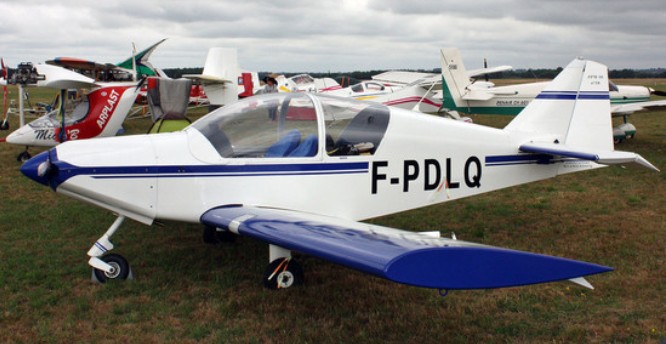
The JPM 01 Médoc is a French amateur-built aircraft that was designed by Jean-Pierre Marie in 1977 and produced by Les Avions Jean-Pierre Marie (JPM) of Le Mesnil-Esnard. The aircraft is supplied as plans for amateur construction, available in 2012 from Les Avions Jean-Pierre Marie (JPM).

The aircraft is named for the French community of Médoc.

The Médoc features a cantilever low-wing a two-seats-in-side-by-side configuration enclosed cockpit under a bubble canopy, fixed tricycle landing gear and a single engine in tractor configuration.

The aircraft is made from wood with its flying surfaces covered in doped aircraft fabric. Its 7.50 m (24.6 ft) span wing has an area of 9.30 sq.m (100.1 sq ft) and mounts flaps. Standard engines recommended are 60 kW (80 hp)-class Volkswagen air-cooled engines, including the 60 kW (80 hp) Limbach L2000 four-stroke powerplant.

The first example was completed by Pierre-Claude Guillem, and registered F-PGMB. It first flew on September 8, 1987. Originally fitted with a 65 hp JPX 4T-60A engine, it later received an 80 hp Limbach L2000 and the aircraft was winner of the 1988 SFACT Trophy for best multi place design. The JPM-01 built by the designer himself was first flown in August 1993, registered as F-PJPM.

A diesel engine powered version was designated JPM-01 Médoc Provence and the first example was completed by Didier Davenna in 2005. He had it registered as F-PDVN under the designation JPM-01 DDI. By mid-2012 at least fourteen Médocs has been built.

Almost forty years after its introduction the aircraft was redesigned and lightened, gaining slotted flaps to reduce stall speed.

JPM 01 Médoc / JPM-01 Tanagra
Engine: 1 × Limbach L2000, 60 kW (80 hp)
Length: 6 m (19 ft 8 in)
Wingspan: 7.50 m (24 ft 7 in)
Wing area: 9.30 sq.m (100.1 sq ft)
Empty weight: 286 kg (631 lb)
Gross weight: 496 kg (1,093 lb)
Fuel capacity: 60 litres (13 imp gal; 16 US gal)
Maximum speed: 210 km/h (130 mph; 113 kn)
Cruising speed: 175 km/h (109 mph; 94 kn)
Stall speed: 70 km/h (43 mph; 38 kn)
Never exceed speed: 247 km/h (153 mph; 133 kn)
Range: 700 km (435 mi; 378 nmi) with no reserve
Endurance: 4 hours plus 0.5 hour reserve
Service ceiling: 4,100 m (13,451 ft)
g limits: +3.5/–1.5
Rate of climb: 4 m/s (790 ft/min)
Wing loading: 53.3 kg/m2 (10.9 lb/sq ft)
Crew: one
Capacity: one passenger

Jourdan 1910 Monoplane

Jourdan Monoplane 1

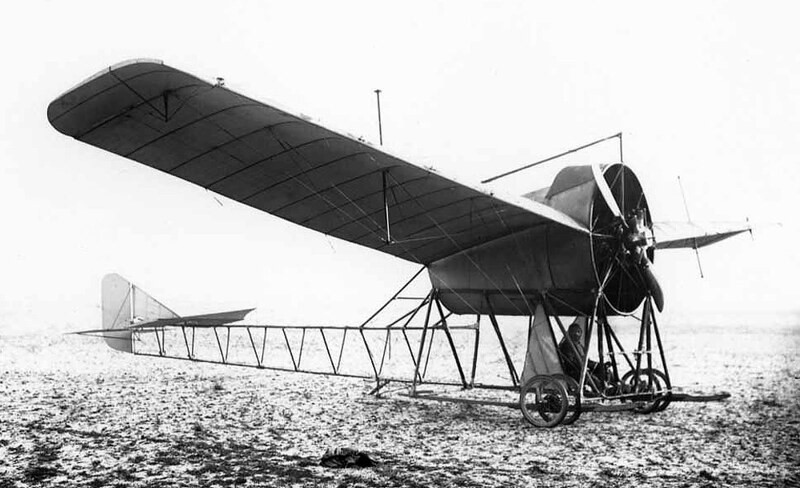
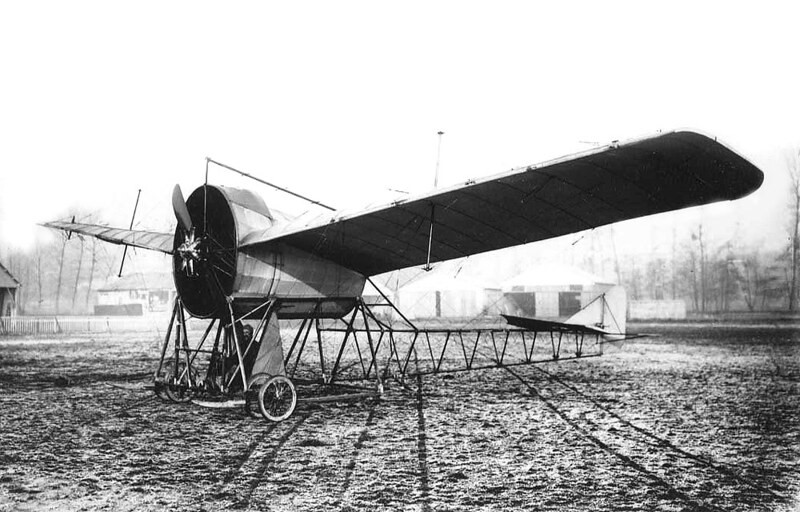
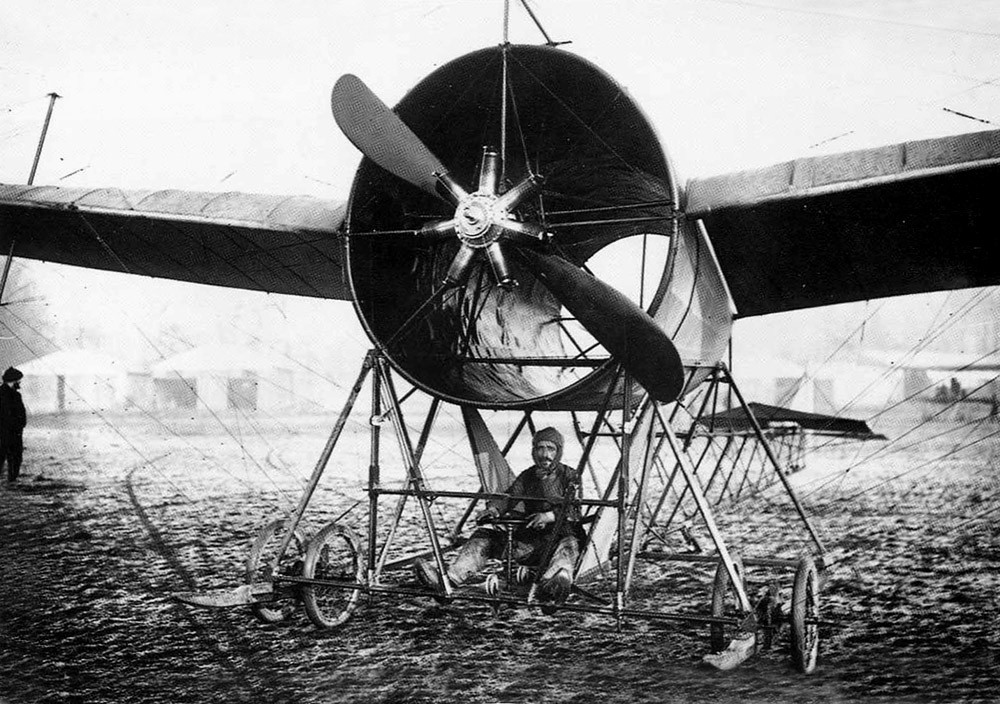
The Frenchman Jourdan tested during 1910-1912 at Juvisy (France) various versions of his aircraft in different forms. All his machines were characterized by a big central tube (‘conical barrel’). The engine with a tractor propeller was mounted before (or at first in) the barrel, to push air in the barrel. The idea might be to push the air through the barrel and fly. The machines had no model registration to differentiate them.

Possibly the Jourdan No.1 from Spring 1911 had a simple full rounded cone barrel in the front, then triangle elevator at the rear, and the wings have ailerons. The original machine giving the clearest view of the ideas of Jourdan. A very big barrel with the engine inside and propeller just as long as the diameter of the barrel. The shrouded propeller was patented December 30, 1910. Shoulder wings with wing warping. Machine did not fly after months of testing during 1910.

The Machine-2 of Spring 1911was a complete redesign, much smaller barrel, with the propeller before the barrel. Pilot could sit comfortably under the barrel seated within the massive undercarriage. This machine was (also) continually modified. At first it was fitted with wing warping, but after modification it was fitted with ailerons. As the machine was continuously modified there can be seen a sort of side board at the undercarriage, maybe to shield the pilot from the wind.

Machine was reported in the German press [Flugsport February 1911] and in the French press [L’Aérophile]. The machine was extensively tested, but no flight occurred.

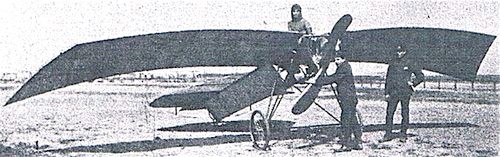
The third machine of Spring 1912, was again a complete redesign. The full circle barrel was here replaced by a big half-barrel with a different undercarriage. The propeller was quite before the half barrel. Again, wing warping. The machine was again reported in the press [Flugsport March 1912] and it Flew. There is at least one picture of it (probably more) of the machine in flight.

A fourth version, which probably debuted in 1912, was a modification of the third, and notable mainly for the removal of the bottom half of the cylinder.

Etienne Jourdan died on July 15, 1912, leaving almost no trace of his ideas.

1912 Jourdan
Propeller: 2-blade fixed pitch wooden
Span: 46′
Length: 32’10”
Weight: 1100 lbs
Crew: 1

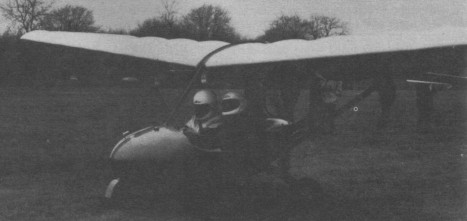
Jordan Duet

Side by side two seat single engined high-wing monoplane with conventional three axis control. Wing has swept back leading edge, swept forward trailing edge and tapering chord; conventional tail. Pitch control by fully flying tail; yaw control by fin mounted rudder; roll control by spoilerons; control inputs through stick for pitch/roll and pedals for yaw. Wing braced from below by struts; Wing profile 100% double surface. Undercar¬riage has three wheels in tricycle formation; glass fibre/carbon fibre suspension on all wheels. Push right go right nosewheel steering connected to yaw control. Glass fibre fuselage, partially enclosed. Engine mounted below wing driving pusher propeller. Aircraft quality materials are used for all structural and control fittings. The wing and tail are of composite construction.
The Duet was conceived by two professional aircraft designers, Dave Kent and Brian Cunnington, as a rugged composite construction machine for touring, training and commercial uses. Their company, Designability Ltd., is a design consultancy and not a manufacturer, so having built and test flown their first 430cc Cuyuna-engined prototype in July 1982, they found a buyer for the manufacturing rights.
Graham Andrews had just set up the company in conjunction with Barney Jordan and the two were looking for a suitable design when the Duct came on the scene. Since becoming the Jordan rather than the Designability Duet, the aircraft has undergone extensive development, particularly as regards power plant. The Cuyuna was rejected as not powerful enough and the big Rotax was substituted. This, coupled to a reduction drive and three blade propeller, gives greatly improved performance and allows the aircraft to be flown safely in conditions which might ground other micro¬lights; it can easily take off and land in a 12 mph (19 kph) crosswind, for example.
The concept of the design, however, remains the same a practical machine with 15 min rigging time from a trailer and suspension supple enough to allow it to cope with difficult fields. For pilot protection, a strong angled strut is mounted in front of the cockpit.
The prototype was designed to the same airworthiness standards as heavier aircraft. A second prototype, a pre production model, was flying in March 1983, dual rudder pedals will be fitted.

Engine: Rotax 503, 45 hp at 6500 rpm.
Prop¬eller diameter 46 inch, 1.16m (3 blade).
belt reduc¬tion, ratio 2.0/1.
Max static thrust 250 lb, 113 kg.
Power per unit area 0.28 hp/sq.ft 11 hp/sq.m.
Fuel capacity 6.0 US gal, 5.0 Imp gal, 22.7 litre.
overall 22.0 ft, 6.71 m.
Height overall 5.5ft, 1.68m.
Wing span 36.0ft, 10.97m.
Chord at root 6.0ft, 1.83m.
Chord at tip 3.0ft, 0.91m.
Dihedral 3 deg.
Sweepback 0 deg.
Tailplane span 10.0ft, 3.05m.
height 4.0 ft, 1.22 m.
Total wing area 162 sq.ft, 15.1 sq.m.
Fin and rudder area: 11.0 sq.ft, 1.02 sq.m.
Total elevator area 26.6 sq.ft, 2.47 sq.m.
Wing aspect ratio 8.0/1.
Wheel track 6.0 ft, 1.83 m.
Wheelbase 6.0 ft, 1.83 m.
Nose¬wheel diameter overall 10 inch, 254 mm.
Main wheels diameter overall 15 inch, 381 mm.
Empty weight 320 lb, 145kg.
Max take off weight 750 lb, 340kg.
Payload 430 lb, 195kg.
Max wing loading 4.63 lb/sq.ft, 22.6kg/sq.m.
Max power loading 16.6 lb/hp, 7.4kg/hp.
Load factors +4.4, 2.2 design; +6.6, 3.3 ulti¬mate.
Max level speed 70 mph, 113 kph.
Never exceed speed 90 mph, 145 kph.
Max cruising speed 60 mph, 97 kph.
Economic cruising speed 50 mph, 80 kph.
Stalling speed 28 mph, 45 kph.
Max climb rate at sea level 480 ft/min, 2.4 m/s.
Min sink rate 350 ft/min at 40 mph, 1.8 m/s at 64 kph.
Best glide ratio with power off 12/1 at 45 mph, 72kph.
Take off distance on tarmac 150ft, 45 m.
Landing distance 120ft, 35 m.
Service ceiling > 10,000 ft, >3050 m.
Range at average cruising speed 115 mile, 185km.