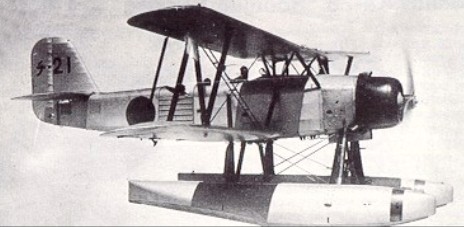
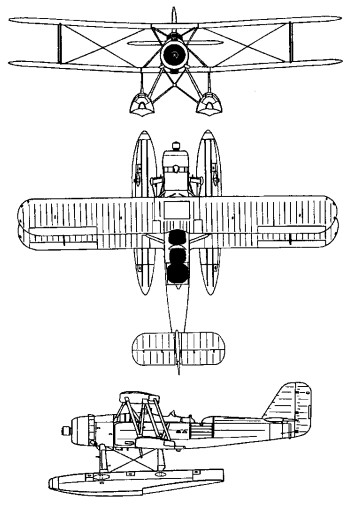
Kawanishi E7K Alf / Navy Type 94

In 1932 the Imperial Japanese Navy sought a replacement for the Navy Type 90-3 Reconnaissance Seaplane which had been built as the Kawanishi E5K. The resulting three-seat Kawanishi E7K1 was an equal-span biplane, powered by a 462kW HiroType91 engine. First flown on 6 February 1933, the prototype was handed over to the Japanese navy three months later for service trials, being flown in competition against the Aichi AB-6 developed to meet the same requirement. The E7K1 was ordered into production as the Navy Type 94 Reconnaissance Seaplane in May 1934, entering service in early 1935. However, its Hiro engine was unreliable, and although late production E7K1s had a more powerful version of the Hiro 91, this offered no improvement.
During 1938 Kawanishi built an E7K2 prototype which, generally similar to the E7K1, replaced the Hiro engine with a Mitsubishi Zuisei 11 radial. Flown for the first time in August 1938, the E7K2 was ordered into production three months later under the designation Navy Type 94 Reconnaissance Seaplane Model 2, the original version then becoming the Navy Type 94 Reconnaissance Seaplane Model 1. Production of the E7K1 totalled 183 (57 built by Nippon), and of the E7K2 about 350 (some 60 built by Nippon).
As a type, the E7Ks saw extensive use from 1935 until the beginning of the Pacific war, when the E7K1s were relegated to second-line duties. The E7K2s continued in first-line service until 1943, and both versions were used in kamikaze operations in the closing stages of the war. When, in the second half of 1942, Allied code names were allocated to Japanese aircraft, the E7K2 became known as ‘Alf’.
Kawanishi / ShinMaywa / Shin Meiwa

In July 1924 a Kawanishi biplane seaplane made a round- Japan flight in nine days. The company formed as Kawanishi Kokuki Kogyo Kabushiki Kaisha in November 1928, taking over the factory and windtunnel (at Kobe) of Kawanishi Machine Works. Held Short Bros license and was Rolls-Royce agent. At the time of formation was supplying aircraft, components, and accessories to Japanese Navy.

Early types included a single-seat biplane fighter and a two-seat long-range high-wing monoplane. At the end of 1930 moved to new works at Narao. In February 1933 flew new three-seat reconnaissance floatplane (E7K) adopted by Japanese Naval Service. Short and Rolls-Royce connections manifested in Navy type 90-2 (K.F.1) flying boat, built in England, assembled in Japan. Built from 1936 a highly successful long-range maritime reconnaissance/ bomber/transport flying-boat, the strut-braced H6K. Subsequent H8K had deep hull and cantilever wing. N1K single-seat fighter monoplane of 1942 originated as floatplane but was developed into outstanding landplane. Projects included suicide aircraft based on German V-1.

ShinMaywa (or Shin Meiwa) became the title of the Kawanishi company after reestablishment in October 1949 as overhaul center for Japanese and U.S. aircraft. Also made components for other constructors, developed re-engined de Havilland Heron.
1962:
Shin Meiwa Industry Co Ltd
125 Agenaruo-Naruocho,
Nishinomiya City

Shin Meiwa’s technical adviser, Dr Shizuo Kikuhara, designed the Type 97 and Type 2 multi-engined flying-boats used by the former Imperial Japanese Navy.
Under his leadership, the company designedg a medium-range patrol flying-boat for the JMSDF. It is also producedfuselage and tail assemblies of the P2V-7 Neptune for Kawasaki and components of the NAMC YS-11, and was licensed to overhaul DH Gipsy Queen engines.
Much other overhaul work is done for the US and Japanese services.

After contract in January 1966 directed attention especially to new marine aircraft. Rebuilt a Grumman Albatross as a dynamically similar flying model for projected very large STOL ASW flying-boat for Japanese Maritime Self Defense Force. The latter type developed as four-turboprop PS-1, but later also as U.S.-1 amphibious search-and-rescue aircraft. PS-1 flew October 1967; U.S.- 1 October 1974. First prototype PS-1 converted later as waterbombing test vehicle. Basic type remarkable for low take-off and landing speeds, achieved by boundary-layer control system and large flaps for slipstream deflection. Company also carries out major subcontract work for advanced Mitsubishi and Kawasaki aircraft, and manufactures components for Boeing 717/ 757/ 767/ 777 and Gulfstream bizjets.

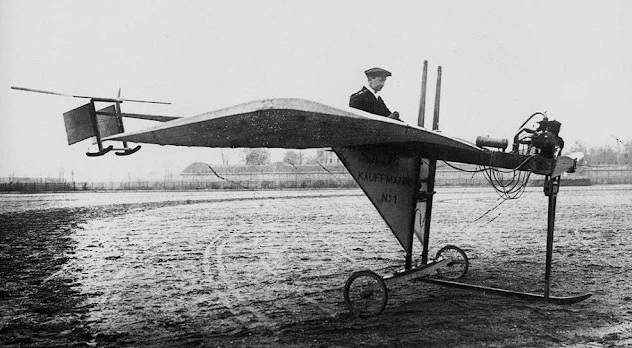
Kauffmann No.4

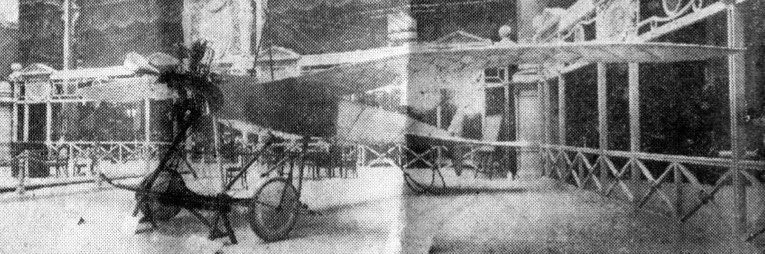
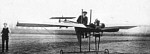
The Kauffmann No. 4 with its pointed wings and a 6-cylinder radial Anzani engine was displayed at the 1911-1912 “Salon”. It was designed and built by Paul Kauffmann (1893-1959), at the time only 18 years old. He had built his first airplane two years earlier, at the same time starting “Le Cerf-Volant”, a kite-flying magazine. He would continue in aviation, filing several patents, until wounded in action in 1915.

Span: 38’1″
Length: 24’11”
Empty weight: 616 lb