KLS became ACD / Advanced Composite Design Inc in 2005.
Aircraft
Klingberg Klingberg
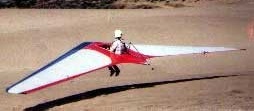
Rol Klingberg built the wing without plans (never drew them) and used only a few templates for making parts. There are no plans for the full size Klingberg Wing as a “one-off” design.
The right wing had slightly less twist due to a construction error and in a stall the wing would drop the right wing. Recovery could be made by simply returning the ailerons to a neutral setting. The test pilot made the error of flying too slow twice. Once at altitude with room to recover and once low without room to recover. At Torrey, the wind was too low for soaring flight and the test pilot attempted to stay aloft by flying slow. A beginner’s type error. As Klingberg watched at the edge of the Torrey cliffs he saw the wing flying near stall speed and was not surprised to see it drop the right wing. The test pilot did not perform the correct recovery process and crashed.
Klingberg still had three feet of the left wing tip (the one that impacted the cliffs) in 2006. The engineering facts surrounding the failure of the Wing is that he modified standard airfoils for the tips. The modification made combined with the low Reynold’s number caused the design to have tip stall problems. A technical report of the problem was published in Hang Glider magazine in the late 1980’s.
The test pilot (Daryl “Monty” Bell) stole the Wing after the crash at Torrey. The Wing was too damaged to provide sufficient information for a second Wing to anyone other than the designer. If anyone knows the locations of any remains, Rol Klingberg would like to have that information.
Klingberg attempted to recover the remains of the wing from the test pilot a few months after the crash but was unable to do so. In the process, Klingberg had extensive discussions with the local law enforcement officials and they pointed out that Monty Bell had a number of “encounters” with the local police and was considered to be an on-going problem for them.
Klimov VK-107
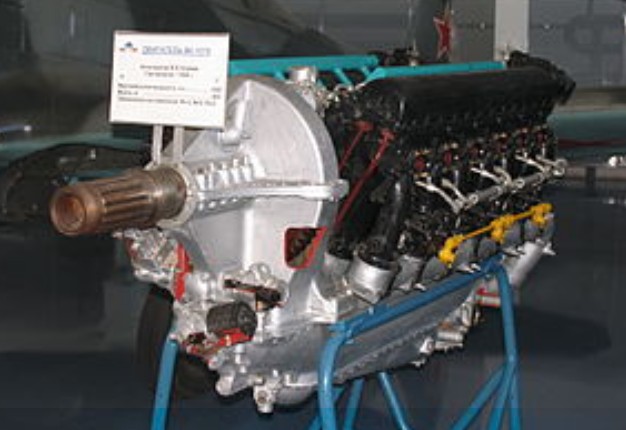
The Klimov VK-107 was a V-12 liquid-cooled piston aircraft engine used by Soviet aircraft during World War II.
The VK-107 was a brand-new design having little in common with its predecessors M-105 and VK-106. To achieve a greater power output, each cylinder now had four valves (two intake and two exhaust), crankshaft and camshafts were completely revised, and a new supercharger design was implemented. Although the engine could have been ready for production as early as 1942, Soviet factories lacked the capacity to produce a brand new design. Thus, less powerful VK-105PF and VK-105PF2 were built instead. However, the appearance of Luftwaffe Messerschmitt Bf 109G with Daimler-Benz DB 605 engine in 1943 created an urgent demand for a more powerful engine. VK-107A was put into production in 1944 and was used on Yak-9U fighters. The engine was not well liked by either pilots or mechanics — it had a life expectancy of only 25 hours and war emergency power was almost never used for fear of decreasing this even more. The engine was also difficult to service, in part because its exhaust headers were on the inside of the cylinder banks, the reverse placement of most V-type liquid-cooled engine designs.
Variants:
VK-107A – production version
VK-107R – version for hybrid piston-motorjet powered Mikoyan-Gurevich I-250 (N) and Sukhoi Su-5 fighters
VK-108 – attempt to further develop VK-107 with 1,380 kW (1,850 hp) on takeoff, used on several Yakovlev Yak-3 prototypes but did not enter production.
Applications:
Mikoyan-Gurevich MiG-7
Petlyakov Pe-2
Yakovlev Yak-3
Yakovlev Yak-9
Specifications:
VK-107A
Type: 12-cylinder supercharged liquid-cooled Vee aircraft piston engine
Bore: 148mm (5.83in)
Stroke: 170mm (6.69in)
Displacement: 35.08 liters (2,140 in³)
Dry weight: 765 kg (1,685 lb)
Valvetrain: Two intake and two exhaust valves per cylinder actuated via an overhead camshaft
Supercharger: Single stage, two-speed, gear-driven centrifugal type supercharger
Cooling system: Liquid-cooled
Power output:
1,230 kW (1,650 hp) at 3,200 rpm for takeoff
1,082 kW (1,450 hp) at 2,800 m (12,500 ft)
Specific power: 35.1 kW/L (0.77 hp/in³)
Compression ratio: 6.75:1
Power-to-weight ratio: 1.61 kW/kg (0.98 hp/lb)
Kleyer
Germany
Adlerwerke vorm Heinrich Kleyer AG. was formed at Frankfurt am Main in 1934 to take over Frankfurter Flugzeugbau Max Gerner GmbH. Made low-cost, low-powered all-metal light aircraft with Gerner engines.
Kitty Hawk Cora
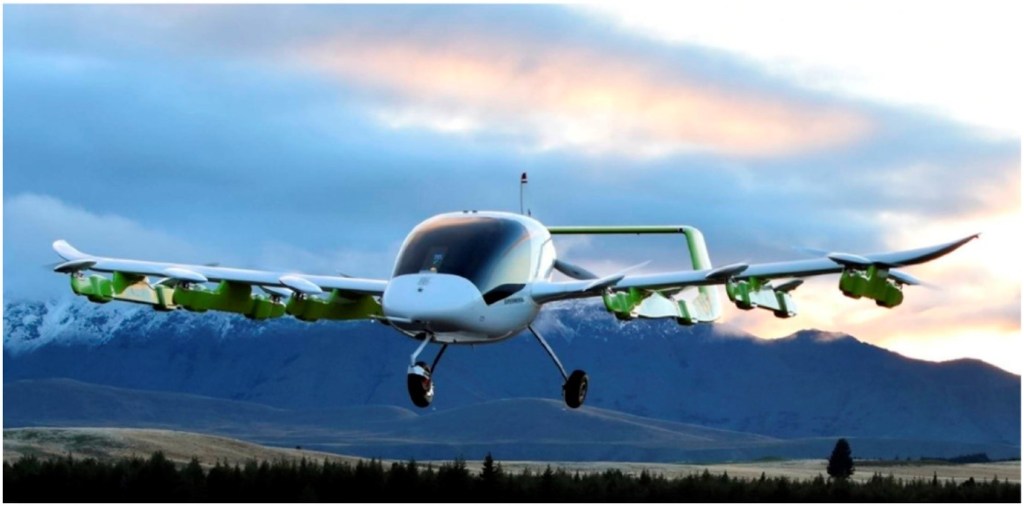
Kitty Hawk started flight testing of the Cora aircraft in California and New Zealand in 2017. The Cora is a two-seat autonomous aircraft with 12 lift propellers and a pusher prop.
Kitty Hawk Heaviside

Kitty Hawk revealed on 3 October 2019 that they had been secretly developing a single seat electric aircraft known as the Heaviside. The Heaviside features a front wing with two propellers, six propellers on the main forward swept wing, and a fairly conventional empennage. The propellers are all behind the wings and tilt downward for vertical flight. Later in October 2019, a software timing error lead to a crash of the Heaviside during flight testing.
KLN VL-3

The VL-3 is an ultralight, single-engine, low-wing aeroplane of classical design with a bow-type retractable or fixed landing-gear and two side-by-side seats. The plane has been certified according to regulation UL-2 of the Amateur Aeronautical Association of the Czech Republic for maximum take-off weight (MTOW) of 450 kg.
Harmonious aerodynamic shape and excellent flying performance make the aeroplane suitable for touring or recreational flying.
The VL 3 is being certified in UL catagory for MTOW 450 kg and for MTOW 560 kg according JAR – VLA.
The KLN VL3 airplane is manufactured by Karel Klenor – KLN, Choceň, Czech Republic.
Stall: 35 kt / 40 mph / 65 kmh
Cruise: 119 kt / 137 mph / 220 kmh
VNE: 162 kt / 186 mph / 300 kmh
Empty Weight: 275 kg / 606 lbs
MTOW Weight: 450 kg / 992 lbs
Climb Ratio: 1200 ft/min / 6 m/s
KLN – Karel Klenor
Karel Klenor – KLN, Choceň, Czech Republic.
LSA builder
Klemperer-Friedrich-Tirnstein Ente

W. Klemperer and a group of friends had built around 90 flying models since high school years in Germany, several of them canards, powered by compressed gas engines. In 1911 they started on a full-scale machine with 22 sq.m of wing area. Construction was started at the “Schiffswerft” in Uebigau a.d. Elbe and completed in Chemnitz and Altchemnitz. At Christmas 1913 it was ready to roll and after various ground tests it was flown in the spring of 1914 by LVG pilot E. Kunze. Problems with the quickly wearing 55 hp Haacke engine and high weeds on the airfield caused difficulties, but finally some flights confirmed the designers’ expectations of stability, ease of control, pleasant flight characteristics and extremely easy landing. Just after these first encouraging successes, the outbreak of war put an end to their experiments.
Klemm Kl-107 / MBB Bo.207 / Bolkow F.207
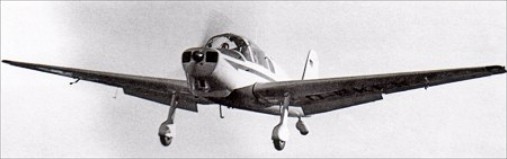
The Kl.107 low-wing, wooden-framed monoplane trainer was designed in Germany during World War II. Early versions were powered by the Hirth HM 500 100hp engine, and only a small number were completed before the factory was erased by Allied bombing. In 1956 it was decided to reintroduce the Kl-107 as a civil training/touring type, initially as the Kl-107B, but then as the three-seat Kl-107C. Rights to the design were acquired by what became the MBB consortium, and the final version became the Bo.207.
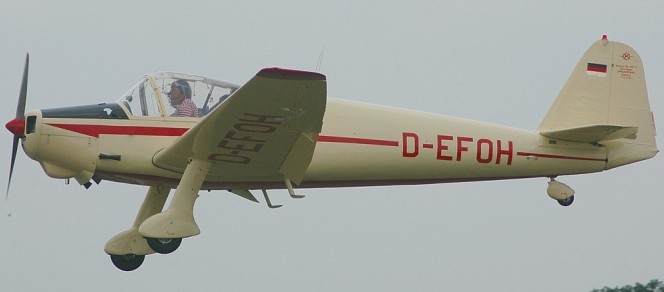
The Bolkow F.207 second prototype development of the Kl107C, originally called the Klemm Kl 107D, first flew on 21 April 1961, from Stuttgart-Echterdingen airport.
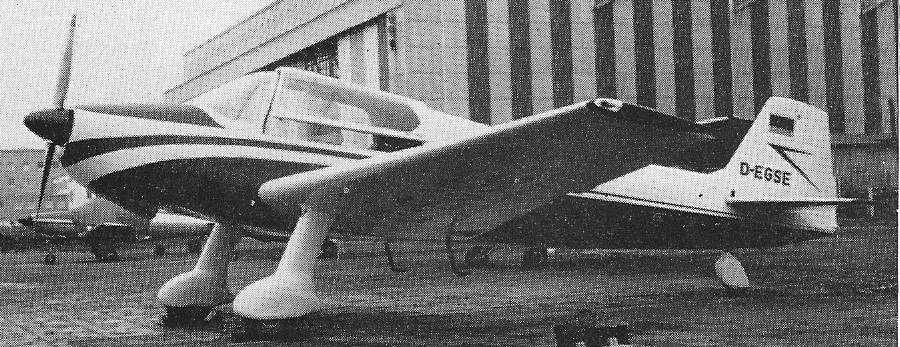
Kl.107C
Engine: 1 x 150hp Continental O-320
Wingspan: 10.80 m / 35 ft 5 in
Length: 8.30 m / 27 ft 3 in
Max. speed: 234 km/h / 145 mph
Range: 820 km / 510 miles

