Lesher Teal

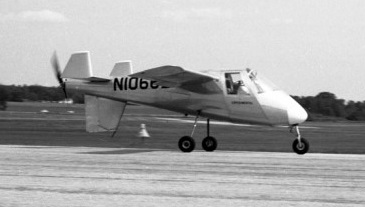
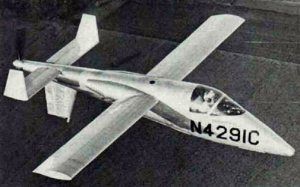
The Lesher Teal, registered N4291C, was explicitly designed to break records in the Fédération Aéronautique Internationale Class C1a, for propeller-driven aircraft of less than 500-kg (1102-lb.) gross weight.

The Teal retained the Nomad’s Continental O-200A power and all-aluminum pusher configuration, this time in a single-seat layout. Its wingspan is a diminutive 23 ft. 10 in. (by contrast, a Piper J3’s span is 35 ft. 3 in.).

At one point of the Teal’s design, Ed, who weighed well over 200 lb., considered using a jockey pilot. Instead, not wanting to miss the fun, he decided this was a good incentive to lose some weight.

The Teal first flew in April 1965.

In August 1965, Lesher piloted it to the EAA Fly-In in Rockford, Illinois, where he was honored for his achievements. Then he began attacking the FAI records.

In 1967, Lesher and his Teal set a Class C1a speed record for a 500-km closed course at 181.55 mph. Later that year, he flew the Teal at 169.20 mph for a new 1000-km closed-course record. Before the year ended, Lesher and the Teal averaged 141.84 mph for a new closed-course record of 2000 km.

In 1968, a loss of power brought the Teal to an emergency landing, and considerable damage, in a Michigan field. After a rebuild, Lesher and his Teal set another FAI record in 1970, this one for a closed-circuit distance of 1554.29 miles. In 1973, he and the Teal set a 3-km speed record of 173.101 mph as well as a 15-25-km record of 169.134 mph. Finally, the pair set an FAI C1a record for straight-line distance, officially 1835.459 miles, by traveling from Florida to Arizona.

For these record-breaking achievements, Lesher earned the FAI’s Louis Blériot Medal four times, in 1967, 1970, 1973 and 1975. He was inducted into the Michigan Aviation Hall of Fame in 1988.

The Lesher Teal has resided in the EAA Adventure Museum since 2002.
Lesher SN-1 Nomad

The 1946 Stinson 106 Skycoach, one of Stinson’s products during Lesher’s time with this Wayne, Michigan, company. The Skycoach’s pusher propulsion, though, intrigued Lesher and he incorporated this feature into his home-built aircraft.

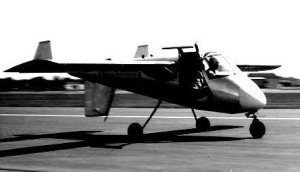
The Nomad was an all-aluminum side-by-side two-place pusher. Powered by a 100-hp Continental O-200A air-cooled flat-four placed immediately behind the cockpit, fed with air intakes at the wing roots, the Nomad made innovative use of a Dodge Flexidyne Coupling to dampen torsional vibration.

The wing was built as a single assembly with a very simple profile and no dihedral. The vee-tailed empennage and vertical fin in low position was meant to impair the Hartzell propeller’s efficiency as little as possible, while the vertical fin placed below helped to keep the propeller clear from the ground.

Construction began in 1959 and the Nomad, registered N1066Z, flew in October 1961 after 5000 hours of construction. Lesher and the plane took Grand Prize at the 1964 AC Spark Plug Rally.

The Nomad was followed by the better-known Lesher Teal, which also remained a prototype.

Lesher SN-1 Nomad N1066Z

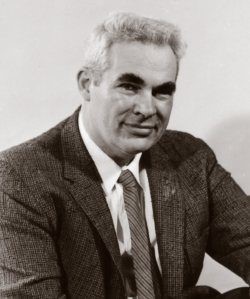
Lesher, Edgar J.

Edgar J. Lesher, 1914 – 1998, earned an undergraduate degree in mathematics during the Great Depression, then did graduate studies in this subject and physics. Prior to World War II, he taught ground school for the Civilian Pilot Training Program and earned his own pilot’s license.

In 1942 Ed joined the University of Michigan’s Department of Aeronautical Engineering, where he taught until retirement in 1985. Ed Lesher was a professor of aeronautical engineering, who used breaks in his academic career to perform design work at Douglas, Stinson and Convair Aircraft.

Attendance at a fledgling Experimental Aircraft Association Fly-In in 1958 inspired Lesher to design and fabricate two aircraft of his own. One of them, the Lesher Teal, set several international records for speed and distance.
Ed also found time to do set design and act at the Ann Arbor Civic Theater and to sing in the Ann Arbor Civic Chorus.

Ed and his wife Margaret had ten children, including four sets of twins. Lesher died in 1998.

Lescarts N’Deke Mwaope

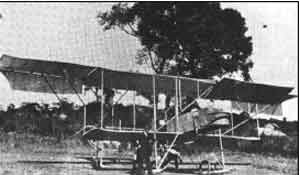
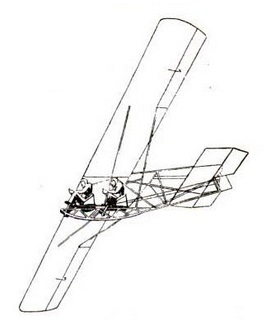
In April 1912 Fernand Lescarts, with the financial help of King Albert, travelled from Belgium to the Congo bringing with him a Farman biplane. The Farman was destroyed during the journey whereupon Lescarts designed and built a new biplane, and named it N’Deke Mwaope (White Bird), which flew pretty well until a violent windstorm wrote an end to the story.

Le Prieur-Aihara Glider / Daiichi Senior High School Glider

An earlier glider had been designed by Le Prieur based on a drawing from a French pamphlet. But when a test flight failed, Le Prieur turned to his friend Aibara for assistance, and Aibara brought in Tanakadate, an aviation pioneer in his own right, to help with the design.

The glider was developed by Yves Le Prieur, a military attache at the French Embassy in Tokyo, Lieutenant Shiro Aibara of the Japanese Navy, and Professor Aikitsu Tanakadate of Tokyo Imperial University’s School of Science, now the University’s Faculty of Science (at the time the University of Tokyo was named Tokyo Imperial University). Also known as the Aihara-Le Prieur, built by Japanese Lieutenant Shiro Aihara and French 2nd Lieutenant Le Prieur using bamboo for the structure.

The team first planned to use an automobile to pull the glider, but on the day of the trial the car broke down and didn’t make it to the test site. Instead they put a small boy aboard and a group of students pulled on the cable attached to the craft.

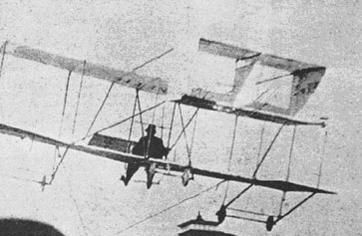
On the morning of December 5, 1909, a bamboo-framed and white cloth-covered glider was hauled onto the Daiichi Senior High School’s athletic field, Ueno Park, Toyko, today a part of the University of Tokyo’s Faculty of Agriculture on the Yayoi campus. A large number of students took hold of a rope attached to the glider, and then ran as fast as they could, pulling the glider behind them. Soon, spectators witnessed the craft, with a boy aboard, ascend slowly and fly at a height of 3.6 meters for a distance of some 15 meters before drifting down to a smooth landing. “

This was apparently the first, though unofficial, glider flight in Japan, and it represents the very beginning of airplane research.

In the subsequent December 9 test flight, piloted by Le Prieur himself, a car was used, which drove along a street near Shinobazu Pond, Tokyo, towing the glider. This was the first certified fixed-wing aircraft flight in Japan.

Leonard Motorless Aircraft Glider

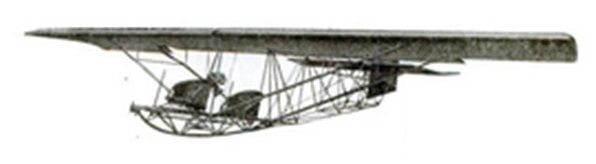
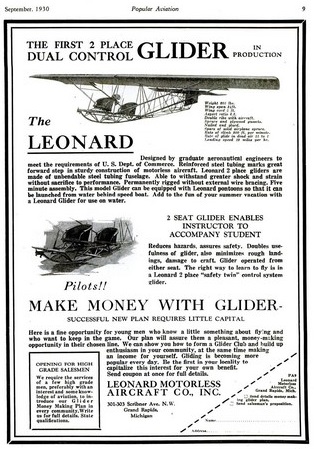
Billed as the first two seat glider to enter production, the 1930 Leonard Motorless Aircraft Company glider of 1930 was designed by graduate aeronautical engineers to meet the requirements of the US Dept of Conmmerce.

The entire fuselage is constructed of steel tubing, welded at all joints and with bals wood inside. The wings are cloth covered and braced with spruce ribs.

Able to be flown from either seat with dual controls fitted, the glider was for sale in 1930 for $550.

Wingspan: 34 ft
Wing chord: 5 ft
Aspect ratio: 6.8
Empty weight: 210 lb
Landing speed: 19 mph
Auto tow ROC: 800 fpm
Glide ratio: 15-1